






The world could use a funny, romping take on the tales of Robin Hood these days. While the rich get richer and the poor get poorer, it seems like a story that regains its relevance every moment. It was only a matter of time before we got another take on Sherwood’s outlaw for the big screen, and given Ridley Scott’s failed attempt in 2010, you’d think that filmmakers would have tried to add some lightheartedness to the proceedings.
They did not.
[Spoilers for 2018’s Robin Hood.]
It seems like it should go without saying, but whenever a film begins with a voiceover instructing you to “forget what you know” about a well-known story, it’s likely a sign that the filmmakers are hoping the audience won’t notice how little they care about the source material. That doesn’t meant that there’s no possible way to create an interesting reimagined take on Robin Hood, but doing that takes actual… imagination. Not the same story we’ve been told over and over with slightly rearranged beats.
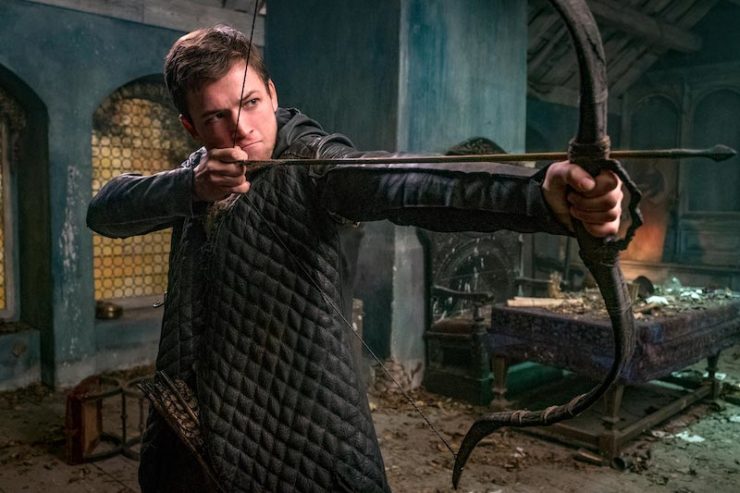
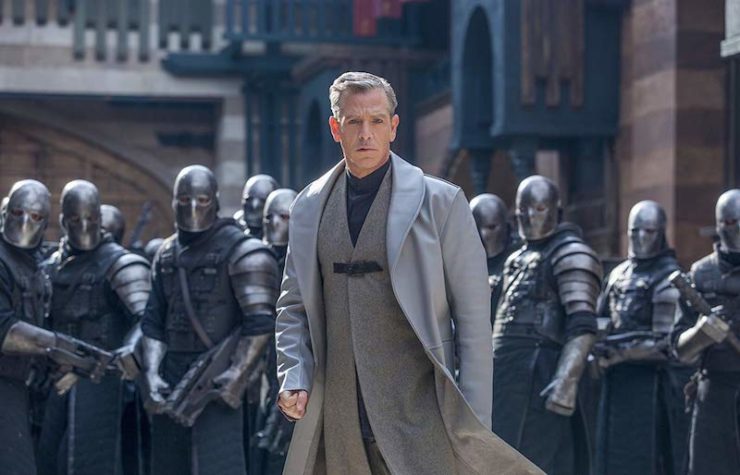
This film owes literally everything to its predecessors. Not just other films, but all the television shows as well. (There are even a few incredibly conspicuous plot point swipes from the laughably bad BBC’s Robin Hood series from 2008.) The only twists are the deep-running anachronisms that season the film’s visual signature, from the weaponry Robin sees in the crusades that fire arrows like a machine gun, to the completely un-English architecture of Nottingham, to modern gambling tables, to the blazers and Matrix-y leather jackets half the characters are wearing. If the film was leaning on those anachronisms for the sake of fun, those would be enjoyable stylistic choices, but in a movie that takes itself utterly seriously, those choices get drowned in muddy action sequences and bad CGI.
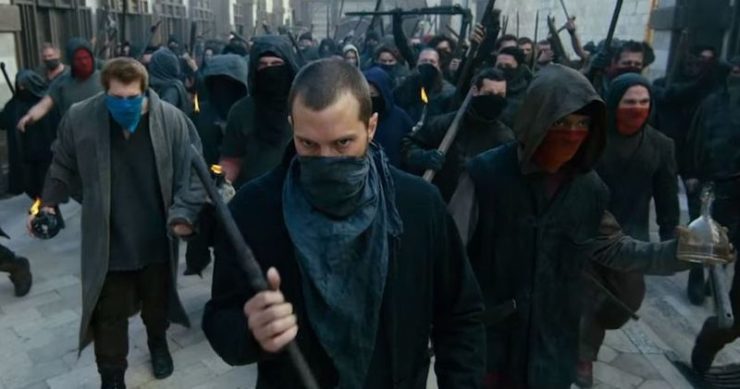
This film also borrows from other similar characters heavily. There are points in the narrative when Robin Hood is Batman, or the Scarlet Pimpernel, and another point where an important central character literally becomes Two Face in almost the exact way it happens during 2008’s The Dark Knight. The irony of trying to equate Robin Hood with more modern heroes that he himself inspired is often too much to bear. There’s a love triangle too, uniquely aggravating and poorly positioned, running between Robin (played to the temperature of lukewarm oatmeal by Taron Egerton), Marian (a blithely smiling, near-sleepwalking performance from Eve Hewson), and Will Scarlet (effecting Christian Grey-esque levels of detachment and boredom).
The cast and crew could be found in behind-the-scenes videos insisting that this was a more “adult” version of Robin Hood, but the only ways in which this particular story could be deemed adult are irritating and unnecessary; more than one male character threatens Marian with rape just ’cause; Ben Mendelsohn’s Sheriff of Nottingham (he tries so hard to be odious and effecting, but he can’t save himself) tells Robin about how he was beaten in the orphanage where he grew up, and the abuse also has rape-laden overtones to it. We see some warfare in the crusades in which most of the deaths are treated with the same levity you would expect from a shoot-em-up video game. Despite attempts to use arrows in interesting ways, most of the actual battle sequences are tepid and messy.
In another “twist”, this version of Robin Hood decided to take the Moor figure of Robin’s crew (which was a story commonality that was introduced in the Robin of Sherwood series, then leapt to cinema with Kevin Costner’s Robin Hood, and has continued onward in most Hood retellings to this day), and mash him up with Little John. Jamie Foxx’s John meets Robin in the Crusades during the start of the film, and deciding that he’s the only honorable Englishman, takes the kid under his wing so they can stop rich men funding the wars that have destroyed their lives. Foxx does his best to give the role his all, but any amount of gravitas he brings to the part gets swallowed by the overall clunkiness of the script and its unwillingness to just make Little John the hero of the story. Instead he’s stuck playing the Alfred to Egerton’s Bruce Wayne, with all lackluster pep talks and sacrifice that entails.
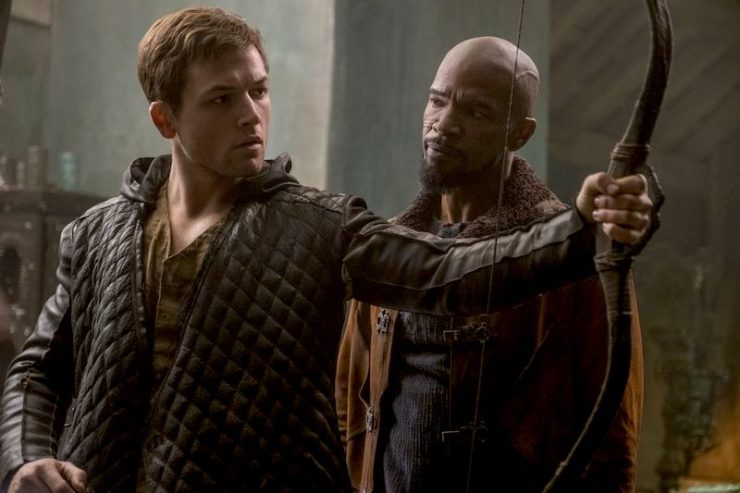
Oh, and he’s called John because it’s so painful to listen to Robin try to pronounce his real name, he just insists that the kid go with the English translation. You know, instead of demanding that the Lord of Loxley wrap his head around non-English sounds. Whatever, I guess.
There are so many little things that go far in ruining the film’s overall effectiveness, even as a goofy popcorn action flick. When Robin is first called away to the crusades, it’s because he’s given a letter from the Sheriff’s office that literally reads “DRAFT NOTICE” in ye olde English font—but again, this is treated as a serious moment, rather than something hilarious. When he returns home, he finds that his manor has been repossessed, but it’s fine for him to live there because no one seems to be using the land. Also, his manor looks like it’s been abandoned for about seventy years, even though he’s only been away for four. (Maybe they set fire to it? No one makes mention of that.) Nottingham straight up looks like Isengard, a great big looming mine-powered city with random spurts of fire blooming out of the ground. Robin’s training montage is out of a completely different film; it’s genuinely funny, featuring Egerton bench-pressing wagon wheels, and dragging chains across the ground to increase his strength while Jamie Foxx sits around chuckling. If the whole film had matched that sequence tonally, we’d have a very different (arguably much better) film.
This film has no character arcs because it has no actual characters; by the end, everyone is almost exactly the same as when they started, with the exception of Little John. Tim Minchin tries his best with Friar Tuck, but the character isn’t given enough to do to be all that relevant to the plot. And we’re also treated to the world’s greatest misuse of F. Murray Abraham as the capital “E” evil cardinal. (There’s maybe a commentary about the church somewhere in this movie, and no one is interested in really exploring that either, so it just dangles.) And the soundtrack by Joseph Trapanese could be copy-pasted onto any current Marvel film and do just fine. Maybe he was trying to audition for them with this score? I’d buy anything at this point.
2018’s Robin Hood believes that it is topical and sharp and funny and full of unstoppable, impressive action. It manages to be none of those things. Someday we’ll get a new Robin Hood film that lives up to the jaunty adventures we adored as children, but we’re currently about as far away from that as we can get. Better luck next time.
Emmet Asher-Perrin is amazed that they seeded a sequel at the end of this thing. You can bug him on Twitter and Tumblr, and read more of her work here and elsewhere.
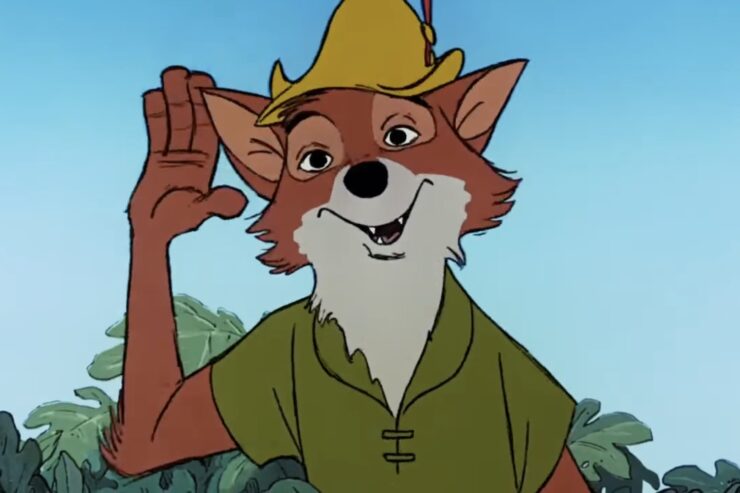
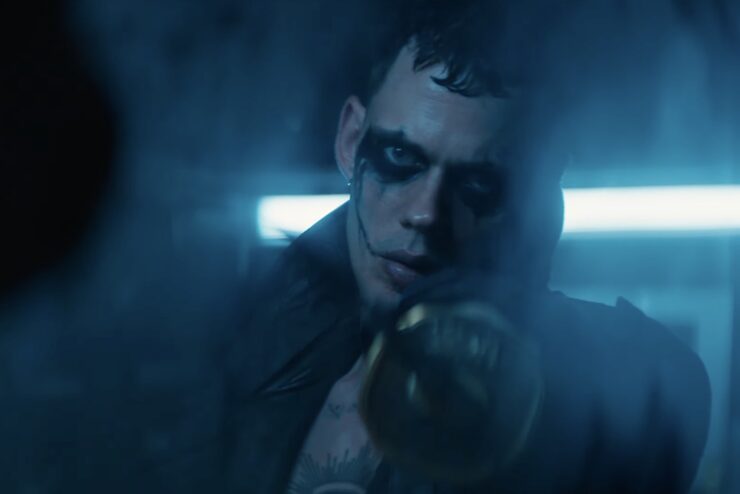


Robin Hood‘s new promo material:
So, it’s Men in Tights without the jokes.
I saw one review that shows how this movie lifted good chunks of THE DARK NIGHT and inserted them into this movie. You know, plagiarism. A pity that didn’t help the movie in the least.
@2: Sounds like there are also large chunks of Prince of Thieves without the jokes that everyone but Kevin Costner noticed.
What’s hard about Yahya?
Why this: “the laughably bad BBC’s Robin Hood series”?
At least that series did not even try to take itself seriously. All the anachronisms made it fun to watch…and these days, that’s about all I ask.
This reminds me of how one reads fanfic that is so out-of-character and disconnected to the source material that they’d have been better off just renaming all the characters and locations and pretending it’s an “original” story.
New rule. Nobody gets to do a Robin Hood movie until they have watched the Errol Flynn version first, and understand why it still works.
Good rule!
You know what? I’d like to see a film with the original script for the 2010 version. The one called “Nottingham”, which had its protagonist being the heroic Sheriff investigating a serial killer. He suspects the psycho that dresses in a hood and runs around the forest scaring the rich folk, but we (and the Sheriff) don’t meet him until half-way through the movie, at which point they team up to find the real villain.
the script-writer went to the effort of actually researching medieval criminology and had the Sheriff investing it in a period accurate way.
Then the script got optioned, Russel Crow got cast as Robin Hood, and then the phrase “if this a Robin Hood movie, why don’t we even see him until half way through the film?” Was uttered. Cue rewrites and all the uniqueness being lost. <sigh>.
I’m all in favor of a new Robin Hood adaptation, but I could tell from the trailer that this suffers from the same problem that plagued Guy Ritchie’s King Arthur: trying to shoehorn the story into dime-a-dozen action-movie tropes. (Honestly…MARTIAL ARTS in a KING ARTHUR movie?! And meanwhile, the non-musical trilogy adaptation of The Once And Future King remains unmade.)
But if you guys are interested in a take on a not-so-heroic Robin and a more sympathetic Sheriff, take a look at Mari Ness’ excellent short story “In The Greenwood”, on this very site.
Saying this is the world’s greatest misuse of F. Murray Abraham in a universe that includes Star Trek Insurrection is a bold statement. *laughs*
—Keith R.A. DeCandido
@12 ST Insurrection was bland, it wasn’t bad.
Here is a question for UK people with young kids:
Do they still teach Robin Hood tales in school? When I was in primary school (oh so very many… many-nesses ago) we got taught the Robin Hood folktales, and a good dash of a lot of other folktales too, and there was always kids tv show on at some point (even if it was just BBC Programming for schools) which had something about Robin Hood and Merrye Englande (sod all about medieaval Scotland, mind you; aye ther wur a bias ther, an nae messin) or King Arthur in it. It was the background noise of my learning about literature; but is that still the case?
If I were more erudite and stuff, I would opine that this is the movie the current generation deserves. Sloppy, half-assed, and convinced of its own awesomeness.
And get off my lawn.
@8, I had to rewatch The Adventures of Robin Hood as a palate cleanser after catching a matinee of Robin Hood. Robin Hood really is that bad, and The Adventures of Robin Hood remains a great, great movie. (Among other things, it is a reminder that snark/crackling dialogue and romance/heroism aren’t mutually exclusive.)
@11, Defending Legend of the Sword is a hill that I will die on. I didn’t have any real hopes that Robin Hood would match Guy Ritchie’s effort, but I had at least hoped it would be mildly enjoyable like the 2011 steampunk Three Musketeers (it was not).
https://everydayshouldbetuesday.wordpress.com/2017/05/12/review-of-king-arthur-legend-of-the-sword/
@@@@@ no. 11: The first thing I want to tell anybody who’s trying to write the next blockbuster film about a quasi-historical legend is, READ A BOOK. And not just books about said quasi-historical legend. Stuff they could’ve put in but didn’t:
Somebody who really knows what they’re doing can use the momentum of a Western-style quarterstaff to jump straight up in the air and land facing a different direction.
An English rural dweller could build a decent year-round hut with their own hands and a knife in less than a week; of course, more tools, and more helpers, made a better hut.
In the time between the extinction of the wild boar and the industrialization of England, feral pigs were all over the freaking place, and they were not too big to capture and use as the nucleus of a small mixed farm.
All of this from one book, and not even a particularly obscure one: Lost Country Life by Dorothy Hartley.
was anyone really surprised? I mean honestly.
I still say the best version of Robin Hood is Captain Picard’s.
“I’m the best swordsman in Nottingham!”
“I’m not from Nottingham.”
random22: I’m not talking about quality of movie I’m talking about use of F. Murray Abraham. He was COMPLETELY wasted in Insurrection.
—Keith R.A. DeCandido
“In another “twist”, this version of Robin Hood decided to take the Moor figure of Robin’s crew, and mash him up with Little John.”
That’s actually a pretty cool twist. It allows them to keep the Moor character while avoiding the problem that he tends to replace Little John as Robin’s closest companion (and audience favourite).
“Oh, and he’s called John because it’s so painful to listen to Robin try to pronounce his real name, he just insists that the kid go with the English translation. You know, instead of demanding that the Lord of Loxley wrap his head around non-English sounds.”
Isn’t that simply historical accuracy? People used to translate their names a lot when they moved to a different country. For example, German painter Albrecht Dürer’s surname is a German translation of his father’s Hungarian birthplace Ajtós. And I know a Czech family who Germanised all their given names when they moved first to Austria and later to Germany after 1968. Demanding that the natives wrap their heads around unfamiliar sounds is a new thing.
Not to mention the Doylist reason that he has to be called John to be Little John.
@13/random22: I can’t answer your question, but I can tell you that German children are taught about Robin Hood in English classes. My daughters’ English schoolbook contains two Robin Hood tales, a somewhat modernised retelling of the archery contest from A Gest of Robyn Hode and a picture story version of Robin Hood and the Potter. Since I grew up listening to Robin Hood audio cassettes but never learned about him in school, I was delighted!
@19/WillMayBeWise: And Vash is a very enjoyable Marian.
Is anybody else bothered by the fact that all the recent Robin Hood films turn Robin into a crusader? Just why is that? Is a simple Englishman not well-travelled enough for the cosmopolitan 21st century?
@21/JanaJansen: My family moved to Germany in the early 1990s, and we changed our last name into something more pronounceable – adding a few more vowels so that German-speaking people had at least a chance to get it right. That version’s still pretty unpronounceable to English-speaking folks though, so I use my husband’s family name (Green) when dealing with English native speakers. Easier for everyone.
Should be “affecting” unless of course he’s causing those levels of detachment and boredom in the audience, which sounds like it could also be true.
Jana: the Crusades have always been a part of the Robin Hood story, since Prince John has always been one of the main villains of the piece sitting on the throne taxing the poor while King Richard is off fighting in the Crusades.
—Keith R.A. DeCandido
@24/krad: “[…] the Crusades have always been a part of the Robin Hood story […]”
Only since the 19th century, if I’m not mistaken. The early ballads feature a king who pardons Robin Hood, but don’t give him a name.
Anyway, that wasn’t my point. In the Robin Hood tales I remember Robin himself wasn’t a crusader, only King Richard was. I think turning Robin into a crusader changes the tale, and not for the better.
The movie tells you to forget everything that you know about Robin Hood yet you sit there and literally compare it to everything. I know it won’t be historically accurate to a literary character that never existed, but I’m going to go and watch it like I did with A Knight’s Tale. Just for the fun of it.
No, not always, because the story has not always been placed in the reign of Richard I; that was a trend. A Gest of Robyn Hode placed it the reign of “Edward”, probably Edward II.
Also, you’re altering the original complaint which was not “recent Robin Hood films make the Crusades a part of the story,” it was “recent Robin Hood films make Robin Hood someone who’s been on crusade.”
Fun fact: Edward II’s son Edward III has an actual Nottingham connection, in that he and a band of companions sneaked into Nottingham Castle through the cave system under it, to overthrow his mother Isabella and her consort (not enough Robin Hood stories use the cave system!) I think I could argue that Edward III started the whole Robin Hood story as a national myth of stout-hearted Englishmen versus servile subjects of the French–an early proponent of popularism.
When he took the King of France prisoner, he arranged for a gang of merry costumed “robbers” in green to “attack” the party on the way to London, and milk everyone of a small amount of change. That had better have been well-organised; the potential for tragic misunderstanding leading to multiple deaths must have been huge.
@27/Del: Oh, you’re right, the king’s name is mentioned in the Gest! My mistake.
Also, interesting anecdotes, especially the one about the underused cave system.
@krad
Actually one of my favourite retellings of the Robin Hood story was Stephen Lawhead’s King Raven trilogy, which relocated it to the Welsh Borders in the 11th century just after the Norman Conquest, a plausible setting than the tame managed forests of a century and a half later.
Robin Hood is like King Arthur or Cuchulainn, a legend no doubt based on something genuine, but embellished and retold and recast to fit the prevailing wind of the times.
Fair points, all. BTW, one retelling that did use the cave is also, IMO, the best Robin Hood movie ever, the 1992 Robin Hood starring Patrick Bergin and Uma Thurman. It was only released theatrically in Europe — in order to avoid competing with the Kevin Costner film in the U.S. it was only released as a FOX network TV movie, and it didn’t get anywhere near the audience it deserved.
—Keith R.A. DeCandido
Looking at that last picture of the coat, I’m thinking this is a weird Robin Hood story with characters that came from the future or other planets. So basically a Doctor Who episode, but without the Doctor.
@21 Many of them do it to justify the Moor in the crew (standard since Robin of Sherwood). In Robin of Sherwood, it was a Sarcen hired by the sheriff that Robin and his men were able to turn to their side.
@29/Mayhem – yes, no question Robin Hood is changed to fit the times. Like King Arthur, there’s stories that literally mythologise him.
Take the different tales surrounding the Wrekin. The Wrekin is a large hill between Shrewsbury [in England] and the Welsh border, that doesn’t appear to fit the surroundings (basically a flat plain). Geologists have explained it, but there are numerous myths to explain its origin, and then how it’s used by Trickster figures (usually a cobbler) to discourage attack by malevolent forces on either Wales or Shrewsbury. The most popular, and the one you’ll most often hear around there, is the Tale of the Cobbler and the Giant.
The reason I bring it up is that other legends around the Wrekin feature (separately) both King Arthur and Robin Hood. Notably both are cast as the villian in both tales.
‘The world could use a funny, romping take on the tales of Robin Hood these days.’
Does anybody remember ‘When Things Were Rotten’? Or am I just showing my age?
https://www.youtube.com/watch?v=ZHKRxjVNinA
@34, I remember! Vividly. I loved that show, so of course it was cancelled. I killed a lot of shows in the ancient days. If I liked it it was toast.
This review of the Trailer to this stinker told me all I ever needed to know about it:
https://youtu.be/HJOQtU0joTI
Only thirteen episodes ever made, Princess Roxana! :(
Sounds like maybe we’ve got the same superpower?
@32 In Robin of Sherwood, the Saracen Nasir was actually the servant of the gloriously wicked Baron de Belleme, played by Anthony Valentine, and was freed in the first episode, choosing to stay with Robin afterwards.
I hear Nasir was originally supposed to be killed along with the rest of the Bad Guys but he was so charismatic they decided to make him a regular.
@38, and a rotten superpower it is Aonghus! At least now I can blame you as well as myself!
@40
According to the DVD extras, that is exactly what happened and is why Nasir has so little dialogue in the first series.
@24/krad: “taxing the poor while King Richard is off fighting in the Crusades.”
Actually he spent only 16 months in the Holy Land. As a military leader, he was very successful. (There may be an interesting alternate history in imagining what the Middle East would look like today if he had been able to stay longer.) But he had also antagonized many of Europe’s monarchs and, on his way back, he was illegally taken prisoner and held for ransom.
Thus the taxes. The Errol Flynn movie makes the very plausible suggestion that Prince John would rather keep the money and let his older brother rot in prison.
@38 and @36
I have the same superpower, but with a twist. If I like something then it does survive, but it is retooled with a twist which strips out the very thing I watched it for. It is like someone slipped me a monkey’s paw and I can’t find it to get rid of it.
@11: Did you actually watch Guy Ritchie’s King Arthur movie? I ask, because I enjoyed that movie a lot. But then, I like Guy Ritchie movies, and it was very much that. It wasn’t accurate or anything, but it was well crafted and fun to watch.
I did get a feeling that this movie was trying to do the same thing, and the first time I saw the trailer wondered if it was another Guy Ritchie movie. But once I saw it wasn’t, I did begin to wonder whether it could live up.
So anyway, I’d like to know from people who did see the Guy Ritchie movie whether it is similar to that, or just a wannabe. (Sounds from the review that it’s in the latter camp).
I don’t know why you’re so condescending about this — I mean, this still happens to this day. Is this a joke–like, is his name really not all that hard to pronounce? Or are you seriously just so offended on behalf of a person who would rather you call them “John” than hear you butcher their mother language? There are phonemes that certain languages lack, and trying to “learn” them at an adult age is really hard, if not impossible.
@44/LH: In my career, I met many coworkers from China. Invariably, they used an “American” first name instead of their real name. I always thought of this as a thinly-veiled assertion of superiority on their part, an assumption that Americans wouldn’t be able to handle their real names.
Perhaps “John” feels the same way.
44 – 45. Yeah, I think the analogy is quite deliberate. The staff working for Tesco outlets throughout Dublin all have name tags. There are quite a few Asians, invariably with names like ‘Mike’ or ‘Tim’. Never quite sure if it’s an approximate version of the original name or totally random (but would suspect the latter).
I do remember my old landlord – many moons ago – referring to a Japanese tenant as ‘Eugene’ which I thought was a pretty unusual name for somebody from Japan. Turns out he was called ‘Yujii’.
@@@@@46/Aonghus Fallon: Or, John could be a Middle Eastern Christian, named after a saint.
Except that, according to Hollywood, there are no Middle Eastern Christians, and never were …
Come to think of it, there were thriving Jewish communities all over the Middle East in those days, as well; nearly all gone now, of course. I don’t recall movies depicting them, either.
In Hollywood‘s defense, they may fear confusing an audience as ignorant of history as it is of geography!
A middle eastern Christian named after St John still wouldn’t be called “John,” any more than a German or Frenchman would. And Muslims can be and are and were named after John, and Joseph, and David, so there’s no requirement he be Christian.
Ivanhoe and its film and TV adaptations feature members of a Jewish community (and a non-nobility Robin Hood).
The Muslim version of ‘John’ Yahya or Yahia is quite popular. I don’t see why Yahya would object to his new friends using the western form of what is after all his name.
Because one’s name is one’s name. Someone named John is John, someone named Juan is Juan, and someone named Yahya is Yahyah. It doesn’t matter that the names are equivalents or original translations of each other: a person’s name is that person’s name.
A given individual might not mind others calling him by an equivalent, but some of us like our names, and respectfully request that people call us by our actual names.
@44 – 46, I work for an American division of a Japanese company, and we have several ex-pats from the home office that mostly all take American/English names. Usually it starts with the same letter, sometimes it’s sort of a shortened nickname (Mac from Makoto), but sometimes it is no where near similar (Jake for Tomokazu). It is almost always done as a convenience for the American workers. I don’t know if it is always voluntary on their part, but they seem to have no problem with answering to it.
@51, Yahya seems to have belonged to the former group.
@45 @46
The reason people from outside the anglosphere use a “Western” first name (quite apart from the 2nd, 3rd, 4th etc generation immigrants just having that as actually their names) is because if they don’t then it is non-stop “Oh, [bad pronunciation of name”. Am I saying that right?” or “f—ing [ethnic slur here], yeah, [deliberately insulting mispronunciation] wot you doing here then?”. Use a western style name and it alleviates some of the most common types of hassle from westerners. There will still be the slurs and hassle of some sort, but at least it won’t revolve around their name and they can leave the fake name at the door when they go home.
@50, yes. See my comment @5.
There couldn’t be more sloppy interpretations than Prince of Thieves or Men In Tights but at least they were entertaining.
This confirms everything the clothes and bow in the image told me. If they used a third of the money that was dumped in that lame hobbit porn series they could do an epic period Robin Hood. Instead of a box office WB kickstarter.
” When Robin is first called away to the crusades, it’s because he’s given a letter from the Sheriff’s office that literally reads “DRAFT NOTICE” in ye olde English font”
(Perhaps the letter was literally a draft notice, it not yet having been finalised, but got posted by mistake?)
This alone might actually induce me to watch the film, being so bad as to be hilarious
Then I see the pictures and the costumes. I remember forgetting about that crappy kids TV program that had similar modern clothes cut to give a faux 12th century flavour. Awful. Just too awful to watch.
Making a film relevant to a modern audience requires more than a nod to history and then slapping on layers of current fashion. The film could raise a serious issue about never ending wars run for the benefit of the ruling elite and the vast disparity of wealth and power between the very rich and everyone else.
Looks like the dodgy production design has undermined any such content, no doubt ably assisted by the plot and script.
@58 Nah, “Draft Notice” because he was supposed to give the Sheriff a pair of oxen to get the fields ploughed. Many peasants starved because of that mistake of Robin’s.
Especially galling since in the 1970s the BFI’s children’s film division did a Robin Hood tale (“Robin Hood, Junior”) with young actors, and a typical shoestring budget, and managed something at least watchable.
https://player.bfi.org.uk/free/film/watch-robin-hood-junior-1975-online
@56
The thing about “Prince of Thieves” which gets me is that while we think of it as ridiculously campy now, if you go back and look at the reviews when it came out then they are all calling it a darker and grittier take on the legend. If we wanted any proof that grimdark has gone too far, it ought to be that.
The old series Robin of Sherwood was also very enjoyable. It had a very ethereal mythic feel along with a young Ray Winstone as Will Scarlett and an array of mullets. It’s my favourite adaptation.
Political correctness has completely misinformed about the complexity of the Crusades. The Crusades were not a European/Christian invasion of the Middle East. Islam originated in the 700s and was rapidly spread through military conquest. Islam invaded Europe and conquered the Levant region and expanded into Asia. That lead to regional wars between the cultures already in those regions and the new Moslem powers. Many cultures a n d peoples of many religions were fighting on both sides in the confluct.The Crusades were a counterattack to retake the Levant region but that is a huge oversimplification of the huge extent of the vast conflict.For instance, Ghenghis Khan and the Mongol descendants fought on both sides of the conflict. In the war, Christians fought Christians, Muslims fought Muslims and every religious group in Asia and Europe and the Middle East fought ,often on both sides.The wars for control of the Mediterranean region and Asia Minor were the actual First World War…long before 1914. The Crusades was one campaign in that conflict which politically correct western teachers now present so simplistically, and it would not be a stretch to contend that confluct continues today as cultures and groups fight to control the Mediterranean.
Ironically, Robin Hood, itse l f, is not about the Crusades but is actually a story about war in general and especially about the conflict between the soldier who goes off to war…any war.. and the war profiteers that stay home and take advantage of the absence of the soldiers from their civilian positions. The story is a soldier goes off to war only to return to find that a group of war profiteers has taken political power and controls the police, the courts and the entire govermental apparatus. Robin Hood has to go rougue to oppose the usurpers. Kipling could have written the story or Steinbeck. Both wrote stories with similar viewpoints. The Robin Hood retellings miss everything that has made the Robin Hood story resonate for hundreds of years.
@61/siempre44: Which Robin Hood story do you refer to? The original Robin Hood stories are ballads about a group of outlaws who live in the forest, rob monks and the sheriff, sometimes disguise themselves to trick their enemies, and generally have adventures. They are not about soldiers or war.
Many of the visual interpretations of Robin Hood focus on the stealing from the rich, giving to the poor aspect. They want to make the character out to be a sort of socialist super hero.
DC Comics’ hero “Green Arrow” is an expression of that concept, especially from 1969 on when DC’s writers had Oliver Queen lose his fortune then pair up with Hal Jordan. Did it boost sales? Nope, they tanked.
@emma.
Robin of Sherwood was great and still stands as the best adaptation of The Robin Hood mythos to my mind (if you disregard the mullets and casting of Jason Connery). To those not familiar, the series combined both the peasant outlaw and the nobleman versions of Robin while also being genuinely creepy and scary at times for a show that was on at about 5pm on a Saturday afternoon. The series also portrays the reality of Medieval England with Richard not being the benevolent and kind King of the other versions, but a man who is more interested in fighting wars (also played by Gimli the Dwarf, LOTR fans) and a really whiny King John. There was none of this Ewok village in the trees rubbish, they slept on the ground and in caves because they were manly men! Other reasons it was great; a non racist version of a Saracen swordsman (this was the mid 80’s after all), a truly wretched and evil Nottingham often sitting looking bored in a quite cold Great Hall and Britain’s own version of a Star Trek Red shirt in your average Norman Knight (often shot by arrows and falling off battlements). No other version is necessary and none have been as good.
IRL, my brother-in-Law is polish, works in London (UK), and his given name is Piotr. Rather than have his name mangled (it’s difficult to automatically roll the r the way his family pronounces it for most of the English he meets) he asks everyone to call him Peter. Doubtless (though I’ve never seen it and he doesn’t speak of it) it also mitigates expressions of xenophobia against the Polish.
In fiction, I still remember the argument between Dr Polaski and Commander Data about pronouncing his name (her saying “Dah-tah”, verses him correcting her with “Day-ter”).
Polaski: but it’s the same word!
Data: No, Doctor. One is my name, and one is not.
That’s always stuck with me, so I always make extra effort to ensure I get people’s names correct.
As far as I can remember from a book my grandfather owned of (what felt like to me) early tales, the only former soldier is Friar Tuck. In the version I recall, he was a religious hermit living in Sherwood Forest, and had two large wolfhounds. He met Robin after Robin is corned in the shrine by the wolfhounds after attempting to steal the candlesticks from the alter.
Friar Tuck has armour under his habit and from what he says it seems he was a member of one of the religious martial orders, but he has a problem with authority. He’s got mileage and has seen a few things. Robin’s the charismatic leader, but Tuck’s the moral center, ensuring they only rob from those that can afford it (the rich), support the local peasants (the poor), and trains the surly teenagers Robin attracts to be effective combatants.
Interestingly, in that version both Alan a Dale and Will Scarlett are both travelling bards. Alan is minor nobility, but Scarlett has a mysterious past and gets his moniker from always dressing in bright red. They’d frequently have sing-offs around the camp fire.
Thinking about it now, I wonder where that book ended up… it doesn’t sound as old as I thought at the time.
This train of thought has rekindled my interest in the Robin Hood mythos. (Amusingly, autocorrect just tried to amend “mythos” to “my toga”). I’d like to study the evolution. Alan a Dale seems like a French introduction, and the Saracen element was obviously introduced by the BBC 80’s series. Can anyone recommend some academic texts?
@65 – Will: Yup, that’s exactly my point.
I’m a big fan of Robin of Sherwood myself. I was HUGELY impressed by the writers not only knowing who the twelfth century Earl of Huntingdon was but all about his connection to the Scottish royal family. BTW David of Huntingdon really did have a son named Robert who ‘died young’.
@65/WillMayBeWise: I get annoyed and uncomfortable when Anglophones show off by trying to pronounce my (Ukrainian) name “correctly“.
@68/princessroxana: I’m guessing you were impressed by Robin of Sherwood’s knowledgeable writers …
Hang on, they planned to make a sequel for this?
@69, my spell check is nuts. And I don’t proof read before posting :-(
@71 Typos happen to all and anyone who points them out deserves to watch this movie on a loop for a whole year.
Oh I didn’t mind. I got a chance to correct it.
WillMayBeWise @@@@@ 66:
Alan a Dale seems like a French introduction …
Apparently Alan a Dale first shows up in a 17th Century ballad, though he doesn’t seem to become a regular character until the late 18th or early 19th Century. (So, not really a French introduction.)
http://d.lib.rochester.edu/robin-hood/theme/alan-a-dale
For a slightly different perspective, here’s Bing Crosby as “Alan A. Dale” in Robin and the 7 Hoods (with Frank Sinatra as Robbo, Dean Martin as Little John, Sammy Davis, Jr., as Will, and Peter Falk as Guy Gisborne):
https://www.youtube.com/watch?v=VjFyX2sSTGs
(Does Robin and the 7 Hoods get credit for the first film to introduce a black character in Robin’s company?)
My biggest question is what poundage is his bow? 30? If he expects to do more than tickle his targets and leave them looking like (entirely unharmed) hedgehogs then he’s got to pump those numbers up. 100 pound draw weight would be a good start, but 120 or more is when he starts getting into real war bow power capable of some measure of armor piercing at certain ranges and engagement angles. Of course, as the Romans and Persians demonstrated in their wars with each other, if you never fight armored people then low weight bows work just fine, if not better due to superior rates of shot, but as soon as armor (even simple riveted mail shirts) enter the equation you’d best be using heavier bows or you might as well not bother at all [this is a reference to the Persian Wars of Justinian, when Persian archers used a finger draw and low weight bows to achieve high rates of shot but could barely harm Roman infantry, while Roman archers used a thumb draw and high weight bows which loosed slowly but had a significant impact on their targets].
@66/WillMayBeWise: I can recommend a website: http://www.boldoutlaw.com. It contains some of the old ballads, a history of the legend throughout the centuries, articles about films and comic books, and a list of scholarly books, among other things. It’s where I got much of my Robin Hood knowledge.
That is definitely NOT an English Longbow. What it looks like is a composite boy of the kind used by West Asian horse nomads.
@76/JanaJansen – thanks. :)
@77/princessroxana – but we’re supposed to “forget what we know”, so clearly that’s a long bow. Even if it isn’t really long. <sigh>.
Is anyone even going to point out how they are trying to pass off “Loxley” as the correct spelling for Locksley!?!?
@80. Yeah, a Loxley is a type of lozenge.
Every interpretation of Robin Hood is a “sloppy interpretation”. Seeing as there are two historical texts, one putting him in the twelfth century and one saying he was out doing his thing in the fourteenth century, both stories are vague and contradict each other at every turn. Marian was never mentioned in either iteration of the real Robin hood. So every version of Robin Hood does a whole lot of imagining given that there is very little actual material to go on. Based on the few things that the old texts about Robin hood agreed upon, this movie, like the rest of them, checked all the boxes. I’m not saying it’s a masterpiece, but it is a decent flick, was better than I expected, and to say it didn’t stick to the (very sparse) source material is just ridiculous. It’s an imagining of a very old story. It doesn’t have to just like every other movie that came before it. They can do pretty much whatever the hell they want.
@82/Some degenerate: I don’t think there ever was a real Robin Hood. Which are the two historical texts?
@82/some degenerate – that’s kind of the whole point of the article and the comments. The film makers told us to forget what we know, which infers they were going to do something new. Instead we get the same thing, reheated and seasoned a little differently. It’s not inedible, it might be quite palatable, but it’s the difference between a freeze-dried ready meal curry, and one cooked with fresh ingredients by a chef trained to know what the authentic spices are.
The film makers had a choice: go with a product that isn’t going to win any awards but is designed to appeal to the broadest palate, but is ultimately a little on the bland side and not really memorable, or go back to the source and create something memorable by deliberately limiting yourself to authentic ingredients. They could have dropped Marion entirely, and written a gay commune in Sherwood Forest using props contemporary to 12 or 14 century England. That would have deserved the tag line. Instead we got an anachronistic, inauthentic ready meal.
Isn’t will Scarlett Robin’s nephew usually?