





All the drama around this year’s Kentucky Derby inspired me to do some rereading of favorite fiction about horse racing. Of course I had to revisit the Black Stallion series, the first dozen or so volumes of which I read as a tween and a teen. I can’t say I outgrew them as the rest of the series appeared through the Seventies and early Eighties—I was still and always irresistibly drawn to books about horses—but I had moved on to other authors and genres.
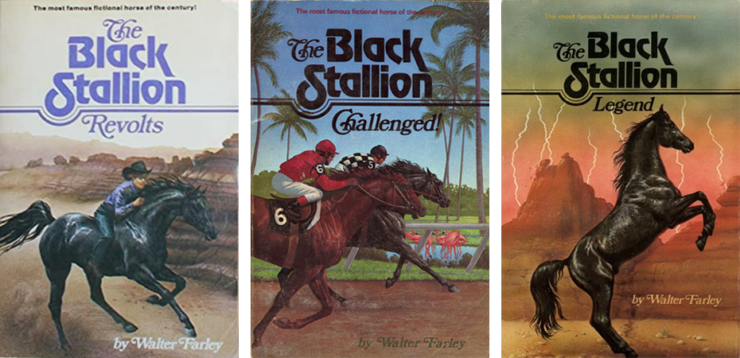
Thanks to the magic of ebooks and the glories of instant gratification, I scooped up a handful of later volumes: The Black Stallion Revolts, The Black Stallion Challenged, The Black Stallion and the Girl, and The Black Stallion Legend. My memory of the earlier entries is surprisingly clear, considering how long it’s been and how many books I’ve read in the interim. The two films, The Black Stallion and The Black Stallion Returns, have helped with that, but I’ve never forgotten the offspring. Satan, Black Minx, Bonfire the harness racer…they’re an indelible part of my personal mythos.
And let’s not forget the Island Stallion, Flame, whose saga intersects with that of the Black. I’ve written about him here before, because Farley dipped into science fiction in the second volume, The Island Stallion Races. This book is partially responsible for my tendency to write weird genre-benders.
My original reason for going back to Farley was to see if I remembered correctly that he wrote often about stallion behavior and misbehavior in and around racetracks. The Black, his hero-horse, was essentially feral, rescued from a desert island by the boy Alec. The horse was originally domesticated, and his owner tracks him down eventually, but all his natural instincts tended toward the wild and free. The only thing that connects him to a domesticated life is his bond with Alec.
A lot of this is wish-fulfillment fantasy. Only a registered Thoroughbred horse can run in Thoroughbred races including the three races of the Triple Crown. The Black, a desert Arabian, originally can only run match races against famous Thoroughbreds—he can’t be entered in formal races—but after a couple of books, Farley stops worrying about that. The Black’s purebred Arabian son Satan wins the Triple Crown, and his daughter Black Minx wins the Kentucky Derby. I suppose the reasoning is that key foundation sires of the Thoroughbred breed were Arabians; why can’t the Black continue the tradition?
I only recently learned that Walter Farley wrote The Black Stallion in high school and published it in 1941, when he was in college. It’s not just a boy’s adventure story in the classic mold, it was written by a person pretty much the same age as his protagonist.
Farley would never mature into a great prose stylist, and his plotting and characterization were pretty basic. He’s not a great literary talent. But he doesn’t need to be. From the very first, he knew how to tell a story. And above all, he knew horses.
The story he told in twenty volumes was a variation on a couple of themes. The boy and only the boy can handle the stallion. The stallion lives to run. He is the fastest horse in the world. Sometimes he runs for glory. Other times, especially in later volumes, he runs for the farm that his winnings have bought. His offspring likewise bring money and glory to their humans.
In every book, there is an antagonist. Sometimes it’s a financial or personal crisis. Often it’s a rival for the Black’s title of fastest horse in the world. Frequently it’s both. Usually there’s a race that determines the fate of the horse and the farm.
The Black is a superhorse. He’s gigantic for an Arabian, and gets bigger with every book, until he’s well over seventeen hands. That’s even huge for a Thoroughbred.
And yet he’s not a machine. In The Black Stallion Revolts, he snaps mentally under all the pressure he’s been put under. So much so that Henry the trainer sends him across the United States with Alec to take a rest break on a friend’s ranch. But of course, this being a Walter Farley novel, the would-be vacation turns into a whole new round of trauma. The plane carrying the boy and the Black crashes, and the Black escapes into the wild and Alec suffers a head injury that causes amnesia.
It’s actually rather difficult to read about the Black becoming a wild herd stallion and Alec having no memory of his name, his past, or his horse. I couldn’t wait for them to be reunited. That’s how powerful the bond between them is, and how strongly it comes through in book after book.
After a series of twists and turns and a villain or two, Alec and the Black are reunited in a high-stakes race. During the race, Alec’s memory comes back, just in time to save him from being arrested for a murder he didn’t commit. But that’s not as important to him, or to me as a reader, as the fact that the boy and his horse are together again at last.
Another exciting reunion is the one between the Black and the Island Stallion, Flame. These two stars of Farley’s universe met during another wild adventure when the Black and Alec were separated by a plane crash, this one in the Caribbean, but Alec doesn’t know that the stallions have met. Nor does he know Flame’s human, Steve Duncan, until Steve sends Alec a fan letter.
In the letter, Steve asks for Alec’s help to enter Flame in a major race in Florida. Steve needs the winnings to buy Flame’s island from the British government. Alec gives him advice as to how to qualify for the race, but doesn’t really expect anything to come of it.
Not only does Flame qualify, he proves to be a serious challenge to the Black’s supremacy on the racetrack. He’s just as fast, and just as wild—and the Black hates him. Alec resents that, and isn’t too happy with Steve, either. He’s not used to having a real rival in the racing world.
I think Farley wrote himself into somewhat of a corner here. He didn’t want either of his equine stars to lose a race, and he clearly wanted Steve to buy his island and allow Flame and his herd to live there, forever free. The Black is injured, which sort of evades the issue of a real head-to-head between the stallions, and Flame gets his win and his money.
Money has been an issue throughout the series. The need for it twists both people and horses. Steve makes his goal, but then keeps on racing, until Alec asks him if that’s what he wants. Is he going to keep pursuing race purses, or will he decide he’s won enough, and let Flame go back to his life of freedom?
Alec has to confront the same issue with the Black. How long can he keep racing? How long should he keep racing? The Black loves to run; he lives for it. But he’s starting to break down physically. Yet the farm needs his winnings in order to keep going.
These realities run through the later books, along with the fantasy of the perfect horse, and the romance between the horse and his boy. A more human romance surfaces in The Black Stallion and the Girl, in which an authentic Manic Pixie Dream Girl appears at Hopeful Farm and applies for a job. Henry the traditionalist is adamantly opposed to women in racing, but Pam has a gift with horses. She can even handle the Black, and in the end she not only rides but races him.
Buy the Book
A Half-Built Garden
It’s an interesting book, very much an artifact of its time: it was published in 1971. It comes out in favor of women in racing, and gives Alec an actual human love interest. Of course he would fall in love with a horsegirl. And of course the Black would love her, too.
One thing that comes out of this book is the sheer physical strength it takes to ride a top racehorse. It’s not just balance and core fitness. It’s upper-body strength. A jockey has to be able to control his mount’s speed, and that means a firm grip on the reins—which at a full gallop is like trying to hold back a runaway train. The horse is bound and determined to run faster than anything else on the track, and the jockey has to rate his speed, guide him through the pack, and convince him to slow down and stop once the race is over. That is by no means an easy task, and for many years the racing world did not believe a woman could do it.
In 1970, women jockeys were starting to prove they could. Farley gets on board with his version of the story, and gives her the greatest gift of all: the chance to race the Black. After thirty years of being a boy’s dream horse, the Black finally gets a girl.
By that point it seems Farley had run out of stories to tell about Alec and the Black. In The Black Stallion Legend, he does what writers have long been known to do when they’ve had enough. For Sherlock Holmes, it was the Reichenbach Falls. For Alec and the Black, it’s the fridging of the girl (on her way to Vienna to see the Lipizzaners—which is especially poignant for me) and the effective blowing up of the planet. Alec takes off into the West with the Black, ends up in Arizona—just as he did when he had amnesia—and he and his horse become the fulfillment of a Native American prophecy. And then a swarm of earthquakes shatters the world.
That’s one way to make sure there won’t be any more stories in that universe. I would have liked to see Alec and the Black in the postapocalyptic world, but that would have been a completely different kind of series. Farley could have killed them off, but even if he could have made himself kill the Black, his fans would have risen up in revolt. So he broke the world instead.
It seems fair. All things considered. The Black is an epic hero, and he deserves an epic denouement.
He’s also a pretty accurate representation of a dominant stallion, and when he’s racing, he’s doing it mostly by the book (except for the part where he’s not a Thoroughbred). Whole generations of horse kids in the United States have learned the basics about horses and racing from Walter Farley’s books. Even when they’ve moved on to other books and authors and to other breeds and types of horses, they always remember how it felt to dream about riding the fastest horse in the world.
Judith Tarr is a lifelong horse person. She supports her habit by writing works of fantasy and science fiction as well as historical novels, many of which have been published as ebooks. She’s written a primer for writers who want to write about horses: Writing Horses: The Fine Art of Getting It Right. She lives near Tucson, Arizona with a herd of Lipizzans, a clowder of cats, and a blue-eyed dog.


I remember the Black stories very, very well. After I moved to adult libraries and college, I didn’t realize the series continued. They are the ultimate boy/girl horse fantasy with all the right feels. Farley definitely knew the buttons to push. I also appreciated the weird of the Flame stories, particularly the alien who is a racing fanatic. From the sound of the later books, he utterly failed at knowing how to end things. Killing love interests and blowing up the world are horrible endings.
The Black Stallion books taught me that seaweed is edible, that if you’re carrying valuable skins across a ravine, tie them to your back – don’t carry them in your hands in case you’re dive-bombed by a rival tribe’s falcon, and if your horse is traumatized by a docked tail, make her a new one with donations from the other horse tails in the barn.
Seriously though, these were magic when I was young. I loved the cover image of my family’s copy and the matte-slick texture. (https://golfschule-mittersill.com/the-book/38471-the-black-stallion-book-cover-664-337.php). I used it to write my first book report, which was probably awful but heart-felt.
I was a little confused when aliens showed up on Azul Island (in retrospect, the bickering between the two aliens about what qualifies as important historical updates and mutual blackmail content is hilarious), but having never read The Black Stallion Legend, I didn’t realize just how wild the series got. Kind of makes me want to do a reread just to see what I think now.
Also, The Black Stallion’s Ghost veers into horror, and has a white mare for the Black, which I thought was cool.
I’ve never read The Black Stallion but I totally agree. Break the world but don’t kill the horse!
I didn’t read the whole series — I only wanted to read about The Black. I don’t know how many times I read just those, but I can say with confidence that Walter Farley bears most of the blame for my horse addiction. He probably also gets some of the credit for it turning out that my soulmate horse was a stallion when I never dreamed I’d ever ride one.
It’s also interesting how many Big Name Arabian horse breeders were influenced by Farley. As you say, he might not have been a great literary talent but he told a heck of a good story.
What a timely post! A couple weeks ago, stopped at the local Half Price Books and though I was looking for some other books (L.M. Montgomery, did not find!), I stumbled across a few Black Stallion books and realized I hadn’t read them since I was a boy, oh so long ago now. They had the first two, and so of course I purchased them! Read them a few days ago and though I must confess I was slightly nervous they wouldn’t hold up…they did not disappoint. Tore through them, smiling all the way. Of course you’re correct – they’re not masterpieces. But they are fun stories and I much enjoyed! One thing I did realize when reading them. I don’t think when I first read them how old-fashioned they were. They were what they were. Now, they seemed like they were talking about an entire different era (which of course, they were!) Alec’s parents were far more permissive than I believe most parents are nowadays! And reading about the travel experience of the 1940s…eye-opener. Alec’s journey to Arabia in the second book – the travel scenes alone were worth the price of admission! A window into a different time, different cultures.
I kind of want to find some of these books to read now. I know I didn’t read all of them (just read whichever they had at library), but I did read a good number. I remember greatly liking “The Black Stallion and the Girl” – think I had a crush on her myself! Definitely never read that last book.
Anyways, I loved the story of Alec and the Black and their love for each other. Farley knows how to write some great adventure stories. And yes, while I never did go fully into horse culture, I too was obsessed with horses growing up, in great part because of these books.
I never read the Black Stallion novels, but I did read as a teenager “My Friend Flicka” by Mary O’Hara, and the two sequels. And of course, certain novels with telepathic, white spirit “horses”.
I read only the first one, and didn’t care much for it, liking the movie much better.
But I read almost all of Marguerite Henry’s books.
I have never read the books (I doubt they have ever been translated into my native tongue so that little me could have read them, and have not looked them up in English as an adult), but I ADORED the series (definitely had a crush on Alec, and Black was just magnificent). And even though there we a couple of gaping plot holes even ten-year me rolled eyes at (after years of being a trainer, it is revealed Henry cannot read? After years of being with Black, Alec only now finds the brand on his back thigh? Oh PLEASE!), it was everything I could have asked for (if there ever was a rerun here, I would definitely watch again). I have also come into the possession of the two movies and still have them somewhere on VHS, which also makes me think that maybe the time has come to introduce them to my niece …
I read somewhere on the internets once that Pam was based on Farley’s daughter, who did die young in some kind of accident.
Never read these, but remember the late 70’s/early 80’s films fondly. I get the sense they were well made and would hold up quite well. Maybe I’ll see if the library has copies.
I did read Black Beauty as a kid, however: another classic, if a rather sad one, told from the perspective of the horses. Curious if this article series has ever covered it.
I respect the sheer melodrama of ending a horse-and-his-boy series with a global apocalypse (It amuses me much more than it should to imagine this book being taken as verbatim history by some poor, desperate scholars in the MAD MAX timeline), but once you go BLACK BEAUTY you never go back.
I’m not a horse boy, I only have room for one equine icon in my heart … probably.
I love Black Beauty but…not sure if I have it in me to read that again. Almost bought that recently as well, but didn’t want the tears that I think would accompany me reading it. Last time I read it was when I was a boy, and it almost broke me then…so don’t want to imagine what it would do to me now.
@13.Sonofthunder: I’m not sure the story could support an article (Since it’s very, very far from Weird Fiction) but I would love to get Judith Tarr’s read on Beauty’s character (I suspect he’s the equine equivalent to a Soft Boy – which is why we love him – but would love to get an actual Horse Person’s insights into the old fellow & his chums).
@13. BLACK BEAUTY and BEAUTIFUL JOE, the dog version of this kind of novel, were written during a time when animals were nothing but tools, and these authors were the impetus of anti-cruelty acts. It’s not surprising that England had the strongest and earlier animal cruelty legislation in the world. If you grab the populace and their kids by their feels, change can happen. And, heck, no, I will never read them again. Too much trauma.
@14 Wasn’t Beauty a viewpoint character? That is fantasy at its finest, and it was very rare outside of books and fables for very young kids.
It’s amazing how deeply Farley’s work has affected generations of young readers. He and Marguerite Henry shaped the youth of so many horsekids in the US.
I suppose I could do an article on Black Beauty. It is a core text as they say in academia. Long before Farley and Henry, there was Anna Sewell. Her influence is visible in both of those later writers.
@11 I had the first film on in the background while I wrote the article. It annoyed me when it first came out–much too much Cinematography(tm)–but it does seem to hold up. I did enjoy seeing Cass Ole again, and being amused more than annoyed by the switch to an obvious Thoroughbred in the big race scene. Plus a two-mile race, yep, that would favor an Arabian, TBs are milers as a rule.
@5 Girls and stallions are a Thing, and I don’t know if anybody has really written about that. I know so many women in the baroque and “romantic” breeds who are bonded with stallions. When my old stallion died, both the farm and I were just not right. Nor did the balance come back until I tried to adopt a nice riding horse from the rescue and they sent me an unbroke stallion. I don’t know that he wants to be a riding horse, but he does love to work, and he loves having his own human. It’s a whole journey with him every day.
@15, BLACK BEAUTY and BEAUTIFUL JOE, the dog version of this kind of novel, were written during a time when animals were nothing but tools, and these authors were the impetus of anti-cruelty acts. It’s not surprising that England had the strongest and earlier animal cruelty legislation in the world.
Fascinating! I’d never heard that before, but it seems so plausible. Was Black Beauty a landmark in the evolution of humanity’s conscience vis-a-vis animal welfare? Was it, no “mere” children’s classic, but a socially significant novel like Uncle Tom’s Cabin or The Jungle? If so, it should be better known.
@16, Wasn’t Beauty a viewpoint character? That is fantasy at its finest, and it was very rare outside of books and fables for very young kids,
She was the viewpoint character, as I recall. And I read Black Beauty at around the age of 7 or 8, so I do tend to think of it as being for young kids.
From Wikipedia:
“Although Black Beauty is looked at as a children’s novel, Sewell did not write the novel for children. She said that her purpose in writing the novel was “to induce kindness, sympathy, and an understanding treatment of horses”[1]—an influence she attributed to an essay on animals she read earlier by Horace Bushnell (1802–1876) entitled “Essay on Animals”.[4] Her sympathetic portrayal of the plight of working animals led to a vast outpouring of concern for animal welfare and is said to have been instrumental in the abolition of the cruel practice of using the checkrein (or “bearing rein“, a strap used to keep horses’ heads high, fashionable in Victorian England but painful and damaging to a horse’s neck).[5] Black Beauty also mentions the use of blinkers on horses, concluding that this use is likely to cause accidents at night due to interference with “the full use of” a horse’s ability to “see much better in the dark than men can.”
And:
“Sewell uses anthropomorphism in Black Beauty. The text advocates the fairer treatment of horses in Victorian England. The story is narrated from Black Beauty’s perspective and resultantly readers arguably gained insight into how horses suffered through their use by human beings with restrictive technical objects like the “bearing rein” and “blinkers” as well as procedures like cutting off the tails of the horses. For instance, Ginger describes the physical effects of the “bearing rein” to Black Beauty, by stating, “it is dreadful… your neck aching until you don’t know how to bear it… its hurt my tongue and my jaw and the blood from my tongue covered the froth that kept flying from my lips”.[12] Tess Coslett highlights that Black Beauty’s story is structured in a way that makes him similar to those he serves. The horses in the text have reactions as well as emotions and characteristics, like love and loyalty, which are similar to those of human beings. Coslett emphasizes that, while Black Beauty is not the first book written in the style of an animal autobiography, it is a novel that “allows the reader to slide in and out of horse-consciousness, blurring the human/animal divide”.[13] Dwyer suggests that “by the end of the nineteenth century the concern for animal welfare was often mediated by considerations of utility”, implying that these animals (horses) were seen to get the job done by any means rather than the approach that they could be demonizing the animal.”
After well over 40 years, it seems I’m long overdue to revisit Black Beauty!