









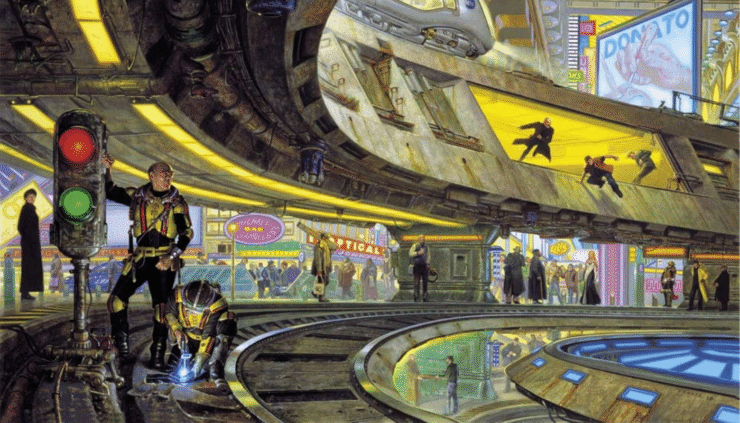
In 2025, Canada’s population shrank for the first time since Confederation. The reason for this is very subtle: if babies born + immigrants is a smaller number than deaths + emigrants, then the population will shrink. Canada has a low birth rate and we recently turned down the dial on immigration. As a consequence, there are fewer people in Canada in 2026 than there were in 2024. Only mathematicians of the very highest order can easily wrap their minds around equations so arcane, thus we cannot blame the government if they are surprised by the logical outcome of their actions. After all, it isn’t like there’s any precedent for low birth-rate, low immigration nations featuring declining populations.
Generally speaking, governments want their populations to grow because the economy and tax base tend to scale with population. Whether or not population growth is always a good idea is a matter for another essay. Let’s just assume for the moment Canada wants more Canadians1.
Currently there are three obvious options:
Increase the birth rate
There are a number of ways this could be done (subsidizing children, for example, or punishing those who try to avoid having children). Decree 770 provides an example of how well the second one works in practice. Subsidizing babies doesn’t seem to be much more successful, aside from having fewer immediate negative externalities like dead mothers or legions of abandoned babies.
Increase immigration
This is easy to implement and works well enough, although you will want to expand housing accordingly. However, it does encounter the minor issue2 that every nation appears to have a healthy supply of xenophobic racists—often people whose ancestors were themselves targets of xenophobic racism—which means immigration can be a political hot potato.
Decrease emigration
Either convince people not to leave or make it difficult for them to leave. I’m all in favour of the first option, but it might involve wild-eyed socialism such as ensuring sufficient housing, economic opportunities, not having a deranged and heavily armed nation right next door, and so on and so forth—all courses to which federal and provincial governments seem cool. The second requires an impenetrable border. Borders are notoriously penetrable and Canada has so very much border. Plus, the voters are unlikely to react well to being told they cannot leave.
What is a government to do when solutions are difficult to implement and/or come with a lofty political price tag? Turn to speculative fiction for solutions!
Territorial expansion
Canada is no stranger to expansion. The province of Newfoundland and Labrador, for example, is a relatively recent addition. One cannot help but notice that immediately south of the border there are millions of proto-Canadians who would no doubt welcome us as liberators. Nibbling a Detroit here and a New York City there would shore up our population for a very long time.
There is a Canada-specific SF work that comes to mind; Dean Ing’s Systemic Shock, in which Canada annexes the upper third of the US, thus allowing a post-World War IV streamlined America to better focus on its core strengths. I don’t know how many new Canadians we got out of that, given that the territory in question was nuked, irradiated, and sown with bioweapons, but probably not zero…and the irradiated, sickly former Americans seem likely to appreciate single-payer health care more than the Canadians for whom it is not a novelty.
Life extension
Remember babies born + immigrants and deaths + emigrants? Reducing the number of deaths can also result in population growth. Additionally, whereas encouraging (or requiring) more babies and immigrants or fewer emigrants could prove very unpopular, almost nobody objects to the idea of living longer. The extreme case is if everyone is immortal. With no deaths and no emigration, global population can only grow.
This logic played a prominent role in the backstory to Brian Stableford’s Inherit the Earth. Hellier and his allies reasoned that:
If the population had continued to increase, so that nanotech emortality spread through a world that was still vomiting out babies from billions of wombs, nothing could have restrained the negative Malthusian checks.
Thus the engineered wave of apocalyptic pandemics to greatly reduce the human population, especially the poor people3, plus an extra pandemic that sterilized everyone to ensure that the elite who survived were dependent on artificial, easily regulated, reproduction.
This seems an appropriate juncture to acknowledge that many people, especially science fiction authors (as discussed in an earlier article), are somewhat cool on high populations. Still, if not for Hellier and his pals, this setting might have been an unqualified example.
Mass production
Currently, the supply of new locally-produced Canadians is entirely composed of artisanal, handcrafted4 babies, each one of whom requires nine months of hard work by a single labourer5 and then almost two decades of communal effort to turn into an adult. What is this, the Paleolithic? We’ve mechanized, industrialized, and automated so much of modern life. Why not people-making?
SF offers a wide range of options here. For example, Bujold’s uterine replicators (seen in her Vorkosigan books), lend themselves to factory production of babies, although as the author notes, they don’t solve the problem of raising or educating the little tykes.
A more effective approach would produce functional adults, created able to fill their role in the economy, or failing that, would duplicate already existing adults. The Pohl and Williamson-scribed Farthest Star’s misleadingly named tachyon transporter (it was actually a duplicator) would almost qualify, if not for the fact the purposes to which duplicates are put greatly limits their lifespan. A better example would be the fax from Wil McCarthy’s Queendom of Sol series, which could produce as many duplicates as there was matter available from which to construct them.
No doubt there are other possibilities I’ve overlooked. Feel free to mention them in comments below—and for further reading on SFF’s treatment of the issue of population decline, you may want to check out this previous essay.
- How many would be ideal? Well, there has to be at least one Canadian for Canadians to exist and even very optimistic estimates of how many humans the Earth can support tend to cap out at about one trillion. The answer is unlikely to be at either extreme. The median is five hundred billion Canadians, which is a nice round number. ↩︎
- Well, two minor issues. Birthrates are falling almost everywhere. How willing will governments be to allow people to leave when everyone is running short of citizens? ↩︎
- Judging by the surnames of the characters in the book, the sufficiently elite seem to have been white Anglophones like their author. What an extraordinary coincidence. ↩︎
- “Handcrafted” isn’t quite accurate, but it is a term Reactor will likely allow to appear in print. ↩︎
- With design input from another person early in the process. ↩︎


Tap tap tap is this on?