






I still remember the first time I saw Andre Norton’s Moon of Three Rings. It was sitting on the New Releases shelf at the Carnegie library in the little town in Maine where we spent our summers. The summer was nearly over, and the family was moving from an apartment to a house on a lake twenty miles away. I was also changing schools.
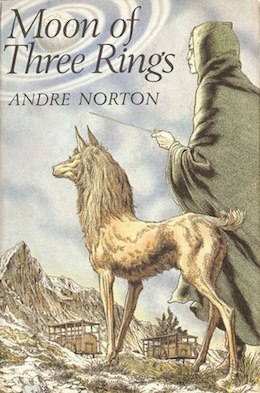
It was a great deal of change in a small span of time. I was twelve, which is the age of wonder in any case, and here was a book with the most intriguing cover: a person in a cloak, carrying a wand, escorted by a strange-looking, lionlike, wolflike, but distinctly alien animal.
I was supposed to be returning the summer’s stack of library books, but my grandparents lived in the town and yielded to my pleas to let me borrow one last book. They promised to make sure it went back where it belonged when its two weeks were up.
I curled up on the back seat of the parental station wagon and dived headlong into the world of Krip Vorlund the Free Trader, Maelen the Thassa Moon Singer, and the planet Yiktor under three-ringed Sotrath.
This book had everything. Archaic prose that sang in my twelve-year-old ears, which were just about a month away from discovering Tolkien—“Talla, talla, by the will and heart of Molaster and the power of the Third Ring, do I begin my part of this tale thus as would any Deed Singer of some upcountry lordling?” Spaceships and magic in the same place. Alien beings interacting with humans. Strange animals and a stranger culture. Danger, adventure, terrible and wonderful things happening to characters who mattered to me from the first page. Not only that, there were two of them, two very different people, and they each told their side of the story from their first-person viewpoint. I didn’t know you could do that.
I was enthralled. I’d discovered science fiction not long before, and read my way through most of two libraries’ collections. If I’d noticed Andre Norton’s name on any of the books, I don’t recall. I was a voracious and omnivorous reader, but I tended to sweep through, devour, and move on.
This time, I noticed. I didn’t know Andre was a woman, and it didn’t matter. I knew I wanted more of this particular brand of magic.
I imprinted on this book. When I had to give it up, I went back to my own library and found it again. I read and reread it. It rocked my world.
I wanted to tell stories like this. Stories about cultures meeting and clashing. Traders in space. Animal lovers on alien worlds. Body-swapping!
That was freaking amazing. Krip, in serious trouble and needing a way out that doesn’t involve getting killed, allows himself to be talked into having his consciousness shifted to the body of an animal, while his own body is carried off, Maelen assures him, to a sacred valley of lost souls, where he can be reunited with it and safely spirited away offworld. Except that Maelen isn’t nearly as good at predicting human behavior as she thinks she is, and Krip’s body never makes it to the valley. Instead it’s returned to his ship and taken away into space. Which leaves Maelen in a quandary, but she has a solution for that, too: the body of her sister’s life-mate who died in animal form while in Moon Singer training.
Of course Maelen pays a terrible price for all of this. In some ways it’s more terrible than the one Krip pays in losing his own body and being permanently relegated to the substitute. Maelen has the best of intentions, but she’s broken multiple laws, and there is no going back from the things she’s done.
So complicated. So engrossing. My heart beat hard when Krip woke as a barsk and realized exactly what Maelen had talked him into, and even harder when he came to as Maquad the Thassa. Then I cried because he still wasn’t who he seemed to be, and poor widowed Merlay knew it instantly. Maelen knew, too, but it didn’t stop her from trying to soften her sister’s grief.
And the Thassa…! Ancient race of magical mysterious beings with very pale skin, silver hair, and slanted eyebrows—Star Trek hadn’t happened yet, but we knew elves, and the idea of people like that in a world with spaceships was breathtaking. Life-changing.
When I discovered Tolkien not long after, that changed my life, too. But if any one book started me on the path to being a writer, Moon of Three Rings was it.
I reread it every so often after that first astonished meeting, and it still enchanted me. When, a couple of years ago, I found a copy of the edition I’d found in the library, complete with library dust jacket and Dewey Decimal label, I snapped it up and read it again. I still loved it.
Not only that, I found out what a barsk was, thanks to social media. A maned wolf! Well, except for the tail, which a barsk doesn’t have, but it’s an alien animal, after all.
Rereading the book this time in public, so to speak, has been a bit of a different experience. Before, I read it purely as reader, with most of my twelve-year-old self intact. I didn’t think, I just felt.
Though very early on, I did see the problem with the name of the Thassa supreme being. Molaster? Seriously? And then in volume three of what turned into a series, either the copy editor went nuts correcting to a familiar spelling (autocorrect not really being a thing ca. 1985), or Andre forgot the original spelling and it became… Molester.
Ouch.
Another lesson learned from Andre, this time in the Don’t-Do column. Names matter.
For this reread I applied a bit of reviewer-critic-brain, and writer-reading-source-text brain. It was hard. I love this book so much, and for me it’s not really anything but perfect. Of its kind. Because it’s so much a part of me.
I see that the prose is a bit thick. It’s very much of the yea-verily school, more so for Maelen than for Krip.
But you know, in context it works. They’re both not of our time or place. Krip is more accessibly human, and at the time it was default for the accessible viewpoint to be male. Maelen is alien in ways that become more apparent to us and to Krip as the story goes on, but she tells her story from her viewpoint, and we get to be a Thassa Moon Singer with an agenda that’s both deeply human and even more deeply not.
I didn’t realize how radical that was for 1966, or how downright revolutionary it was in science fiction for a female protagonist to be a fully rounded human being with a full range of agency, without standing on a pedestal like Galadriel or serving as a trophy like, for example, Guinevere. Maelen does not exist to be rescued—exactly the opposite, in fact. If there’s any damsel in distress in this book, it’s Krip.
Maelen is complex and conflicted, and she isn’t nearly as smart as she thinks she is. She makes huge mistakes, but she makes them out of honor and love.
She is not a Love Interest. Krip is fascinated by her, but there’s nothing romantic about it. She’s alien, she’s interesting, she’s powerful. Their relationship is that of two people caught in the same predicament and doing their best to find their way out of it.
Sex and gender don’t come into it in any perceptible way. They’re partners in an adventure. And Maelen, step for step, is the senior partner.
Maelen is a remarkable character. Krip is more the standard young male undergoing Life Experiences. He’s well drawn and there’s a subtle twist to the way he talks about the planet and people of Yiktor: he’s not a part of them, in some ways he’s above them, and when he first shows up, he’s just visiting. It’s only with time and trauma that he develops something more like respect for the world and its inhabitants. Especially the Thassa, who are completely unexpected, but who end up changing his life completely.
Maelen’s role here is wonderfully subversive. Star Trek was considered radical because it allowed women to go into space. The original female first officer was removed by the network in favor of a male alien—that was how unacceptable it was for women to even think about being equal to men in a science fiction adventure. They could be secretaries, receptionists, or nurses (in their tiny, skin-tight miniskirts), and even that was a major departure.
Now, mind, Norton’s human world is like the network’s world. All the Free Traders and the Combine commanders and crew are men. There are, apparently, no female humans on Yiktor.
It’s a man’s universe. We know Krip has a mother, but she’s an appendage of a male Trader, who abandoned her child to go off with husband number whatever. There’s no sense of female space. At all.
Except among the Thassa. The ancient alien species with, apparently, full equality of the sexes. (And who knows, maybe there are more than two.)
And we get to live in Maelen’s head. To know what she thinks and where she comes from. She’s not The Girl. She’s not a cipher or an armrest or an unsolvable mystery. She’s a person. Just as if she were male. That’s…really something.
The message I took away from it at age twelve is that our bodies aren’t who we are. It’s what’s inside that matters. Whatever shape we wear, we’re still ourselves. And that includes gender as well as all the other aspects of our identity.
And Andre did it without preaching or polemic. It just was. Seeing that, finally, after all this time, makes me love the book even more. No wonder I grew up with a slippery sense of genre boundaries and a propensity for matching my early default-male protagonists with uppity, complicated women. Andre corrupted me in the writer-cradle.
Thank you, Andre. And thank you, Maelen, for being you.
Judith Tarr forayed into the Witch World with a novella, “Falcon Law,” in Four from the Witch World. Her first novel, The Isle of Glass, appeared in 1985. Her new short novel, Dragons in the Earth, a contemporary fantasy set in Arizona, was published last fall by Book View Cafe. In between, she’s written historicals and historical fantasies and epic fantasies and space operas, some of which have been published as ebooks from Book View Café. She has won the Crawford Award, and been a finalist for the World Fantasy Award and the Locus Award. She lives in Arizona with an assortment of cats, a blue-eyed spirit dog, and a herd of Lipizzan horses.

Thanks, Judith. I must have read this way back when, because I collected and read every Andre Norton I could lay my hands on and I had it in my home library, but when I re-read it last week I didn’t remember it. Which one will you do next? I’d like to re-read it before you review it.
I’ve read as much Andre Norton as I could get my hands on over the years and adored everything she ever wrote. Her world building was amazing and her characters are always engaging, even when they aren’t particularly nice people.
@1: The sequel, Exiles of the Stars. Thank you for reading along with me! That’s one of the coolest things about doing these rereads.
@2: Total agreement. That impresses me as I do this reread, how keen an eye she had for human personalities with all their flaws as well as their good points.
Oh wow – is that a Robin Jacques cover as well? Double-awesome.
While Moon of Three Rings wasn’t my first/my favourite, it’s one of those that you can thoroughly fall into. The male human space-goer and the powerful female non-human is something Norton repeats in other series and I’ve always suspected that she knew that our human culture wouldn’t (at that time) allow women an active role, so she used a non-human to achieve that participation.
In early Norton, space is the domain of men, and women barely appear at all, but I love them enough to accept that and just read.
I thought I’d read every Norton novel from this era, but I somehow missed this. Now to search it out!
Regarding the Free Traders, do they appear in other stories? I seem to remember one ship or clan being matriarchal, or at least having a significant female power base (or am I half-remembering something from Citizen of the Galaxy instead?)
@5 – it’s been ages since I read anything by Norton, but nothing is ringing a bell with matriarchal trader trader families. Are you possibly thinking of The Rolling Stones by Heinlein?
Any Teen Titans fans here? Did Maelen the Thassa remind anybody else of Starfire/Koriand’r the Tamaranian? Not only do the two aliens seem to share similar personality traits and dynamics with their male peers, but they seem to have other similar motifs: Thassa/Tamaranian, Moon Singer/Starfire and they both share strained relationships with their older sisters too. I have a feeling Starfire’s creators at DC Comics had read Moon of Three Rings before creating the character in the 80’s.
I guess I have another reason to love Andre now, since I love your books, too, Judith! I was always more partial to the Witch World novels, but they did for me what Moon of Three Rings did for you. I was about the same age, too. I love the fact that in Andre’s books we have both sci-fi and fantasy co-existing in the same novel. I now am going to have to reread the trilogy, which I have sitting on my bookshelf.
Thanks Judith, A wonderful job for a wonderful book.
Actually, Mitana, there are four books in this series. Moon of three Rings is one of my top five SF/F Norton books. I love to reread it at least once per year. Maelen is my favorite female protagonist in the realms of SF/F, .Jaelithe coming in very, very, very close behind (A photo finish, I would say)
Judith, are you just doing the SF/F titles? Andre has several strong and memorable female characters in her non-SF/F tales, my favorite being Johanna Lovell from Follow The Drum which I reread 3-4 times per year. Later Kind Folks–Paul
Moon of Three Rings and Enchantress from the Stars by Sylvia Engdahl were the first two books I read in which the female character was IMPORTANT. When I was 11 years old this was an intense, world-shattering, wondrous discovery. Maybe I, too, could be important.
Prior to reading these two books – every single science fiction book I read had a male protagonist. Women (or girls) in the stories existed to be rescued. They did nothing. I still read the books, because I adored science fiction, but I swore to myself that I was going grow up to be a woman who did things, and not one who had things done for her (or to her). That was what the SciFi/Fantasy genre was like in the 1960s.
I loved reading about women who went into space. And of course, about anyone who could talk to an animal.
This book was so magical to me, I’m almost afraid to reread it.
And that cover? That was the one on the library copy I read in ’70. Thanks for posting it.
@8 Thank you!
@9 I’ll be sticking with the SFF titles, since this is an SFF site, but I’ll make a note to check out Norton’s non-SFF titles just for my own pleasure. Thanks for the referral!
@10 For me the book held up. I was ever so glad to discover this. I know the fear of losing the childhood love to adult eyes, too. But this one I just keep on loving.
A few months late here, but I just recently finished reading this one, as part of my chronological readthrough of Norton’s various S-F books. I think it’s a good book, one that holds up fairly well today.
Mind you, I had just finished reading Victory On Janus (which I found to be a real slog) before starting Moon of Three Rings, so the latter looks especially good by comparison… ;)
Wow, have I been out of the loop. Sliding in here at the end of the series! Just wanted to say that I share Judith Tarr’s love for Moon of Three Rings. It was my introduction to science fiction in junior high school, and what caught my imagination most were Maelen’s title of Moon Singer (imagine! singing to the moon!) and the barsk. Oh my. I didn’t know it then, but the barsk would lead to my amazing relationships with three Siberian Huskies later in life. Thank you, Andre. I also owe her an unpayable debt of gratitude for recommending Gate of Ivrel by CJ Cherryh in the blurb she wrote for the paperback. I never would have picked it up otherwise. If I hadn’t, I would have missed out on decades of amazing books. Thanks to Judith Tarr for this series.