






In this bi-weekly series reviewing classic science fiction and fantasy books, Alan Brown looks at the front lines and frontiers of the field; books about soldiers and spacers, scientists and engineers, explorers and adventurers. Stories full of what Shakespeare used to refer to as “alarums and excursions”: battles, chases, clashes, and the stuff of excitement.
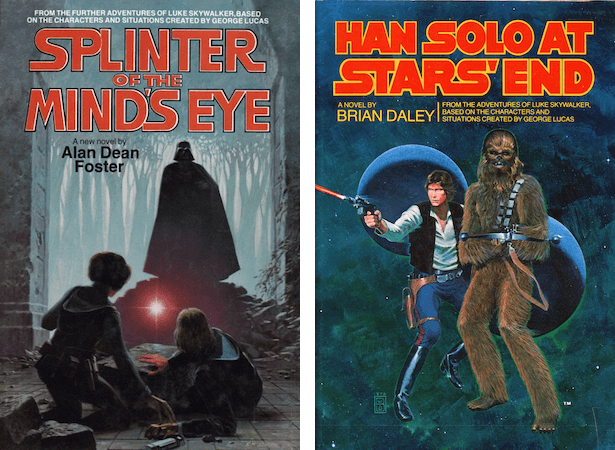
The Star Wars movies are notable for spinning off into a wide variety of other media and related products, including TV shows, books, comic strips, comic books, radio dramas, toys, housewares, and other products. Since the series was largely modeled on the old Flash Gordon and Buck Rogers serials, this is no surprise, as both of those properties were also adapted into a variety of formats and merchandise, something George Lucas certainly noticed and emulated. Today, I’m going to look at two of the first Star Wars tie-in books, Splinter of the Mind’s Eye and Han Solo at Stars’ End. These books, both excellent adventure stories, represent two very different approaches to media tie-in fiction
Novelizations and tie-in novels have long been part of the movie-making business. They were especially important back in the days before home video recording devices, when the only way you could revisit a favorite movie, other than waiting for a theatrical or television re-release, was to read the story in book form. And these books have always provided lucrative work for authors, whose income from original fiction is sometimes quite modest by comparison. The royalties for movie tie-ins can be small on a per volume basis, but these books sell lots of copies, and in some cases, stay in print for years, if not decades.
Alan Dean Foster and his Star Wars books have recently been in the news. When Disney bought Lucasfilm Ltd, Foster stopped receiving royalty checks from his works. When he approached the company, he found that while they had purchased the rights to those books, they did not feel they had inherited the obligations that came with those rights. He enlisted the aid of the Science Fiction Writers of America (SFWA), who took the rare step of publicizing the dispute in an effort to bring Disney to the bargaining table. If Disney is successful in redefining the relationship between authors and publishers in this case, it could set a precedent and have a profound and negative impact on all professional authors, who have already been facing difficult times because of changes in the publishing industry.
About the Authors
Alan Dean Foster (born 1946) is a prolific American science fiction author who has not only produced a large body of original work, but has also written tie-in novelizations for a number of movies/franchises. He started his career as a copywriter for a small advertising firm. Much of his original science fiction work is set in his Humanx Commonwealth universe, with a number of those books following the engaging duo of Pip and Flinx, a small flying dragon-ish creature and a young human. He also writes the fantasy Spellsinger series, currently at eight books. Foster’s selection to ghost-write the Star Wars movie novelization cemented his reputation as a go-to writer within the cinematic community. He has written extensively in the Star Trek universe, and has a story credit for Star Trek: The Motion Picture. He has written novels set in the Aliens, Terminator, and Transformers universes, and over a dozen other movie novelizations.
Brian Daley (1947-1996) was an American science fiction author who began writing in college after he served in the Army in Vietnam. Daley is most widely known under his own name as writer of a trilogy of Star Wars tie-in novels featuring Han Solo, and for the National Public Radio audio dramatizations of the original Star Wars movie trilogy. The first book of the Han Solo trilogy made The New York Times Best Beller list. The Star Wars audio dramas, starting with NPR’s excellent adaption of the first movie in 1981, were very well received, and kicked off a large series of similar adaptations (I’ve previously discussed the world of Star Wars audio dramas here). Daley was quite prolific, writing in partnership with James Luceno under the pen name Jack McKinney—among other novels, they wrote 26 books set in the Robotech universe. Daley died of cancer shortly after completing the script for the NPR radio drama Return of the Jedi.
The Star Wars Expanded Universe
Splinter in the Mind’s Eye and Han Solo at Star’s End were the first two books in a publishing phenomenon that became known as the Star Wars Expanded Universe. I’ve addressed some of my favorites in this column previously; the first of the X-Wing books, Star Wars: Rogue Squadron, and also Timothy Zahn’s classic Thrawn trilogy. Lucasfilm exerted a strong editorial hand over these spin-offs, and created a detailed canon that kept all these efforts consistent.
Buy the Book
We Shall Sing a Song Into the Deep
In 2014, in order to allow the writers of the sequel movie trilogy to tell new tales, unconstrained by decades of continuity, any work that was not part of the filmed universe continuity was rebranded as “Star Wars Legends.” The old canon was not completely abandoned, and writers have frequently used characters, settings, and vehicles from those works in newer stories. Between the old canon and the new, when you consider all forms of officially published fiction, including movie novelizations, tie-in books, anthologies, short stories, and children’s books, there are currently hundreds of works spawned by Star Wars.
Splinter of the Mind’s Eye
I had long thought that Splinter was based on an unfilmed script, but when I stated that belief in a previous column, Foster himself joined the discussion to set me straight: “One small correction: Splinter of the Mind’s Eye was not based on an unfilmed script. It was a wholly original work from the get-go.” Foster had been brought on board to ghost-write a novelization of the Star Wars movie, and while the movie was in production, was contracted to write an additional novel whose story could be used as the basis for a lower budget sequel with a smaller cast, more modest sets, and fewer special effects. The resulting story strongly reminded me of Andre Norton’s work, with a mysterious artifact acting as a MacGuffin, and a journey through underground caverns and a lost city. It is somewhat marred in retrospect by the portrayal of Luke’s romantic interest in Leia—Lucas having not yet decided that the two were brother and sister.
The story begins with Leia traveling to a conference in a Y-Wing with C-3PO, escorted by Luke and R2-D2 in an X-Wing. A space storm causes them to crash on the planet Mimban, and while they are looking for a spaceport, they find a secret Imperial outpost. Halla, an older, Force-sensitive woman, tells them about the Kaiburr crystal, an artifact that helps magnify Force powers. The two decide they must find the crystal before trying to get off-world. Luke and Leia are captured by the Imperials, and imprisoned with two Yuzzem, characters who provide some assistance and comic relief. Halla frees the four prisoners, and they all set out into the swamps in search of the crystal.
Luke and Leia are separated from the rest when a monster attacks, and journey through underground caverns to an abandoned city. They are captured by natives known as the Coway, who have also captured the rest of the party. Luke prevails in a challenge by combat and wins the support of the locals, only to sense that the Imperials are attacking, this time led by Darth Vader himself. The rest of the book deals with Luke and Leia’s efforts to survive their predicament and win the day.
The book was an enjoyable adventure that sold well to an audience hungry for more Star Wars stories. But because of the success of Star Wars in the theaters, the idea of a more modest sequel was abandoned, and new adventures were scripted that superseded the story in Splinter. The book, while it remained in print, was no longer considered part of the official Star Wars canon, one of the risks of producing a tie-in novel that acts as a sequel. It did, however, introduce some elements that were picked up in other Star Wars novels, including the planet Mimban and the Kaiburr crystal, an inspiration for the kyber crystals that were later explained as powering lightsabers, and also the planet-killing weapon used on the Death Stars. Foster is a skilled author, and while the book is jarringly inconsistent with the new Star Wars continuity, it remains an entertaining read all on its own.
Han Solo at Stars’ End
Another early Star Wars publishing effort was the production of a tie-in trilogy featuring the early adventures of Han Solo and Chewbacca and their beloved Millennium Falcon. These take place in the days before they met Luke and Leia, and are set in a previously unmentioned corner of the galaxy. The author was Brian Daley, an author who proved adept at capturing the feel of the Star Wars universe, and was later selected to script the aforementioned NPR radio version of the original Star Wars movie trilogy. The decision to set the books apart from the continuity of the movies proved a good one, and while the Daley trilogy is no longer considered part of canon, it has stood up well over time, and is an enjoyable, stand-alone read.
Daley also made some solid contributions to the greater Star Wars universe, with the Corporate Sector, its planets and its organizations appearing in a number of other works, and the Z-95 Headhunter fighter also being used in books and in the Clone Wars cartoon series. Pitting Han against the corrupt and evil Corporate Sector Authority also allowed him to play the role of a space pirate while still keeping the reader’s sympathy firmly on his side.
The book opens with Han and Chewie pulling off a successful heist, but damaging the Falcon in the process (it loses its sensor dish, for the first of what will be many times). They go to pay off an old creditor, who betrays them to the Security Police, or Espos. Han puts a small but vicious beast in the box with his payment, and in the chaos that ensues, he and Chewie are able to escape. But now he needs someone to forge new papers for the Falcon in addition to seeing to his repairs.
Han goes to an old friend, Doc, at a pirate support base, to get what he needs, but Doc has disappeared. Doc’s daughter, Jessa, will provide Han with the help he needs if he can find Doc. Han is pressed into service flying an old Z-95 when the pirate base is attacked by the Espos. There are others with missing relatives who want to join the effort, including Rekkon, a leader of the efforts to find the disappeared. They also have a manual labor robot, Bollux, who carries a highly intelligent robot, Blue Max, in its chest. The two robots prove to be among the most entertaining characters in the story.
They fly to an agricultural planet where an Authority data center is located, with the Falcon disguised by embedding it in a gigantic grain barge. After Blue Max extracts the data they need, there is a dramatic escape that involves the clever use of a load of grain to counter a tractor beam, but Chewie is captured by the Espos and Rekkon is murdered by a traitor among their group. Before dying, however, he wrote down the name of the planet where the Stars’ End prison is located. Han finds the traitor, discovers Chewie was moved to the same facility as the other missing persons, and heads out to the rescue.
The rescue plan involves posing as a circus troupe, robot pit fights, gun battles, and an escape from a prison building accidently launched into a sub-orbital trajectory. Daley proves adept at telling an exciting adventure story, mixed with plenty of derring-do and humor. Unlike some other books that are now considered part of the Legends continuity, this one has held up over time. Out of all the authors who have written Star Wars novelizations, Daley remains one of my favorites, and he did a great job scripting the excellent radio dramas as well. I would highly recommend this book to all fans of Star Wars books.
Final Thoughts
Now it’s time for me to end my remarks, and for you to start your own ruminations: What are your thoughts on these early Star Wars adventures? Do you prefer a tie-in that is a direct sequel to the original work, or more of a stand-alone adventure featuring the same characters? How do these two books rank among the many tie-in novels spawned by the Star Wars series? And of course, Star Wars is not the only franchise with tie-in novels; for example, the Star Trek universe has spun off many books over the year. What other tie-ins do you think are worthy of note?
Alan Brown has been a science fiction fan for over five decades, especially fiction that deals with science, military matters, exploration and adventure.

I had both of those and enjoyed the Daley trilogy a lot as a teen. IIRC part of that first book had the Falcon refitted with advanced hydraulics, much to Solo’s dismay, as being the best local tech option.
I discovered these in the late 80s and early 90s before they had been reprinted. I had no idea they existed until I started playing the West End Games RPGs.
I was able to find one of the Han Solo books in my school library.
“Splinter” came out at the Golden Age of Science Fiction (I was 12) and was my intro to Foster’s work. Have a hardcover of it. Still have the original Star Wars paperback I bought back in 1977.
I bought Han Solo at Stars End in 1979 at age 8. I have re-read the trilogy annually for 40 years. It still reads fresh and fun.
This reminds me: Had Disney paid ADF yet?
Splinter: I vividly remember being on a family vacation visiting relatives in Arizona in, I assume it was the summer of 1978?, walking into a drugstore and, in the wire paperback rack, seeing A NEW STAR WARS BOOK!!!!!!!!! Which, needless to say, I was the proud owner of in a matter of minutes, and I probably read it cover-to-cover twice before we got home.
The Daley books I never actually owned back in the day — I just read whichever ones were on the SF paperback spinner at the public library, so I think I didn’t actually read Star’s End until many years later.
I wish they had followed this track of Luke and Leia not being siblings in the movies. Easily the worst part of the original trilogy for me.
I remember reading Splinter in college, shortly after Star Wars premiered in theaters. It was premature to go ick at Luke/Leia; the part I remember most was that Darth was surrounded by weird lizardy dudes of which he was the lord. They were sith. Obviously prior to the prequels and the concept of the sith being the dark jedi…
And the Golden Age of Science Fiction may be a relative term; I always thought that was the 40’s and 50’s when Asimov, Clarke, and Heinlein were at their peaks of creativity…
@5 As I researched this article, I could find no word that the royalties dispute had been resolved.
@8 I find people are equally split between defining the “Golden Age of Science Fiction” as a function of the reader’s age, and as the glory days of the “old masters” of Clarke, Asimov and Heinlein.
I don’t think I really need to point this out, but ‘the Golden Age of science fiction’ referring to a person’s age (typically 12 or 13) was meant to be a joke. It’s attributed to Asimov, but I think it predates even him.
@10
I apologize; I had never heard of the term in that context before…
This Encyclopedia of Science Fiction entry is a quite comprehensive discussion of the term “Golden Age of Science Fiction.”
Themes: Golden Age of SF: SFE: Science Fiction Encyclopedia (sf-encyclopedia.com)
@Dr. Thanatos, I’d never heard of it in that context either, but awful nice of you to apologize.
I remember reading Splinter when it came out, and I suspect that’s why the whole sibling thing was as surprising as it was when it was disclosed.
@1/RJStanford:
As I recall, it was “fluidics” as a control system, not hydraulics as mechanical actuators. This caught my attention at the time because I had recently read an article in the February 1985 issue of Popular Science, although since Han Solo at Star’s End is dated 1979, Daley would’ve been inspired by earlier efforts like MONIAC (1949) and FLODAC (1964).
I suspect the main storytelling advantage is exoticism: a “galaxy far, far away” shouldn’t use something recognizable to readers as transistors or ICs. The same impulse leads other authors to optronics, photonics, positronics, duotronics, and “Zygon organic crystallography.”
I had both these books as a kid and read them repeatedly. I later read the second Daley Solo novel, but never read the third.
As for the Luke-Leia romance thing in Splinter, in-story, neither of them would’ve known they were related yet, so it could still have been consistent, just unfortunate in retrospect. It wouldn’t be the first or the last story about a man and woman being attracted to each other before discovering they were long-lost siblings. (The CW’s The Outpost did that in season 2, after having the couple get pretty hot and heavy for weeks, though I don’t think they actually consummated. That was a weird story choice, and not as funny as they tried to make it.)
I think the bigger issue for me was that it was hard to reconcile Luke and Vader’s meeting here with the events of Empire where it seemed they’d never met face to face. And of course there’s the question of when Vader first knew Luke was his son.
Come to think of it, it was probably smarter to go the route of the Solo books, prequels that filled in Han’s backstory and steered well clear of the movie’s events.
@14/phillip_thorne: “I suspect the main storytelling advantage is exoticism: a “galaxy far, far away” shouldn’t use something recognizable to readers as transistors or ICs.”
I think if you can accept a galaxy far, far away being inhabited by human beings with names like Luke, Owen, and Ben, you can accept them using transistors. Heck, if anything, the latter is far more plausible, since transistors are based on physical laws that would be universal.
So I read both series,….and read is not the right word. Devoured would be and multiple time when they were first released. As I reflect both authors styles really resonated with me and coming up with totally new adventures with great character as well as series universe development. And if you have never heard of Daley’s Star Wars audio treatment filled with “lost scenes”, totally brilliant in both audio execution and writing.
Alan Dean Foster was the guy for me then and now with his original works as well as media tie-ins. I think his adaptation of the Star Trek series (entitled the Star Trek Logs) was so captivating and always leaving me wanting more adventures.
With the ST Logs, he develops further the original animated episode plot into a very incredible satisfying story in itself and then….then crafts a wholly original new rich follow-up adventure that transitions from the original episode story. To be honest, if the the Star Trek producers wanted to dig into those stories, they would likely find some blockbuster plots right there.
6. hoopmanjh, I also have vivid memories of walking into a Hong Kong hotel gift shop in 1979 at age 10, spotting Splinter on a wire rack and losing my nut with glee. We were expats returning to the US so I had a nice, long flight ahead of me to read. I had all three Han Solo books, but I only recall reading the first all the way through.