







“Blaze of Glory”
Written by Robert Hewitt Wolfe & Ira Steven Behr
Directed by Kim Friedman
Season 5, Episode 23
Production episode 40510-521
Original air date: May 12, 1997
Stardate: unknown
Station log: Nog is over for dinner at the Siskos, where they’re eating squid in a sauce made of pureed tube grubs. (Jake loves it right up until he hears what the sauce is.) Nog is currently on a security rotation, and he’s not happy at how Klingons aren’t taking him seriously, or even acknowledging him.
Martok reports to Sisko with a coded message from the Maquis—a bit of a surprise, since the Maquis were believed to be wiped out by the Dominion after they absorbed Cardassia. The message is for “Michael,” saying the missiles are en route to Cardassia. Martok reveals that the Klingons provided the Maquis with cloaking devices, which they could have used on the missiles themselves. Sisko and Martok fear that such a strike by humans will result in retaliation against the Federation.
Worf and Dax search the Badlands in the Defiant but they can’t find them, and the Defiant can’t stay in the Badlands too long as it’s too powerful to remain undetected in the plasma storms, even while cloaked. So Sisko goes to Eddington, currently in prison, to try to get his assistance in narrowing the search. But he’s uncooperative, not even willing to admit that he’s the Michael the message is for, nor is he willing to provide the abort code for the missiles, or the location of the launch site. Whatever compassion he might have had was burned out of him when the Maquis were slaughtered by the Dominion while he listened to the reports of the massacre from his jail cell. All he wants now is to lie in prison and wait for the Jem’Hadar to blow up the station he’s being held on.
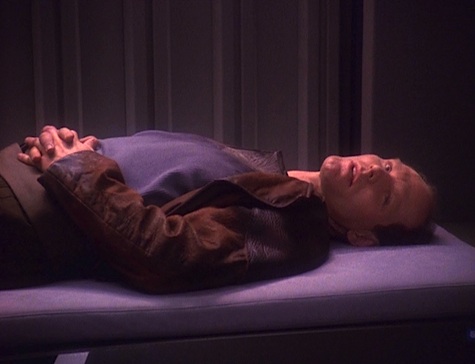
So Sisko doesn’t give him a choice. He takes Eddington in shackles onto a runabout and heads into the Badlands to find the launch site. Eddington is less than cooperative, though, and decides to throw Cal Hudson in Sisko’s face, informing Sisko that Hudson was killed by the Cardassians.
As they search the Badlands, Sisko detects two Jem’Hadar ships. His response is to casually wander aft and get a raktajino. He’s betting that Eddington’s death wish is nonsense and that he’ll take the helm and plot an escape. Sisko even frees Eddington from his shackles. Sisko wins that bet, and Eddington gets them away from the Jem’Hadar and even agrees to take him to the launch site. But he promises that when it’s all over, he’s going to kill Sisko.
Eddington’s first trick for getting rid of the Jem’Hadar doesn’t work, so plan B involves realigning the impulse engines while they’re still active so they spit out exhaust that can ignite a plasma tendril. It works, despite Eddington shaking the ship up enough to give Sisko a head wound.
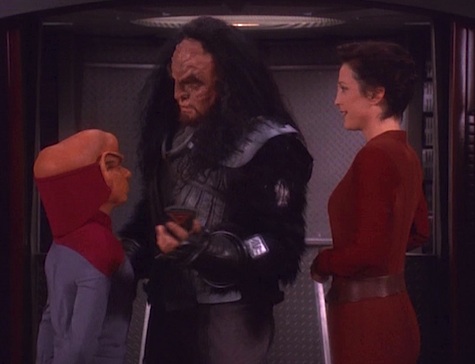
Nog’s first attempt to gain the Klingons’ respect by arresting them when their noise level hits 70 deciBels (the legal limit for disturbing the peace) fails when he falls down from leaning back in his chair in Quark’s. Plan B is to get them to move along when loitering on the Promenade—in Jake and Nog’s old spot, no less, which gets his blood boiling. He throws regulations into Martok’s face and threatens arrest, which is enough to get Martok to laugh with respect at the Ferengi’s cojones and move along. Later, when Nog and Kira bump into Martok (after Nog recovers an earring clip Kira had lost), the general treats Nog with respect, to Nog’s glee.
Eddington takes Sisko to the launch site, which is on Athos IV—where they find two Jem’Hadar. They only have one phaser, which Sisko gives to Eddington while he goes around and attacks the Jem’Hadar with a pipe. Amazingly enough, this works. Now armed with Jem’Hadar rifles, they head to the launch site, coming across tons of dead bodies along the way. Eddington is devastated; the Maquis were his responsibility and he failed them.
They take out two more Jem’Hadar and then go into the “launch site”—actually a hidden room where the final dozen survivors are hiding, led by the woman in the recording. That woman is Rebecca Sutherland, Eddington’s wife, and there are no missiles, the message was a code saying they’d come to Athos IV, which was their fallback position if things went into the toilet. It was all a ploy to get Sisko to come take him to the Badlands in a runabout so they could be extracted.
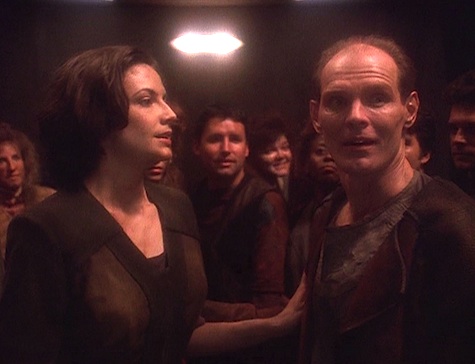
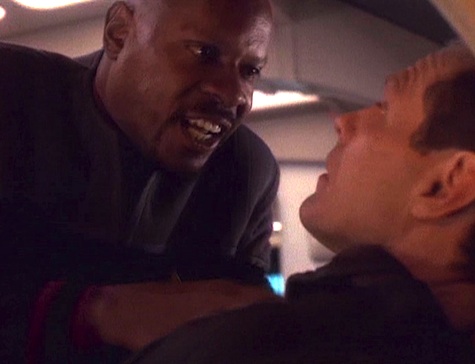
Sisko decks Eddington for lying to him, and then they head to the landing site. They’re ambushed, and Eddington is shot. He stays behind to hold off the Jem’Hadar while Sisko leads Rebecca and the others to the runabout. Eddington is killed with his wife’s name on his lips, while the runabout flies to freedom.
Well, freedom for Sisko, anyhow. He and Dax talk about how Eddington died the way he lived, Maquis to the end.
Can’t we just reverse the polarity? You really shouldn’t realign the impulse engines while the impulse engines are still running. It’s very very dangerous.
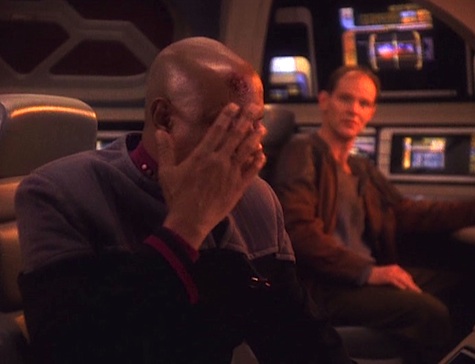
The Sisko is of Bajor: Unlike the last time he dealt with Eddington, Sisko is remarkably even-tempered, and does a wonderful job playing Eddington, even though Eddington is, in fact, playing him the entire time, too.
Rules of Acquisition: Quark has to be treated in the infirmary because he told Morn that there was a good chance that the Jem’Hadar would be invading Deep Space 9 soon. Morn snapped, panicked, hit Quark with a barstool, and ran naked through the Promenade.
For Cardassia! Apparently, the Maquis were on the verge of declaring themselves an independent state, and Cardassia was in no shape to stop them from doing so—at least until the Dominion showed up.
Victory is life: It took three days for the Jem’Hadar to annihilate the Maquis, leaving only a few left on Athos IV.
Tough little ship: The Defiant is too powerful to stay hidden in the Badlands, even while cloaked, as it’s so overpowered that it’s detectable amidst the plasma storms regardless.
No sex, please, we’re Starfleet: Turns out Eddington’s married. Who knew?
Keep your ears open: “I can barely see two meters in front of me. How will I know what I’m aiming at?”
“I’ll be the one holding the pipe.”
“Attacking two Jem’Hadar soldiers with a pipe? That’s a brilliant plan.”
“It could be worse.”
“I know. It could be me holding the pipe.”
Eddington and Sisko discussing hand-to-hand combat strategies.
Welcome aboard: Kenneth Marshall is back for the final time as Eddington, while Gretchen Garman plays Rebecca. Plus we’ve got Aron Eisenberg and J.G. Hertzler as Nog and Martok.
Trivial matters: Dukat said in “By Inferno’s Light” that the Maquis were on his list of things to deal with now that Cardassia was part of the Dominion. This episode establishes that they were taken care of pretty seriously.
This is the last time the Maquis storyline is seen on DS9. Chakotay, Torres, and the rest of the Maquis on Voyager will learn of the elimination of the Maquis by the Jem’Hadar when they receive letters from home in the episode “Hunters.”
The novel Avatar Book 1 by S.D. Perry establishes that Ro Laren and a very small group of Maquis who survived the Jem’Hadar’s massacre fought a guerilla war against the Dominion. Those Maquis would later be pardoned after the Dominion War. Similarly, the Maquis crewmembers of Voyager were pardoned in Homecoming by Christie Golden, which took place right after the ship’s return home in “Endgame.”
Klingon assistance to the Maquis mentioned by Martok is also seen in two of the eBooks in the Slings and Arrows miniseries, Robert Greenberger’s A Weary Life and your humble rewatcher’s Enterprises of Great Pitch and Moment.
Eddington’s death scene was based Steve McQueen’s death scene in Robert Wise’s 1966 movie The Sand Pebbles.
Walk with the Prophets: “Rebecca…” This is a fun episode to watch, mostly for the banter between Eddington and Sisko, which is some of the best work Avery Brooks and Kenneth Marshall have done together. This actually works better than the Javert-Valjean dynamic that Eddington forced on “For the Uniform,” and has some superb moments. The verbal fencing between the two characters is electric and the screen just lights up when the two of them—who are so much alike and so very much can’t stand each other—go at it.
But ultimately, the episode’s a bit of a letdown, rather like the entire Maquis arc was. The storyline just never really worked. The treaty that forced the issue was fairly stupid, though not entirely unrealistic, but the Maquis just never were convincing as tragic heroes, especially because—and I know I keep harping on this—their first official act was to blow up an empty freighter on a crowded space station. Forget whether or not the Bok’Nor was a viable target or not: they blew it up on Deep Space 9, a hugely crowded port of call filled with innocent civilians. Yes, the damage was limited to the Bok’Nor itself, but there was no guarantee of that outcome. Hundreds of lives, most of whom had nothing to do with the Maquis conflict, were endangered. And that was just the beginning. It didn’t help that Voyager, for which the entire Maquis setup was created in the first place, did absolutely nothing with it (despite pretty much all the pre-show hype being about how the show would be about the conflict between Starfleet and Maquis).
In this episode, the final nail in the Maquis’s coffin is Eddington’s hubris. He never imagined that his plan to have the Maquis declare their independence and become a sovereign nation could have failed. He never imagined that the Cardassians would be strong enough to fight back. He never imagined having to deal with the Jem’Hadar or that if he did, that they would find Athos IV (given that he was DS9’s security chief going back to first contact with the Dominion, he really should have known better).
Still, the episode is fun to watch for the sake of the banter between the captain and the Maquis, and we do actually close out a plotline for once. Best of all, we get closure with the revelation of Cal Hudson’s death without having to suffer through what passes for acting by Bernie Casey.
It’s a fitting end to both the Maquis storyline in general and Eddington’s in particular. But the latter is far more compelling, and that’s both the episode’s strength and weakness.
Warp factor rating: 6
Keith R.A. DeCandido will be at the Highland Library Comic-Con this coming Saturday, the 26th of July in Highland, New York, along with authors Linda Zimmerman and C.L. Schneider, comics writer Todd Dezago, cartoonist Roger L. Phillips, and makeup effects artist Danielle Masterson, as well as a dozen local cartoonists and various fan clubs. Information can be found here.

I can’t help wondering if the Maquis getting massacred off-screen was a deliberate f*** you to Voyager.
I may be misreading the behind-the-scenes interviews…but I get the sense that Behr and the others were never really happy with the Maquis
The rebels weren’t really a DS9 creation. They got foisted on them in order to set up the VOY and they had no choice, but to use them.
Yeah, I never could buy into the Maquis cause either. Though I guess recent events have proven [again] that rebels/terrorists are not the sharpest tools in the shed. Not unrealistic indeed.
I was definitely more of a Maquis sympathizer, made even better when they suddenly had Eddington as their face. To me, this episode was the best possible outcome for the whole story. Tragic, but inevitable.
I don’t see it as Behr flipping the bird to Voyager. Most of his resentment towards it was because of the media attention the show started getting around 1994/95, which also happened to be the formation of a new network. He rightfully felt DS9 was getting lost in the shuffle, but I don’t think any self-respecting writer/producer would really commit to a story simply out to spite a friendly competitor. Not to mention Rick Berman and Brannon Braga graciously incorporated the Maquis’ demise into Voyager, generating not only the letters from home episode, but also season 5’s excellent Torres-centric Extreme Risk.
As for Blaze of Glory, I wouldn’t give it anything less than a 9. Marshall and Brooks made the episode, and despite a few issues surrounding the Maquis, I can’t deck points over previous developments, especially when the episode is written this well.
If anything, this episode is a brilliant example of season 5’s second half. The Dominion/Cardassian alliance informed the remainder of the series, having massive consequences. Naturally, the Maquis thread would have to have some closure, no matter how fatal.
Yeah, Eddington made crippling mistakes, and he played Sisko to the end, but he still cared for his people, and died a hero.
This was also Kim Friedman’s final Star Trek directing assignment. Not as good as The Ship, but still terrific.
This is a good episode if nothing else to tie up some loose ends. Three fairly strong episodes in a row is building some nice momentum.
Oh noes, a bunch of terrorists died. How terrible. /Sarcasm.
This raises-again-the issue of the immense military advantage conferred by the cloaking device. If you can use it on missles to get through undetected by defenses and strike planets, which Sisko obviously believes you can, then why haven’t the Klingons or the Romulans wiped out the Federation or the Cardassians when there were hostilities between them?
Well acted, but a weak story to close out a couple of arcs that never went anywhere. I found the end of Eddington’s arc more than a bit of a letdown. I’ve always felt like he peaked with his rant about the Federation and then they just never quite knew what to do with him. They tried to write him as a master manipulator who is convinced that he’s smarter than everyone else in the room, if not the quadrant, a sort of more socially oriented Hannibal Lecter if you will, but they never sold it. Kenneth Marshall could have played it pretty well if they had established it a lot sooner. All of this is a byproduct of the whole Maquis storyline not really having a place in DS9. It was a sideshow and a distraction at best.
As portrayed in Balance of Terror, the cloaking device made you pretty much blind both ways, the cloaked ship can’t be seen but can’t see. This is also scientifically plausible, since active sensors (such as an FTL sensor beam that sweeps space around you) will give away your position*, while passive sensors (telescope, radiation detector) will be limited to speed of light and will give you information about your surroundings that is lower resolution and temporally delayed. Plus, cloaking takes an enormous amout of power. So a cloaked missile/torpedo might have to be relatively short range, or slow, and would not have active sensors so would be hard to aim with no in-flight course corrections.
But of course, ST did away with the “cloaking device also make you blind” idea long ago.
(*Hence, the use of small satellite probes as “whiskers” in both Andromeda and seaQuest DSV. In fact, in real outer space the only cloaking device any sensible ship needs is to turn off the exterior lights and active sensors and use small thrusters to create a random drifting patterns so anyone seeing your heat signature will always be out of date.)
Excellent episode. I agree totally with krad’s review, except I dont think the episode was a letdown, although the Maquis storyline definitely was.
The banter between Sisko and Eddington was so good I found myself rewinding and playing their parts back, particularly the excellent debate between the two on the runabout. Of course I agreed with Sisko, but I liked how Eddington made his arguments with such passion and meaning. Those parts alone make the episode worth watching and rewatching.
A good send-off for Eddington, fighting and dying for the hopeless cause.
This one wasn’t very memorable for me on any level. I liked Kenneth Marshall in his earlier episodes, but I just couldn’t invest in where they took his character in his last couple of appearances. And this one felt like kind of a forced and stilted way to wrap up his loose thread. I felt “For the Uniform” did that well enough, so this seemed unnecessary.
So let’s see. The Trek universe has an Athos IV and a beagle named Porthos, and both Sulu and Reg Barclay have imagined themselves as D’Artagnan. Poor Aramis doesn’t get any love (which is ironic considering his proclivities). Although apparently FASA’s RPG included a USS Aramis.
@10, They were going to have to tie up the Maquis arc regardless since Dukat had made it clear they were going after the rebels earlier in the season.
Could it have been done without Eddington? Probably.
It would have been better, though, if they’d broguht back Cal Hudson for this role. It’d have been a nice bookend to “The Maquis”.
You know, Keith, it really surprises me that despite the energetic arguments which come up in the comments whenever the Maquis appear on-screen, you always act as though it’s fait accompli that everyone feels about the Maquis as you do. The question of whether or not the Maquis were effective tragic heroes (or if they were intended to be, as oppossed to being more deliberately contentious) seems very much up in the air, post after post.
Completely agree with StrongDreams. In “Balance of Terror” the cloak was a nuanced device with significant pluses and minuses, and this worked very well in the context of the submarine vs destroyer plot . But, later on, we frequently see Klingon and Romulan cloak-cababile warships whic, even without this ability, seem a one-on-one match for a Federation Galaxy class, culminating, I suppose, in the Scimitar. what bothers me is that the script writers never seem to have thought out the implications of dealing with fleets of enemy invisible ships.
@13 Possibly because the TNG writers seem to have established that the Federation using a cloaking device was unsporting, though the Feds could use ittactically through Klingon proxies. So they tended to ignore that all the surrounding powers had cloaks was bad unless there was an easy way to defeat them.
Yes, another wonderful example of Gene’s Kumbuya Directive…
@12 Matt Doyle
His job is to express his considered opinion, not to conduct an opinion poll. I would certainly hope that our esteemed reviewer would not simply assert importance and quality where he sees none simply because others disagree. I hope that he does take various arguments and ideas into account, certainly. But I have also read those threads and they leave me still hating the Maquis subplot and still finding the Maquis to be incredibly unsympathetic overall.
I am fully aware that others seem to disagree. But I think they are wrong. The Maquis subplot is terrible, in my opinion. I have no problem with the debate, and have enjoyed reading arugments on both sides. But respecting the debate doesn’t mean sublimating your own judgment.
I will say that I think this is among my favorites – if not my single favorite – of the Maquis episodes. In part because it’s the first time I’ve truly genuinely felt bad for them. Whatever stupidity was built into their crusade, they didn’t deserve to be completely wiped out by an ascendent Cardassia. And I sympathize for Eddington FAR more in this role than in any of this others.
Matt: I don’t think everyone feels about the Maquis the way I do. But, while I have loved the debates that have gone on in these commens on the subject, those debates haven’t actually changed my mind. :)
The thing is, my opinion has changed — while doing this rewatch. Watching all the episodes again years later in a row like this has made me rethink any number of things about DS9 (and TNG before it). Watching “Journey’s End,” “Preemptive Strike,” and “The Maquis” two-parter recently has made me less sympathetic toward the Maquis…..
—Keith R.A. DeCandido
Something that caught my attention this time around, which I didn’t giver much thought previously.
Martok said the Klingons supplied the Maquis with cloaking devices. I’m surprised this wasn’t brought up later in the series, the fact that the Klingons would support any struggling faction. A race so obsessed with victory over the enemy, I’m surprised to see them supporting anyone.
If they believe the Maquis cause was honorable enough to assure the occasional supply of military equipment, who’s to say they didn’t do the same for the Bajorans (they also hate the Cardassians, after all)? I don’t believe Klingons share the same disdain for terrorism that the Federation does (Worf excepted). And if they didn’t support the Bajorans, why support the Maquis?
That’s something I can buy the Klingon forces doing under the command of the Martok Founder during Season Four.
Making the Maquis stronger makes Cardassia’s situation more intolerable and desperate and perfect for an eventual takeover.
@18: If the Klingons had covertly supported the Bajorans, wouldn’t the Bajorans have allied with the Klingons rather than the Feds after the Occupation ended?
And as a related matter, was it ever explained why the Federation didn’t assist the Bajoran resistance? I wouldn’t think the Prime Directive would apply in that situation since Bajor was occupied by a foreign power. At a minimum you would think the Feds would have insisted on the Cardassians withdrawing from Bajor as part of the armistice agreement that ended the Federation-Cardassian War.
@18:
“And if they didn’t support the Bajorans, why support the Maquis?”
Bajor was already an occupied world that had been conquered under the pretense of peace. At the time the Klingons weren’t at war with Cardassia; that didn’t happen until they were convinced Cardassia’s government was a bunch of changelings. At one point Garak and Bashir briefly mention a lengthy war between the Klingons and Cardassians, but that one ended decades earlier and its exact nature is never disclosed. We have no evidence that any organized resistance on Bajor existed when that war took place, so there was no reason for Bajor to be on the Klingons’ radar.
@20: The Prime Directive precludes interference in the political or military affairs of non-allies. The Federation can provide diplomatic or humanitarian assistance, e.g. offer to negotiate a peaceful settlement, but it doesn’t take sides in an armed conflict, unless it has a pre-existing treaty with one of the sides.
Also, would it really have done much good? Federation-Cardassian tensions were pretty high during the Occupation, with a declared state of war existing well into TNG’s second year, although presumably the actual fighting had stopped years before that point, given the evident peacetime status of the early-TNG Federation. (War can exist between two nations without actual fighting; officially North and South Korea are still at war today, even though the fighting stopped 61 years ago.) If the Federation had tried to liberate Bajor by force, it probably would’ve escalated the UFP-Cardassian conflict, and Bajor would’ve gotten caught in the middle between two much larger powers, which would’ve surely done it more harm than good.
@20
I don’t think so. The majority of Bajorans didn’t even want the Federation around when they first moved into DS9. They don’t take sides. They want independence. Wouldn’t really work with the Klingons. This would be more of a Mirror Universe possibility.
The alliance worked with the Feds because Sisko was a persistent officer, willing to compromise and work alongside the Bajorans, appealing to their better side, and the whole Emissary development sealed the deal. To unite the Bajorans on your side, you have to appeal to their religious side.
@17, I agree, KRAD.
I like the CONCEPT of the Maquis. But it’s really clear now thanks to the Rewatches that there have always been serious flaws in their foundation and execution.
Yeah, Starfleet and the UFP f***** up. But space IS vast and there are plenty of other planets out there for settlement.
The Maquis now come off like fools for not wanting to leave their homes and knowingly staying with a hostile landlord.
@22: I don’t know. We see the Federation give direct aid to the Cardassian government throughout “The Way of the Warrior,” up to and including firing on Klingons ships, and the Federation wasn’t allied with the Cardassians at the time. That makes it seem like the PD does allow the Federation to come to the assistance of non-aligned species who are being attacked by external powers, and if so then they should have been able to have assisted the Bajorans as well.
As for it possibly going worse for Bajor if the Federation tried to liberate it by force, I suppose that’s possible though given that just in the time that Dukat was Prefect of Bajor the Cardassians murdered 5 million Bajorans, its hard to see how things could really go worse for the Bajorans than allowing the Occupation to continue.
@23: Don’t you think it was likely that a lot of Bajoran hostility to the Federation was due to resentment that the Federation hadn’t come to their aid during the Occupation? The Bajorans would probably be a lot more receptive to a foreign power that actually had helped them. (And indeed we saw that just a couple of episodes back when the Bajoran government was willing to let Hagath do arms sales in their territory out of gratitude for the assistance he provided them during the Occupation.)
Quoth bguy: “We see the Federation give direct aid to the Cardassian government throughout ‘The Way of the Warrior,’ up to and including firing on Klingons ships, and the Federation wasn’t allied with the Cardassians at the time.”
Allied, no, but there was a peace treaty in place. And at that stage, Gowron had withdrawn from the Khitomer Accords.
—Keith R.A. DeCandido
@25
Some of it might be resentment, but definitely more than that. Keep in mind that not all Bajorans agreed on all issues. The Provisional Government agreed for the Federation to take over DS9, but people like Kira thought they had no business being there in the first place.
One debt of gratitude to an arms dealer doesn’t grant full trust and cooperation. I’m sure some Ferengi salesmen helped Bajor, and it didn’t make them join the Ferengi alliance.
What I always wonder when I see this episode is, when did Rebecca become part of the Eddington storyline? How long have they been married, and how long before that were they courting?
The idea that they met after Eddington joined the Maquis and fell in love and got married relatively quickly is interesting … but the idea that his relationship with Rebecca largely led Eddington to his defection is even more interesting. Benedict Arnold of the 24th Century.
Does the tie-in fiction have anything to say about this relationship?
@25: “As for it possibly going worse for Bajor if the Federation tried to liberate it by force, I suppose that’s possible though given that just in the time that Dukat was Prefect of Bajor the Cardassians murdered 5 million Bajorans, its hard to see how things could really go worse for the Bajorans than allowing the Occupation to continue.”
Then you really need to study your history. Look at Vietnam. A small country that becomes a battleground in a struggle between two superpowers is not likely to benefit from it. Even if the Federation had initially gone in with Bajor’s liberation as its priority, the conflict would’ve quickly escalated and Bajor would’ve become a secondary concern, or been used as a pawn to achieve greater military or political goals. Superpowers like to think they can swoop in and save the day for smaller countries, but as often as not, their paternalistic intervention makes things worse. Part of the reason there is a Prime Directive is because the Federation learned that lesson from history.
(For instance, do you know one of the main things the CIA did when it backed the Afghani rebels against Soviet incursion in the 1980s? It funded a guy named Osama bin Laden and helped him set up the insurgent network that became al-Qaeda. Talk about your unintended consequences. War has a way of causing more long-term problems than it solves.)
Not to mention that we’re talking about an era in which a single starship has sufficient armaments to exterminate all life on a planet’s surface, at least according to “A Taste of Armageddon.” Put one planet in the middle of a wholesale interstellar war between entire fleets of such ships, and far more than five million lives could be lost in a single battle.
@20 I’ve been thinking about this lately and I think the answer could be fairly simple. First, Bajor may have been well inside Cardassian territory for most of the Occupation, beyond the reach of Federation help even if it had decided that it wanted to. Second, you have the war that concluded a handful of years before the Occupation ended, so Starfleet works have been busy dealing with the Cardassians elsewhere. Perhaps the war was also one of the reasons the Cardassians left Bajor.
@29: Vietnam isn’t really a valid comparison because that was the US getting involved in a local civil war and trying to impose its will on the native population. Freeing Bajor from Cardassian occupation doesn’t involve choosing sides in a intra-Bajoran conflict or trying to prop up a colonial regime against the wishes of the local population though. It is much more more akin to the Allied Armies freeing Western Europe from Nazi occupation which was an unqualified good for both the people of France, Belgium, Luxembourg, the Netherlands, and Denmark and for the world at large. (And notably did not lead to the rise of terrorists in any of those countries.)
I also think you are overestimating the potential danger to the planet from sending in a liberation fleet. The Cardassians weren’t going to try and deliberately scorch Bajor since there were Cardassian colonists all over the planet at that point. (Whatever else can be said about the Cardassians, they aren’t inclined to wantonly slaughter their own people.) And remember during the Dominion War, the Federation made multiple efforts to liberate occupied Betazed. Would Starfleet have done that if it thought there was even the slightest possibility that it could lead to the destruction of all life on the planet? So it seems that Starfleet at least is confident it can liberate a planet without causing widespread civilian casualties.
What was the population of Bajor before the Cardassian occupation? Five million is a huge number of people, but contrast that with Stalin, lower estimates suggest Stalin managed to kill some thing like four million of his fellow Russians, even excluding the six million or so who died as a result of famine.
bguy I notice you refer to Vietnam as ‘a local civil war’, do you not accept that there was any external involvement besides that of the USA?
@31: The point is that it’s naive to think that the Federation could avoid mission drift that would be detrimental to the Bajorans. It had already been fighting the Cardassians on and off for years at that point. As I’ve said, if the UFP had tried to intervene militarily on Bajor, the Cardassians would have undoubtedly seen that as an escalation of their conflict with the Federation and would have responded accordingly. So it would have blown up into a bigger hot war between the two superpowers, and it would not have remained simply about the liberation of Bajor. Bajor would have been reduced to a sidebar and would have suffered accordingly. It doesn’t matter what the Federation’s initial intentions toward Bajor would have been; once it escalated into a direct Cardassian assault on the Federation itself, then the Federation would have been forced to make that its priority, and Bajor would’ve been caught in the middle.
Remember, the Prophets told Sisko to keep Bajor from joining the Federation, because they knew that if it didn’t remain neutral in the Dominion War, it would have become an active battleground between two larger superpowers and would have been devastated. Much the same could have happened if it had become a battleground in a Federation-Cardassian war.
As for Betazed, that analogy makes no sense. It had already been a Federation member for decades, and of course a nation is going to defend a part of itself against invasion. But Bajor was technically part of the Cardassian state at the time we’re talking about. Officially, the recognized government of Bajor welcomed the Cardassians there. Granted, it was a puppet government of an occupying force, but the Prime Directive is clear. It does not allow invading another nation’s territory or attempting to overthrow a sitting government, no matter how much the Federation may deplore how that nation acquired the territory or how it treats its occupants. The Federation is not the United States. It takes a far more cautious approach to military intervention in other people’s disputes.
@32: The Soviet bloc and China both provided substantial support to the Communist forces in the Vietnam War. And there were other nations than the United States that contributed troops to assist the anti-Communist forces. At its origin though the war began as a colonial revolt against the French, and then turned into what was effectively a civil war, after Vietnam was divided into 2 counties. That means US efforts, no matter how well intentioned, basically involved us trying to impose the political system we believed was best on the Vietnamese people. That is very different than going in to liberate a country that has been occupied by a foreign power. In that instance you aren’t trying to impose your values and culture on the native people, you are freeing them from an outside conqueror, so they can make their own choice about what kind of government they want.
@33: I’m skeptical the conflict would have escalated in the manner you suggest. The Federation was militarily far stronger than the Cardassians during that period. (Just see the episode “The Wounded” where both the Enterprise and an unshielded Phoenix easily swat down every Cardassian ship they face). The Feds were also allied with the Klingons at that time, who based on Way of the Warrior, are capable of crushing the Cardassians by themselves. It would be suicidal for the Cardassians to try and escalate the conflict against the Federation-Klingon alliance. More likely you would see a conflict akin to the First Persian Gulf War, where UN forces liberated Kuwait, with minimal damage to Kuwait, and without significant mission drift occuring.
As for the Betazed analogy, it was dealing with the mechanics of liberating a planet without destroying it. Obviously Starfleet believes they could liberate Betazed without getting its population wiped out in the fighting. (The Feds aren’t nearly callous enough about their people to try and storm Betazed if there was a prospect it would cause massive civilian casualties.) And if they could do it for Betazed, why couldn’t they do the same for Bajor? The tactical challenge involved is exactly the same, whether the world they are trying to liberate is a Federation world or not.
As for the suggestion that occupied Bajor was part of the Cardassian state because its (Cardassian installed) government welcomed the Cardassians, just a couple of episodes ago we saw Sisko tell Dukat that the Federation does not recognize his (Dominion installed) government, so obviously the Feds are not obligated to recognize an occupation regime that is installed at gunpoint as being the legitimate government. (We also see that in the TOS episode Errand of Mercy, where Kirk and Spock were actively encouraging the Organians to fight against a Klingon occupation.) And again the Fed intervention in the Klingon-Cardassian War shows that the Feds are perfectly willing to military intervene in other people’s disputes. So why help the Cardassians resist a foreign power but not the Bajorans?
@34: I explained why they couldn’t do the same for Bajor. It would’ve been against Federation law, because Bajor was not a Federation member or ally and thus the Prime Directive did not allow military intervention. Yes, morally the situation was reprehensible, but it’s just as immoral to throw out your own laws when you find them inconvenient. The Federation is based on the principle that a powerful state should not throw its weight around just because it can. That’s why it has the Prime Directive — because it’s wise enough to learn from history that aggressive military intervention in other people’s problems is more likely to do harm than good. I’m sure it was doing all it could to help the people of Bajor diplomatically, to intervene for them politically, but Federation law and policy do not allow taking sides in other nations’ military disputes.
Yes, morally the situation was reprehensible, but it’s just as immoral to throw out your own laws when you find them inconvenient.
This reminds me of a silly Star Wars debate I once had with some stubborn fans that felt the Jedi had every right to free Anakin through use of force on Episode I, even though Tatooine was an independent planet controlled by Hutts and not answerable to the Republic. That was their convoluted excuse to cut the podrace from the movie, and find asinine ways to criticize the plot.
Rant over. Back to the topic at hand.
@3, Speaking of “Hunters”, you reminded me of something that drove me crazy about Seasons 6-7 of VOY once they re-established regular contact with Starfleet.
They missed a great opportunity to see the crew’s reactions to the fallout from the Dominion War. I’d have loved to have seen the ex-Maquis’ reaction to you-know-what.
@37: Yeah, but Voyager was on UPN and DS9 was syndicated, so they weren’t necessarily shown in the same markets or watched by the same audiences. So they couldn’t depend too heavily on each other’s storylines. The fall of the Maquis was relevant to VGR because it had a number of Maquis characters. But the Dominion War was part of a separate show.
Why doesn’t the Federation go to war with Cardassia to save Bajor? Well because the Federation is not 21stC America, with no military peer and the ability to do as it pleases. Cardassia might be a mid-level power, but it isn’t the only one in the Trek verse. And the Federation, even pre-Dominion war, still has two massive military rivals in the form of the Klingon and Romulan empires. We know that both the Klingon and Romulans have conquered other races, that has been stated on the show, and it is implied many of the minor powers have too.
If the Federation goes to war for Bajor, does it then go to war for all the rest of the conquered races and planets? They might get away with that once, maybe even twice, but after that the mid-level powers and the Big Two are going to start considering their position in regards to the Federation, because they might be next. That military expedition to save Bajor could easily spiral out to be an Alpha quadrant spanning war with the Federation on one side and the Klingons, Cardassians, Romulans, Tholians, and who knows what else on the other side. That is a war the Federation would not win.
Especially since Starfleet (pre-First Contact movie) is a bit of a paper tiger with the pre-Wolf 359 era having only a few newer models and the bulk of the fleet made up with Excelsior and Reliant-variant class vessels. Then after Wolf 359 when the Federation loses a lot of ships, they have to rebuild and train a lot of new green folk. It isn’t until after the 2nd Borg incident they really ramp things up militarily speaking. The Federation has to use a lot of soft-power in the form of diplomacy and economic sanctions, because that is the only truly effective means at its disposal that won’t cause everyone else to gang up on it.
The situation is: Lots of planets get conquered at some point, and the Federation will supply soft-power aid, but the indgenous population have to do the hard work. That is just the way the galaxy is.
As far as the Maquis goes, I’m glad they got wiped out. They weren’t noble freedom fighters, they were the worst kind of terrorist. The stupid type. They are partly to blame for the Dominion gaining a military foothold in the Alpha Quadrant just as Sisko says.
@38, Yeah, I know.
But given how some of the characters’ hatred of the Cardassians lingered for years (ex. Torres in “Nothing Human”), it just seemed like a missed opportunity.
@35: And again that explanation doesn’t fly in light of the fact that the Federation attempted to provide military assistance to the Organians (TOS era) and then the Cardassians (DS9 era), neither of whom were Federation allies at the time. So unless Kirk and Sisko were violating Federation law, there can’t be a Federation law against providing military assistance to non-aligned nations being threatened by foreign powers.
@39: At the time of the Federation-Cardassian War (which would presumably have been the ideal time for the Federation to liberate Bajor since they were already fighting the Cardassians anyway), the Federation was allied with the Klingons, so they would have been fighting right alongside the Feds. As for the Romulans, remember that was when the Romulans were their isolationistic phase, so it’s very unlikely the Romulans would have intervened. (As it was it took the Borg attacking multiple Romulan outposts to get them to come out of their shell.) And as long as the Feds freed Bajor as part of their ongoing war with the Cardassians, I don’t see why it would spook the Klingons or Roumlans. They would most likely think the Cardassians got what they deserved for being stupid enough to pick a fight with a superior power.
Anyway it still seems a stretch to say that just because the Federation liberates Bajor that that would lead to it having to fight every imperialistic power in the Quadrant. The U.S. liberating Kuwait in 1991, didn’t lead to war with Russia and China because they were suddenly afraid that we were going to try and free Chechnya and Tibet after all.
If anything it’s more likely the opposite is true. The Federation’s limp response to Cardassian aggression, and it’s refusal to help the Bajorans probably encouraged a decade of Cardassian, Romulan, and Klingon aggression. The Federation seemed weak, and that made the galaxy much more dangerous. (And it would certainly helps explain why so many of the Alpha Quadrant nations cozied up to the Dominion.)
@41: The reason Organia was contested was because it was directly in the path of the Klingon invasion of the Federation and was going to become a battleground regardless. Frankly, Kirk’s mission wasn’t about protecting the Organians so much as it was about protecting the Federation from a Klingon beachhead on Organia.
As for providing military assistance to Cardassia, I assume you mean during the Dominion War, in which case, again, it was about protecting the Federation itself from invasion by gaining allies against the invaders. In the case of the Klingons’ invasion of Cardassia, Sisko helped the Detapa Council evacuate, but Starfleet mostly stayed out of the war except when the Federation’s own security was threatened.
The Bajoran occupation was a different matter. Yes, the UFP and Cardassia were technically and sometimes actually at war during the later years of the occupation, but Bajor itself was never of direct strategic relevance to any Cardassian attack on Federation territory. So there was no Federation security reason for intervening; it would have been simply about getting involved in other people’s problems. And as I’ve been saying over and over, the Prime Directive doesn’t allow the UFP to do that uninvited, and it certainly doesn’t allow them to do it militarily.
You seem to have this very disturbing, naive notion that war is a desirable or natural solution to any problem. War is a horrible, horrible thing that invariably causes far more problems than it solves. It should never be anything but an absolute last resort. Starting wars just because you can is called imperialism — it doesn’t matter if you claim to be doing it to help other people, you’re still wielding violence as an instrument of asserting your own state’s power, and that is not a good thing no matter how altruistically you dress it up.
Full disclosure: I’m commenting because I want to keep following the thread, but I can’t think of anything especially unique or interesting to say myself.
Another episode filmed in the dark.
I get that this is not a particularly optimistic show. It won’t be very bright. We’re looking at limited resources, limited technology and a grimmer reality.
But even the aliens that visit often wear the same dull hues that the cast wears, namely mauve and taupe. There is little flashiness even in Quark’s bar. A late 20th century bar is more interesting. At least there would be a jukebox and flashing neon signs.
Whenever they visit another planet, it’s generally one of two styles- exactly like a beautiful place on Earth, or a quarry. A DARK quarry. I get tired of seeing the same gray DS9 set, but whenever they go anywhere else it’s either just like Earth or you can’t really see it.
I get they’re going for atmosphere, but what they’re missing is the variety that makes a show visually interesting.
Bernie Casey was indeed a teeth gritting affair to watch and listen to, bit I’ve always felt that Kenneth Marshall’s acting was put-on — that unconvincing tone that sounds like a junior reading his script for the first time. He never came close to convincing us with his voice that he was a man in the moment of the story. I’d kindly not call him back after an audition.
I will have to dissent to that last comment as to Marshall. I thought the tone he hit for Eddington’s character was just right. And I’m breathing a sigh of relief because for the last several episodes I have really not care much for Sisko, but this seems to set things right. That discussion at the end with Dax was perfect. He acknowledged Eddington’s cause. He didn’t approve of it, but he finally begrudgingly seemed to respect the reason the Maquis existed. Of course, it’s easy to be magnanimous when Eddington’s dead.
44: You think this episode is dark? Wait til we get to The Siege of AR-558. And it’s amazing that it only took the Jem’Hadar three days to do what Starfleet nor the Cardassians could accomplish in three years.
It’s amazing what great of an antagonist Eddington is. He was almost bland as Star Fleet officer, but is so unbelievably hateable as Maquis, that it’s really a pleasure to watch him. And of course it’s also a pleasure to see Sisko and Eddington coming to terms at the end, more or less.
Seeing “Klingon assistance to the Maquis mentioned by Martok is also seen in two of the eBooks in the Slings and Arrows miniseries” suddenly had me imagining a strange and wonderful crossover in which Geoffrey Tennant and the ghost of Oliver Wells try to deal with Klingons …
Lockdown rewatch. A shame they couldn’t have kept Eddington alive I liked his interactions with Sisko in all the episodes since he joined the Marquis. This isn’t as good “For the Uniform” but it is still pretty entertaining and the Jem Hadar really are a bad ass enemy.
This is my first time watching DS9 all the way through and I have to say the Maquis are not nearly as sympathetic as I thought they’d be. I can’t believe I agree with Admiral Nechayev on this one but she wasn’t wrong when she dismissed them as “irresponsible hotheads”. Not helped by Eddington being their face, their oh-so-punchable face.
FUN FACT:
Sisko basically says that Eddington sees himself as the hero of a lost cause and joined the Maquis out of a romantic sense of adventure.
And even Sisko is left with a sense of confusion because Eddington’s last act was to rescue colonists by tricking Sisko into believing he was a villain. Just like Eddington wanted to believe Sisko was the bad guy hunting him, the good guy, Sisko bought Eddington’s claim about doomsday weapons because he wanted to paint Eddington as the bad guy.
So I believe Eddington got the last laugh.
It’s difficult, in retrospect, to see what the point of the Maquis was.
To add some shades of grey to the Federation? Well sure, but the fact that UFP diplomats and Starfleet brass are capable of making boneheaded decisions has been well-established since TOS.
To set up conflict on Voyager? Certainly, but it was almost entirely resolved by the end of the first season.
To drive Cardassia to join to the Dominion? The Klingons did that; the Maquis were only ever a nuisance.
In some ways, I wish that the Maquis had sparked the war with the Dominion in this episode; at least then there would be some pay-off to a story arc that had run for four years across three separate series. Not that rebellions that go nowhere and achieve nothing are unrealistic in history, but from a storytelling perspective, it’s weird how much time was spent building them up.
The point of the Maquis was to set up Voyager. Voyager then proceeded to do absolutely nothing with it, but the entire reason the Maquis was created was to set up the spinoff. Period.
—Keith R.A. DeCandido