








“Treachery, Faith, and the Great River”
Written by Philip Kim and David Weddle & Bradley Thompson
Directed by Steve Posey
Season 7, Episode 6
Production episode 40510-556
Original air date: November 4, 1998
Stardate: unknown
Station log: Odo has received a coded message from Gul Russol, one of his most reliable contacts in Cardassian space—and whom he thought was executed when Cardassia joined the Dominion. But he was Odo’s most reliable informant so he has to answer the call. He takes the Rio Grande to the rendezvous, only to find that Russol really is dead, and the message actually came from Weyoun—and he wants to defect. He claims that his life is in danger because he’s being scapegoated for the failure of the war to have already been won.
Sisko needs the Defiant’s malfunctioning gravity net to be working when he returns from a conference on Bajor in three days, but the quartermaster, Chief Willoughby, says it’ll take three weeks for the part to arrive. O’Brien has no idea how to make that happen—but Nog has a few ideas, and goes off to work his Ferengi magic, to O’Brien’s dread.
Nog befriends Willoughby which enables him to learn that the soonest he could provide a stabilizer is in one week—sooner than three weeks, but not soon enough for O’Brien to fix the Defiant in time. But Willoughby tells Nog that the Sentinel has a spare, and they just have to work a trade.
The Rio Grande is contacted by Damar—and another Weyoun. Turns out that the Weyoun who’s been prosecuting the war on behalf of the Dominion was Weyoun 5, now deceased. Odo is on the runabout with Weyoun 6, and the one with Damar is Weyoun 7, and he was activated when #6 was deemed to be defective, which explains his attempt to betray the Dominion. #7 orders #6 to trigger his termination implant, but #6 will only take orders from Odo.
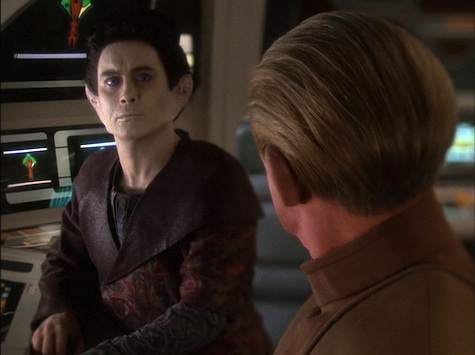
#6 explains that, from the moment of his activation, he’s felt that the Founders’ war on the Federation was wrong and misguided, and that they should try to live in peace with the solids. Meanwhile, #7 is concerned, as he can’t allow Odo to be killed—but Damar insists that, if Odo doesn’t turn #6 over, they must destroy the Rio Grande. Eventually, Weyoun comes around to Damar’s point of view, as the alternative—a Weyoun in Federation hands—is too terrible to contemplate.
O’Brien reports to Ops to discover that Sisko’s desk has gone missing—and O’Brien’s authorization code (which he gave to Nog) is on the order. Kira tells O’Brien that the desk better be back when Sisko returns in two days. Nog explains to an annoyed O’Brien that he just loaned the desk to Chief Lorenzo of Decos Prime. Lorenzo collects holophotos of himself sitting behind the desks of Starfleet captains (his collection includes DeSoto and Picard). In exchange, Lorenzo will get them an induction modulator, which Nog can trade to the Musashi for a phaser emitter, which the Sentinel needs—and they have the graviton stabilizer the Defiant needs. Cha cha cha.
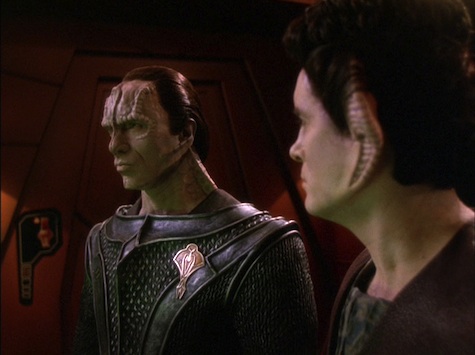
On the Rio Grande, #6 awakens from a nightmare, in which he was lost and being chased by either Jem’Hadar or Klingons. A Jem’Hadar ship catches up to the Rio Grande and fires on them. #6 tells Odo how to destroy the ship, and they live another day. In response, Damar and #7 prepare to send an entire battalion—and then the female changeling enters. Damar and #7 bullshit their way past the notion of Odo being fired upon. However, the female changeling’s skin looks parched and dried out. She fixes it when Damar points it out, and she orders the temperature lowered, but Damar is suspicious.
#6 tells Odo of the story of how the Vorta were created. Once they were simple apelike tree-dwellers, who took in a wounded changeling who was being chased by a mob of angry solids. In return, the changeling promised that the Vorta would be part of a great empire some day. Eventually, that changeling’s promise was fulfilled, and the Vorta made into the Founders’ right hands. He also reveals that the female changeling’s skin condition is (as Damar suspects) part of something bigger. The entire Great Link is suffering from a debilitating disease. Odo doesn’t appear to have it, which #6 sees as an opportunity for him to take over the Dominion and rule it with a kinder, more compassionate hand.
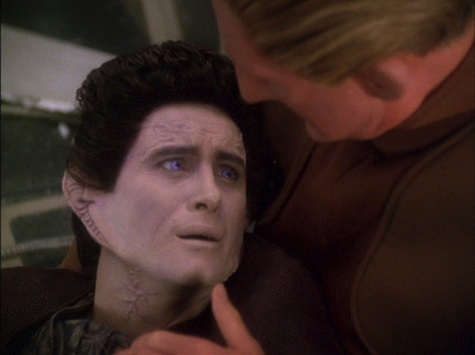
Four Jem’Hadar ships close in on the runabout. Odo tries to hide in a comet, specifically taking refuge in a crevasse in an ice fragment, with the power down. This works for a while, but eventually the Jem’Hadar just start randomly destroying ice fragments. Realizing the jig is up, Odo makes a run for it. But #6 realizes that they have no chance, and so he contacts #7 and Damar and activates his termination implant in front of them, proving he’s loyal to the Dominion. Against Damar’s better judgment, #7 calls off the Jem’Hadar ships. #6’s final wish is for Odo to give him his blessing, and so he dies happy.
To O’Brien’s surprise, Nog has left the station on a runabout—and to Martok’s surprise, his sixteen cases of bloodwine, sent to him by Sirella, have gone missing. Martok and Worf make it abundantly clear to O’Brien that he has one day to get the bloodwine back.

Sisko returns to the station and summons O’Brien to his office. Fearing the worst, O’Brien is relieved to enter an office that has an actual desk. Nog also was able to get the stabilizer and, as an added bonus, Nog replaced the missing bloodwine with a much better vintage, to Martok’s glee. So all’s well with the world.
Odo tells Kira about what happened. He can’t stop thinking about the look of contentment on #6’s face when he died, and he can’t stop worrying about his people. He also bleakly realizes that no matter which side wins the war, he’s going to lose.
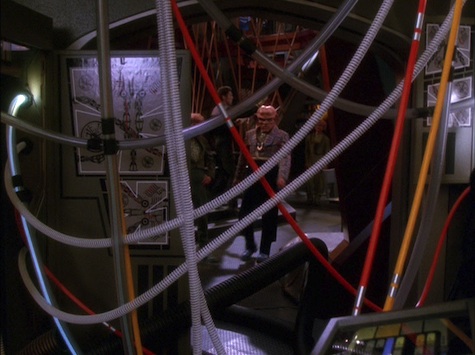
Can’t we just reverse the polarity? It’s never made clear what, exactly, O’Brien and Nog are doing on the Promenade that requires shutting it down and spreading conduits all over the deck, but it is amusing to look at…
Don’t ask my opinion next time: Kira reminds Odo that, even if he doesn’t see himself and his fellow changelings as gods, Weyoun does, and his faith is very real, just as her faith in the Prophets is real.
Preservation of mass and energy is for wimps: Odo spends the entire episode denying that he’s a god, and Weyoun #6 spends the entire episode insisting that he is (even crediting his notion to hide in an ice crevasse to be something only a god would think of). In the end, he embraces divinity for at least half a second in order to give #6 his dying wish.
Rules of Acquisition: We get the 168th Rule, “Whisper your way to success,” and also learn of the Great Material Continuum, the force that binds the universe together: all the worlds in the universe have too much of one thing and not enough of other things, and the Continuum is like a river that goes from “have” to “want” and back again.
Victory is life: The Jem’Hadar who are sent after the Rio Grande are instructed to fire on the runabout as soon as they see it, and to jam communications, which keeps them from finding out that there’s a Founder on board. Weyoun 7 and Damar also keep that knowledge from the female changeling. (Meanwhile, #6 actually refers to her as “the female changeling,” which sounds exactly as absurd as you think it does.)
For Cardassia! Weyoun 7 says that #5 was killed in a transporter accident, and he looks right at Damar when he discusses it, though Damar unconvincingly (or uncaringly?) insists there was no foul play involved.
Tough little ship: The Defiant’s gravity is off-kilter, which does not make Sisko happy.
No sex, please, we’re Starfleet: Kira’s reward for losing to Odo at springball is a massage as only a shape-changer can manage. Woo hoo!

Keep your ears open: “Don’t do anything I wouldn’t do.”
“Chief, I can’t operate under those kinds of restrictions.”
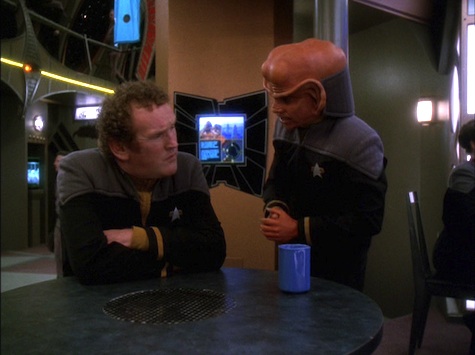
O’Brien and Nog discussing scrounging methods.
Welcome aboard: Jeffrey Combs does double duty as two different Weyouns, while the rest of the guest cast includes other recurring regulars Casey Biggs as Damar, Aron Eisenberg as Nog, Max Grodénchik as Rom, J.G. Hertzler as Martok, and Salome Jens as the female changeling.
Trivial matters: While Weyoun’s reappearance after being vaporized in “To the Death” established that Vorta are cloned and reused, as it were, this is the first time since “Ties of Blood and Water” that it has been a plot point, as we have both the sixth and seventh iterations of Weyoun. We also get the Vorta’s origin—or, at the very least, their creation myth.
This episode establishes that the Founders are suffering from a virus. This virus will continue to recur for the rest of the series, and play into the resolution of the war in the final episode “What You Leave Behind.”

Captain Robert DeSoto was first mentioned in “Encounter at Farpoint” as the CO of the Hood, under whom Riker had served as first officer before coming to the Enterprise, and an old friend of Picard’s. He’s referenced several times on TNG, and also seen in “Tin Man.”
The O’Brien-Nog B-story was inspired by Catch-22 by Joseph Heller, specifically the Milo Minderbinder character, as well as the sort of wheeling-dealing that was done by both Radar O’Reilly and Max Klinger on M*A*S*H.
It’s never made clear whether or not Russol is the informant Odo consulted in “Improbable Cause,” though Odo’s rendezvous appears to be in the same spot as the rendezvous in that episode.
Weyoun’s suggestion that Odo take command of the Dominion is something that sorta-kinda happens in the post-finale DS9 fiction, specifically Olympus Descending by David R. George III in Worlds of DS9 Volume 3.
The Sentinel is established in the Starfleet Corps of Engineers series as being the post Sonya Gomez (from TNG’s “Q Who”) served on as chief engineer during the Dominion War. The ship itself is seen, along with the Musashi, in War Stories by your humble rewatcher. The Sentinel is also seen in the games Armada, Invasion, and Starfleet Academy while the Musashi is seen in Star Trek Online.
Walk with the Prophets: “I don’t think the universe is ready for two Weyouns.” There’s one rather major glaring flaw in this episode: the Federation of the 24th century has replicators. Big ones, small ones—there are some things they can’t make (like whatever part it was that prompted the trip to Empok Nor in that station’s eponymous episode), but for the most part? Supply issues aren’t actually an issue.
Which is too bad, because it pretty much torpedoes the entire B-plot. Every single item Nog mentions in his little scrounge-fest is something that they should be able to replicate—including Sisko’s desk. O’Brien’s silly fake desk should never even happen, because he should be able to replicate an exact duplicate of Sisko’s desk.
Which is really too bad, because the B-plot is an absolute delight. Watching Nog put Ferengi instincts to the time-honored military traditions of scrounging is a total joy—once you shut your brain off and pretend that they don’t have replicators in the future. Le sigh. Still, lotsa fun.
And the A-plot is superb. In a wide field of amazing actors on this show, Jeffrey Combs stands out as a treasure. He gets to play two different Weyouns, and it’s to his credit that they’re very obviously different, yet just as obviously the same basic person. Seeing the two of him is a treat.
Combs is also at his best when he has someone to play off of. For a while it was Marc Alaimo’s Dukat, then Casey Biggs’s Damar, and every scene he’s had with Avery Brooks’s Sisko has been gold—and some of his best have been with Rene Auberjonois’s Odo, first seen back in “To the Death” and on great display here.
On top of all this, we get important bits of Dominion and Ferengi mythology (the Great Material Continuum is fantastic, just the perfect Ferengi notion), and we get some significant movement on the Dominion War for the first time since “Tears of the Prophets,” as we learn that the Founders are suffering a debilitating disease. This will be important…
Warp factor rating: 7
Keith R.A. DeCandido has a story called “Fish Out of Water” in the new Jonathan Maberry-edited anthology Out of Tune from JournalStone, which features Cassie Zukav. Other Cassie stories, which take place in Key West and feature scuba diving, Norse gods, rock music, folklore, and beer drinking (not necessarily in that order) can be found in the collection Ragnarok and Roll: Tales of Cassie Zukav, Weirdness Magnet from Plus One Press.

I am wondering, how many people took Weyoun 6 at face value? Does he truly want more compassion and peace, or did he realize that the Founders were dying, and, as a true opportunist, decided throw his lot in with Odo? That was my first thought, but I’m also wondering if it’s a bit too ‘outside the box’ even for a Vorta. Are the Vorta as self-effacing as the Jem’Hadar or can they break their loyalty for selfish reasons? Unless he managed to convince himself that Odo truly is the future of the Dominion and therefore he’s not being disloyal.
I thought some of the ideas of the Vorta were somewhat interesting, especially about the motives of ‘Gods’ for creating other creatures. Although as somebody who loves to eat, I feel quite sorry for them that their ‘Gods’ only saw fit to give them a taste for nuts and berries.
I loved the Great Material Continuum…especially becase I think it provides a little more nuance and depth to Ferengi culture/religion. It doesn’t necessarily have to be about being a greedy jerk and getting as much as you can, but could be about understanding all the little eddies of who has what and who needs what and making everybody happy. I also had the thought about the replicators, but I’m willing to overlook it.
I wonder, did Weyoun 6’s death inspire the final “By Grabthar’s hammer” scene in Galaxy Quest? This episode aired a year before the movie came out, so there was probably enough time to add it to the script.
The entirety of Weyoun 6’s life is sweet, touching, and earnest, a testament to Jeffrey Combs’s versatility, given how harsh Weyoun’s always been before. 6’s death is the most poignant moment in the episode for me.
As for the replicators, perhaps we can find an in-universe explanation. The desk is a bit hard to fathom, but for the parts, maybe there are rules about replicating them, or only certain types of replicators can fashion those parts, or you have to be a certain class of engineer to make the request. Grasping at straws, I know – and if there were such a reason, they should have told us – but there could still be something we’re just not thinking of.
I love a good chain of favors story. This one, despite the replication problem, works so very well, because we mostly see O’Brien watching things go out of control and wondering just who it is who’s going to hand him his ass. Sisko? Martok? There’s just no way he gets out of this unscathed (especially since the universe has it in for Miles O’Brien).
I don’t really see the replicator thing as an issue. There are various ways to explain that. Maybe these are large scale items that need to be built by industrial sized replicators, and those are too big to have on the station or on starships. As for Sisko’s desk, the replicators need a pattern to work from. Maybe O’Brien doesn’t have that pattern.
I’m not letting any of that worry me, because this was the first episode of the seventh season that I can say I truly, fully enjoyed from beginning to end. The B story was suitably amusing, not just seeing Nog put his Ferrengi-sense to work, but seeing O’Brien tearing his hear out wondering what the heck is going on.
And the A-plot, just magnificent. Jeffrey Combs totally sells the “true believer” in a way that is almost hearbreaking. Sometimes, over the series, the Vorta have been a bit one-dimensional, snarky and superior when with other races, simpering and submissive with the changelings. I think this is the episode where they became fully rounded as a species, you could see and understand their motivations, and in a way that is equally sad because you can kind of see the species they could have become if the changelings hadn’t meddled with their development.
A lovely episode. Worth more than a 7 for my money.
I’m gonna have to disagree with you on the B plot. Sure you can replicate things, but certain things just have significance existing and being used that you can’t replicate – even if it’s just in our head. Yeah, the chief could recreate the desk in a holodeck/suite, but it’s NOT the same desk that Sisko left his baseball on as a warning to Dukat, it’s not the same desk he stood across for the last 7 years. Also wasn’t there an out given (TNG Technical Manual?) that certain things couldn’t be replicated?
Agree with 6. Someone who has a sentimental attachment to a real desk is not going to want a replicated desk, and there is ample canon that replicated food is different from/inferior to real food. I suppose that all the other parts are technical things that similarly can’t be replicated–we never get a list of what can’t be replicated or why, but there do seem to be a fair number of advanced technical parts that can’t be replicated.
Actually, it’s rather silly that they have to defend the swap at all. Nog should be proud to tell Sisko he loaned out his desk in order to get the Defiant fixed early, and Sisko should have commended his ensign’s ingenuity.
@1: I took Weyoun 6 at face value, but for a bit of a different reason. Even if the Vorta faithfully serve “the founders”, what do they do when different founders disagree? I figured #6 for some reason decided to serve Odo / Odo’s “side”, whatever you want to call it.
Also regarding the replicators in the B plot, I’ve found a fair amount of lore falls apart when scrutinized (at least IMHO), so I give it the MST3K treatment.
I didn’t have a problem with the replicators, because I always assumed (like latinum) there was certain things they couldn’t duplicate well (perhaps the bloodwine) and they would have needed a detailed scan of Sisko’s actual desk to replicate it in detail down to the scratches (with also goes to the issue of ‘authenticity’).
There could also simply be an issue of complexity requiring more power/processing time that standard replicators can’t handle quickly (yes, I am stretching here).
I like this episode a lot the B-plot is a blast to watch because Nog gets to shine in a totally Ferengi way not just as an officer or ensign. It’s also fun to watch O’brien’s growing dread as the episode goes on. I didn’t think of the replicators when I watched this episode so I didn’t have to turn my brain off to enjoy it. I also found the Weyoun and Odo interactions interesting because Odo gets a glimpse into the faith of the Vorta. It’s not just the Founders are gods reaction the Jem’hedar and Vorta when they see Odo or other changlings. It’s also just a bit ominous that 7 is willing to kill Odo and 6 is the defective Weyoun.
Look, I enjoyed the episode, too — I did give it a 7 — but the rationalizations are silly. Yes, a replicated desk wouldn’t be the same as Sisko’s desk, but it’d be a lot better than the short, squat white thing that O’Brien says he needs to paint. Also some of the items Nog is scrounging for are things like phaser emitters that are ridiculously common items that I can’t believe they can’t be replicated. Finally, the U.S.S. Voyager was regularly building entire shuttlecraft with their on-ship replicators, and they were a stranded ship with no external resources, yet O’Brien has to wait three weeks?
It doesn’t track. It’s wholly inconsistent with every other 24th-century Star Trek story.
The episode in general and the B-plot in particular are enough fun that I’m willing to give the episode a high rating and consider it fun and a joy to watch anyhow, but it’s still, basically, wrong. :)
—Keith R.A. DeCandido
I don’t remember ever seeing replicators big enough to make Sisko’s desk on DS9. Probably has something to do with the Federation furniture movers’ union.
I don’t think the Female Changeling would be happy if she found out that Weyoun #7 had no problem with having Odo killed to get at Weyoun #6.
I can excuse the replicator question for Sisko’s desk, since it was the specific unique item that was wanted and because the pattern might not have been available; and for Martok’s bloodwine, since there’s presumably a difference between real and replicated foodstuffs (which makes some sense given that the aging of an alcoholic beverage is an ongoing chemical reaction over time). But that shouldn’t be the case for Starfleet equipment like the graviton stabilizer, induction modulator, and phaser emitter. By all rights, those should be standardized components available in any Starfleet industrial replicator’s database. And the “they contain substances that can’t be replicated” dodge doesn’t work that well, because if that’s the case, Starfleet should’ve long ago redesigned those components to rely on substances that can be replicated. Especially in the middle of a war, where supply issues are urgent, you’d think they’d want to emphasize ease of mass production over reliance on scarce materials.
It would’ve been better if the trades had been for items where only the original was valuable (like the desk, the bloodwine, works of art, autographed pictures, etc.), or if the trades had been for favors rather than material objects (although they already did that in “In the Cards”).
Come to think of it, this episode was probably an attempt to do “In the Cards” again, and like most of DS9’s attempts to recapture past glories, it isn’t as good as the original. Still, it had its moments, with some new worldbuilding for both the Ferengi and the Vorta.
I elaborated a bit on the Great Material Continuum in my sole work of DS9 fiction, “…Loved I Not Honor More” in the Prophecy and Change anthology — adding a “Law of Conservation of Property” in which wealth is neither created nor destroyed but merely transferred from one owner to another.
@2: Movies take a long time to make. If the episode aired a year before the movie was released, then it was well after the movie was written and probably after it was filmed. Besides, the trope is hardly original to Galaxy Quest and can probably be found in fiction going back thousands of years.
@13: The replicators we usually see are food replicators. We’ve heard mention of industrial replicators, which are no doubt considerably larger.
@12 krad, I love you man, but seriously, I dunno that Voyager can be used as an example of anything when it comes to the rest of Star Trek (or SF in general).
I really wanted to love Voyager, as my teenaged brain made up fan fictiony stories about a female captain (alien too, but a woman at the helm was good regardless), and the initial concept was great, but the show’s inconsistencies and issues made me drop it part way through (granted, real life changes, like joining the military out of high school, didn’t help…).
It’s been awhile since I’ve watched the series though; maybe when we get to that rewatch I’ll see it differently so many years later. I doubt it, though.
Replicators have always been established as being good but not perfect. Food is the biggest thing that often gets called out. Replicated food is missing subtlety. You can replicate ‘bloodwine’ but not an exact vintage.
So I have no trouble believing that specialized engenering parts have tolerances or fabrication issues that make the replicated versions not acceptable fur military use. Maybe civilian ships can get away with replicated parts?
If they had the pattern. However if someone has deleted the pattern from the local database, or if they never stored the pattern then they are stuck. Of course, it wouldn’t be Sisko’s desk either now, would it? When you live in a society where you can potentially replicate almost anything, then veractity and provenance suddenly become a lot more important then they were in a pre-scarcity economy, and they are pretty darn important to us already. It’s canon in Trek that the “real” thing is of more personal value than a replicated or replica thing. Not to mention that there would be a huge chunk of incriminating evidence floating out there in the wilds of space just waiting for Sisko to go to the wrong conference and someone to say “Oh, and I have your old desk…”. Always bury your evidence
and witnesses.@12
Industrial replicators are undoubtedly present, but they would be necessarily limited by available time and materials. From Memory Alpha:
So, replicators require a store of suitable raw materials, which helps to explain why there are freighters and Ferengi plying the space lanes.
On another front, O’Brien could requisition phaser emitters, and even get them fast-tracked, but Nog has a faster method, especially with the demands being placed on station resources during wartime. For example, we take computer time for granted in the present, but a limited number of industrial replicators would make the situation no different than allocating time on a mainframe computer or a supercomputer – which was still the dominant paradigm when this episode aired.
The inconsistency of this episode with Voyager’s replication of shuttle parts is not DS9’s failure. It is Voyager’s.
The great material continuum is basically a melding of the Coase Theorem and Comparative Advantage. If only the Federation had not evolved beyond such petty concerns, they might actually learn something from the Ferengi.
I hate to defend Voyager, it burns us, but you can square Voyager’s shuttle problem with a bit of handwaving. Voyager was a mission specific ship and would go through a greater or lesser amount of refit between each mission, this much is canon, so if Voayger was to be sent into an unstable area of space where small ships would be at an advantage (presumably Intrepid class was as small as Starfleet could go and maintain overwhelming firepower advantage) over larger starships, then you could handwave that they packed Voyager as full of shuttles, prefabricated and replacement parts for them as they could in case then needed to go old school dogfighting. That is the best I can manage.
Despite the obvious inconsistency with the B-plot, I did think it was nice seeing O’Brien when he’s in “mild comedic peril”, rather than the usual “actively tortured”. Plus the idea of Al Lorenzo sneaking into the ready room of the Enterprise always raises a chuckle.
@17: “So I have no trouble believing that specialized engenering parts have tolerances or fabrication issues that make the replicated versions not acceptable fur military use.”
But that sounds like a fundamental design flaw in the replicator technology itself, then, or else in the design of the components. By now, they’ve been using replicators for decades. They’ve had plenty of time to come up with ways to redesign either the components or the replicators so that this wouldn’t be a problem.
@23. hey the idea of a battle tank has been around for coming up on the century and we still haven’t overcome the design flaw of it needing internal combustion engines, or deflector fields, or inertial dampening devices… Just because you’ve had the time to overcome a design flaw does not necessarily mean you’re going to be able to do it. In that, this actually makes Trek a little more realistic. Can’t get the parts, or can’t get the time booked on the industrial replicator to get the parts, welcome to every day life. It sucks. Lots of things have design flaws that we cannot overcome, but we still use them.
Really a greatly entertaining episode. I was thinking it an 8, but I overlooked the replicator problem (especially with the desk of all things!). I guess I was just so busy enjoying Nog’s wheeling and dealing, so I didn’t even consider why they didn’t just replicate up a desk, among other things. When they say they are short of things, I guess I just take for granted that they are (or rather should/would be).
On that notion though, unlike on VOY where replication was minimal because of resource scarcity, are we sure that DS9 has plenty of whatever you need to replicate up desks or ship/station parts? It is wartime. Could they be short because of that or on some restriction? I don’t explicitly recall that being mentioned, but it has been several months since I watched this season.
Addendum to my earlier comment: I guess VOY did more replicating than I recalled. I do seem to recall rationing of replicator use, presumably so they COULD put it toward shuttle parts rather than more frivilous stuff (say replicating a violin or a deck of cards). Still, for their frequent mention to being low on resources, they sure managed to make a lot of stuff.
I also feel that some of the starship parts should be able to be replicated. But I think one explanation they could give is that whatever the reason is that they need to have conduits all over the promenade is also affecting the industrial replicators at the moment (though food replicators are fine). Would’ve been nice to get some dialogue for that though.
As much fun as the B plot was, even if they had a good explanation, it is sort of like “In the Cards,” and it reminded me of the stembolts episode as well. So maybe it should lose a point for having been done before….then again, maybe that’s part of what makes it great, because we know it’s a total Nog thing and now O’Brien has to deal with it for the first time.
Anyway, I did love Nog’s explanation of the Great Material Continuum as though he were Obi-Wan explaining the Force.
Oh, and I forgot to say…what exactly do they mean by phaser emitter? On a starship, do they mean one of the little nodes that make up the larger phaser strip? I could imagine that one of those could still be quite large, so maybe it just wouldn’t fit in their starship replicator (or the cargo bay with their industrial replicator isn’t attached to the cargo loading doors [or they are not big enough and there’s not a big enough industrial turbolift to the shuttlebay]). And maybe DS9 can’t directly make one for them because of the Cardassian replicator (they’ve used the Cardassian technology as excuses for things before) or they have a similar problem with not being able to replicate something that big or getting it outside once they did (Terok Nor was never intended as a parts supply base, to my knowledge).
@26: Maybe Neelix’s cooking saved more on replicator usage than they originally thought, so they could make that other stuff. : )
@26: Voyager‘s references to replicator rationing pretty much ceased after the second season. Presumably they repaired or adapted their power systems enough that they no longer needed to ration energy.
@28: Yes, a phaser strip is a linear array of emitters. And while a complete emitter may be too big to fit in an industrial replicator, that doesn’t mean its individual components wouldn’t be. It would only make sense in a replicator-based society that large components would be designed to be made out of replicable pieces.
I know krad is the official rewatcher but props to C Bennett. Co-rewatch on st:voy?
Agree with KRAD, this is an episode with fatal flaws that are easy enough to overlook in enjoyment of its charms.
@1: Vorta are made to be diplomats, politicians, etc., so it makes sense that they aren’t intended to be as “self-effacing” as the Jem’Hadar. I’m confident in stating that they CAN betray the Dominion (in minor ways) out of selfish motives, because we have one superb example of just that: Keevan selling out his Jem’Hadar platoon and turning himself over to the Federation as a prisoner to be combed for war information, in order to save his own life in Rocks and Shoals.
That said, something about Weyoun 6’s demeanor has always made me believe that his motives were mostly sincere. I mean, I don’t doubt that seeing the other Founders terminally ill was a factor in his decision to revere Odo above all, but Odo is a very small part of the Dominion (and some other Vorta surely know about the Founders’ illness without making the same decision), so I doubt defecting to Odo personally is something that would have occurred to 6 without an underlying distaste for the war they were waging.
@8: I agree, it was silly for Nog and O’Brien to think that they should be hiding their actions from Sisko when they were creatively managing to fulfill a difficult order from Sisko. I’d like to see Sisko reveling in the fact that he has facilitated the introduction of Ferengi strengths into Starfleet.
As for the desk, it’s pretty clear O’Brien should have been able to whip up something pretty good with the replicator technology on hand — is he a freaking engineer, or not?!
Finally, I wish we’d gotten more on Weyoun 5’s “no foul play” death. Weyoun’s deaths are always so satisfying (except for 6’s, which was satisfyingly tragic). Is this the real beginning of Damar’s redemptive arc?
@15 CLB:
I’m going to have to read that story to find out how you worked this in, since such a “law” is antithetical to a capitalist economy. In the ideal form, free trade most certainly creates wealth. Whether or not ideal free trade can actually happen is an entirely different matter.
And whenever Voyager detractors chime in, I have to mention that I like Voyager. I think DS9 and VOY have different but similar amounts of problematic issues. But as for my liking of them, I kinda like VOY better because it was more fun. DS9 gets so grim. I seem to recall that KRAD has said he won’t do a VOY re-watch. If so, I’d love a CLB VOY re-watch.
KRAD, if you don’t feel like doing the Voyager rewatch, just send me the DVDs. I’ll do it. (Unemployment has at least THAT perk: spare time.)
@32: Granted, it doesn’t fit our style of capitalism, but it seems in character for the Ferengi to see acquisition as a zero-sum game where one person’s gain is another’s loss. And honestly, when I look at the growing inequality between the one percent and everyone else, I don’t see wealth being created, just hoarded at the majority’s expense.
True, new resources can be obtained from the environment, like mining precious metals or growing valuable crops, but that’s still taking something from somewhere in order to gain something. “Creating wealth” is still about exploiting something that already exists in some form.
@31: Exactly that, McKay B – Weyoun 6’s demeanor is straight-up honesty. I don’t read him at all as manipulating Odo, just being utterly worshipful of his god. And again, it’s 100% the acting for me. Like Keith said, 6 and 7 are very obviously different – and yet cut from the same cloth. I think if 6 were being deceptive, we’d see it in the performance.
Folks, this is a space station on the edge of a battle zone that has already been captured once. The question is not whether the replicators can make war material, but whether you want that capability in a position where the enemy could use it to repair and re-purpose captured federation ships. It is possible that the replicators have hard wired bans against making classified war material placed in them based on where they are being sent.
For the curious , something like half of the Afrika Corps transport support was made up of captured allied trucks and tankers.
I think the issue here was not so much that O’Brien and friends couldn’t replicate the parts, it was that they couldn’t replicate the parts in the time provided, or that in each of these cases Nog could get them the parts faster than they could get them from the nearest industrial replicator (this doesn’t so much work for O’Brien and the captain’s desk, though maybe at this point the guy figured he was so under water what’s the point, I think I’ve had days like that).
About the industrial replicators, though, I seem to remember an episode where they shipped a dozen of them or so to Cardassia and this was talked about as a major boon to the planetary economy. If this is a case, then there may not actually be all that many in an area of the Federation that was only retaken from the enemy a little over a year ago.
Finally, it seems to me that a ship’s phaser emitter is exactly the type of part where you would be willing to sacrifice ease of production for increased effectiveness. Each ship can only have so many of them and so the extra quantity only gets you so far. As a result, you want to make sure that each one gives you the absolute most you can get. For this you are willing to install something that can’t necessarily be easily mass produced in an effort to throw a few more gigajoules of power at the enemy when you need it.
This is kind of the difference between a laser-guided bomb and a conventional bomb. The conventional munition is much easier to produce, but so long as you have enough of them on hand the laser-guided munitions will be much more effective. Another analogue might be an AK-47 vs. an M-16.
(Now, I’ll go back to lurking)
Edit: It occurs to me that a far better example is the 18″ guns on the USS Iowa. There are probably loads of ways to produce those guns more quickly/cheaply, but the Iowa only needs twelve of them and this isn’t the sort of part you want crapping out in the middle of a fight. Therefore, when you build the ship you produce only what you need plus a few spares and then accept that if for any reason you need more it will take several months to make them.
Random aside @37 first. The Iowas had16″ guns, not 18 and had 9 of them, not 12. Also they were relatively common as the 4 Iowa class all had them. Plus the 4 South Dakotas and 2 North Carolina classes had 9 each of an earlier version of the weapon.
I think the key to the replicator might be @19. If the limitation of the replicator is that it cannot take any piece of matter and make it any other piece of matter. There could be some substances that due to either physical or chemical properties cannot be replicated. You might be able to replicate the case and battery of the phaser but perhaps the emitter is made up of some really rare material. Likewise you can’t go to the nearest replicator and ask it for a dilithium crystal- you have to mine those.
Besides, if everything can just be *poof* replicated it removes a lot of the tension from the series. The loss of 40 ships doesn’t matter if the exact same ship can be instantly materialized. The writing may have gotten lazy at some point and not paid attention to how replicators and transporters work, but that doesn’t make them miracle machines
@37 Apologies on the numbers. I was writing while trying to put a six-week old to bed and so neglected to do my homework. I think, though, that the point still stands, and is actually basically the same as yours regarding the dilithium crystals and related to @19.
@34, I’d certaily agree that the 1% is increasingly hoarding wealth at the expense of the 99% and that it is to the detriment of us all–including the hoarders. But at the same time, wealth is about the perceived value of goods and services. When I buy something it’s because I value the “thing” more than the “money” it takes to buy it. Nog’s whole bartering chain is dependent on a non-zero-sum game of beings who value some other thing more than the thing they have, so they make a trade and all parties come out ahead. I think that in this episode, Nog is being portrayed as being the quintessential wheeling and dealing Ferengi to get the job done. As such I think at its core, Ferengi society realizes that commerce is not zero-sum. When you have a group of individuals who have items/cash/latinum that they’re willing to trade, and they’re able to freely trade them for items they value more, the overall value at the end of those transactions is greater than the overall value that existed at the beginning. That’s what I mean when I say that free trade creates wealth. It doesn’t require the exploitation of additional raw materials or labor, it can occur in a small, entirely enclosed system of people (human or otherwise) and already existing things.
What we’re missing in the Star Trek universe are the great debates between the Ferengi Keynes and the Ferengi Hayek. Instead, we get superficial portrayals of the Ferengi as ruthless misogynist capitalists. They remain caricatures.
ChristopherLBennett,
The idea that wealth is a zero sum game and is ties to raw materials is called “mercantilism” and is widely discredited by all major economists from Smith to Krugman. Trade absolutely creates wealth, even in a post-scarcity economy.
@41: That’s an excellent explanation on the workings of trade. It doesn’t mean that a “Law of Conservation of Property” cannot exist for Ferengi, just that we shouldn’t confuse property (i.e. the physical thing in question) with wealth (the utility derived from the thing). Trading zero-sum property to increase overall wealth is after all pretty fundamental to all market exchanges. Such a law might also explain the general disregard the Ferengi seem to have for productive occupations; they value trade over labour.
With hindsight of knowing what’s to come, I love the
foreshadowing in the scene when Damar convinces Weyoun 7 to destroy the Rio Grande.
Weyoun 7’s so stressed out that he’s not really processing Damar’s words about the sacrifices Cardassia’s made for the war effort. And even if Weyoun wasn’t, he’d still brush them off instead of seeing the warning signs they are.
It’s nice groundwork for the continued deterioration of the Dominion-Cardassian relationship and how Damar’s getting more and more frustrated with his ‘allies’.
Aren’t you forgetting something? The loss of 40 ships means the death of thousands of people. That is the irreplaceable loss. That is the source of the tension. The ships are irrelevant.
And of course replicators still need raw materials and energy. Those are available in nigh-limitless supply for any starfaring civilization, since every star is a gigantic source of free fusion energy and there are kajillions of asteroids just waiting to be mined; but it still takes time and effort to gather and use them, and if your replicators are overworked, they could run out of materials for a time. And of course you could replicate the individual parts for a starship, but you’d still need many person-hours of labor to assemble and test them, as we saw on Voyager when they built the Delta Flyer. So it’s hardly “poof.” Just because technology is more advanced than what we have today, that doesn’t automatically make it pure magic. It just has different limitations.
@42: “Mercantilism” sounds just like something the Ferengi would embrace. Ferengi capitalism has always been portrayed as a more rapacious and exploitative system than the theoretical ideals you guys are discussing.
Anyway, in the story, the Law of Conservation of Property said that wealth is only transferred from one owner or source to another. Perhaps what human capitalists see as the “creation” of wealth is seen by the Ferengi as the harnessing of potential wealth that already exists within the Continuum — analogously to converting potential energy into usable energy. If you drop a rock off a cliff, it may seem that it’s gaining kinetic energy out of nowhere as it accelerates, but the gravitational potential energy was already there due to its altitude, just unrealized. The same with a fire or explosion extracting chemical potential energy that already existed within the materials, or a nuclear reaction extracting potential energy from the nuclear bonds of the reactants. What appears to be the creation of new energy is simply the conversion of unseen potential energy into a usable form.
To the Ferengi, wealth is a force of nature, a law of physics and metaphysics. It’s already there throughout the universe, just waiting for them to exploit it. “Opportunity” may be the equivalent of potential energy in this analogy. We see a business opportunity as a way to “create” new wealth, but in Ferengi metaphysics it could be seen as potential wealth that already exists and just needs to be converted into a usable form.
@45: I’ll buy that ;)
@47
The logical consequence of a Law of Conservation of Property is that wealth cannot be created or destroyed. If Bajor’s sun had gone supernova and destroyed the planet and DS9,and everything else in the system, that would have destroyed no wealth or property.
There could be n0 such thing as a destructive event, because nothing of value could ever be destroyed.
How could the Ferengi be stupid enough to believe that?
A Law of Conservation of Property should be the sort of thing that thieves believe in, to justify themselves in thinking that theft is no worse than trade.
@47: Umm, we’re talking about the Ferengi here. They do think theft is no worse than trade, as long as they’re not the ones being stolen from.
Besides, a disaster could well create new opportunities. “War is good for business,” so disasters can be good for business too, e.g. for construction firms seeking contracts to rebuild in their wake, or for people seeking to exploit the desperate refugees or to misappropriate relief funds and goods. Or you could use the supernova as an energy source and profit that way. The wealth is not destroyed, just converted into a different kind of opportunity. “The wise man can hear profit in the wind” — it’s just a question of being able to spot opportunities where others would see only futility and loss.
And then, of course, there’s always Rule 239: “Never be afraid to mislabel a product.” Maybe that applies to the conservation law itself.
Note, Catch-22 was written by Joseph Heller, not Richard Heller. But I’ll let it go, Keith, because everybody has a share.
folkbum: Oh, geez, can’t believe I did that. *sigh* Thank you, edit function….
—Keith R.A. DeCandido, dumbass
16 years and I never realized the Nog story could have been settled by the replicator.
The way I see it, that’s an inherent problem in world building. You set up the concept of replicators. You have to establish what they can or can’t do, otherwise you run into this kind of problem. The better you establish the details, the better it’ll be for people to create believable stories.
Personally, I don’t believe the replicator can do EVERYTHING. I think there are limitations. And Voyager really pushed it with the shuttlecraft per week.
Nevertheless, even if the replicator can supposedly generate Nog’s parts, this still doesn’t hamper my absolute enjoyment of this particular story. If anything, this is my favorite Thompson/Weddle script. Both stories work. The Nog story is a very creative way to show how Starfleet can benefit from having a Ferengi onboard.
And the Odo story is simply tragic. This is one that took me by surprise, back when it aired. I never expected Weyoun 6 to commit suicide. It makes perfect sense, otherwise Odo would never have gotten away. And it gives him a taste of being a god. Kudos to both René and Jeffrey for pulling it off.
Indirectly, this episode sets up Damar as a potential ally for the good guys. Since it implies he may have been behind Weyoun 5’s death, it gives Damar a much needed boost of credibility, since now we know he can take action against the Dominion for his own people if needed. This is the first step. Now, he needs to put the bottle of Kanar down so he can become the freedom fighter Cardassia needs.
This was a well planned arc for the series, as was the fate of Cardassia Prime.
Found this scene between Nog and O’Brien from the episode.
https://www.youtube.com/watch?v=N8hcHXwqPEo
@51: I don’t think Voyager “pushed it” at all with the replicator’s capabilities. I think the rest of 24th-century Trek downplayed them too much. I mean, if you have transporters, replicators are easy. If you can record the exact subatomic pattern of an object, disassemble it, transmit it, and reassemble it with the exact same pattern, then you should be able to store that pattern and assemble it out of a different set of particles. The fundamental technology is exactly the same. Replicators are transporters — they’re just transporters that are fed stored data rather than live data.
So anything that can be transported can also be replicated. There’s no reason it shouldn’t be. Sure, for dramatic reasons, Trek has fudged things so that living beings can be beamed but not replicated, but that limitation doesn’t apply to inanimate objects. We’ve seen Voyager beam entire shuttles into its shuttlebay. If you accept that it can do that, then replicating all the components of a shuttle must be acceptable too. It’s just a matter of having enough raw material to build the parts from.
@53 Don’t forget the Romulan two-man attack fighter the Enterprise beamed up in Nemesis, with Picard and Data aboard.
Also, I’m so glad I didn’t watch all of Voyager yet. I like to know when or if something I’m watching is about to get stupid on me. Not sure if I can handle all of the regenerating shuttles.
@54: Again, I’ve never understood why people find the shuttle replacement so implausible. It’s a logical consequence of the existence of replicators that manufacturing becomes simple, and our present-day assumptions about the difficulty of making replacement parts would pretty much cease to apply. The only limitations are energy and raw materials, and Voyager‘s energy and supply shortages seemed to end by the third season. And no shuttles were lost in season 1 and no more than three in season 2.
It would’ve been better if we’d SEEN the replication and re-construction in proress or even throw-away lines about the toll it was taking on the ship’s resources.
Hell, this is why I loved “Extreme Risk”, the justification for a more advanced shuttle, and the construction-in-progress.
@56: Granted — and I’ve always felt that “Extreme Risk” was a belated effort to address that very issue. But it seems that most people just don’t think through the ramifications of replicators and don’t realize that they could be used for more than food. It helps to be shown it happening, but it’s not that hard to deduce if you think about the ramifications of the technology. Replicators are to transporters as DVRs are to live TV. If it can be beamed, it can be replicated — that shouldn’t be hard to figure out. So it’s very, very odd to me that out of all the improbable and ill-considered things about Voyager, it’s the shuttle replacement issue that so many people can’t get past.
Honestly, I have a harder time believing that shuttles could be beamed up than believing that they could be replicated. Presumably, the denser and stronger a material is, the more energy it would take to break down the bonds between its particles. So something durable and armored like a spacecraft should be harder to beam up than something like a humanoid body. Sure, it would take a lot of energy to replicate such materials too, but presumably you’d have time to produce them slowly, gradually build up the particle bonds until it was done (and indeed, by all rights, replication should allow revolutionary new types of materials engineered on the atomic level). Beaming a whole shuttle up in five seconds, on the other hand, is much more implausible. It shouldn’t be that easy.
Not to mention that if transporters are powerful enough to disintegrate any spaceship components almost instantaneously, then that makes them a superweapon more potent than phasers, so why not use them instead of phasers? Sure, they can’t get through shields, but neither can phasers. It would make more sense for them not to be used as weapons if there were limitations on what they could beam, e.g. people but not ships. (Although in that case there’d be no reason the technology couldn’t be the basis of an anti-personnel disintegrator ray.)
@48 – that would be the Broken Windows Fallacy (or the Parable of the Broken Window). Rebuilding after a disaster basically shifts capital that had previously would have been utilized elsewhere, to trying to just get back to where it was previously. That’s a net loss.
Let’s just say that most writers are not econ majors and leave it at that.
@58: Don’t blame authors for the mistakes made by their characters. Ferengi are greedy and amoral. Why is it so hard to believe that their ideas about economics are based more on providing excuses for their cutthroat, piratical methods than on more objective standards? Ferengi social values, their gender values, have been consistently shown as screwed-up and in serious need of reform, so why should their economic theories be any less dysfunctional?
Let’s just say that most writers are not econ majors and leave it at that.
@58: Forgive me if I strongly call BS on that sentence. Do I have to be an econ major to write a Ferengi story?
If a writer doesn’t have an economics degree, does that mean he/she can’t write a story about the oil crisis? I thought it was Stephen Gaghan who wrote Syriana. And Aaron Sorkin, a playwright with no political degree, ran The West Wing.
@48
Conservation laws have meaning only in a closed system. If I destroy everything valuable in such a system, it has certainly suffered a net loss of property. So a Law of Conservation of Property can not hold, even among Ferengi.
And if Ferengi did believe that, and knew that other Ferengi believed that, they would believe that another Ferengi would agree to a deal with you, only if that deal was to your own disadvantage. No Ferengi would ever be able to deal with another Ferengi! They would be like the devils of The Screwtape Letters, convinced that in any relationship, one person must be being exploited by the other.
Gene Roddenberry and Herb Wright might well have thought like that – they worked in Hollywood – but a society of merchants and traders cannot work like that. They would not be able to trade with each other if they did.
@62: But by your argument, conservation laws couldn’t work in physics either, because the universe is full of open systems. Many physical laws are meant to apply to particular, specialized conditions, and when a broader set of conditions are taken into account, the laws have to be added to and adjusted. If that’s true of physics, why can’t it be true of economics? The conservation law could work in exactly the same way — applying as relevant to specific cases, and interacting with other laws to deal with more complex situations. You don’t have to reject a law altogether just because its application is non-universal. That’s like saying Special Relativity “can not hold” because of General Relativity. Of course it can hold — it’s just a simplified case of the more universal set of rules.
In the story, Quark didn’t claim that the law applied in every situation throughout the universe; he was using it to point out the paradox in a specific situation, namely, that a person was evidently destroying his own wealth for no apparent gain. And he wasn’t so much saying that wealth couldn’t be destroyed as that it made no economic sense for someone to destroy their wealth. (Which led him to conclude that there must indeed be some hidden profit motive behind it, and indeed there was.) After all, even though I was having fun with the conceit of Ferengi treating their economic laws as if they were (meta)physical laws, economics is still a science of behaviors and choices rather than inviolate natural laws. Its rules are therefore meant to codify ideals, principles that should be followed, rather than cosmic absolutes.
And the energy etc of these systems need not be conserved. But you can isolate a system and if you do, the energy of the system will be conserved during the period of its isolation. Applying conservation laws is mostly a matter of finding a system which will not interact with the rest of the universe significantly during the critical period.
But the property value of a system certainly need not be conserved while it is isolated. In particular, it can be destroyed relatively quickly. So property is not a conserved quality, in the manner of energy or electric charge.
*sigh* Again, just because I had a character in a story express a belief, that doesn’t mean I intended it to be a valid or functional belief. It’s Ferengi economics, which is based largely on the Rules of Acquisition, and those are a total hodgepodge of random bromides and vague generalities. And to a large extent, it’s more a set of articles of faith and superstition than a hardcore scientific model. I mean, these are people who believe in the Divine Treasury and the Blessed Exchequer, and they actually pay bribes to idols of the Exchequer in the belief that it will improve their economic fortunes. That doesn’t strike me as a particularly rational or coherent economic theory.
I had Quark talk about the “Law of Conservation of Property” because I thought it was funny — because of the incongruity of expressing one of the Ferengi’s articles of faith in terms that sounded like physics. I’ve been trying to defend it in those terms because that’s the way my mind works, but ultimately it’s not meant to be taken all that literally. It was a Ferengi story, after all, so it wasn’t written in a serious vein. You guys are overanalyzing a joke.
And it’s fiction, anyway…
On a side note, this episode has my favorite Martok quote from the series:
“Where are my cases of bloodwine?!”
It’s the way Hertzler delivers it which cracks me up.
Or as SF Debris put it, “There’s nothing more dangerous than a sober Klingon”.
@65 Fair enough. But its a joke that many people believe to be true. In particular the Communists and Nazis both believed that if they destroyed the bad capitalists and ethnic minorities, and perhaps their property, everyone else would suddenly be better off.
There is a sense in which perhaps one hundred and fifty million people were killed in the twentieth century, because someone believed in the Law of Conservation of Property. Makes you think.
@68: Godwin’s Law aside, did you just equate the Ferengis to Marxists?
Okay, it did make me laugh a little to see CLB accuse somebody of overanalyzing something :)
But, I can see what he is saying and the joke he is trying to make, as I also find it funny that the Ferengi have ‘laws’ of economics, and in fact, even that we do, because it seems to me (a non-economist) that all of economics is really kind of made up. Value, wealth, etc aren’t inherent, objective properties. It’s mostly subjective (aside perhaps from there being an inherent value to things biologically required to survive).
I know that this doesn’t mean there can’t be rules and principles derived from general study of human behavior to determine which philosophies will result in what outcomes.
Also, in a way, I think your Nazi/Marxist example kind of proves CLB’s point – my impression is not that he believes in the Law of Conservation of Property, but that he wrote that the Ferengi did. And as you point out, other groups have too. So it’s not that far fetched, even if it’s a dysfunctional theory that did not result in a healthy society (and one could also argue that Ferengi society is pretty dysfunctional too, although in different ways). Not to mention your Screwtape devil analogy does sound pretty close to the way Ferengi view relationships at any rate ;)
Actually, I think the Material Continuum is probably the ‘healthiest’ belief I’ve seen, as it seems to allow for an interpretation/philoosphy centered around making sure everybody gets what they want.
I really do hate to squelch discussion – forgive me, Keith and Stubby – but could we leave Nazis out of it, please? Bringing their genocide into a conversation about Ferengi economics is straight-up Godwin and has no place here; the Ferengi have never been genocidal. A name-drop of ethnic cleansing makes no sense in this thread, let’s stick to economic policies like Marxism and Communism.
@68: What are you even talking about at this point? The “Law” is the premise that property cannot be created or destroyed. So your post is a total non sequitur, as well as profoundly inappropriate. I don’t understand where this hostility is coming from.
Moderator stepping in here: let’s steer the comments back on track, and avoid digressions into sensitive areas of discussion. Please avoid taking an aggressive tone towards other commenters and keep the conversation on-topic and respectful, in accordance with our moderation policy. Thank you!
@74: Thank you.
Comment #76 unpublished by moderator. As Katharine already asked in #74, please stay on topic and avoid digressions into sensitive areas of discussion.
Replicators can only reproduce things on a molecular level and not a quantum level. This is a basic Star Trek rule. Hence, they can reproduce generic bloodwine, but not “aged” bloodwine. They can reproduce “a desk” but not “Sisko’s desk.” Yes, DS9 had an industrial replicator, but again, the complexity of the part may have prevented its replication. For example, Data cannot be replicated.
@78: I can agree with you on bloodwine, but I beg to differ on the desk. It may not have the same scratches and dings as Sisko’s original, but it can be of the same design. We can do this today with 3-D printers, can’t we? So I still think the point stands that something very, very close could have been made.
@78: The whole molecular/quantum resolution thing is only meant to explain why replicators can’t produce living beings. A desk isn’t a living being. There’s no reason it couldn’t be replicated down to every detail on a microscopic, molecular scale, far finer than any human’s ability to discern a difference.
well, I will never accuse this group of not thoroughly dissecting an episode.
I kinda file this episode under “trying to cram as much world building into the last season as possible” category. At least the A plot. Having two defective Vorta, one defecting to Odo and the second willing to kill Odo, came across as fairly heavy handed. I didn’t mind much, though. The origins of the Vorta…well, that just struck me as tacked on. What really saved the whole episode for me was just the fact that we had 2x the amount of Jeffrey Combs. He is just a blast to watch. It was him, on ENT, that got me back into Star Trek. For that, I owe him a huge debt of gratitude.
The B plot was fun and I didn’t take it for anymore than it was meant to be. Nog really brought a new level of complexity to the Ferengi culture.
@81/doompaul:
Just a wee bit… :D
Sorry, krad, but I have to chime in with the others about the replicator problem being a non-issue. This is not simply because of the easy rationalizations others have pointed out (namely: quantum specificity, scarcity of the material substrate, and lack of time), but moreover because with Trek, filling in the blanks in logic where hardware is concerned to make the story work is never an issue for me. E.g. maybe the induction modulator and the phaser emitter in question are special parts of their kinds, experimental parts that will take longer to replicate or require some unobtainium to make, who knows?
The whole Trek universe is built on magical hardware and thrives on the vagaries of the applications of that hardware. Yes, the writers should always work as hard as they can to minimize the inconsistencies and gaps in logic (after all, even Voyager is still millions of parsecs away from being as bad as Star Wars, thank the Prophets), but given that the transporter technology that drives replicators is itself driven by something called a “Heisenberg Compensator,” which is essentially an Anti-logic Machine, the benefit of the doubt can go a long way for me to make a good story work. And the B-story was a good story.
Unfortunately, the A-story was ruined for me due to its having two fatal gaps in logic of the kind that I can’t forgive: convenient character stupidity. First, knowing that there was a high likelihood of being obliterated by Dominion ships before reaching Federation space, which Odo explicitly emphasizes several times, why wasn’t Odo pumping Weyoun 6 for as much intel as he could and transmitting it back to DS9 via subspace– instead of letting W6 take a little nap and chatting him up about food textures? (Even if their transmissions were then jammed, Odo could still have recorded the intel and try to launch it out in a probe or something before being annihilated.) Because of an incredible lapse in judgement to make the plot work, that’s why.
Second, why does it take the Jem’Hadar firing on the runabout for W6 to realize that the Jem’Hadar wouldn’t attack them if they knew they might kill Odo? He should have pointed this out to Odo in the rendezvous cave as soon as Odo agreed to the defection plan, so that they could both proceed to try their darnedest from then on to make the Dominion ships aware of the score. Also, now that Odo knows the Jem’Hadar won’t fire on a ship if they know he’s on board, shouldn’t the Federation make him their new mascot and put him on any ship they don’t want destroyed?
On another note: I continue to be totally creeped and weirded out by the Kira-Odo romance, since we were introduced to them as having a father-daughter relationship and since Kira herself made it clear over the course of several episodes that she was not interested– only for that lack of interest to be flipped because the script said so. However, this episode contains evidence for the theory I keep reminding myself of to make the pairing bearable, which is that Kira must have a little pervy Intendant deep down in her that just can’t get enough of what a shapeshifter can do in bed, what with the tentacles and the smooshy hands …
@83/ebyronnelson: Actually the Heisenberg compensator idea was more plausible than even its creators thought. At the time they came up with it, it was just a handwave to get around the Uncertainty Principle. But later work on quantum teleportation came up with an actual way around it, by quantum-entangling the object to be teleported with a reference object that would be entangled in turn with the matter supply at the receiver. By measuring the difference in positions and momentums between the teleported object and the reference object, you can recreate them precisely without actually needing to measure them both. Which is, essentially, Heisenberg compensation.
This is why there’s a difference between informed handwaves and pure fantasy. In the former, you know and acknowledge the physical laws that create an obstacle to what you’re depicting, and suggest that some future science may find a solution to that obstacle, even if you leave it as a black box. In those cases, it’s not uncommon for that prediction to come true, for future science to find a solution after all. So acknowledging the known physics and extrapolating beyond them is still much less fanciful than just ignoring physics altogether and treating technology essentially as magic.
(And just to nitpick, I don’t think replicators require Heisenberg compensators, because they don’t use quantum-level resolution, which is why they can’t replicate living beings. There’s enough uncertainty in the positions and momenta of the particles they assemble that they couldn’t perfectly recreate the entire physical and neurochemical state of a living being sufficiently to retain its life and consciousness.)
@84/ChristopherLBennett: I agree with you about informed handwaves. The groundbreaking efforts to use real science and scientific consultants to give the fictional tech both consistency and plausibility, from TOS on, is a major factor for me in making the Trek universe (prime) great. Still, as you note with the Heisenberg Compensator notion, usually the order of things is that 1. the writers want something to happen, plot-wise, 2. they stick in a black box whatsit that allows that thing to happen, and 3. they then fill out in more detail, either in further drafts of the script or in tie-in manuals etc., the science of the whatsit and how it might be realized as actual future tech. Sometimes they get especially lucky further down the road. This kind of retroactive-scientific-continuity process allows for the kind of fluid benefit of the doubt with hardware I was talking about (within reason and within the limits the show has already set for itself, more or less), I think.
The entanglement experiments you talk about sound cool! … Although, I’m pretty sure real world quantum teleportation is teleportation in name only, that is, is unrelated to science fiction teleportation in that it only involves the movement of information and not the movement of matter? (Yes, I’m aware that talk of characters’ “signatures” being caught in “pattern buffers” and stored as data would seem to indicate that Trek teleportation also works by the movement of information alone, but I remain doggedly resistant to that interpretation because that would mean the transporter beam actually kills the person being transported at the beam out point and makes a copy of that person at the beam in point, which is horrific! Instead, I’d like to think that the beam sucks up a person’s actual particles and reassembles those same particles in the same positions at the person’s destination.)
Anyway, as for replicators, I honestly don’t see how replicating living versus nonliving things (including, obviously, organic food), or unique versus non-unique objects would require significantly less Heisenberg compensation. If the show says that it does, okay. But I mean, it would still require transporting and positioning trillions of atoms perfectly to avoid creating radioactive goop.
@85/ebyronnelson: Yes, quantum teleportation is the transmission of information, but as far as quantum physics is concerned, the information that defines a thing is the thing.
A transporter does transmit the actual original particles of a person and reassembles them at the destination according to the original pattern, which is how it’s able to beam people and things to remote locations with no transporter station. However, this really doesn’t have any bearing on whether the original person survives, because what defines you as an individual is the pattern of quantum states of your particles, not the individual particles themselves, which are just interchangeable building blocks. After all, your cells keep taking in nourishment and expelling waste, so the actual particles that make them up largely change over time anyway. It’s the way those particles are organized that defines who and what you are.
As for the question of whether you retain continuity of self when you go through a quantum teleporter, I’ve come to the conclusion that you would, for reasons that I explain in this blog post. Although there are practical hurdles that I covered in a followup post.
The reason replicators don’t require Heisenberg compensators, as I said, is that it isn’t necessary to get around the Uncertainty Principle. They work at “molecular resolution” rather than “quantum resolution,” which means they don’t need to exactly duplicate the state of a pre-existing object. Really, a replicator is basically more an advanced form of 3D printing rather than teleportation. The goal isn’t to create an exact duplicate (or quantum continuation) of a thing down to the last particle state, just to create an item that is structurally and chemically equivalent to it. I believe food replicators work with a pre-existing supply of molecular compounds that can be restructured with a minimum of difficulty into just about any compound found in food or drink, so its basic building blocks are mostly molecular rather than subatomic. All it has to do is plug them into the right positions to bond chemically with each other. So it doesn’t need precise position and momentum information for pre-existing particles. It just needs a molecular-level assembly pattern to follow. (Which is why a lot of Trek characters find replicated food and drink to be different in quality from the real thing. There’s enough artificiality in its structure that it doesn’t taste exactly like the real thing.)
ebyronnelson: Sorry, I’m not willing to buy quantum specificity, scarcity of the material substrate, or lack of time as an excuse for why the replicator can’t create a desk. Honestly, I’m not willing to buy it for most of the material that Nog was scrounging for, but I can see the argument for some of it. Maybe. But not the desk. (And honestly, not most of it. See my comment #12. Nothing anyone has said in this thread has convinced me otherwise.)
Also, you are the first person I’ve ever heard describe Kira and Odo’s early-seasons relationship as father-daughter, and I don’t see it at all. How do you see that as a father-daughter dynamic? (I’m genuinely curious, here, because that has never been the vibe I’ve gotten from them.)
—Keith R.A. DeCandido
@86/ChristopherLBennett: Alright you win! You’re obviously the expert here on transporter and replicator tech. But I stick to my guns on the principle of the thing, on what I said about filling in gaps in hardware logic and the retroactive-scientific-continuity process. One thing I am curious about with replicators: if what they do is assemble things at the molecular level, does that mean there are vats of all kinds of different raw molecules sitting somewhere to be pulled from? If they wanted to build molecules they don’t have out of atoms, would they be able to do that? If so, shouldn’t they be able to build any substance, including latinum and dilithium?
Also, about transporters, on the question of the original person’s survival: this is a rich philosophical problem in the philosophy of identity (going back to Heraclitus, and Plutrach’s description of the ship of Theseus: “… they took away the old planks as they decayed, putting in new and stronger timber in their places, in so much that this ship became a standing example among the philosophers, for the logical question of things that grow; one side holding that the ship remained the same, and the other contending that it was not the same.”), specifically as stated by Derek Parfit in his book Reasons and Persons, as (amusingly) the Teletransporter Paradox. Addressing a scenario in which the transporter does destroy you and transmits only information to be reassembled out of new particles, Parfit uses a concept called “Relation R” to argue, as you do, that what matters is the psychological and physiological connectedness between the beamed out and beamed in you. He goes on to discuss the problem we see in the Will Riker/Tom Riker conflict, of who would have “original” and “copy” status. I was just hoping Trek‘s transporters avoided the debate altogether by having the original particles preserved. If not, that means there would have to be some kind of purist protest group back on Earth that goes around with signs reading “Beaming Is Murder!”
@87/Keith: I grant you the desk, the replacement one (not the one on loan to the famous desk enthusiast). It could be that there are no Cardassian station office desk patterns stored anywhere, though this would be inexcusable given how often things get scorched, electrocuted, and blown up around the place. Probably they just thought the scene with O’Brien, the dinky, unpainted desk, and Bashir making fun of him was too good to let logic stand in the way of. Miles really should have been able to do better. Though, the whole bit doesn’t make that much sense, because what was he going to do when the original desk was returned and Sisko found out some geek had been posting pics of himself with it on Federation facebook?
About Kira and Odo: I’m equally surprised you’ve heard no one describe their relationship as father-daughter like, at least in the early seasons. For me, this may partly be an artifact of knowing that Auberjonois is 17 years Vistitor’s senior (whereas the difference in the characters’ ages depends on whether you think Odo became a person when he gained self-awareness in Dr. Mora’s lab or when he was first squirted out of the Great Link). From “Past Prologue” on, though, we see Kira seeking out Odo for advice, even though he’s not her CO or anything, and basically directly describing him as her mentor, since she trusts his wisdom. Isn’t that the role of a father figure? Even when a teacher is the same age as her student, it can be an ethical violation for her to pursue a relationship with that student, especially where the student looks up to the teacher and goes to her for counseling. Kira and Odo’s relationship may not be that formalized, but it has that vibe for me. (Then again, Kira is established as having a history of pursuing relationships with mentor figures, in her Vedek and then in her former cell leader. That doesn’t make Odo right for pursuing her.)
Another thing that bothers the hell out of me about the relationship is: what happened to Kira’s complete disgust toward and rejection of Odo over his betrayal with the female changling? Even if she has been able to forgive him, it should still stand as some kind of scar or sore point between them, preventing them from ever being as close as they were again– but it seems like that just got wiped clean away. I prefer to see Odo as wavering on the edge of becoming a villain, as someone who merely puts on the form of the ethical constable in same way he puts on his humanoid form, due to his not really knowing who he is, with his betrayal serving as a revelation of that. The relationship feels like a betrayal of that betrayal.
@88/ebyronnelson: Yes, according to the published tech manuals, replicators draw on a stock of stored matter.
“If they wanted to build molecules they don’t have out of atoms, would they be able to do that? If so, shouldn’t they be able to build any substance, including latinum and dilithium?”
That depends on whether they’re pure elements or compounds. If all you can do is mix atoms, then you need to have atoms of the desired element to begin with. For instance, the TNG Tech Manual claims that dilithium is actually a crystalline compound called “dilithium diallosilicate heptoferranide,” which means it includes, at the very least, lithium, silicon, iron, and most likely oxygen. So you’d need those four (or more) types of atoms to begin with in order to synthesize dilithium. But if something were a pure element, like gold, then you’d have to have gold atoms (i.e. atoms with 79 protons and around 118 neutrons in the nucleus) to begin with. Changing one element into another — transmutation, like the alchemist’s dream of lead into gold — would require nucleosynthesis, combining subatomic particles into atoms. Or nuclear fission or fusion, changing the number of protons and neutrons in existing nuclei. (E.g. to change lead into gold, you’d need to remove three protons and c. 29 neutrons from every atom’s nucleus. Which would give you a gold atom, a lithium atom, and a spray of neutron radiation. Lucky for the alchemists that they never succeeded.)
This is one of those points on which Trek technical materials are somewhat inconsistent. It’s generally implied that replicators can synthesize any element. After all, the whole value of latinum is that it’s just about the only known substance that can’t be replicated, at least not without changing its crystalline structure in a way that would instantly reveal the counterfeit. So if anything else can be replicated, that implies that replicators can create any desired element by nucleosynthesis, not just combine existing raw materials into new compounds. Unfortunately, this has never been definitively cleared up as far as I know.
As I said, transporters do preserve the original particles, but that has nothing to do with continuity of self and identity. We’re constantly taking in new particles and expelling the old ones. The particles used in the cell metabolism and neurotransmitter exchanges of the neurons in your brain get expelled from the cells, circulated through the body, and eventually eliminated through breath and sweat and… so on… and can end up anywhere. And some of the particles in your breakfast will be used to replenish them and will briefly be part of your brain before they get expelled in turn. So it isn’t our particles that make us who we are. All subatomic particles of a given type are identical and interchangeable. What gives us our identity is what’s called the “connectome,” the pattern of interconnections in the brain. The particles that contribute to the connectome change over time, but the pattern remains, and that’s what gives us our continuity of self even as the particles that make us up are replaced over time. In that sense, we’re already being “teleported” gradually throughout our lives, as the patterns that define our brains and bodies are expressed by an ever-changing set of particles. You aren’t a single, monolithic physical object, but a standing wave being slowly propagated from one set of particles to another to another. (Well, mostly. There are some parts of the body where material accumulates and doesn’t get replaced, like in the teeth and parts of the bones. And metal atoms can accumulate in the body over time and not go away, which is why heavy metals like lead are so toxic. But the brain is a dynamic, active system, so its cells would depend on expending and replenishing at least a fair percentage of the atoms that make them up.)
So preserving identity through teleportation does not depend in any way on preserving the same particles you started with. It depends on preserving the connectome and ensuring that there’s a direct, uninterrupted continuity between the connectome pre-teleport and the connectome post-teleport. That’s where quantum entanglement comes in. As I said in my blog post, your brain is already a collection of billions of separate particles, and what makes them function as a continuous whole in the first place is the interaction and quantum correlation among them. They’re correlated by direct physical proximity and interaction, but quantum entanglement is independent of distance, so a correlation between widely separated particles — say, at opposite ends of a teleport beam — works just as well.
The relative ages of the actors are irrelevant — Odo only has been a “person” for a few years. In truth, Kira is older and has more experience. I always saw their relationship — and their relationship was written — as two friends who were united by common experiences (they’re the only members of the senior staff who were on Bajor during the occupation) and common interests (annoyed at Starfleet and the provisional government more often than not) and so on. They always came across as friends, colleagues, and equals. Kira doesn’t go to him for advice because he’s her mentor — because he isn’t in any real sense. She goes to him for advice because she trusts him.
I don’t disagree about the relationship, mind you, as I said several times throughout this rewatch. Visitor and Auberjonois sold it despite itself, not because it was a great idea. Although regarding Kira’s feelings regarding Odo’s betrayal during the occupation arc, I’d say the same thing happened to it that happened to Odo’s feelings regarding Kira lying to him about who killed Vaatrik: forgiveness. It happens between friends — and between lovers — and between fathers and daughters, if it comes to that.
—Keith R.A. DeCandido
@90/Keith: About Odo’s betrayal: I think his behavior compares unfavorably, to say the least, to Kira’s murder of Vaatrik, even taking into account that it involved Kira lying to Odo about it all those years. This is because killing Vaatrik was not a betrayal of Odo’s person, or of any kind of explicit pact between people who had pledged their lives to the same cause. Also, Kira stated again and again, to Odo and everyone else, that she had done things she wasn’t proud of during the occupation and that she harbored secrets about those times. Odo’s behavior with the female changling, on the other hand, showed that he couldn’t be trusted even when it came to his closest friends’ lives, as there were things that were more important to him than any concerns of the “solids.”
Nonetheless, I agree with you about forgiveness, that it makes sense that Kira would be able to forgive him– eventually. The important thing for me is how abrupt that kiss scene in “His Way” is– it gave me whiplash! Supposedly Kira and Odo resolve their not-talking issue in the closet during “You Are Cordially Invited…,” but in “Wrongs Darker than Death or Night,” the last Kira story of any scale before “His Way,” she turns to Sisko, not Odo, to confide in about what she’s experienced with her mother, etc. This tells me things are not back to the way they were by that point. I think a much better idea than the closet non-scene and “His Way” would have been to devote an entire episode to Odo and Kira working toward forgiveness and understanding over his betrayal, at the end of which she would go back to confiding in him (as a friend).
@/89 ChristopherLBennett: Interesting discussion! It seems to me that gold would not be worthless in the 24th century unless replicators were able to conjure it up through a fusion-fission process like you describe. I think it’s appropriate to compare the technology to alchemy! (I’m not a quantum physicist though, so what do I know?)
I read your blog post and found it fascinating. However, I think that you are still making a philosophical argument that is very close to the one Derek Parfit makes (and to one David Hume makes, for that matter), and that your quantum entanglement considerations are not enough to carry you out of the realm of philosophical metaphysics and into that of scientific certainty. For one, opponents to Parfit’s position point out that there is an “interruption of service” problem with even teleportation in which the original particles are preserved: when I am beamed up, at the beam out point I cease to be, and then at the beam in point I am reconstituted and exist as such again, but what am I in between the moment I cease to be and the moment I come to exist again? Am I dead during that time? Also, what are we to make of poor Tom Riker? If a transporter could work by transporting quantum information alone, then it should be able to produce a Riker duplicate/original at the beam in point every time. (You say in your post that the quantum teleporter would need to annihilate the beam out person, but since even in present day experiments, the original photon is preserved, let’s assume this problem could be overcome.) At the moment beam-in-point Riker has been fully (re)constituted on the Enterprise (or the Potemkin, as in “Second Chances”), beam-out-point Riker is still standing on the planet. From each of their perspectives, they are the one true Riker, but they can’t both be right.
For my part, I tend to default to a natural language position with questions like these. Here, what matters to me is the definition of “self.” Parfit is right according to his definition of self, and his opponents are right according to their definition of self. Even Heraclitus, who claims we are not the same persons from one moment to the next, as our bodies change incrementally and fluidly over time (though without there ever being a complete interruption of service, where all of our particles disappear at once), is right according to his definition of self …
I was not claiming scientific certainty. Science is not about claiming certainty, but about asking questions. More importantly, it’s about formulating questions in such a way that they can be experimentally tested, rather than just argued over endlessly in the abstract. This was my purpose — to move beyond the dead end of philosophical debate and try to redefine the question in terms that could potentially be tested scientifically someday.
Time is not an absolute. The apparent passage of time is subjective and dependent on the observer. Any question that assumes otherwise is improperly formulated to begin with. And quantum entanglement is independent of both space and time. Two quantum-entangled particles separated over any distance will still affect each other instantaneously. Separation in space has no relevance to entanglement, and space and time are aspects of the same thing. To the teleported individual, no time would have passed in any meaningful sense.
Think of it as equivalent to passing through a wormhole into the future. As far as outside observers are concerned, you “cease to exist” between the time you enter the past end of the wormhole and exit the future end. But as far as you’re concerned, you had a continuous and uninterrupted existence that simply skipped over the intervening time. It’s exactly the same here. Indeed, that might be literally true, since there’s a theory that quantum entanglement may be the result of quantum wormholes connecting the particles (“ER = EPR,” in physics-speak).
Clarification: I did not use the word “annihilate” (literally “make nothing”), but “destroy” (literally “unbuild,” remove the structure from). Again, remember that what matters quantum-mechanically isn’t the particles, but their state information. The destruction of the teleported subject does not mean that the physical particles cease to exist, since that would violate conservation of mass. Rather, the information that defines the larger structure they belong to is removed and teleported onto a different set of particles, and conservation of quantum states requires that only one ensemble at a time can contain that information. The photon may still exist, but the specific quantum state that it had has been stripped from it and teleported onto a different photon. So it’s destruction in the same sense as if you cremated or vaporized someone — all the particles still exist, but they’re broken up into a state that bears no resemblance to the person they used to belong to.
Something like Tom Riker or “The Enemy Within”‘s duplicate Kirks doesn’t work within the rules of quantum teleportation theory, because an exact quantum-level duplicate of an entity violates conservation of information. It’s a fictional conceit that goes beyond the physics. Maybe the Kirk situation can be rationalized since neither duplicate is exactly the same as the original, so it’s not quite the same set of information. But I can’t think of a real-physics fix for Tom Riker.
The thing about individual definitions of “self” is that it’s scientifically useless. Science is about getting personal opinion and bias out of the way altogether so that we can determine what’s actually happening on a physical level. Sure, observers in different frames of reference will derive different results, but that’s because they’re actually getting different physical measurements, not just having different opinions or idiosyncratic definitions of words. All that subjectivity just contaminates the science, and it’s the exact thing I want to get away from. Philosophy is fine if you want to debate abstract things like morality, but it’s totally the wrong tool to use for questions of physical reality, things that can actually be measured and tested and known rather than just wondered about.
@92/ ChristopherLBennett: Well, by “scientific certainty,” as opposed to other kinds of certainty, I meant that experimental lab conditions would have to obtain for the question of identity that could yield empirical data allowing for a conclusion to be reached one way or another on the question. The trouble is, the question of identity cannot be a subject of rigorous empirical investigation– unless a specific rigorous and measurable definition for what constitutes the identity of self or of personhood is assumed from the outset. For instance, a scientist may stipulate that perfect preservation of neural connectome constitutes preservation of the identity of a person. Then, she may conduct an experiment with her quantum teleporter device, and she may find that connectome is in fact perfectly preserved. She would therefore conclude that the identity of the teleported person is preserved as well. Such an experiment would never satisfy a philosopher, however, who has taken issue with the scientist’s stipulated definition. To the philosopher, to claim that she has proven that identity has been preserved would be circular, since the very question at issue, to wit, what constitutes the identity of a person, has been assumed in the premise of the experiment. Perhaps there would be people who would say that a person stepping through a wormhole into a future time frame, thereby ceasing to exist in our present universe, no longer exists at all. To lock down a testable scientific theory would require the stipulation of a precise definition of what it means to “exist.” Such a definition, as with the definition of personhood, would be an operational definition for the purposes of a scientific experiment or theory and would not be an absolute. Some philosophers contend that analytic logic is enough to get us to an absolute decision on which definition is the right one, that is, which is the one we really mean. I would say that in natural language use (per Searle and the later Wittgenstein) everyday accepted meaning (not merely “idiosyncratic” meaning) is relative to the user and the context of use. In any case, contrary to Hawking’s ridiculous “philosophy is dead” essay, such philosophical discourse can be an invaluable contribution to the way scientists think about their formulations of theories, procedures, and definitions (just ask Einstein!).
@93/ebyronnelson: Well, “what satisfies a philosopher” means nothing to me, since philosophers would seem to have a vested interest in avoiding definitive answers, otherwise they’d run out of things to argue over. Personal satisfaction is irrelevant. Science, again, is about eliminating subjective opinions and viewpoints as much as possible.
To us, teleportation is just a hypothetical question. But if it ever became real, then society would need more than just an endless, circular philosophical debate about the nature of identity. The continuity of self would become a real, concrete question that would need to be answered if possible. And that’s why I’m trying to move beyond the same old endless philosophical debate that’s been going on for generations and add something new that’s actually measurable and quantifiable. What is identity? What is continuity? In a physical sense, my brain is just an ensemble of separate subatomic particles. What makes me perceive those particles as parts of a continuous entity in the first place? The interaction between them. Their correlation. My perception of myself is an emergent property of the quantum correlation among the particles of my brain and body. Therefore, questions of the continuity of self are more fundamentally questions about the preservation of quantum correlation, and that is a physically quantifiable phenomenon.
And that’s important, because all physics is interlinked. The same basic principles operate on everything, so a principle that is understood in one context can be extrapolated to a different context. That’s what makes physical laws useful — because we can follow the links from a known phenomenon to an unknown phenomenon and gain insight into the latter through our understanding of the former. It’s like gravity. Philosophers argued the nature of planetary motion for centuries, based on their beliefs and ideals and fabricated conceits, and got nowhere. Then Newton figured out that planetary motion was governed by the same laws of gravitation as the fall of an apple, and thus, by observing the way objects fell on Earth and calculating the underlying laws that shaped that phenomenon, we could apply those laws to a different phenomenon and get the kind of real answers that philosophers never had a prayer of providing. It’s the universality of physical laws that makes them so powerful. Understand how they cause one phenomenon, and you can understand a more remote phenomenon that’s governed by the same laws. So if we can understand that the thing we call identity is an outgrowth of some more basic physical phenomenon that we can test and learn about in other contexts, then we can use that broader understanding to address the question, rather than just relying on subjective opinions that are never going to resolve a definitive answer.
@94/ChristopherLBennett: You didn’t address what I said about the need to stipulate a definition of identity in terms of observable and measurable phenomena, such as MRI scans measuring connectome, thereby assuming the answer to the question in the premise of the experiment (also, gravity is clearly a physical phenomenon, given a specific mathematical definition as g or G by Newton for the purposes of his scientific inquiries, while personal identity is clearly at the core of subjectivity as such; any cognitive scientist would tell you that the philosophy of mind plays an active and central role in their interdisciplinary field, as evidenced by the importance of such schools as connectionism, which espouses a definition of self identical to yours)– so I’ll just leave it at that. Fascinating discussion regardless! Cheers!
@95/ebyronnelson: But that’s just my point — today, we see identity as being a purely subjective question, but it’s arrogant to assume that our current viewpoint of things is the exclusive and perpetual arbiter of reality. Before Newton figured out the mathematics of gravity, the motions of heavenly bodies were seen as a purely abstract, unknowable matter that was the exclusive province of philosophers and priests. Science found an answer to a question that was once believed unanswerable. So it’s short-sighted to assume that just because we don’t currently have a scientific answer to the question of identity, that means it can never have one. Science is constantly discovering new things that we never could’ve imagined on our own.
And no, I don’t yet know all the answers about how you could measure it. I’m just suggesting a direction to start looking in. Science isn’t about having all the answers, it’s about asking the right questions.
@@@@@96/ChristopherLBennett: “Science isn’t about having all the answers, it’s about asking the right questions.” Like philosophy. Again, though, science as such proceeds through empirical experiments that depend on precise definitions stipulated, i.e. assumed, in their premises. By “identity” you stipulate that you mean a measurable quantum-resolution neuro-physical connectome pattern, and your claim is that you believe a hypothetical, or fictional, quantum teletransporter device would or could completely preserve that connectome pattern. Wonderful, I don’t doubt it.
@97: No, it’s totally different from philosophy. Philosophy is about asking questions that can’t be answered, so that philosophers have an excuse to just go on arguing endlessly so they can continue to have a job. Science is about asking questions that can potentially be answered and thereby improve our understanding of reality. That’s why I said it’s about asking the right questions. As I clearly stated earlier in the thread, the goal of science is to formulate testable questions.
And I’m not “stipulating” anything. To stipulate something is to assert or accept it as an axiom so it isn’t questioned any further. I’m suggesting a possible new way of asking the question, to find a property of identity that can actually be tested rather than just debated in the abstract. As a philosophical issue, the question of whether teleportation is murder has just been going back and forth without resolution for decades. Clearly that’s a dead end. Philosophy can’t help here. So a new angle is needed if there’s any hope of actually answering it, and that’s where science has the advantage. As Mark Twain said, “Supposing is good, but finding out is better.”
@98: LOL. I don’t know how you came to form such an ugly opinion about philosophy, but good luck with that! The ironies are myriad … As for me, given that axioms and axiomatic definitions are the foundation of mathematics, mathematical physics, and all logically sound professional scientific research (quod vide Euclid, Newton’s Principia, Kurt Gödel, Max Planck, etc., etc.), QED.
“I fully agree with you about the significance and educational value of methodology as well as history and philosophy of science. So many people today—and even professional scientists—seem to me like somebody who has seen thousands of trees but has never seen a forest. A knowledge of the historic and philosophical background gives that kind of independence from prejudices of his generation from which most scientists are suffering. This independence created by philosophical insight is—in my opinion—the mark of distinction between a mere artisan or specialist and a real seeker after truth.” (Einstein to Thornton, 7 December 1944, EA 61-574)
And with that, good day sir!
So if the Runabout’s communications were being jammed how was #6 able to contact #7 at the end?
Regarding the replicator debate:
There are multiple possible explanations. Firstly, replicators aren’t exactly precise, and therefore might not be safe to use for ship parts. We know for certain that they can’t replicate starships. When it comes to space travel, mathematicians need to be absolutely exact-if they’re off by a fraction of a fraction of a percent, it could ruin everything. Perhaps replicators are precise, but not quite precise enough.
And secondly, this episode is entirely in keeping with how DS9 approaches the economy. I’m gonna quote Darren Mooney from his own review (he says it better than I can):
“I think the subplot is very much in keeping with the approach that Deep Space Nine has towards the economy. Other Star Trek shows like The Next Generation and Voyager are like “replicator!”, but Deep Space Nine seems to believe that something resembling an economy is key to human (and alien) interactions.
Deep Space Nine argues that, on a very fundamental level, there will always be something that you want that you cannot have right now without a cost, and understanding that is fundamental to understanding human nature. (And pretending that this is not true, by leaning so heavily on the replicator, is to ignore a fundamental aspect of who people are.)
After all, Deep Space Nine was the show that introduced money to the twenty-fourth century with the concept of “Gold-Pressed Latinum.” More than that, Treachery, Faith and the Great River is the third of the show’s “chain of deals” stories after Progress and In the Cards. All three are stories about how people are fundamentally interconnected by forces that are not readily apparent. The economy – something as basic as supply and demand – is part of that. After all, bartering is negotiation. Negotiation is the key to peaceful coexistence.
It is a perspective that is (in its own way) as optimistic (if not more optimistic) than the Roddenberry philosophy that it replaces, because it assumes that people’s greed and their desire to acquire more can serve to connect them to one another in a fundamentally constructive way.”
Onto the A-plot, it’s fantastic. Jeffery Combs is wonderful as Weyoun, and here he gets to really show off his chops. Pairing Odo with a recurring character really seems to work for the show. The dialogue between Damar and Weyoun 7 is also excellent. That the story takes such a tragic turn at the end while still feeling entirely in tone with the rest of the episode is a mark of good writing.
Pairing the two plots together was also a rare stroke of brilliance from two writers I’m generally not a fan of-it results in one of the most nuanced explorations of faith in all of Trek.
“Treachery, Faith and the Great River” is an arc episode, with two superb plots that complement and elevate each other instead of getting in each other’s way. An unreserved 10 from me, and an underrated gem from a vastly underrated season.
There is one thing a replicator cannot provide, and that is provenance. If you want to stand behind The Sisko’s desk then you still need his actual desk. You could get a precise replicator copy, but it cannot provide that personal connection. Same as that baseball card from “in the cards” (and “The Most Toys”) the replicator can provide a copy but it cannot produce the same authenticity.
And that is okay. 99.99% of the time that authenticity and provenance is not relevant to the piece (I have one of those face Back to the Future “Outta Time” licence plates that I bought down the Barras, it doesn’t bug me that it is neither off the movie prop nor even an officially licenced merchandise piece, it has the look I wanted and that is good enough), but in those 0.01% of cases where provenance matters, it really matters. I also have one of those “Utility” CC41 tables and it is special because it belonged to my grandmother. No replicator or hipster repro piece could ever replicate that connection.
Can you program a replicator to replicate itself? If so, have you just created a new life form? Will the Prime Directive apply? Should it be admitted into the Federation?
@103/Keleborn: That’s actually what the word “replicator” means in the Stargate franchise and in other science fiction — a self-replicating robot, a machine that can reproduce and proliferate like a living being.
And life and intelligence are two different questions. Microbes can reproduce, but you don’t see them getting a seat on the Federation Council. (Well, there are probably billions of them on the actual seats, but you know what I mean.)
Oh, I have a love-hate relationship with the replicator. On the one hand, it’s a perfectly logical thing for the Federation to have developed. The transporter is the ‘impossible’ technology that they somehow managed to create despite the fact that I think that (purely as a hypothetical example) if we’re 200 years away from an Alcubierre drive or other warp drive type technology, we’re somewhere between a thousand years and a sideways-eight years away from teleportation. Once you’ve solved that you can probably pretty easily move molecules into place and make something new.
But it’s such a game breaker. The way it’s been established, you have a replicator, you have just about everything that can possibly exist. From Earl Grey to musical instruments to shuttlecraft (or as established the pieces to create said shuttlecraft), we’ve seen everything come out of those black boxes. And precious few things have been established to be unreplicatable (am I coining a term?) and it seems pretty random as to what those items are. CLB is right, the way they’ve established the rules, all you need is a bunch of asteroid matter because it seems like you can reform anything into ANYTHING. It’s too powerful a device, and I wonder if Roddenberry and company realized it when they created the replicator in TNG. (Pretty sure they called them ‘food synthesizers’ in TOS, and Spock’s World, based on TOS/TMP as I recall, implied they needed the real foodstuffs to work with.) And I love the thought that they just made it because it would be a cooler way to get food, and they ended up bending the universe.
@105/wizardofwoz77: You’re right, they were food synthesizers on TOS. The Making of Star Trek explained that they rapidly prepared meals from real ingredients that were kept perfectly fresh through advanced preservation techniques, although the word “synthesizer” implies a different process in which the food was put together from raw chemical ingredients. The concept of transporter-based food replication was introduced by David Gerrold in his 1980 Star Trek novel The Galactic Whirlpool, then later incorporated into TNG, of which Gerrold was an uncredited co-creator.
Really, though, replicators are a logical extrapolation from transporter technology, in much the same way that recorded video is a logical extrapolation from live television. If it’s possible to take objects apart at the subatomic level and then reassemble them back into their original pattern, then it follows that it should be possible to store that pattern and make copies out of raw material. (Arguably the first portrayal of the concept in Trek was “The Enemy Within.”)
I know, Sisko’s unrealistic demands are played for laughs here, but this kind of sh*t just isn’t funny. If O’Brien says it takes 3 weeks, then it takes 3 f*cking weeks! Not 3 days, but 3 weeks!
If O’Brien says “installing takes 8 hours”, then it takes 8 f*cking hours!
Being on the recieving end of such laughably unrealistic time demands, this scenes really did grind my gears.
On the development of Transporters. Lets not forget that Starfleet is allied with a species that has been spacefareing and technologically advanced for 1,000+ years. It stands to reason that even if they didn’t get the technology from the Vulcans, they probably saw it in action and were able to devise how it worked.
I really liked this one on rewatch. Well, except for the cringe-inducing back rub at the top of the episode. Yeesh.
As for the replicator stuff, I figured the gravity stabilizer, which apparently does nothing short of regulating one of the four fundamental interactions of physics, wasn’t the easiest thing to replicate. And as for Sisko’s desk, I don’t remember seeing his laptop on the floor, so it must’ve gone with the desk. Probably some important information on that computer (like top secret for Sisko’s eyes only). And did the baseball go with the desk, too? I mean, why else have your picture taken with a famous person’s desk if it doesn’t have their personal touches with it?
And of course replication wouldn’t cover all the nicks, scuffs, and scratches that naturally accumulate over years of use. Sisko might notice something being off about it. Unless… they found the exact desk in a transporter log — uh, you know, best to just get the original desk back.
JFWheeler: Yes, Sisko might notice something being off about a replicated desk. He’ll definitely notice something off about a desk THAT’S HALF THE SIZE OF HIS REAL ONE AND HAS BEEN PAINTED.
—Keith R.A. DeCandido
Is this episode the most sympathetic portrayal of Ferengi ideology in Star Trek? You could even call it admiring, and that’s really different from every other depiction I can think of. I wonder what Gene would have thought of this episode?
Also, krad: “Seeing the two of him is a treat” gave me a major chuckle today. Thank you!