







“Daedalus”
Written by Ken LaZebnik & Michael Bryant
Directed by David Straiton
Season 4, Episode 10
Production episode 086
Original air date: January 14, 2005
Date: unknown
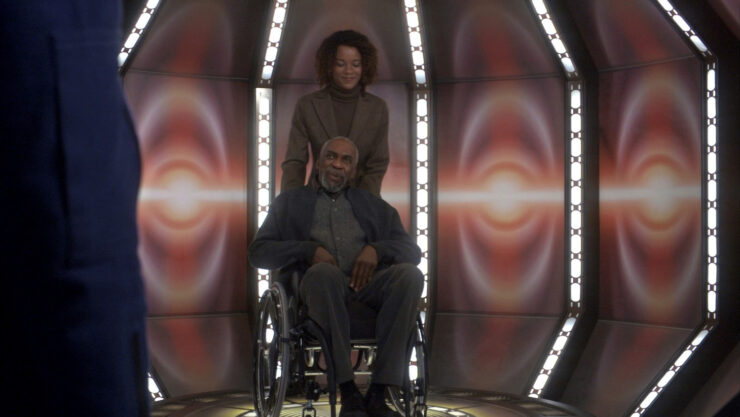
Captain’s star log. Enterprise is hosting Emory Erickson, the inventor of the transporter, who wants to test a new long-range, sub-quantum transporter in a barren region of space. The Ericksons and Archers are old friends, and this is a nice reunion for the captain as Erickson and his daughter Danica are beamed on board.
Tucker is particularly thrilled, as Erickson is one of his heroes, and the two get to work together on the transporter.
The Ericksons have dinner at the captain’s table where Erickson discusses his new toy, which he jokes will put Archer out of a job, as you’ll be able to transport between solar systems. (Nobody mentions that you’ll need ships to get to the planets in the first place to set up the transporter platforms…) Archer recalls his father and Erickson having many arguments over whether or not the future of space travel would be the warp drive or the transporter pad. Erickson sadly says he misses those arguments.
Enterprise arrives at the Barrens, an empty area of space with nothing around for many many light-years. Tucker works with Erickson to modify the transporter, with Erickson reminiscing about the first time he went through his own invention. It took a minute-and-a-half to cycle through, and he threw up as soon as he materialized—and then he got drunk, adding that he learned the latter trick from Zefram Cochrane.
Archer gives Danica a tour of the ship, and the captain expresses surprise that Danica never joined Starfleet. She says she needs to take care of her father. He’s wheelchair bound and needs regular injections into his malformed spine, and besides which, he’s still devastated by the death of her brother, Quinn, who died during a transporter test fifteen years previous.

Returning to their cabin for Erickson’s injection, Danica expresses concern over lying to Starfleet—especially to Archer, who is a dear friend. Erickson insists it’s necessary. That’s not ominous at all.
Reed and Burrows are working in the armory when a weird anomaly shows up and zaps Burrows, killing him instantly.
Erickson tells Archer he’s never seen anything like the anomaly that killed Burrows. When he and Danica return to their quarters, she berates him for lying to Archer, and now someone is dead. Erickson insists on going forward with the experiment, which is the only way to bring Quinn back.
They beam a probe 40,000 kilometers away. Tucker, however, is growing suspicious. For one thing, Erickson refuses to let Tucker help him observe the telemetry from the probe. For another, all the modifications Tucker made seemed unnecessary—part of the point of the sub-quantum transporter is that it uses less power, yet this test required a ton of power.
Archer is equally suspicious, as there’s a log from one of the research vessels Erickson worked on that includes a sighting of an anomaly very similar to that which killed Burrows, which belies his earlier statement that he’d never seen anything like the anomaly before.
T’Pol then reports another anomaly on C deck. Archer, T’Pol, and two MACOs investigate. It brushes T’Pol and badly injures her hand. However, she was able to take a scan of it, and Archer realizes—after they enhance the image—that the anomaly is Quinn.
Erickson finally comes clean. The sub-quantum transporter is unworkable. Quinn disappeared during the first test of it, and he’s spent the last fifteen years trying to get him back.
The anomaly returns, this time blowing up an EPS junction. Nobody was hurt, though Erickson would’ve been if Archer hadn’t tackled him out of the way. At this point, both T’Pol and Tucker are loudly advising Archer to leave the Barrens and have Erickson arrested. The anomaly came dangerously close to a stash of torpedoes. Archer insists that, once they rescue Quinn, everything will be fine.
When the anomaly reappears, they try to rematerialize Quinn. The process of doing so, however, triggers cellular degeneration. He rematerializes on the platform and dies a few seconds later.

Archer says Erickson will have to answer for his crimes, and he knows his career as a scientist is over. He contemplates the possibility of becoming a teacher, and my first thought is that he’ll be too busy being in prison for manslaughter for that to be an option…
Danica and Archer have their goodbyes, and they beam off to the Sarajevo, with Erickson giving Tucker the specs on how to increase the range of the transporter.
Can’t we just reverse the polarity? Sub-quantum transporting is supposed to be able to transport over interstellar distances, but is apparently just technobabble. Ahem.
The gazelle speech. Archer and Danica grew up together. Also when Tucker is geebling about how excited he is to meet Erickson, Archer reminds him of the time he met Zefram Cochrane, and therefore knows exactly how Tucker feels.
I’ve been trained to tolerate offensive situations. T’Pol has been keeping to herself since they left Vulcan, spending her spare time reading the Kir’Shara. She refuses to talk to Tucker about how she feels about T’Les’ death, and later breaks up with him, even though they really weren’t in a relationship, entirely.
Florida Man. Florida Man Learns That You Should Not Meet Your Heroes.
Optimism, Captain! Phlox gets to tell T’Pol that she’s completely cured of Pa’nar, and also has the sad duty of informing Erickson that rematerializing his son will kill him.
Good boy, Porthos! Danica meets Porthos for the first time and is, of course, completely charmed by the pooch.

The Vulcan Science Directorate has determined… With the release of the Kir’Shara, stigmas against mind-melding has been greatly reduced on Vulcan, and sufferers of Pa’nar Syndrome are coming forward to be cured.
No sex, please, we’re Starfleet. Tucker keeps trying to reach out to T’Pol, who shuts him down, and eventually she makes it clear that a relationship isn’t really on, right now, as she’s reexamining everything about her life and what it means to be Vulcan. Tucker says that, hey, at least the warp engines still need him…
More on this later… Erickson admits that long-distance transporting isn’t possible, and probably never will be for a thousand years, by way of explaining why the Federation doesn’t have anything resembling such transporters in the twenty-third or twenty-fourth century in the mainline timeline.
In addition, Erickson’s modifications allow a probe to be beamed 40,000 kilometers away, which has never been done before, but that was established as a safe transporting distance two hundred years hence in TNG’s “A Matter of Honor.”
I’ve got faith…
“I’ve waited so long for this moment—planned for it. What if something goes wrong? What if I fail?”
“On the day before I entered flight training, I asked my father pretty much the same thing.”
“What did he say?”
“‘Don’t fail’.”
“Henry never was a poet.”
“He didn’t need to be.”
–Erickson and Archer.
Welcome aboard. The great Bill Cobbs plays Erickson, while Leslie Silva plays Danica, Donovan C. Knowles plays Quinn, and Noel Manzano plays the poor doomed Burrows.
Trivial matters: This episode establishes who invented the transporter. It supersedes a 2001 TNG graphic novel Forgiveness by David Brin & Scott Hampton. That had the inventor be Colin Blakeney, who developed the tech in the twenty-first, rather than the twenty-second, century.
This episode also establishes that Surak’s writings have had quite the impact on Vulcan society after its being unearthed and made public in “Kir’Shara.”
The Rise of the Federation novels by regular rewatch commenter Christopher L. Bennett establishes that Erickson was imprisoned and died in jail. Danica is a recurring character in those novels, and she and Archer become a couple.
Erickson mentions that one of the (many) objections to the transporter made while he was inventing it were concerns that the transporter killed you and created a duplicate. That philosophical argument was a major underpinning of the first adult Star Trek novel, James Blish’s Spock Must Die!
While the Federation is not seen to have developed long-range transporters in the mainline timeline, we do see them in the alternate timeline of the Bad Robot movies in the 2009 Star Trek and in Star Trek Into Darkness, and also employed by Gary Seven’s supervisors in the original series’ “Assignment: Earth,” by the Triskelions in the original series’ “The Gamesters of Triskelion,” by the Dominion in DS9’s “The Jem’Hadar” and “Covenant,” by the Sikarians in Voyager’s “Prime Factors,” and by a Ferengi in TNG’s “Bloodlines.”
Zefram Cochrane was established in the movie First Contact as someone who appreciated his liquor, so to speak…

It’s been a long road… “All breakthroughs are hard to imagine before they happen.” I desperately wanted to like this episode, as I’m a huge fan of Bill Cobbs, and I like the fact that they established that the transporter was created by a person of color. Indeed, Trek did this once before, in “The Ultimate Computer,” an original-series episode that established Richard Daystrom—a person of color, played by the great William Marshall—as the person who revolutionized twenty-third-century computer technology.
And that’s part of the problem. This episode is trying really hard to be as strong an episode as “The Ultimate Computer,” and hoo-hah, is it not. They even go so far as to have Erickson having the same lament as Daystrom, about how when you achieve greatness as a young man, you spend the rest of your adulthood trying to live up to that accomplishment.
On the one hand, I like the friendship that this establishes between the Archer and Erickson families. On the other hand, the fact that Erickson is Archer’s friend warps his entire personality, as the fact that Quinn is someone he grew up with means he decides to barrel on ahead and risk the ship and more deaths to rescue him. It’s bringing us back to first- and second-season Archer, who appeared to have gotten the job because of who his Daddy is, not due to any innate captaining skill. His behavior is irresponsible as hell here, as T’Pol and Tucker are absolutely right to advise him to end the mission.
I do appreciate the fact that Burrows isn’t just redshirted. His death changes the entire tone of the episode, and it’s never forgotten throughout. That, plus the very presence of the regal Bill Cobbs, who is always excellent, raises the quality of this episode up a bit, but only a bit…
Warp factor rating: 5
Keith R.A. DeCandido’s latest work is “Prezzo,” a new story that appears in Weird Tales: 100 Years of Weird, an anthology celebrating the centennial of Weird Tales magazine, edited by Jonathan Maberry. The anthology, which will be out this month, includes new stories by Scott Sigler, Laurell K. Hamilton, R.L. Stine, James Aquilone, Hailey Piper, Usman Malik, Blake Northcott, and Dana Fredsti; new poetry by Linda D. Addison, Owl Goingback, Marge Simon, Jessica McHugh, Anne Walsh Miller, and Michael A. Arnzen; new essays by Lisa Morton, Lisa Diane Kastner, James A. Moore, Henry Herz, and Jacopo della Quercia & Christopher Neumann; and reprints of classic stories, essays, and poems by H.P. Lovecraft, Robert E. Howard, C.L. Moore, Richard Matheson, Ray Bradbury, Isaac Asimov & Frederik Pohl, Victor LaValle, Charles R. Rutledge, Karin Tidbeck, Allison V. Harding, and Tennessee Williams.

I’ve always found this episode pretty mediocre; part of it isn’t really its fault: I just figured that a fourth-season Enterprise episode called “Daedalus” would finally show us one of the eponymous Daedalus-class starships, which, together with the Earth-Romulan War, was one of the two things that I really hoped to see in a 22nd century series. Beyond that, though, the idea of finding and reintegrating the transporter pattern of someone lost decades ago over a whole vast region of space really undermined my willing suspension of disbelief, even if it didn’t work out. Agreed that Bill Cobb was absolutely a high point, though.
Also, it’s been a long time since I’ve read “Forgiveness”, but I seem to recall that the plot hinged around Blakeney’s 21st century invention of a transporter being completely forgotten from history, and the technology needing to be reinvented a century later; so this episode doesn’t necessarily contradict it.
“He’s not an enemy. But he’s not on our side either.”
After a run of multi-part stories, it’s a bit of a jolt to have this story wrapped up in the space of an episode. Perhaps that’s why there never seems to be any doubt that Emory is up to no good. For all the joviality, he comes across as arrogant and mentally unstable even before we find out he’s actually lying. I wonder if he lived long enough to tutor Richard Daystrom. It would explain a lot. It’s only at the end, with what’s been his purpose in life for fifteen years finally over, that he shows even a trace of humility and even that doesn’t seem to last long.
Archer’s on a short fuse for much of the episode but he gets points for not letting his past with the Ericksons cloud his judgement and quickly working out the truth. I find it hard to fault him for attempting to save a life and he’s objective enough to realise when it’s hopeless. There’s a certain tragedy in Emory’s quest going unfulfilled: He isn’t able to save his son, just recover him from a living death.
Even with a basically standalone episode, the focus is still on the three leads. Mayweather and Sato have no dialogue and Reed only appears fleetingly. Phlox fares a bit better but is still clearly a rung down from the trinity.
There are a number of references back to the preceding three-parter (T’Pol apparently has the eBook of the Kir’Shara), with Tucker stating T’Les’ death in ‘Awakening’ was a week ago. He also mentions losing his sister twice (from ‘The Expanse’).
On a tangentially-related note, one of my favourite bits of secondary canon in STAR TREK is the story from FEDERATION: THE FIRST 150 YEARS in which we learn that, at their first meeting, a much younger Jonathan Archer asked Zephram Cochrane to fix the family fridge (Which was broken) and that Henry Archer, returning home from a brief absence, found Old Zeph trying to do just that.
Being optimistic enough to believe that when his Dad called for a repair man, the Universe would send only the Very Best might well be Peak Archer.
Getting back to the actual episode, @krad, I tend to agree that it has almost all the right notes but doesn’t quite manage to rock our world with them: If nothing else, the fact they made the pre-credits scene so brutally banal was a bad sign (I’d argue the scene where T’Pol and Trip discuss their Not Talking would have made an equally low-key, but far more suitable opening).
On the other hand this episode does work quite well as a classical tragedy, with Doctor Erickson ranking as one of the most painfully human of ENTERPRISE villains – disgracefully high handed and pitiably desperate in equal measure.
It’s also rather sad to see Captain Archer regress to his less admirable former self, but it’s not hard to understand his decision as a mix of childhood loyalties and a burning desire to balance out the loss of one man with the rescue of another.
Alas, this is a Tragedy.
*By the way, I had not noticed the parallels with Professor Daystrom until you pointed them out – my compliments on your clear sightedness!
Considering the parallels between the two characters does make me suspect that Erickson may be rather the worse person: my impression is that Daystrom was blind to the faults in his machine comprising a genuinely fatal flaw, but that Erickson KNEW he was risking lives and was nonetheless lying to all & sundry in order to be put in a position to do so.
Isn’t Danica some kind of accessory to her father’s crimes? I guess this is a question that relates to modern day crimes. What is your culpability if you don’t actively help in the commission of a crime but you’re fully aware of its planning and it being carried out?
This would be the one real dud of season four if not for the series finale.It’s yet another episode rehashing a plot we’ve seen in Trek before, this time VGR’s “Jetrel.” That was a superb episode, so this one pales even more in comparison.
My biggest problem is the huge continuity error of the Barrens. This is supposedly a starless void 100 light years in radius. Not only does no such void exist anywhere in the observed galaxy, let alone near Sol System, but Erickson supposedly did his experiments in its exact center 15 years earlier. So he had to be well over 100 light-years from Earth in 2139. And yet in 2152, in “Two Days and Two Nights,” it was stated that NX-01 was the first Earth ship to have made it as much as 90 light-years from Earth. Indeed, it was a defining element of season 1 that it was the first ship to make it more than a few dozen light-years out, because every previous ship was so slow that it took months or years to travel between star systems, hence the emergence of the Space Boomers. So this episode’s premise casually discards the entire foundational worldbuilding of Star Trek: Enterprise.
I’ve tried to rationalize the Barrens as some kind of dimensional anomaly, a spatial pocket bigger on the inside. But I ended up deciding that, since the size of the Barrens is mentioned in only one log entry, I can just ignore the reference.
The one thing I like about it is Leslie Silva as Danica Erickson — as you can tell from the fact that I brought her back in Rise of the Federation.
One thing I have to wonder is, why was it humans who invented the transporter when Vulcans have been a starfaring power for centuries longer? Maybe it’s just that the Vulcans find it so unreasonably dangerous a means of transportation that they’ve never bothered to develop it. It took the recklessness of humans to actually go for it and prove it could work. And I doubt the Vulcans would’ve been willing to encourage and cooperate with its development by humans any more than they were with warp drive. So it was up to us to test it at our own peril.
“(Nobody mentions that you’ll need ships to get to the planets in the first place to set up the transporter platforms…)”
Not really, because Trek transporters aren’t limited to station-to-station teleportation. The real problem with interstellar beaming is that it only makes sense to travel to a known destination. It’s useless for exploring new places (unless you just beamed probes), since you don’t know whether it would be safe to beam there, and your team would have no local support if something went wrong. The other problem is that any targeting error would be insanely magnified over interstellar distance, so you might miss your target and materialize somewhere dangerous, like miles in the air or underground, if not in space. (ST ’09 paid lip service to this with Scotty’s transwarp beaming mishap.)
“by way of explaining why the Federation doesn’t have anything resembling such transporters in the twenty-third or twenty-fourth century in the mainline timeline.”
They have them in principle, according to TNG: “Bloodlines.” They just don’t use them because they aren’t reliable enough to use safely. Which is why it drives me crazy when people assume Scotty must’ve invented transwarp beaming sometime after Nemesis.
@5/CLB: “Erickson supposedly did his experiments in its exact center 15 years earlier. So he had to be well over 100 light-years from Earth in 2139.”
I don’t think that’s actually stated? What Erickson says is “This region, the Barrens, is actually a subspace node, a bubble of curved space-time. It’s why there are no stars. Quinn’s transporter signal is trapped here.” I took it to mean that Quinn was trapped in subspace and the Barrens are a kind of dividing point between subspace and normal space that he’s drawn to.
jaimebabb: you may be right about Forgiveness. All I can say for sure about it is that Scott Hampton illustrated Blakeney to look like Elon Musk, a decision that has not aged well……
—Keith R.A. DeCandido
1) Add the Kalandans to the list of species with Long Range Transporter Technology. In That Which Survives, the Enterprise (and crew) were transported essentially instantly almost 1000 Light Years from the Kalandans Outpost. Spock specifically says that the ship was rematerialized slightly out of phase
2) The Barrens reminds me of the “star desert” in The Squire of Gothos. Remember that early episodes of TOS played fast and loose with the century that the series was set in. Part of the issue is that we tend to think in 2 dimensional terms when we talk about “distance” in Star Trek. I’m the Galactic Plane there’s less likelihood of finding a significant bubble without stars but go far enough in the Z axis and the stellar density drops off significantly. It’s also possible that calling The Barrens a starless region might be an exaggeration. Perhaps it’s a region where there are only small late M class and Brown Dwarf mass objects and those are separated by several parsecs.
3) As far as how Erickson got to the Barrens, we’re assuming that it was via an Earth Warp Capable ship. I don’t think that the Vulcan High Command would have provided a ship, but how about the Denobulans? I don’t recall how long they have had contact with Earth, but apparently at the time of Broken Bow, Phlox had been on Earth for a while.
@7/krad – This is why it’s important for people to be dead before you beatify them.
@6/cap-mjb: “I don’t think that’s actually stated?”
It’s stated in Archer’s log entry, as I said. “We’re entering an area known as the Barrens. There’s not a star system within a hundred light years.” Meaning it’s a void whose minimum diameter is 200 light-years.
@8/Charles Rosenberg: “Add the Kalandans to the list of species with Long Range Transporter Technology.”
And the Metrons, who were able to snatch Kirk off the bridge and teleport him to the Vasquez Rocks asteroid an unknown distance away.
“As far as how Erickson got to the Barrens, we’re assuming that it was via an Earth Warp Capable ship. I don’t think that the Vulcan High Command would have provided a ship, but how about the Denobulans?”
Hmm, conceivable, but it still feels like somewhat of a retcon from how seasons 1-2 portrayed humanity’s interactions with other worlds.
Say, @krad, what’s your rewatch plan for after ENT?
@10/CLB: Yes, sorry, I realise that’s stated, but I don’t believe it’s ever stated that the experiment where Quinn was lost took place in the Barrens. Like I said, I assumed he was lost elsewhere and then drawn to the Barrens as a “subspace node”.
FWIW, according to IMDb, Wikipedia, and Memory Alpha, the guest star’s name is Bill Cobbs.
@13 – Fixed, thanks.
@12/cap-mjb: That’s an interesting idea, but I think the following exchange proves that Erickson did indeed perform his initial tests in the Barrens:
EMORY: I sympathise, believe me. During the initial tests for the transporter, some brave men and women were lost. Not a day goes by that I don’t think about them. How can I help?
T’POL: You’ve spent a great deal of time in this region of space.
EMORY: I never encountered anything like this.
T’POL: Are you sure?
EMORY: There’s a reason this is called the Barrens, Captain. There’s nothing out here.
jaimebabb: Not even then, as H.P. Lovecraft can attest.
Craig Jackson: Excellent question. :enigmatic grin:
rickarddavid: Someone also pointed that out on Facebook. Derpity derp. As stated above, it’s been fixed.
—Keith R.A. DeCandido
@15/CLB: Hmm. I think there’s still some ambiguity, but you’re right, it is stated Erickson’s spent a great deal of time in the area, and it’s probably not all since the first two seasons of the show.
Long-range transporters are an idea that almost made it to the TNG finale, “All Good Things”. According to the TNG Companion, an early draft of the Moore/Braga script had an older Lwaxana Troi beaming straight from Betazed to inform future Picard and everyone else about Deanna’s passing. That obviously didn’t make the final cut, and of course, that was an alternate future thanks to Q’s actions.
“Deadalus” is an idea that almost sounds interesting on paper. And yet, it feels as if Manny Coto was so focused on the trilogies and two parters that they almost forgot they had a spare episode in-between. And to keep in line with this season’s theme of worldbuilding events leading up to the creation of the Federation and Trek as we know it, why not do an episode about the guy who came up with the transporter? Sadly, there’s not even enough meat on this one for a single episode, let alone more. Even T’Pol and Tucker’s post Kir’Shara drama have more of an impact.
And given the overall quasi-serialized nature of the show by this point, it feels almost jarring to have an episode so out of left field. At least “North Star” was an episode about a strange new world in the middle of the Delphic Expanse. It fit the setting. But here? Even if ENT had been picked up for season 5, I doubt they would have gone back to these characters, let alone their predicament having any long term effects for Archer. The result is an episode that not only feels like a leftover from season 2, but also has no long-term impact.
Again, it feels as if they had the transporter creator idea first, and decided to ape the same beats from older Trek episodes instead of really working out a better story. Erickson and Danica aren’t even bad characters. They had potential, but the story felt like an inferior version of one of Mayweather’s family drama episodes.
@18/Eduardo: “And given the overall quasi-serialized nature of the show by this point, it feels almost jarring to have an episode so out of left field.”
But that’s what I like about season 4, the way it was neither purely episodic nor purely serial, but allowed each story to be as long as it needed to be, whether that was one, two, or three episodes. I’ve never liked the tyranny of a rigid format, whether it’s every storyline having to wrap up in 40-odd minutes or every storyline dragging out through an entire season (and always coincidentally coming to a climax in late May, or when the stardates roll back around to 000). I love the idea of just letting the story dictate the length instead of the length dictating the story. So hell yeah, give me some single-parters in between the 2- and 3-parters. It adds variety.
And of course, you still had a serial aspect to the character arcs with Trip & T’Pol, and with the followup to the Vulcan business. So it was still of a piece with the overall season, just taking a break from the big plots so it could let their aftereffects resonate. It’s just good pacing to slow down between the big climaxes.
I like stand-alone episodes, but this one rated a solid ‘meh.’
The miniarcs-and-standalone-episodes format that this season uses has always reminded me of a comic book. I actually think that it works really well, and I’m disappointed that Star Trek has never used it again (though it would be a bit more problematic now that they’re generally only given 10 episodes per season).
That said, of this season’s standalone episodes, only “Home” really stands out as being good.
@21/jaimebabb: Yeah, I loved season 4’s format, and it’s always surprised me that it didn’t catch on more widely, since it’s so versatile. You’re right that it is like comic books and their variable story-arc lengths, at least back in the days before it all became about doing everything in decompressed arcs long enough to add up to a trade paperback collection. Interestingly, the only other shows I know of that did a comparable format were kids’ shows from the 1950s. Rocky Jones, Space Ranger mostly did 3-episode arcs (most of which were then re-edited into movies for theatrical release) but had three 1-part stories here and there through the season. And the second season of Disney’s Zorro was mostly 3- or 4-part story arcs with a couple of 1-parters.
There’s also the original Battlestar Galactica, sort of; it opened with a 3-parter and then was a mix of 2-parters and 1-parters. Though that’s because it was originally conceived as a series of TV movies, but ABC decided to do it as a weekly hourlong show instead, so they inserted a bunch of standalone episodes between the early movie-length installments that advanced the main plot. Which was probably part of why it tanked in the ratings, because there were so many weak filler episodes early in the season.
I think that the animated Spider-Man series from the 90s had a similar format (which of course is just derived from comics). I think that there are a few other animated series using similar formats.
@22/CLB: Doctor Who from the 70s and 80s was much like that: some stories wrapped after a few half-hour episodes, while some others went on for 5–6 episodes. That seemed so neat at the time.
I wonder how much we’d have to pay James Nicoll or CLB to review “Spock Must Die”? I vaguely remember reading it before Pocket Books started their line and, well, never rereading it. IIRC (and I may not, it was almost a half-century ago that I read it) it was pretty bad…
I wonder if I was really bored 18 years ago when this ep first aired, because I sort of remember it, so I must have watched it. The only episode from this season that I really remember was the Mirror Universe one.
@23/jaimebabb: The ’90s Spidey series doesn’t quite fit. The first season was mostly 1-parters with a 3-parter and a 2-parter. Seasons 2, 3, and 4 were extended story arcs with blanket titles, 14 episodes each for season 2 & 3, 11 episodes for season 4. They followed a comics-style format with various 1- and 2-part stories that contributed to the larger arc. Only season 5 approaches the kind of format we’re talking about; it opened with a one-parter, then had a 5-part arc followed by a 2-part arc, a 3-part arc, and a 2-part final arc.
@24/SaraB: The original Doctor Who was in a serial format of a type that had been used in radio and TV for decades. In the 1960s and early 1970s, the serials were typically 4, 6, or 7 half-hour episodes, with occasional longer or shorter ones, but the end of one serial was typically a cliffhanger for the start of the next, so that the whole series was effectively a continuous serial. After 1975, it was typical for most serials to be 4 episodes, with one 6-parter per season. By the ’80s, the standard was 4 episodes with occasional 2- or 3-episode serials.
So most of Who was fairly standardized in length, normally 4 episodes with occasional exceptions. It’s not quite as flexible a format as what ENT achieved in season 4.
It’s somewhat similar to Clone Wars, although that had mostly settled on four-part serials in its second half.
@@.-@ I thought that as well. It’s not as if she stayed home and completely out of it. She was vouching to the captain about this fraud they were committing. Her father needed her help to get there and pull this off. It might be understandable if you know about someone’s plans to commit a crime but stopping them puts you at some personal risk. Don’t think she can say that about her own circumstances though. Even if you could excuse her complicity before the crewperson died, after that point it seems pretty criminal that she didn’t go to the captain with what she knew and continued to help cover it up. There’s got to be some obstruction of justice regarding the investigation into the crewperson’s death. So much so I found it offputting that she was considering joining starfleet. Even if somehow what she did wasn’t illegal, Starfleet cares about moral obligations which there was a real failing here of.
I feel like Power Rangers slipped into a similar format at one point: The third season of MMPR had a high number of 2- and 3-parters (after a 4-part opener!), to the point that when we did suddenly get a standalone episode in the middle of them I felt “Oh, are we still doing those then?”
Mr Cobb, did an excellent job of portraying the desperation behind the single minded absolutist approach to this.
Daystrom thought he was doing something for the greater good and he would have finally proved that he still had great ideas. He would’ve solidified his legacy and made Starfleet safer. But he was so stressed out that he didn’t see his own failings.
Erickson on the other hand was trying to recover from a failing, to redeem himself by saving his son. But that combination of fatherly love and scientific ego became morally apathetic.
Daystrom was a man chasing former glory, but while Erickson may have had similar feelings about peaking too early, he also gave a sense that he was going to succeed no matter what. So Daystrom’s tragedy is easier to empathize with, he was a good man who had failed catastrophically trying to be good. Erickson loses that empathy because he still thinks he can win, even against death. Erickson has much more hubris.
Both carry the burden of “The Road to Hell is Paved with Good Intentions”.
The worst part is that Danica is right, they should’ve told Archer. He’s a friend and he likely would’ve helped voluntarily. With Tucker and T’Pol helping they may have been able to do it safer and with a higher probability of actually saving Quinn. He may have defeated himself being so insular. His invention will outlive him, but his legacy will always have the asterix.
The only thing I have to add is that you’d have to be blind to believe that Danica and Archer grew up together.
@31/David Pirtle: “you’d have to be blind to believe that Danica and Archer grew up together.”
Scott Bakula is 14 years older than Leslie Silva, but when ENT started he was a 46-year-old actor playing a 39-year-old character, so that halves the age gap right there. It’s easy enough to assume that Danica is 5-7 years older than Silva and has simply matured more gracefully than Archer. I imagine the radiation a space pilot gets exposed to might cause premature aging of the skin.
Necroplying to say, not only that, but the impression I got was that Danica was Archer’s bestie’s little sister. So he chased her around with a ray gun when she was first able to run. I didn’t get the impression anyone said they were the same age.
Most of the things I would have mentioned have been mentioned …
One thing: It is common for humans to risk their lives, or even for multiple humans to risk their lives, to rescue even one individual. “The needs of the many …” is not always the way we go. So why not go ahead and inform Starfleet that there needs to be a rescue mission? Yes, it is a big one, but wouldn’t Erickson have plenty of favors to call in?
@32. ChristopherLBennett: I’d imagine that Archer’s repeated encounters with ‘enhanced interrogation’ and other expressions of ill-intent haven’t enhanced his youthful good looks either!
Mr Bennett, I also wanted to suggest that – given the STAR TREK galaxy’s eventful nature – it’s perfectly possible that The Barrens formed at some point between our present day and Archer’s 22nd Century, rather than being intended as an accurate reflection of present day astrography.
It must be said that “ … and thereby hangs a tale” is definitely my preferred response to/explanation for this sort of thing.
@34/ED: Except if there were a void 100 light years in radius whose center was less than 90 light years away, Sol and its neighboring star systems like Alpha Centauri and Vulcan would obviously be inside it, which is a contradiction in terms.
Also, if such a gigantic void formed suddenly in local space, it would be a cataclysmic transformation that would have massive consequences for every civilization around. Systems that were once neighbors would suddenly be months apart from each other. Imagine if Eurasia suddenly split in two and a huge ocean formed in the middle of it. All subsequent world history would be transformed by that. Governments would rise and fall, commerce would undergo seismic transformations, axes of power would shift, and people would be talking about it for centuries thereafter. It would be as massive as the Burn in its impact. Which obviously is not the case.
Easier just to ignore that single sentence about the Barrens’ size. Maybe Archer misspoke or massively exaggerated when he said there wasn’t a star system for 100 light years around. Or maybe the TV producers creating a dramatic reconstruction of the event introduced an error. I’ve realized in recent years that a Doylist approach to Trek — which was Roddenberry’s own preference, to treat it as an occasionally inaccurate dramatization — works far better than a Watsonian one.
@35,ChristopherLBennett,
I disagree, because that log is very messed up structurally. If the Barrens is an area, then in order for him to just be entering it, he would need to be at the edge, therefore the hundred light years is in front of him. The second sentence however states there’s not a star system within a hundred light years which would imply they were already at the heart of the barrens, since no systems within 100 light years includes what is behind them, above and below etc. Despite the other cartographic incongruities; I think that Archer being on the edge and saying he’s entering an area 100 light years in diameter that has no star systems, fits better than him already being at the center of the void.
@36/mr_d: A factor of two makes no difference — it’s still absurd to postulate that such a gigantic void exists close enough to Earth for Erickson to have reached it with at most a warp-2 starship. And again, if such a huge void existed, even if it had been there all along, it would be a massively important factor in the region, affecting the shape of civilizations and their relationships, and there’s no way it would’ve gone completely unmentioned for 200 years thereafter. It’s just a stupid idea, a single throwaway line whose implications are too massive to be worth rationalizing. Immensely easier just to ignore a single sentence. It doesn’t deserve a defense.
Not completely off-topic for this rewatch:
https://candorville.com/2023/10/04/the-admission/
@37/ChristopherLBennett
Well I don’t care about the plausibility of it, I agree it was conceptually wrong from jump and a continuity error, I was just pointing out that the log entry is self-contradictory. I’m in No way defending the existence of this void. But one interpretation is more rational to me than the other for the purpose of the episode.
@38. wiredog: Words of wisdom, though one must admit to never disliking ENTERPRISE in the first place – I was too casual a fan when it was first released to really resent the show with that special passion seen in witch hunters, heretic-burners and other overly-enthusiastic nerds.
Also, @krad, just remember – you’re written novels for SUPERNATURAL, so if you’re not really, really careful you could be dragged down that rabbit hole and never see daylight again.
If you’re really, really willing to invest your time in yet another rewatch project and fancy a change of pace from all this STAR TREK, I suggest you go with BUFFY and rejoice in the fact that particular show will devour rather less of your foreseeable future.
…
Or you could just go with FIREFLY, if you feel like sticking to Science Fiction but also want to tackle something short, but sweet.
@37 – That’s all based on the assumption that the writers of Trek, in all its incarnations, had some sort of master plan laid out and thought about such things far in advance. World building in trek tends to be incremental at best and done only when it is directly related to the story of the week. How many nebulae or black holes and such are located extremely close to Earth? Voyager 6 fell into a black hole that must have been close enough to Earth for its gravitational effect to make it obvious to the astronomers of the day, to name just one.
The writers wanted a big void that was close enough for Eemerson to get to and big enough to give the story lots of room Running the idea past an astronomer wasn’t ever on the table
And remember, this is the show where dark matter is literally something that you cannot see through, where cold fusion can freeze lava and the number of super novas in the local area is way above average
> This would be the one real dud of season four if not for the series finale.
I want to say this is the worst episode of the season then I too remember the season finale and also that Stormfront does in fact counts as season 4 even though it really is a waste of time cleaning up unfinished business of season 3.
Even the episode title is disappointing. Meh. Boldly going nowhere.
@43/bob: “Even the episode title is disappointing.”
How so? Because it isn’t about Daedalus-class starships? The title works perfectly as a mythological reference — Emory = Daedalus, his son = Icarus, the premature attempt to develop interstellar transporters = hubristically flying too close to the sun. If anything, it works better as an episode title than a starship name, given the air of failure and tragedy associated with the myth.
Hey folks! In honor of Indigenous People’s Day, Tor.com is taking Monday the 9th off, and so is the Enterprise Rewatch. We’ll be back on the 16th with “Observer Effect.”
In the meantime, in honor of the holiday, I recommend the following three of my pieces from my rewatch articles over the years here:
Batman ’66: “An Egg Grows in Gotham”/”The Yegg Foes in Gotham” — https://www.tor.com/2016/04/15/holy-rewatch-batman-an-egg-grows-in-gotham-the-yegg-foes-in-gotham/
Star Trek The Original Series: “The Paradise Syndrome” — https://www.tor.com/2016/05/18/star-trek-the-original-series-rewatch-the-paradise-syndrome/
Star Trek: Voyager: “Tattoo” — https://www.tor.com/2020/04/16/star-trek-voyager-rewatch-tattoo/
—Keith R.A. DeCandido
The most frustrating thing about all the continuity/astronomy errors caused by the concept of the Barrens is that it’s completely unnecessary to the plot. There’s really no reason for them to have to be testing this technology in such a remote area.
I watched this episode last night and enjoyed it quite a lot more than other re-watchers here, though I had no memory of it at all from when I watched it first time around back in 2007 or so. Having said that, my main takeaway is that spending so much time on the transporter set really emphasises how the back of the transporter, which is presumably meant to look like hyper-futuristic lights and circuitry, it just cheap wallpaper.
Two questions:
1) Fairly recently, though I forget which episode, Archer said that he lost his father when he was 14. I know it’s the family business, so to speak, but would he have started flight training before that age?
2) When Archer visits Emory in his cabin, it looks like quite a narrow doorway so that Archer has to turn sideways to enter and he also quite visibly has to step over a raised threshold to get in. So how did Emory and his wheelchair get in and out?