







“Metamorphosis”
Written by Gene L. Coon
Directed by Ralph Senensky
Season 2, Episode 2
Production episode 60331
Original air date: November 10, 1967
Stardate: 3219.8
Captain’s log. Kirk, Spock, and McCoy are transporting Assistant Federation Commissioner Nancy Hedford via shuttlecraft. In the midst of negotiations on Epsilon Canaris III, she contracted Sakuro’s Disease, a very rare disease that Hedford nonetheless thinks Starfleet should have inoculated her against before going on this mission. Her attempt to bring about peace on that world was interrupted, but Kirk assures her that they’ll get her to the Enterprise in time to fix her up and get her back to work.
They encounter a large cloud of ionized hydrogen that is on a collision course for the Galileo. It envelopes the shuttle and brings it to a planet. McCoy and Hedford are both pissed—they need to get her to the Enterprise—but Galileo is powerless.
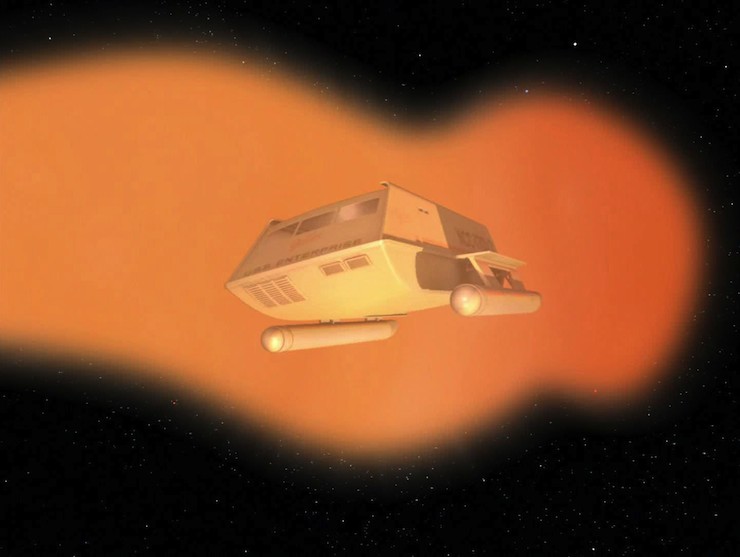
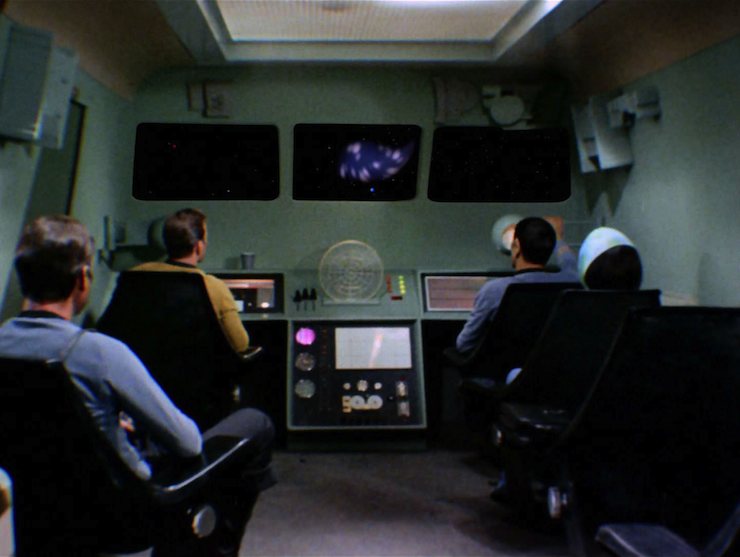
The shuttle is put down on a planetoid that has Earth-like atmosphere and gravity. The Galileo isn’t transmitting, so they can’t call for help. McCoy explores the area on foot, while Kirk and Spock check the shuttle: there’s nothing wrong with the shuttle, but nothing’s working. McCoy detects the same cloud of ionized gasses that Spock picked up in space.
And then a person cries out “Hello!” in English and runs toward them. “Are you real?” he asks—he recognizes them as being from Earth, and also recognizes Spock as a Vulcan, but hasn’t heard of the Federation. McCoy confirms that he’s human. He identifies himself as “Cochrane,” and he says that there’s a dampening field on the planet that keeps any power source dead.
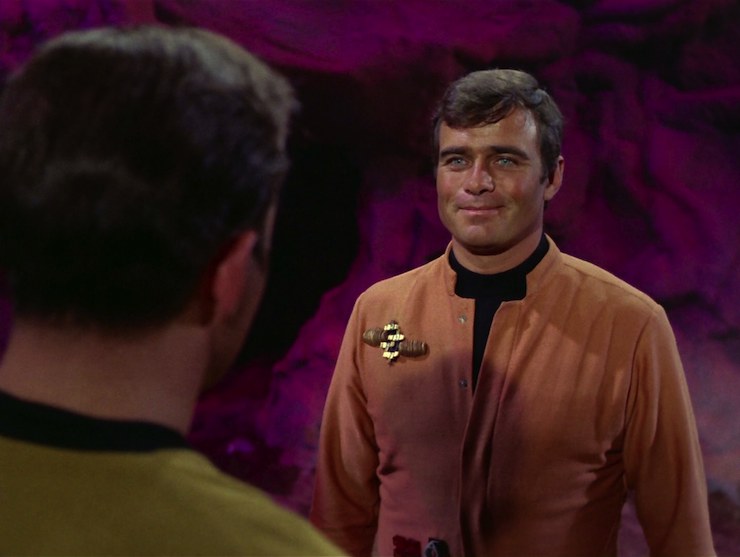
Cochrane is particularly fascinated by the shuttlecraft. Kirk sends him off with Spock to show him the inner workings of Galileo, while Kirk and McCoy express their suspicions to each other—both his evasiveness and also his familiarity, as they each recognize him, but they’re not sure where from.
Cochrane takes them to his home, which he constructed from the remains of his ship that crashed on the world. While he’s preparing cold drinks (Hedford is getting feverish, which is not a good sign for her continued health), the landing party see the energy cloud (which looks like a giant floating omelette). Cochrane brushes it off with a line about seeing things as he pours the drinks. But Kirk demands an answer.
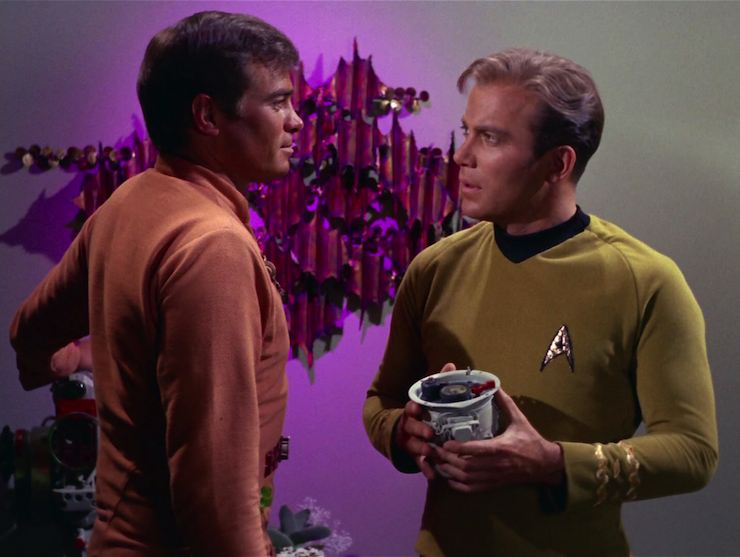
Finally, Cochrane explains. He was a dying old man when he encountered the energy being—he calls it “the Companion”—and it disabled his ship, brought him to the planetoid, and cured him of his ailments and made him permanently young again.
When Cochrane gives his first name, Zefram, they’re stunned to realize that they’re talking to the inventor of warp drive—who died 150 years earlier. But his body was never found. Cochrane says he wanted to die in space, so he got in a ship and just flew away until the Companion found him.
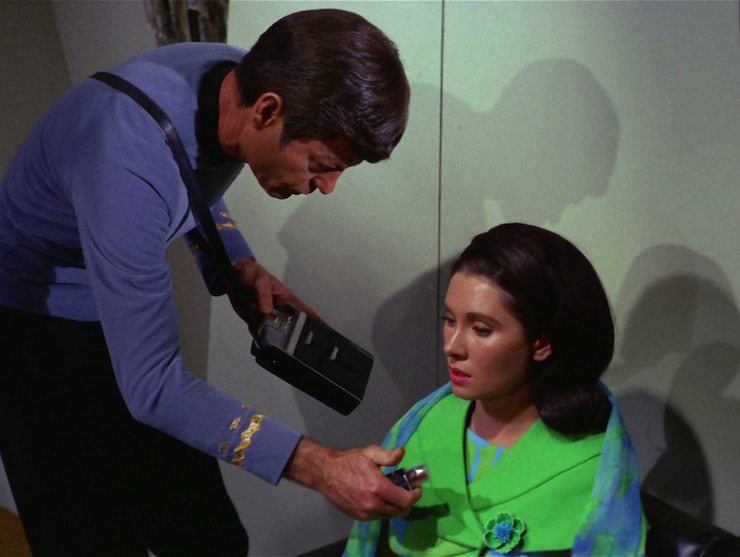
Cochrane also admits that the Companion brought the Galileo here to keep him company. He told the Companion that he was going to die of loneliness, and instead of letting him go, the Companion brought a bunch more people. Hedford, who’s already got a massive fever, has a fit. They put her to bed, and Cochrane asks what the galaxy is like now. Kirk tells him, and despite the fact that he’d age normally again if he left the planetoid, he wants to leave and see his legacy.
Kirk asks if Cochrane can communicate with the Companion, get it to help Hedford, who’s getting sicker. Meanwhile, Spock’s repair attempt on the Galileo is interrupted by the Companion, who destroys his instruments and fries the shuttle’s systems.
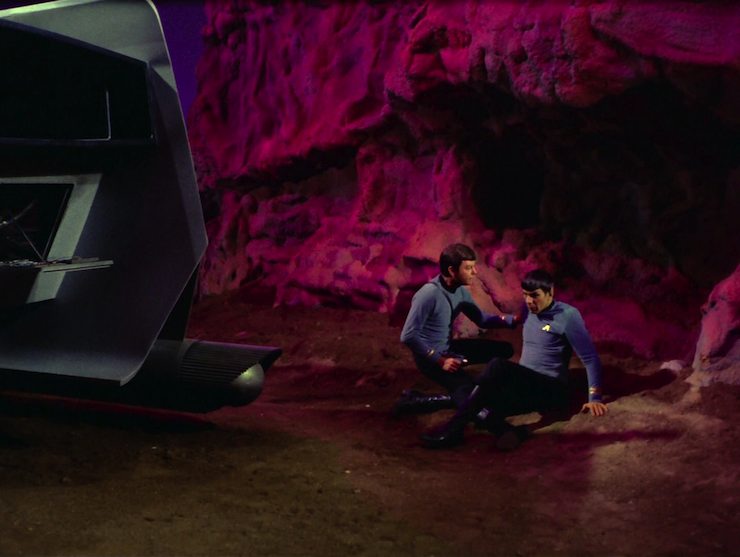
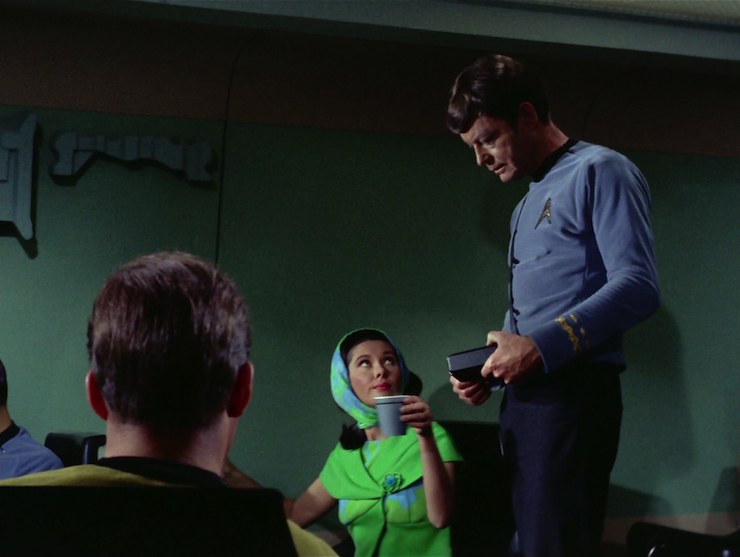
The Companion appears before Cochrane and envelopes him for several seconds. Kirk and McCoy speculate as to the relationship—talking to a beloved pet, symbiosis, possibly even love—and then Cochrane informs them that the Companion won’t help Hedford.
When Spock hasn’t checked in for a while, McCoy goes to investigate and finds Spock on the ground. Spock realizes that much of the Companion’s “substance” is electricity, which means it can be shorted out. He puts together a device that will disrupt the Companion. Cochrane is apprehensive—he doesn’t want to stay, but he doesn’t want the Companion hurt, either—but Kirk and McCoy convince him that it has to be done.
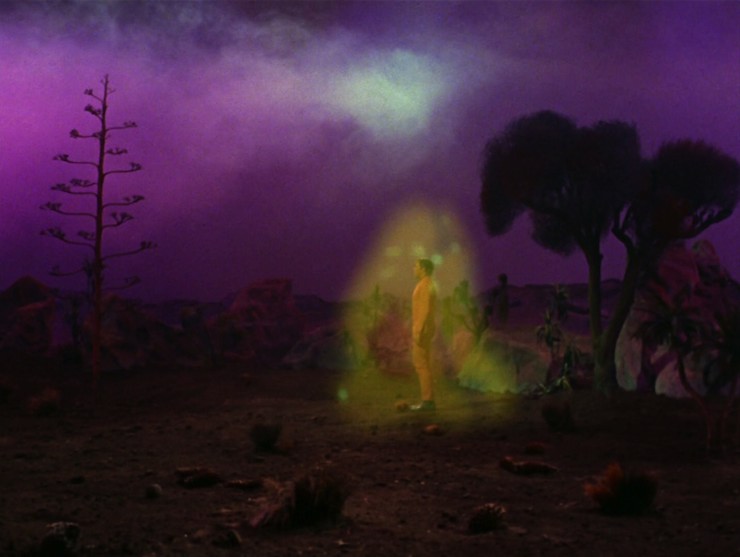
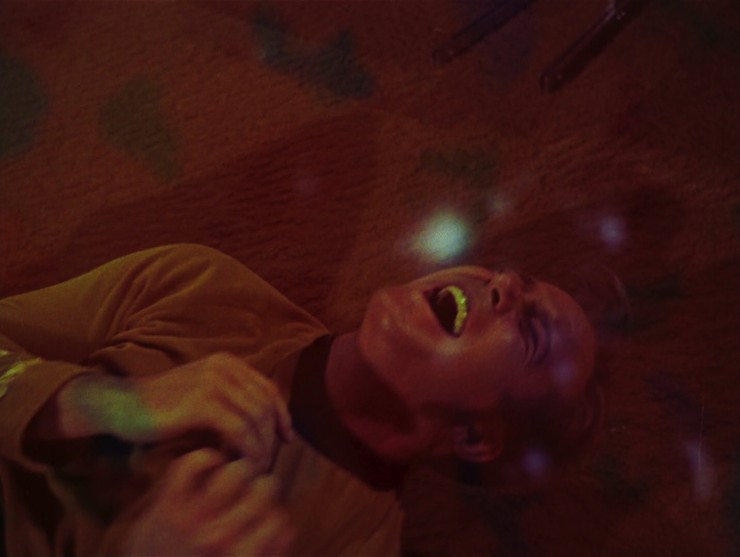
Cochrane summons the Companion. It envelopes Cochrane, Spock throws the switch, and then it turns red, hurting first Cochrane, then Kirk and Spock. Cochrane comes to and convinces the Companion to stop hurting them.
McCoy tells Kirk that diplomacy may work better than violence, and Kirk tells Spock to adjust the universal translator in the shuttlecraft, try to get it to understand the Companion.
Back on the Enterprise, Scotty engages in a search for the now-way-overdue shuttle. They pick up a particle trail, but it fades away. There’s no debris, no radiation, and no expelled atmosphere, which indicates to Scotty that they were towed. All they can do is continue on the course of particles Sulu picked up and hope they find them. When they reach an asteroid belt, they have to examine all of the planetary bodies in the field—though they start with the ones that have atmosphere.
Spock messes with the UT and then Cochrane summons the Companion. The floating omelette envelopes Cochrane once again, and Kirk speaks to it through the UT (which looks a lot like a sonic screwdriver), and it responds in a female voice. To Kirk and Spock, this changes everything—not a zookeeper, but a lover. Yes, they base this entirely upon gender. 1967. Sheesh.
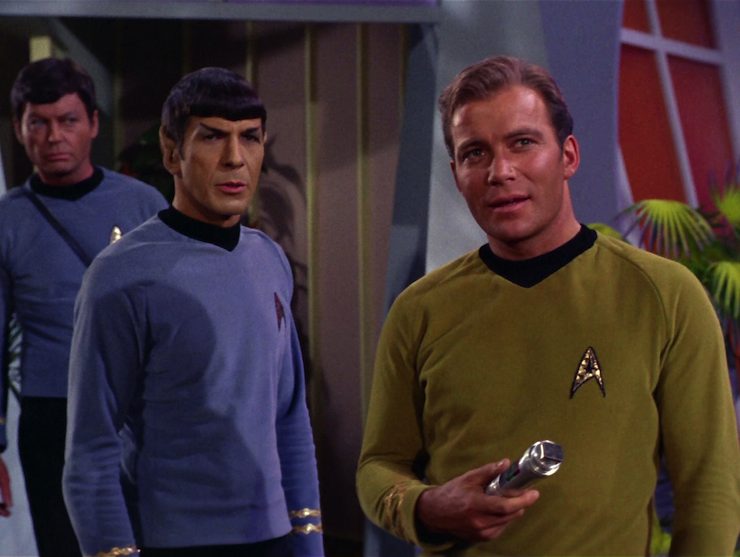
Kirk tries to explain that it’s the nature of humanity to be free, just as the Companion’s is to remain on the planetoid. The Companion doesn’t get it, as they’ll stay healthy forever (she refers to aging as a “peculiar degeneration”). Spock is fascinated by this new life form, but they don’t have time to study it—especially since the Companion disappears in a huff, unwilling to let Cochrane go, and unwilling to let the others go, as “the man” needs their companionship.
Cochrane is more than a little squicked out by the whole thing. Kirk, Spock, and McCoy are confused by his disgust—it’s just an alien, what’s the big deal? Spock points out that it’s been a pleasant, mutually beneficial relationship for 150 years. Cochrane storms out, appalled at the lack of morality and decency in the future.
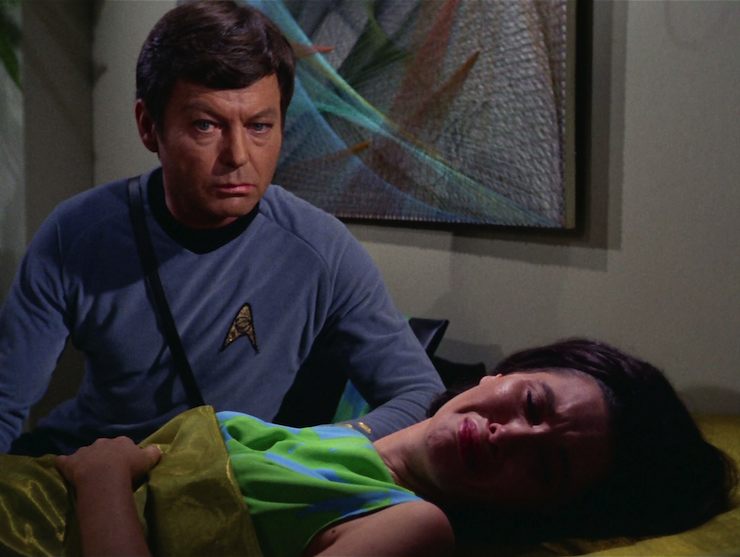
A feverish Hedford overhears their conversation, and is appalled that Cochrane is running away from love. Hedford is filled with regret that nobody ever loved her that way.
They try to talk to the Companion again. Kirk explains that Cochrane will cease to exist spiritually as long as he’s trapped on the planetoid, even though he’ll physically live on. Humans thrive on having obstacles to overcome; the Companion takes away all obstacles. Kirk plays on their differences to convince her to let him go—they’ll always be together, but always apart as well.
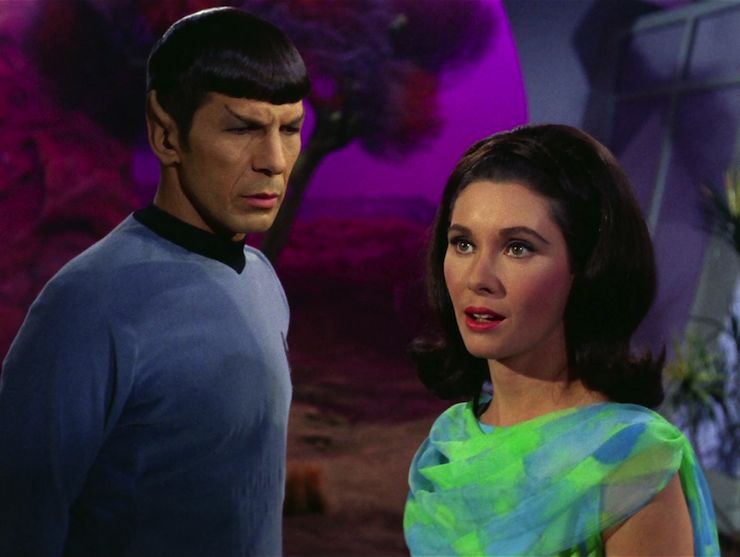
The Companion’s conclusion: if she’s not human, there can’t be love. So she becomes human by melding with Hedford. She’s cured of the disease and in perfect health—and she is now both Hedford and the Companion. She also repaired the Galileo—but that was her last act as the Companion. She is now powerless to stave off the “peculiar degeneration.” She will continue to age normally, as will Cochrane and the others.
Kirk contacts the Enterprise. Sulu locks onto his coordinates, and they can be there in an hour. Cochrane has come around to loving the Companion now that she looks like a person instead of a giant floating omelette—but she’s physically tethered to the planetoid. If she leaves for more than a day or two, she’ll die. Cochrane, therefore, decides to stay—it’s the least he can do after she saved his life. They kiss and stay on the planetoid where they can grow old together.
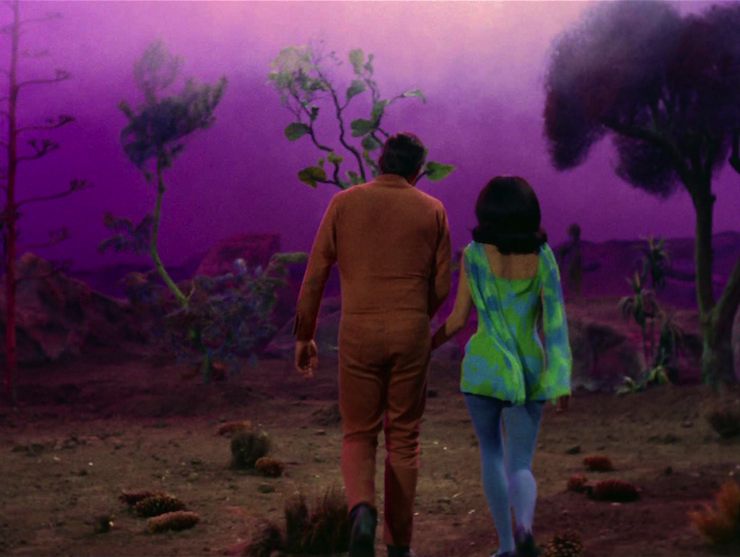
The landing party returns to the Enterprise when it gets there. They wish Cochrane and the Companion/Hedford well, promising not to say anything about him. When McCoy asks about the war on Epsilon Canaris III, Kirk blithely says that surely the Federation can find someone else to stop the war, and off they go.
Can’t we just reverse the polarity? We have the first appearance of the universal translator, the existence of which is a useful hand-wave for why everyone seems to speak English.
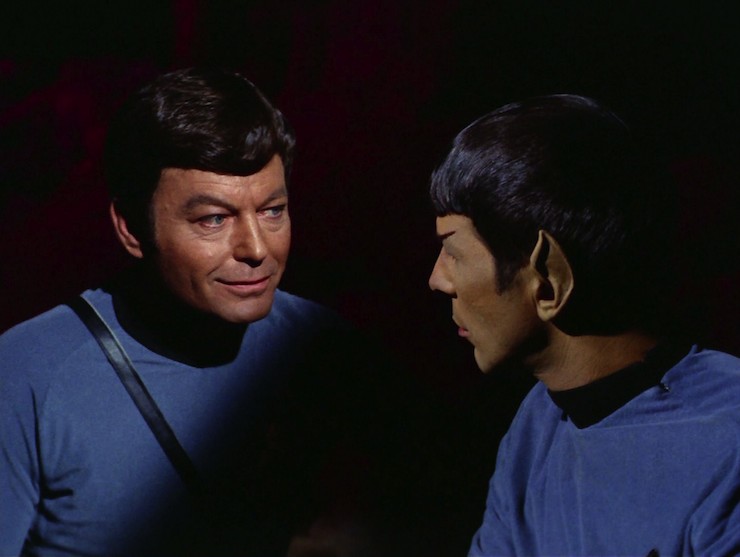
Fascinating. When Spock shows off his disruptor he says, “It cannot fail.” He then activates it and it totally fails.
I’m a doctor not an escalator. McCoy doesn’t seem to do much in the episode beyond keeping us apprised of Hedford’s failing health, but he helps Spock with his breakthrough regarding the Companion’s physical nature and he’s the one who talks Kirk into trying diplomacy.
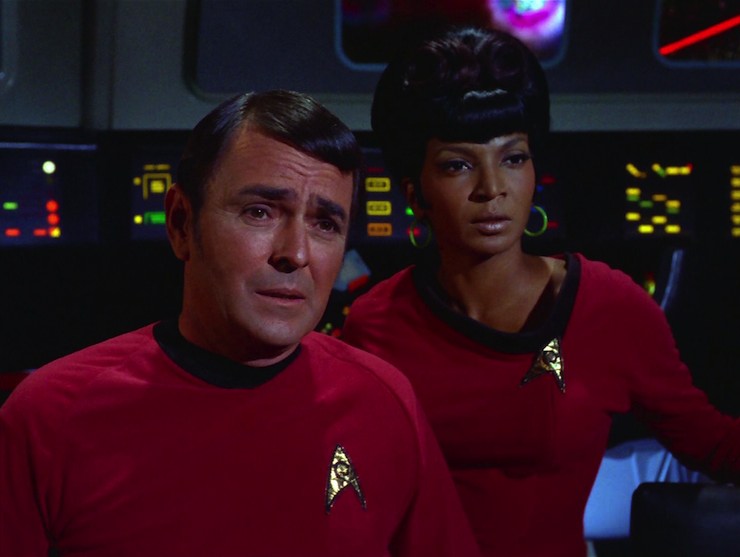
I cannot change the laws of physics! Scotty is in charge of the Enterprise in Kirk and Spock’s absence, and he leads the search party.
Ahead warp one, aye. Sulu does the actual work of searching, and gets on the right track, but the Companion fixes Galileo before the Enterprise can complete the search.
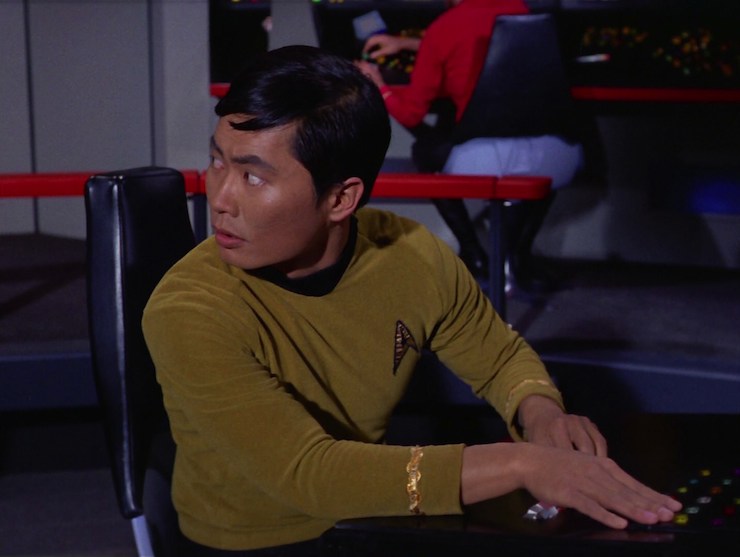
Hailing frequencies open. Even though she’s a bridge officer and therefore should understand how searches work, Uhura asks Scotty lots of dumb questions and expresses concern about the search pattern in order for Scotty to be able to explain that stuff to the audience.
No sex, please, we’re Starfleet. Kirk says that the concepts of male and female are “universal constants,” and that the UT somehow just knew that the Companion was female. Right.
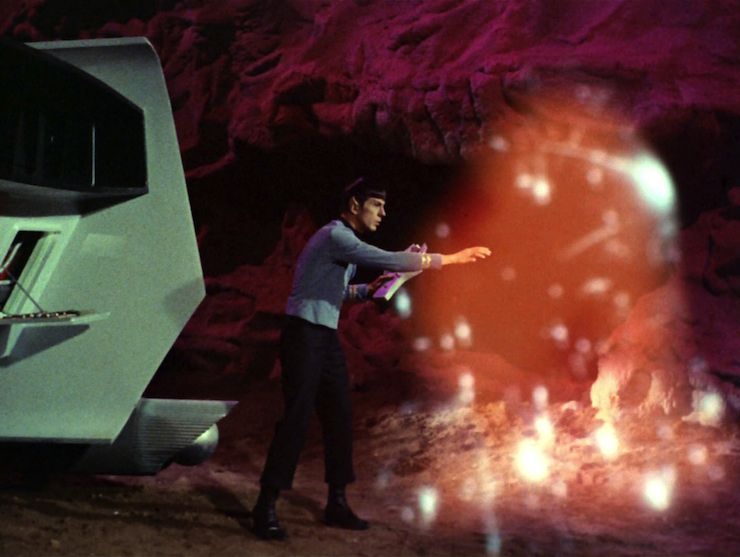
Channel open. “I could even offer you a hot bath.”
“How perceptive of you to notice that I needed one.”
Cochrane being polite and Hedford being rude. Hilariously, she never takes him up on the offer of a bath…
Welcome aboard. Glenn Corbett debuts the rather influential character of Cochrane, while Elinor Donohue plays Hedford. Elizabeth Rogers does the voice of the Companion—she’ll return in “The Doomsday Machine” and “The Way to Eden” as Palmer. Plus we’ve got recurring regulars James Doohan, George Takei, and Nichelle Nichols.
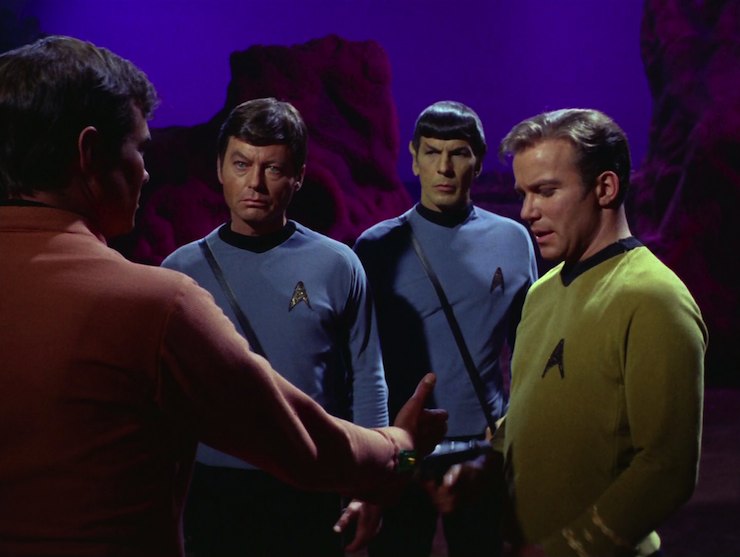
Trivial matters: The character of Cochrane will be referenced any number of times—e.g. “Cochrane distortion,” cited in the TNG episode “Ménage à Troi“—and be seen again as a younger man played by an older actor, James Cromwell, in the film First Contact as well as a couple of episodes of Enterprise. The Cochrane of the movie is far different from the one in this episode, but Glenn Corbett’s Cochrane had lived for centuries on a planetoid with only a giant flying omelette for company after his decision to die in space as an old man. Cromwell’s Cochrane hadn’t yet become the famous pioneer, and was instead a cynical drunken scientist living in a post-war mess.
Cochrane is regularly mentioned throughout the Enterprise series, and is credited in that show’s pilot episode, “Broken Bow,” with coining the Starfleet catchphrases about seeking out new life and new civilizations and boldly going where no one has gone before and so on.
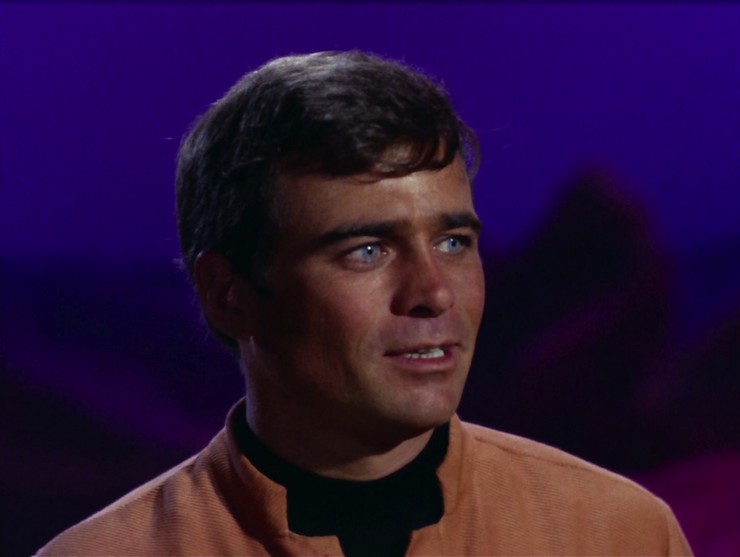
Cochrane’s backstory was also developed by Judith & Garfield Reeves-Stevens in the brilliant novel Federation, which came out several years before First Contact, and more recently in Federation: The First 150 Years by David A. Goodman.
A sequel to this episode was done in issue #49 of Gold Key’s Star Trek comic by George Kashdan and Alden McWilliams, with the Enterprise again encountering a much older Cochrane and Companion/Hedford.
In addition to the James Blish adaptation in Star Trek 7, it was also adapted into a fotonovel, which also included an interview with Elinor Donohue.
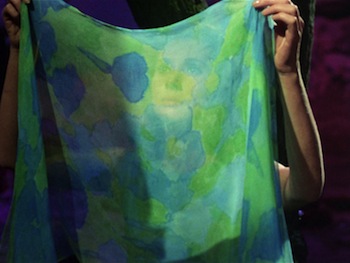
Several scenes had to be re-shot due to the film negatives being damaged. However, in the interim between the original filming and the reshoots, Donohue had contracted pneumonia and lost ten pounds. They tried to hide this by judicious placement of her scarf.
To boldly go. “You are, after all, essentially irrational.” This episode makes me crazy.
On the one hand, it’s incredibly progressive. Cochrane’s attitude toward being in love with a giant flying omelette is pretty standard for 1967, but Kirk, Spock, and McCoy’s utter casualness about it is a joy to see. After all, here we are 50 years after Star Trek debuted, and there are still people who think anything other than a monogamous relationship between heterosexual people of different genders is icky. Cochrane’s situation with the Companion borders on bestiality in some senses (before you go “ooh, ick,” keep in mind that the same is true of Spock’s parents), but in the 23rd-century Federation it barely warrants a comment.
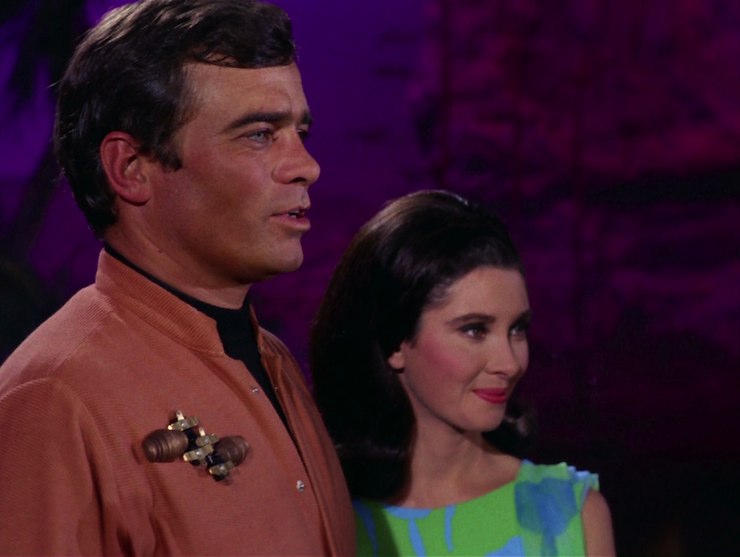
On the other hand, it’s depressingly traditional. Every time I hear Kirk say that the idea of male and female are universal constants, I want to throw my shoe at the screen. Never mind that it isn’t a universal constant even on this planet—there are genderless species out there, for starters—it shows an appalling lack of imagination. And the sexism is just awful. When they didn’t think of the giant flying omelette as female, it was considered at best someone keeping Cochrane as a pet, at worst his jailer. But as soon as the universal translator identifies the Companion as female (and how the hell does it do that anyhow? It’s a giant floating omelette, in what way can it possibly be considered female in any meaningful sense?????) everyone just assumes that it has to be a lover. Erm, why? If she’s female it has to be a romance because, y’know, female hormones and stuff. Except why would a female giant flying omelette react the same way as a female humanoid?
And then we have Hedford’s speech, where she says that she’s good at her job but has never known love, a speech that would never, under any circumstances, be given to a male character. (And why is she an assistant commissioner? Ferris in “The Galileo Seven” got to be a regular old commissioner, and he was just delivering medicine. Hedford is negotiating a peace on a warring planet, and she’s just an assistant? Seems to me that she has the harder job…) Having said that, in the end, Cochrane actually does choose a life of love over a life out in the galaxy he helped make.
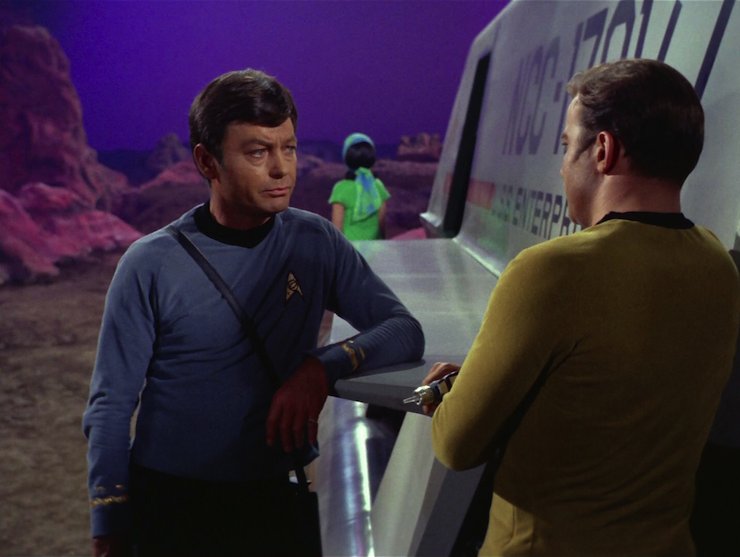
Also, while the “Kirk, Spock, and McCoy go on all the landing parties” trope is pretty well entrenched at this point, it’s even stupider than usual here. All they were doing was ferrying a commissioner from a planet to the Enterprise—this really requires the captain and the first officer? Seriously?
Cochrane is an interesting character, and it’s fun to see the clash of values between him and our “modern” heroes, but ultimately this episode is maddeningly schizophrenic, jumping back and forth between a serious look at the future of humanity as filtered through the encountering of many aliens and taking an idiotic view of the future of humanity as filtered through the lens of 1967 values.
Warp factor rating: 5
Next week: “Friday’s Child”
Keith R.A. DeCandido‘s Heroes Reborn eBook novella Save the Cheerleader, Destroy the World is now available for preorder. One of six novellas tying into the new NBC series, Keith’s tale will be released on the 20th of November, and can be preordered from Amazon, Barnes & Noble, or Kobo.


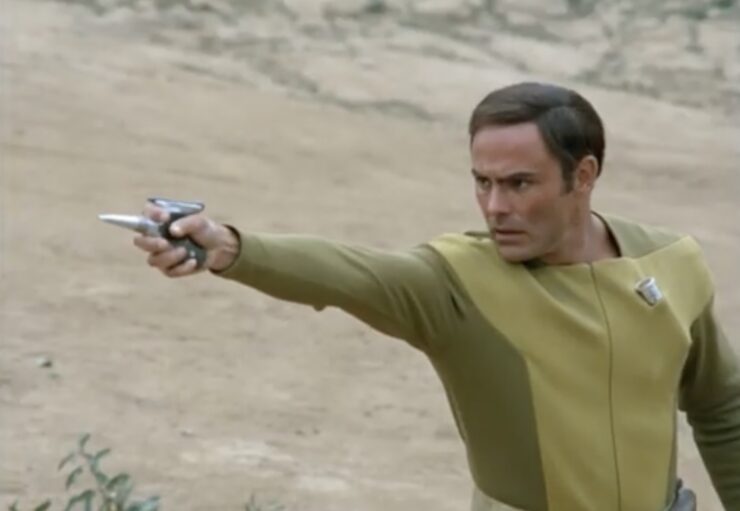


Baby steps. It’s probably partly because episodes like this slightly nudged open the door to the idea of unconventional forms of love that we’re able to take it so much farther 50 years later. At the time, they couldn’t have taken it much further than they did, not and still gotten it on the air. But it was a start.
I like this episode for its production values as well as its story. The score, the first of six TOS scores by George Duning (who studied at the same college of music as my father), is beautiful, lyrical, and romantic, one of my favorites. And the set of the Companion’s planetoid is probably the show’s most successful simulation of an outdoor environment on a soundstage, complete with clouds in the sky.
It does have its issues, though. As I remarked during the “Menagerie” rewatch, if the Federation had translator devices that could read the brain waves of alien energy clouds and convert them into English, why couldn’t they get more than yes/no beeps out of Pike? And, yes, there’s the question of how the Companion can have a gender that the translator can detect.
Christopher: I’m aware, but this is also a rewatch taking place in 2015, not a firstwatch taking place in 1967. Part of the point of the exercise is to rewatch the show with modern eyes. It’s more extreme than it was for TNG and DS9 (and Stargate, for that matter), but still examining it with contemporary eyes, as it were.
—Keith R.A. DeCandido
Funny thing is, I took that more as him being in love with a woman. I’m probably viewing it through highly personal lenses, but I see it as “oh my god, it’s a woman?!” I kind of see Cochrane as thinking of himself as gay up to that point (obviously not, because it’s 1967, but this is the story I tell myself), and then when he realizes the Companion is female it makes him question his own identity.
And then, of course, you get fluid sexuality dropped in at the end, as they ride off into the sunset together on white ponies. Or something like that. In any case, I take his horror at being more toward the fact that it’s female than the fact that it’s a giant flying omelette.
It’s been a while since I’ve seen this episode (more than30years in fact) and what really strikes me is the casualness with which the crew leaves a diplomat on their way to settle what we can only assume to be a major war (you don’t divert the equivalent of a Navy cruiser with all of its personnel to ferry someone to a war unless the stakes are really high) to be taken over by a non-corporeal alien of a type never encountered before on a desert planet, leaving the gestalt being so created shack up with an assumed long dead foundational genius of the Federation.
It also beggars belief that having done this, they would then promise to keep this series of events a secret!
Well, there’s your answer for why Cochrane looks so different in this episode and First Contact. Why it’s “Cochrane distortion” of course! Or… let’s just say he went through a… wait for it… metamorphosis if you will.
Despite the goofy parts of this one, I like it. Adds a nice bit of, as much as I hate to use this term, “world-building.”
@3: But how does that reading jive with the fact that Cochrane was also shocked that Kirk, Spock, and McCoy weren’t shocked?
To be fair, the great majority of animal species on this planet have distinct male and female sexes. Although how the UT could tell which one the Companion was is beyond me.
@8/ad: But as Keith pointed out, not all animal species on this planet have distinct sexes, or are limited to only two. (There’s a kind of microbe that effectively has seven sexes.) “The great majority” is not enough to constitute “universal,” because “universal,” by definition, means that there are no exceptions. (As in “universal translator,” a device that can translate every language.) The episode’s claim was that a simple binary model of gender is the only one that exists anywhere in the universe, and that is obviously not true.
“And then we have Hedford’s speech, where she says that she’s good at her job but has never known love, a speech that would never, under any circumstances, be given to a male character.”
It does provide some basis as to why Hedford would be accepting of sharing her body with the Companion, especially since it apparently let her die in the first place (the Companions actions with regard to Hedford are quite sketchy, jealousy to a semi-consensual deal with the devil for a “Grand Theft Me”).
However, is that speech really much different from Kirk’s “no beach to walk on” speech about his relationship with the Enterprise in “The Naked Time”?Perhaps the Companion decided it was female from its interactions with Cochrane’s mind over the years. It apparently should not have normally felt the kind of emotions it developed for Cochrane. Putting them in the human context of a male/female relationship justified to itself why it was feeling these things and the translator picks up on that human idea.Wonder exactly what happened to Cochrane to go from a goofy, irresponsible drunkard to this Captain America type.I think Kirk is going to regret his promise to Cochrane when Starfleet wonders how Kirk misplaced a deathly sick asst. Commissioner and not even have a body to bring back with him
For a change I don’t agree with the review at all. This is a beautiful episode and should get at least a rating of 7. Watched with my “modern eyes”, it holds up very well and contains very little sixties sexism.
First item: Hedford’s job. It’s silly that she’s just an “assistant commissioner”, but that’s a minor flaw. The writers gave her the job to stop a war! That wasn’t necessary for the story – they could have invented any other backstory for her.
Second item: “The idea of male and female are universal constants.” Totally silly. Agreed. But I don’t think it’s such a big plot point. After all, Kirk and McCoy are on the right track right from the beginning. When they see the Companion and Cochrane together for the first time, there’s this dialogue:
McCoy: Almost a symbiosis of some kind, a sort of joining.
Kirk: Exactly what I think. Not exactly like a pet owner speaking to a beloved animal, would you say?
McCoy: No, it’s more than that.
Kirk: Agreed. More like love.
So, no, they don’t consider their relationship “at best someone keeping Cochrane as a pet, at worst his jailer”. They understand what it is right away. The rest is TV drama – there has to be a turning point, so they come up with the female voice and the silly explanation. Points off for that, but no more than two :-)
Third item: “a speech that would never, under any circumstances, be given to a male character”. I don’t agree. Maybe they wouldn’t have a male character use the exact same words, but when I imagine it with switched gender roles, it works just fine. (Well, I guess they wouldn’t have made the genius engineer female in the sixties, but we’re watching it with modern eyes, so there.) As Crusader75 wrote, Kirk makes similar speeches on more than one occasion. And Cochrane makes the exact same decision as Hedford in the end, despite having been intrigued by the prospect of seeing the new world before. No gender bias here.
And there’s so much to like! As Christopher wrote, the setting is just great. And did we know that starship captains are trained to be diplomats? Also, I like the fact that Cochrane is from Alpha Centauri, so we get the information that there was some human space travel before the invention of the warp drive. (Sadly, First Contact changed that.) Finally, I also like Hedford’s outfit.
@3/MeredithP: That’s a cool interpretation, but does it fit with the way Cochrane treats Hedford when he first sees her (“You’re food to a starving man”)?
@10/Crusader75: Apart from being a goofy drunkard, the Cochrane from First Contact was also a brilliant inventor. We don’t get to see enough of him to really know him.
I thought Shatner delivered that last line with a proper “yeah, this is going to be _my_ problem, isn’t it?” tone of exasperation.
@12, @13; I agree. That is not “a speech that would never, under any circumstances, be given to a male character”. Besides Kirk we have already had a couple of examples of Spock talking about love.
In This Side of Paradise Spock tells Leila, “I love you, I can love you” with a genuine sense of wonder and happiness and ends the episode with an almost wistful observation “that for the first time in my life I was happy”.
In The Naked Time Spock tells Kirk, “My mother. I could never tell here that I loved her”, and “Jim, when I feel friendship for you, I’m ashamed”.
Granted Spock was under the influence of outside forces when he said those things but he did say them.
Definitely more than a 5. At least an 8. I adore this episode. First and foremost, as Christopher pointed out, this show earns major points thanks to the memorable George Duning score as well as the outstanding production design which simulates what’s likely the best non-location outdoor environment ever done in the series. Ralph Senensky executes the whole episode with a lot of grace, delivering a unique take on the usual campy adventure format, giving a lot of space for reflection and emotional resonance. Slower paced, but in a quirky fashion. Easily one of the best directing efforts of the original series.
Many people give First Contact a lot of undeserved flack over its different portrayal of Zefram Cochrane. Clearly they didn’t remember that Metamorphosis takes place 200 years after the film’s events. A person can change over time. The funny thing is FC nailed Cochrane’s essence as a character. He was a lone soul who always wanted to be left alone in some shape or form, preferably in some far-away forgotten paradise.
In the film he wanted to live at an island with naked women (I wonder if Ron Moore and Brannon Braga threw that line in the script as an indirect reference to a possible homossexual tendency). In the end, he still got his wish and got lost in space with a lone companion.
Could they have avoided the whole sexism issue by not having the companion be a female? Possibly, but then again, there’s no way they would have gotten anything else past the censors (heaven knows they threw a fit over Plato’s Stepchildren). It was a backwards stance, but that’s as far as Gene Coon could take the concept in 1967. Imagine a network meeting where a writer pitches the word genderless. Heads would fly.
It’s even not even as bad as what Jeri Taylor would do 25 years later, with some really poor dialogue choices in The Outcast. Thankfully, Trek would get this kind of story right later on. The DS9 folks finally did a proper unconditional love story through Rejoined, plus Rick Berman and Brannon Braga brought forth the outstanding Enterprise episode Cogenitor.
@@@@@ Crusader75
“II think Kirk is going to regret his promise to Cochrane when Starfleet wonders how Kirk misplaced a deathly sick asst. Commissioner and not even have a body to bring back with him.”
I doubt it. Kirk was wonderfully free of consequences throughout the TOS run. It wasn’t until the movies that he really paid. And the only “punishment” he got was to be busted back to Captain of the Enterprise.
The Companion does not look like a flying omelette, more of a flying lemon jello fruit salad.
@11/Jana: Referring to “Zefram Cochrane of Alpha Centauri” doesn’t necessarily mean he was from Alpha Centauri. Lawrence of Arabia and Scott of the Antarctic were both from England. Helen of Troy was from Sparta. The episode repeatedly stated that Cochrane was a human and implied that he was from Earth (e.g. “It’s not Earth, but it’s home” — and the asteroid’s conditions as created for Cochrane by the Companion being a near-perfect match to Earth). So the “of Alpha Centauri” epithet was probably meant to indicate that Cochrane was famous for colonizing Alpha Centauri or for being the first human to travel there, rather than that he was born there.
I didn’t think much of this episode, but I did like the line, “Immortality consists largely of boredom”. We’ve seen this idea come up in various forms in other TV shows, movies, and books.
I rank this episode as one of the worst ever, mostly because of Hedford line. So there’s a woman who has diplomatic mission but falls ill, then either dies or is taken over by some non-corporeal being and – if case some of her mind still remains (it probably does, because there’s a line “In a moment, there would have been no continuing“, so Nancy was alive in the moment of joining) – is forced to live on some planet with a guy she met 2 hours ago. All in the name of Great Love, apparently.
Well, maybe she was asked and maybe she did give her concent to being taken over and maybe she indeed likes Cochraine. But the fact it was not shown on screen or even alluded to bugs me to no end, especially because her “never known love” speech hardly translates for me to “ok, I’m happy to live here with a guy who is in love with electrical cloud because !Love!”. And what bugs me even more is that everyone is absolutely ok with it. So she died or is posessed, no big deal, Cochraine and Companion are happy and it’s all that matters.
I find it all hard to believe, especially with the attitude towards mind-control established in previous episodes, and I shudder to imagine myself in Hedford’s place. So this whole episode just screams “wrong, wrong, wrong!” to me. I’d give it 1 for team interaction and some dialogues, but that’s about it.
@@@@@ Crusader75 as for Kirk regretting… I’d imagine Hedford would be reported dead, and even if investigation is opened shuttle’s logs will show emergency landing and all systems failing and McCoy’s instruments and his logs will record rapid decline of her health and terminal condition. No body may be explained by the nature of disease, if there is risk of contamination she’d be buried where she died… Something like that. Although this is another thing that rubs me the wrong way about this episode.
@17/Christopher: I didn’t know that “<person> of <place>” has this meaning. Thanks for improving my English!
@19/Darr: It isn’t mind control, it’s a symbiosis. Rather like the Trill. At least, that’s what Hedford/the Companion herself states (“We are both here”, “that part of me”). I guess you could criticize that they don’t check if she’s telling the truth, but I imagine that Spock would notice the difference.
@9 That is true. Indeed,there are fungi with 36,000 sexes: http://www.independent.co.uk/news/scientists-discover-why-fungi-have-36000-sexes-1119181.html.
But in any given reproductive act, one fungi takes on the male role and the other the female. Hermaphrodites often have fights over who takes which role (neither wants to be left holding the baby, as it were). There are few parthenogenic species, and Richard Dawkins pointed out that they seem to die out rather easily, with one mysterious exception: http://harvardmagazine.com/2000/11/an-evolutionary-scandal.html
So sex does seem to be quite a big deal, for reasons we don’t quite understand, at least for Eukaryotes like ourselves, mushrooms, and vulcans.
So Kirks statement was an exaggeration, but not much more of an exaggeration than calling the Universal Translator a Universal Translator.
Oh, come on, too much is being made of the universal male and female constant line. This is Kirk we’re talking about here. Sure, there are fungi and microbes that have multiple sexes, but that’s really something that would interest Spock more than Kirk. Are women a constant throughout the universe? James T. Kirk would certainly hope so.
@22/GeorgeKaplan: It’s Spock who adjusts the universal translator. It’s Spock who says that the matter of gender could change the entire situation. It’s McCoy who tells Cochrane that he’s not a pet but a lover. “Male and female are universal constants” is a fact in the context of this episode.
As I said, I think it’s a TV shortcut for “the Companian loves Cochrane; Cochrane never notices; he’s disgusted when he finally finds out”.
@22/GeorgeKaplan – I’m going to agree with @23/JanaJansen. Kirk may be the one who says it, but he says it as if it’s an obvious fact of life, basic science everyone knows.
@6/Idran – I dunno, maybe he thinks everyone is gay? I didn’t say it was logical, I said it was headcanon! Really, though, I do have gay male friends who react the same way to the suggestion of relationships with women. They’d totally do an “am I right, guys?!” in this situation, even without knowing the orientation of the “guys” they’re addressing.
@@@@@ 20/ JanaJansen My problem with buying a symbiosis theory is that we only hear Companion speaking about new experiences and so on and Nancy is kept silent. Phrases like “we would not know love because we were not human” sound a bit strange if part of it comes from Nancy… On the other hand, symbiosis hints at a rather disturbing threesome where Cochraine is landed with two women one of whom he doesn’t even know and the other he never considered as a love interest, Nancy is stuck on a planet with some stranger and an alien-thinking something in her body, and Companion is just beginning to understand how humans work. Oh, and did I mention the idea of this episode seems somehow wrong to me? :)
@Ad and @ChristopherLBennett
As a microbiologist, I can tell you that the majority of life on earth are billions of different kinds of Bacteria and Archaea, and they do not have a “female” or a “male” version of their species. So, not only the female/male concept is not universal, it is not even applicable to our back yards, our own bodies (in our bodies we have more bacteria/archaea cells than our own), basically anywhere on earth where these little critters thrive.
@26/VN: Absolutely right. Life on Earth existed for more than 3 billion years before sexual reproduction evolved. Sure, it turned out to be a nifty way to accelerate genetic change and give evolution the jumpstart it needed to create multicellular life, but just because it proved a useful upgrade on Earth, that doesn’t guarantee that it would evolve on other planets, or that it would turn out the same way. And since it was so late an arrival on the evolutionary scene, that means it’s hardly an innate, fundamental property of life.
As I recall, bacteria use conjugation to swap DNA strands, and in many ways it strikes me as a much better system than sex. But almost every complex multicellular creature uses sex, and not conjugation, which suggests there may be a very good reason to use sex, if you are not a unicellular bacterium.
So I don’t think it obviously absurd for Trek to have a universe in which it is the near-universal system among intelligent beings, which of their nature must be complex. It is perfectly possible that OUR universe is like that. (Or it may not be. )
It is certainly more likely than a lot of characteristics of the Trek universe.
About the Universal Translator: Look, we all know the UT works by magic and is made by Keebler Elves. The way it works makes no rational sense whatsoever. We can only assume the people who buy them insist on believing it isn’t magic despite all the evidence and that the Keebler Elves just don’t want to explain the principles behind it.
****
I have mixed feelings about Hedford’s speech. I think a lot of people get to a point where they question the choices they’ve made and potential relationships they’ve sacrificed. I don’t see that as just a women’s issue.
I think it would have been more interesting if they were returning from a successful negotiation–not leaving in the middle of one–and that Kirk and company had been there as officers putting in an appearance for PR purposes. Hedford could have had a condition that she’s known for years is going to lead to her early death. Her bad temper is because she knows she’s near the end and doesn’t want to explain any of this to relative strangers. She may have been driven to achieve in the short time she had but her isolation might be more due to being someone who will die young in a world where most people take long life-spans for granted (guys in red shirts excepted) rather than sacrificing her personal life for her career. Cochrane is her opposite, a man who’s been isolated as the price of immortality.
It makes her disappearance a bit easier to explain. Her death wasn’t unexpected or at a critical time in negotiations. She would also be the kind of person who might request to have her body left on the asteroid where she died.
*****
Discussing male/female evolution:
In the original Trek, we’ve seen multiple intelligent species with different evolutionary histories where the human-level, intelligent lifeforms all evolved male/female. Kirk’s reference, then, may be to male/female among human level intelligent life forms. As of the time of this episode, Kirk either doesn’t know of any intelligent species that don’t have a male/female split or he’s very good at rationalizing away data that doesn’t fit his worldview, your pick.
#24
And I’m saying Kirk may know that basic science but he doesn’t care. For two space cowboys like Kirk and Cochrane there’s a universe of green babes out there, and that’s all that matters. (Or am I confusing Kirk with Zapp Brannigan?) In any event, the captain can’t announce to his crew he’s made it with a microbe.
I’m with Darr (and Keith) on this one. Woman with important career is Not Happy because she’s Never Had Love. If she gets the chance, could conceivably throw over career and all previous life choices in order to hook up with a man she’s known for a couple of hours. Yes, I know she’s dying, but it’s not clear to me that she would accept this “life” as a happy ending. I definitely think there are sexist assumptions at work here. Her statement about never having had love is not equivalent to Kirk’s or Spock’s regrets. (Kirk is not saying he’s never known love, just that he’s chosen work over a constant relationship–and his lament over what he’s given up does not mean he would rather choose otherwise. Spock is talking about being cut off from emotion generally as well as romantic love specifically.) After all, it could not conceivably be a happy ending for one of them to Trilled into life with a gal on a planet with no other people and no work for them to do. I also do not think that Cochrane’s choosing to stay with her/them rather than to re-enter the mainstream is a choice equivalent to Hedford’s (if, indeed, she can be said to have had a choice). There’s no clear suggestion that he could have important inventing work to do in the present, is there? And certainly he has no relationships with other persons currently alive.
If you take Hedford’s POV in this story, the ending just sucks. Hard for me to imagine Nancy and the Companion getting along longterm, unless there is some mind-alteration involved in the symbiosis. Even if she enjoys the lovin’ by sharing the Companion’s infatuation with Cochrane, when the novelty wears off she’s gonna want her some diplomacy to do. And some aliens to talk with who have more complicated goals than “I want my man to love me back.”
Plus, Kirk’s cavalier statement that they’ll just find somebody else to do her work is obnoxious.
Mostly, I think the notion that this is a happy ending is based on the ridiculous romantic ideal that two people can find everything important in each other, apart from society, other relationships and commitments, and occupation for their brains and talents. The romantic ideal here is complicated by the involvement of the flying lemon jello, but to all intents and purposes the FLJ gets merged with the (other) Woman in Need of a Man, so you’re left with two individuals who are supposed to find happiness just in each other for all eternity. Gah.
And yes, I have some of the same issues with the ending of “Menagerie”….
@28/ad: “As I recall, bacteria use conjugation to swap DNA strands, and in many ways it strikes me as a much better system than sex.”
Then you really need to get out more… ;)
“But almost every complex multicellular creature uses sex, and not conjugation, which suggests there may be a very good reason to use sex, if you are not a unicellular bacterium.”
Not necessarily. Sure, on this planet, it works better than other methods, but that doesn’t necessarily apply universally. Evolution isn’t driven by inevitability, but by productive happenstance. If it happens to produce a trait that works, that trait will be kept. But that doesn’t rule out the possibility of other traits that work just as well but just didn’t happen to crop up in the luck of the draw. On another planet, maybe mutations happened differently and another method of reproduction that works just as well as sex was coughed up by random chance insteaad. Whichever method came first would’ve been successful enough to supplant the other from ever taking hold.
If there’s one thing we’ve learned from modern exoplanet studies, it’s the folly of assuming that the way things have happened for Earth are a universal inevitability. When we’ve made that assumption about geology or the formation of planetary systems, we’ve generally turned out to be wrong. It’s just not wise to extrapolate from a single example. So the same might go for biology. What seems like a universal rule to us may simply look that way because we’ve simply never seen anything different and are too limited to imagine it.
OK, let me clarify. I think the conflict brought up–personal live vs career–is a common one. Yes, I agree that the way it is presented in the episode it is very much saying things about a woman evaluating her life by 1960’s standards. Also, it equates a personal life with romance, not other family or friends. It’s also complicated because her job is apparently negotiating peace settlements that will save thousands, perhaps millions of lives. It seems difficult to do that and still question whether or not your life has had any positive impact on others.
But, the basic question still seems like a valid one that I can see someone asking.
I also agree that, assuming everything else in this romance works (big assumption), two people living in isolation are going to get lonely and get on each other’s nerves. It’s a hard situation for humans.
That said, I’ve always liked the Companion’s reaction to feeling loneliness for the first time and the bit where she’s holding up the scarf and you can see the similarity to patterns of light she made in her old form. She’s looking at it and seeing it as a human would for the first time but there’s also a suggestion that she’s seeing the world as she used to through it.
Usually on Trek, the aliens who become human are like Sylvia in Catspaw or overly sheltered teens who are suddenly let loose as college freshmen who have joined a fraternity with nightly parties and who are loving the pure hedonism of it all even if they get overwhelmed by it. Here, we have an alien who is hurting because she’s become human, but that’s overshadowed by her understanding that Cochrane has been dealing with this save kind of pain for decades.
I like this episode. It may have problems and weaknesses, but I always feel like its heart is in the right place.
*****
That said, I think I should mention a reason Cochrane has for being squicked by the Companion being in love with him. They’ve shared a very intimate, telepathic bond. Cochrane has either seen it as platonic or may have convinced himself not to see the signs that it’s not platonic for the Companion. In that sense, what upsets him isn’t that the Companion is an alien who is love with him, it’s that he’s seeing things that happened when they were linked in a different and disturbing way, that boundaries he’s been able to ignore were violated.
@Ad and @ChristopherLBennett
That depends on how do you define a complex organism. Multi cellular life forms might look complex, but the vast majority of them does one simple thing to survive, taking up electrons from an organic substance and putting those electrons on molecular oxygen. In simpler terms, for their survival they respire oxygen and eat sugars (apart from a couple of exceptions).
Species of Bacteria and Archaea on the other hand, not only can do that, but also can perform any chemical reaction that is thermodynamically feasible, i. e. allowed by the laws of chemistry and physics. They can use light, they can use all sorts of compounds that are exotic or toxic to us (benzene, phenols, naphtaline, nitrates, sulfates, heavy metals, etc. etc.). They can pull of reactions at room temperature that chemists need high pressure, high temperature and very expensive catalysts to function. Imagine making rocket fuel in your body; yep bacteria can do that too. They do all this with very elegant, but complex network of proteins.
They can also live in environments that are extreme for the higher life forms such as pH 1, 120 degrees centigrade (imagine a boiling pot of mud with a lot of acid in it) and to be able to do that they have elegantly constructed, but very complex cellular structures, lipids, nutrient transport systems, etc.
Yep, they can also use bacterial conjugation for the transfer of genetic material, but they can transfer genes in other different ways as well, such as picking up genetic material from the environment or making use of viruses.
They can also build complex multicellular structures known as biofilms and “talk” to each other using chemicals or bacterial nano-wires which pass on electrons. For example, they can build a large system of many cells, whose top reaches one of their substrates and when the cells on the top of that structure use that substrate, they can pass on the acquired goodies to the other cells below, which share other compounds with the cells at the top.
What I am trying to say with this microbiologist tirade is that complexity has different forms and male/female separation does not indicate a complex life form. I should learn how to shut up I guess! I was going to write just two sentences! :)
Wow, this episode is quite open to interpretation.
@33/Ellynne, I agree with you entirely.
@31/Saavik: I didn’t say that Kirk’s or Spock’s regrets are equivalent to Hedford’s, only that they are similar. I used this to explain why I can imagine a male character giving the same speech.
I imagine that Hedford is happy with her life and her work until she almost dies. Then she reevaluates her life and finds something missing. That doesn’t mean that she made the wrong choices before, only that she now wants to have the things she didn’t have before. And I do think that Cochrane’s choice is equivalent to hers (yes, if she had a choice – I assume that the Companion asked her before joining with her, but that’s headcanon) – not the same, but equivalent. No, he isn’t working on anything currently. But he could see the results of his previous work, he could learn about new technology, meet lots of new species and people. That’s not the same thing, but it’s equally worthwhile.
That said, I have issues with The Menagerie too, but mostly for a different reason – it irks me that after Star Trek usually is all about rejecting a life of pleasant illusions, it’s suddenly seen as the best choice if someone is physically disabled. But the random female that is thrown into the bargain is an additional annoyance.
@25/Darr: I agree that it would have been better if Hedford/the Companion had said at least one sentence that sounds like Hedford and not like the Companion. It might have been difficult to come up with such a sentence, though, because we don’t know Hedford all that well. We don’t know what she’s like when she isn’t in a bad mood or ill. I take the symbiosis at face value, but if you don’t, I really can’t say anything to convince you otherwise. I don’t think it’s a “disturbing threesome”, though – I think this mixture is what will prevent them from getting bored in the decades to come :-)
Come to think of it, it would have been nice if Kirk and Spock had talked to Hedford too in the final scene, not just to Cochrane. OK, so it’s a 7, not an 8.
@30/GeorgeKaplan: We’re talking about different things. I’m talking about the episode – nothing in the episode would change if you gave Kirk’s statement to Spock instead. You’re talking about Kirk’s character, and how it would make sense for him to make this statement in any other context too. (By the way, that’s not how I see his character, and neither Cochrane’s, at least in this episode. First Contact is a different matter, unless you go for the nice interpretation Eduardo gives in @14.)
@22 – GeorgeKaplan: No, even if Kirk is not a scientist (and he’s an explorer), he can’t spout out stuff like “male and female are universal constants”, when here on Earth we have people who are gay, intersexed, asexual, etc, etc. Would any of that would have gotten past the network? No, but as krad said, this is a REwatch.
Also, have you been paying attention to this rewatch? Kirk is NOT a space cowboy, and his macho macho antics (despite him having some affairs here and there) are actually pop culture exaggerations.
@23 – Meredith: Your male gay friends automatically think any other men they meet are also gay?
#35 #36
Please realize my comments on this matter are meant to be very tongue-in-cheek. Sorry, it’s just hard for me to take a story about a space omelette—or whatever you want to call it—from a show made in the late ’60s quite this seriously. But hey, one commenter’s irreverence is another’s thesis. Rock on.
Have you noticed we’re all trekkies? Of course we’re taking this seriously. :)
@35 – The problem with whether Companion asked Hedford if she wanted to merge with it or not is Hedford dies as a direct result of the Companion holding them there and apparently refuses to heal her (like it does with Cochrane) because it is jealous about Cochrane’s pleasure at seeing a young attractive human woman. Hedford has the choice to remain dead or merge with the creature responsible for her not getting the medical care that would have saved her life. It is a choice made under some duress.
@39: Hedford would have died if the Companion hadn’t merged with her, so it wasn’t much of a choice. And the Companion was indirectly responsible for her death because it abducted the shuttle. I’ll give you that.
As for the rest – my, that’s a grim reading of the episode. I can think of at least two others:
1. The Companion really couldn’t heal Hedford except by merging with her. Sakuro’s disease is not the same as old age. It’s perfectly possible that it could reverse the one without being able to heal the other. We don’t know how this alien medicine works anyway. That’s what I always believed. Maybe I’m naive?
2. The Companion refused to heal Hedford because it wasn’t interested in anyone but Cochrane, and there were still three people left to keep him company, so why bother?
I don’t think that the Companion was jealous because I don’t think it understood the concept of “a young attractive human woman”. It didn’t understand humans. It didn’t understand loneliness. It didn’t understand love. It wanted Cochrane to be happy, but Cochrane had to spell out his need for human company before it acted. If anything, the fact that Cochrane liked Hedford best would have been an additional incentive to heal her.
I love this episode. It’s a nice, quiet episode, beautifully scored, with really great production values. It examines, as much was possible in 1967, what love is, and how our limitations can keep us from seeing it when its there in front of us. The score for this one is one of my favorites, and to me one of the best of the entire series. The set for the planetoid is so great; it really sets the tone for the episode. No fisticuffs, no space battles, just quiet, thoughtful examination. As hokey as the end may seem, it’s done really well. Elinor Donahue’s quiet delivery of Companion/Hedford’s new reality (being human, knowing love as well as eventually knowing death) is always moving to me, with that fantastic score to back it up. I love the screen cap at the top; it’s probably my favorite moment of the episode.
@30/GeorgeKaplan: Besides, space cowboys are guys who herd space cattle.
A lot of you are probably already aware of this, but a few years back Ralph Senensky started blogging about his experiences as a director. He has done blog entries on each of the 6 and a half episodes of Star Trek that he directed. I recently read through them all and found them quite enlightening. The entry for Metamorphosis can be found here:
http://senensky.com/metamorphosis/
Robert B: Thanks for sharing that!
—Keith R.A. DeCandido
Robert, that’s amazing. That post, and the following ones, are very valuable insight. Thank you!
I guess we’re lucky someone didn’t pull a George Lucas and re-shoot Corbett’s scenes with James Cromwell…
Rather than just assume Cochrane is speciesist maybe we should consider that possibly we don’t know everything about the interaction between Cochrane and the Companion. They have clearly been intimate (mentally) for decades. Maybe some of that intimacy looks VERY different when given a sexual subtext. Or maybe it’s just the shock of discovering that the relationship he’s thought he’s had for the last century or so is very different from what’s really been going on.
@47/Roxana: Well, there’s active racism and then there’s just inexperience. Cochrane came from an era in which humanity had had comparatively little experience interacting with aliens — for him, it would’ve been mostly just Vulcans, who aren’t that different from human. So the idea of something so drastically alien being in love with him was off-putting to him because he’d never encountered the idea before and lacked the experience to deal with it. If anything, he adjusted to it pretty quickly.
This is an episode that I appreciated more as I got older, because it spoke ultimately to appreciating the possibilities of an existence and redressing regrets while one still could. My read on Hedford is that she was essentially a sociopath whose dispassion served her well as a negotiator, since us hoomans tend to anthropomorphize any cute widdle creature we see, and that won’t do when that cute widdle creature is a sentient life form in conflict with other sentient life forms. But the cost to her is that she couldn’t even look at herself as a human, and it caught up with her as her health failed and she realized how differently she could’ve turned out if she could’ve let herself be vulnerable with a personal relationship. Perhaps someone here more fluent than I in modern gender studies could categorize her sexuality, but I’m guessing asexual with occasional hetero leanings that she learned to squelch long ago. So she may be feeling that she has a “piece missing”, and lo and behold, the Companion is that missing piece.
The Companion is almost pure blind love, but noncorporeal, so without the sensual stimuli that inform the nuances of expression. I don’t know of any better way to define gender and sexuality than as a collection of impulses and responses to certain stimuli (and even that is not satisfactory). Perhaps the Universal Translator can recognize a number of genders, but the one the Companion fits closest is human female, simply because the Companion has shaped itself to love Cochrane. And Cochrane comes across as very hetero male here, so — hope I’m not offending! — the Companion has become the yin to his yang, and the UT punts and calls the Companion human female. Best guess.
So, Hedford and the Companion, together, form a symbiotic being; it isn’t that Hedford needed the Companion to become a “complete person”, it’s just that the Companion is a welcome “upgrade” for Hedford since it perfectly patches the piece that Hedford perceives she is missing. The Companion wins, too, since “she” gets to experience love in a directly sensual way that is more compatible with the human creature that “she” loves.
One glossed-over point is how the Companion is tied to the planetoid. You’d think that the Enterprise crew would want to investigate that further, given how planets form and the difficulties with abiogenesis. What is it about planet formation that might create an exceedingly powerful and intelligent life form, but one that cannot stray too far from the planet?
In sum, this is a sweet fable of an episode. It doesn’t really hold up to tight scrutiny if you consider the motivations of a 23rd C. scientific exploratory mission that intersects with a heroic figure from the past still alive through a heretofore unseen sentient development, but I for one can just eat the popcorn and appreciate the neat economy of getting together three of the loneliest creatures in the galaxy.
Hmm, lots of comments about Cochrane’s sexuality, but only one question about how he was a drunk old man trying to get rich in First Contact?
That question was answered in the novelization of First Contact, and I have to wonder if it’s part of a scene that ended up on the cutting room floor, because just one sentence would have totally changed audience perception of Cochrane.
To wit: Cochrane had bipolar disorder (formerly known as “manic depressive”). When he was in a depressive state, he drank because… well, because he was depressed. And when he was manic, he drank to take the edge off the mania.
It isn’t unreasonable to assume that, since the Companion can make him young and healthy again, it (she) could also correct the chemical imbalance that caused his bipolar disorder.
@50/MSpears: I never saw a need to “explain” why Cochrane’s personality was different in “Metamorphosis” than it was in First Contact, because the two stories take place over 200 years apart and he lived through that whole time. Nobody who lives for 200-plus years is going to remain exactly the same person throughout.
@51 And I imagine that by the time he even gave that speech about just being a man and letting history look after itself that was mentioned in FC, that he’d have been a lot more mellow a person than the angry dude who had just lived through a nuclear holocaust. I can’t imagine that did anybody’s temperament any good. I would imagine that in that period we’d be seeing most people at their worst.
MSpears: I addressed that question right in the rewatch entry itself, in the “Welcome Aboard” section.
—Keith R.A. DeCandido
@51/CLB: You misunderstand. I don’t care that his personality changed; you’re right, nobody’s going to remain the same after living for 200+ years. But I had friends who asked me after the movie why he was a belligerent drunk. And the answer is, he was bipolar. So really, the essence of my complaint is that one sentence which probably ended up on the cutting room floor could’ve nipped a lot of questions in the bud.
@54/MSpears: I dunno, I don’t think it needs to be explained why a guy living barely a decade after a global nuclear war would be an angry, bitter drunk.
As it hasn’t been explicitly said to this point – very interesting, insightful post, KevinDenelsbeck!
I found this one extremely hard to pay attention to. It just kept going on and on. Even “Catspaw” was more exciting than this; at least that was so terrible it was almost awe-inspiring. “Metamorphosis” is simply dull.
@57/Fujimoto: Okay, perhaps you should skip ahead to TNG. This doesn’t seem to be the show for you.
I love “Metamorphosis”. Last year I picked it to introduce a friend to Star Trek, and her reaction was: “I’m beginning to understand why you like this show so much.”
@Krad/Cochrane’s manners: I agree he was just being polite, but it is kind of weird that he centred Hedford out in offering a hot bath. Besides, her comeback was awesome!
@The gender issue: Perhaps if the line was that the idea of male and female are fairly common in the universe, it would have been a little less closed-minded.
@57/Fujimoto: I understand where you’re coming from, I did feel this episode dragged on a bit too long. I still thought it was a good episode, though.
@58/JanaJansen: That’s a bit of a harsh assumption. I’m sure everyone has episodes they didn’t like for whatever reason and just wished they would end.
I know I shouldn’t judge this episode based on the movie First Contact–yet it bugs me. Not only does Zephram Cochrane look and totally different–which I can live with–but they specifically say that he was 87 years old when he disappeared a century and a half earlier. That means that Cochrane was like 30-somcething when we saw him in the movie. Really?
I’m really just annoyed at the writers of the movie. Would it’ve been so hard to cast someone so it’d make sense in canon?
Disregarding the age thing which threw me out of the story, I did enjoy this episode. I did think it was strange that the universal translator could not only deduce what the Companion was saying but also deduced its emotional state. That was one perceptive computer! (PS–I know it’s sexist to assume it has to be a woman’s voice since it’s in love with Cochrane but considering this was a show in the 1960’s, I’ll give it a pass.
@60/Mary: “I know it’s sexist to assume it has to be a woman’s voice since it’s in love with Cochrane”
That’s not the reason why; what Kirk said in the episode was that “The ideas of male and female are universal constants” and the translator could tell the Companion was female. It was McCoy, not the translator, who chose to associate that with her feelings for Cochrane.
Of course, that’s still an outdated notion, but the problem isn’t that it’s sexist, but that it’s cis-normative, assuming that gender is binary and immutable. And later Trek has proven that it’s not so universal. TNG: “Data’s Day” established that Andorians marry in groups of four, implying that they may have four sexes (the novels’ interpretation, though it’s not unambiguous). “The Outcast” also established the existence of a species without gender. ENT: “Cogenitor” featured a species with three sexes (working almost exactly like the Tenctonese in the 1989-90 TV series Alien Nation, with the third sex being a minority that catalyzed conception without contributing genetically), and Phlox said in the same episode that “Not all species are limited to two sexes” and that Rigelians have either four or five (he wasn’t sure).
The fact that Hedford is an Assistant Commissioner makes sense to me when you factor in her age – she’s looks a little under 30 and the other commissioner we saw was in his mid 40s at least. I’m guessing that the title of “Asst. Commissioner” is kind of like assosciate or assistant professor in the academic world(and Hedford might have it better – I remember when I was in school some of my instructors, even at the 400 level, were still assoc. or asst. professors even into their fifties… what does it take to get tenure at a university?!).
And yeah, I can actually imagine Corbett’s Cochrane is the same as Cromwell’s just more mellow. Both versions like the ladies but compare how Cochrane is all over Troi in First Contact with how he treats Hedford when he first meets her. 150 years and a lack of tequila will do that.
This episode is okay, although a little gooey for my taste.