








“The Terratin Incident”
Written by Paul Schneider
Directed by Hal Sutherland
Animated Season 1, Episode 11
Production episode 22015
Original air date: November 17, 1973
Stardate: 5577.3
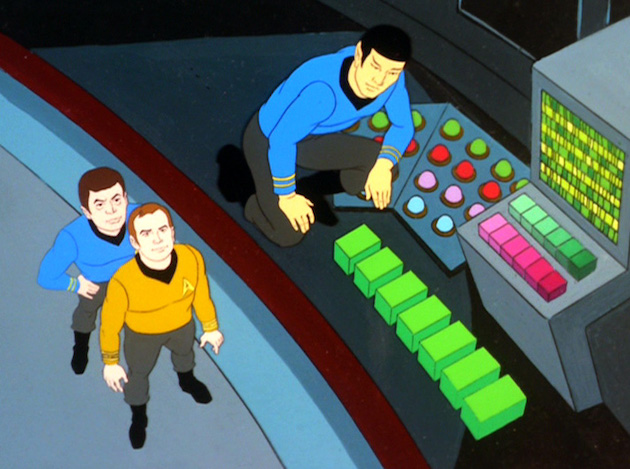
Captain’s log. The Enterprise is investigating the burned-out supernova Arachna. However, Uhura’s attempt to alert Starbase 23 that they’ve arrived is met with interference from Cephenus, a star that has never emitted radio activity before. The transmission is in Intersat Code, which has been out of use for two hundred years, but it broadcasts the word “Terratin” twice before shutting down.
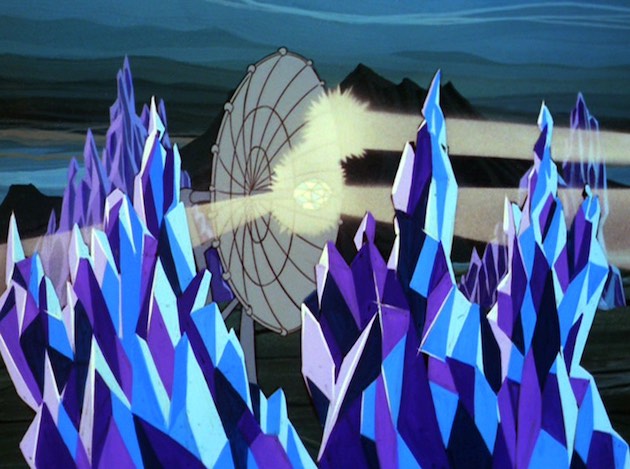
Kirk goes to investigate. When they enter orbit, a diffuse beam of some sort hits the ship, but it doesn’t seem to have adversely affected their systems. The surface of the planet is crystalline, and is suffering from lava eruptions. There’s also an antenna dish on the planet, and it emits a beam at the Enterprise that engulfs the ship and makes everyone glow.
The only damage in the aftermath of the beam is the dilithium crystals, which have spiral fractures that have shattered them. This leaves the Enterprise without anything to channel warp power.
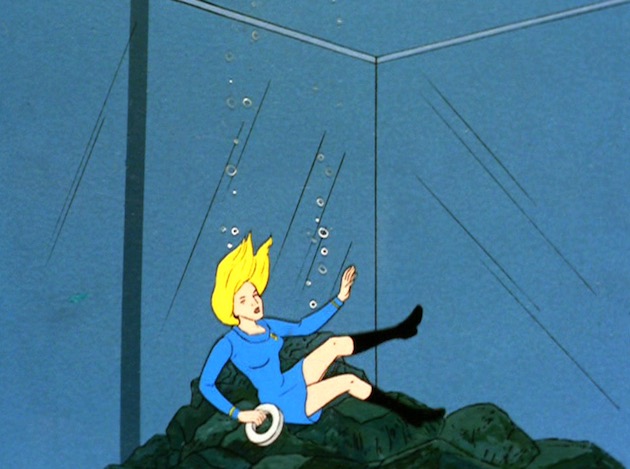
And then the crew all start to shrink. At first, they think the instruments are growing in size, but they soon realize that they’re all shrinking. It grows increasingly harder to operate instruments as everyone gets smaller. At one point, Sulu falls off the navigation console and breaks his leg. In sickbay, Chapel fetches a miniature laser to use as a bone knitter for Sulu’s tiny leg, but trips and falls into a fish tank. Kirk has to rescue her after she cries out, “HELP!” about eighty thousand times.
Kirk—who just five minutes earlier told Sulu they had no place to aim phaser fire—asks Spock if he can pinpoint the center of the wave that’s shrinking them. Spock says yes, and Kirk beams down there. He only has twenty minutes before they’ll all become too small to operate ship’s systems.
Kirk materializes at normal size. Unfortunately, the surface is littered with exploding volcanoes. However, Kirk finds a very tiny city, but then he’s beamed back to the ship. The crew is so tiny that Kirk’s normal speaking voice deafens them, and the bridge crew is missing. Kirk tries to contact the city he found from Uhura’s station, threatening them with phaser fire if they don’t restore his bridge crew.
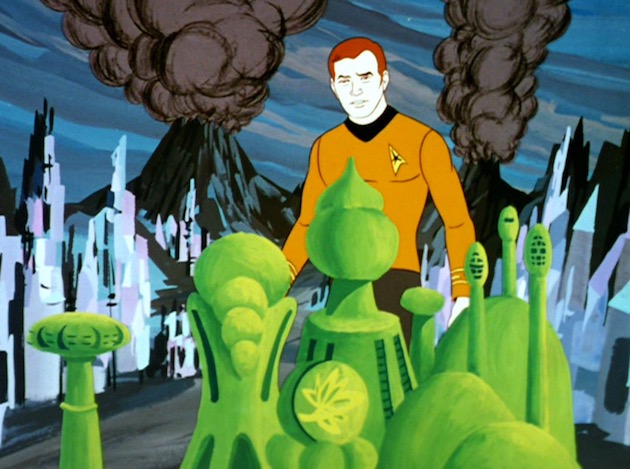
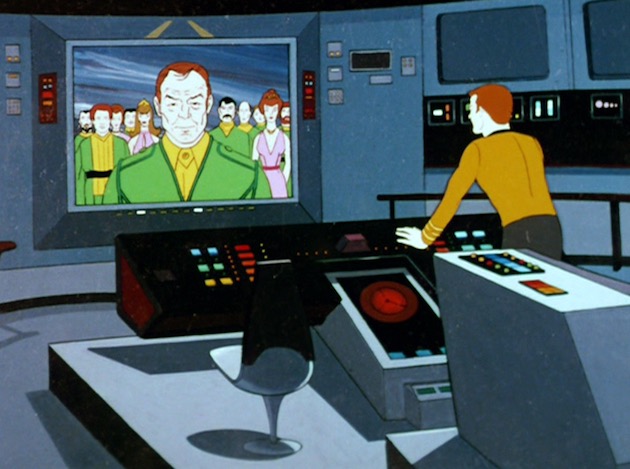
The city of Terratin responds, apologizing for the damage they did, and also showing him the bridge crew, who are all safe. Their planet is dying. They are a lost Earth colony that was subjected to the spiroid waves that shrunk the Enterprise crew, so they’re all tiny. Now it’s a genetic trait, and they’ve harnessed the waves. Unfortunately, their attempt at a distress call failed because of damage done to their communications, so they were forced to “contact” the Enterprise by shrinking the crew and beaming them down to ask for help.
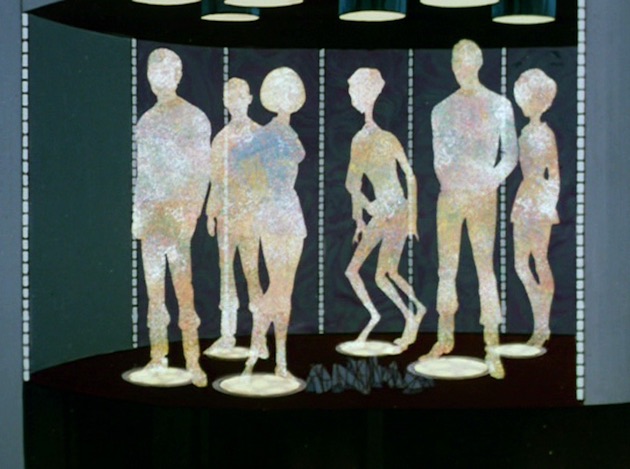
The planet is also chock full of dilithium. The Terratins donate some so the Enterprise gets full power back. First they run the crew through the transporter so they are restored to normal size, then they beam the entire city back (it’s kinda tiny) and take it to Verdanus for relocation.
Can’t we just reverse the polarity? According to McCoy, the crew is shrinking because the space between the atoms in their bodies is closing, though that would actually make people more dense. Spock then hypothesizes that—because it’s only affecting organic matter—it’s actually shrinking DNA, which makes even less sense.
Also Starfleet uniforms are apparently made out of a kind of algae-based fabric, which is a handy way of explaining why the uniforms shrink with the people (the spiroid waves affect organic matter), thus keeping Broadcast Standards & Practices happy.
Fascinating. Spock is Exposition Boy Like Whoa in this one, even more so than usual, though at no point does he explain how, if the spiroid waves on the planet shattered the dilithium crystals on the Enterprise, how come the crystals on the planet itself are intact?
I’m a doctor not an escalator. McCoy grumbles about chasing down the signal from Cephenus because—er, um, because he’s the grumbly guy and his job is to grumble about things? Seriously, his complaining is way out of character, and seems to be there for its own sake.
Ahead warp one, aye. Sulu is also out of character, as he panics and insists that Kirk fire phasers on the planet. His flailing about is why he falls off the console and breaks his leg.
Hailing frequencies open. Uhura is the one who picks up the radio signal and expresses surprise, since Cephenus never broadcast any radio signals before.
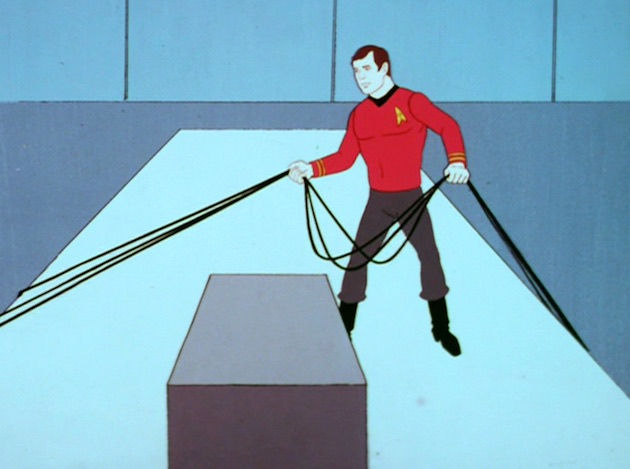
I cannot change the laws of physics! Scotty and his engineers set up a nifty little pulley system in order to operate the transporter.
Forewarned is three-armed. Arex is in mid-scan of the planet when the beam hits the ship and blinds him. You would also think that his three arms would enable him to be more, ah, handy when he shrinks, but no advantage is taken.
Channel open.
“Spock, are you slumping?”
“I have never slumped in my life, Captain.”
–Kirk being confused about Spock shrinking, and Spock taking offense.
Welcome aboard. James Doohan voices Scotty and Arex as usual, as well as the leader of the Terratins. Nichelle Nichols plays both Uhura and the mess hall officer who calls the bridge in a panic when people start shrinking. Majel Barrett and George Takei are Chapel and Sulu, respectively. Gabler, the engineer, is voice by an unknown actor (Doohan is often credited, but it doesn’t quite sound like him.)
Trivial matters: Paul Schneider previously wrote “Balance of Terror” and “The Squire of Gothos” for the live-action series, and based this teleplay on a one-paragraph story notion from Gene Roddenberry.
Trek would dip into the shrink-the-crew well again on DS9 in “One Little Ship.” And, of course, the Enterprise was shrunk in “Catspaw” also.
To boldly go. “For the love of heaven, be careful where you step!” There are times when you appreciate it when a writer goes to the effort of providing scientific rationales for the crazy-ass stuff in a science fiction story, but sometimes the explanation just makes it worse. Farscape did a particularly nice job of this in “I Shrink Therefore I Am,” where Sikozu raises all the usual objections to shrinking stories—if you compress the space between atoms, you just make people denser, if you take away atoms, the body won’t function, and if you shrink the atoms, you can’t breathe the air—and Rygel points out that it may not be possible, but it’s happening, and you have to deal with it.
I kinda wish that scene had been here, because the explanations offered by McCoy and Spock really don’t make anything like sense.
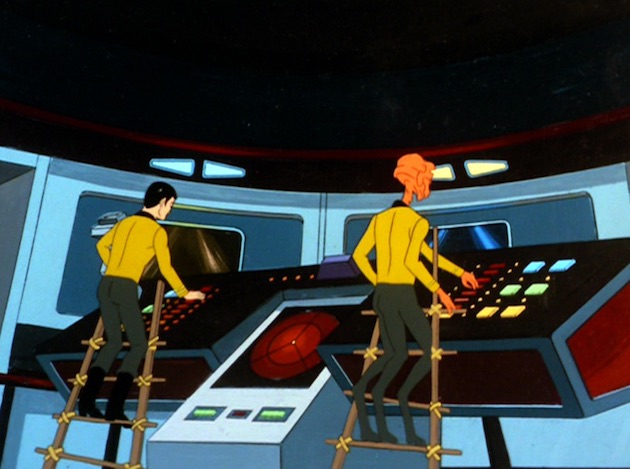
Which is too bad, because once you get past that, the episode has possibilities. It’s honestly hilarious watching the crew crawl all over the consoles, climbing up jury-rigged ladders in order to mind their posts, tripping over pins and being too small to make the turbolift doors open, and so on. And I like the fact that Kirk is pissed at what the Terratins did to his ship—and the Terratins are really snotty about it too, providing the lamest apology ever—but there’s still no hesitation on Kirk’s part to help them out in the end. (I half expected him to beam the city into a bottle, though—guess that would be too on-the-nose…)
Having said that, there’s a lot of frustratingly out-of-character behavior here, from McCoy’s grousing about responding to a possible distress call because they have a dead star to study, which is 180 degrees from the doctor’s usual priorities, to Sulu of all people panicking and crying out for a violent answer. And hey, look, the transporter fixed the problem again! It’s magic!
One expects better from the guy who wrote two of the finest first-season episodes.
Warp factor rating: 4
Next week: “The Time Trap”
Keith R.A. DeCandido will be a guest at Farpoint 2017 in Timonium, Maryland this weekend, both as an author and as a performer, the latter with both Prometheus Radio Theatre and the Boogie Knights. Other guests include Star Trek Discovery consulting producer Nicholas Meyer, actors Sam Witwer and Enver Gjokaj, fellow Trek scribes Peter David, Michael Jan Friedman, Dave Galanter, Allyn Gibson, Robert Greenberger, Glenn Hauman, David Mack, Marc Okrand, Aaron Rosenberg, Howard Weinstein, Richard C. White, and Steven H. Wilson, plus tons more authors, performers, podcasters, artists, and scientists. Keith’s schedule can be found here.

I think I deserve credit for not actually referring to this as a “tiny toon adventure” in the rewatch.
Even though I was a little short with the episode.
Okay, I’ll stop now…………………….
—Keith R.A. DeCandido
Does anybody have a production-related explanation for why all Chapel says in the fishtank is “Help!” over and over and over and over?
“One expects better from the guy who wrote two of the finest first-season episodes.”
Well, one of those two episodes is just a rewrite of a really good WWII movie by someone else.
@krad: “Coming up next: they’re tiny, they’re toony, they’re ALL a little loony… Star Trek.“
Is Kirk’s toupee algae-based too?
The star name is supposed to be Cepheus, but there are two mistakes there — one on Paul Schneider’s part, since it’s the name of a constellation rather than a star, and one on the actors’ part, since it’s pronounced “see-fee-us,” not “see-fus.” Oh, and the planet name at the end is spelled Verdanis (clearly a play on “verdant,” as in green with vegetation). Alan Dean Foster’s adaptation says the Terratins are going to rename the planet Verdantin.
This is a fun episode in terms of taking advantage of the possibilities of animation. I like seeing the ways the crew adapts to the shrinking, and there are some nice worldbuilding touches like the lab animals and the xenylon uniforms. Although the perfect shrinkage of the uniforms wasn’t just about placating BS&P — it was about not having to redraw their stock cels of the characters. As I’ve mentioned before, Spock’s desert gear in “Yesteryear” is the only time any main character in TAS wears anything other than a standard uniform and accessories — and even then, Spock has his uniform on under the desert robe.
I agree that the explanation for the shrinking is nonsense. People often seem to think that living tissue is made entirely of DNA, but that’s ridiculous. It’s found only in the chromosomes in cell nuclei. Shrinking DNA molecules would only make it impossible for them to interact with the enzymes that reproduce them and transmit their messages, so it would just cause the cell machinery to shut down and would result in death, not shrinking.
My best guess for an explanation is that the epsilon waves are actually causing the same kind of subspace compression effect seen in “One Little Ship” — which is less implausible because it’s more of a dimensional shift than an actual change in the body structure — and spiral molecules simply provide a sort of antenna that concentrates the effect.
The chronology doesn’t fit with later Trek, because it’s claimed that the Terratins used a code that was abandoned 200 years earlier but also had transporters. We now know that transporters for personnel use weren’t introduced until about 119 years before this episode.
There are a number of size continuity errors here, but the big one (so to speak) is the Terratin city. On the surface, its towers come up to Kirk’s chest, but when it’s beamed aboard, it’s small enough to fit on one transporter pad. Foster’s adaptation had it fill the whole transporter stage. The animation also fails to adequately get across that the reason for the pinpoint phaser barrage was to cut the base of the city free from the surrounding rock.
I’m increasingly starting to think that Gabler’s voice is Lou Scheimer, but that his voice didn’t quite sound like it would later in life so I can’t entirely recognize it. If it’s not him, it sure sounds like a relative of his.
The last group of officers beaming up from the Terratin city includes a couple of oddly 1970s-looking guys, one of whom is even wearing glasses. I think these must be caricatures of somebody, but I’m not sure who. The second guy from the left looks a bit like Scheimer.
@2/Meredith: Trust me, if you were drowning, you’d be calling “Help” over and over too. I know — I almost drowned once as a kid. I didn’t exactly have the presence of mind to formulate a more eloquent expression of distress. And I sure as heck wasn’t going to call out once and just trust that I’d been heard. It felt like it was forever before the adults figured out I wasn’t just playing and needed help.
Time to put on my Science Geek pants and point out that most of the perils and problems faced by the tiny crew shouldn’t have been problems at all. The square-cube law should be working in the shrunken characters’ favor: if they get half as tall their mass drops to an eighth but their muscles are only a fourth as strong as usual. That means they should be able to leap twice as far, proportionately — which means exactly as far as when they were full-sized! They should be bounding about the bridge like squirrels.
Falling should be utterly harmless. Rats can survive a fall of four stories unharmed; mice can apparently fall without harm from any height, as their surface drag and bone strength are so high compared to their mass. So the shrunken Enterprise crew can hop casually from the control panels to the floor. And they can carry proportionately large loads: a one-inch crewman would have a mass of only 50 grams (2 ounces) but would be able to lift five or six times that much!
Even falling into the fish tank shouldn’t be such a problem for Nurse Chapel. She can still float, after all, and as she shrinks the surface tension will be able to support more of her weight, until she can lie on the surface of the water as if it’s a waterbed. (She will have to worry about hypothermia, though, as she’ll be losing heat faster than normal. Let’s hope it was a tropical fish tank.)
Someday I’d love to see a story about shrunken characters which takes advantage of the science.
KRAD, you forgot about the Enterprise being shrunk also in “Requiem for Methusaleh.” (sp?)
I rather liked this one. It’s more about the crew solving a problem for themselves rather than showing up and trying to solve someone else’s as so often happened in TOS. Sure, it suffers from the usual problems of shrinking that SF usually just glosses over but it’s such a standard SF trope that it really doesn’t matter.
We also get a bit of pre-TOS history with the Terra 10 Ark (and presumably at least 9 others). Also, the fact that transporters were known prior to 2100 before being retconned later on. Some nifty new animals too with the halo fish and gossamer mice, although I wonder if McCoy keeps them around for scientific experimentation like his JJ-Verse counterpart. Does he randomly kill them and inject them with the blood of his patients just to see what happens? Is that why Uhura didn’t want to know if he was planning on dissecting her tribble?
I imagine that somewhere there’s a big algae tank that they use to make fabric. Could explain how they came up with McCoy’s Nazi uniform along with all the other native outfits. Apparently xenylon can be made to resemble many different materials, including the uniform boots since they shrink along with the rest of the uniforms.
As far as the city changing size when it’s beamed aboard, that’s pretty much what happened with the crew except it made it smaller instead of larger. Maybe when they get to Verdanis and beamed down to their fertile plain, it’ll get smaller again. Or return to the size they were on Terratin. It’s the transporter. Who knows? It does whatever it’s needed to do.
5/10
@7/Cambias: McCoy specifically said that their weight remained the same because they weren’t losing atoms, just decreasing the empty space between them. So they were growing more dense as they shrank, which would actually have made it harder to move (since the decreasing size of their limbs would’ve reduced their leverage). Foster’s adaptation addressed this; there’s a bit where Spock warns against walking on a glass surface because they’d break right through it.
“Someday I’d love to see a story about shrunken characters which takes advantage of the science.”
Isaac Asimov’s Fantastic Voyage novelization is the gold standard for this. See also James Blish’s story “Surface Tension.”
has anybody ever just used a shrink ray to get rid of bodies?
@11/roblewmac: In the Ant-Man movie, Darren Cross used his unstable Pym-knockoff particles (which killed the test animals they shrank) to kill a person who got in the way of his plans, then cleaned up the very tiny remains with a paper towel.
Not quite the same thing, but the Master in classic Doctor Who used a weapon called the Tissue Compression Eliminator, which killed people by compressing them in on themselves to about 1/10 their normal size, leaving doll-sized corpses that sometimes went unnoticed for a time.
I, too, like the way Kirk deals with the Terratins but would have expected a better story from Schneider. On the plus side, it’s neither a sequel to a TOS episode nor a rehashed plot.
Krad, the Enterprise was not shrunk in “Catspaw”. The aliens had a starship model which they used as a voodoo doll.
I wish they had left out the Chapel drowning scene and spent more time on the crew’s dealings with the Terratins instead. This is the second episode in a row where she is portrayed as incompetent. Doesn’t Starfleet teach their personnel how to swim?
Why does the transporter restore the crew to their original size, but not the Terratins? Because for them, “it has become a genetic characteristic” (and how does that work, anyway)? And why doesn’t the Terratin transporter restore the bridge crew in the same way?
@3/StrongDreams: “Well, one of those two episodes is just a rewrite of a really good WWII movie by someone else.” – It wasn’t “just a rewrite”, it changed the story in important respects. Most importantly, the episode doesn’t take place in a war, it’s about preventing a war. Then there’s the wedding subplot, which helps to make clear that it’s an anti-war story, and the Stiles subplot, which makes a statement about prejudice and racism. (I assume that these were additions by Schneider, but I haven’t watched the film, only read a plot summary on Wikipedia. So please correct me if I’m wrong.)
@13/Jana: As established, the crew still had their full mass, so they were far denser than normal. Chapel would’ve been far less buoyant as a result — essentially she would’ve been like a lead weight, maybe 130-some pounds in a volume the size of a goldfish. It’s impressive she could even stay afloat at all.
And she did have the idea to use the microlaser for inner-ear surgery to knit a broken leg bone, which is pretty brilliant.
As for the transporter, remember, Spock said it restored the crew to normal because it stored a memory of their normal patterns. Basically it would’ve read their increased density as an error in the pattern and automatically corrected it. But the transporter had no memory of the Terratins, having never beamed them before. Nor did the Terratins’ transporter have a memory of the Enterprise crew, having never beamed them before.
Of course, that requires assuming that all 430 members of the crew have been through the transporter at least once, but that doesn’t strain credibility too much — at least, not compared to the other ideas in this episode.
@@@@@ 14 Christopher and 13 Jana
I thought this episode treated Chapel much better than the previous one.
I wonder if the increased density could account for some of the clumsiness that the shrunken crew exhibit. Would the increased density mean that they would have to adjust their motions in some way to compensate? I’m thinking something like how one has to adjust to the motions of a boat, and then readjust to being back on solid ground afterwards.
Seemed awfully convenient that someone just happened to have left a needle and thread next to the aquarium in sickbay just prior to this episode!
Jana, I agree that it not being a sequel or a plot we’ve seen a dozen times before is a big plus.
@14/Christopher: Ah, that makes sense. I’ll gladly change my mind about the Chapel scene. And I’m sure everybody has been through the transporter recently, when they visited the Shore Leave planet.
@15/The Usual Suspect: That’s true, what do they need a needle and thread for? To mend their futuristic algae-based clothing?
Maybe Chapel likes sewing, after all, she is female. (sarcasm)
@16/Jana: Good point about the Shore Leave planet.
As for the needle and thread, it is a sickbay. Okay, they use high-tech laser salt shakers and stuff to close wounds, but McCoy’s nothing if not a traditionalist, so it’s plausible that he’d keep sutures and surgical needles on hand.
Christopher: given McCoy cordrazine-fueled rant about the appalling barbarism of using needles and sutures in “The City on the Edge of Forever,” I disagree about that plausibility……
—Keith R.A. DeCandido
@19/krad: Come to think of it, didn’t the sickbay set dressings in TOS include a wall display of antique medical instruments? Isn’t that where Khan got the scalpel he threatened McCoy with? Maybe the sutures weren’t something he kept around for emergencies, but a display item.
I had a sort of half idea for a story about a guy shirking a dead body and flushing it down a toliet but the ray wears off mid flush. His poor landlord!
@5 “Is Kirk’s toupee algae-based too?”
No. It’s a tribble.
I suddenly remember a Cracked magazine Star Trek parody where Kirk/Shatner argues with Spock/Nimoy about his direction of the film and Spock winds up pinning Kirk to the floor with that traditional Vulcan weapon. With a malicious grin, Spock says, “Hold still, Jim. I believe a tribble is attacking your scalp.”
Surf Wisely.
By this point, I was just glad we got an episode that actually gave some different animation poses, even if the science gives way to pure fantasy storytelling. The jokes work for the most part.
The good thing about this is that you really couldn’t do this kind of episode during TOS’s run. Even when DS9 did One Little Ship, computer animation was still evolving, and not quite up to the task. But the limited hand drawn animation in this case works in giving a stilted, yet humorous look into the crew’s attempts to do their job. That’s part of the episode’s quirky charm.
But Schneider really dropped the ball on characterization. And this coming from the guy who wrote Balance of Terror. I wonder how much the writers had to compromise on character in order to shrink these stories to 20 minute bites as well as having to indulge network executives who expected a cartoon.
The transporter solution, on the other hand, I have no problem with. The way I see it, they painted themselves into a story corner with an implausible plot device right from the beginning. They might as well come up with an equallly implausible solution. At least they don’t drown scenes with technobabble.
A couple things:
First, where did they get the materials they were using to make ladders on the bridge? Figure they had to be 3-4 feet tall to reach the consoles. I don’t imagine they had sticks and staves (not to mention, twine or rope to attach the rungs) just lying around the bridge. Generally, an abundance of convenient miniature supplies lying around for today’s episode.
As for the Terratin’s transporters – A possible explanation for why they might have transporters (since, as we learned on Enterprise, they weren’t safe for human transport 200 years earlier), and why the transporters wouldn’t have had an effect on the size of the Enterprise crew: perhaps the Terratin’s developed their own transporter technology after they were stranded on the planet and shrunk. They developed the transporters to work on people their size, so there’s no way to accommodate re-sizing people to their original size. I realize the episode mentioned the memory of the crew’s pattern, but this is another possibility.
All told, I liked this better than last week’s offering, but Mudd has generally annoyed me whenever he was on screen (except for the logic-off at the end of “I, Mudd” which I find to be absolutely hilarious).
@24/JamesP: I think it’s simpler just to disregard the “200 years” reference and assume it was closer to 100, to fit it better into modern continuity. I’ve found that it’s generally best not to take any sort of numbers in Trek too literally or strictly, whether it’s date intervals or distances or stardates or registry numbers.
For what it’s worth, the earliest transporter experiments done by Emory Erickson were about 130 years before this episode. Maybe the “Terra 10” colonists included someone who’d worked on the early transporter experiments. And maybe there were some private organizations that continued to use intersat code for decades after it had been officially discontinued.
@24/JamesP: I imagine they had planned ahead and brought the materials from somewhere else to the bridge while they were still big enough to carry them easily. Perhaps from the arboretum, if it’s really wood.
@26/Jana: Maybe Sulu had recently taken up model-building as one of his many hobbies.
CLB @25 – Of course you’re right. I was just looking for another possible explanation.
Another thing that occurred to me is that the materials they were using to build the ladders (definitely the sticks/poles/staves and likely the rope) would also have been shrinking, since they were organic. But the ladders weren’t shrinking.
@27/Christopher: I like that. This episode definitely exalts the imagination.
@28/JamesP: Oh, that’s right! I guess that means it isn’t wood or any other organic material after all.
Alternate title: Honey I shrunk the Enterprise Crew.
25. ChristopherLBennett – Or later writers can simply stop retconning what’s come before and actually write in the established universe.
Another way of doing it is the way that Arthur C. Clarke handled his 2001 sequels.
“Since the stories and settings in the books and films all diverge, Clarke suggested that the “continuity” of the series represents happenings in a set of parallel universes. One notable example is that in the 2001 novel, the voyage was to the planet Saturn. During production of the film, it was decided that the special effects for Saturn’s rings would be too expensive, so the voyage in the film is to Jupiter instead. The second book, 2010, retcons the storyline of the first book to make the destination Jupiter as seen in the film.”
The Space Odyssey series is a series of science fiction novels by the writer Arthur C. Clarke.
The Clarke solution seems to be the easiest. Everything happens in pretty much the same way in each universe but there are differences. In this case, transporters are invented earlier in one universe rather than the other.
@31/kkozoriz: That’s a matter of taste. I find it “the easiest” to ignore the bits that don’t fit. Creating a whole universe to deal with a small fact that could be dealt with by looking the other way feels like overkill to me.
And of course, there’s always the simple explanation that the characters may be wrong when they say things like “that’s been out of use for two centuries”. It happens to me all the time.
32. JanaJansen – But Trek has had alternate realities ever since Mirror, Mirror. Personally, I have no problem with imagining different versions. Heck, I can watch TAS and read the ADF adaptations and not feel the need to pick one over the other as being “correct”.
I mentioned in post #6 that the last group of officers beamed up from the Terratin city looked like they might be caricatures of real people, but I didn’t know who. By coincidence, I just came across an answer to that question in this TrekBBS thread, linking to an interview with Filmation layout artist/animator Bob Kline. From left to right, the three Filmation staffers represented are layout artists Herb Hazelton, Kline himself, and George Jenson.
I must admit I faced a moment of terror when Kirk’s attempt to rescue Chapel has him throw the equivalent of a javelin in her direction. Was he attempting to save a drowning person or to harpoon a whale? Just lucky his aim was poor, I suppose.
If this was Terra Ten, was Terra Nova from Enterprise the expedition before it?
@36/tjareth: More like eight expeditions before it, I guess (since Earth would be Terra One). Terra Nova means “New Earth” and it was said to be the first human extrasolar colony (though why did they go 20 light years instead of settling Alpha Centauri first?).
Well, obviously because Alpha Centauri was already inhabited by transplanted humans.