







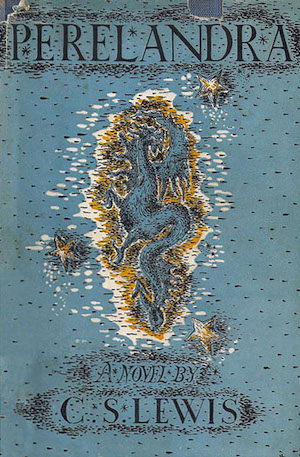
I was pretty nervous about re-reading Perelandra. The last time I read it, several decades ago, it was pretty firmly in the top three of Lewis’ novels for me, and I was concerned that after all these years I might discover some fatal flaw that would make the book less enjoyable, less interesting, or less fun. I’m glad to say that although there was a lot to process, and a lot of scenes I had no memory of whatsoever (there are a fair number of multi-page philosophical rambles), and although I’m still trying to wrap my brain around what exactly Lewis was saying about gender, overall I still enjoyed the book a great deal and, indeed, it’s still one of my favorites.
Perelandra was one of Lewis’ favorites of his own work, too. Multiple times throughout his life he suggested it was the best thing he had written (in his later days he’d sometimes push it to second after Till We Have Faces), and there is a lot about the novel that brings together Lewis’ particular interests, skills, and thoughts. It’s a theological book and a space adventure at the same time, and successfully does both things at once… it never feels like two books fighting with each other.
The book is dedicated to “some ladies at Wantage,” which is a reference to the Community of St. Mary the Virgin—an Anglican convent (Lewis was, of course, Anglican himself). After Out of the Silent Planet was published, one of the nuns—a woman named Sister Penelope—wrote to thank him for the book. Lewis was pleased by her letter, and a long correspondence and friendship began. Sister Penelope’s Mother Superior invited Lewis to come speak to the community in early 1942, when Lewis was just finishing up the manuscript for Perelandra.
In one of his letters to Sister Penelope, talking about Out of the Silent Planet, Lewis wrote, “You will be both grieved and amused to learn that out of about sixty reviews, only two showed any knowledge that my idea of the fall of the Bent One was anything but a private invention of my own! But if only there were someone with a richer talent and more leisure, I believe this great ignorance might be a help to the evangelization of England: any amount of theology can now be smuggled into people’s minds under cover of romance without their knowing it.”
If Lewis was being subtle in Out of the Silent Planet, he throws away any pretense of subtlety as he writes Perelandra. It is, unapologetically, a “Christian” story about the Fall of Humanity, about God’s plan for redemption of the universe, and about the future of creation. It’s not allegorical (or at least, so Lewis tells us), but a type of (Lewis’ preferred term here) “supposal.” So, in a letter to Mrs. Martha B. Hook, Lewis summed up the key starting place of Perelandra as, “Suppose, even now, in some other planet there were a first couple undergoing the same that Adam and Eve underwent here, but successfully.”
Buy the Book

Sisters of the Forsaken Stars
Dr. Ransom (our main character from Out of the Silent Planet, a man fashioned in large part around Lewis’ fondness for his friend J.R.R. Tolkien) may take on many of the attributes and even the role of Jesus Christ in some sense in this book, but Lewis pushes back on the idea that he’s meant to be allegorical. Also from his letter to Mrs. Hook:
Again, Ransom (to some extent) plays the role of Christ not because he allegorically represents him (as Cupid represents falling in love) but because in reality every real Christian is really called upon in some measure to enact Christ. Of course Ransom does this rather more spectacularly than most. But that does not mean that he does it allegorically. It only means that fiction (at any rate my kind of fiction) chooses extreme cases…
On the other hand, Lewis can get a little coy about these things, and there are certainly some decisions Lewis makes in the narrative that appear to be (heavily!) symbolic rather than driven by the narrative or any supposal, and this is more true in Perelandra than in perhaps any other of Lewis’ books.
Some things to be watching for as you read, in preparation for the discussions to come:
- There are many, many, many references, allusions, and straight quotations from the Bible in this novel. We’ll do a full article pulling some of that out, because there are unremarked references throughout.
- Related to this, the story of Adam and Eve is leaned on heavily throughout, and if the story is unfamiliar, it might be worth your time to read it before diving into Perelandra. It’s just two chapters: Genesis 2 and 3.
- Mary’s “Magnificat” is also echoed, and if you’re interested in that particular scripture you can find it here.
- Angels and demons play heavily in the narrative as well. Interesting sidenote: Lewis toyed with the idea of suggesting that Dr. Ransom was the one who discovered (and translated!) The Screwtape Letters.
- Get ready, because in many ways Perelandra is an interstellar exorcism story. There are some interesting insights to be had by recognizing that the book is about demonic possession and exorcism.
- As always, there are plenty of literary allusions, but the most notable and important ones are Milton’s Paradise Lost, Dante’s Inferno, and (yet again) Plato. There’s also a pretty heavy cribbing from French philosopher Henri Bergson.
- The themes about mythology and reality being intertwined or unified are consistent and there’s a lot Lewis is doing in the text to try to make that true and clear in the novel. It’s a theme worth paying attention to.
- We won’t talk about this at length anywhere, but I’m sure Lewis would be surprised by how the word “trans-sexual” has changed since he used it in this text!
- Pay attention to Weston’s arguments. Note which seem compelling and which aren’t, and to whom (i.e. you the reader, The Lady, and Ransom).
- “Abundant death” gave me chills, not going to lie.
- Predestination and freedom are addressed at length. In what sense is God aware of the future? Is fate a thing? Is each thing that crosses our path a good thing in some sense? Is that different in an unfallen world vs. a fallen one? Can we make “wrong” choices? (Lewis has pretty clear thoughts on all of these questions.)
- Before Weston is totally lost, he talks about his previous goal (i.e. the preservation of humanity among the stars), as discussed at great length in Out of the Silent Planet, and his thoughts seem to have changed. That’s worth noting as the narrative proceeds.
- The lengthy and almost dream-like descriptions of the planet itself and the planet’s ecology is not just worldbuilding. There are purposeful symbolic techniques at work here (note how often Lewis refers to heraldry in this book for a clue to get you started). Just be aware that those lengthy descriptions of the flora and fauna are done with mythological and thematic intention.
- Lewis talks about gender enough in this novel that some critics see it as a major theme of the book. It’s a fair point. If we do a full article on this (I’m still debating!), be sure to make distinction between who makes which assertions about gender as the novel progresses. There are, in fact, some conflicting ideas about gender in the book and it matters whether it’s Ransom or the Un-Man or the Lady making different assertions.
- I’m sure fans of this site will learn the name of the true King of Perelandra with some joy.
- Lastly, for Tolkien fans, there are a few sweet moments where Lewis-as-narrator talks about Ransom (i.e. Tolkien) and shares his thoughts about the man, as well as a few “Easter eggs” where Lewis has lifted things from the pre-published Lord of the Rings, most notably of course the angelic eldila.
As always, Lewis would be horrified if he thought for a moment that our critical adventures would distract us from the story itself. So if nothing else, be sure to relax and enjoy Dr. Ransom’s adventure to Venus. I’m looking forward to hearing your experiences and discussing it with you!
 Matt Mikalatos is the author of the YA fantasy The Crescent Stone. You can follow him on Twitter or connect on Facebook.

One of my favorite parts of this book—although it may seem odd to use the term “favorite” for something so unpleasant!—is the first chapter, with the narrator’s walk to Ransom’s home. Lewis’ description of the Enemy’s tactics is so accurate and evocative that I have often used it to explain them, especially with someone who has read the series, but also even those who have not.
It’s got some great SF moments, for instance Ransom’s initial encounter with the floating islands and the way the ground changes from being a hill to being a valley as a wave goes through. The weaving of terrestrial mythology into the story of Venus is also a really fun design.
None of which are the heart of the book, but they’re still moments worth reading — and the celebration at the end is wonderful.
I love this trilogy so much. While each book is unique and does its own thing, this one has the most evocative imagery. The shifting landscape has always stayed with me. The introduction of death and how unnatural its inclusion into the world is. It’s definitely written in Lewis’ amazing style, but has elements that remind me of L’Engle’s work as well.
@1/srEdit. It’s amazing how much of the book is a very straightforward “spiritual attack but on Venus” story!
@2/tonyz. A lot of wonderful moments for sure! Lewis really works to bring all the senses to bear, and I couldn’t help but think that it would be a pretty incredible movie to watch.
@3/Paul Cypert. I’m a little nervous about book 3 because I didn’t like it at all as a kid!
This book was a palate cleanser for me after I looked into Lovecraft at much too young an age and without guidance. The floating islands of Perelandra are some of the loveliest places I have ever imagined. I was also greatly helped at various times of my life by recalling Lewis’s distinction between “the sober pleasure of munching and being nourished” and eating for the delight of taste; and by Ransom’s vision later in the book.
I very much want to talk about the gender thing, as it’s one of my big struggles with the novel. Also about the idea that Lewis seems to highly value obedience for its own sake – doing what God wants only because God wants it without it making any rational sense. And maybe I’d be okay with doing that if I had the constant direct connection that the woman in Perelandra has, but too often that idea of obedience is used to try to persuade people into doing what some other human tells them God wants, while refusing the necessity of convincing people’s reason or affection
@7, I haven’t heard of this, can you say more?
@7: As always, we ask that you keep the tone of the discussion civil and constructive–no matter how strongly you feel about one author or another, please keep our commenting guidelines in mind and refrain from insults and name-calling. The full moderation policy can be found here.
I has been many years since I re-read this trilogy, a favorite of my late father’s. I’m glad to see it getting a deep look. I remember seeing the 1953 edition, which had been re-titled Voyage to Venus, in a used book store and being horrified.
One of the things I’ve always found interesting (in addition to the above excellent bullet points) is the clear and intentional contrast between the typical “reach for the stars” science fiction of the era and the model Lewis presents across the trilogy (even with a post-WWII mindset developing in Europe along with the publication of the second and third books). Mr. Mikalatos may be hinting at this in his comment on Weston’s shifting aims. The vision of where all life is headed is also a clear rebuttal of the fictional presentation that heaven is just sitting on a cloud playing a harp.
Perelandra is also the name of a health food store on Remsen Street in Brooklyn Heights, NYC. I shop there often, and am able to tell people where the name comes from. For more information about the store, see:
https://www.perelandranatural.com
“any amount of theology can now be smuggled into people’s minds under cover of romance without their knowing it.”
Perhaps some respect for one’s audience would not come amiss.
Matt @@.-@: It’s amazing how much of the book is a very straightforward “spiritual attack but on Venus” story!
Yes, true. But it’s the very mundaneness (*neologism?) of the setting on Earth as opposed to the exotic locale of Venus that made this first part so evocative for me.
The convent of St Mary at Wantage still exists, by the way, and is lovely.
“Perelandra” is both one of my favorites and one of my least favorites of Lewis’s novels. The descriptions of the planet Venus are heart-stoppingly beautiful, and memorable in the same way that Tolkien’s Lothlorien and Fangorn and Gondor are memorable — they live in my mind so vividly that they seem to be real places that I once saw, rather than imaginary places invented by an author. When Venus is visible in the sky, I often find myself thinking of the floating islands and the fruit and the heraldic dragon and the frogs. This is what Tolkien called “subcreation” at its best. The section in which Ransom realizes that his horror of insects (“objecting to another creature because of the number of its legs”) was always an invention of the Enemy also often comes into my mind. The book is filled with wonders, and I reread it every 10 years or so.
BUT. The characterization of the Lady makes me cringe (I hope we do have an article on gender), especially in the final scene when we see her and the King together. She comes across as close to witless. And that final scene — the pages and pages of metaphysical “praise” . . . well, I have found that my best bet on rereading is just to skip that part. I get to the point where Ransom is in the presence of the King and Queen, and then I skip to where they tell him goodbye and cover him with the flowers. It is very, very rare for me to skip anything in a book, especially one that I love enough to reread regularly, but that whole section just strikes me as almost embarrassingly unsuccessful. It may be that Lewis set himself an impossible task in trying to represent how such creatures as those he’s imagined would talk about God. I can’t really imagine how anyone could pull that off successfully. But for me at least, that section is a terrible blemish on an amazing novel.
I agree with wanting to discuss the gender thing because it very much ties into the whole theme of “obedience”: the Green Lady isn’t just required to be obedient to Maleldil but also to her husband and, indeed, we get the entire hierarchical set up with the beasts, which given this is an explicitly pre-lapsarian world gives me pause.
@17 I am totally with you on loving the worldbuilding and that bit about objecting to a creature because of the number of its legs, and also with the way the Lady seems less a person than the King, which annoys me. I love the pages of praise part, except for the gender stuff, but I can also see how someone might find it boring.
Dear Matt,
I am not a frequent commenter but am a regular reader of your Lewis posts.
I just wanted you to know how much I appreciate and enjoy them.
Thank you!
Lewis’ Space Trilogy is one of a very small number of Christian Science Fiction works. Obviously there’s an enormous amount of Christian fiction, but few writers seem interested in using explicitly Christian themes and imagery in a futuristic extraterrestrial setting. Most of what I would classify as Christian sci-fi are near-future apocalyptic stories such as the Christ Clone series.
In fact, the only Christian scifi I can think of that’s thematically comparable to the Space Trilogy is the Lamb Among the Stars series (and possibly the Wrinkle in Time series, albeit on a smaller scale). Does anyone know of any other examples? I find it interesting to see how writers handle the theological implications of Christianity in a futuristic setting.
@21 In the Honor Harrington series, the planet of Grayson has a more or less planetary religion that’s derived from Christianity, and Honor herself belongs to the “Third Stellar Communion, Reformed.” I think there are other characters who are Catholic and one of the plotlines deals with how relationships are understood in a religious context in a universe where lifespans have been dramatically increased.
If you’re up for looking at fantasy as well, Brent Weeks’ Night Angel series doesn’t spell out Christianity, but it’s obvious from the text that he knows his Bible – and he is in fact a practicing Christian; I looked it up after the 5th or so unmistakable Biblical reference. His Lightbringer series is less explicitly Christian in the religion, but it does deal with monotheistic religion. I also see Mormon influences in Brandon Sanderson’s work.
I’m not a fan of the version of Christianity presented in the Christ Clone series. The first book was interesting, but the way it ended up was too much of the end-of-days, only-a-few-are-saved theology for my tastes.
18. — I agree that the “obedience” theme is troubling in Perelandra, and of course it gets much, much worse in That Hideous Strength, where Lewis makes the truly bizarre claim that erotic pleasure in heterosexual intercourse is only possible if the woman accepts her duty of “obedience”. I’m sure we will have some interesting discussions about that passage when we get there!
@21 Though Lois McMaster Bujold is not to my knowledge a Christian, Cordelia’s belief in God is at least a minor plot point in some of the Vorkosigan novels.
@24 And her World of the 5 Gods books are theologically fascinating.
I read the trilogy. I thought they were bizarre, badly told SF.
I was too young to spot allegories. Too ignorant to spot theology.
I never reread them.
@25 I thought about saying that, but I think the original question was about Christian and Christian-adjacent sci-fi rather than fantasy (there seems to be a lot more Christian-adjacent fantasy). I love the 5 Gods books!
This has always been my least favorite of the three: probably because I’ve always more interested in plot than description, so although the descriptions of Perelandra are wonderfully evocative, they didn’t do it for me. (I missed the heraldic theme altogether, much to my surprise.)
I was quite interested in some of his (alas, unexpounded) ideas concerning sex being a representation of gender rather than the other way around, and the number of genders being possibly greater than two (7, if I recall). I’m a bit disappointed though by the assumption that the female is subordinate to the male even before the fall, given that “he shall rule over thee” is explicit in Eve’s curse.
Despite that defect, however, I think the theme of obedience even without understanding is presented well. @8, on the one hand we can’t possibly hope to have God’s wisdom, so some amount of obedience without understanding is necessary; but I grant you that there is a fair admixture of “what some other human … wants” that needs careful consideration and discernment.
@28 The idea of 7 genders is interesting and I’d be curious to know where you got that in Lewis’s writing. Not at all saying I think you’re wrong, just not something I remember and it sounds fascinating to me.
As far as obedience without understanding goes, I’m starting to think that’s an impossible thing to ask of humans as we know them. Obedience with understanding is tough enough, in the sense of reasoning out how you would want to be treated and then allowing for circumstances and individual variation. But if you’re doing or not doing something for the sole reason that God tells you to, how do you even figure out if it’s God that’s doing the telling? How are humans, with that same lack of wisdom, supposed to distinguish between God’s command, their own impulses, the desires of other humans, and the voice of some malevolent force? There seems to be nothing to do besides run it past our conscience and see if it makes sense, whether rationally or emotionally, and that seems to bring us back to obedience with understanding.
@29 Sorry, not in Perelandra as I had thought but in That Hideous Strength, chapter 15:
I also agree with you that in the end a person has to make their own choices about whom to trust, since you are basically talking about trust. The implicit assumption I was making (and which, I think, is valid for Tinidril as written) is that the source of the commandment in question is known, whether by experience or by faith. How to know that–whom to trust and how to discern God’s voice–are much larger discussions than will fit in this comment thread.
@30 I missed that bit in That Hideous Strength, how interesting! If I remember correctly, there were visits from Mercury, Venus, Mars, Jupiter, and Saturn, so I don’t quite know where seven came from. Presumably Earth would have had a gender too, and I would have loved to know what the essence of Earth was, as it was for the other planets. But that still only gives six, unless I’m forgetting one. From what I remember of those scenes in That Hideous Strength, I think I’d rather my gender be Mercury than my biological Venus. But I guess this is more a discussion for the next book.
As for Christian-themed SF, what first comes to my mind is A Case of Conscience by James Blish, in which an entire planet is explicitly exorcised by Father Ruiz, a Catholic priest, That novel also contains a good deal of theology and philosophy. I suppose the sequel, Black Easter must be considered fantasy.
The next such work that occurs to me is A Canticle for Leibowitz by Walter M. Miller Jr, and particularly the discussion of the ethics of euthanasian for someone dying of a radiation overdose in the 3rd section. But Christian ideas and specifically Catholic theology are all through that book. And through Miller’s previous story about the colonization of Mars, too.
There is a good deal of theology in the 1632 series by Eric Flit et al., and particularly The Papal Stakes and The Cannon Law. (Including the interesting question, how far is the 17th Centaury church bound by later ecumenical councils, particularly Vatican II?) But I wouldn’t really call them Christian-themed.
“The Star” by Clarke is a very interesting piece of Christian-themed SF. I find “The Quest for St Aquin” by Anthony Boucher to be much more superficial and less interesting, even though (or perhaps because) Boucher was (I understand) a Catholic., while Clarke was not (and neither was Blish).
There is the interesting anti-Christian story “The Streets of Ashkelon” by Harry Harrison.
In Fantasy I would mention the Deryni series by Katherine Kurtz, which is quite accurate about the Catholic Church of the middle-ages
While I detest the book intensely, “The Last Starship From Earth” by John Boyd is very much about SF and religion.
Oh, there’s also Eifelheim by Michael Flynn, in which an alien ship crashes in 14th century Germany. One of the major human characters is a priest, and although it’s not the only theme of the book, the way his faith informs his reaction to the aliens and the way the aliens understand his beliefs are definitely important.
@31 I think the 7 genders (since they seem to be represented by planets) is a reference to Greek mythology and astrology. The heavens were ruled over by seven classical planets (or great lights), from which we also get the days of the week. Lewis had a high respect for mythology and this is strongly evident in the Space Trilogy and comes to life in That Hideous Strength. If that was Lewis’ intent, then the 7 genders would be represented by Saturn, Jupiter, Mars, the Sun, Venus, Mercury, and the Moon. The Moon is certainly (although we never meet her Oyarsa) represented and mentioned in a similarly anthropomorphic way as the other planets. The Sun, much less so. We are told the name (Arbol), but The Field of Arbol (the entire solar system) has much more prominence in the books than Arbol itself.
The earth (Thulcandra) is described several times as being in some sense outside of the Field of Arbol. It is the place apart, isolated, separate. In an analogous way, the Bent Oyarsa has separated himself from all personhood and no longer represents a gender at all. As the Green Lady said: “To walk out of His will is to walk into nowhere.” Or from Mere Christianity: “There are no real personalities apart from God.” I don’t think he intended Thulcandra to represent one of the genders.
This interpretation is complicated by the statement that two genders are represented by three Oyarsu: Viritrilbia, Venus, and Malacandra. I think, however, that he was simply implying that those 3 genders are more closely analogous to our 2 biological sexes. The rest are much stranger and difficult to recognize as genders to our limited (bent?) understanding.
Harry Turtledove’s Agent of Byzantium stories are set in a world where Mohammed became a Christian monk. So Islam never arose. Without the Islamic conquests, the Eastern Roman Empire is still going strong.
Christian theology is more important in some stories than in others. But it is always a living issue.
@35. Ken
Is it? If I am correctly recalling the scene in Out of the Silent Planet where Ransom sees an image of the “field of Arbol” the Moo0n is not represented nor is a planetary Eldidl or Oyarsa for the moon shown or mentio0ened. Yes it is in chapter 17, on pages 111-112 of the edition I have. A representation of the Sun is at the center, with no indication of an Oyarsa, Then there are a series of circles centered on the sun.
It seems clear that the Moon is not considered as one of the planets, and has no Oyarsa , nor does the Sun. Thus the scheme does not follow the classical notion of the “seven planets” which include both the Moon and the Sun, and was Earth-centered. This is a heliocentric system, stylized, but far more accurate than the classical Ptolemaic system. It does not appear that the “seven genders” are in any way associated with the classical “seven planets”. At least not unless there is some other evidence for this.
It may be worth noting that the worlds that are said to have animate, biological, mortal life, all have masculine or feminine Oyarsas, while Jupiter and Saturn do not, but have other genders. But since there is no mention of life on Mercury, perhaps one should not make too much of this.
In That Hideouts Strength, we are given the name of the Moon, Sulva, and told that Sulva acted as a shield in the battle between the fallen Oyarsa of Earth (Satan) and the Oyarsa of Mars. But there is still no mention of an Oyarsa of Sulva.
One might also mention “the Field of Arbol” is an obvious borrowing of Tolkien’s “The Field of Arda” which does seem to mean the immediate neighborhood of Earth in Tolkien’s legandarium. But “Arda” does not mean the Sun, for the term is used of times long before the creation of the sun. Rather, to Tolkien, “Arda” itself seems to mean the neighborhood of Earth, the “stage” of the “Drama” and the most important part of Eä, the created universe.
Also, in Tolkien’s work it is said that the Valar, (Tolkien’s equivalent of the Oyarsas) do have gender, each is masculine or feminine, and many are partnered as “spouses”, but no other genders are mentioned. The “seven genders” must have some other source, if they are not an invention of Lewis’s.
@35,37 I agree with desiegel60 that the seven genders can’t really refer to the seven classical planets (modulo modifications for Earth being a planet and the Sun not being, or however you interpret that) for the simple reason that, in the exact way that Ken says “those 3 genders” above, Lewis says “those two genders”.
I was beginning to speculate about the planets as a possibility, or grammatical declensions (the IE languages I’m familiar with, aside from English, have at least three) or the classical colors of the rainbow, or classical heraldic tinctures, or …. But then I recalled that Lewis doesn’t seem to value consistency (in fiction) for its own sake, e.g. “astrolabes, orreries, chronoscopes, poesimeters, choriambuses and theodolinds” from Voyage of the Dawn Treader (and cf. the second essay in this series). It wouldn’t surprise me at all if he chose the number seven simply because he liked it.
Piggybacking on the book recs, Maria Doria Russel’s ‘The Sparrow’/’Children of God’ are basically about Jesuits in space.
Anyawy, I have enjoyed these deep dives and am looking forward to the discussion – it’s been so long since I read this book. I kind of laughed at Lewis’s comments about fiction always choosing the extreme cases because I always think about how convenient it is that in a book/movie so and so survives something or is the one that just happens to encounter something, but of course it is – that’s why that person was picked to carry the story :)
Anyway, I wonder what discussing some of these things with Lewis would be like now…hopefully he’d at least be game for a good-faith discussion/debate.
I have a lot of the same conflciting ideas about obedience – not that it doesn’t make sense, it does, but the real danger inherent in discerning if something is worthy of that obedience. I think we naturally shy away from a lot of talk of obedience/submission because most of our experiences are with fellow humans and none of them deserve that, frankly. I do think there are certain dynamics that would be inherent in a relationship with God that simply cannot (and should not) be applied to other humans. There are definitely some writings of saints that have made me feel really uncomfortable reading them, in part because I was unable to stop projecting them onto relationships with people.
Probably of interest: Stargate by Pauline Gedge– fall and partial redemption of the angels for an invented solar system.
Not related at all to the tv show.