






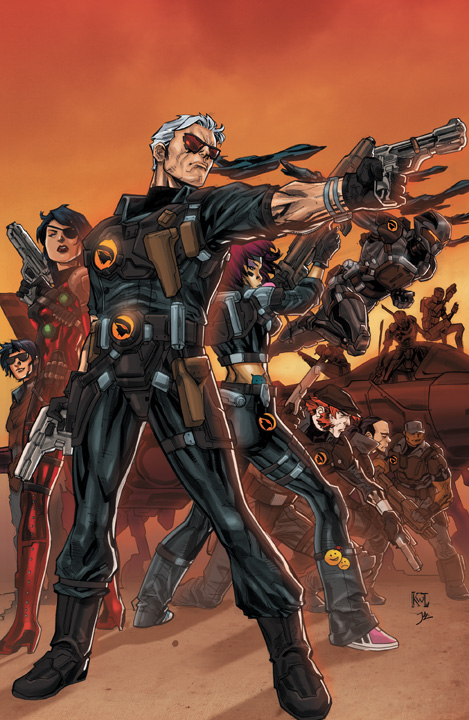
As part of their relaunched line of comics, DC has announced a new Blackhawks series, recasting the classic WWII-era team of aviators as an “elite group of mercenaries made up of brave men from around the world equipped with the latest in cutting-edge hardware and vehicles.”
Blackhawk and his team of, well, Blackhawks, may not be as familiar as most of the DC superhero characters—or even anywhere near the same league as DC’s iconic war hero Sgt. Rock—but the Blackhawk and his pals have been around for seventy years, in one incarnation or another, weathering the ever-changing winds of a fickle readership.
Perhaps that’s too strong of a statement about the endurance of the Blackhawks, because they have never been top-tier characters, even when their stories were written and drawn by some of the best creators in the comic book industry. Maybe it’s safer to say that the out-of-the-spotlight Blackhawk comics are surprising exemplars of how things have changed over the decades. Maybe we can say that an effective way to track trends and tendencies in American comics since 1941 would be to tell the story of Blackhawk and company over the years. Blackhawk, and his international team of freedom fighters, represents the course of American history. Or at least the course of American comic book history from the 1940s until today.
Yeah, let’s say that. I feel good about that. As bad as that course may be.
Blackhawk debuted in August 1941’s Military Comics #1, in an eleven-page strip written by godfather of American comics Will Eisner and Bob Powell and drawn by Chuck Cuidera. In typical pre-Pearl Harbor yet itching-for-interventionism fashion (like Marvel’s Captain America Comics #1), the first Blackhawk story dealt explicitly with the hunger to punch Nazis in the face, or at least throw them around like rag dolls and then shoot them in the gut.
 In that opening tale, we learn about a “stranger” in Poland who sees his family killed by Captain Von Tepp, a no-good Nazi, and then, one lengthy middle-of-the-page caption later, we find out about “a name that strikes terror in the hearts of men
Blackhawk.”
In that opening tale, we learn about a “stranger” in Poland who sees his family killed by Captain Von Tepp, a no-good Nazi, and then, one lengthy middle-of-the-page caption later, we find out about “a name that strikes terror in the hearts of men
Blackhawk.”
Blackhawk and his men, who warn enemies of their arrival by singing, “over land, over sea, we fight to make men free, of danger we don’t care, we’re Blackhawks!” are a kind of international wartime vigilante squadron of fighter pilots.
Not surprisingly, that stranger with the tragic past from the first pages of the story in Military Comics #1 turns out to be Blackhawk himself.
That basically means that Blackhawk is a wartime Batman, with the same archetypal origin of slain family members and a quest for vengeance, and even an echo of the “strikes terror into the hearts” line from “criminals are a superstitious, cowardly lot” caption from Batman’s own origin story. Except Blackhawk doesn’t wear a cape and cowl. He wears black leather leather military garb. And he doesn’t have a cave full of gadgets. He has an island full of gadgets. And he doesn’t have a boy sidekick. He has a squad of sidekicks, one of whom is an incredibly racist Asian caricature called “Chop-Chop.”
Well done, Will Eisner! Plopping Batman down in wartime Europe and making him a fighter pilot with 100% more racism in the stories.
Eisner, for all his amazing achievements in visual storytelling in his Spirit comics and, later, popularizing the idea of a “serious” approach to graphic novels with A Contract with God and beyond, is also the guy who wrote and drew dozens and dozens of stories featuring Ebony White.
 The Golden Age Blackhawk stories are typical of their era, with their overt racism (even the international cast is not much more than walking stereotypes, and the supposedly polish Blackhawk acts more like a lantern-jawed American movie icon than anything else), their reliance on a nine-panel grid page layout (which does open up into more interesting possibilities when artist Reed Crandall takes over in the second year of the strip’s existence), and their simplistic approach to politics and morality.
The Blackhawk stories aren’t stodgy, though, and Eisner’s dexterous hand is apparent, even though he’s not credited as penciler on any of the early stories. But his influence permeates the book, and I can only assume he helped with layouts or put the finishing touches on a few panels here and there, because of so many Eisner signature images: the bedraggled hero, with torn clothing, leaning on a young woman for support; bird’s eye, three-quarter views of architecture, with shadows looming large; underground bunkers and alleyways, with the Eisneresque circular windows; and even some of the panels of floating heads or the crosshatching on the folds in clothes. It may be the Eisner studio look more than the direct hand of Eisner himself, but the two become almost inseparable during that era of comics.
The Blackhawk strip continued as the main feature in Military Comics for the next decade, and also spun off into its own, self-titled comic, which lasted (after some stops and restarts along the way) until 1984’s Blackhawk #273.
Like most war comics, Blackhawk was never able to shake its period setting, even though some noble and not-so-noble attempts were made to update the series for the contemporary audience at the time. The most infamous of the attempted updates was 1967’s “Junk-Heap Heroes” by Bob “Hepcat” Haney and Dick “I Drew the JLA For Years” Dillin. Haney and Dillin recast the Blackhawks as high-tech costumed superheroes. It’s a concept that didn’t stick with the wartime aviators.
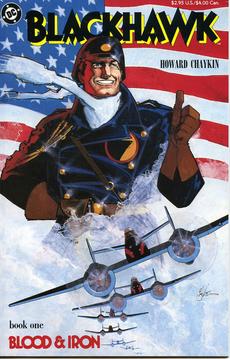 The best of the updates had to be Howard Chaykin’s three-issue prestige format Blackhawk miniseries from 1988, which kept the period setting but, filtered through Chaykin’s post-American Flagg!, post-revamped Shadow visual style and idiosyncratic fetishes, gave us a fresh look at well-tread ground. It was certainly unlike any version of Blackhawk that had come in the 47 years prior, even though many of the outward trappings looked similar. The planes and the pilots and the heroism vs. Nazis was still present, but the morality was murkier, the whole thing layered with power struggles and an overt conflict between appearance and reality. Simply put, Chaykin’s brief Blackhawk series is a startling good comic book—one that I would consider underrated if I didn’t personally rate it so high whenever the topic arises.
The Chaykin version of the character continued into the 1990s, alongside costumed superheroes in Action Comics Weekly and as a series all its own, but with Marty Pasko and Rick Burchett instead of Chaykin providing the scripts and artwork. It just wasn’t the same, even if the concepts followed logically from what Chaykin had established as the new status quo for the Blackhawk team.
Since the 1988 Chaykin series, the only interesting thing done with the Blackhawks (beyond a few guest appearances in some animated Justice League episodes and an occasional minor role in a comic book) was done as a pastiche. In Alan Moore and Gene Ha’s 2004 graphic novel, Top 10: The Forty-Niners, the Blackhawks appear, recast as the “Skysharks,” complete with a shark logo where the hawk logo would have gone.
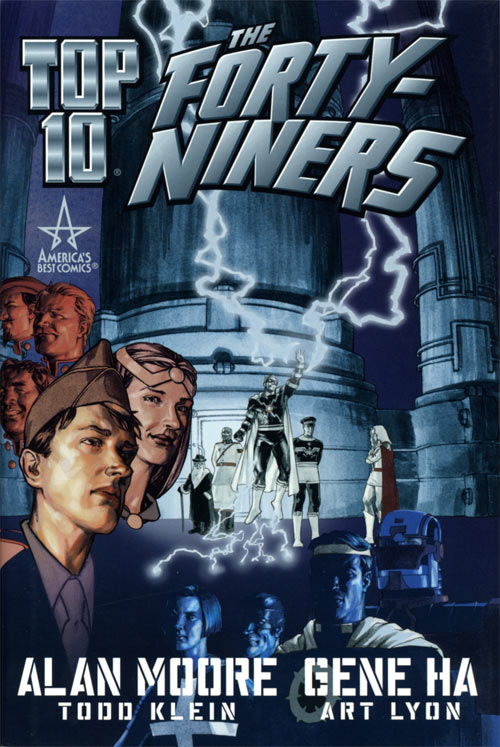 The Moore and Ha graphic novel was written as a prologue to their Top 10 series, a strip in which comic book archetypes populate the city of Neopolis, and the police force is composed almost entirely of superheroes, but the Skysharks, one in particular, play an integral role in The Forty-Niners. Ultimately, the book is a gay love story set in a comic book landscape of the past. Like the Chaykin Blackhawk series, it makes the subtext that could never be addressed in the original Will Eisner stories (the sexuality, in particular) an explicit part of the text. And if you were to only read two Blackhawk stories in your life, you couldn’t do any better than the Chaykin miniseries and this Moore/Ha collaboration.
But now there’s this new Blackhawks series debuting in September, a comic that’s clearly abandoning the trappings of any previous incarnation entirely in an attempt to recruit a new crop of readers. From the cover image, writer Mike Costa and artist Ken Lashley are giving us a squad that’s like the A-Team mashed into Nick Fury and his agents of S.H.I.E.L.D.
If they’re smart, they’ll keep the Batman essence of the Will Eisner original, because “The Out-of-Costume Batman and his Squad of High-Tech Military Heroes” is probably a much more marketable concept than my favorite Blackhawk stories mentioned above.
Just as all the other incarnations of the Blackhawks were products of their era, this one is as well. Or, like all entertainment artifacts, it reflects what the company thinks the fans of the time would want, and it remains to be seen how well they respond to this seemingly direct, unsophisticated approach to military action comics. It’s a return to the new good old days, when Nazis were meant for punchin’ and islands were meant for secret bases filled with the coolest hero-but-not-superhero gear. It’s a classic take on Blackhawk, really, just with contemporary hairstyles and fashion.
And one with, we hope, substantially less racism than the original.
Tim Callahan has read several comics. In a row. He also writes for Comic Book Resources every week. He likes it when you follow him on Twitter and ask him questions, because it gives him an excuse not to do whatever it is he’s supposed to be doing at the time.

Huh. Dunno why my comment was blank. Take two:
Man, there must be a gentler way for me to say this, but I’m failing, so I’ll be blunt: I think the unexamined racism of the young Will Eisner in the 1940s is far less reprehensible than the blatant misogyny of Howard Chaykin’s Blackhawk. Chaykin’s a bright guy, and I loved his early work like The Scorpion, but something soured around the time he was assigned Blackhawk.
ETA: I see I could’ve solved my posting problem using the edit function. Apologies for posting much too hastily.
I just realized Sky Captain is really Blackhawk!
John Ostrander did a Blackhawk one shot that I enjoyed. He gave the ‘Hawks a reason to exist in the modern world, taking the characters from JFK’s assassination to the fall of Saigon. He would also do a few stories with Wing as the public face and CEO of the Blackhawks and use him as a playboy detective type. Very cool.
@willshetterly: Oh, totally. I think Blackhawk may have been the source of the first in-continuity blow job in the DC Universe, and it was a particularly unpleasant scene.
Not for nothing, but Chaykin’s next big project after this was the even more sexually explicit Black Kiss.
Will — Captain Confederacy — Shetterly? I read the heck out of that comic in the 1980s.
I think there’s a big difference between explicitly racist images (and portrayals and nicknames) and hyper-sexuality with characters who are misogynistic, don’t you? Is Chaykin a misogynist because his characters are? Because his character have oral sex? I don’t buy that. I mean, he MAY be misogynist, but you can’t use Blackhawk as a definitive example, I don’t think. Maybe you can. I’d like to hear the argument with some more specifics.
Ron, thanks for confirming my memory. I should look up whether Chaykin’s Shadow came before or after that, ’cause I remember it as lacking any admirable women also. Now, Chaykin may’ve gotten over whatever he was going through then–Eisner sure realized his youthful take on Ebony sucked.
But I would argue that Ebony and Chop-Chop, in their racist incarnations, were more admirable than Chaykin’s women. Ebony and Chop-Chop had virtues, like loyalty and the occasional bit of cleverness and, well, pluck. Chaykin’s women at that period in his art were only out for themselves. Eisner’s take on E & C was condescending, but it was also fond. Chaykin didn’t seem fond of any of the women in his stories then.
Tim, yep, that was mine. It’s not the depiction of sex that I object to. As a character says in Treme, “Cosmically speaking, the more cocks that get sucked in the world, the better for humanity.” But Chaykin in the ’80s was writing characters in a world where there were no admirable women. After American Flagg, the first 12 issues of which I also loved, I was very disappointed. I’d been a Chaykin fan since his Cody Starbuck and Fafhrd and the Gray Mouser. His men may not have been extremely admirable either–he was working in a noir tradition–but the men were the POV characters, so they seemed more sympathetic than the women.
To go further with this, I would have to reread his Blackhawk and Shadow. I may’ve missed something, but I what I remember, I did not like.
Will, off the top of my head, Chaykin’s Shadow came out before Blackhawk.
James, Wikipedia says you’re right. It’s possible my intense dislike for his Shadow colored my opinion of his Blackhawk.
I liked some of Chaykin’s earlier work, but yes, his misogyny got to me. I didn’t like his Blackhawk series. I did like the Pasko/Burchett take on the series, enough that I’ve sometimes bought duplicates when cheap copies presented themselves–because I have no idea where my other copies are!
Mike Grell also wrote some Blackhawk for Action Comics when it became an anthology. I’m a Grell fanboy so I enjoyed it despite getting a Tales of the Gold Monkey vibe.
Reading your piece I actually got interested in the upcoming book. But I did think of how great it would be to have series of stories set with different eras of the Blackhawks throughout history, past, present, and future. Be kind of a fun read I think.
The racism and sexism of the respective Blackhak series I recall fairly well, particularly the sexism of the Chaykin series of stories. His storytelling was ever top notch but his treatment of women as objects oftrn drove me to stop reading his titles no matter my fondness for pulp era pastiche.
I do not really know if I will be hip to this imagised looking gijoe looking series. To be honest going by the cover I would be tempted to pass but the fact it will be available electrinicly I may give it a try on spec alone. Not being ties to the paper pamphlet style publishing I may take a chance on titles I would pass over since storeing them will not be an issue
It doesn’t seem, ever, to fail to shock me anew when people will take up a topic just to run it down. Or to criticize something from the past for not having modern-day information and attitudes about the subject. Sure, Blackhawk in the 40s was racist by today’s standards.
I’m sure it probably wasn’t politically correct by the standards of some, even in the 40s. You may well argue that racism is racism no matter when it occurs. But in the Blackhawk strip in the 40s, the characters and their attitudes were not very much out of step with the general culture, if the impression I’ve gotten from watching war films of the time is accurate. Is it therefore fair to criticize Will Eisner in the 1940s for not having the sentiments and attitudes of the early 21st century? Again, this is not to say that the Blackhawks as presented then were not racist.
But I believe that it’s important not to Monday-morning quarterback, and not to presume to have the arrogance of the 20/20 vision that comes from hindsight, and to tell Will Eisner, back across a span of 70 years, that he should have known and written differently back then. Observe and remark, in comparison with today, but what’s the point of criticizing after the fact?
There is no utility in decrying the past for attitudes about owning slaves, or for drowning witches, or for encouraging people to have a “nice, relaxing smoke” as a way of relieving stress. These things have all happened in our own country’s past, but they *are* past. Nothing will come of critiquing them after the fact, other than stoking our own feeling of superiority.
I suppose I should observe how simple and callow I must be–or at least, appear to be to people like Mr Callahan–in that I always liked the Blackhawks simply because I thought they looked cool, because they were fliers, because they were good-guy soldiers fighting the bad guys, and because they were a comradely company of manly men fighting the good fight– because that’s what real men do. I take particular exception to Mr Callahan’s praise of the Chaykin and Moore depictions of the Blackhawks, where
“. . . the morality was murkier, the whole thing layered with power struggles and an overt conflict between appearance and reality.”
and
“Since the 1988 Chaykin series, the only interesting thing done with the Blackhawks . . . was . . . Alan Moore and Gene Ha’s 2004 graphic novel, Top 10: The Forty-Niners . . .””Ultimately, the book is a gay love story set in a comic book landscape of the past. Like the Chaykin Blackhawk series, it makes the subtext that could never be addressed in the original Will Eisner stories (the sexuality, in particular) an explicit part of the text. And if you were to only read two Blackhawk stories in your life, you couldn’t do any better than the Chaykin miniseries and this Moore/Ha collaboration.”
I completely disagree. I’ve never read Alan Moore’s story, but specifically on account of the sexuality and the antiheroic tone of Howard Chaykin’s “Blackhawk,” I will forever remember that miniseries as one of the most singularly off-putting experiences of my comics-reading career.
Maybe Mr Callahan will call me callow, naive, unrealistic, or immature–or all of those things. But I don’t have his, and apparently many other people’s attitude, that literature must reflect life as they see it, where apparently all morals and motives are murky and changeable; where all people lack integrity, dependability, and honor, and where it’s always every man and woman for him or herself. Nor do I share Mr Callahan’s, Mr Chaykin’s and Mr Moore’s fondness for inculcating sexuality into everything as a way of emphasizing how real, or gritty, or important it is–or whatever they think inserting sexuality accomplishes.
I suppose I ought to be ashamed of my non-intellectuality for not looking at every damned thing through a postmodernist, sociopolitical lens. The more the fool I, I suppose; tsk!
the post-Chaykin Blackhawk was also the co-star in a storyline in Sandman Mystery Theater, close to the end of that wonderful book. I’m not sure if that storyline ever made it into the collections from that title (which seem to have stopped). Matt Wagner has a very different worldview from Chaykin, so the character retains the best parts of Chaykin’s revamped origin while being a bit more admirable. I believe that he does still have womanizing moments, however.
I liked the Pasko/Burchett series in Action Comics Weekly and the short-lived followup series. I also pick up the back issues of this series whenever I find them (and if I find them, they’re cheap). This series took a Steve Canyon approach to the post-war adventures, and it worked.
I do believe that it was John Ostrander who really ran with the “Blackhawks Express” idea, turning the Blackhawks into a superhero universe FedEx that can handle your more “delicate” shipments. That particular approach had potential but never really got much play or traction. I’ll tell you, if the New 52 had hired writers like Ostrander and William Messner-Loebs instead of people like Scott Lobdell, i’d be much more excited.
the 1940,s stories were good adventure stories,no more exagerated than other comics or films of that period.however it seemed that when the lads traded in their f5f,s for the f90,s they seemed to drift towards the realms of fantasy and science fiction.[put the jets on remote control whilewe bail out for a punch up] was a typical action. what happened next ????????