








We continue our exploration of regional cryptids in North America, mammalian and mammal-adjacent, with one that may be as old as the Jersey Devil. According to legend, famous frontiersman Daniel Boone encountered the beast in what is now Missouri and possibly even shot it.
That takes it back to the mid-eighteenth century, contemporary with the Jersey Devil but quite a bit farther west. There are a few similarities between the creatures (hairy, horned, and given to howling), though the Howler doesn’t seem to have been regarded as demonic. Whatever it is, it’s an earthly creature, if not quite like anything else in that part of the world.
I say “is” because Boone’s sighting is the first of many from colonial times onward, right up to this century. People have seen and heard it in Missouri, Arkansas, and even Oklahoma and Texas. In 2015 a man named John Meyers claimed to have taken photos of it, but those were debunked as a hoax.
The Howler in Meyers’ photos is a quadruped. It’s black with tan points, doglike in body shape, with a long, thin, catlike tail. The head looks like a dog’s, with a pointed muzzle and a set of deer-like antlers. It looks like a mashup of a chupacabra and a big cat, with jackalope horns. The newspaper article opines that it “looks less like a mutant horned black mountain lion and more like a German shepherd pup with a badly done Photoshop haircut.”
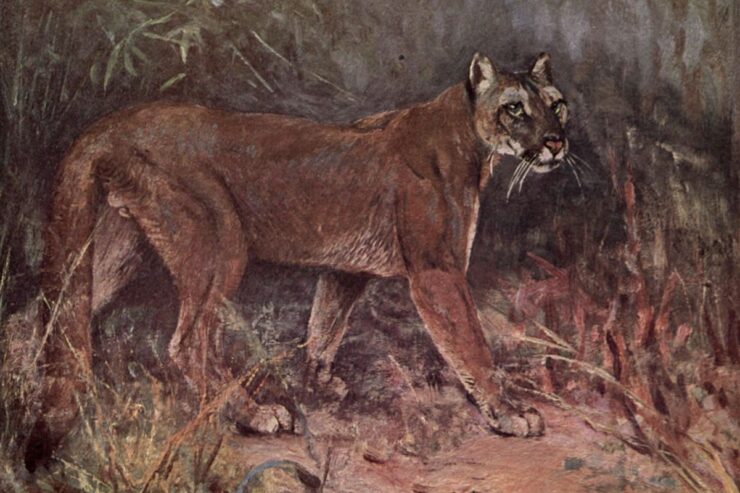
The original Howler is more like a giant mountain lion with horns and long, shaggy, bearlike fur. It’s big—about the size of a bear—and it has a terrifying cry, though reports vary as to what it sounds like. Blood-curdling scream, elklike bugle, wolf’s howl. It’s been called the Black Howler and the Devil Cat.
As to what it might be, other than a bear or a deer or elk moving quickly and confusingly through the woods, a likely candidate is a mountain lion. Supposedly there is no breeding population of these animals in the area, but big cats have big hunting ranges. My state of Arizona knows about that—there are jaguars in the mountains near the Mexican border, and all of the current individuals are males. The females so far have stayed in Mexico.
There’s another possibility, too, as noted in Unlock the Ozarks. Many of the people who colonized the Ozarks came originally from the British Isles, and brought with them their lore and legends. One such is what the site calls the Cù-Sìth, the Hound of Death. This creature is “the size of a young bull with the appearance of a wolf. Its fur is shaggy, and usually cited as being dark green though sometimes white. Its tail is described as being long and either coiled up or plaited (braided). Its paws are described as being the width of a man’s hand.” Its howl is a harbinger of death—in fact it’s associated with another mythical creature, the Banshee.
This legend may have combined with Native tales of sabertoothed cats that roamed those hills during the Ice Age. Native peoples arrived in North America well before these cats became extinct; it’s possible that humans caused that extinction, along with that of the native horse and the mammoth. Stories of the great cats may have survived long after the species had vanished. Then came the colonizers with their own tales, and encounters in the deep woods with animals half-seen and distantly heard.
Unlock the Ozarks provides recordings of calls that might be taken for that of the Howler. They include the red fox (the shriek of a vixen will freeze your blood), the fisher cat, and fighting raccoons. I’d add the scream of a mountain lion.
If you’re out in the woods at night, you’re most likely primed to be scared, and more so if you’ve been telling tales of a monster that hunts in the darkness. Catch a glimpse of a large animal, bear or elk or even a big cat, and your imagination may go into overdrive. A bear crowned with branches, a mountain lion looking for a mate—there’s your Howler.
Or, as we often say, maybe there really is something else out there. It’s not impossible.

About 40 years ago when I was in the Army and stationed at Ft Polk in Lousiana I was on a field exercise and heard a panther scream. Doesn’t sound like a fox. Gets your attention. Is he in the tree right over there or a mile off in the woods? Something in the lizard brain says “Big cat! Be alert so you don’t get eaten!” Heard cougars in Utah that sounded like that. Ft Polk is a huge place with lots of wooded training areas so it wouldn’t be surprising for a population to have held on into the 1980’s.
Foxes sound more like a woman screaming. We have them in the woods behind my house and I sleep with the windows open so once in a while they wake me up.
There have been numerous cougar sightings in that area, up to the present day. They aren’t the right color, but one of the sounds witnesses talk about does sound a lot like a puma scream. When it’s not closer to a fox. Night, woods, human imagination, and there you are.
The mountain lion or cougar doesn’t have melanism (the gene that turns the base coat black) in its genetic makeup.
There are no verified cases of melanistic cougars, which isn’t necessarily the same thing.
Apparently they lack the gene for it. I’ll say more about that in Monday’s post.
Sounds more like Black Shuck than a cu sith to me.
Could go either way.
Did you see the recent news bit about finding big-cat DNA in the Black Shuck’s hunting grounds?