









Sorry, I forgot to stop reading and got all the way through Chapter 6! So that’s where we’re reading up to this week.
Summary
Tiffany is at the end-of-summer scouring fair on the Chalk. Two girls approach to give her a bouquet meant to attract a beau and ask if she has any “passionate parts” as a witch (since they’ve been told not to become witches on account of witches not having those parts). Tiffany tells them that witches are just like everyone else that way, just more busy. She goes to watch the cheese rolling, which turns to mayhem due to the Feegle turning up and unleashing Horace on all the unsuspecting and unsentient cheeses. Rob Anybody tells Tiffany he was sent on behalf of the kelda, who just wants to make sure that Tiffany is okay. Then Roland pauses on his journey home after seeing the injuries on the cheese-rolling field. Tiffany assures him that nothing wrong, and he leaves with his new paramour, Letitia. Later that night, Tiffany is sent to Mr. Petty, an angry drunk who has beaten his daughter until she miscarried, to warn him away before the men in town come to kill him. Then she has a talk with her father about why Petty became the sort of man he is, and the fact that his daughter might not be his biological child. Tiffany tells her father to get the old stone barn cleared out for her.
The Feegle are nearby listening. Tiffany asks them to help her get Petty’s daughter Amber up to their mound where she can be helped. Jeannie, the kelda, and the Feegles aid the girl, who is still unconscious. Jeannie then has Tiffany fed and tells her that she’s been having visions in her brain that danger is surrounding her, but she cannot tell where the danger comes from this time around. She warns Tiffany to be cautious and invites her to stay the night and rest. Tiffany does and wakes to Amber laughing: The soothings that Jeannie performed have worked well on her, and she can begin to heal. Tiffany leaves swiftly to head back and bury the stillborn child, but she sees a figure with a walking stick that vanishes. Then she sees a hare that bursts into flame, runs off, and also vanishes. When she gets back to Petty’s barn, she finds Mr. Petty has come back and put a ring of flowers around the baby’s body, then tried to hang himself from the rafters. Tiffany cuts the rope with Rob’s help, saving his life. She brings Amber to her home and learns that Mrs. Petty went back to find her husband, claiming he was attacked. Tiffany’s father says the rest of the town need to look after the family and not everything can be Tiffany’s job.
Tiffany goes to the Baron next to help take his pain away, and his nurse Miss Spruce is talking about how she doesn’t hold with Tiffany’s magic and thinks that people shouldn’t fall to demonic forces. The Baron talks to Tiffany for a while and asks if she saved his son’s life all those years ago—as her father apparently told him recently. She admits that she did, and he gives her fifteen dollars: old money made of mostly gold, which will fetch a very high price. Tiffany doesn’t want to accept it, but he insists. He asks if he’s going to die soon, and she admits that he is. Tiffany shows him the fire trick she does to sanitize her hands, and it brings up a precious memory for the Baron, a song about a hare going into fire, and he dies happy. Miss Spruce is quick to accuse Tiffany of murder and theft, though the head of the guards, Brian, knows Tiffany and isn’t too concerned about that. Tiffany suggests that she go to the city to inform Roland that he is Baron, which everyone agrees to. She arrives at the Feegle mound to find Amber back there; Jeannie thinks Amber should be trained as a witch, as she learned their ancient language just by hearing it. Tiffany goes to talk to Mrs. Petty and has the Feegles clean her kitchen, which terrifies the woman.
Tiffany comes home to find that Wentworth has been in a fight with a local boy who was saying mean things about her being a witch. Tiffany’s mother warns her that things are getting strange out there, and that she needs to be more careful. Tiffany and the Feegles start toward the city, but Daft Wullie sets fire to Tiffany’s broomstick, necessitating a landing on a carriage that’s carrying a disco ball. The coachman, William Glottal Carpetlayer, has jumping bones. Tiffany tries to help him when a figure suddenly appears—a man with no eyes, who casts no shadow and promises to find her wherever she goes. The Feegles attack him and he’s gone, and the coachman is so grateful for having his bones fixed that he agrees not to charge Tiffany for scraping the carriage’s paint job. They make it to Ankh-Morpork, where Tiffany heads to Boffo’s Joke Shop and meets Derek and his mother Mrs. Proust, the witch who all the warty stereotypical witch masks are actually based upon. Mrs. Proust tells Tiffany about witching in a big city and takes her to see dwarfs who can repair her broomstick. When they find out she’s friends with the Feegle, they agree to do her repairs at no charge.
Commentary
Unsurprisingly, as Tiffany approaches adulthood, she finds herself doing too much and expecting that she can somehow shoulder the whole thing by sheer force of will. Or, as the narrative helpfully hands us:
Perhaps that was the trick of it, Tiffany thought. If you kept yourself busy you wouldn’t have time to go nuts.
Gurl. That’s not how this works.
I dunno, I love that while a good witch’s work is predicated on doing what needs to be done that other people are leaving by the wayside, this book is peeking over the top of that summit and finding… oh look, there’s just more work. And Tiffany is in a prime position to allow this to happen because she has always been like this, always believed that other people couldn’t manage without her and always trying to do everything herself. It’s very easy to blow right by the Self-Sufficiency mark and careen straight into burnout being your life’s default state.
This is a subject I happen to be a little belligerent on personally, due entirely to personal experience. I will grab my more Type A friends by the face and lovingly whisper “If you don’t take a break, your body will decide when you take it in the most dramatic way possible” every chance I get. I wish I could do the same for Tiffany, but that is the point of this story.
Buy the Book
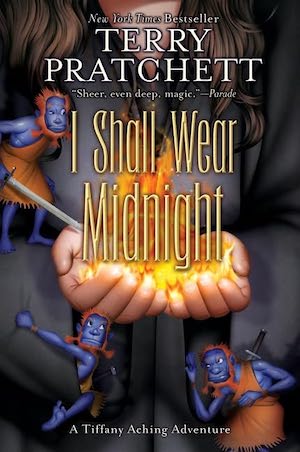
I Shall Wear Midnight
These coming-of-age lessons for Tiffany always deal in both rather than either-or as a rule of development, like a finely balanced seesaw: In previous books we’ve seen her take responsibility for her community, learn that most of life is in doing the gritty awful jobs that you’d rather look away from, but now we’re getting the inverse of that, an acknowledgment that being part of a community does involve relying on it in some fashion, and also that no one person can be everything that people need.
We’re also arriving at the point where many of Tiffany’s personal relationships are reshaping themselves into what they will be when she’s an adult, and the changes there are rocky, to say the least: Her potential romance with Roland is over—he’s moved on to Letitia—and her relationship to her family is altering too. Mr. Aching would hardly be the first parent to realize that his kid’s grown up a bit faster than he’d prefer, but the real tragedy is in Tiffany looking at her family and not believing for one moment that they can aid her, that she can trust them to pick up slack.
It’s going to be a rude awakening.
Asides and little thoughts
- Of the Baron: “To him, the pain was a bully, and what do you do to bullies? You stood up to them, because they always ran away in the end. But the pain didn’t know about that rule. It just bullied even more.” Yeah. Um.
- I’m trying to remember if it was ever suggested that the Baron was such a genial fellow, because I feel like this is a sizable retcon on Pratchett’s part. The guy we heard about in the first couple books sounded pretty distant, haughty, and cold to me. Granted, dying probably makes a difference, but he’s still a lot more affable than I would have expected.
- It seems important that Mrs. Proust says she’s teaching young people respect for other people’s property, not because vandalism is in and of itself some kind of high-grade evil, but because a lack of respect for it “would, you mark my words, have resulted in him getting a new collar courtesy of the hangman.” A teach-to-the-outcome sort of plan.
Pratchettisms
She sidled away as politely as she could, but as noise went, it was sticky; you got the feeling that if you let it, it would try to follow you home.
For the onlookers, of course, it was just another show; you didn’t often see a satisfying pile-up of men and cheeses, and—who knew?—there might be some really interesting casualties.
What a name. Halfway between a salad and a sneeze.
The world was always very nearly drowning in mysterious omens. You just had to pick the one that was convenient.
At last someone had taught a boy something useful!
Next week we’ll read Chapters 7-10!

Thoughts
The book somehow feels grimmer and darker than the previous Tiffany books, albeit with a hefty dose of Feegles to make up for it.
So far, unlike most coming of age books, it seems less about gaining power and agency as you approach adulthood and more about losing it.
I think you are too harsh on the old Baron. If I had to describe him in one word, it would be comfortable. The chalk, his serfs, his employees; all had a comfortable relationship with him. Unlike with Roland.
Pratchettisms
Tiffany had no understanding of the word “minefield,” but if she had, it would have seemed kind of familiar.
This was a terrible misfortune, since more than half of those ailments are never found in pigs, and one of them is a disease known only in freshwater fish. (Tiffany reflecting on Petulia and her beau)
In Tiffany’s case there were sometimes Third Thoughts and Fourth Thoughts, although these were quite difficult to manage and sometimes led her to walk into doors.
Somehow everything balanced and they could look at advertisements for gingerbread cottages in the builder’s brochure without putting a deposit on one.
The Baron lay with thin white lips. Tiffany could hear him not screaming.
A grunt from Granny Weatherwax was like a round of applause from anybody else. (Tiffany)
She felt sorry for Brian, even though he too often opened his mouth before he got it attached to his brain. (Tiffany)
“Behind everything simple is a huge tail of complicated.” (Toad)
If I recall correctly, the Chalk’s version of the Rough Music is a lot more drastic than the definition given in Brewer’s Dictionary of Phrase and Fable (17th Ed.), for which Pratchett wrote the Introduction (I just checked my copy). Mr. Petty was lucky to escape maiming, at the least.
But the Tiffany novels are where Pratchett deals with the less salubrious aspects of rural life, without a mask of humour – in one of the earlier novels there was that business with the local solitary old woman accused of being a witch and driven out of her cottage. And they killed her cat – that stuck in my mind as a particularly cruel thing to do.
It’s a testament to Pratchett’s skill as a writer that, despite writing about how ignorant and violent the Chalk dwellers could be, he never makes us despise them. Just wish that they could do better.
Wikipedia has an article on rough music, according to which it might or might not be physically violent. But what this book describes is more like a lynching.
I would guess that is a euphemism, as in German, where to teach somebody the tunes of the flute (jemandem die Flötentöne beibringen) means to give him anything from being put down in public to – as it most often is meant – a thorough beating, usually by a group of people.
As is often the case, the nature of a certain punishment tends to turn to excess if administered by peers. See the pillory, a sentence for petty crimes, often resulting in stones, bad food and faeces being thrown at the convict, which is a bad combination without antibiotics. It often resulted in being scarred for life, if Npnot worse.
that’s Witches Abroad. where that scenario happens
There is an old woman living in an isolated cottage and neglected by her neighbours in Witches Abroad, but she was part of one of those fairytale scenarios (Little Red Riding Hood, in this case) set up by Granny Weatherwax’s evil sister.
The incident I’m thinking of took place in the first Tiffany Aching book, if I recall correctly, but I don’t know where my copy currently is.
Raskos is right. When Roland vanishes in Wee Free Men, the people people accuse an old woman of being responsible for the vanishing, believing her to be a witch. The Baron throws her out of her home and she freezes to death.
Nothing to do with Tiffany, but while reading Pratchett’s old stories in “A Stroke of the Pen” I came across the original CMOT Dibbler.
Grubble (a magician) – “Real bargains, genuine solid brass plating, only three pieces each to you, all right, two, okay, one – but I’m cutting my own throat.”
Is it just me, or is this book a little heavier on moralizing? It’s not nearly as stupid-sticky as the books that were once considered appropriate for children, but Pratchett is getting even more into rightful behavior than I recall from any of the previous Aching (or other witches) books. He’s also getting seriously cross with religious … enthusiasts …, more so even than in Small Gods; going beyond being cross at God for not existing (as he was described on the jacket of Good Omens). Tiffany is going to have to deal with the … enthusiasts … at some point, but I’m forgetting whether they’re all humans (who think that dabbling in black arts is OK because it’s for a good cause) or a supernatural embodiment as in her previous outings.
I wonder whether cutting down Petty is in fact merciful; he’ll have to live with what he did whenever he’s not too drunk to remember (hard on him), and when he’s drunk he’s probably going to be hard on his wife. But Tiffany probably couldn’t not cut him down even if she were awake enough to have Third Thoughts.
Some more Pratchettisms:
“Well, as a lawyer I can tell you that something that looks very simple indeed can be incredibly complicated, especially if I’m being paid by the hour.”
Even a witch can be out-looked by a cat that has had it up to here and is still up here.
Feegles tended to bounce when they hit the ground, although sometimes they damaged it a little.
respect for other people’s property, not because vandalism is in and of itself some kind of high-grade evil, but because a lack of respect for it “would, you mark my words, have resulted in him getting a new collar courtesy of the hangman.” A teach-to-the-outcome sort of plan”.
Tell that to all the graffiti taggers in New York BD
A few questions:
What is the meaning of the hare in the fire?
Chapter 4: After discussing the events of an earlier book in which Tiffany led Roland through the fairyland: ‘Tiffany knew that the long lie had hurt her father. She’d never really worried about it, but it had worried him.’
What is this ‘lie’ exactly?
Chapter 9: After the Baron dies, Tiffany creates a ‘new custom’ – she transfers heat from the marble slab (which gets cold) to the bucket of water (which boils). Why?
We won’t know the meaning of the hare in the fire until the end of the book.
The lie was that Roland rescued Tiffany.
To freeze the slab and keep the body from rotting before the funeral.
‘But like many other invalids she had seen, he somehow kept on going, living in a holding pattern and waiting to die. She had heard him described as a creaking door that never slammed. He was getting worse now, and in her opinion, it would not be long before his life slammed shut.’ My uncle died last year, my mom’s ex-boyfriend died last month, and they were like that — their ruined bodies holding onto life long after becoming unable to do anything else and their minds were ready for death — and there were no witches to remove their pain and help them stay lucid. It happened to my grandfather and to my mom’s partner long ago, and is happening to a friend’s husband now. It’s a state I dread.
I can so relate to envying people for having something that’s not precisely what you want, as Tiffany envies Petulia’s pig-witch career and impeding marriage. I’m in no hurry to get married, because I can hardly imagine committing to permanently *live with* one person, let alone have them be my final-and-forever sexual and romantic partner. (Lots of marriages don’t last forever, of course, but I believe that any marriage gets initiated in the hope that it will.) But that’s because I’ve never had *any* romantic or sexual relationship, so I’ve never begun to get the experience that could empower me to make such a decision. So I bitterly envy my married peers for having found someone who they think they want to spend the rest of their lives with, while I’m not even on square one of that path. (I also envy people who derive great happiness from visiting places I don’t want to go, having weight-loss diets I don’t want to try, doing jobs I’m incapable of, etc.) Though Tiffany seems to feel that her separateness from the populace at large is a permanent, unchangeable thing. She could be right, despite the listed examples of other witches forging their varied social connections.
‘To a true country man, all hares are referred to as ‘her.” Brings to mind Brian Jacques, who was a city man despite his brilliance at writing painfully gorgeous portrayals of wilderness, and referred to plenty of hares as “him” (and other hares as “her”).
“That did just happen, didn’t it?” That’s the right attitude in Discworld, where almost absolutely anything can happen.
The broomstick repair negotiation scene demonstrates that friendship with Feegles can be quite useful…for finding help with fixing problems *caused* by friendship with Feegles.
Pratchettisms:
‘Why was it, Tiffany Aching wondered, that people liked noise so much?’ (I wonder the same.)
Looking back:
‘Of course every now and then, a witch might marry a grand husband, like Magrat Garlick of Lancre had done, although by all accounts she only did herbs these days.’ (By the way, a fossil species of Mesozoic ginkgo has been named Ginkgoites garlickianus after Magrat.)
Tiffany calms the coach horses (or rather, paralyzes them with fear) by using a Horseman’s Word, with which a blacksmith had ‘paid’ her. The Horseman’s Word used by Jason Ogg (and Granny Weatherwax, who learned it from him) is a threat to put a stallion’s “goolies” on one’s anvil. But there was no anvil for Tiffany to threaten these horses with, and what she said would allegedly work on any horse, not only stallions. So did she say something different?
Looking ahead:
‘Tiffany liked fire. It was her favorite element.’ I can’t relate to that (maybe because I haven’t had to face the Wintersmith), but she’s lucky that it’s the case, as fire will be important in this book.
Hey Preston.
wrt the horses: she could have phrased it in the future subjunctive (like a university president I once heard when commencement fell before the finishing date of one of the graduate schools, only turned around). Or she could just have told them what she’d direct her broomstick to do — “batter up!”.