







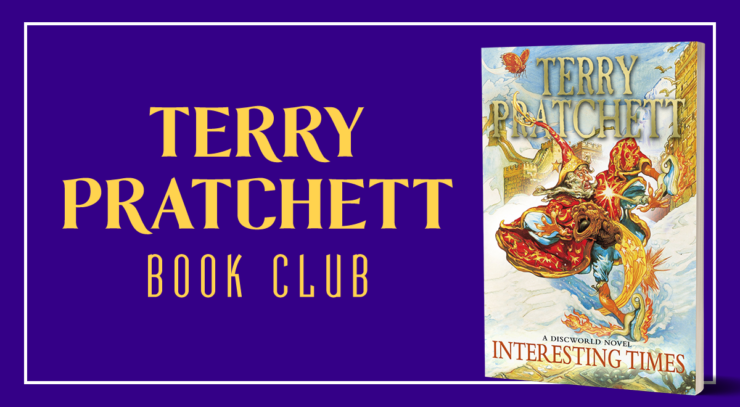
We’re back! Let’s not waste time with pleasantries! Unless they’re your thing, in which case, you look lovely today!
Summary
Rincewind is caught for having a stolen horse, and then brought to a palanquin and told by the occupant (District Commissioner Kee) that he will be made a slave. He is told to make a mad dash run for it by a nearby guard and complies, finding refuge in a small village where he hides amongst citizens taking a test for a public works position. Once the coast is clear, he continues on until he comes across an inn, and, being hungry, stops in for a meal. By virtue of a poorly placed comment and the presence of his copy of “What I Did On My Holidays,” the innkeeper starts talking loudly about how he doesn’t serve rebels. There is a theatre troupe performing at the inn and the innkeeper gives Rincewind soup and later a fortune cookie, and then the wizard is promptly knocked unconscious. He comes to in a cart where a woman assures him that she is a friend—one of the theatre troupe who also pretended to be a guard earlier in the day and told him to escape—but she is unimpressed by what she’s seen of him. She doesn’t believe he is the Great Wizard they’ve heard tell of, and suggests him to get better or she’ll kill him.
Buy the Book
Siren Queen
Cohen talks to Saveloy about how they might invade the city; they get themselves captured at the gates for not having the right papers, so that the Silver Horde is taken to the guardhouse and can capture the guards. Rincewind’s cart stops and he finds that he has been delivered to Hunghung, and that Butterfly and her cohort are about to introduce him to the Red Army that he’s supposed to aid… so he runs away. He finds it hard to move about the city, and also mistakes a funeral for a celebration of some sort. He wanders into a quiet spot that turns out to be the Imperial Square, getting stopped by soldiers. Realizing that no one ever disobeyed their orders, he makes a run for it to play on their surprise. He comes across a fellow named Disembowel-Meself-Honorably Dibhala, who reminds him a great deal of someone he knows back home. Dibhala tells him about how the city feels about “foreign ghosts” and what exports they might have to trade overseas, and how they use paper money in place of all the gold sometimes. Rincewind then sees a young member of the Red Army getting dragged off for putting up posters and tries to run again. He’s hit over the head.
Saveloy tries to give the Silver Horde lessons in civilized behavior so that they can interact with the people in the city for future reference. This prove a difficult task. Rincewind wakes up amongst the Red Army again and talks to them about their plans. He realizes that they’re mostly quite young, clearly with no fighting experience and practically no rebelling experience either. They want his help rescuing their friend Three Yoked Oxen from prison, which is a tall order, but the only option he’s given. The Luggage escapes its corral where it’s being kept with other luggages. The Silver Horde spend the day shopping and Saveloy gets to teaching them table manners. The Red Army wants Rincewind to make a hole in their Forbidden City’s wall, which he doesn’t know how to do; Butterfly knows Rincewind doesn’t have any great power, but she expects he might get lucky, as he has before. The Forbidden City’s Master of Protocol hears “ghosts” beneath him (it’s the Silver Horde, entering through the sewers while they set a diversion at the wall). Rincewind pretends to attempt magic, not realizing he’s right by all the fireworks set up by the Horde, which promptly explode the wall, giving the appearance that he’s actually done magic. He’s immediately arrested.
Lord Hong is making another sword (which he does when thinking), and is approached by a messenger, who tells him that the Red Army and Great Wizard have been captured. Hong demands their imprisonment and also dispatches an assassin who has been sent to kill him in the same breath. Rincewind is brought before the Emperor and makes him laugh, so the Emperor decides to keep him. His Grand Vizier turns out to be Lord Hong, who seems perfectly happy with this turn of events. The Emperor retires for the day, and sends Rincewind to the special dungeon. Lord Hong is pleased that his plan is working out exactly as he suspected while the Silver Horde are complaining to Saveloy about their lack of murder in the invasion of the Forbidden City. Rincewind winds up in a dungeon cell and hears tapping, a form of communication between prisoners. Asking what the tapping means leads to conversation with the person one cell over—it’s Twoflower. Rincewind asks why he’s still sitting there since he wrote the revolutionary book everyone’s on about, and Twoflower admits that he hadn’t meant to start trouble. He thinks they’ve forgotten he’s down there at all.
Commentary
This book is a bit slow-going compared to Pratchett’s usual. It reminds me a lot of Pyramids in that respect; I think setting up new locales on the Disc results in taking the wind out of the story sails, so to speak. It’s actually fascinating to see when it does or doesn’t seem to hamper things, as Small Gods does a much sharper job with a similar setup.
We’re getting a lot of cross-cultural commentary in this section, and it mostly works well. I think the thing I enjoy the most is how we get translations of both Agateans speaking Morporkian, and Rincewind speaking Agatean—rather than choosing to make fun of how one particular group of speakers might mangle a foreign language, the humor is largely derived from the fact that translation is a minefield, and that different languages have different stumbling blocks. For Morporkian, it’s all in missing words and strange phrasings, whereas for Agatean, Rincewind is likely coming upon tonal issues that result in completely incorrect terms getting thrown into his sentences. It’s an accurate rendering of real difficulties in learning new languages that isn’t just down to you can’t speak English good.
Within the description of the Agatean Empire, we learn of the people who try to move beyond the wall, to travel to distant places, specifically the ones who finally make it to Ankh-Morpork with nothing and then open shops and work every hour of the day: “People called this the Ankh-Morpork Dream (of making piles of cash in a place where your death was unlikely to be a matter of public policy).” And this is interesting because… well, obviously this is a play on the American Dream, which kind of is exactly that. Except plenty of people who moved to the Unites States to partake in said dream did find their deaths and disenfranchisement becoming part of public policy. See: ICE camps on our borders, or Japanese internment, and that’s only naming a couple. Of course the quotation says “unlikely,” but that’s just the point—unlikelihood is really from the vantage point of the person who might be doing the dying. Perhaps, in this case, “a bit less likely” would be more accurate?
There’s also the bit about the Silver Horde freaking out at the idea of eating dog, and I appreciate that it’s immediately countered by one of them admitting to having tried cannibalism before, as a point of illustrating how one person’s delicacy is another person’s I-would-never, and it’s such a good way of treating the topic that I came away stunned? I was fully expecting the joke to end with everyone being upset about what the Agateans eat because you encounter that sort of thing everywhere. This is a personal peeve of mine because food is a fraught and touchy subject for so many: People love to get rude over what other groups of people eat, especially when it comes to animals (but also with everything). And it’s an area where people really should mind their own dang business because there are so many contributing factors to what is “normal” in a person’s diet: culture, upbringing, class, religious beliefs, allergies and dietary difficulties—the list goes on and on.
We love to attach morality to food when the point is that we need it to stay alive. It’s perfectly fine to make choices for ourselves, but it’s equally important to be clear-eyed about said choices. A dog is a pet to me, so I’m unlikely to eat one, but I have no call making that choice for anyone else. And here we have a horde of elderly barbarians balking at the idea of eating dog, and suddenly one of them admits to eating people, thereby reminding us that the rules of engagement around these topics are contextual and permeable, whether we want to think of them that way or not. And that’s what makes it funny. Not haha, let’s all get collectively grossed out at the idea of someone eating a dog.
Of course, now we’ve finally got Rincewind and Twoflower reunited. Which probably means everything is about to get more interesting, since they seem to have that effect on causation and the rules of reality.
Asides and little thoughts:
- I do love meeting Dibhala, but even more than that, I love how he keeps mentioning all these things he’d like to import into Ankh-Morpork, and Rincewind responding with “yep, we get that from [pick other place].” I’ve genuinely had this conversation, usually with people who live in the suburbs or smaller towns, and want people to believe that they have everything the city has and more somehow. But this is literally the point of a big city. We’ve got it all. It’s actually weird when you come across a need for something you can’t get. It’s our one magic trick.
- Look the thing is, once you describe paper money, you quickly realize that capitalism is a sham and it’s really hard to keep wrapping your brain around it. (I’m sorry to you if you’re hot for capitalism, but seriously. It’s all fake.)
Pratchettisms:
A foot on the neck is nine points of the law.
Rincewind rose like a boomerang curry from a sensitive stomach.
Butterfly’s anger was bad, but a spike was a spike. Of course, he’d feel a bit of a heel for a while, but that was the point. He’d feel a heel, but he wouldn’t feel a spike.
The Horde were feeling quite proud of themselves when they sat down for dinner. They acted, Mr. Saveloy thought, rather like boys who’d just got their first pair of long trousers.
The Emperor had all the qualifications for a corpse except, as it were, the most vital one.
Next week we’ll read up to: “That’s what I said, sir… er… yes.”

The cultural differences discussion reminds me of an ancient Greek story. A group of Hellenic Greeks are horrified to discover the outlanders they’re talking too eat their honored dead. They describe their own custom of cremation and their guests beg them not to talk about such horrible things.
I found this book to be a much better cultural commentary (than, say Pyramids or Witches Abroad) because the misunderstandings go both ways and, in some cases, persist to this day.
Notes on the Great Wall. The man carrying kites were a successful Chinese invention. The fireworks propelled chair does not have contemporary documentation but is widely known and generally considered unsuccessful in Chinese myth.
As I love Who’s on First, the Noh confusion is great, if brief. BTW, Noh originated in China under another (not at all comically amusing) name and troupes of traveling actors were a thing.
Butterfly talks of the first emperor and the Red Army of earth. Minus the wizard, this is a clear reference to Qin Shi Huang (Qin the First Emperor) who built the Great Wall and constructed the Terracotta Army (baked by normal means rather than lightning) to defend him and China after his death. BTW, his Chancellor (Vizier?) Li Si, was responsible for creating China’s highly bureaucratic system.
Rincewind’s idea that there are a lot of bodies but only a few people seems to be an existential truth and one that Pratchett subscribes to; sometimes explicitly, like Disembowel Meself Honorably Dibhala and the Interchangeable Emmas, sometimes in recurring character motifs.
It will take a while for paper money to come to Ankh-Morpork and it will be a different shyster who does it but D. M. H. Dibhala’s explanation will have to do for now.
Pratchettisms
A foot on the neck is nine points of the law. [@0 mentioned this but I can’t help but think of how the connotations have changed since Pratchett wrote it.]
“Luck is my middle name,” said Rincewind indistinctly. “Mind you my first name is Bad.”
An experienced coward never bothered with the to when the from held such fascination.
Rincewind had faced many horrors in his time, but none held quite the same place in the lexicon of dread as those few seconds after someone said “Turn over your papers now.”
No one bothered with a formal battlecry, relying instead on the well-tried “There ‘e goes! Get ‘im! Got ‘im? Now kick ‘im inna fork!”
Natural selection saw to it that professional heroes who at a crucial moment tended to ask themselves questions like “What is my purpose in life?” very quickly lacked both.
“You just killed that guard,” said Truckle. “I’m breaking myself in,” said Cohen. “You’ve got to creep up on civilization a bit at a time.”
He had been forty before he found out that oral sex didn’t mean talking about it.
“Ah, Eureka,” he said. “That’s Ephebian, that is,” Cohen told the Hoard. “It means ‘Give me a towel.'”
Probably the last sound heard before the Universe folded up like a paper hat would be someone saying “What happens if I do this?” [I suspect it would be a wizard.]
@0: as I read it, our particular Luggage breaks into the corral to rescue a fellow chest from thuggish footlockers.
I’m not sure that having a new territory bogs down the story as such; it’s more whether Pratchett thought he’d wrung enough out of a particular gag. There’s an awful lot of riffing on barbarians trying to follow a schoolteacher’s idea of civilization, and on the rhetoric of the revolutionaries, and the allegedly strange customs (much less symmetric than the difficulties with language).
Was China in the 7th century (when banknotes (as opposed to specific IOUs) were issued) capitalist?
@6 – In Roundworld’s China the vast majority of coins were made of copper, not gold, and the weight of the coins required by merchants to purchase stock led to paper promissory notes. The government liked the idea and created an official currency.
That said, the government was still a monarchy and, at best, the economic system was a form of merchantilism, not capitalism.
The Horde is pointedly forbidden to say “fuck” (and other swearwords) while in “civilization.” But they’re allowed to say “rape,” even if they’re supposed to refrain from committing rape. For once, Pratchett didn’t draw attention to this ugly irony.
I like the description of fortune cookies as ‘vaguely bivalvular biscuits.’ But I dislike the claim that they generally follow an “inferior meal.”
‘[Teach] had been forty before he learned that “oral sex” didn’t mean talking about it.’ That reminds me of my journalism professor in college saying “I would’ve expected teenagers to know the difference between verbal and oral.”
I like the word play. Cohen thinks conspicuously-absent “aqueducts” are “invisible ducks.” The Horde thinks “hygiene was a greeting,” as in “Hi Gene.” Cohen kicks a produce vendor “in the nuts”…i.e. into a bin of nuts, probably.
Pratchettisms
‘Peacocks made their call, which sounds like a sound made by something that shouldn’t look as beautiful as that.’
‘The passage of the inauspicious man was a nightingale floor. One wrong step, and it would sing out.’
Looking back
There’s a reprise of the “figgin” joke from Guards! Guards!
Looking ahead
‘Ankh-Morpork had had the occasional rebellion, too, over the years. But no one went around organizing them.’ Yeah, we’ll see one of those. (Looking back in chronology, but ahead in publishing/reading order.)
Aside for those interested in way-back context: Friday’s New York Times observed the centenary of the “Just William” books, which were Gaiman’s initial inspiration for the work that became Good Omens.
@7 I understand what you mean vis-a-vis rape but I disagree rape is an obscene act but not an obscene word and that is how it should be. When, later in the book, The Horde started saying ravish, this euphemism belittles the obscenity of rape. Too often euphemisms are used to lessen the obscenity of the act they describe.
As far fortune cookies, I will say that I’ve never been offered one after an excellent meal.
It’s not just Cohen who doesn’t understand unfamiliar words. In this book the wizards puzzle over Redo From Start asking who Redo is, where Start is, and why did he come here. And, of course, the witches are in a class of their own.
Now this is one of my favorites… that doesn’t involve the Watch. I’m a little too attached to Vimes, Carrot, Nobbs, Colon, Detritus, Angua, Littlebottom, Stronginthearm… there is a specific reason why I didn’t give The Watch more than three episodes, and let’s just say it should have ended in two without spoiling more because I’m horrible at spoiler tags.
Rincewind, however, I have to admit I got a little exhausted with him doing his thing at this point. This is, partially coincidentally, the last novel in the series I remember reading that I remember mentioned him. Which makes it interesting that I like this one so much. Even if the revolutionaries kind of remind me of Bonnie in “The Zygon Inversion”, which is odd since she’s supposed to be the bad guy in that episode of Doctor Who; then again that wasn’t so cut and dried there. I believe that most of my justification is in the rest of the book however.
@7: I may have been offered a fortune cookie after a good Chinese meal (I’ve lost track of what was what at the many restaurants my fan group tried when reasonably-faithful Mandarin and Szechuan food became massively popular in the northeast US half a century ago) — but note that the cookies aren’t originally Chinese, so they’re at least associated with western (i.e., … modified …) versions of Chinese food. It’s a simplification/stereotype — but ISTM that could be said about much of this book. (I haven’t reread this one in decades, so I’ve forgotten whether Pratchett sticks the landing after stretching out tired jokes.)
@10: count me as another reader tired of Rincewind; ISTM he’s a violation of the rule Pratchett spelled out (in commentary) that humor comes from situations rather than stupidity.
I’ve had plenty of delicious meals followed by fortune cookies, though they probably weren’t very authentic. (I think the most authentic Chinese food I’ve had is the homemade feasts my cousin’s Chinese girlfriend’s chef brother gives us when we visit). Given what we’ve seen of the baseline standard for food in Ankh-Morpork, I wouldn’t be surprised if the Hunghungese refugees catered to a low common denominator and the joke is on Rincewind for considering it inferior to the similar locally-developed cuisine which he now misses badly.
I actually like Rincewind as a protagonist. He’s not one of my favorite Discworld characters, because there are so many others I love. But I find him more relatable than the characters who *don’t* scream and run when confronted with danger (though I’m impressed by his running ability when I get winded almost immediately), and I’m inspired by the resilience and innovation with which he keeps himself alive even in terrible conditions when countless beings would gladly put him out of his misery.
I think the reason I like Rincewind is that, as Death says, “WITH HIM HERE, EVEN UNCERTAINTY IS UNCERTAIN. AND I’M NOT SURE EVEN ABOUT THAT.”
Beyond that, I can identify with his avoidance of conflict (although running is not my strong suit) his desire to be ignored, and his belief that he is destined to have bad luck.
As far as Chinese cuisine, I did not mean to imply there are no good meals which end with a fortune cookie, only that as the price (and authenticity) go up the chances of fortune cookies goes down. I love that the DC area has witnessed a blossoming of Chinese cuisine since my childhood days of Chop Suey and fortune cookies.
A lot to unpack about this book (I loved it when I read it as a teen, but in hindsight, I find the cultural stereotypes rather painful. Full disclosure: am a white European, if my name didn’t give it away). However, I’ll add myself to the people who like Rincewind as a protagonist.
That said, I feel that as the series goes on, Rincewind gets flanderised (as TV Tropes would put it) from “cautious, unheroic everyman” to “person whose response to literally everything is to run away,” and while it was certainly present in earlier books (like at the end of Sourcery), this is the one where it becomes his main gimmick. It’s not as bad as it could be, since, as Aerona points out, in virtually all cases he runs from things that it is legitimately rational to run from. (That’s why I wouldn’t call him a coward.) But like all flanderisation, it flattens the characterisation. I wonder if that why a rather large proportion of the fandom seems to dislike Rincewind: he became more one-note as the series went on.
I think Rincewind’s reaction to his finding out how the iconoscope actually worked (imp in the box, doing paintings of the scene it sees, rather than chemically-treated film reacting to light etc.) in The Colour of Magic exemplifies his entire baffled, exasperated approach to life on Discworld – whenever you think you’ve got something figured out, you find that the world is not only weirder than you’d imagined, it seems to be set up to frustrate your expectations.
No wonder many of us find him to be a sympathetic character.