





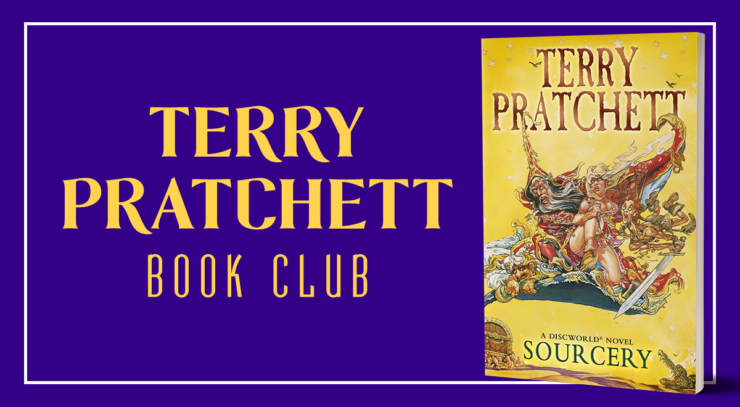
We’re back to get yelled at by a very bossy hat. Let’s get halfway through Sourcery together.
Summary
Conina gives Rincewind a haircut on the deck of the ship they’re sailing on (toward the location given by the hat). She notices the boats of slave traders descending upon them. Rincewind, disbelieving, asks the hat, which tells him to put it on. He cannot disobey, and upon placing the hat on his head, he sees all the dead archchancellors of old. The slavers board the ship and defeat the crew handily (Conina doesn’t have her swords, unfortunately). The men suggest a new career for Rincewind as a eunuch, but Conina goes at them with her scissors and comb, gets her hands on a sword, and quickly sets about dispatching them with the Luggage’s help. Rincewind is clipped on the ear, sees blood, and promptly faints. In Sator Square just outside the Unseen University, as market is going on, the wizards leave their school and begin harassing all vendors, killing the man with the seafood stall for getting angry. Ardrothy Longstaff tries to sell one of them a pie, but the wizard in question produces a beautiful one on the spot. Ardrothy makes to leave the city, knowing his livelihood is ruined.
Rincewind wakes up to find the slavers driven off, the boat headed to the right place, and the hat gone. Conina tells him that the slavers are going to same city they are anyhow, and that they can go find the hat once they make port. Rincewind would rather not, but his conscience talks him into it. Spelter has made a fake Archchancellor hat in place of the missing one, and he and Carding go into the Great Hall where Coin and the other wizards are waiting. Coin has remade the city into a pristine and perfect thing, and plans to remake the world as well. He wants a ceremony to name him Archchancellor, and also plans to abandon the University because he has made the wizards a new place. Spelter wants to dissent to all of this, but Carding steps on his foot and knocks the impulse from him. Later on Spelter goes to the Library door to talk to the Librarian about what’s happening and how wrong it all is. The Librarian won’t come out to chat, and he’s got the converted person of the Patrician along with his dogs Wuffles, and Spelter leaves feeling better for at least saying that things aren’t quite right. As he’s heading back to his room, he hears sobbing, and goes to investigate.
Buy the Book
Hollow Empire
Rincewind and Conina are in Al Khali, looking around for a bazaar because that’s where Conina reckons they’ll find the criminal element and thus the hat. Rincewind is trying to handle being in a city that isn’t his own, and being around a woman whom he sort of likes even though wizards aren’t supposed to. They are set upon by a lot of people in black clothes, and Conina makes a go of fighting them, but they’re eventually captured. Spelter wants to talk to Carding, but Coin is in the process of creating a new home for wizards, which he explodes into being on the banks of the river, a tall New Tower made from raw magic, solidified. Coin tells them that he intends to dissolve the Orders and close the University, and that the senior wizards will stay on as his advisors. Then he tells them to burn the University Library down. Spelter goes to warn the Librarian and ask for his help; the sobbing he heard was Coin and he saw the staff teaching him, talking to him, and he knows it’s wrong. The staff finds Spelter, follows him through the University, and they have it out in the kitchens. Spelter loses, and the Librarian knows he’s got to do something about all the books, so he gets their attention.
Rincewind and Conina are brought to the Wilderness of Creosote, the Seriph of Al Khali. He is the son of the famously wealthy Creosote, and he has far more wealth than his father had, and is attempting to devote his life to writing to give himself some meaning. He calls in his Grand Vizier, Abrim, to remind him of why he had Conina and Rincewind brought here. It’s because they have the hat, and they don’t understand what it is or why it keeps telling them what to do. Abrim knows the hat is magical; he is the one who employs slavers and he heard about Rincewind through them. He has Conina sent to a seraglio, and the Luggage is nowhere to be seen (he’s gone to get drunk because Conina told him off and he’s in love with her), which means it only takes a simple threat to get Rincewind to tell him what the hat is. The hat says they should negotiate terms, and Abrim tells his men to throw Rincewind into the snake pit (after having to forego several better options that are not currently available, like tigers and spiders and the pit of fire). Upon being thrown into the snake pit, Rincewind believes the single snake there is talking to him, but it turns out to be a rather emaciated barbarian hero.
The barbarian is a young man named Nijel the Destroyer, and he’s relatively new to (and not very good at) the whole barbarian schtick yet. He asks Rincewind to help him move a door in the pit that he thinks is a way out—he needs magic to get it unstuck. Rincewind insists he’s no good at magic, but when he points a finger at the door, it explodes. A great magical charge begins building, and Rincewind and Nijel witness wizards arriving and killing the guards who attempt to stop them. Nijel is aghast—he’s never seen murder like that before, he’s only been a barbarian for three days—and Rincewind is terrified. He realizes that they need the hat and to find Conina, so they set off searching, moving along endless corridors before a quick ask to a guard sends them to the harem. Said harem is covered by armed guards racing in their direction, so Rincewind turns it over to Nijel, who merely says “Erm, excuse me…”
Book Club Chat
So here’s a thing: There’s an oddness to this whole book. And the oddness comes from Pratchett attempting to satirize Eastern culture, but doing so through what seems to be a deliberately Western lens—for example, many swaths here are direct parodies of Samuel Taylor Coleridge’s Kubla Khan. Which means that Pratchett is essentially poking fun at the way Western people think of Eastern cultures, the manner in which they are exoticized and often derided or looked down upon for merely being different than the Western world. Even Creosote’s poetry, though based on Omar Khayyam’s Rubaïyat, is based on a translation by Edward Fitzgerald (who is an English poet). So then the real question ultimately becomes, does Pratchett succeed in his task here?
I think he manages it on paper, but it does demand that the reader have knowledge of what he’s parodying in order for the humor to fully come across when it needs to. If you don’t know the textual references, you might think that he’s genuinely dismissive of this part of the Disc, and then the whole thing kind of falls apart. For example, the footnote about the hashishim assassins is partially a reference to the “hashashin” that were reported on by the likes of Marco Polo, assassins who used hashish for stimulation before getting down to business. Yet again, it’s a play on what Westerners were told about the east from colonizing and imperialist sources. If you’re unaware of the history behind it, you might miss what Pratchett is playing off of in order to create this environment.
The one pointed and helpful indication the reader receives that Pratchett is definitely poking fun at the Western perspective is actually through Rincewind here—who, in his thoughts about how this city is not right because it’s not like his city, gives himself away utterly. This place has different trappings than he’s accustomed to, it’s not home and so he wants to critique it, but there is nothing functionally off about how the city is arranged or running. He’s just being a jerk about it.
Crush aside, it’s interesting to note Conina’s role as Rincewind’s partner in this section, specifically the ways in which she is and is not like Twoflower. Conina is certainly more capable than the tourist ever was, but she has a lot in common with him in regard to temperament, which makes sense. She’s the sort of person who takes things as they come to her and isn’t much bothered by how dire the world may look in any given moment. She’s not clueless the way Twoflower was, but she’s unflappable in the same way. Just from a functional storytelling standpoint, it’s interesting to see how Pratchett works that because Rincewind is the sort of character who needs catalysts around him, usually in human form.
Asides and little thoughts:
- The bit about Sator Square, which is a play on that magic square of letters is such a fun bit of weirdness to throw in there, and so specific too.
- The aside about how inspiration often hits the wrong mind is hilarious, and as a person who frequently feels like the particle missed me, it’s oddly comforting too.
- Look, it’s just really funny that Pratchett has Rincewind use the word “Kazam” to bring down a stone door years before the movie Kazam was ever made, is all I’m saying.
Pratchettisms:
But there was an edge to the voice that no one had heard before. It had knuckles in it.
It was the ending of the first day of the sourcery, and the wizards had managed to change everything except themselves.
Their dull splashing was the only sound that broke the cholesterol of silence that had the heart of the city in its grip.
The vizier twirled his mustache, probably foreclosing another dozen mortgages.
This is thought of as somehow wonderful. It isn’t. It is tragic. Little particles of inspiration sleet through the universe all the time traveling through the densest matter in the same way that a neutrino passes through a candyfloss haystack, and most of them miss.
With fifty years ahead of him, he though, he could elevate tedium to the status of an art form. There would be no end to the thing he wouldn’t do.
Next week we’re stopping at “There was the subtle, unpleasant sound of the universe suddenly catching on.” Woo!

This book might successfully walk the line between stereotypes and parodies-of-stereotypes. But Interesting Times will fall hard off the wrong side of it, into a muck pit of unchallenged caricatures. And then Jingo will shine with very direct in-world criticisms of cultural stereotypes, hate crimes, and other manifestations of racism, too real but sadly not real enough. (It won’t be so good with regard to gender identity, though.) Anyway, that will all be discussed in time. BRB, going to watch Mark Oshiro read Jingo…which I’ve done at least three times…OK, I’ll finish this comment first…
Cut-Me-Own-Throat Dibbler must be around somewhere (we’ll learn that he was selling pies in Ankh-Morpork since before Vetinari was Patrician), but Coin just removed one of his competitors. How fortuitous. We don’t know when Verity Pushpram will start selling seafood there, but now she’s got less competition too.
We may laugh at Creosote’s “bijou wildernessette,” as Pratchett calls it, or at the “wildernesses” on Georgian England estates. But they’re no more artificial than the sculpted lands in our zoos and parks. Even in wild national parks, many features are there because humans created or allowed them.
If this was Xanth, the Luggage and Conina could probably mate and reproduce. Good thing it isn’t; Xanth is awful.
Somewhere it says that Creosote has the poetic ability of a hyena. I object. Hyenas are poetic. I’ve written poems about them. And the ones in the Lion King musical are as good at spontaneous song composition as everyone else.
@AeronaGreenjoy, Couldn’t agree more that Xanth is dreadful. My sister liked those books, so I dipped a toe in and loathed them. And I hold a special grudge because when I first saw Discworld books, something about the covers and the marketing put me in mind of the Xanth books and I figured it was similar rubbish and gave them a wide berth. Delayed my entrance to the joys of Discworld for decades! Is what comes of judging a book by its cover.
🎃somewhat off topic, for Halloween tonight, I will be dressing as Nanny Ogg and my cat will be Greebo. He is a gray, but will have to pretend he has only one eye. I always thought I would age in an Esme Weatherwax way, but honesty compels me to admit I am becoming more Oggish. I do, at current writing, still have my teeth. But I do like a drink now and then.
@2: It was that Piers Anthony cover endorsement “Terry Pratchett is right up my alley!”
That put me off reading Discworld for _years_ .
Does the luggage actually suggest gender (outside of Rincewind’s limited imagination)? I suppose it could be assumed male on the grounds that Pratchett wouldn’t have written a non-straight pairing that early; OTOH, the Luggage could just have what used to be called a “schoolgirl crush” (because “Real Boys Don’t Crush”). Considering what an impressive display Conina puts up (and that the Luggage was the most dangerous XXX in the valley before she appeared), there’s obvious reason for adoration.
Pratchett mocking his countryfellows by their narrow vision (rather than directly as in many other instances) sounds right. I remember reading that the visiting ~crown-prince of Japan very much wanted to see The Mikado and was amused by it; these days it’s harder to make clear one is mocking local limits rather than carrying on old prejudices.
ISTM that Coin is the wizardly equivalent of the strain of Mad Scientist that assumes their vision of the world is Right and Must Happen — or at least the staff (with his father’s spirit) is, because this section shows Coin-without-the-staff as an unhappy child. The whole they-despised-me-well-I’ll-show-them line was common (especially in movies) a long time ago, but still shows (usually in parody, sometimes seriously) — see Seanan McGuire’s collection Laughter at the Academy.
@1/2/4: that Anthony endorsement appears on my copy of Sourcery (first US pb); fortunately, I’d read the first few in SFBC editions, so I ignored it. It’s ironic in retrospect; Anthony sold well for quite a while but I doubt he ever got Pratchett’s later recognition, e.g. the 1997 railway-station bookstore whose few windows were 100% filled with the latest Pratchett hc and pb. I remember liking the imagination of the first 1-2 Xanth books when they were new, and then realizing on rereads (after the series kept finding deeper hills to go down) just how much was wrong with them — and being appalled when a remote-office colleague (who also introduced me to Bakka Books, now Bakka-Phoenix) pulled out a copy as airplane reading. I guess each age has its incomprehensible tastes.
While I commented last time on the Coin-Adam comparison and suggested that at that point in the book Coin-Arthur (from Mort) was more appropriate, here we see the split between Coin (who is definitely a pre-Adam) and the staff (who is a revenge driven Arthur).
We also begin to question the motivation of the Hat which, presumably, dates back to Arthur.
Regarding the parody of Eastern civilization as seen through Western eyes, Pratchett assumes that the reader has some knowledge of what is being parodied. Of course the same can be said for all of the tropes he skewers. It is only singled out due to the current debate on cultural appropriation.
Speaking of cultural appropriation, Kazam is probably a British appropriation and parody of a 1940’s American comic hero who gained his power by saying Shazam.
@@.-@ I went the other way – searching for books similar to Discworld that I could read while I was waiting for this club to catch up, something pointed me to Xanth. It reads like a six year old boy’s dream after overdosing on sugar.
Discoworld helped get me to stop reading Xanth, by providing another vast banquet of wordplay and endless weirdness with considerably less (though not zero) misogyny and rape apologia.
In Interesting Times, the Luggage appears to have mated with a more feminine-coded counterpart, as they’ve somehow produced a litter of baby Luggages. But we don’t actually know how gender works for their species. Rincewind does seem to assume it’s male, as he tells it to remove the feminine garb that “female impersonators” put on “her” in a really problematic segment of The Last Continent, but that’s Rincewind.
@7 Let’s not go overboard on modern sexual language. Female Impersonator is a perfectly acceptable term (although drag queen is more common now). It is a neutral term which is meant to avoid labeling the person as any cis type (although they may be any of a number of those types but they may also be straight males). We will find out (minor spoiler) in Wyrd Sisters that Discworld follows the Shakespearean tradition of women’s roles being played by men and the theater is where the term originated and persists today (mainly in television).
@8: Judging by the Mark Reads Discworld discussion of that segment, I think the phrase itself is less of a problem than what it’s part of here — an unfortunate joke (the “female impersonator who’s actually female”) in a punching-down parody, lacking depth or context, on a complex topic that Pratchett was an outsider to and relatively unfamiliar with (compared to the areas where he shines most, like inter-class conflict or journalism). That’s not really a topic at hand here, though. It might or might not be discussed here in the far future, when this club reaches that book.
@9 I will grant that Pratchett was probably unfamiliar with the details of sexual identity beyond gay and lesbian when he wrote this in 1988. I also think that he actively avoids sex itself except to note that it exists (as in Granny avoiding “the talk” in Equal Rites and similarly throughout his works).
We won’t have to wait until Lost Continent to discuss this further. He addresses it with respect to female dwarves in upcoming books. I feel his consistent view is wear what you like, be what you like, and don’t criticize others for their choices.
One note on the female impersonator who’s actually female “joke”. Female drag queens are a thing. The most prominent might be Michelle Visage, co-host on Ru Paul’s Drag Race, who self identifies as a drag queen.
One note on the female impersonator who’s actually female “joke”. Female drag queens are a thing.
And several appear, much later on, in Monstrous Regiment, in which a platoon of soldiers who are all women pretending to be men have to disguise themselves as women, and do a very unconvincing job of it. (Not that their male lieutenant does any better.) And, far from being a punching-down parody, it’s a comic staple going back to Shakespeare – Viola in Twelfth Night is at one point a woman disguised as a man impersonating a woman, and would have originally have been played by a boy.
Jingo also includes a lampshade of the ancient joke about the man disguising himself as a woman and having to fend off the attentions of various other men – the narrator points out that normally, of course, the Laws of Narrative dictate that this would happen, but since in this case the impersonator is Cpl Nobbs, the Laws of Narrative just give up.
The Fitzgerald Rubaiyat was an absolute cultural tsunami when it was published, by the way. “Omar” became a popular name for boys in America. General Omar Bradley was named after a friend of his father’s, who was in turn probably named after Khayyam.
I suppose ’80s pop culture might be a somewhat unfamiliar country in 2020, but Victor/Victoria had been a rather well known Broadway musical at that time. Julie Andrew’s had starred in the stage production and the movie, which was released 1982. I believe the “female impersonator ” was referencing that.
@Ajay, 11: Monstrous Regiment is a comic glove over a pretty savagely punching-up fist, taking aim at misogyny, militarism, religious fundamentalism, and the not-coincidental intersections between them.
The Rubaiyat was indeed a cultural tsunami, and so was Coleridge’s “Kublai Khan” before it. Pratchett was of a generation– maybe the last one– where it was assumed that everybody read the same works in school and everybody would recognize the references.
“Kazam” or “alakazam” was a nonsense word meant to mimic a magical incantation, along the lines of abracadabra or hocus-pocus. It was once in fairly common usage, but I guess not so much any more. Various Hebrew or Arabic etymoloigies have been proposed, but I understand that scholars are dubious.