






It’s time to trip the… well, you know.
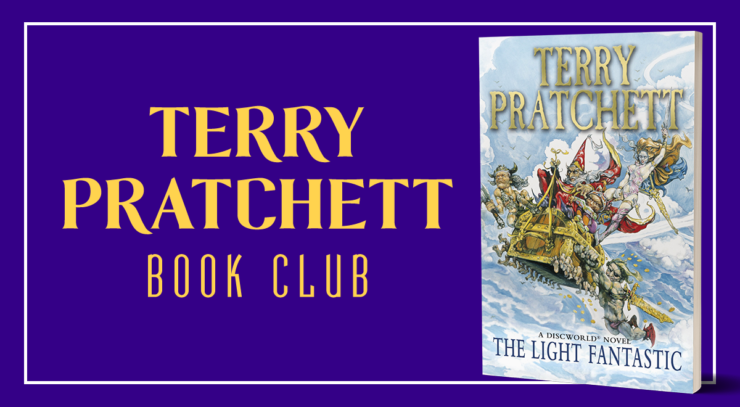
Terry Pratchett Book Club is trucking right along, and we’ve reached the second book! Which is named for a line in the John Milton poem L’Allegro, but you’ve probably heard the phrase all over the place because it’s still fairly common, even if it’s a bit more old-fashioned these days.
Let’s dance, friends.
Summary
Twoflower is in a ship and Rincewind is falling, and at the Unseen University, the Octavo is glowing with magic light. There’s an explosion that shoots through the University, turning things into many other things, while Galder (an eighth-level wizard) and his initiates run to catch up with the problem. Galder and his second in command, Trymon, witness a Change spell being cast over the whole world… but nothing seems to have changed. It has, in fact—the world has changed to save Rincewind, who is suddenly in a forest. He promptly gets into a conversation with a tree, which he just as promptly leaves.
Twoflower and the Luggage are also saved by this powerful spell, with Twoflower appearing on the hull of the Potent Voyager (which sinks into a lake), and the Luggage materializing in front of a shaman before scampering on its way. The two of them find Rincewind, and they sit together under a tree while it rains and Rincewind proceeds to give the wrong names for the vegetation around them. Meanwhile, the eight highest ranking wizards on the Disc meet to discuss their lack of understanding about what happened. Galder suggests the Rite of AshkEnte, they all agree, and roughly forty minutes later, the group have summoned Death (he’s holding a skewer with pineapple and cheese—they summoned him from a party).
Death explains that the Octavo readjusted reality to avoid losing Rincewind because he has its eighth spell lodged in his brain. The reason why is because all eight spells of the Octavo must be said next Hogswatchnight, or the Discworld will be destroyed according to a prophecy. Trymon immediately heads to the library to get a book on the prophecy Death mentioned (he had been listening to the whole ritual). Meanwhile, Rincewind and Twoflower are arguing about whether or not the very small person they’ve run across is or isn’t a gnome. The gnome (named Swires) offers to show them to shelter and food, and they agree, having no better options. He leads them to a gingerbread cottage abandoned by a witch. Galder has read that if Rincewind is dead, the spell lodged in his brain will simply hop to the next ready mind (this is not true), so he elects to send an arrow to him while the other wizard orders send out agents to fetch him.
The wizards break into the gingerbread cottage, but Twoflower finds a magic broomstick, allowing him and Rincewind to escape as the Luggage is hit by Galder’s arrow. Rincewind and Twoflower end up taking the broomstick far too high, and find out what is soon to befall the Disc—the Great A’Tuin is taking the world directly toward a red star. Elsewhere, the Luggage materializes directly on top of Galder, killing the man. Rincewind and Twoflower hit a rock in the sky, hidden by a cloud, and come across a druid computer hardware consultant named Belafon, who is delivering a replacement part for a large computer—the replacement part being the rock. The Luggage breaks out of the Unseen University after swallowing the Dean of Liberal Studies. Among the druids, Rincewind remembers the star they saw, then slips into a dream where voices of the Octavo Spells tell him that he must safeguard the Spell in his head so that they can all be said at the right moment.
Rincewind runs away.
Buy the Book
Harrow the Ninth
Book Club Chat
A note before we begin: I do know about L-Space, and its veritable library of excellent annotations! But I will not be bringing up every single reference that’s packed into these books because we would be here for a literal age, and also because we have a comments section full of you lovely folx. If I miss out talking about one of your favorite references, please, by all means, get in there and talk it up!
It’s fascinating to see how much the tone has solidified into something with a specific pace and rhythm, and how much more he packs into this book than the previous one. I’d forgotten what a clear shift it was, and how much shrewder the prose comes off as a result. I was startling myself by laughing aloud, which is my favorite kind of reading.
Meet Galder Weatherwax, who will not be the greatest character in the Discworld series to bear that surname, but it’s a fun prod about things to come. (Especially if you remember all the things Granny had to say about the guy. Such a lengthy diatribe…)
Because being contrary is sometimes a very worthy exercise, I always find myself particularly excited over moments where Pratchett just casually tears apart a cliché. Obviously, not all clichés are bad (and they can sometimes be amazing when employed well), but I have a lot of abiding love for the way that he begins a section toward the start of this book by saying that “Ankh-Morpork, largest city in the lands around the Circle Sea, slept” and then immediately proceeds to tear that thought to shreds by letting you know the myriad of ways in which it is not sleeping, all to eventually point out that “descriptive writing is very rarely entirely accurate.” And then launches into an aside about a Patrician of Ankh who wasn’t very into metaphors and similes and so forth. Which comes back at other points in the narrative, of course.
There are moments when I relate very heavily to Rincewind, and nowhere is that more evident than when his city-ness comes to the fore. Even the little bits when he’s thinking about how he would prefer a cobbled path to the dirt one he finds, or when he can’t really fathom what one would eat if they were stuck in the woods, or when he feebly tries to name the trees and bushes he cannot identify, and my brain immediately goes oh no it me. I am not a country person; I’ve spent my entire life either living in cities, or being close enough to get into the city in 15-20 minutes by car. Usually from very large suburbs that functioned more like small cities themselves. There are plenty of people who hate cities, which is a completely fine way of being, but I adore them. And I completely understand what it’s like to have been away from one too long, and start missing all the little conveniences that come from metropolis living, paved roads being among them.
Gonna talk about Death again, but before I do, a thing—Death technically isn’t gendered in these books until Reaper Man, where we are finally given a masculine gender. This has been the subject of some debate in translation as well because of the way certain languages gender their nouns, leading to translations where Death started out female and in later books had to be switched to male. My personal feeling on this as a non-binary person is probably somewhat obvious: Death could just be non-binary. In a lot of ways, that would make more sense, and is the opinion I’ve carried about most deities since I was a teen (look, I was a weird kid, I know). If you’re part of a pantheon, sure, have a bunch of different gods who have tons of genders. But if you’re a singular figure (like Death) or a monotheistic deity… why would gender apply at all? It’s frankly rather trivial on a universal scale.
Death’s character has cemented more fully by this point, his delivery and matter-of-fact wisdom on full display. I wonder about how others readers find Death sometimes because my take has always been very specific—to my mind, Death speaking in “all caps” imbues him with a deadpan overarching tone that I cannot unhear. While Pratchett gives him the ability to use proper nouns (capitals within the all-caps format) and emphasis, the use of all-caps makes all of his dialogue read with equal emphasis to me. Which means that I end up rather puzzled with they inevitably pick Shakespearean-style actors full of rumbling gravitas (see: Christopher Lee, Ian Richardson, Stephen Thorne) to voice Death in audio dramas and television miniseries because, to me, Death should always be played by a comedian capable of scathing monotone.
For this sequence, of course, there’s the fact that Death being pulled from a party is a reference to The Masque of the Red Death, which is always my personal preference if you’re gonna go for any Poe references at all. I somehow doubt that pineapple and cheese were being served at the party Edgar described, though.
Look all I’m saying is, the Luggage somehow does laundry and I really wish I knew how and also wish that I had a trunk that did laundry. Or that my dog did laundry. We all deserve that in our lives. On a completely different note, I do wish that someone would talk to the trees, they’re being ever so patient.
Pratchett does a thing where he’s able to switch tenses in his narrative—in this case, from past to present, as he moves to the section about Greyhald Spold trying to ward off Death—so effortlessly. And then the next section starts and he’s back to past tense. When you learn things about fiction writing in any sort of classroom environment, you are always going to be taught that there are rules that one shouldn’t break. But any good teacher worth their salt knows that all rules absolutely can and should be broken… you just have to do it with purpose. This is one of those examples.
Lots of fairy tale asides in this section, which is gonna happen if you have your protagonists hole up in a gingerbread house, though we get more references to Goldilocks and the Three Bears than we do to Hansel and Gretel ultimately. Rincewind and Twoflower escape by witch’s broom, and while Rincewind may be exasperated by his tourist pal, if Twoflower weren’t around, he’d have a much harder time staying alive in all of this.
But of course, we’ve still got a ways to go.
Asides and little thoughts:
- The Book of Going Forth Around Elevenish is a book I wish to own, please, as the title is an excellent life philosophy, no matter what mythical “morning people” say. (The fact that the actual title of the Egyptian Book of the Dead was, in fact, The Book of Going Forth By Day just makes it better, honestly.)
- I like the fact that the Unseen University has a vegetable chef.
- First mention of the Dungeon Dimensions, I believe, which is important for various and sundry reasons as we go along.
- Twoflower mentions that the Tooth Fairy was in The Little Folks’ Book of Flower Fairies.
- Rincewind thinks “Look, the life of gnomes and goblins is nasty, brutish, and short. So are they.” This is, of course, a reference to Thomas Hobbes’s Leviathan, where he talks of the state of nature for mankind. I never much liked it applied to humans, but maybe it serves better as the state of nature for gnomes.
- There a bit where Pratchett is talking about a sound and says that it is “‘spang!’ plus three days hard work in any decently equipped radiophonic workshop” and I love it, in large part because the Doctor Who theme is the result of the BBC’s radiophonic workshop, dontcha know.
And! I finally got around to making the Pratchettisms section (which is basically just “favorite quotes”, but that sounds horribly dull to my mind). Granted, this is a completely subjective culling on my end—feel free to add your own.
Pratchettisms:
The sun rose slowly, as if it wasn’t sure it was worth all the effort.
Picture it as a diving suit designed by men who have never seen the sea.
The silence of the room crowded in like a fist, slowly being clenched.
It is well known that things from undesirable universes are always seeking an entrance into this one, which is the psychic equivalent of handy for the buses and closer to the shops.
Some people, Galder thought grimly, would have had the decency to put an exclamation mark on the end of a statement like that.
On the high shelf above him various bottled impossibilities wallowed in their pickle jars and watched him with interest.
Swires and Rincewind’s kneecap exchanged glances.
There was a long silence. Then a slightly shorter silence.
Next week we’re reading up to: “If we meet Old Grandad I’ll try to explain…” See you then!

The Milton line, if anyone’s interested, is from L’Allegro:
Come, and trip it as ye go
On the light fantastic toe.
One thing I missed on my first few read throughs is that this is the magical accident where the librarian gets turned into an orang-utan! It’s an easily overlooked detail in the Octavo sequence, but Pratchett would later take this idea and run with it…
I think the “turning things into many other things” part at the beginning, is when the Libarian is turned into an Orangutan. A quick joke that turned into a beloved character.
Ook?
The voice of Death that I hear in my head when I’m reading is very much like Marvin from The Hitch-Hiker’s Guide to the Galaxy (the original radio version).
James Earl Jones. In my head, Death always sounds like James Earl Jones
Do you have a list going of what order you will be reading in? It’s like to start putting my name down for a few library holds ahead of time!
No mention of the Librarian !?
“before I do, a thing—Death technically isn’t gendered in these books until Reaper Man, where we are finally given a masculine gender”
Sorry, what? Unless I am missing something here, Death is always “he” from his first appearance in TCOM. (In fact, interestingly, he is “He” – capitalised – in TCOM, which is wisely dropped for subsequent books.)
“DARK IN HERE, ISN’T IT?”
The gnome Swires may well be Buggy Swires, who becomes a corporal in the City Watch. If not, he is certainly a relative.
I love TLF: it starts with a bang and keeps going. The tone is different to TCOM but it feels a much more cohesive book, largely due to the storyline not being as episodic. Pterry keeps the pace fast and the jokes faster: the gags feel a lot more organic and natural when you aren’t searching for the homage and that means you can pay more attention to the plot.
I didn’t know what voice to hear Death in until I first saw some of the TV adaptations. Afterwards, I always heard Christopher Lee. The last few Discworld installments I’ve been through were Nigel Planer’s audiobook readings, and he also leaves a lasting impression.
If I am not mistaken, death speaks in ALL CAPS in the US editions of the book, but “small caps” in the UK editions. (Not a font option on Tor.com, but you can google for it.) The difference bothered me so much that I mail ordered my entire set of the early books from the UK.
Yes, I am weird that way but it just sounded *different* than ALL CAPS somehow.
“…to me, Death should always be played by a comedian capable of scathing monotone.”
Yes! This! I don’t think I’ve ever heard a voice for Death that quite sounded right to me.
Or better yet, the Hitchhikers Guide radio series. Which has my choice for the voice of Death, Valentine Dyall (playing Gargrava).
Thank you Emmet, for this club. PTerry has been essential to my sanity for so many years and to see other fans come together like this is lovely. CTOM and TFL was my introduction in ’92 to what was to become an isolated obsession. I met the man twice when he came to Australia for book signings and he was very patient and funny when presented with all my loved (dog eared, a bit foxed, and slightly badgered) books to sign. Love the Pratchettisms, comments and asides. Thank you! I could murder a curry!
I have actually forgotten the plot of TLF, so it will be interesting to find it out as we read along.
Joe@13
My 1st paperback UK edition reprint which I am reading has Death speaking in all caps but the UK first hardback editions use small caps. I’d never noticed this before and it explains why I hear his voice better with the hardbacks.
He is also referred to as male:
I must admit that I’m conflicted about the first two books. TCOM could easily have been a series of short stories, each of them an homage to a genre. TLF is much more a single cohesive (if such adjective can be applied to a PTerry story) story. That said, it feels rushed compared to his later work. It’s as if he felt he put too little into TCOM and he (or his publisher) wanted much more story in TLF.
Because of my past career, I loved the hardware consultants and the wizard org chart.
But my favorite character was Cohen the Barbarian with his liniment and soup..Maybe it’s because I’m getting old.
I’m going to disagree with the columnist: Ian Richardson was *perfect* casting for Death. Few other actors had quite his combination of deep, sonorous, and ever so slightly put out.
In terms of differences of typesetting causing differences in tone, the best example of that I’ve ever seen was in “Reaper Man”. I first read it in hardback where the text leading up to Azrael’s judgement was perfectly spaced so that you turned the page and were suddenly faced with just a single gigantic word occupying the entire page. When I saw the book in soft cover, changes in formatting resulted in the effect being entirely lost.
If you think Ian Richardson can’t do comedy, you haven’t been watching House of Cards right. In one of the adaptations (Hogfather?) they actually give him the line “YOU MAY VERY WELL THINK THAT, BUT I COULDN’T POSSIBLY COMMENT.”
But my favorite character was Cohen the Barbarian with his liniment and soup..Maybe it’s because I’m getting old.
They really do need to get Schwarzenegger back to do “King Conan”. He’s the right age now and I’m sure Gerry Lopez would be available.
On the gender of Death, later on Ysabell refers to him as Daddy.
Marvelous as TCoM was, I feel like Pratchett spent much of it tuning his writing-style machine like a musical instrument and is now striking up an overture. The randomness is more audacious but fits together better, the wordplay more continuous. Though I’d rather he hadn’t repeated the “four-sided triangle” bit in this section; it was funniest the first time.
The Book of Going Forth Around Elevenish sounds like a good alternative title for The Hobbit. Two section titles in Pyramids will pay more direct homage to the Book of Going Forth By Day, aka the Book of the Dead. The Annotated Pratchett File writer of the relevant Light Fantastic annotation adds “Note that in the UK until a few years ago the pubs opened at 11 a.m.”
There are actual books of gorgeously-illustrated poems about flower fairies (and their plants) by Cicely Mary Barker. I love them dearly and memorized some them before I could read, and they taught me a lot about British plants. But if I met one of those fairies, I wouldn’t be so rude as to ask things like “Why don’t you have a red hat?”
And they don’t include tooth fairies, who don’t belong in such books on Discworld either. Rincewind’s imagining of a “castle made of teeth” is unfortunately close to (alternate) reality.
I prefer country to city. Maybe not logistically — I don’t think I’d be better than Rincewind at surviving alone in the wilderness — but mentally. The one time I lived in a big city (Boston), for a three-month internship, I spent much of my spare time searching for places where my view could occassionally be entirely free of concrete.
I have a real problem with any vocal portrayal of Death in any other media. Pratchett describes the tone of his voice frequently, the one that sticks with me the most is “like tomb lids slamming down” (or something, I mis-remember the exact quote).
Every single description hammers home the point – no human can sound like Death. His voice is transcendental (in the philosophical sense) and Lovecraftian, to a degree. Any voice portrayal of Death for me is a failure, his voice in the books sounds completely inhuman, a-human and ungraspable by the minds of men.
Ian Richardson – great actor, great voice. But not Death – because he’s a human.
This always bug the hell out of me.
Another vote for Nigel Planer. I first read the Discworld books as audiobooks on my way to and from work. Most were read by Nigel Planer and his characterization of Death has stuck with me as the most “authentic”.