






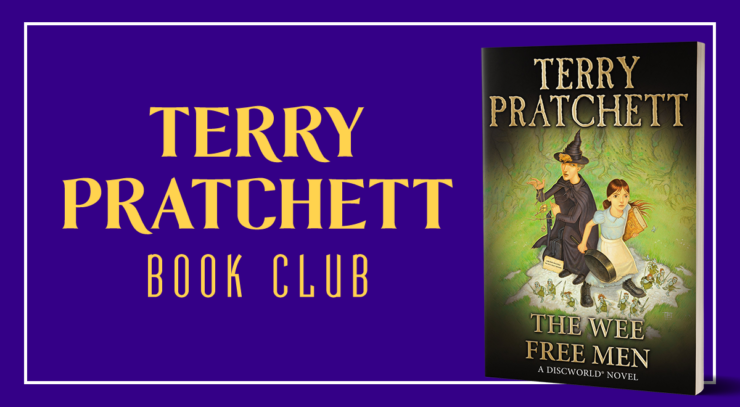
“We willnae be fooled again!” —Roger Daltrey, probably.
Summary
A witch named Perspicacia Tick notes that another world is brushing theirs, but that there’s a witch in the area where it’s occurring, though that seems unlikely to her because it’s an area full of chalk, which is bad for growing witches. She looks into the rainwater from her hat and sees a nine-year-old girl named Tiffany Aching, who sees a Nac Mac Feegle and isn’t afraid, and saves her brother from a monster in the water. Miss Tick decides the child needs watching. Tiffany heads home, reads from a fairy tale book, takes a frying pan back to the water’s edge and creates a trap using her baby brother as bait for the monster, Jenny Green-Teeth, who she hits with the pan. She finishes her chores in the dairy and goes into town for some education from a traveling group. She’s directed toward a new tent—Miss Tick. She figures out that the woman is a witch very quickly and learns that Jenny showed up because something bad is coming. She also tells Miss Tick that she’s sure her grandmother was a witch of a sort. The only other one presumed in the area was Mrs. Snapperly, who was left to die in the snow last winter because the baron believed she killed his twelve-year-old son when he got lost in the woods; the town burned her books and threw her out of her cottage and the baron forbade anyone from helping her.
Buy the Book
Mammoths at the Gates
Miss Tick tells Tiffany that she does like to help witches find their school, which is at a high point once you open you eyes twice. She also advises Tiffany that if she believes in her dreams and trusts in herself, she’ll still get beaten by people who put in hard work and learned. Then she kicks Tiffany out. Tiffany heads to the top of Arken Hill, but when she opens her eyes twice, she doesn’t find anything, so she heads home. Miss Tick leaves her toad and goes for help—all the monsters from children’s stories are coming and Tiffany can’t handle it alone (even if she seems to have the Nac Mac Feegle on her side). The Feegle watch Tiffany as she’s sleeping, not sure who the family witch is. Tiffany gets up and goes to the privy for some privacy, then hears the Feegle steal a sheep and try to do the same with their chicken egg. She tells them off and stops the egg theft, then tells the Feegle there will be a reckoning if they don’t return their sheep. They begin to help Tiffany with her chores and return the sheep. Wondering if they’re brownies, she leaves them a saucer of milk, but they are’t pleased. Tiffany comes upon a headless horseman, and when she tries to run, the Feegle instruct her to stay still and look it in the eye. She does and a Feegle named Big Yan trounces the thing, scaring it off. In town, she finds the educators gone, but the toad is there to give her information on everything she’s seeing, and to tell her that Miss Tick is coming back with help… eventually.
Tiffany comes home to find that Wentworth has disappeared and everyone is looking for him. She asks the toad how to get the Feegles’ help for this and is told to leave out liquor, which she does (it’s the special sheep liniment). The group come out of hiding, tell her that her brother has been taken by the Queen, and are shocked that she doesn’t know who that is—being Granny Aching’s kin, the new witch. Tiffany remembers when Granny Aching got the Baron to be kinder to the locals after saving his dog from being put to death after it killed a sheep on the chalk. Tiffany asks them to help her steal her brother back from the Queen, and that straightens things out, as Feegles do nothing but drink, steal, and fight. Rob Anybody and Daft Wullie strap themselves to the bottom of her boots and set off, stopping at the site of Granny Aching’s grave (where the iron wheels and potbellied stove from her old hut cart rest) to find and talk to Hamish, who arrives on a buzzard. He saw a woman carrying a boy on a black horse. Suddenly grimhounds appear and snow arrives—it’s the Queen’s land now, but Tiffany tricks one of the hounds off the snow where it becomes a normal dog she can defeat.
Tiffany learns that the Feegles believe they are dead and this is their afterlife for a life well-lived. (Anyone who “dies” has gone back to the land of the living, and gets another shot at coming back here once they’re dead.) They tell her that they had a deal with her grandmother to take a sheep or egg now and then in return for keeping their flock safe. She thinks of the shepherdess statue she won at a fair and gave to Granny Aching, and thinks perhaps she hurt her grandmother by giving her something that suggested she wasn’t right. The Feegles bring Tiffany to meet their kelda, in a room full of gold. She is fading, and knows Tiffany is a witch like her grandmother, and offers her the position as kelda until she gets her brother back from the Queen. The kelda’s daughter Fion is unhappy at this, even though their ways state that she must go search out a new clan in need of a kelda instead of becoming the kelda of hers. Tiffany talks to William, the kelda’s brother, who explains that they once served the Queen, who tricked them; they rebelled against her. Tiffany gives a letter to Hamish to fly home to her family, and finds that tradition insists she pick a warrior to marry and name the day. She picks Rob Anybody and names a day that will never come—when the bird at the end of the world wears down that mountain with its beak. Then she works out how to find the door to the Queen’s realm by thinking it out… which she thinks is cheating, but the Feegles assure her is how magic actually works. She steps through to a black-and-white landscape.
Commentary
And here is our introduction to Tiffany Aching, a child with plenty of siblings who still, nevertheless, reads like an only child.
I just have to call it out because even when he’s trying to create characters in large family schemas, Pratchett is still ultimately focusing on the character who has the interior world and self-sufficiency of an only child. And this is used partly because she’s becoming a witch, and witches are certainly apart in many senses from the traditional roles and expectations of family structures (though not entirely or always, as in Nanny Ogg’s case), but also because this is clearly the type of brain that makes sense to Pratchett as a person and he can’t stop himself from using that as a foundation in many of the personalities he creates.
It’s also relevant that I read so many of these books out of order, and it’s only just occurring to me now that the Tiffany Aching books are a little bit of a reply to the Potter books. The fact that Tiffany is getting excited over the prospect of the magical school that she’ll maybe get whisked away to by a unicorn—and promptly being told that no, it’s not that kind of magical school, that’s not how you make witches—it’s all very pointed. Tiffany is also pegged as a know-it-all by Miss Tick, which was the insult always leveled at Hermione Granger, but it’s instantly marked as a good thing here. And of course, there’s the remarks that dreams and hearts are great, but the way you achieve anything in life is through hard work, something that the Potter books are… less big on, let’s just put it that way.
And there’s the common thread that runs through the Witches books, being about how story works, how it exerts pressure over our lives, and how important it is to buck the arc of story in order to lead a good life. Or, as Tiffany notes:
The stories didn’t want you to think, they just wanted you to believe what you were told…
As we get deeper into these stories and see those common threads, it’s incredible how the Discworld books manage to appreciate the importance of story in our lives, as a manner of shaping reality, but also explicitly acknowledge the way that the human capacity—and even need—to couch everything in narrative is not solely a good thing. As with most aspects of life, it comes with good and bad baked in. A witch in Tiffany’s village died because people believed in stories, and it’s not the first time we’ve seen this treatment toward a witch by the local population. Sometimes stories do harm, and it’s essential that we acknowledge the places where that occurs.
But at the core of this particular story is something much more human and painful: It’s the tale of a girl who is still mourning the loss of her grandmother, and learning to take up the position that the woman left behind for her. So many sections of this book amount to Tiffany thinking back on the magic of her grandmother, and also the ways in which they could and could not manage to communicate. They have witching and a love of comfortable silences in common. They are observers who have first sight and second thoughts. They are both intrinsically the flint born of chalk.
Yet Tiffany knows that there is so much of Granny Aching that she never understood. Words that the woman didn’t know how to use (whereas Tiffany wants all of the words and will read the dictionary to get them), lessons that Tiffany couldn’t pick up on in the moment for being too young, the fear that she hurt her grandmother by winning her a shepherdess statue that reflected nothing of the woman she knew. And the fact that this story is grounded in such palpable grief makes it so much more than a sharp, funny book about a young witch.
Asides and little thoughts:
- You know how you sometimes have moments where you know you’re going to like a character from a very specific cue? For me, it was Tiffany thinking about susurrus, “a word that not many people have thought about, ever.” Because I have, of course. A lot.
- The Feegle swords glow blue in the presence of lawyers, and Sting glows in the presence of orcs, so now I’m thinking about orc lawyers.
- Seems to me that all small folk on the Disc have the same method for teaching birds to do their bidding. Maybe they’ve got a club? I feel like Hamish and Buggy Swires would get along great.
Pratchettisms:
She cupped it in her hands to keep the raindrops out and listened to her eyes.
They went to sleep under the stars, which the math teachers would count, the astronomy teachers would measure, and the literature teachers would name. The geography teachers got lost in the woods and fell into bear traps.
She’d watch the buzzards and listen to the noise of the silence.
But that time it had been magic. And it didn’t stop being magic just because you found out how it was done.
The stories weren’t real. But Mrs. Snapperly had died because of stories.
Nothing’s louder than the end of a song that’s always been there.
I never knew about all this. I never knew I lived in heaven, even if it’s only heaven to a clan of little blue men.
But she thought there should be a word meaning “a word that sounds like the noise a thing would make if that thing made a noise even though, actually, it doesn’t, but would if it did.”
Next week we’ll finish the book!

Thoughts
We meet Miss Perspicacia Tick, who is one of my favorite witches, and she provides the lay of the land, figuratively and literally. Later she takes Tiffany as a student to learn about witches.
Totally unrelated to the story arc, I also have a soft spot for Granny Aching since my mother spent her early childhood on a sheep ranch and lived in a wheeled shepherding hut that moved around the ranch as needed.
We learn that the Feegles think that they are dead and those lost to the grimhounds have gone to the land of the living to await their return to this, the land of the dead. Death doesn’t appear in this book but I would love to hear him discuss this.
Pratchettisms
“just bags of bones, eyeballs, and teeth, lookin’ for new ways to die.” (Granny Aching on sheep)
“Sometimes it’s so hard to find half a mind when you need one.” (Miss Tick)
He was big to start with, but Ratbag flowed. He was so fat that, on any reasonably flat surface, he gradually spread out in a great puddle of fur.
“You’ve got Nac Mac Feegles!” (Toad, likening them to a disease)
That’s the trouble with a brain – it thinks sometimes more than you want it to. (Tiffany)
“They think written words are even more powerful,” whispered the Toad. “They think all writing is magic. Words worry them. See their swords? They glow blue in the presence of lawyers.”
“I’m up here most o’ the time anyway, because I’m studying to become a gonnagle.” The young Feegle flourished a set of mousepiles. “An’ they willna let me play doon there on account o’ them sayin’ my playin’ sounds like a spider tryin’ to fart through its ears, mistress.” (Not-as-big-as-Medium-Sized-Jock-but-bigger-than-Wee-Jock-Jock)
“They can tak’ oour lives but they canna tak’ oour trousers.” “Ye’ll tak’ the high road an’ I’ll tak’ yer wallet.” “There can only be one t’ousand.” “Ach, stick it up yer trakkens.” (Feegle battle cries)
The position of gonnagle is named for William McGonagall, a 19th century writer and performer who was either a terrible and oblivious poet or a skilled comic actor portraying same.
I believe that it turns out Buggy Swires is actually a displaced Feegle in a later book.
Loved the Feegles’ dialect. I had relatives who talked like that. Used the same sort of logic as well.
I definitely noticed the relation to Harry Potter, because when it was published, I had an 11-year-old, and we compared the two books at length. My kid related much more to Tiffany.
Over and over, Pratchett gives his own take on stories. The Wee Free Men, to me, was much more an answer to Narnia. Now, if you love Narnia, I hope it gives you joy forever, but The Lion, the Witch, and the Wardrobe (the only Narnia book I read) deeply upset me as a kid. It was full of stuff that was just plain wrong, and it kept treating horrible things as acceptable. Even the movie, as an adult, gave me nightmares for most of a week.
So when I started The Wee Free Men, and Tiffany’s brother disappeared, I could see where this was going, and I was a bit worried. But Pterry did what he always did, and told the truth. Horrible things are horrible, not normal, not acceptable. His books made my world a better place.
@2, I am so glad you brought up William McGonagall. His poetry is epic(ally bad)! Anyone who hasn’t read McGonagall should treat themselves to his most famous work, “The Tay Bridge Disaster.” Pratchett absolutely nails his style later on.
You can find McGonagall’s poetry here. Be careful it doesn’t make your ears explode, though!
I’m not sure the separation @0 describes is particularly unique to Pratchett; without some reason to strike out separately, characters could be involved in endless repetitions of Little Women and its ilk. Pratchett may be on less-general ground in having characters who are set off from the beginning rather then being given last place by life, but ISTM that’s a traditional form that has been fading for some time; e.g., David Balfour being orphaned, or “The first son got the mill, the second son got the donkey, and the third son got the cat.”(*) (Another fading version of this is the third son being unaccountably either smarter/more-careful as in Ti-Jean and His Brothers, or sometimes mostly lucky even through stupidity as in the traditional story recycled in Apple Wars.)
I read tLtWatW so long ago that I was blown away rather than repulsed; it took me a while to catch on to the fact that fitting into a story isn’t necessarily good (let alone that stories themselves can be ridiculous or even outright nasty lies, as Pratchett makes clear here, and not for anywhere near the first time). Being able to mock a story takes a bit of distance — growing up differently (as @0 points to), or aging, or maybe just enough of some undefinable difference that makes nominal peers occasionally slip past. I didn’t read a dictionary when I was young (no matter what people said about my vocabulary — it would have been even weirder if I’d read the Shorter Oxford English Dictionary that had a prominent place in our home), but I did read most of World Book Encyclopedia(**), which Tiffany probably would have read from one end to the other if she’d had it. I’m a bit surprised she was able to make that much of a dictionary given the sidelong attitude toward education the Chalk has even for girls (she’s already way beyond the “fiddly bits” that women would need for household management); that’s some ferocious bootstrapping — which I suppose is one of the characteristics of an incipient witch.
The idea of teachers as Travelers (complete with the canonical taste for hedgehogs) who the other Travelers don’t even associate with is interesting. The idea of having to advertise for students has all sorts of genre resonances, from “And Madly Teach” to Kampus and beyond.
The Annotations for this work suggest that a 512some Reel would be very complicated. According to The General Danced at Dawn (a possibly vaguely-biographical work by the author of the Flashman books), it would simply be very very long; the title comes from a visitor roping in everyone in the neighborhood to do a 128some after dinner (and some reels of smaller numbers). However, there’s nothing urgent the Feegles have to do once they’ve moved the kelda to the burial chamber.
Another couple of Pratchettisms:
Then there is the dress. It has been owned by many sisters as well, and has been taken up, taken out, taken down, and taken in by her mother so many times that it really ought to have been taken away.
Sheep are not known for their conversation.
(*) My “complete” Grimm says this story appeared in early editions but left out of their last edition; I’ve seen arguments that they added a lot of moralizing, often explicitly “Christian”, to the later versions, and wonder whether they got stuck for a good moral to draw from an extended con job.
(**) Yes, that’s a thinned-out work for not-adults (although not nearly as thinned-out as the uniform-size, brightly-illustrated volumes that some other company was doing then). It showed up well before I was 10.
I just came here to say YAY! I’ve been waiting for this one. These were the first books in this universe I read, and the first I have given to my nieces and nephews.
Tiffany meeting Miss Tick’s toad gives us the greatest pun Sir Pterry never made.
She had to follow the yellow sick toad.
@8: ISTM he did make it; he just didn’t spell it out, any more than he spelled out the reason for the hard-of-hearing spotted cat in Soul Music.
@chip137,
I think I also went to the same story. Glad to see another reader of the McAuslan stories
I’d argue that once you find out how magic is done, it becomes science.
I was thinking about Tiffany seeing sea creatures made of flint and flint and chalk in general. It turns out she (Pratchett) is right. While most flint is found in veins in the chalk, it’s possible for sea creatures that die in a particular environment to be fossilized into recognizable flint shapes.
@12 – “It turns out she (Pratchett) is right.”
Man who grew up in chalk country is right about what you can find in chalk…
@12 – The shepherd’s crown is exactly that in chalk country – a silicified fossil echinoid.
There’s a flint hand ax from the Boxgrove site – 400,000 years old – that incorporates a fossil echinoid, apparently not by accident – the maker chipped the flint so as to preserve the fossil in the wide end. And the maker would have been a Homo heidelbergensis, so fascination with fossils in flint goes back to before our species emerged.
Come to think of it, Granny Aching’s wheeled shepherd’s hut is vaguely like Baba Yaga’s hut on chicken legs. I wonder if that was intentional?
@11: Science works (mechanically, not necessarily beneficially) for anyone; doing magic frequently requires some innate talent. Whether or not this is true isn’t necessarily connected to how well the story is done.
@9 There’s no way most readers would make that leap on their own. I sure didn’t. If it’s not spelled out properly in prose, the reference is not likely to be understood.
@2,5 What’s wrong with McGonagall’s poetry? It’s hilarious.
Tiffany meeting Miss Tick’s toad gives us the greatest pun Sir Pterry never made.
She had to follow the yellow sick toad.
He did in fact make this pun! Way back in Moving Pictures – it’s an overheard line in the Holy Wood cafeteria from a confused actor who is obviously making the Discworld version of The Wizard of Oz.
It would have been very easy for Pratchett (who isn’t, of course, Scottish himself) to really screw up with the Feegles and end up with something of Braveheart/Outlander quality – the sort of thing that veers from offensive to unintentionally hilarious – but in fact he got them absolutely right, and he was definitely strongly inspired by the McAuslan stories in doing so.
The Annotations for this work suggest that a 512some Reel would be very complicated. According to The General Danced at Dawn (a possibly vaguely-biographical work by the author of the Flashman books), it would simply be very very long
I think the Annotations are wrong on this.
They say:
the thing about Scottish dancing is that the length of the dance increases almost exponentially as you proceed upwards through powers of two. A twosome is simple; a foursome takes longer as each dancer has to interact with three others before it can end. In an eightsome, each dancer has to physically dance a measure with each of seven other dancers. In a sixteensome, that’s fifteen other people, and it takes proportionately longer.
But that isn’t actually the case.
The standard is an Eightsome Reel, which involves four couples and in very general terms goes like this: there is a sort of everyone-dancing-in-a-circle introduction bit, then there’s a middle bit in which each lady in turn goes into the middle of the circle and dances with all four of the men, then each man in turn goes into the middle of the circle and dances with all four women, and then you do the introduction-bit again and that’s you.
A sixteensome sounds like it should take twice as long, because you have twice as many ladies and men, each of whom get a turn in the middle of the circle. But it doesn’t – because two of the ladies go in at once, and they only dance with half the men each. (And then two of the men go into the middle of the circle at once and each of them dances with half the women, and so on.) So when it’s your turn in the middle of the circle, you only dance with four people – just like in an eightsome.
And a thirtytwosome works the same trick – you have four ladies in the centre of the circle, and each of them only dances with a quarter of the men.
And a sixtyfoursome, as this handy video demonstrates, https://www.youtube.com/watch?v=8sOJbxfkBsw has eight ladies in the middle of the (enormous) circle at once.
So, in fact, while the 16some, 32some, and 64some occupy a lot more space, and there’s definitely more room for confusion and error, they don’t take up much more time than an 8some.
I know that GMF in “The General Danced at Dawn” says that it took over an hour to dance a 64some, but
a) the story isn’t meant to be an absolutely accurate account, and the gradually increasing length is good for comic value
b) everyone was very tired and drunk by that time
c) there are big distances to cover so the band might have slowed the tempo down a bit
d) maybe they did decide to do the insane thing and have everyone dancing with everyone
e) including time taken to brief everyone on what to do, work out the choreography etc I can definitely see the whole project taking an hour or more, even with experienced dancers, let alone a combination of Gordon Highlanders, Fusiliers, German prisoners of war and unfortunate Arabs who happened to be passing by at the wrong time
This is such a comfort read for me, especially the parts about the Chalk country (where Pratchett grew up). There is a quiet sense of wonder and appreciation for the beauty in ordinary things. I’ve been re-listening to the audiobook and childhood memories are popping up of watching a river flow, finding little treasures like stones and wildflowers and toads, thinking about interesting words…
Speaking of the audiobook, the new version is on Audible now. It’s narrated by Indira Varma, with Bill Nighy reading the footnotes and Steven Cree of Outlander fame voicing the Nac Mac Feegles. This may get me to finally sign up for Audible.
@17
McGonagall presented himself as a serious dramatic poet who took all his poems 100% seriously and didn’t understand why everyone was laughing. It’s not clear whether he was deliberately putting on that persona for comedic purposes or not.
@11: ISTM that depends on suitable values of “find out”; If the best you can find out is that somebody with an inborn talent waves a wand and things happen, that’s still magic. The other side of this is that science works (mechanically, not necessarily beneficially) for anyone — although convincing people that it does is separate from making it work. (You can argue that a certain talent or mental bent is necessary to do science with less difficulty, but ISTM that’s not the same as “most people can’t do it at all”.) There’s also the question of help from supernatural entities (after you’ve defined such entities); e.g., Blish’s Black Easter does not seem to me to be science even if it seems to call for study (and bargaining) rather than talent, as it involves summoning demons to make things actually happen.
Anderson’s Operation Chaos appears to require study rather than talent, and like much of his work it pulls scientific facts and organization into the practice of magic — but the characters in the book still see a difference between them even before somebody summons a salamander as a halftime effect.
There is a lot of room for argument, not to mention authors who gleefully trample on boundaries; I don’t think a reduction works.
@19: fascinating. I was thinking from Frazier of something like a Virginia Reel, in which each couple in succession is head. (When I folkdanced at MIT, sets were limited to 6 couples, which still required restarting the phonograph record to get everyone through.) However, ISTM that there’s definitely more room for confusion and error suggests Feegles might never get through the dance due to brawls, distractions, interruptions (the hall doesn’t sound big enough for such a formation — wouldn’t they have to disperse if humans happened on them?), …
On the FiveHundredandTwelve some Reel.
I I think all of you (and the annotations) are lacking in First Sight. A reel involves male and female partners. In the mound, there’s only one available female partner, Fion. Fion dances with 512 Feegles, one at a time. It doesn’t take too long because they are solemn and probably in a line.
After she finishes the ritual reel, they start the drunken reeling wake, which is a whole other thing.
However, ISTM that there’s definitely more room for confusion and error suggests Feegles might never get through the dance due to brawls, distractions, interruptions
I mean, this definitely happens even just with normal Scots a lot of the time.
In the mound, there’s only one available female partner, Fion. Fion dances with 512 Feegles, one at a time.
An excellent bit of headcanon and undoubtedly correct!
(Though of course one doesn’t need female partners to dance a reel. As the Colonel says in “The General Danced at Dawn”, “As you know, gentlemen, there are two forms of Highland dancing. There is Highland dancing as it is performed when there are ladies involved; and there is Highland dancing. We will have Highland dancing.” When there are ladies present – and I know this will sound unlikely to ladies who’ve attended some of the ceilidhs I’ve attended – there is less of a focus on speed, intensity and violence of action, and slightly more care taken to minimise momentum and therefore fractures. Sometimes the ceilidh can actually be completely bloodless.)
Re Tiffany being like an only child: Sometimes in very large families, a child can sort of slip through the cracks, because they’re not the oldest, or the youngest, and not the loudest, so they partially end up bringing themselves up. Tiffany’s parents didn’t deliberately ignore her, but as she wasn’t actively demanding their attention, she didn’t get much of it.
That’s my take on it anyway. Mind you, I grew up on limestone, so what would I know about chalk? ;)
any more than he spelled out the reason for the hard-of-hearing spotted cat in Soul Music.
Or, in the same book, the all-dwarf band who decide to call themselves “We’re Certainly Dwarfs”.
I highly recommend the whimsical and magnificent illustrated edition of this book.
Tiffany Aching is such a great character — indomitable, intelligent, and compassionate, but *not* infallible.
The Feegles are wonderful, too — formidable fighters yet emotionally over-dramatic, foolhardy goofballs with cores of deep wisdom, very multitudinous yet not monolithic in personality and focus.
In the flashback of the fair where Tiffany wins the shepherdess (a million-to-one chance invoked by her father), a fortune teller tells her that ‘many, many men would want to marry her.’ Indeed, a crowd of Feegles briefly vie to marry her, though she thinks they don’t actually *want* to.
Rob Anybody was this clan’s Big Man (chief) at the book’s beginning when his mother was the ruling kelda, then remained Big Man after Tiffany chose him as her husband and Jeanie married him next book. Does this mean the Big Man is the finest warrior, not necessarily the kelda’s husband? Or might Rob Anybody have gotten the position after his father died or…retired or something? I always assumed the old kelda’s husband died before the book began, but this isn’t stated, and she seems to have been birthing until somewhat recently, as Tiffany notices young Feegle children in the mound.
Pratchettisms:
‘What they did was sell invisible things, and after they sold what they had, they still had it. They sold what everyone needed, but often didn’t want. They sold the key to the universe to people who didn’t even know it was locked.’ — description of the itinerant teachers
“A unicorn is nothing more than a big horse that comes to a point, anyway.” — Miss Tick
“Crivens, I kicked meself in me ain heid!” — some Feegle
“A law that is brake by silver or gilt is no worthwhile law.” — Granny Aching
‘If light made a noise as it reflected off a dust window, it’d go *glint.* And the light of tinsel, all those little glints chiming together, would make a noise like *glitterglitter.* *Gleam* was a clean, smooth noise from a surface that intended to shine all day. And *glisten* was the soft, almost greasy sound of something rich and oily.’ — Tiffany’s thoughts
‘It was amazing that there could be a sight like this. The fact that Tiffany had seen it nearly every day of her life didn’t make it any less fantastic.’
Looking back:
“It didn’t stop being magic just because you knew how it was done” is akin to the line in Small Gods: “Just because you can explain it doesn’t mean it’s not a miracle.”
According to the annotations, Pratchett *claims* that the toad in this book wasn’t *intended* to be a “yellow sick toad” joke at all, let alone a Brick Joke reaching back to Moving Pictures.
Tiffany and Susan have the same reaction to Jack and the Beanstalk as a tale of murder and “ecological vandalism” done with impunity.
Looking ahead:
Feegle swords apparently don’t glow in the presence of *transmogrified* lawyers who have forgotten their pasts.
The toad claims to still have nightmares about what happened to the rest of his human body’s mass when a small amount of it was turned into a toad. A Hat Full of Sky will reveal exactly what happens in such situations.
So begins the marvelous Tiffany Aching subseries — funny and and emotional and sometimes very dark, managing to feature especially lyrical prose *and* be especially immersive with everyday minutiae.