







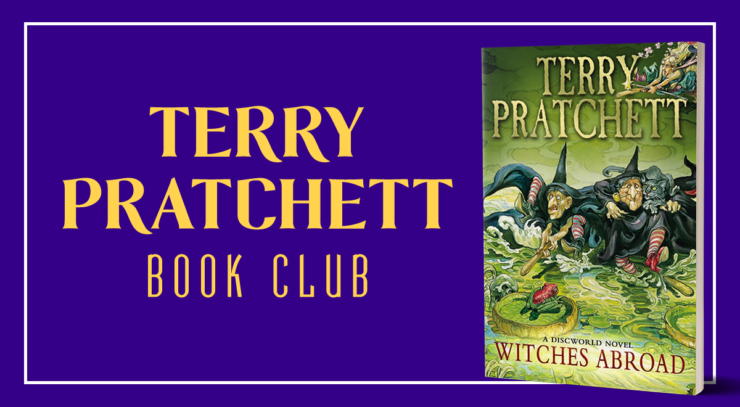
We’ve arrived at Genua, and it’s time to drink a lot of rum with bananas in. Let’s get up to no good with some Witches Abroad.
Summary
The witches make it to the gate of Genua (after accidentally landing in a swamp that Magrat thought was a field), but they are stopped at the gates for not being scrubbed up enough. Nanny insists that they are cleaning staff and gets them through. They try to get accommodation at a local inn, but everything is booked up for Mardi Gras, and they don’t have witches around these parts, so no one is impressed with Granny’s usual demands. Magrat and Granny have another spat in a local tavern and the trio adjourn to a stable for the night. Magrat gets up at dawn and decides she should handle this problem herself, leaving Nanny and Granny to follow Desiderata’s instructions. Nanny gets up directly after her and makes for the palace. Granny winds up at a public execution (someone stole) and encounters her first sign of Genua witchcraft: figures who appear to be women in veils. They climb into a carriage and Granny follows. Magrat meets the young woman she’s meant to be fairy-godmothering, Ella. Nanny heads into the palace and meets a woman named Mrs. Pleasant, and they get along swimmingly. Mrs. Pleasant tells her that the walls have ears and takes her out to the streets where she samples all the incredible food Genua has to offer. When she turns her head she finds Mrs. Pleasant has disappeared.
Buy the Book
Battle of the Linguist Mages
Nanny does some thinking and figures she’s been led where she needs to go. She notices a tent nearby with something bubbling in front inside a pot, helps herself to a bowl as she sees other folks doing, then steps inside and sits next to the owner of said tent: Erzulie Gogol. They gamely size each other up and compare magics, and then Esme shows up too. They meet her cockerel Legba, and then Mrs. Gogol takes them back to her house. Magrat sits down for tea with Ella, who explains to her that she’s not going to marry Genua’s prince or go to the ball, but her other godmother has insisted that she must. Everyone who has a fairy godmother has two: a good one and a bad one. But the other godmother and Magrat have both insisted they are the good ones. Nanny and Granny meet Mrs. Gogol’s zombie, a fellow who goes by the name Saturday. Mrs. Gogol tells them that the changes to their city occurred when their old Baron was murdered by the Duc. The Baron had a daughter who is being raised and kept by the Duc and his magical protector, so that she’ll marry him and his claim as ruler of the city will be legitimized.
In discussing who is protecting the Duc, Granny’s hat falls into the swamp and is snapped up by an alligator. Mrs. Gogol tells Saturday to fetch it, but Granny won’t allow even a dead man to risk himself. Mrs. Gogol has Saturday give Granny her best hat, and Esme finally admits that the witch causing all the trouble is her sister, Lily. Magrat is talking to Ella about her life in Genua, and the Sisters who watch her, and how she doesn’t want to go to the ball but suspects she’ll be forced to marry the Duc no matter what she wants. Nanny and Granny arrive to retrieve Magrat, and they run into the Sisters, who turn out to be transformed snakes. They escape, and Granny explains how her sister is feeding people into stories, making herself the ringmaster of a particularly gruesome circus. They form a plan: Nanny goes to the coachman house and begins drinking rum with the lot of them until they’re wasted; Magrat goes to find Ella’s wedding dress and rip it to shreds; the witches all meet in front of the coach and Magrat uses the wand to turn it into the pumpkin. Plan executed and story ruined, they decide to head to Mardi Gras.
The trouble is, Granny’s sister (who goes by Lillith now), isn’t that easily put off. As the witches join the celebration, Granny is worried—the story isn’t right and they fixed the problem too easily. She insists they go back, and they find Ella in a pumpkin carriage, drawn by two rats turned into horses and two mice turned into coachmen, on her way to the ball. Nanny suggests that they turn Greebo into a human for their plan, and he steps out in front of rat horses and mice coachmen as a cat human, and stop everyone in their tracks. The trio argue about how they should confront Lillith, and Granny decides that the only way forward is to send Magrat to the ball in Ella’s place, with Greebo as her coachman. She enters the ball (possessed of some of Granny’s confidence) while Nanny and Granny look around the palace. They find the Duc’s room and finally deduce his part in all of this—Esme realizes that her sister is combining more than one story in this set up. A rude ball invitee takes Nanny for a servant and demands to be shown the powder room; Granny makes her pass out so Nanny can steal her dress.
Commentary
We finally arrive at Genua and get a feel for this New Orleans/Magic Kingdom mashup that Pratchett has created. Having been somewhat disappointed with how Pyramids did a Discworld-ed version of Egypt, this attempt to stretch out beyond Britain and “classical” histories, as they are often termed, works far better to my mind. Maybe it’s because New Orleans is a place you can currently visit and Ancient Egypt is sadly not? Maybe it’s just down to being an even more experienced writer who keeps honing how he prefers to tell these stories. This is still coming from my perspective as a white person, commenting on the work of another white person, so obviously I’m bound to miss things in the rendering that might not work. But there’s a canniness to how Pratchett approaches Genua, starting with the discussion on how the new city lays over the old one: “The new one might not like the presence of the old one, but it couldn’t quite ever do without it. Someone, somewhere, has to do the cooking.”
It’s such a perfectly scathing commentary on everything from imperialism to its more commonplace contemporary cousin (gentrification) that it marks the city differently. There’s a lot of respect for the culture, the history, and of course the cooking that you find in New Orleans, and it helps pull the whole book together in a way that Pyramids doesn’t manage. As with many ideas you find in Discworld books, Pratchett has been playing around with these ideas for a bit—Baron Samedi has popped up before (around Death, of course), but now he’s finally found a place to make him a character within a story. It’s not the Samedi of Haitian Vodou religion by any means, as combining this location and culture with a fairy tale leads to a trope smash that alters the portrayal. I can understand if that ruins things for some readers, though, as accurate portrayals of Vodou that are rooted in its culture are harder to locate in fantasy narratives at this point in time.
I do appreciate that some familiarity with the figure gives you a great big hint in this narrative, though. Once the zombie announces himself to be “Saturday” and Mrs. Gogol talks of the city’s old baron being murdered, it’s not hard to put two and two together. There’s also Legba, who she says is a dark and dangerous spirit before passing it off more lightly… but of course, Legba is a crossroads spirit of the Vodou religion. The meeting of Mrs. Gogol and Nanny Ogg is wonderfully satisfying if you’re a fan of the “two experts meeting with suspicion and ending in mutual respect” sort of scene, which I love. But I wish a bit more of the narrative centered on Mrs. Gogol because she’s a riveting presence in the book. (Also, now I really want some gumbo.)
Also, the reframing of a wicked stepmother or fairy godmother figure as a “ringmaster” is maybe one of my favorite ideas this book achieves. Granny is using it to explain what her sister gets out of this gambit, and it’s effective as metaphors go, but there’s something particularly satisfying about taking roles that women are relegated to for the crime of simply being female (or worse, being female and old), and instead centering it on the idea of a genderless figure who appears to have mastery over an entire circus of delights. Ringmasters are sinister from a certain angle, when you think about it.
There’s something just a little heartbreaking about Magrat’s desire for the wedding dress when she goes to rip it up for Ella’s sake. It’s not the desire for weddings in particular, but more a real fantasy I’d imagine most people have in one form or another: a moment when you feel special, but more importantly, when you feel that you deserve to be special, and everything magically fits. A moment when you feel beautiful and content and capable, which are things that Magrat never really feels at all. I want that for her, and for everyone, really.
Have a beautiful, content, and capable day.
Asides and little thoughts:
- There’s a footnote about racism not being an issue on the Discworld on account of speciesism, which is a rather common way of handling social issues in fantasy—and for many authors I’m not inclined to give them that leeway. Pratchett is one of the few exceptions for me because satire demands a certain level of remove to be effective, and also because his stances on these matters are abundantly clear in his writing. He’s not using allegory to sidestep having to say anything meaningful or difficult within his work.
- Nanny Ogg likes cooking provided that someone else chops the vegetables and washes up afterward, and I know that sounds like she just doesn’t want to do the more work-y parts, but I’m also like this and I’m pretty sure it’s an ADHD thing on my end. (Certain parts of the task keep me moving, other ones bring me to a standstill.) Maybe Gytha has it too.
- “That’s the biggest cock I’ve ever seen, and I’ve seen a few in my time.” *gets judged on her upbringing* “What with living next to a chicken farm and all, is what I was going to say next.” GYTHA OGG IS A DAMNED TREASURE, I SAID.
- I’m just saying that there’s a whole aside here about the power and importance of hats and Pratchett was certainly very particular about his own hat. As a hat person myself, I’m inclined to agree. (But I also have a lot of different types of hats? I don’t subscribe to a central identity, is the problem, I suspect. Having a collection allows you to be different people all the time.)
Pratchettisms:
Little old ladies were by definition harmless, although in a string of villages across several thousand miles of continent this definition was currently being updated.
Nanny could feel Granny Weatherwax’s disapproval. What they said about women with red skirts was even worse than whatever they said about women with red shoes, whatever that was.
A medium-sized Three-Banded Coit gave her a frightened look, considered biting her nose for a moment, thought better of it, and then shut its mouth very tightly in the hope she’d get the message.
That’s why kings had hats. Take the crown off a king and all you had was someone good at having a weak chin and waving to people. Hats had power. Hats were important. But so were people.
At her feet Greebo sat primly watching some dancing women wearing nothing but feathers, trying to work out what to do about them.
Next week we finish the book!

One note while I get my thoughts together. Your thoughts on the wedding dress are, as a man, alien to me.
I was married in a rented tuxedo while my wife went the wedding dress route. I’m sure she doesn’t regret her choice but neither do I regret mine. As an heirloom, our professional wedding album provides more enjoyment and more memories for both of us.
But more than that, I am saddened by Magrat (and Roundworld brides) buying into the Disney princess fairy tale. That “moment when you feel special, but more importantly, when you feel that you deserve to be special, and everything magically fits” shouldn’t be a single moment. It is the job of a spouse, of both spouses, to make those moments extend through a marriage.
Not that we always succeed.
Ringmasters are sinister from a certain angle, when you think about it.
The Ringmaster was an established villain by the time I ran into him in one of the first Spiderman comics I read (way over 50 years ago); there’s definitely something about commanding all those specialized skills.
Magrat could easily have had Her Day — had she been willing to drop into a mold that didn’t have room for practicing magic, or even being knowledgeable about herbs. (Deleted discussion about That Day being a way of slipping someone offstage.) Bujold showed up at a Pratchett panel some years ago; I wonder whether she was specifically thinking of this book when she had Kareen (in A Civil Campaign) ask “Why do all the stories end when the Count’s daughter gets married?”
Lily is the one who tries to control everything; Esme acts when somebody needs a swift kick. That sounds small-l libertarian, but I don’t see Pratchett having any patience with the formalisms of {l,L}ibertarianism. I wonder why Lily thinks everything must be bent into Story, when the point of Story is that it’s the way things just happen — maybe she grew up bent, or maybe there’s something not-Lily that has already stepped out from between two mirrors?
Pratchettism:
The sight of Ankh-Morpork’s city guard made thoughtful people wonder who could possibly attack that was worse. But A-M residents might find Genua guards to be worse.
While I can see that the execution of the thief is a key point for Granny, I think that the trial of the Toymaker is far more sinister and indicative of Lily’s mindset. To her, Story is not the way things happen, it’s the way things should happen.
I finally found the actual joke that Granny tried to tell its “get me an alligator sandwich and make it snappy.” Granny never got punes.
The Greebo versus Legba confrontation is marvelous. It’s as if the duel between Uma Thurman and Lucy Lui in Kill Bill had ended with Uma running away.
Two things come to mind when the witches are making their first attempt at stopping the story. First, the horseman’s word involves a hammer and is meant to make a horse docile. Second, why didn’t they smash the pumpkin?
As they decide to change Greebo, the words they speak are the justification for so many bad Roundworld actions: “It can’t be bad if we’re doing it. We’re the good ones.”
Pratchettisms
Granny Weatherwax always held that you ought to count up to ten before losing your temper. No one knew why, because the only effect of this was to build up the pressure and make the ensuing explosion a whole lot worse.
Genua, city of cooks, had found the appetite it deserved.
This is Greebo. Between you and me he’s a fiend from hell.” “Well, he’s a cat” said Mrs. Gogol generously. “It’s only to be expected.”
Greebo as a man. Full Stop.
Nanny: Now I know why the lady cats scream in the night.
@@.-@ – Wrowwwl?
I love Genua. I love Nanny Ogg in Genua. But that description of the seafood-rich market shouldn’t be read while hungry. I wanna go there.
Many relatively-blameless people die throughout the Discworld series, but for me, Lilith murdering the coachmen has always been one of the saddest (sets of) deaths. It’s so unnecessary in-story, so cold-blooded, so deliberately done by a villain and unintentionally resulting from the actions of a protagonist. And we got to get to know them just a little beforehand. It’s a brilliant character-defining moment for Lilith, in case anyone doubted the extent of her cruel ruthlessness. And it’s chillingly prefaced by Lilith saying “If you don’t have respect, you don’t have anything” — just like her heroine sister.
But my sadness didn’t stop me from punning that the under-footman (like the others) became an “underfoot-man.”
For some reason, I tend to laugh uncontrollably whenever Nanny writes “bananana” or “banananana.”
I like Nanny seeing “HOTEL NO VACANCIES” and saying “Hotel Nova Cancies, that means Hotel New Cancies in foreign.” And Magrat pouring soothing oil on the internal fires. And Nanny calling lianas “them llamas.”
The anecdote of Granny cursing Mr. Wilkins to think he was a frog, with his amphibious inclinations (i.e. urgent love of swimming) lingering after the curse wore off, makes me jokingly wonder if someone inflicted that precise curse on me when I was too young to remember it.
I’ve always wondered what Nanny horrifically did to the drink of the man who poured beer down her back, which Magrat wasn’t “old enough to be tole.” I imagined an eyeball appearing in it, like in The Twits when Mrs. Twit puts her glass eye in Mr. Twit’s beer, but that’s probably not what happened.
Magrat bought occult jewelry as a sort of distraction from being Magrat. She had three large boxes of the stuff and was still exactly the same person. Relatable. I take every opportunity to buy jewelry (and clothes and COVID-era face masks) featuring aquatic animals, and I’m still frustratingly terrestrial. I also buy hippie-coded things whenever possible, and still feel like I’m not a real hippie because I’m second-generation and wasn’t *there.*
Lily Weatherwax calls herself Lilith de Tempscire. “Tempscire” is said to be a French transliteration of “Weatherwax,” though Google Translate says “Tempscire” is “weather” even though “cire” is “wax.” (I took French classes for…nine years…albeit over a decade ago…and somehow I can’t do better than Google Translate, imperfect though it is. I’m embarrassed.)
I’ve wondered if the recent roundup of a 1,000 elephants had something to do with the fact that the circus visiting Lancre didn’t have the elephants they’d advertised. But the circus visit was “last year” and the L-Space Wiki timeline says Moving Pictures and Witches Abroad happen in the same year, so maybe not.
I was surprised by Granny’s shocked realization that Lilith was Ella’s other fairy godmother and could undo their damage with her own wand. Hadn’t she previously put those pieces together?
Pratchettisms:
“Well, it seems to me the land and water around here can’t decide who is which.”
Where the water was visible, it was black like ink. Occasionally a few bubbles would eructate to the surface like the ghosts of beans on bath night.
[On being treated like ordinary people] Getting muddy when you had a nice hot tub to look forward to was fun. Getting muddy when all you had to look forward to was more mud was no fun at all.
People in chains had a tendency to look guilty.
Nanny Ogg would try anything once. Some things she would try several thousand times.
Looking ahead:
Contrary to the footnote, human-on-human racism is a problem on the Disc, in more ways than the in-story exoticism and xenophobia we’ve seen. It will be clearer in some of the later books, most blatantly in Jingo where nationalism is the focus but racism is also expressed.
I don’t know if the dress Magrat destroyed was supposed to be for Ella’s wedding as well as this ball. But (major spoiler) ///Magrat will swiftly destroy her own wedding dress, too, only a bit more gradually.///
My very-long-ago knowledge of French suggests that “temps” (literally “times”) can also mean circumstances, conditions, … — e.g., weather. (Vague recollection of “Il fait beaux temps” meaning “It’s nice weather”.) I don’t know why Google Translate gives “tempscire” as “weather”, but it also asks whether I mean “temps cire” (“wax time”), which suggests that somewhere in its electronic brain it realizes that it’s been outdone by the real world. Comparing it to trip hazards of some decades ago, I see it is almost OK on a back-and-forth translation of “The spirit is willing but the flesh is weak”; “Out of sight, out of mind” circles perfectly, but I suspect the translation is narrower than the original.
wrt Esme not realizing Lily’s office&powers: I suspect Esme is too used to being the most powerful witch in the room (or at least thinking she is — ISTR hints (an author comment?) that Nanny Ogg is actually more powerful but much more casual about it), and so likely to underestimate powers that actually match her own.
“Lily is the one who tries to control everything; Esme acts when somebody needs a swift kick.”
That is Lily committing the sin of treating people like things.
@7 – “Tempscire” does in fact translate to “Weatherwax”, if you go to an old-fashioned paper-and-ink dictionary.
Google Translate really isn’t much good. You should see what it does with Latin.
@7, @9: In my French version – (Mécomptes de Fées) the family name becomes Ciredutemps, so Esme Weatherwax becomes Mémé Ciredutemps, accompanied by Nounou Ogg and Magrat Goussedail
@10: So in Nanny’s translation, Magrat the wet hen comes from Goose Dale.
@6,7,9,10
Tempscire does, in fact, translate directly into Weatherwax … in Genuan. Just as Rincewind’s possible ancestor, Lavaeolus’ name directly translates to Rinser of Winds in Ephebian. Roundworld dictionaries don’t handle Discworld languages that well.
@10 – can’t argue with that. Although French versions of English names are sometimes not direct translations – Potter’s Jemima Puddleduck was published in French as Sophie Canetang, which is similar but not the same.
@12 – this of course is something we should all take into consideration.
@13: indeed. Translating wordplay and puns is one if the trickiest propositions for any translator. It was always one of the things I admired most about Michael Kandel’s translation of the Cyberiad, which is all wordplay, and incredibly funny
Human Greebo: his eye glittered with the sins of angels. His smile was the downfall of saints. in a later book he is described as able to commit sexual harassment sitting quietly in the next room. Wow! 😲
Being born and raised in the UK, Terry is much more likely than someone from the US to be familiar with the song Baron Saturday, from the Pretty Things’ great rock opera S.F. Sorrow. I’m only familiar with the name being used, even in English language media, in its original French. The Pretty Things song is one of the very few times I’ve read or heard it in its English translation.
@19
I’ve always rather assumed that Baron Saturday come more from the James Bond film Live & Let Die which features as a villain one Baron Samedi.
Baron Samadi or Baron Saturday has been a major character in Louisiana (and Caribbean) voodoo for centuries. The two names are equivalent since Saturday is the English translation of the French Samadi, although I suspect Terry chose the English translation to reference Robinson Crusoe’s Man Friday.
Since the voodoo aspects of the book are extensive, I suspect that Baron Saturday derives from his own research and not from other popular culture references.