






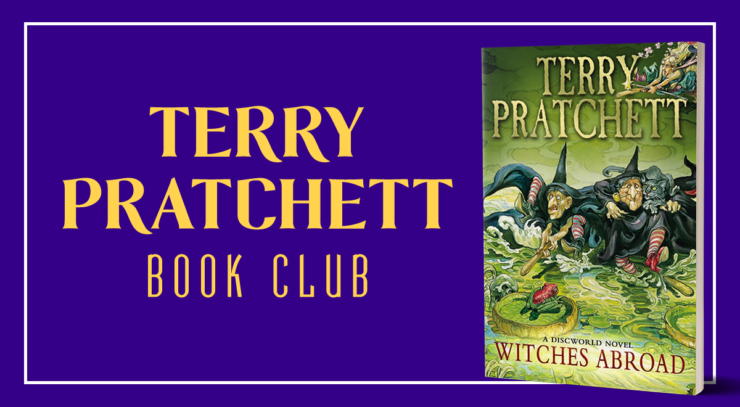
A ball, a slipper, and Baron Samedi makes his appearance… It’s time to finish Witches Abroad!
Summary
Nanny and Granny steal the clothes of a couple of guests and make their way through the ball, spotting Magrat holding court to one side while they sample the buffet table. Nanny is located by Casanunda, a dwarf who is “reputed to be the world’s greatest lover.” Granny is dancing with a colonel (leading of course), and swings by Nanny and her new dancing partner right as the Duc arrives with Lily Weatherwax. The story gets to work, and the Duc (now the Prince) begins to dance with Magrat, and both seem entranced. Granny knows the power of the sequence, and that it won’t be broken until the clock strikes midnight. They’re three hours from that, so Nanny and Casanunda head up to the clock tower to move the mechanism along faster. The clock strikes twelve and Magrat realizes that her dancing partner is wearing smoky glasses. She removes them and finds inhuman eyes. She runs, losing a glass slipper on the stairs (you can’t run in those things), which the Duc picks up.
Buy the Book
Battle of the Linguist Mages
Granny focuses on how she can break the story, walks over to the Duc, takes the slipper from him and lets it smash to the floor. The story wobbles, Mrs. Gogol works magic from afar and prepares to attack, Greebo goes to the palace kitchens and gets fish heads and milk from Mrs. Pleasant. Lily isn’t impressed with Esme’s interference, and there’s another slipper to give the Prince anyhow. Magrat is revealed to be the wrong girl, however, so Nanny insists that they try the shoe on her, since that’s how the story goes—it fits her perfectly. Granny reveals that Lily’s prince is actually a frog, but Lily doesn’t see the issue. Where Ella is waiting, Mrs. Gogol’s hut emerges from the swamp and she encourages the girl to come with her. Lily imprisons the witches so her story can come out right, knowing they’ll escape. They sit in their cell and try to figure out how they’ll get out. Casanunda appears and offers his help, but there’s not much doing at the moment (and he reveals himself to be only the second greatest lover on the Disc). Legba appears and then Mister Saturday, who makes a hole in the wall for them to escape. Mrs. Gogol appears, and so does Greebo, who fights one of the guards aiming a crossbow at them.
Baron Saturday arrives at the ball; new music begins and he dances down the steps. The Prince is horrified and demands that a guard kills him. He can’t, of course, and is struck dead by Mrs. Gogol’s magic. Lily tells Mrs. Gogol that she doesn’t belong there anymore, and tries to fight the baron, but nothing works. She concentrates all magic in the area, turning the Prince back into a frog, and Baron Saturday steps on him. He tells the room that they can have him back as ruler (he was the Baron Lily killed) or they can have Emberella. But Granny isn’t happy with how the story is being changed because Mrs. Gogol’s magic is now the primary influence instead of Lily’s, when magic should be out of the whole process now. Granny confronts Mrs. Gogol and explains that she’s won and has to stop interfering, which Mrs. Gogol doesn’t like at all. They set a challenge between them, but the terms get wooly because Granny wants Mrs. Gogol to leave the city alone and also leave Lily to her. Mrs. Gogol happens to have a doll that was meant to be for Lily, but could be Granny instead. Esme doesn’t care; she respects Mrs. Gogol, but this is her family, so she goes to look for her sister. Mrs. Gogol begins stabbing the doll, asking Granny to stop before she kills her.
So Granny sticks her hand into a burning torch, setting the doll aflame.
She runs after her sister and Nanny and Magrat head after her. The Baron points out that Mrs. Gogol promised him death and vengeance, but Mrs. Gogol reckons that Lily Weatherwax will get what’s coming to her. They turn the kingdom over to Ella—their daughter—who immediately ends the ball and decides to go dance at the carnival. Death comes for Baron Saturday; this was always their scheduled appointment. Mrs. Gogol goes back to the swamp. Granny confronts Lily, but Lily threatens Nanny and Magrat’s lives unless Esme says she’s won and lets her start over with Genua. Granny agrees, says she’s won, then drops herself off a parapet. But it was a gambit, and after Nanny and Magrat go after her, Granny confronts her sister. She breaks one of her mirrors, telling Lily that she’s finally going to get the hidin’ she deserves because all the fun she had with magic meant Granny had to be the good one all her life. And it was hard. The sister mirror reaches out and pull Lily into it. Granny reaches for her and cuts up her arms, which is the state Nanny and Magrat find her in. Lily is stuck inside the mirror amongst billions of reflections, and Death tells her she will stay there until she finds the reflection that’s real. Esme is in the same place, but she knows which one is real straight away and wakes. Magrat throws the godmother wand into the swamp, and the three witches head home together… the long way, so they can see the elephant.
Commentary
This book is about a lot of things, but I think the thing that hits the hardest for me is Esme Weatherwax telling her sister that all the trouble she caused meant that Granny was stuck being the good one, and how much that stings. It’s probably strange for it to resonate with me so much because I’m an only child; I’ve never had a little sibling I had to shelter or set an example for. But it seems to me that this dynamic can play out in many types of relationships. Between children and parents (in either direction), between friends, between surrogate siblings. The pain here isn’t out of a desire to be bad, of course, but an acknowledgement of how much strength it takes to do the right thing. And there’s nothing quite so taxing on one’s ability to do the right thing as watching other people get away with anything they like sans consequences. We’ve all had those moments. It’s like the opposite of schadenfreude. There must be a word for that.
I do find myself wishing that we knew a little bit more about Lily Weatherwax, though. Because I want to know why she needs this so badly, what led her to it aside from just the abilities themselves. I understand her function in the story, but I don’t feel like we really know her by the end. We only know how Esme feels about what she does.
There’s a moment here where Mrs. Gogol is reflecting on the people of Genua who are not those living in the fancy houses and going to balls. The invisible ones who are not the subject of stories. The narrative states: “Stories are not, on the whole, interested in swineherds who remain swineherds and poor and humble shoemakers whose destiny is to die slightly poorer and much humbler.”
But the thing is… some stories are. Which is probably where the “on the whole” caveat is coming from. It’s a very European thing (that has bled into the U.S. via colonizing forces), this conceit of stories that herald from the epic tradition where stakes have to be higher than anything in order to warrant a telling. It is also a conceit that’s being more readily challenged in this day and age, and I find myself wondering if Pratchett would tell this story differently now. If there would be room for the shape of smaller stories within this book, and questions about their configurations. This ultimately plays back into my earlier assertion that what’s really being used here is the tyranny of fairy tales’ shapes, and how that is ultimately what Granny is fighting back against.
There’s another interesting aspect here about the Baron and the concept of monarchy and ruling classes within the Discworld. Mrs. Gogol thinks about how Saturday hadn’t been a particular good guy when he ruled Genua, but “at least he’s never told people that they wanted him to oppress them, and that everything he did was for their own good.” This is entirely similar to how to witches viewed Lancre’s king before he’s killed and usurped by the duke and duchess, and I think that’s extremely relevant to the overall worldview offered by the Disc.
Pratchett is pulling a lot from the fantasy tropes that he grew up on, and that combined with living in England means that monarchy is always going to be something worth dissecting. If it’s the system you’ve got—which is true for quite a bit of the Disc—then you’re not going to spend a whole bunch of time considering whether kings and queens are a good thing. You’re going to ask what makes them good or bad. And, of course, the truth of the matter is that monarchy is an inherently flawed system, and Pratchett obviously knows this. So rather than tackle the “morality” of monarchy (because there isn’t one), we stumble upon a general consensus between populations with different rulers, namely that the best rulers are the ones who let you get on with your life and never pretend that they’re on your side. Which seems a likely perspective for our own world too, for peasants who never had much control over their own circumstances.
I will say, all analysis aside, Granny’s use of headology to reverse-destroy a vodou doll by sticking her arm into a torch is one of the best callbacks Pratchett has done thus far, and also proof that the most dramatic moments in a story require practically no explosions and high-octane action whatsoever. Which is really probably what Granny means by headology in the first place.
Asides and little thoughts:
- Okay, but I feel the need to point out that lobster is on the banquet spread for this ball, and if Pratchett is going to devote so much time (rightfully so) to talking about how truly great cooking comes from people eating the scraps that the rich don’t want, then we need to acknowledge the fact that lobster only became “rich people food” in the last century, specifically since WWII. It used to be food that anyone ate if they lived on the coast, it was fisherman food, and then the advent of transportation and industry changed that.
- Mrs. Gogol’s hut moves on duck feet, which is a sort of shoutout to Baba Yaga’s house on chicken feet. And while I’m not always against splicing story bits together in fantasy, the lack of anything Russian in Genua makes that stand out weirdly?
- I think this bit here at the end is the first time Magrat calls Nanny Gytha? *sniffs*
- Granny insisting that plenty of places are like home, but only one of them is yours is just… my heart.
Pratchettisms:
There was a slight struggle as the colonel tried to lead, but he soon gave in, partly in the face of Granny Weatherwax’s sheer refusal to compromise but mainly because of her boots.
What Granny could achieve with two pounds of hobnailed syncopation Nanny Ogg could achieve merely with her bosom.
Somewhere in the genetics of the Weatherwaxes was a piece of sapphire. Maybe generations of them.
She hated everything that predestined people, that fooled them, that made them slightly less than human.
The invisible people knew that happiness is not the natural state of mankind, and is never achieved from the outside in.
Nanny Ogg and Magrat came up onto the roof like avenging angels after a period of lax celestial quality control.
Next week we start Small Gods! We’ll read up to:
“Most pressing and urgent business. Which only he can attend too.”


The point about the mirrors that Esme and Lily are trapped in is that they’re mirrors — Lily is constantly stuck looking for which reflection is really her; Esme knows that they’re all just reflections, taps herself on the chest, and says “This one [is real]”. Seeing people for what they are, not for what you think they ought to be.
The mirrored parallel sequences where Lily and Esme are stuck in the mirror world are one of my favorite Pratchett bits. “Until you find the one that’s real.” Such brilliantly succinct characterization.
I use Freudenschade as the opposite of Schadenfreude. Try it, you might like it!
I think the book explains a lot of what makes Granny Granny. She has been angry all her life and she shows it. It started with her sister and and her parents but it seemed to expand to the world in general. Her attitude towards apologies seems to stem from this. So, too, does her attitude towards winning (and it mirrors Greebo’s idea that killing something is to be avoided because then they won’t know they’ve lost).
Her treatment of Magrat shows this. Magrat is quite correct that Granny’s angry that Magrat got the wand and despite the fact that Granny knows how to use it she won’t help Magrat at all. Sticking your hand in the fire is another instance of denigrating Magrat for something she knows how to do.
She does get better, by the Tiffany books she actually does some coaching and teaching. But at this point I wouldn’t want to associate with her.
BTW, the celebration described is much more reminiscent of All Hallows Eve and Halloween (the night of and day of the dead) which is presided over by Baron Samadi and involves drumming, dancing, and parades.
Yes, the whole “you got to be bad so I HAD to be good” makes so much sense for Granny – throughout her appearances we’ve had little asides talking about how she could have been another Black Aliss but chose to be good instead. And Nanny firmly established herself as Granny’s sidekick to keep her pointed in the right direction, ish. Nanny is arguably a better witch than Granny, because she knows what happens when witches go bad, and has spent a large part of her life making sure it doesn’t happen.
while they sample the buffet table.
Are we understating yet?
The Wikipedia entry for lobster documents that it was a fancy food much earlier than WWII, at least in Europe.
I thought the duck-footed hut was a clever adaptation — a bit like the way the local food starts with whatever-can-be-caught. For that matter, ISTM that “Saturday Nuit Mort” is a cold-blooded mashup of the Day of the Dead (cf @@.-@) with a certain TV variety show.
“I had to be the good one!” is a line that stuck in my memory long after all the witty bits had faded.
Pratchettisms:
Apart from being as well-adapted a parasite as the oak-bracket fungus…
In the swamp, the difference between the water and the land was practically a matter of choice.
Her hand moved so swiftly that any wisdom-seeking saffron-clad youth would have started The Way of Mrs. Ogg there and then.
And the trouble with small furry animals in a corner is that, just occasionally, one of them’s a mongoose.
An artistic slip: Nanny Ogg discovers the banjo here (appropriately), but the cover of the DVD of Wyrd Sisters shows her playing one while riding her broomstick. I suppose there are few enough of the videos that they can’t be held to chronological order.
Another fan of the Lily/ Esme face off at the end here. “I had to be the good one” resonated for me as the youngest of five because it was expected that I would learn from everyone else’s mistakes. Fortunately, my siblings didn’t make too many blunders and when they did it paved the way for me to make my own with less dire consequences. Granny knowing where the real reflection was also important to me and still is. Thank youfor the chat on this: WA is a long-time favourite in the series for me.
It’s rare and nice to read a book where nearly all of the major characters are women.
I don’t like the description of Nanny’s bosom (described as a large and experienced bosom, and not one that was subject to restraint) swinging every which way as she dances — because it sounds so painful. My own detestably-massive bosom is not at all “experienced,” but is subject to constant restraint lest it be intolerable instead of incessantly uncomfortable. Having it swing wildly around sounds agonizing to me, and I don’t understand how Nanny enjoys the experience. I’ve seen plenty of readers say they appreciate the description’s visual realism because they’re big-bosomed, but I personally can’t detach from imagining the sensations of it.
Colonel Moutarde’s name sound like something Pratchett thought up in an especially goofy moment.
“I enjoy open relationships. If you want to go out with a frog, that’s fine by me.” Casanunda, you charmer, that’s exactly what I like to hear from a potential partner. Human-minded frog or frog-minded human, of any gender, it’s all good.
“You’re not a godmother of any kind, are you?” “No. No gods.” But not “no mother.”
Personally, I prefer historical fiction about the ordinary lives of ordinary-yet-interesting people. Can’t be having with royalty and suchlike.
Just getting away, that was the important thing. From was more urgent than to. Magrat is briefly embracing Rincewind’s philosophy of life.
I want to sleep in a “great big indoor pond” like the Duc had. Or a great big outdoor pond. Or lake, or ocean. Sadly, I’m too human to manage that.
I was saddened when Saturday stepped on the frog-Duc, just as Lilith had stepped on the beetle-coachmen. But since the Duc had wanted to stay human, he might have been unhappy as a frog, maybe even like the wolf, unless the loss of the humanity spell destroyed any memory of his sapience.
Given Saturday’s critical importance in this plan, I was retroactively surprised that Mrs. Gogol previously ordered him to retrieve Granny’s hat from the alligator that ate it. But if he was super-strong even before the big final spell — possible, judging by Windle Poons — he would perhaps have easily torn the alligator apart with little risk of getting eaten as Granny feared.
I don’t think it’s clear that Mrs. Gogol killed the guard who shot Saturday, just that he crumpled to the floor.
The age difference between Lily and Esme is unclear. Lily got kicked out of home when she was 13 and Esme was “tiny” but old enough to remember her. So maybe Lily was 5-10 years older than Esme, even though she now looks the younger of the two.
Pratchettisms:
“The wages of sin is death, but so is the salary of virtue, and at least the evil get to go home early on Fridays.”
“I hunger, my love, for the warm dining room of your macerations.” — Nanny (presumably) mistranslating Casanunda’s song
“They say travel broadens the mind. I reckon I could pull mine out of my ears now and knot it under my chin.”
“There’s a billion places like home, but only one of ’em’s where you live.”
Looking ahead:
Sadly, we’ll never again visit Genua.
Greebo will briefly turn humanoid again. And again, and again.
Mrs. Gogol gave Nanny a banjo. Nobody in Lancre will be happy about this.
>Sadly, we’ll never again visit Genua
We do briefly in the climax of Going Postal, with Devious Collabone and his shellfish research
I’m trying to remember the Theodore Sturgeon story, where a man destroys a voodoo doll. At the end, a dying young woman is saying “He called me Dolly.”
PamAdams: The title is “A Way of Thinking” and here’s the ISFDB entry.
@8 : Colonel Moutarde = Colonel Mustard, from ‘Cluedo?
@6
The lobster thing is partly a difference between the US and Europe. In Europe, from the Middle Ages on it was a high-status food, and has remained that way ever since (when lobsters feature in Dutch still lives, it’s a brag about the food the household can afford). Oddly the first European settlers in America seem to have pretty much immediately decided that it was an inferior food – presumably this was partly because of its abundance, but it’s strange that they didn’t pass through a phase of regarding it as amazing bounty (maybe they were inlanders who just didn’t like fish much). But, as you say, interest in eating it picks up in the US in the 19th C.
@6
Is one of my favourite throwaway Prachett lines.
As is the scene with the voodoo doll. Along the river boat card scene it shows how Granny not only likes to fight, but how she loves to beat you both at your own game AND using your tools to do it.
@@.-@ davep1 To be honest, the night sounds a lot more like Mexican Day of the Dead celebrations than Hallowe’en, at least how it is celebrated in its home in Ireland. There’s nowhere enough bonfires, fancy dress or asmall sticky children running around, although I’m blaming the pumpkins on the fairy godmother trope. No drumming, traditionally no dancing and certainly no parades!
And the trouble with small furry animals in a corner is that, just occasionally, one of them’s a mongoose.
That’s our Magrat, the soft nice one…who just shot an elf in the eye through a keyhole. She’s the Nice One. But don’t push her.
@15: Keep in mind that Voodoo is a product of religious syncretism (as, for that matter are Christianity, Judaism, and most modern religions).
The date of Halloween came from Pope Gregory IV. The concept of it goes back many centuries before as a harvest festival. The autumnal equinox marked the start of winter and about a month later the end of the harvest was celebrated as we saw in Reaper Man.
Day of the Dead celebrations are many and varied. The Danse Macabre of medieval times comes closest to the Caribbean Voodoo celebration. In Voodoo, celebrants use drums, dance, drugs (cleaned up by Terry), and drinks to summon Baron Samedi who will possess one of the participants (in this case, Baron Saturday).
@9. We do get that brief return, as I’d forgotten, but it doesn’t offer much opportunity to experience Genua.
@12: I assume so. It reminded me of George R. R. Martin naming several historical Song of Ice and Fire characters after Muppets. When authors have a zillion minor characters to name, inconsequential goofy shortcuts often happen. I enjoy them.
@18: Talking about experiencing Genua makes me think the city would have been improved with a Dibbler cousin (Couper la Gorge Dibbler?) selling ‘meat’ pies to Granny.
@19: An interesting point; considering the number of correspondents Dibbler has, it would be surprising if Genua never had one. OTOH, considering that Lily has so “cleaned up” the city that she’s down to abusing toymakers for not being merry, it’s not surprising that there’s no corresponding character in Genua-now. Worst case, he had his throat cut by someone else official for theft (of not having the advertised meat in his pies), since we’re shown that’s the penalty; otherwise he may have seen what was coming and gotten out while he could.
@12: that was my guess.
@13: among the original 13 colonies that became the US, the one with the most lobster available is also the one with the most ascetic settlers; it’s possible they looked on it as … unsuitable … for those who wished to seem closest to their deity. Homarus americanus is also a different species from the European lobster; I don’t know how much the flavor differs, or whether the differences in appearance were enough to put people off.
@20: It might well have been the appearance. You know what they say about red shoes and red dresses. Well European lobsters are blue and American lobsters are red.
You’re probably right about Dibbler. I can imagine Lily assisting him in cutting his throat.
I don’t know how long Genuans would normally suffer the presence of a Dibbler variant besmirching their cuisine. The idea reminds me of the Good Omens footnote that “The Burger Lord pathfinder salesmen had been shot twenty-five minutes after setting foot in France.” (Though Famine inflicted the French with nouvelle cuisine instead, as well as his more traditional means of involuntary mass starvation at some points in time.)
@21: American lobsters are usually greenish-brown when alive,* European lobsters are usually blue when alive, and both species turn red when cooked.
*Rare color variations in live American lobsters include blue (the most common rarity), red, white, yellow, and split lengthwise between two colors. While I worked at the New England Aquarium, they displayed a split “Halloween lobster” that was half dark brown and half orange-yellow.
@22: I bow to your superior knowledge. In my defense, one of the ways of identifying the two is that the bottom of the claws and, often, the speckles are red or orange according to the UK Retain and Report program (Europe considers them an invasive species).
The real answer is probably the tougher shell and blander taste. But then I couldn’t have tied it to the red shoes. ;-)
Nanny Ogg and Magrat came up onto the roof like avenging angels after a period of lax celestial quality control.
What’s the joke here? IDGI
@24: I don’t see it as a deep joke, just a throwaway line. At their best, neither Nanny or Magrat looks very angelic. And neither, in this book, seems very avenging. That’s more Greebo’s thing.
I’ve always pictured avenging angels, visually, as Valkyries riding with Wagner’s “Ride of the Valkyries” as their theme music.
@24: It’s a way of describing that they’re rather upset and prepared to take it out on someone.
@@@@@ 25 – Yes, and they don’t carry anyone back to Heaven with them when they’re done.
With the “lax celestial quality control” implying that the riffraff have been let through to heaven and the avenging angels are mad about it? Or that the angels themselves are undeserving and have been made into angels because of lax quality control?
Well stumbling onto this book club featuring my favourite book is a delight. And so is the wealth of knowledge and wit in the discussion.
Witches abroad made New Orleans into my dream destination and which I finally visited in the Mardi Gras before Katrina, and then again when they film the finale episode of Treme. It lived up to its promise in all but one way: no gumbo could live up to Mrs Gogol’s pinnacle of the form. But the investigation w still a delicious joy.
Most relatable for me is Nanny Ogg knowing how to start spelling bananana but not when to stop.
I too would have welcomed more Genua, esp a return trip for a Mrs Gogol -centred story.
@28: I think @25 has it: neither of the senior witches is particularly kempt, let alone shining, toned-looking, etc.
A late thought: Lily doesn’t know which one is her because she’s been being roles (ruler, controller of destiny, maker of stories, …); Esme does know, because she’s first and foremost herself — being The Witch of a specific place is secondary, even if she’d make mincemeat (or just a public fool) out of anyone who tried to assume that position. Possibly an echo of Adam being himself/human first and the Spawn of Hell etc. a poor second.