






“For who could ever learn to love a beast?” —Beauty and the Beast (1991)
From classics such as Eros and Psyche to modern narratives like The Shape of Water, stories of paranormal romance—often between a human woman and a supernatural male partner—are tales as old as time.
While many may question the continued and expanding popularity of this trope in recent decades, wondering if it expresses an increased proclivity towards teratophilia (i.e. monster f*ckers), the monster husband storyline has older roots within human narrative civilization.
Around the world, tales of animal bridegrooms, or stories of human women betrothed or married to an animal or animal-esque figure, pervade folklore and legend. Examples of this include “The Snake Prince” (an Indian fairytale in which a human woman marries a snake), “East of the Sun and West of the Moon”(a Norwegian fairytale in which a human woman marries a bear), and “Marya Morevna and Koschei the Deathless” (a Russian fairytale featuring three avian suitors.) Though each tale has its own distinctions elements due to specific topography and cultural circumstances, many of these stories (despite their geographic distance from each other) bear a striking resemblance to the familiar Western narrative “La Belle et la Bête,” (otherwise known as “Beauty and the Beast”).
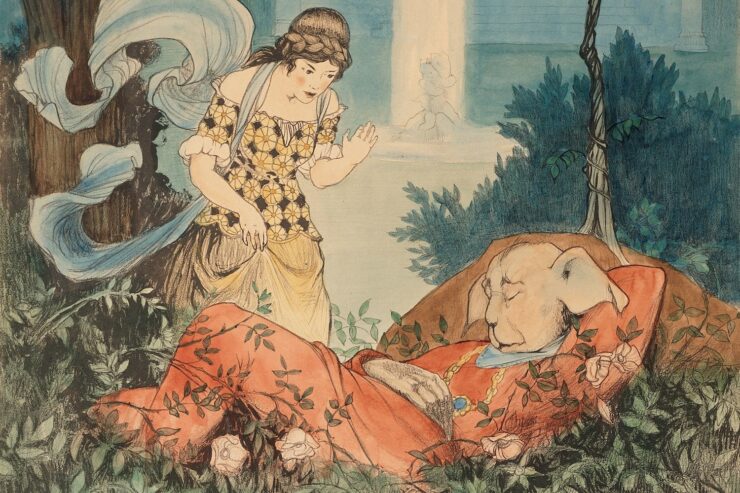
This version of the story, originally written by French novelist Gabrielle-Suzanne Barbot de Villeneuve, and later abridged, adapted, and retold by writers such as Jeanne-Marie Leprince de Beaumont and Andrew Lang, tells of a young beautiful maiden (in many versions referred to directly as “Beauty”) who, as the result of a debt her father owes, becomes engaged to a man with a monstrous or “beastly” appearance. As the popular Disney movie tells the tale, through patience and compassion, Beauty is able to look beyond the Beast’s appearance and soon falls in love with him and his inner “beauty,”—her love results in the breaking the Beast’s curse and restoring his original human appearance (and therefore humanity).
On the surface, it’s a seemingly simple case of “love conquers all,” but the fairy tale, like all fairytales, encompasses more subtle meanings and messages rife with societal implications.
Over time, various scholars have theorized that during times when a wide number of women were forced into arranged marriages to men they were not familiar with, that many conceptualized their future husband as ominous figures, the stranger becoming a monster in their imaginations. And truly, how could they not?
When the result of an arranged marriage might run the gamut between loving caretaker or abusive jailor, it’s easy to understand how fear of the unknown might take the form of the monstrous or villainous. As such, animal bridegroom stories may have offered a metaphorical outlet for these fearful brides-to-be, fictionalizing their very real fears and anxieties through the lens of the fantastic. As film critic and video essayist Lindsay Ellis commented, “Many an arranged marriage must have seemed like being tethered to a monster… and the telling of stories like ‘Beauty and the Beast’ may have furnished women with a socially acceptable channel for providing advice, comfort, and the consolation of imagination.”
And as with all stories and legends, scholars also theorize that there were key lessons to be learned from these stories of monster marriages. As classic fairy tales taught children moral lessons in distinguishing between “good vs evil” behavior, they also served to reinforce social norms, particularly in terms of conventional gender roles and romantic protocol.
As seen in early versions of “Beauty and the Beast,” the story seems to emphasize that Beauty’s qualities of self-sacrifice, physical loveliness, and well-mannered grace (all highly treasured “feminine” attributes) provide the key that will finally unlock the Beast’s potential as a (conventionally attractive) spouse, one capable of providing both emotional and financial security. In this sense, it’s hard to ignore the unspoken lesson that those who behave as a woman “should” will be rewarded, as well as the promise that the beast/husband can surely be tamed into being “better.” While both are fairly unappealing takeaways, it should be noted that the latter message continues to be a fixture in many heterosexual romance narratives presented in modern-day media, in which women are often expected, if not encouraged, to “tame” their problematic male partner (“I can fix him!”) through patience and affection. Thus the fairytale of redemptive love becomes a trap for emotionally frustrating, if not abusive relationships.
However, not everything “monstrous” is evil or awful in nature…
Many are drawn to monsters for the way they embody or represent the “outsider” figure within society, the one who is feared yet still yearns for love.
Within the figure of the monster, there is the appeal of the liminal, an “outsidership” for those cast on the edges of society, whether due to their appearance or their supernatural abilities, and how some people may find an empathetic nature in those qualities, seeing in them a reflection of their own vulnerability. In fact, as academic Saraliza Anzaldua, author of the paper “Teratophilia: An Inquiry into Monster Erotica and the Feminine Psyche” notes, the monster presents a vicarious fantasy that embodies a type of “masculinity” that is separated from the patriarchal violence of “real” flesh-and-blood human men, “Though it may be masculine (in some cases), the monster is not human, and the problem of humanity eliding with the male is circumvented.” (p. 9, Anzaldua.)
What’s more is that there is also the intriguing appeal of dissonance in the contrast between appearance and reality. Beneath the monster’s beastly surface or assumedly “aggressive” nature, there lies a tender disposition, demonstrated through genuine affection for their partner. This in turn is met by a personal agency from their human lovers, who bypass societal prejudices and biases in order to extend compassion and understanding for these often misunderstood outcasts of society. After all, is it not Gaston from Beauty and the Beast who, despite his “normal” human appearance, turns out to the actual villain of the story with his misogyny and hatred of all those who are different (including the Beast and Belle)?
In the Japanese light novel series Kakuriyo no Yadomeshi (Kakuriyo: Bed and Breakfast for Spirits) written by Midori Yūma (and subsequently adapted into a manga and anime series), human protagonist Aoi Tsubaki finds herself engaged to an ogre called Ōdanna, as a result of gambling debt owed by her grandfather to the oni. Rather than being forced into a marriage with someone she barely knows, Aoi cleverly bargains for herself, agreeing to pay off the debt by becoming a cook for the ogre’s inn, Tenjin’ya. As a chef, Aoi displays considerable skill, using her knowledge of the Yōkai world to prepare meals the ayakashi prefer, as well as a quick-wittedness in adapting to this strange world to which she has been spirited away.
Over time, the ogre and Aoi come to an understanding, as he comes to admire her tenacity and resourcefulness, while she appreciates his kindheartedness and dedication towards his workers and those he cares for (including, eventually, Aoi herself). While the initial premise of a “supernatural kidnapping” isn’t great, Aoi demonstrates considerable agency in her circumstances that is nicely balanced by Ōdanna’s surprisingly sweet gentleness.
And while the majority of the relationships thus described so far have been primarily heterosexual, there are those who have queered the monster husband story, further disrupting traditional gender norms.
In the Chinese novel series Heaven Official’s Blessing (Tiān Guān Cì Fú) written by Mo Xiang Tong Xiu (author of The Grandmaster of Demonic Cultivation, or Mó Dào Zǔ Shī), the monster husband figure can be seen in the series’ deuteragonist, Hua Cheng. Known as Crimson Rain Sought Flower throughout the Three Realms (Heavenly, Human, and Ghost), he is a murderous Ghost King of indescribable power. Hua Cheng is infamous for his ferocious nature and ungodly strength, a wicked shapeshifter who inspires dread throughout the world, feared by all. Well…almost all.
Around his love interest—the main character, Xie Lian—Hua Cheng is the complete opposite. When he is with Xie Lian, Hua Cheng (or San Lang, as he prefers to be called by his beloved,) presents a charming character, intelligent, witty, and pleasant to be around. While he mostly behaves with utter disregard if not mocking humor toward others, San Lang treats Xie Lian with only the utmost respect and favor, unabashedly delighting in his company.
Xie Xian, who is unencumbered by the prejudice of that other characters hold toward this ghost king, equally enjoys San Lang’s company, finding in him the closeness he has been craving for years. As a once Crown Prince turned god known for bad luck, Xie Lian has been mocked and ridiculed and shunned for eight centuries, forced to walk a lonely and isolated path. Yet with San Lang, Xie Lian finds a companion to laugh with again, an attentive ear to listen to his thoughts and conversation, and a loyal companion—and only readers who read the full series will comprehend quite how deep this loyalty runs.
The origin of his infamous moniker, Crimson Rain Sought Flower, further demonstrates the complexity of Hua Cheng’s character: It’s derived from a time when, after causing a bloody rain to fall following one of his attacks, he noticed a single white flower struggling under the torrent and carefully shielded the fragile blossom under his umbrella.
A perfect illustration of this distinctive dynamic can be found in the following lines from Hannah Whitten’s novel For the Throne, which draws on various fairy tales and myths:
“On my word, the only monster you have to worry about here is me.”
She scoffed, turning her head back and forth to find a comfortable angle.
“What part of that strikes you as funny? That I’m a monster?” It wasn’t joking, not really. There was a chord to his voice that begged earnestness.
“Not that part,” Neve said, already half asleep. “The part about me needing to worry about you.”
To me, that’s ultimately the appeal of the best kind of monster husband: A figure who may be or look “monstrous” to most, yet will never actually present any true danger to their beloved. Only love.
While many may question the continued allure of the monster husband in fiction and popular culture, wondering if there must be a bizarre monster fetish or an uncomfortable power dynamic within any relationships involving one, clearly the trope goes back a long way to traditional folklore and fairytales, reflecting cultural ideas at the time that may reveal surprisingly contemporary insights about human sexuality and romance today. Hopefully as more storytellers continue to explore this dynamic, there will be even more stories reinventing it in new and fascinating ways, queering it further, asking new questions…and perhaps opening up new opportunities for the monster wife to appear, as well.
If you’re a fan of Monster Boyfriend/Husband stories, share some of your favorite narratives surrounding this trope, as well as your reasons for why it’s so compelling…
Michele Kirichanskaya is a first-generation Ukrainian Jewish American writer from Brooklyn, New York. A graduate of the New School MFA Program and Hunter College, when they are not writing, they are reading, watching an absurd amount of cartoons, and creating content for platforms like GeeksOUT, Catapult, Bitch Media, Salon, The Mary Sue, ComicsVerse, and more. Their work can be found here and on their social media, @MicheleKiricha1. Their first non-fiction book, Ace Notes: Tips and Tricks on Existing in an Allo World, came out in March 2023.

Robin McKinley has written two (or three, loosely) adaptions of Beauty and the Beast. The first was one of my comfort reads when I was a teenager. The second, Rose Daughter, was written ~20 years later and is much less fluffy. When given the choice, the protagonist (spoilers for a 26 year old book) chooses to lift the curse on the Beast’s castle and staff but not on him because it would take away his magic. As a child I found this jarring. “What, he stays ugly?!” but of course that misses the point of the “beauty is skin deep” message. (caveat: I haven’t revisited them in several years so I don’t recall how problematic the dynamic is between them otherwise)
In case no one brings it up, I of course also love Spinning Silver, which has two monster husbands of different flavors.
Not to mention the Psyche and Eros version in which Psyche is told her husband is a monster. C. S. Lewis told the story in Till We Have Faces.
Over time, various scholars have theorized that during times when a wide number of women were forced into arranged marriages to men they were not familiar with, that many conceptualized their future husband as ominous figures, the stranger becoming a monster in their imaginations. And truly, how could they not?
You could say the same thing for some of the stories that are the other way around – human husband/nonhuman wife. Like the seal-wife myths of selkies, for example.
I’d like to commend the following…:
‘Uprooted’ by Naomi Novak
“Set in a village plagued by a deadly evil known as the Wood, Agnieszka and every other young girl grew up knowing that one of them would be swept away by the Dragon, the wizard who keeps the evil at bay.
Everyone believed that it would be the beautiful and sweet Kasia that would be his tribute. However, no one is more surprised than Agnieszka when she learns that the Dragon has his sights set on someone else…”
2. ‘Bryony And Roses’ by T. Kingfisher
“Bryony and her sisters have come down in the world. Their merchant father died trying to reclaim his fortune and left them to eke out a living in a village far from their home in the city.
But when Bryony is caught in a snowstorm and takes refuge in an abandoned manor, she stumbles into a house full of dark enchantments. Is the Beast that lives there her captor, or a fellow prisoner? Is the house her enemy or her ally? And why are roses blooming out of season in the courtyard?
Armed only with gardening shears and her wits, Bryony must untangle the secrets of the house before she—or the Beast—are swallowed by them….”
The mutation into “modern” romances goes at least as far back as Damon Runyon: “Marry the man today and change his ways tomorrow!”
@3: Do you have another example? Selkie wives are prisoners of their husbands, who have stolen the skins that let the women become seals; they’re as badly off as the human-form wives of “monsters” and their husbands get human-form spouses. The ballad Steeleye Span sang as “King Henry” seems more similar — but the “monster” in this case became human-form after just one night.
@2:
Till We Have Faces was my second thought—after being reminded of the My Bookhouse version of “East of the Sun and West of the Moon.”
5: yes, agree – I meant that the selkie stories are also stories about women trapped into marriages, even though in them the husband is the normal human, not the wife.
There are also, incidentally, stories about relationships between male selkies and human women, but neither side is trapped into the relationship – they still don’t end well for the selkies.https://en.wikipedia.org/wiki/The_Great_Silkie_of_Sule_Skerry
For men trapped into relationships with monstrous seal-women, try the story of Selkolla https://en.wikipedia.org/wiki/Selkolla and for men trapped into relationships with non-human women more generally, all the various stories of men bewitched by (for example) the queen of the fairies.
Katlinel the Dark-Eyed and Sugoll, King of the Howlers (think Unseelie Court) from the Saga of the Exiles by Julian May. Under his glamour of a normal looking person, he looks like a monster but has a good heart.
*Spoiler* When there is a way to help his also unfortunate-looking subjects, he decides to let them be helped before it’s his turn.
I really enjoyed this article, in part because it really does read like a college essay, thesis statement and all! That might sound nerdy but I felt like I was back in my old literature Gods and Monsters class and it just really brought a smile to my face.
Another Selkie story in song… Peter Kagen and the Wind
This is one of my favorite tropes to explore and deconstruct in fiction (all my love to Cat Valente’s Deathless, an adaptation of the Koschei the Deathless mythos) and do find it interesting that there are so few beloved monstrous wives in fiction. We do have plenty of historical examples of “loathly ladies” like Ragnelle and Sir Gawain, or even the story of The Crane Wife that has a true animal-bride, but I think it’s especially telling that these stories usually revolve around the transformation of the women into something more appealing—the crane wife plucks her feathers every night to become a suitable partner for her husband, her life revolving around molding herself into a shape that is easier to love.
My favorite Beauty and the Beast is the Cocteau movie from 1946 with Josette Day and Jean Marais. It captures fairy tale wonder better than any movie adaptation I’ve ever seen.
T. Kingfisher’s Bryony and Roses shows the terrible possibilities of botany when you have feral roses.
Also, if the genders are reversed, you have Sir Gawain and the Loathly Lady.
The discussion of monstrous women being trapped in bad relationships with normal men reminds me of Cory Doctorow’s novel Someone Comes to Town, Someone Leaves Town. There is a “monstrous” woman who periodically needs to cut off her wings when they regrow, in order to get along with her normal boyfriend. Eventually she is able to accept her biology when she goes off with her new man (who appears normal but is the child of a mountain and a washing machine, so not really).
So many of the excellent romantic fantasy stories have been mentioned in earlier comments that I thought I’d discuss the fantasy romance side of this. BatB, in and of itself, is a massive romance trope, and there are retellings in every romance subgenre. Monster romance has simply exploded in interest in the last few years, so it’s the BatB concept where the Beast never transforms and isn’t expected to. And you can pick your monster–almost everything is out there. Some fascinating ones are Regine Abel’s Prime Mating Agency (humans matched with all different kinds of monsters), CM Nascosta’s Morning Glory Milking Farm (which, despite its premise, has one of the best depictions of consent I’ve seen in a while), and Finley Fenn’s marvelous Orc Sworn series (which is darker, as the orcs are tricksy and there are layers upon layers of deception). And I have to give a shout-out to Grace Draven’s magnificent Radiance, a SF romance and a BatB about an arranged marriage between a human woman and an alien man. Each thinks the other is just hideous (and it’s wild to read a book discussing how ugly humans are). It’s amazing. Please, please read it.
Forgive me for the shameless plug, but I rewrote “East of the Sun and West of the Moon” into a sapphic f/f short story a few years ago: The Polar Bear Queen
I would also be interested in more stories with “monstrous” women marrying a beautiful but ordinary man. I have at least 2 WIPs with that theme.
There are monstrous women in mythology – the Gorgon & Grendel (who’s also a mother) (haha, they both start with G) but I can’t think of any where they get married or find romance. Much less kidnap the man first.
Not to be confused with an ugly woman becomes beautiful, because that’s a different trope.
<i>I would also be interested in more stories with “monstrous” women marrying a beautiful but ordinary man.</i>
The story of Elynas and Pressyne, and the other versions about Melusine? https://en.wikipedia.org/wiki/Melusine Though the point is that Elynas doesn’t initially know she’s monstrous.
And there’s also “And I Awoke And Found Me Here On The Cold Hillside” by James Tiptree.