






The emergence of the Hyrule Historia, out on January 29th from Dark Horse Comics, was meant as a pleasant retrospective for The Legend of Zelda video game series, but ended up making a little history itself. Made available for pre-order in early 2012, it immediately knocked Fifty Shades of Grey off its perch as the number one bestselling book on Amazon.
So how did that happen?
(Note: Spoilers ahead for Skyward Sword.)
For Zelda fans, the book promised official validation of a theory that they had been constructing since about 2002: that the 15 individual video games in the series were actually taking place in the same timeline, stretching all the way to the original eponymous installment, which was released for the Nintendo in 1986.
The basic plot of all Legend of Zelda games is this: You are Link, a silent protagonist in a sleepy village suddenly thrust into a battle that will determine the fate of Hyrule, the fairytale kingdom you inhabit. A black-hearted monster, often going by the name Ganondorf, plans to conquer the land and plunge it into darkness. More often than not, this plan involves kidnapping Princess Zelda.
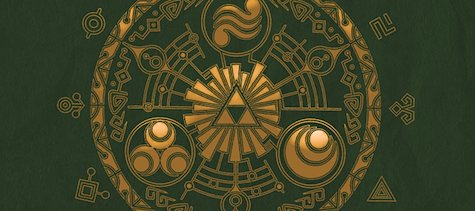
The macguffin often being fought over is a power called the Triforce, which consists of three parts: one of Power, one of Courage, and one of Wisdom. You, Ganondorf, and Zelda tend to embody these three parts, and as events progress to a final showdown, it becomes clear that this is a struggle that is destined to repeat over and over and over. (Hence the many games in the series.)
As a result of the timeline revealed in the Hyrule Historia suddenly games that players had assumed were simply different interpretations of one basic struggle were now different installments in a long, building mythology.
The timeline was constructed by Legend of Zelda series producer Eiji Aonuma and, once revealed, proved to be far more complicated than fans had previously suspected. The games didn’t depict just one long chain of events. Rather, they depicted a single chain of events that then broke off into three separate timelines, all of them depicted by legitimate installments of the video game series.
We had been playing a saga this entire time, the creators revealed. Albeit a saga retroactively created.
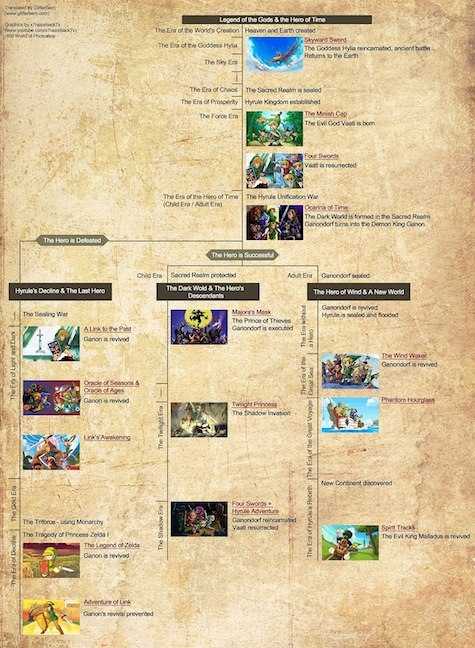
[Update! Kotaku has the English version of the timeline.]
The timeline itself was leaked in early 2012, but the more detailed mythology that fleshes out that timeline is contained within the Hyrule Historia itself, making it a prized item by fans of the series.
About one third of the book is dedicated to the details of stitching together the various games into one chronology. Aside from Skyward Sword, each game gets about 3 pages explaining the events of that game; stopping for little sidebars that theorize on whether a tool, sigil, or something else was inspired by events in a previous game. The evolution of the various races of beings that pop up in the games, like the Zora, the Goron, the Kokiri, and more, is tracked, and the events of each game are depicted as affecting and being affected by the other games. In the end, it hits the Fantasy Fan Detail Porn spot very nicely.
The explanatory text itself is very light, which matches the sentiment in producer Eiji Aonuma’s foreword. He is happy to present the timeline, but cautions that it shouldn’t be taken as strict dogma, as Zelda games are created with gameplay foremost in mind, not story, and a new Zelda game could land anywhere in the timeline, changing the context of the games around it. It’s a good warning to give, as a reading the details in the Historia makes it obvious that while there are a few notable guideposts in the timeline itself, there’s a LOT of wiggle room otherwise. As you continue to read through the details of the timeline it also becomes clear that the timeline itself doesn’t consistently adhere to its own logic*, meaning you’ll only drive yourself mad trying to make the timeline a rigid, cohesive whole.
*For example, the timeline splits after the events of Ocarina of Time, but not after the events of Skyward Sword, which seems odd since the same circumstances occur at the end of both games.
The rest of Hyrule Historia is taken up with an exhaustive and illuminating supply of draft sketches from all of the games in the line. A mini-manga closes out the book, which I found largely rote and unexceptional, but that’s alright. By the time fans get to that point, the book has already given them what they’re looking for. (Or as much as it’s going to give them.) The manga is a pleasant afternote.
The Historia should definitely satisfy hardcore Zelda fans. It provides a rich new context within which to view these games, evoking the same sense of exploration that the games themselves do, while leaving plenty of intriguing gaps for the imaginative.
Casual fans of the series should be warned that they won’t find much to keep their interest. The sections on the games I hadn’t played, like Four Swords and The Minish Cap, couldn’t hold my interest, and if I hadn’t hustled to finish Skyward Sword before reading the Historia the whole book might have fallen flat.
Where the book might also fail to satisfy is with hardcore fans of the series who are also avid readers of epic fantasy. (A crossover of interests that one assumes is probably fairly extensive.) Perhaps the most fascinating aspect of the Hyrule Historia is how the retroactive timeline essentially turns the Zelda games into an epic fantasy series, with all of the expected narrative tropes that this implies.
It’s unlikely that this was actually the intention of the creator and producer of the games, and Aonuma’s foreword eagerly underlines that the series should still not be viewed under this light. Regardless, fans of epic fantasy won’t be able to help but see the same underpinnings from their favorite book series now present in the Zelda games.
Aonuma and company may not have been aware of this when crafting the Historia, and this may become the most controversial aspect of the timeline and mythology presented in the book. If you’re essentially retconning these games into one story, a story with the same tropes as other epic fantasies, then fans are going to want a massive amount of detail. Epic fantasy is held to a joyful scrutiny that is unrivaled by other genres of fiction, and if you don’t provide the detail, then your fans will. The Historia doesn’t provide that detail, and in a lot of cases simply can’t without losing the fluidity that allows Nintendo to keep releasing new Zelda games.
It’s an interesting spot that the Historia puts this famed video game series in. The Zelda games, even at their most story-heavy, are essentially fairytale Indiana Jones-style adventures. They don’t hold up to scrutiny and you could make a good argument that they shouldn’t have to; that the point of the games is to give you something new to explore for a fun 50-ish hours.
Now they exist within a framework that invites more detailed scrutiny, and while this is also essentially something fun and new to explore, this new territory comes with different and more demanding expectations. Most likely, the creators behind Zelda will manage these expectations with a light touch.
But should they? Would The Legend of Zelda be more interesting if it became as richly detailed as The Lord of the Rings or The Wheel of Time?
I don’t know the answer to that question, and it’s not a question I would have ever thought to ask before reading the Hyrule Historia. But I will never look at The Legend of Zelda the same way again, and that is a fascinating accomplishment for a companion book.
Chris Lough is the production manager of Tor.com and had to grow into an adult before he was able to beat Zelda II: The Adventures of Link.

I have been looking forward to getting my hands on this book for a while, I am glad I finally can tomorrow. I have been planning on doing a playthrough of all of the Legend of Zelda games and blogging the experience as well, so I think I may have to start that epic journey with the release of this book!
I might pick this up, but I’ve never been a fan of Zelda. I guess it has to do with not playing a Zelda game until OOT3D and having SS but not the Wiimote+ for it.
I did now about the timeline probably being split thanks to the events of OOC, but who would’ve thought Zelda 1 and Zelda 2 were in their own timeline? and the cartoony games being a continuation of Adult Link is weird.
Hyrule Historia confirmed a few theories that fans have speculated on like the Hero Shade that Link meets in Twilight Princess is the ghost of the Hero of Time aka Link from Ocarina of Time and Majora’s Mask. The biggest bombshell to alot of Zelda fans was the reveal of a third timeline.
If anyone is curious about the whole Zelda timeline check out this well put together video on the subject:
http://www.gametrailers.com/full-episodes/en597n/timeline-the-legend-of-zelda
@1. Jobi. The book produced the same reaction in me. Currently revisiting Wind Waker….
@2. Futurewriter. Yeah, that one’s a bit of shocker. More so because it means that right now Zelda 2 is possibly the last game in the chronology. And that is kind of a bleak game. (Although that’s really a bleak timeline, seeing as how it stems from Link being defeated in Ocarina.)
You should give Skyward a try, though. I had my doubts at first but it’s a very tightly structured game. And I didn’t mind the lack of overworld map at all.
@3. danman007. It doesn’t actually come out and say that the Hero Shade is Link, but it does point out that the Shade is left-handed, like Link. Seems like they’re fine with us believing whatever we like in that regard. (Though if it’s Link, does that make Twilight Princess the first game where Link speaks?)
Cool def gonna have to find this book. Zelda is pretty much the only video game series I am obsessive about playing.
I remember this coming out in Japan, but I had no idea it was coming Stateside until this post.
The Legend of Zelda is what got me into fantasy; as a kid, I watched my brother play Ocarina of Time and my eyes just opened. I’m not much of a gamer and I haven’t had time or the resources to play Skyward Sword (although that now sounds like a great graduation gift to myself…), but I have consistently played most of the titles. And it’s always been an epic fantasy in league with the big boys to me—the eternal monster, corrupted by his own greed, defeated by a wise princess and a brave hero, with various riffs on that motif.
I agree that they’ll manage these expectations with a light touch. These are games first and stories second, although it’s a very close second. But they’ve doing this ever since the series hit 3D; all the echoes and callbacks are quite satisfying, even if they frustrate the obsessive timeliner (which I totally was as a preteen girl). But there’s enough there to satisfy people like me while still satisfying the first and foremost priority of being a fun game. I spent much of Twilight Princess gasping and tearing up, because of what is implied to have happened to my beloved Gerudo. And that’s just one thing—I could go on, having spent a lot of time exploring the games for just these things. Aaahh… I think it’s time to revisit Hyrule…
Apart from when it’s Termina, or Holodrum and Labrynna, or Vaati or Majora’s Mask… or whenever Phantom Hourglass is set. Ganon and Hyrule are very common elements, but by no means close to universal.
Considering the long wait we usually have between Zelda games, the capacity of most fans for endless discussion is very large, and this sort of continuity debate was in prime position amongst them (to the point that some fansites had whole subfora for timeline discussions alone. In my experience, most fans assumed there was a timeline, and vast resources were spent on hashing out various possibilities. I even tried it myself in the distant past. Miyamoto had stated that there was a timeline several times in the ’90s, and it was clear that, for example, the original and The Adventure of Link were directly connected (having the same Link as protagonist, for a start. It’s all there in the manual!). A Link to the Past and Link’s Awakening were assumed connected based on the LA manual, although we obviously didn’t know anything else at the time. Ocarina of Time was long assumed to be the “Imprisoning War” from the backstory of A Link to the Past, although the dreadful lack of fidelity in the translation of the ALttP manual made this unnecessarily confused in English-language debate (and this is where the discredited “Ganondorf Dragmire” and “Mandrag Ganon” names come from). Majora’s Mask was explicitly a direct sequel to Ocarina of Time. The Oracle games were also clearly connected: either one could be a sequel to the other! The Wind Waker was described from the beginning of its public appearances as occurring “a hundred/hundreds [the Japanese not being specific] of years after Ocarina of Time. And it was at this point that there was discussion of a split timeline, and so continued the debates. Twilight Princess was also described as a sequel to OoT, and it neatly slotted into the Child Timeline. The Minish Cap was specified as being long before Ocarina of Time. And the DS games were set up as sequels to The Wind Waker, Phantom Hourglass directly (many of the characters, and the ship, cross straight over), and Spirit Tracks as a “many years later” thing in the new Hyrule.
That was the status quo before Skyward Sword. We had a definite statement from Miyamoto on a single timeline when there were five games in the series, and a lot of pairwise links and a couple of “hundreds of years after”s. Point being, that even if there was no official timeline for a long time, there was certainly one originally, and the games were certainly not all distinct isolated objects. To assume they were all unrelated would have been the mark of a fan who was not paying any attention, rather than the intention of the creators; therefore I strongly disagree with that last quoted passage.
I think the above evidence refutes most of that. There were certainly some consistent and established relations. We have no idea when much of the information shared with us in Hyrule Historia was created, but certainly a lot of it existed before, in the public domain or not. Of course, I never heard anyone suggest a triple timeline before 2012…
Then at some point in the development of Skyward Sword, the creative team decided to make it the origin story for the whole series, explain the repetitive nature of the plots, and just clarify the whole timeline thing in general. Hyrule Historia was the culmination of all of this, rather than a separate project: this is why it links so closely to SS (and why it has the fairly superfluous manga backstory in the back).
This is not a lot of information. And indeed, a not of it was known previously (the relationship between the Zora and the Rito, for example, is trivial for anyone paying attention to the plot of TWW).
Oh come on, that sort of thing is easily fixed, as anyone who speculates as much as you do knows: you just pull apart the tiny details inherent in the time travel and declare that the differences cause one to result in one set of events and the other to result in another. Or, the timeline does split, but we simply have no games in it yet. After all, there was technically one timeline until Majora’s Mask was released. Such is the method, and the nature, of continuity massaging.
This statement does not seem meaningful to me by itself, given the above; further, nothing in the subsequent text disabuses me of that impression.
Maybe so (although I’m not convinced), but the fact is that fans had been analysing the games in (far too much?) detail for decades before Hyrule Historia appeared. There were even people making their own language from Hylian, despite the only writing system in the games being strictly for transcription of Japanese or English easter eggs.
Yes, that’s number 2 on the Gannon-banning list…
Fundamentally, the most interesting question of this sort is: what has Hyrule Historia changed about the way the fandom discusses the series? I’m not as involved as I used to be, but primarily I think it has (obviously) basically killed the timeline debate that was such a bit part of the online fandom. It also ruined the Imprisoning War ~ OoT theory. Otherwise, the arguments about how the various maps of Hyrule fit together continue (many people continuing to fail to notice that OoT’s map does not have north at the top…), and the fate of the drowned land post–Wind Waker. There are also many more articles about symbolism and interpretation, which probably have arisen as a result of Let’s Plays and other videos enabling easier access to visual parts of the game. (Why, back in my day we didn’t have any of these fancy “videos” on the Internet! We had text dumps, and considered ourselves lucky if the Japanese text dump existed and was not corrupt or otherwise unreadable. And if we wanted to record a game, we jolly well linked the video recorder between the television and the games console!) But I do worry about the availability of old interviews and other sources of information: the Zelda canon is unusually diffuse compared to other pop-cultural works, and some of the old fansites just don’t exist any more. Will people be interested in the history of the Zelda timeline in the future? If they are, they’ll find it quite difficult to find out what anyone thought in, say, 2003, if too much disappears.
So Hyrule Historia has been really more of an end than a beginning, at least for a lot of fandom discussion. The facts it lays down are mainly of two sorts: stuff we knew and stuff we suspected. The timeline was the biggest surprise, not by its existence, but by its form. And Zelda always has been a connected series, just not simply connected.
Nope: now that we have three timelines, “last” is not globally well-defined. The timeline is now a partial order, not a total order.
And if anyone is wondering where this wall of text came from, I thought that it was about time to deal with the tab I’ve had open for over two and a half years, and close it.