







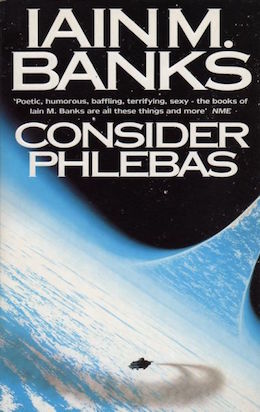
Welcome to the Culture Reread! Today is the first proper post of the series, and we’re off with the prologue and chapters 1 and 2 of Consider Phlebas.
Consider Phlebas, the first Culture novel that Banks completed and published, appeared in 1987. It takes place against the background of a long and destructive war between the Culture and the Idirans. The Culture, of course, is more or less human as we know it, post-scarcity, essentially socialist, and, until the war, largely thought of as a bunch of hedonistic pacifists; the Idirans are three-meter-tall tripedal beings bent on a war of religious conquest. At the time of Consider Phlebas, the war has been going on for four years, with enormous casualties on either side and no sign of surrender either way. One might expect this novel to be the story of some key conflict in the course of that war, something history-changing—whether that’s the case, well, we shall see.
(A note on the post titles: they are drawn from the names of Culture ships that appear in those novels. Hopefully this is a joke that will not wear thin before the series is out.)
Prologue
We begin with a literal bang. A newly manufactured, still unnamed Mind—a Culture artificial intelligence, embodied in a fantastically dense ovoid and contained in a hastily jury-rigged ship—is jettisoned by its factory ship shortly before that ship’s utter destruction. Name your favorite story of a desperate parent making one last bid for their child’s safety—notwithstanding that these are artificial intelligences, that’s what’s going on here. It’s almost for naught, as the Mind’s ship is cornered by a hostile fleet, but it escapes through a complicated bit of four-dimensional jiggery-pokery, to take refuge on a planet called Schar’s World, “near the region of barren space between two galactic strands called the Sullen Gulf … one of the forbidden Planets of the Dead”. We don’t know yet what this means, precisely, but it’s not hard to guess: both the Culture and the Idirans will be interested in getting hold of this Mind, and it will not be easy.
Chapter 1: Sorpen
Now we meet our protagonist, Bora Horza Gobuchul. He is a spy, from a species known as Changers—humans who are able to alter their appearance to impersonate nearly anyone they like, which obviously makes them extremely valuable spies. They have other interesting characteristics as well: venomous teeth and nails, for instance.
None of that is doing Horza any good, when we meet him. He’s being subjected to a spectacularly gross form of execution: shackled to a wall in a watertight cell that is slowly filling up with effluent—refuse from the kitchen, and raw sewage from the toilets above. Banks spares little detail in his descriptions of the warm, foul liquid slowly making its way up Horza’s face and Horza’s attempts to keep his head above it—and believe it or not, this isn’t the most disgusting thing we’ll see in this book.
Horza is an Idiran spy, and his unfortunate state is a consequence of being caught impersonating a high-ranking government official—he murdered the original, which is apparently Horza’s standard operating procedure—on a Culture-allied planet called Sorpen. (Sorpen is run by a “gerontocracy”, a ruling body entirely composed of elderly men. Typical Banks: this interesting idea, which might have formed a setting for a whole other novel, is used, noted, and never dealt with again.)
He’s not the only alien agent on this planet; the Culture is represented here by Special Circumstances agent Perosteck Balveda, who, when Horza was installed in the execution cell, attempted to plead with one of the Gerontocrats for his life, even as Horza railed against her and the Culture. Her request was denied; Horza, in a moment of bitter dark humor, asked her to at least “promise me that you’ll eat and drink very little tonight, Balveda. I’d like to think there was one person up there on my side, and it might as well be my worst enemy.”
It’s looking very bad for Horza indeed, when quite suddenly the wall of his cell is blasted away. His employers, the Idirans, have come to his rescue.
Chapter 2: The Hand of God 137
Safe aboard the Idirian ship The Hand of God 137 (the 137th ship to bear that name, Idiran ship-naming conventions being in strong contrast to the Culture’s predilection for jokes and irony), Horza gets cleaned up and learns his mission. Before he went to work for the Idirans, he was a caretaker on Schar’s World, and as such, he may be able to go there and retrieve the Culture Mind hiding there. Not anyone can just pop in on this planet; it’s surrounded by a “Dra’Azon Quiet Barrier” (precisely what this means is not revealed at this point), which will damage or destroy anything else that tries to land there. Horza agrees, and in classic One Last Job fashion, his condition is that once it’s done, he—and an old friend who, to the best of his knowledge, still lives on Schar’s World—will be given the resources to escape the war altogether.
Meanwhile, the Idirans finish off the planet Sorpen by fusion-bombing a few of their cities, and Horza learns that Perosteck Balveda has been captured by the Idirans. He takes up the Idirans’ offer to visit her in her cell for one more confrontation, and here we learn specifically why Horza has thrown in with the Idirans—not because he cares for their religion in any way, or endorses their brutal methods: “I don’t care how self-righteous the Culture feels, or how many people the Idirans kill. They’re on the side of life—boring, old-fashioned biological life; smelly, fallible, short-sighted, God knows, but real life. You’re ruled by your machines. You’re an evolutionary dead end.”
This is how Banks chooses to introduce the Culture and its philosophies to the reader: through the eyes of someone who hates them with a passion. The prevalence of machine intelligence in the Culture is revolting to Horza; he is convinced that the Minds really run things in the Culture, manipulating the humans who “couldn’t see that one day the Minds would start thinking how wasteful and inefficient the humans in the Culture themselves were.” And he sneers at the hypocrisy that he believes is embodied in Balveda and Special Circumstances—the dirty tricks and espionage organization that the average Culture citizen thinks of as both sexily elite and distasteful. “No other part of the Culture more exactly represented what the society as a whole really stood for, or was more militant in the application of the Culture’s fundamental beliefs. Yet no other part embodied less of the society’s day-to-day character”.
Balveda weathers his verbal attacks stoically, quietly reiterating her conviction that the Culture is going to win the war, and though she doesn’t say it explicitly, she seems to suggest that Horza and the Idirans underestimate and misunderstand the Culture—its willingness to fight, its ability to learn how to win. Horza is unconvinced and leaves her in her cell, resisting the urge “to ruffle her short black hair or pinch her cheek”, knowing that it would only “aggravate the experience for somebody who was, in the end, a fair and honorable adversary.” Horza, though something of a spy-novel cipher at times, is not without compassion or tenderness, as we’ll see again later.
Moments later, the Idiran ship is attacked by a Culture ship which, Horza is shocked to learn, had been hiding nearby in the upper layers of the system’s sun—a sneaky tactic he wouldn’t have expected of them. Bundled into a space suit, he is shoved out into space to await rescue by the Idirans. Here he has time to contemplate the war between the Culture and the Idirans, in terms that are disturbingly relevant to a reader in the age of unmanned drone warfare: “He looked for the Culture ship, then told himself not to be stupid; it was probably still several trillion kilometers away. That was how divorced from human scale modern warfare had become. You could smash and destroy from unthinkable distances, obliterate planets from beyond their own system and provoke stars into novae from light-years off…and still have no good idea why you were really fighting.”
Horza himself is somewhat baffled by the war’s persistence, in fact. He finds it hard to believe that the Culture, a “communist Utopia”, would not only stir itself to fight against the Idirans in their war of religious conquest, but persist for years. “The early reverses and first few megadeaths had not, as the pundits and experts had predicted, shocked the Culture into retiring, horrified at the brutalities of war but proud to have put its collective life where usually only its collective mouth was. Instead it had just kept on retreating and retreating, preparing, gearing up and planning. Horza was convinced the Minds were behind it all.”
There’s something chilling about the casual phrase “the first few megadeaths”. That, along with the Idirans’ casual bombing of Sorpen, are details that indicate just how brutal this conflict has actually been. It’s not a war of tribes or nations—it’s a war across planets, and it seems to be notably lacking in the glamor or heroics of certain other space operas about interplanetary war that one could name.
As Horza ponders these matters, floating alone in the depths of space, his suit alerts him to an incoming vessel. Who is it? And what are they going to do with Horza—who, it should be remembered, still looks like an elderly politician with thin hair and sallow skin. We’ll find out in two weeks, in the next section of the Culture re-read.
Karin Kross lives and writes in Austin, TX. She can be found elsewhere online at hangingfire.net, on Tumblr, and on Twitter.

I’ve read through Excession (book #5) and have been wholly looking forward to this reread!
A note to the author: Worry not, the names of Culture ships never wear thin.
“Sorpen is run by a “gerontocracy”, a ruling body entirely composed of elderly men. Typical Banks: this interesting idea, which might have formed a setting for a whole other novel, is used, noted, and never dealt with again.”
At the time when the novel was written, the government of the Soviet Union was commonly referred to as a gerontocracy.
This was a really enjoyable book. I need to delve further into series.
Oh this is awesome! Thank you tor and thank you Karin!
This is my least favorite Culture book, but its still got an idea a minute. Including the so-common idea that ‘The Enemy’ whoever they may be, will not be as motivated to fight as we are. They are too oppressed by their government/ they have too much freedom / they have too much material comfort and are soft / they are too poor and concerned with not starving to fight, any excuse will do.
So many criticisms of Banks start with aspersions against his “communist machine ruled utopia” that I’m convinced they never read the books. That question and conflict are central to the entire Culture series. I’m eagerly looking forward to some intelligent discussion of these books :)
Looking forward to this and wish it was a weekly thing. I may not have time to re-read all the novels, but I’ll definitely follow along.
IIRC, the backstory for the war involved epic miscalculations on all sides. Including the incomprehensibly-brilliant AIs responsible for… guiding?… the Culture.
Apparently wars still happen, post-scarcity. So the ideals keep getting left by the wayside, even when the ideals are the only point of contention?
As kyptan notes above, it’s jarring to read all the people who think they’re coming up with a novel criticism of the Culture by suggesting the biological citizens are “ruled” or “kept as pets” by the minds, when the very first book has as its viewpoint character someone who makes that very criticism. Banks was very aware of that line of thought and addressing it from the outset. The books are all about examining the tensions in the Culture and its self-conception.
Consider Phlebas is the only novel by Banks I read and I really did not like it. The prologue was quite promising though. The concept of the AI sounded interesting, but the story soon reduced it to a classical McGuffin that had no further relevance for the plot except as a motivator. The scene with Horza beeing killed slowly (and therefore unsuccessfully) could have been lifted from any second rate James Bond movie. The stereotype of the stupid villain that is so busy gloating that the hero can escape even though he is allready defeated is just tiresome…
Clearly I’m going to have to have my own Banks-ian re-read. I’m not sure I’ve ever sat down and read all the Culture books in order before.
Probably of interest to most everyone reading this; next year Orbit are releasing a book about the Culture, featuring many of Bank’s notes and sketches.
@2, it’s a pretty common thread throughout the Culture series that many of the societies outside of the Culture are run by by something akin to traditional oligarchies. We never see how the Idirans are ruled, but they are genocidal and and slave-holding (the Medjel).
—-
@8, I’m pretty tired of the “AIs treat the humans as pets” meme. It’s nonsense; the AIs consistently honor the personal autonomy of the Culture citizens, something many of the societies the Culture bumps up against do not: the Idirans are on the sort of “convert or die” crusade that seems to be current goal of organizations like ISIS and their willingness to kill anybody who’s inconvenient (I won’t explain; read the book). Later, the Sichultians, that Libertarian/Randian paradise, virtually enshrine inherited debt slavery, where a wealthy man can use fraud to bankrupt somebody then enslave that person’s future children so he can rape them from childhood.
—
Horza is interesting, as I can’t really figure out his motivation. He doesn’t seem to get any real payoff from the Idirans, but he’s ostensibly a mercenary.
We never see how the Idirans are ruled, but they are genocidal and and slave-holding (the Medjel).
Not really; the Idiran/medjel relationship is described as a complex sort of symbiosis or alliance that has kept sociologists busy for decades, but it isn’t ever called slavery. We see Idirans giving orders to medjel and expecting them to obey without question, but in every case that’s within a military hierarchy.
If I recall, it wasn’t that Horza didn’t expect sneakiness; it’s that the capability surprised the Idirans.
It was a foreshadowing of the Culture ability to push technology
A
“The ship didn’t even have a name.” That’s a great first sentence for a series in which the author and readers will have so much fun with ship names. The Prologue continues as an account of “vast open reaches between star systems” and other macro-scale stuff.
Then chapter 1 changes scale, introducing the protagonist. I’d say that he’s up to his neck in shit, but that would be an understatement.
So far, so scale-switchingly good. But there is some rather leaden exposition in the dialogue of the first chapter, such as: “You will soon be dead, impostor, and with you die your master’s plans for the domination of our peaceful system!”
Great post. So glad you’re reading these in publication order. Almost everyone puts The State of the Art *after* Use of Weapons even though it was published first!
‘Consider Phlebas’… Now that’s a really catchy title for a book! What’s a Phlebas when it is at home?
And now I really can’t wait to move (and get my books back out of storage)… Already reminding me how much I loved this book (and the subsequent ones).
My favourite description of the Culture that it is as soft as the ocean.
@10. Kah: “Consider Phlebas is the only novel by Banks I read and I really did not like it.”
I had the same experience at first. Put it down for a long time. It’s a huge roadblock for some readers. The Culture was new and we didn’t know they were supposed to be the good guys at the time. Very jarring when we find out the Idirans are genocidal religious zealots. And since our protagonist works for them, what are we to think of him then.
Perhaps one of the later novels may change your opinion of Culture novels.
@17. Thomas: it’s a TS Eliot reference from The Waste Land, but I don’t remember the context.
@19. Colin: That’s a beautiful image. It ties in perfectly with the Mistake Not…”s full name: Mistake Not My Current State Of Joshing Gentle Peevishness For The Awesome And Terrible Majesty Of The Towering Seas Of Ire That Are Themselves The Mere Milquetoast Shallows Fringing My Vast Oceans Of Wrath.
I never get tired of that.
“Senator” is derived from the Latin “senex” meaning: “old man”.
I’m totally new to the culture series, but am getting myself an electronic copy of Consider Phlebas to read along.
@17 It is a poem reference, It was cited in the opening preamble pages in the edition of the book I own :-
IV. Death by Water
Phlebas the Phoenician, a fortnight dead,
Forgot the cry of gulls, and the deep sea swell
And the profit and loss.
A current under sea
Picked his bones in whispers. As he rose and fell
He passed the stages of his age and youth
Entering the whirlpool.
Gentile or Jew
O you who turn the wheel and look to windward,
Consider Phlebas, who was once handsome and tall as you.
I always interpreted it to be talking about Horza who is filling the role of the Ancient Mariner – kinda damned in his quest against the Culture but not unworthy of considering his point of view.
I’m reading the Culture series for the first time and I’m enjoying it so far. It’s interesting to read this from the perspective of knowing that the Idirans and the protagonist are the “bad guys”.
@10, @20, If Consider Phlebas had been my first Banks, it likely would have been my last. Not because of any confusion over who the “good guys” are supposed to be, but because of Banks’ need to shock the reader. Thus “death by sewer” and “The Eaters”. Shocks me right out of my WSOD.
But I started with The Algebraist, which had its own problems (The villian, Luseferous, is paper-thin, let alone cardboard), but I mostly enjoyed. And I enjoyed Player of Games and Use of Weapons (other than Chapter Fourteen) greatly. I skipped The State of the Art because short stories usually leave me cold.
After those I read Against a Dark Background (which I guess isn’t really a Culture novel) and Excessions, both of which bored me. I likely won’t be going on soon, since my SBR is a little deep, and nothing by Banks is currently in there.
Quite a few authors — not excluding genre authors — use titles from poetry. Look to Windward is from TS Eliot’s The Wasteland. Robert Parker (of Spenser fame) used, among others, Yeats’ The Second Coming as a source for the title of his book The Widening Gyre and Keats’ La Belle Dame Sans Merci for the title of Pale Kings and Princes.
@26. iddw: Agree about Luseferous. Can it be any more obvious that “Lucifer” is the bad guy? He also has a sadistic execution under way at the start of the story, involving the growth of horns that will eventually bore thru the back of the victim’s skull.
Some of the plotting in these books seems derived from pen and paper games or early text-based online games. They can be meandering. Some of the later books either repeat elements of earlier books or fail to add new things. Sometimes there’s too much emphasis on religious themes, like the afterlife. (The Culture is generally leery of Subliming.) And here and there pop up bizarre elements, like a character with multiple penises grafted to his body. Or characters, like an apparently very superficial girl recruited by SC in Excession, who do not have an impact on the outcome of the plot.
So there’s quite a bit of fodder for those inclined to criticize, but mostly still more interesting and dense in ideas than almost anything out there.
The great thing about the Culture books is the grand sweep of Banks’ imagination. The individual books may or may not work for any given reader; I find that not wanting to revisit the horrible things tend to outweigh any desire I have to re-read (for example) Surface Detail or Use of Weapons. But damn, in all the books, the man is talking about the possible future of humanity and the possibilities of Galactic levels of civilization, at the same time that he’s satirizing human religions and political ideas, opening up a post-scarcity universe that we can barely imagine. The books are almost a throwback to Olaf Stapledon, but they’re much more fun because Banks is neither a pedant nor an obsessive. And I for one welcome the appearance of Minds who choose names for themselves like You Call This Clean? and So Much for Subtlety.
I’m with those many few that started Consider Phlebas and bounced off the Culture at first. The scope of the war was both too vast and too ethereal, like I was seeing a Wargames global thermonuclear map without any key to understanding it; I found it too hard to gel with any of the characters. The general murmurings of the internet told me I’d be better off starting with Player of Games, and I found them right. But then I bounced off the next book again – I forget exactly why. I think I’ll start reading along with this re-read; the Culture might make more sense to my obtuse brain with someone to explain it to me.
Related: Elon Musk is a Culture fan, and called his two drone landing ships the Of Course I Still Love You and the Just Read The Instructions, after a couple of GCUs in The Player of Games; the Economist ran a profile of him last week which didn’t mention the Culture at any point, but used the name of a Culture spaceship for every sub-headline…https://www.economist.com/news/briefing/21736597-failure-most-definitely-option-falcon-heavys-creator-trying-change-more-worlds
@iddw
My problem with Consider Phlebas is more that the plot is so idiotic and senseless… it is mostly a sequence of action scenes that dont have anything to do with one another (espeacially the attack on the temple, the raid on the “megaship” and the episode with the cannibals come to mind).
Consider Phlebas, if I’d gone in completely cold, might have been the only Culture book I’d read. It feels a bit too long and meandering for the story actually being told.
But I’d heard enough about the interesting ideas in the series as a whole, the delightful ship names, and the recommendations to start with Player of Games that I’d already committed to reading on and ordered the first three books simultaneously.
Plus, I had experience with this already. I’ve read most of Discworld, starting in the middle, and was thus a bit underwhelmed when I went back to the beginning…The Color of Magic and the first few books after are acceptable, but definitely not Terry Pratchett’s finest work.
Sometimes authors just take a while to hit their stride when setting up a new universe. I’m willing to give them a chance.
@12:
My opinion here, Horza is driven by this sort of noble hatred of the Culture. The Idirans have their flexible holy words and their history that suggests that it’s better to be the guy at the top than being continually underfoot. That’s solid and real to the Idirans. Horza’s is much more idealistic. The payoff is indeed nebulous for such an undertaking. That is the real crux of the allusion to Phlebas likewise noble (as might be read into steering the ship, handsome and tall). What will he pay for pursuing his idealistic goal in the face of a conflict that is so vast as to make any individual action less than a footnote? Couple that with the fact that it seems like he has trouble at times separating his distaste for Culture and the specific people within (Balveda). The profit and loss of idealism versus real interactions with people.
I have never read any of the Culture books before, or Banks for that matter, but started this one a few months ago for some research while writing my own novel. The first few chapters really drew me in and made me want to keep reading. I’m getting close to finishing this book and very much look forward to the re-read of the series here and everyone’s discussions and comments. I’m also very interested in reading the rest of this series and finding my own favorite book of the series
@34, I’d not call Horza’s hatred of the Culture to be particularly noble; I found his hatred to be more ignorant stupidity than “noble.” He was, after all, a member of an endangered, genetically engineered species, not the result of any kind of evolution. If there’s an evolutionary dead end here, it’s his species, not the humans of the Culture.
The interesting aspect of Consider Phlebas is in the subversion of expectation; the war was purely religious on both sides. As Horza notes in the course of the book, the Culture is notoriously evangelical (through the works of Contact and SC) and the Idirans have their religion. For the Culture, besides ensuring that their technological evangelism continues, the war seems to be an exercise in applying advance tech to demolish one of many dedicated our-truth-is-better galactic empires.
On a re-read, the moral and ethical ambiguity of the Culture comes out clearly. Across the entire series, it is really hard to say if the Culture are the good guys!
@37. yuguuk: Moral and ethical compromise maybe, esp. when it comes to SC operations. But ultimately not morally ambiguous.
As I’ve said elsewhere, Banks interrogates the Culture’s ideals, but never is it morally equivalent to the cultures they come in conflict with. That’s why they have a conflict in the first place. The Culture and its Minds has a problem, based on moral judgement, with how that other culture behaves.
Excession‘s villains are offensive and aggressive, called the Affront for a reason (both funny and a bit too on the nose). Surface Detail‘s villains are absolutely corrupt, running a massive deception of the afterlife. And the Mistake Not… in Hydrogen Sonata, as I mentioned above, is seething with hidden righteous indignation and oceanic wrath at the actions of a civilization of comparable power to the Culture, which is about to Sublime under another massive deception.
The Culture has put off Subliming again and again, because they don’t know what’s on the other side, or higher dimension, or brane. They are a bit afraid of letting go. It’s why they judge these other cultures. They absolutely abhor hypocrisy and claims of superiority based on race and/or religion.
That is a moral stance. And the compromises happen. Idealism can only be pure in a vacuum. But the core values don’t change. Perhaps one way to look at it is to see the Culture as retaliators. As this first post points out, the Culture seems to be receding like the ocean’s tide under the Idirans aggression. But then the tide turns and the enemy is surprised the “soft and pampered” Culture will actually fight.
Argh! Two copies of Feersum Endjinn and two copies of Transistion on my shelves (both Culture novels?!?) but no Consider Phlebas – misplaced? loaned? stolen?! I’ll have to rectify this. Have always been a keen rereader of IM Banks – an incredible wealth of fun and disturbing ideas. I miss him and his words.
@38, I think the other reason — other than a generally tendency to meddling — the Culture doesn’t sublime is that they’re simply too interested in the goings-on of the sophonts around them, and subliming would impair that sort of curiosity. Indeed, one of the Minds sublimed and came back.
@39, I’ve read Transition, but not Feersum Endjin, and thought the former was interesting, well-written, and, ultimately, unsatisfying. The latter, I probably won’t read, mostly as I find long passages of writing meant to emulate dialogue dialect to be very annoying.
it is mostly a sequence of action scenes that dont have anything to do with one another (espeacially the attack on the temple, the raid on the “megaship” and the episode with the cannibals come to mind).
Discussing this elsewhere, someone else argued that these episodes are all thematically linked. They’re microcosms of the greater conflict of the religious zealot Idirans vs. the Culture, and examples of the sort of pointless death that is happening everywhere as a result of the war.
I tend to see the Culture’s Special Circumstances as the sort of fictional smarter-than-everybody-else-about-existential-threats intelligence agency that almost certainly does not exist in the real world, where that sort of intelligence agency is usually the existential threat they think they’re fighting.
@37, I disagree: the Culture’s war with the Idiran is most certainly not evangelical; it’s self-defense: the Culture would not go looking for the Idiran to exterminate them. Indeed, it was quite willing to evacuate an orbital — an orbital with a population of several tens of billions of sophonts — to avoid a battle.
@38, Sunspear, I think it’s pretty unequivocal that Banks considers the Culture the ambiguously imperfect good guys in all the books about the Culture. If nothing else, the Culture gives all its citizens the sort of self-agency and individual liberty that doesn’t exist for the vast majority of the Chelgrians, Affront, Sichultians, Pavuleans, ….Even the supposed-rulers, the Minds, could do far more to control the people of the Culture, witness Meatfucker, who is outcast by the Minds because MF will use the sort of manipulatory power that all Minds have to read human minds and implant dreams and memories directly into them. Can one see one of the Sichultian plutocrats, the Idiran, or the Affront finding that sort of control by the aristocrats to be unacceptable?
@36: Perhaps I chose a poor word for trying to describe Horza’s opinion. What I was trying to get at is that he doesn’t exactly have skin in the game. He’s not fighting because he’s particularly invested in their religion, or for any reason that makes him intimately involved. Instead he has this intellectually distant philosophy that is more “the Culture is wrong” rather than “the Idirans are right”. He has volunteered to be part of the war effort effectively to give the middle-finger to the Culture.
@42. swampyankee: “Banks considers the Culture the ambiguously imperfect good guys…”
Yes, of course, but that’s why this first book is tricky and off-putting for some readers. We don’t know the protagonist’s POV is not to be trusted till the end of the book. Banks took the unusual route of building a case against the Culture as an intro to the Culture. Wonder how much of a difference that makes for those readers going in armed with that knowledge first.
@44
Again, I dont see that as much of a problem. The problem is the overall quality of the book. It has no coherent plot, the main character is not very relatable and most of the action scenes could easily feature in a Michael Bay movie…
@45
Remember, Banks also writes mainstream fiction, where main characters are frequently unlikable, e.g., Lolita’s Humbert Humbert, F Scott Fitzgerald’s Gatsby, and his own Wasp Factory
@46
Those books are rarely full of nonsensical action sequences though…
@47,
Nonsensical action sequences are a major point of modern sf/f movies, so that would be seen as a positive. The problem with that thought is that Iain Banks’ audience probably doesn’t tend to be teen-aged boys, who seem to be considered as interested in nothing but pointless action sequences and female nudity.
@26,@28:
I took Luseferous to be a statement about the amoral nature of the universe—SPOILERthe worst person imaginable won’t do that badly if they but read and attend to the Evil Overlord’s guide.
There may as well be a side-order of ‘believe that life isn’ t really real and you will easily be monstrous’ in line with Banks’ usual stance—I took the Eaters to be his characterisation of all religion.
@49,
The Eaters may well be that, but they may be more specifically drawn to lampoon the sort of celebrity-centric televangelists who would impoverish their parishioners to enrich themselves.