






In later interviews with press and fans, Anne McCaffrey would bristle at any attempt to classify her Dragonriders of Pern series as fantasy. Her dragons, she pointed out, were genetically engineered animals ridden by descendants of space explorers, not magical elves. The language of Pern was not a creation of the author, but descended in a fairly straight line with only a few expected deviations from English and, after McCaffrey moved to Ireland, a few Irish cadences. The plots focused on the development and rediscovery of technology. Most importantly, the presence of dragons, fire lizards, and just a touch of telepathy aside, no one in her Pern books could do magic. They focused on technical solutions to their problems—the use of nitric acid; telegraph machines; metal tools and machines; bioengineered invertebrates; and, when possible, spaceships.
Magical, Pern was not.
And this was all perfectly true—for most of the short stories, novellas and novels about Pern and its dragons and fire lizards.
Which makes it feel rather odd to start off a Pern reread by noting that the first work in the series—the one that started everything off—is, well. Fantasy. Pure pulp fantasy, at that. And not just because of the dragons.
Weyr Search, or Dragonflight, part one, if you prefer, opens as a young woman, Lessa, wakes up with a sense of foreboding and danger, and a young man, F’lar, begins his Search. These two events might just be related.
More specifically, F’lar, the rider of bronze dragon Mnementh, is hunting for the next Weyrwoman for the Weyr.
It’s a lot of new verbiage to take in at once.
But hey, DRAGONS.
Buy the Book
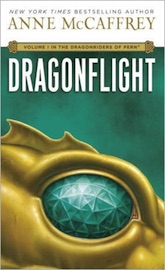
Dragonflight
F’lar has decided to head to the High Reaches, an unpleasant place in the north, under the theory that adversity and uncertainty makes for strong-minded people who are exactly what the Weyr needs just now—not those indolent yet lovely women in the south.
We’ve barely started this, and F’lar and I already need to have a long talk. Moving on.
Geography is only one of the High Reaches’ many problems. It’s also under the control of Fax, who has conquered five Holds, married into a sixth, and inherited the seventh. He’s also borderline rude and has a tendency to ignore various Laws and Traditions, including the one about Sending Food to the Weyr to Keep the Dragons and Dragonriders Fed. So, it’s easy to see why F’lar might get a bit annoyed.
Pause for a verbiage break:
Holds: In this section, castles, more or less; in later books, a large stone/cave dwelling that provides very necessary shelter from alien life forms.
Dragons: Awesomely large creatures who fly and can somehow communicate with their riders.
Weyr: Where the dragons and dragonmen live.
Weyrwoman: Rider of the queen dragon. In this section, there can apparently Be Only One.
F: A letter that McCaffrey seems to like to use in names: of the six people in this section with major dialogue, THREE have names starting with F – F’lar, F’nor and Fax.
Ancient Laws: Things Fax likes to ignore. Many of them involve keeping everything as ungreen and rocky as possible.
F’nor: F’lar’s brother. He will become important later; here, he’s mostly there as someone else for F’lar to talk to and Fax to be rude to.
Watchwhers: Weird beasts that howl a lot, are mostly blind, and are used as watch animals. Also, they seem to have a strange fascination with human genetics.
Back to the story. All of this misery fails to help F’lar find the right strong-minded woman trained up in adversity, so off he heads to Ruatha Hold, one of Fax’s conquests, along with Fax, some of Fax’s women, and various other dragonmen. Ruatha, it seemed, was Quite the Place in the past, and frequently provided women for the Weyr. Now, however, they find Ruatha a complete disaster area, thanks to the manipulations of Lessa of Ruatha.
The last surviving daughter of the last Lord of Ruatha, capable of changing the shape of her face and body with a mere thought, Lessa is determined that Fax will not profit from slaughtering her family, and has been using her not inconsiderable other psychic skills to nearly destroy Ruatha. Fax is appalled; F’lar convinced that he has found the new Weyrwoman. Lessa uses her psychic powers to manipulate F’lar into killing Fax in a duel, just as Fax’s wife Gemma expires during early childbirth.
Impressed by all this—
(yes, I went there)
—F’lar convinces Lessa that she can do much more than manipulate people into preparing inedible food, destroying their own lives, and murdering each other, and takes her off to the Weyr. Ruatha is left under the control of Gemma’s newborn, Jaxom, who, SPOILER, will be a central character in upcoming books, and former dragonrider Lytol, another major character in upcoming books, given rather short shrift here by the narrative and F’lar.
At the Weyr, to the relief of everyone involved, Lessa has a bath, before F’lar scoops her up and flies her to the nearby volcanic sounds where dragon eggs are hatching. Boys get injured and mauled by dragons. A little golden dragon hatches, immediately kills one woman, severely injures another, and heads for Lessa, who has the common sense to try to stop the little beast before it can injure more people. Lessa bonds with the dragon, finds out the dragon’s name is Ramoth, and decides to get the little dragon some food.
End of part one.
And, wow.
Shapechanging humans! (Ok, only one shapechanging human—Lessa. But still.) Watchwhers who will only respond to the Blood! Swaggering swordsmen! Harems! Extreme misogyny! Doom-laden prophecies! Crowing cocks! Dogs! Or, more specifically, canines! Even more specifically, canines working in the kitchens by rotating the spits, ensuring that the meat is evenly cooked! A reference to a male green dragon, referred to quite clearly as him! F’lar concerned about adhering to traditions!
Not to mention all the murder: F’lar killing Fax in a duel! Fax almost casually massacring various holders! Lessa less casually murdering or arranging the deaths of various minor officials desperately trying to restore Ruatha to functionality. And those baby dragons killing various hopeful dragonriders!
(And yes, keep that in mind in later books—Lessa has used her mental powers to kill. It’s not clear how many people other than F’lar know this, but presumably at least a few other people and dragonriders would be able to make an educated guess. Which in turn helps explain Lessa’s later isolation—but we’ll get to that.)
All so radically different from what would follow that, if not for the familiar names of Lessa, F’lar, Lytol and Jaxom, readers could be forgiven for thinking that this section is from an entirely different series.
Some of the differences can be excused away as minor elements that McCaffrey simply hadn’t considered yet. For instance, how to render the telepathic dragon speech, making it clear that her dragons were communicating, but not actually speaking—communications that could not be heard by most humans. Here, that speech was represented as reported dialogue without quote marks, a somewhat clumsy way of letting readers know that the dragons aren’t actually speaking out loud, but can communicate.
(It also helped leap over the “uh, how can they form human speech without human jaws, tongue and teeth” problem, something that musically trained McCaffrey put significant thought into in all of her descriptions of alien life.)
In the two later novellas that formed the rest of this novel, she came up with an ingenious solution later borrowed by other writers: rendering those dragon communications with italic markings. This worked so well that it became her standard method of transcribing the speech of dragons to their riders, but it was evidently something that had not occurred to her at this early stage.
Other minor parts were simply quietly updated without explanation. That green dragon, for instance, was later changed to a brown (and male but still dead) dragon called Larth in the indexes to the later books. The term “birthing woman” was replaced with “Healer.” Humans took over turning the spits, displacing the dogs. With no need to help cook meat, the dogs disappeared for several books as well, replaced in their roles as pets and guard animals by fire lizards and watchwhers. The chickens became wherries. Everyone, it turned out, was eager to follow the standard Baby Dragon Safety features ignored—or just not developed—here.
But the largest shifts, I think, occurred for other reasons. Namely, in this initial work, McCaffrey was primarily interested in a dialogue with the classic fantasy works of the pulps. In the 1950s, that meant stories that featured magic, dragons, duels, conquerors and harems. But this interest soon waned, replaced by an interest in science fiction—stories that featured few if any of those things. The occasional conqueror remained, of course, as did the occasional harem. But if McCaffrey wanted to use Pern to explore concerns of technology—and she did—she had to drop most of those fantastical trappings.
She wanted dragons. So those stayed. But the rest vanished. After one brief, final appearance later in this novel, the swaggering swordsmen disappeared, replaced by swaggering belt knife wearers. The harems vanished, replaced by largely monogamous, heterosexual pairings in the holds and crafthalls and comparatively open sexual arrangements in the Weyrs. And just three decades later in Pern’s timeline, the easy acceptance of murder, massacre and death in Fax’s timeline would be superseded by Pernwide horror at a single attempted murder—along with the sense that murder just isn’t the sort of thing that happens on Pern.
With at least two killers—Lessa and F’lar—witnessing every word of this.
So smoothly done, it’s hard to realize just how unusual it would be for any planet—even a planet with dragons—to have that sort of cultural shift.
And Lessa’s magical abilities to transform the look of her face and skin, and force people to do and speak things through her mental command? Well, that didn’t vanish completely—Lessa continues to use her abilities to influence others—but her abilities were greatly toned down in later books, and no one else on Pern learned to shapeshift. I must admit I’m kinda sorry about this: I would have loved to see the later adventures of Lessa, Shapeshifter of Pern.
Which is to say, I kinda wonder what might have happened had Pern—the books as much as the planet—kept the feel of this opening, and remained a fantasy series.
This must have been at least slightly tempting. Weyr Search was an immediate success. It was nominated for the 1967 Nebula and won the 1968 Hugo for Best Novella, triumphs that allowed McCaffrey to write two more novellas set in Pern, and eventually bundle them into a novel, Dragonflight. But for whatever reason, McCaffrey avoided this temptation, managing to transform her fantasy world of dragons and swordsmen into something quite, quite different.
But first, she had to take a long, hard, look at the educational systems of Pern—and deal with those standing armies.
Coming up in part two.
Mari Ness currently lives rather close to a certain large replica of Hogwarts, which allows her to sample butterbeer on occasion. Her short fiction has appeared in Clarkesworld, Lightspeed, Fireside, Apex, Daily Science Fiction, Nightmare, Shimmer and assorted other publications—including Tor.com. Her poetry novella, Through Immortal Shadows Singing, was released in 2017 by Papaveria Press. You can follow her on Twitter @mari_ness.


I’ve been a bit leery of returning to Pern, especially the first few books. They haven’t aged too well. I’m glad that I’ll get to do so anyway!
I’m relying on memories of reading this very, very, very long ago, but are you sure Lessa was supposed to be shapeshifting? I thought what she was doing was a much simpler form of mind control — convincing everyone around her that she was an ordinary unattractive servant, which was aided by literal disguise in the form of dirty rags and dirt rubbed on her face. People weren’t exactly seeing her inaccurately, they were not noticing her as important or interesting.
yay! have been debating whether to ever return to pern, but maybe this will be a good gateway…
At least Lord Fax never became a dragonrider with the apparently mandatory loss of initial vowel that comes along with that promotion.
I hadn’t picked up on Lessa as a shifter either; now I want to go and do a quick reread myself to see if I agree!
Yeah, I always thought she was just mentally disguising herself, so to speak, though the way it’s described is clumsy.
It’s interesting to see how McCaffrey expanded on her initial idea. IIRC, she said that she just started with a short story “to improve the reputation of dragons”, which were so often villains in stories. And then, “over a million words later, I’m not allowed to stop!”
I have probably read Dragonflight over a hundred times since I first picked it up as a kid. Bits of it do make me wince, for various reasons, but it shaped my tastes in sf/f enormously. In middle school my best friend and I used to trade trivia questions from the series (only seven books then!) and we actually ran out of questions by the end of the year.
Sorry, but no, just no.
Calling Dragons “genetically engineered animals ridden by descendants of space explorers” can’t turn a fantasy into Science Fiction. All of the Pern novels are still fantasy. Pretty good fantasy, I thought at the time (though I haven’t reread them in decades) but still fantasy.
@6 Given that sufficiently advanced technology is indistinguishable from magic, that’s pretty much all you need to do to turn Fantasy in Science Fiction.
Mari, I’m very excited that you’re doing a reread of one of my favorite series! I’ll be looking forward to this every week.
I’ve always had the same impression as @2 LizardBreath about Lessa’s disguise. Maybe the shapeshifting was edited into illusion when the three novellas were combined into one book?
Science Fantasy. That’s all I have to say on genre.
Again, as with several above, it’s been a while since I read Dragonflight, but I never caught that Lessa was actually, physically changing, just that she was making herself less noticeable.
Yes, there are some… dated parts to this, but on the whole, it’s rather enjoyable. I’ve loved Pern since my father dumped his copies in my lap and said “read” with a stern face.
Interesting note, there is a sequence in a later book, regarding a certain traumatic event to Pern and a certain musician, that signals the very first time any author made me cry in sadness. I actually had to put the book down and curl up on my bed, so distraught it made me. (Don’t judge me. It really was a very, very emotional scene)
So, “Weyr Search” should be considered like a TV pilot, whereby some of the premises, actors, sets and costumes get rethought for the series-proper? That tracks.
Re: Lessa’s ability to disguise herself, it’s probably a para-telepathic form of suggestion, but there might be a textual difference between “Weyr Search” as first published in Analog and as later collected in Dragonflight. I think I have copies of both, and can check later.
Certainly in later stories, telepathy is the only form of psi exhibited by the human colonists, and even then the heavy lifting is by the draconic partner — also the literal heavy lifting, as the AIVAS colonial mainframe tells them that telepathy-teleportation-telekinesis are typically exhibited together (by other species in the universe, presumably). AFAIR, there’s no human-human telepathy. For such, you’d have to go to McCaffrey’s “Talents” series (Get Off the Unicorn, The Rowan, etc.).
McCaffrey calls out the sudden extreme cultural (and technological) shift in later books (with excuses in the author’s preface to a later one). And does a good job of portraying the counter-revolutionary currents as well.
Also, yay for a Pern reread. I’ve been doing that myself lately. In story-chronological rather than publication order, which really shows up the changes made after Dragonflight, and how poorly some of it has aged. Although at least the character realizes he’s a rapist and Feels Bad about it.
Science fiction has, for better or worse, more prestige than fantasy. It is not uncommon for writers of fantasy to like to pretend they are writing science fiction. Some invoke “sufficiently advanced technology” and move on. S. M. Stirling chants “Quantum Quantum Quantum” and declares the result to be for realsies scientific. Whatever. The result is never improved by this process.
In the case of Pern, it obviously started out as straight-up fantasy, then got retconned. Pretending otherwise is just silly. And even for the later sciency bits, do we really want to discuss, say, the orbital mechanics involved? Even this is stipulating to giving a pass to psionics, the classic magic–but sciency!–story element.
Such nonsense has little effect on me as a reader, but it makes the author look faintly ridiculous.
i just started re-reading the series, and there is a part at Ruatha where Lessa noticed F’Lar looking at her arm which did not seem to match the dirty older serf she was acting as, and “blurred” her arm to make it match the rest of her.
That has always struck me as odd, since that never occurs again. Lessa’s mental abilities to influence other humans remains but not any ability to either change her own appearance or make others see something that wasn’t real.
I first read this book before any of the others had come out. I liked it enormously, but was very disappointed with the sequel because it was so different in tone. So I didn’t read the series until years later. The difference between the first book and the others was still stark, but this time round I wan’t expecting more of the same from the first book, and I ended up falling in love with the series after all.
I’ve always thought that Lessa could telepathically affect peoples view and impression of her rather than actually changing her shape.
My family discovered these books one vacation and were all reading them at the same time, stealing a book from someone if they were too slow. I pointed out to my Mom that they were actually science fiction not fantasy and she was strangely offended.
I totally forgot that Lessa had any psionic powers. I only remember her as the scrappy upstart.
For those saying this is straight up fantasy (and this single portion alone may well feel like it), I think Pern has the trappings of fantasy but has the outlook of SF. Much of the initial books (including the Harper Hall stuff) is about discovery and figuring out the explanations for why things are.
This was one of the prime works that shifted from Fantasy to very firmly SF as they went on, along with MZB’s Darkover.
Dragonflight has not aged well in terms of gender relationships and a lot of that only got worse going forward. But it still has a spark of greatness in the next two parts.
Also does this mean we won’t be returning to Valdemar any time soon?
I never read any of the earlier works, started my exploration of Pern in the mid seventies with The White Dragon. By then the reprints of the earlier books had them firmly in the realm of SF, and the bugs had been worked out.
Not sure what story you were reading but nowhere did I get the impression that Less a could change shape, rather It seemed she could affect how others saw her. A pretty impressive trick but a far cry from shapeshifting. I never saw any fantasy in the Perbooks either, genetic engineering, telepathy and even teleportation all fit easily into sci-fi, there’s no magic involved.
To my mind the biggest differentiator between Fantasy and SciFi are the rules and their consistency. You can have a Fantasy Setting without writing a Fantasy Novel by those terms. Star Wars? Pure unadulterated fantasy, even though there’s spaceships and laser beams in the setting. Someone like Pratchett or Modesitt, and even the bulk of Pern, would be closer to SciFi in philosophy.
Been a while since I read this series but the casual mention of shapeshifting here has thrown me for a loop, I’ll have to agree with the others here and just say “Nah”.
I did enjoy this series for a while but eventually got too annoyed with the inconsistencies between each book and the general unwillingness to bow out gracefully.
I loved Pern and read many of the books as a preteen and teen (it was the early 80’s in the middle of nowhere wisconsin). One of the things that stood out to me as I watched GoT was the scene where the Bolton heir kills his father and then his stepmother and brother–the plotting of this scene owes a lot to part 1 of Dragonflight. The more I watch the more I realize how indebted Martin is to some of the masters of his craft, oh which McCaffery was one.
Yes, misogyny. Yes to the belief that woman only had babies and coked. All of those things are right there, however, I will say that as the series moved forward McCaffery worked to fix her mistakes. And Dragonflight was definitely of it’s time.
Oh frabulous joy! I’m so exciting about this re-read and glad that you are the one doing it!!!
I concur with those who seem to recall that she wasn’t actually shifting her form, only warping how she was perceived. Lessa is remarked as an extremely, uncommonly powerful telepath. Recall, she is one of the few dragonriders who can *hear* all the dragons.
I need to go rummage through my parents’ attic this weekend and dig out my copy.
“Science fiction or fantasy” is a hoary false dichotomy. Science fiction is fantasy– specifically, a variety of rationalized fantasy. Dragons, time travel and telepathy are fantastical, how so ever “explained.”
I’m pretty sure that Weyr Search starts with the omniscient narrator establishing the SF bonafides of the story with the description of how Pern as colonized and how dragons were genetically engineered:
“
Rukbat, in the Sagittarian sector, was a golden G-type star. It had five planets, plus one stray it had attracted and held in recent millennia. Its third planet was enveloped by air man could breathe, boasted water he could drink, and possessed a gravity which permitted man to walk confidently erect. Men discovered it, and promptly colonized it, as they did every habitable planet they came to and then, whether callously or through collapse of empire, the colonists never discovered, and eventually forgot to ask, left the colonies to fend for themselves.”
“To forestall the incursions of the dreadful Threads, the Pernese, with the ingenuity of their forgotten Terran forebears, developed a highly specialized variety of a life-form indigenous to their adopted planet. Such humans as had a high empathy rating and some innate telepathic ability were trained to use and preserve this unusual animal whose ability to teleport was of great value in the fierce struggle to keep Pern bare of Threads.”
When I google these words, I see that they are available in a snippet of a collection of Analog, confirming that these paragraphs weren’t introduced in the book, but were there from the beginning. That being said, yeah, the rest of the story seems very fantasy-like.
No actual shapeshifting – it was projective telepathy. Lessa and one other character (Brekke?) could hear all dragons – while all the dragonriders had some latent telepathic skills, those two were much more advanced. This was certainly shown as anomalous. There were a handful of other characters, all women, who could do this.
Presumably, they also had Lessa’s other gifts, but may have been less desperate and/or sociopathic.
One other thing was important here, this was one of the first if not the first story where dragons were an ally rather than an enemy monster.
I haven’t read through the series for lo these many years. Accuracy is not guaranteed.
@@@@@ 0: I also read Lessa to be playing mind tricks. No shape shifting involved.
@@@@@ 26, AndyLove:
“To forestall the incursions of the dreadful Threads, the Pernese, with the ingenuity of their forgotten Terran forebears, developed a highly specialized variety of a life-form indigenous to their adopted planet. Such humans as had a high empathy rating and some innate telepathic ability were trained to use and preserve this unusual animal whose ability to teleport was of great value in the fierce struggle to keep Pern bare of Threads.”
In the 60s I didn’t think the Pernise developed fire lizards into dragons through genetic engineering. Genetic engineering didn’t exist. It only took baby steps in the seventies.
I read developed as artificial selection. Which made no sense to me.
Start with a creature the length of your arm and breed it to something the size of a DC3? Not you don’t. Not on any human time scale.
Humans started with wolves and successfully bred them down to lap dogs. Breeding up, the best we got were “giants” like the Great Dane or the Mastiff. No elephantine canids.
Once she had real world genetic engineering as a model, McCaffrey wrote that into the backstory.
Every single thing that you see as fantasy is explained later in scientific context. Science fiction is, after all, possible science. Not confirmed science. Lessa’s talents lie in telepathy. A common trope in science fiction. The dragons are also telepathic and respond best to humans who have a genetic predisposition to strong telepathy. The world Pern is 100% based on science. The feudalism and backward attitudes are emphasized because they have fallen from their original society because of incredible hardship. When people rediscover their origins, the best of them start changing to reflect more modern ideas. Or in this case, old ideas returning. Including social justice. I recommend reading the series again.
“And yes, keep that in mind in later books—Lessa has used her mental powers to kill.”
Trying and failing to remember who and when this is.
Who cares? A good story is a good story. This genre thing is only good for searches. The best stories combine ‘genres.’ Even one of the greatest epic fantasies ever, The Lord of the Rings, had a little romance, murder mystery, action/adventure…
I’ve always viewed Lessa’s capabilities as hearkening back to the golden age of science fiction’s fascination with psionics.
When she blurs her hand to make it appear old, it’s appearance only.
@29: Could be. Though genetic engineering as we know it didn’t exist in the 1960s, people were already talking about it by then – here’s an article from 1970 https://www.thecrimson.com/article/1970/12/1/the-molecular-basis-of-life-pmost/ that mentions “genetic engineering” and doesn’t even bother to explain the term – suggesting that even as early as then, people could be expected to know what it meant.
You can call it “explained later in scientific context” if you want, but hand-waving all boils down to the same thing in the end. For the most part I just don’t see any value in being real strict about claiming a distinction between “fantasy” and “science fiction” based on any sort of supposed plausibility or mechanism. The Lensmen use a bauble to power their psychic abilities, is that all it takes to make it SF? Most every modern SF invokes faster than light travel with hand waving that’s just different words for “a witch did it.”
Is still SF until we discover new limits on physics? Does stuff that used to be fantasy become SF when we refine our understanding of quantum physics or make some strides in materials science?
Lessa was not a shapeshifter, She used disguises – looking like a laborer (dirty, messy, hunched over) in combination with latent mental abilities that allowed her to be “ignored” and occasionally to convince people to do things. Shapeshifter she was not.
I started Pern around at the age of 13 two months after my birthday – I remember only because for some reason my father thought Pern was more socially acceptable for his young teen daughter to read then the Acorna books that I had originally asked for (there was a UNICORN GIRL ON THE COVER). I loved Lessa, . I read every single book I could at the time (1997), then convinced my dad to let me read all of McCaffrey’s other works after I wrote a 5 page paper for 7th grade ELA class describing how uncomfortable I was with the fact that Lessa was “tricked” into having sex with F’lar because no one told her about how devastating dealing with dragon hormones could be. (my teacher was less then pleased).
21 years later I still have a deep fondness for the Pern books and world. some hasn’t aged great (the sexual politics for instance and yeah the casual, but deeply seated misogyny that exists in a lot of the books), but Lessa still remains a favorite of mine. I re-read Dragonflight recently after the announcement of the new comic coming from one of my fav writers (Delilah S. Dawson) and have been meaning to continue with them (but alas the TBR pile…)
Lessa didn’t shapeshift. Her powers were completely mental. What she influenced was people’s perceptions of herself. F’lar got her to stop using her powers all the time because the consequences of her actions was causing misery. In fact, in one of their first conversations, F’lar calls her out for her indiscriminate use of manipulation and the misery she was spreading out of her selfishness. That’s what made them such a great pair. They called each other out as needed and supported each other. Eventually. It took a bit to get there.
To me, there are 2 underlying factors that reflect whether a story is probably Sci Fi or Fantasy. The first is what I call “the axis of conflict.” In fantasy stories, typically the theme is good versus evil on a very personal level. The archetype of this is “young hero must defeat demonic dark lord.” In comparison, most sci-fi has conflicts based around individual(s) vs society or the environment. Very crudely and put in broad strokes, order vs chaos; for instance some group of people rebelling against a corporation or corrupt future government. Of course there are exceptions, particularly in British High Fantasy where Order (which I think you can typically read as “the [British] Empire”) is often equated with good while having “the Empire” break down into Chaos and anarchy is a Bad Thing. You see this in Michael Morecock and Louise Cooper for instance. Anyway aside from the UK specific twist, going by this axis, the Pern material is firmly in the order vs chaos camp because it’s always about the people vs the environmental threat (the alien “thread” menace) or the struggle to fight against ignorance. There’s some villains but they’re just assholes not demons. I mean, Moreta was about the race to develop and deliver a flu vaccine. And I know from an interview I read that the author deliberately was trying to do a people vs environment theme.
The second factor I look at is where does power come from and how is it paid for. In Fantasy it’s usually a personal power which is paid for directly – mages who cast spells powered by bits of themselves or who earn their power through years of study and ascetic practice. In Sci Fi, power comes from technology and the environment pays the price – weapons are manufactured and can be widely used and pollution and abuse is the “price.” Pern’s in a weird spot there. Psionics are personal power and the price is more or less risk of mental damage or death due to failing mid-teleport; and people are sometimes at the mercy of the dragons’ telepathically conveyed mating urges as well. So individuals are paying a price. On the other hand manufacturing and mass production of tech doesn’t come up very much at all. However if you consider the dragons themselves to be genetically engineered bioweapons who exert a cost on the entire civilization in terms of the required maintenance and upkeep that is brought up in Weyr Search then it flips it right back, I think.
So, overall I think the balance of conflict, and the social cost of the dragon rider infrastructure, combined with the consistent return to the themes of “recovering technology and examining how society copes with this recovery” move it clearly into being Sci Fi, albeit with some typical fantasy setting trappings in the early entries.
@35 Is a story like The Machine Stops fantasy or SF? Published in 1909, it describes a society that would have been utterly impossible with the technology of the day, but very nearly possible now. Was it fantasy then? Is it SF now?
What about stories set in the future but with no technology we don’t know to already be possible? (Generation ships with sublight engines for star colonization, etc.) Are those only regular fiction and not science fiction?
About Pern specifically, I too was taken aback by the focus on shapeshifting. Lessa does some pretty impressive things over the course of the series, but I do not remember that one.
Anyway, I am super excited about this reread. A child of the ’80s, I loved Dragonsdawn for the colonization story, The White Dragon for the talented underdog, the Menolly sequence for the music, and the whole AIVAS sequence for the spirit of rediscovery and rebuilding (and callbacks to Dragonsdawn).
@31: Doesn’t Lessa manipulate F’lar into dueling with Jax and killing him?
ETA: Oh, whoops, you said “later books.” Guess I need more coffee!
yeah, i’m with Lizardbreath and and some of the other commentors about Lessa, no shapeshifting, just well placed filth and lack of bathing supported by a mental nudge that she was MUCH less comely than she actually was. Ruatha Hold had legendarily produced ‘physics’ not shapeshifters. Like nudging the Ruatha hold kitchen staff to oversalt the meal and the hearth dogs to lag turning the spits so that meat was burnt on one side and raw on the other…
I’ve idly wondered if some of the idea behind dragonriders was “knights riding dragons but without the moral difficulties of war against other people.” So Thread was an dire threat but without any intelligence. (But how does it get up off the planet to continue its life cycle? (as someone alluded to above.))
But for many years I bought the Harper Hall books for the daughters of my friends because SF, dragons, subversion of sexism.
I read the novellas as they appeared in ANALOG in the 60s. I read deep into the series as the books appeared, but eventually burned out. But my kids liked them as high-schoolers in the 90s.
I’m not Too concerned about the SF/Fantasy categorization, BUT I think that McCaffrey must have convinced John Campbell that the stories were SF, because I don’t think Campbell was open to “fantasy” in his magazine . . . which he wanted to present as a mix of SF and “real” science.
I remember reading these books as they came out and loving them. And yes, Lessa was manipulating how people saw her. And yes, I’m glad Fax never got the honorific.
My original Weyr Search (as published in an anthology of “Great Science Fiction” was interesting in that the opening statement about the settlers refers to them relying on the ingenuity of their forgotten YANKEE forebearers.” A most interesting change…
Is this a reread or a run-through? I was expecting some actual textual analysis of the story, not a literal listing of the shortcomings of the first story in a mega-series.
I agree with a few others here- I don’t remember Lessa having the ability to shapeshift. She wore disguises, and yes, had telepathic abilities.
McCaffrey’s goal to create a science-fiction series with clear fantasy elements seeping into the blurred lines between the genres, the fire-lizards were known to have a type of telepathy, which extended to the dragons when they were genetically modified. Seeing as Dragonflight takes place a long time after the events of Dragonsdawn, it is not impossible the humans of Pern also evolved (through the telepathic links they established with the first dragons, I see no reason why eventually some humans could be born, under the same conditions as the fire lizards, with telepathic ability.)
I was really excited to see a Pern re-read, but I’m disappointed in this first one. The author hardly does a good job explaining what the Pern series is and analysing the story. Yes, the early Pern works have a lot of problems. But the incredibly casual way in which this article was written leaves much to be desired in this upcoming series and calls into question the quality of some of Tor’s rereads.
@46 Let’s give her a chance. It’s fairly common to introduce a re-read with an overview. I, like you, hope for more text-centered commentary in future posts, but I have little doubt that it will come.
Not only that, Mari Ness’ other columns about fairy tales and the Disney/Pixar re-watch are full of awesome-sauce so I have high hopes for this re-read. I’m sure it will shift into higher gear.
I always thought Lessa blurred her hand by making it tremble. She used dirt and matted hair and rags to cover herself. I never thought she had any powers, just the subtle art of manipulation ¯\_(ツ)_/¯
funny how differently i think of lessa and the gang. yes, mccaffery’s characters have issues with misogyny. people will be people. sometimes we need to just read things for what they are. things i read that make me uncomfortable prick me to do better in my life and expect more of people around me. the real universe is full of bad. we have to look at it so we recognize it when we see it. snark does not make me see this book differently…that is all on the author of this artcle.
Just checking to the join the “Shapeshift what?” club. I always interpreted what Lessa does as a form of Clark Kenting mixed with some really minor psychic suggestion. As others have said there might be a gap in the description from Dragonflight (which I’ve read) and the original novella (which I haven’t).
Lessa didn’t have a “mystical” foreboding…there is a reasonable (within the context of Pern) explanation for it that turns up later in the book.
I just re-read a few of the books last week (not realizing there would be a discussion around them somewhere), and what struck me more than the sexism is the classism. Not just Weyr vs. Holds vs. Herders etc, but damn, there are “drudges” everywhere. It seems like everyone else has a chance to better themselves or get out of a bad situation, but except for when Lessa is disguising herself as one, none of them are ever even named. I haven’t read most of the later Todd books, but hopefully at some point someone found a way out for them.
Minor: “slaughtering her family” I think you meant
@53: Thanks!
Also, just a general note that the Pern Reread will be published biweekly–that is, every other Wednesday, for those who want to read along. So Mari will be back with the next installment on March 13th!
@52/morepastryplease, re: the place of drudges in the social order — yeah, that’s one of the social elements that gets short shrift by Anne, and I don’t think it’s one that son Todd patches in his pre-Third Pass novels (disclaimer: I haven’t read all half-dozen of those).
We’ve got Weyrs, Crafthalls, Holds (later divided into the major Holds and smaller village- or single family-sized Cotholds). People born into one leg of the tripod may move to others. (Notably Lytol, who became Dragonrider L’tol, then a masterweaver, then Lord Warder of Ruatha.) Drudges fit the fantasy trope of “generic household staff” — so maybe the class consists of everybody with no demonstrable talents in agriculture or more specific Craft? Logically, it would be the responsibility of the Hold to find some kind of gainful duty for law-abiding citizens. Consider Camo, the mentally impaired son of Masterharper Robinton and Headwoman Silvina, who works in the kitchen at the Harper Masterhall.
(Renegades of Pern introduces the Holdless, exiled for one reason or another during the Ninth Pass, and Todd introduces the Shunned — same idea, but during the Second Interval. From what we see, Pern generally avoids capital punishment.)
Started reading at the library, got several books through the Science Fiction book club in the 80s. Picked up the rest as I found them on Amazon or at Half Price Books.
Met one of the illustrators and authors of one of the guides to Pern at Origins / Gen-Con 2000.
Still one of my go to series when I just want something good to read. Crystal Singer is another. It’s lasted the test of 30+ years time for me. Looking forward to further installments in this reread.
Some day I will start hunting down first editions or signed firsts, as I have a bad habit of doing. For now, a great read.
Will
I have issues with Lessa using ‘magic’ to ‘blur’ her hand. What she did was more like character actors do, becoming a part.
Here is a definition of blur, which I think is appropriate.–
1. To become visually indistinct: The faces blurred in the crowd. n. Something that is hazy and indistinct to the sight or mind.
I always took it to mean that she moved her hand, making F’lar doubt what he saw. And most of the rest of what she did was physical manipulation, distracting the holders and staff, then screwing things up. However, she *did* try to influence F’lar and F’nor to start a fight. There is a conversation between F’lar and F’nor about it.
Retcon or not, what Anne did was brilliant, and I still say Pern is Fantastical Science Fiction. They had technology when they settled Pern and would have continued to use it… except for Thread.
I believe the intro of the first novella in Analog said “North American stock.” I put that down not to the author, but the editor. Later re-printings generally said “Earth stock.”
I had an interesting conversation about the Dragonrider books at a church rummage sale. A woman of about fifty and I were going thru the boxes of books. In them I found Dragonflight, Dragonquest, and The White Dragon, plus one other.
As we had been chatting as we looked, I tried to interest her in the books. She was definitely NOT interested. They had dragons of the covers. Therefore they must be fantasy… and therefore for children, only. I guess she’d never even heard of LOTR. I soon let the conversation lapse.
Lessa blurred her arm. I assumed she meant like a tremor. She disguised herself with matted hair, ragged clothes and the demeanor of a slow-witted drudge. I never saw any type of human mind control, just her masterful manipulation. And harems? Fax had multiple consorts. And the opening is the sci-fi summary of how humans came to be on Pern, which is entirely skipped over in this article. Just… did you actually re-read it? A friend sent me a vintage copy recently and I was delighted to delve back in to Pern! Lessa was more petulant than I remember, and F’lar a little more condescending but that’s why they were meant for each other. And the author kind of adressed that by showing that’s why they were out of touch/unsuited for rule in later tales of Pern.
Like others, I understood it more as Lessa using her telepathic ability (along with a heavy layer of grime) to convince others she wasn’t worthy of notice rather than actual shapeshifting.
I was always confused by the phrase “she blurred her arm” as well. I thought it was magic. And I am another who always wondered about drudges. In “Nerilka’s Story”, they are treated quite scornfully by the author — I would go so far as to say that one was given the impression they were practically subhuman, something I found quite disturbing. I liked the description of the Holdless in “All the Weyrs” far better.
The constant commentary about the ridiculous amount of hair possessed by Claire in the Outlander series, from the first put me back in mind of Lessa, and all the endless amount of snarls of broken hair that float away in that bath. I have always been convinced that Gabaldon had read the first Pern books.
… Lessa has a bath…
I actually picked up Dragronflight to re-read recently, but got distracted by studies and never got back to it. Will definitely be revisiting and probably reading through my entire collection.
I also was wondering about the shapeshifting as I did not remember that at all – althogh I also forgot about Lessa’s advanced psionic powers.
Pern is a fun intersection, I think – different books have different feels. I think it’s similar to Sharon Shinn’s Samaria trilogy, which definitely has a fantasy feel but has a sci-fi backstory.
And yeah, the gender politics of these books have not aged well (dragon mating…ugh) but I still loved reading them. I had a friend in college who was obsessed with dragons and LOVED these books, and for my birthday one year got me an ominbus with the Dragonflight trilogy in it. I’ve read almost all the books Anne has written and maybe a few that she co-wrote with her son? Eventually I lost track.
I’ve always read it that Lessa had a minor metal talent to gently nudge people with *ignore me*. Combined with keeping herself filthy and wearing tattered clothes to fit in with the rest of the menials.
As for the “blurring” anyone can do that. Look at your own hand and forearm. Now slightly claw your fingers and tense up your arm muscles a bit. With a good coating of crud it wouldn’t look so great. For your face keep your lower lip slack and lower your brows. Walk with a bit of a hunch, keep your head bowed and affect a little limp. No shape shifting or psychic powers required to create a big change in how others see you. With a decade of practice it’d be first nature to Lessa to avoid attention.
It wouldn’t be difficult to mess with the roasting spit and the dogs powering it to get uneven turning and cooking. Mucking up the rest of the food would be easy, sneakily toss in a bit too much salt or spices, go into the kitchen after hours and tamper with the contents of the spice containers like putting a little salt into them. Want the stew under or over cooked? Swing the pot crane into or out of the fire when the cooks aren’t looking.
For outdoors, go out at night and toss a bit of trash around, take dirty straw back from the compost pile and throw it into the stalls. Every waking hour Lessa would be doing something to subtly sabotage the running of the Hold.
Why? To push Fax into disowning Ruatha in disgust at its failure, which he publicly announced at the crappy meal which Lessa had pulled out all her tricks to make extra bad.
Goading Fax into challenging F’lar involved no metal *pushing*. F’lar was already P.O.ed at Fax over how he’d violated the One Holder, One Hold tradition. The final straw was announcing that Fax’s child lived, when Lessa though it and it’s mother were both dead.
Yes! Fax dead, his wife and child too! She can finally come out of the shadows and reclaim her birthright as Holder of Ruatha! Ohhh crap! Someone cut the kid out of its dead mother, and even worse, it’s MALE. IIRC Jaxom’s mother was a Ruathan and at that time in the history of Pern they were giving male heirs priority, no matter seniority, or apparently how specious the father’s claim. In this case by ‘right’ of conquest.
The Dragonriders were OK with this outcome, the usurper Fax was dead, Ruatha Hold would have a native son as Holder, to be mentored by an ex-Dragonrider, and Lessa’s resourcefulness and determination had piqued their interest (especially F’lar’s, and his Dragon’s) as a candidate to Impress what was then the last Queen dragon there would be on Pern, as the only Queen alive was barely holding onto life and had only laid a single gold egg in her final clutch.
Lessa is doing “But it’s MY Hold!” so F’lar lays out the bennies of becoming Weyrwoman (assuming she Impresses the Queen dragonet). Lessa is far from convinced, having zero up close and personal experience with Dragons. Yeah right, *his* Weyrwoman in *his* Weyr. She thinks the whole thing is a bunch of BS and the dragonriders are just after bedwarmers. But it’s a fait accompli. Jaxom is by tradition Holder and even if she did have the Holdership, Ruatha is now a right shitehole that will take a huge amount of effort to clean up and get productive again. By installing Lytol as Regent, the Dragonriders expect to have the hold in shape soon and sending their tithe to the Weyr.
Even if she doesn’t Impress the new Queen dragon, life at Benden Weyr can’t be worse than it has been the past several years at Ruatha.
Oh my God how many people have to mention that Lessa wasn’t shape-shifting? We all get it! You can stop!
Someone mentioned Sharon Shinn’s Samaria series. A few years ago some friends and I read the first novel, Archangel, along with the first Pern novel. Archangel shares many of the same beats as it seems to be written in homageand answer to Dragonflight. Shinn, however, changed the problematic elements.
Mari, I’m so glad you’re the one doing a reread of the Pern novels. I think you’re the only one here who could do them justice. I hadn’t read the novella in probably 30 years and I always wondered how much changed between that and the first section of the actual novel. That made for some interesting reading.
Although the main Dragonriders stories did seem to move from fantasy to scifi fairly quickly, the Harper Hall trilogy–Dragonsong, Dragonsinger and Dragondrums–stuck with the fantasy elements for the most part (at least, that’s my recollection, and I’m sticking to it). And truthfully, I enjoyed them more, though I did lament the shift of focus from Menolly to Piemur in the final book in the series.
@67/Kevin G — The Harper Hall books are speculative fiction, yes, but because of their coming-of-age narrow focus on Menolly and Piemur, they lack most of the elements that would clearly mark them as either fantasy or science fiction — certainly not the elements found in the main trilogy. Dragonriders appear only briefly. Menolly has her fair of fire lizards which can teleport, but any telepathy is limited and non-verbal. There are no science-adventure elements (finding a sealed genetic engineering lab in a disused back corridor, excavating the city of Landing, reinventing flamethrowers, working out the pattern of Threadfall) nor the biggest science fantasy element (time travel).
What does the trilogy have? Fishing, singing, fashioning musical instruments, demanding instructors, mean schoolgirls, imposter syndrome, big city whiplash (not by our standards, but Fort Hold is certainly bigger than Half Circle Seahold), intentionally-fantastic neologisms (bed furs, redfruit, gitars).
We tend to equate “fantasy” with “presence of magic or Forces-of-Evil” but there’s no good term for “invented world that’s as mundane as ours, but has no explicit linkage to it”. Or would that be “sub-creation”, coined by Tolkien?
Alas, while this is a lovely trip down memory (Menolly?) lane, I don’t buy it. Anne was always vehement “I’m a science fiction author!” And she lived by it. The feudal grit and medieval stuff? Well, she was an SCA member and aficionado of bardic songs and horses and crafts and so? Anne maintained — and I agree — that the trait distinguishing fantasy from SF is one of attitude. In most fantasy realms, whether magical or not, the social hierarchy is assumed. A right to rule or the talent to ‘mage’ are generally inherited but always exclusive and narrowly held. Hence Star Wars may have spaceships and lasers, but the entire galaxy is wracked and ruined by a secret society of dismally stupid magic monks and especially by one mutant Nabooian extended family. Star Wars is fantasy.
In Anne’s Pern series, humans were crushed by disaster down to a medieval level. But they start to realize they once had universities, starships, flush toilets, democracy, social and sexual mobility… and they want all those things back! They may revere the Harper and salute a lord or dragonrider, but heaven help those elites if they try to prevent a rebirth of scientific/egalitarian civilization. And that attitude was there from the start. And its impudence is science fiction at its heart.
Okay, so Lessa has some psychic abilities. Dip into ANALOG during the 60s and you’ll see that every other story assumed Psi would be the next electricity. It was a gimme, like hyperdrive. A storytelling cheat? Well, maybe. But a sin of SF that doesn’t make it fantasy.
So sure, this essay is fun. But it misses the key reason why Anne McCaffrey proudly called herself an author of SF. Her style was feminine and she dwelled on crafty arts and songs and there were knights and ladies and so what? Her gaze was fixed upon the future, upon the potential that people might deal with change and have children who rise above the mud and head for the stars. She was one of us.
David Brin
So…
…
…
Anyone up for a David Brin re-read…?
I’ll bring cookies. :)
@70: Sign me up.
It’s just possible that there might be a trace of overreaction in #69, perhaps? I believe the point of the essay here is not that the Dragonriders series was fantasy, but that it used many fantasy tropes early on before moving firmly into SF. I could make a comparison between “Weyr Search” and (to be completely, guilelessly random) The Practice Effect, in which I believe the author was consciously using fantasy tropes in a very science-fictional story. Compare to, say, Poul Anderson’s Operation Chaos or Heinlein’s “Magic, Inc,” which I would classify as fantasy stories that use science fictional tropes.
@@@@@ 69, David Brin:
Okay, so Lessa has some psychic abilities. Dip into ANALOG during the 60s and you’ll see that every other story assumed Psi would be the next electricity. It was a gimme, like hyperdrive. A storytelling cheat? Well, maybe. But a sin of SF that doesn’t make it fantasy.
On yonder hill there stands a building
And upon the fourteenth floor
Stands a group of authors moaning
As they’ve never moaned before
Oh, No, John, No John, No, John, No.
There in a manner quite pontific
Speaks the Master from on high.
“Slaves are better off than free men,
Surely you can all see why.”
Oh, No, John, No John, No, John, No.
“There are supermen among us;
We must now discover psi,”
Says the Master; and the authors
Groan in agony and cry;
Oh, No, John, No John, No, John, No.
“Well, then,” said the Master, smiling,
Since my gospel you deny,
Would you rather sell to others,
Where the rates are not so high?”
OH NO JOHN. NO, JOHN. NO JOHN. NO.
[Randall Garrett, Oh, No, John]
ETA: The Master in question was John W. Campbell. He fell for Dianetics and orgone boxes and psi powers. He put his money where his mind was; and bought SF tales about mind powers and psi projectors. Read James H. Schmitz’ Telzey stories, for one example. (I actually tried to read Dianetics on his urgent recommendation.)
NB:
Randall was taking off on an older song:
On yonder hill there stands a creature,
Who she is I do not know.
I’ll go and court her for her beauty;
She must answer Yes or No.
O No John! No John! No John! No!
72. Carl
For what it’s worth, the 3-4 Pern novels I read as a teenager were firmly Fantasy in my mind. True, there was a scientific backstory, and an astronomical explanation for the Intervals, but that was just backstory. In the last books, it comes into the foreground, and becomes an integral part of the plot. It felt a little jarring, but I didn’t mind. I was already sufficiently invested in the world – and that investment came from Dragons and Thread and a medieval/feudal setting, which are firmly Fantasy tropes, with no science fiction thrown in.
Also, there was no Gorilla/Guerilla pun (Hi there @69 !!! ;))
@69 David Brin
Dip into ANALOG during the 60s and you’ll see that every other story assumed Psi would be the next electricity. It was a gimme, like hyperdrive.
That’s actually a very interesting thing to learn, as I was not around to read those at the time.
Anne maintained — and I agree — that the trait distinguishing fantasy from SF is one of attitude… In Anne’s Pern series, humans were crushed by disaster down to a medieval level. But they start to realize they once had universities, starships, flush toilets, democracy, social and sexual mobility… and they want all those things back! … And that attitude was there from the start.
It seems to me that you’re saying that the main criterion for distinguishing between science fiction and fantasy ought to be whether or not the fictional world embraces our modern idea of Progress. That’s not a bad criterion, though like any other, it would leave many books languishing in no-man’s-land. But it’s not how I remember the series at all. My recollection is more like C.S.Friedman’s Coldfire trilogy, spread over dozens of books – a Fantasy world with a scientific backstory, and an ending that forces the plot away from its origins and towards Science Fiction.
But as I mentioned to @72, I ought to defer to others’ recollections, and not stand too much on mine. I was occasionally distracted as a youth – I hope you will indulge my indiscretion – by *real* science-fiction books, such as (cough cough) Startide Rising, The Uplift War, etc.
I always thought of Pern as Fantasy until fairly recently when it was pointed out that it’s meant to be science fiction. I think the impression was because of the society with Harpers and an otherwise typical Fantasy sort of set up. And of course dragons.
I find it so interesting how many people are asserting that the Pern books are part of their preferred genre (“it’s fantasy!” “it’s science fiction!”) or trying to deny it (“calling it science fiction when it is clearly fantasy is making the author look faintly ridiculous.”)
McCaffrey engaged in a conversation. She asked herself, “Is it possible for me to tell a story that has all the tropes of fantasy, and yet, make it entirely science fiction?” And she answered the question with a Hugo and Nebula winner – the first woman to win either, in point of fact. The *point* was to blur the line. She bristled about it being called fantasy because that told her the reader had completely missed the point of her effort; or at least, so I gleaned from reading her son’s biography of her, Dragonwriter.
@68 I’ve heard it called secondary world fiction.
I started with the Menolly books that are fantasy. Only the later books became SF. Genres were only invented by marketing anyway and people try to find definitions for them afterwards. Earlier stories seem to mix fantasy and SF elements more because marketing categories didn’t yet force authors to decide which genre the story is supposed to belong to. Today there are many more distinctions between subgenres that force authors to concentrate on narrower subsets of elements that are “allowed” in their story. That just limits what stories can be told.
The Pern books were one of my first entries into the SF/F. And does it really matter which is which? Can we just enjoy them for what they are.
The books meant so much to teenage me that when McCaffrey died when I was an adult, I actually cried. Up until that moment I don’t think I realized how much they meant to me, and to know that the person who created them was gone shook me to my core.
As for my favorite character, I’ll always be a Menolly fan.
Looking forward to the rest of the posts!
@29: “In the 60s I didn’t think the Pernise developed fire lizards into dragons through genetic engineering. Genetic engineering didn’t exist. It only took baby steps in the seventies. I read developed as artificial selection. Which made no sense to me.”
Genetic engineering—in the general sense of being able to make heritable changes in a species faster and more drastically than you could do with just selective breeding—was absolutely a thing in SF of that time and earlier. They didn’t have a plausible mechanism for how it would be done (“use radiation somehow” was a common hand-wave) but it was a common assumption, as soon as we knew anything at all about DNA, that we’d be able to manipulate it directly without having to wait 10,000 years to produce a chihuahua. So I don’t think there’s any reason to assume that McCaffrey had imagined the dragons being bred up the slow way.
The earliest appearance of the specific phrase “genetic engineering” in SF is thought to be in 1951, by Jack Williamson, in (appropriately) Dragon’s Island. But the concept is older than that.
A birthing woman was a midwife. They did have Healers, it was a craft. F’lar killed Fax with a belt knife, which has a short blade. If anyone had a sword, it was Fax. As you continue on in the series, you will find that when F’lar fights in a duel, his opponents always seems to have a longer bladed weapon
And oh BTW, a chicken is a chicken, & a wherry is a wherry. Chickens were brought to Pern by the original colonists. They’ve even survived unto the 9th Pass. Wherries are indigenous to Pern. They can be terrible predators
If you read “Dragonsdawn”, which tells of the colonization of Pern, you learn of how Kitti Ping Yung, Terra’s most respected geneticist develops the dragons from fire lizards, using a process called “mentasynth” which she learned, because she was the only Terran allowed to learn from an alien society called the Eridani, this same “mentasynth” process was used on the pod of 25 dolphins that were brought to Pern, & allowed them to be able to speak.
Wasn’t it wonderful that Anne McCaffrey could speculate such advances in genetic science in the late 60s, & that she had Terra’s most respected geneticists as one of the original colonists, someone so respcted that she was allowed by an alien society called the Eridani to learn the “mentasynth” process that allowed her to develop the dragons from the fire lizards & give the pod of 25 dolphins who came to Pern the power of speech. Wasn’t also wonderful that she was able to speculate, in the late 70’s when she hit a wall, a Voice Address, Artificial Intelligence System ?
I started with Dragonsong. It was pretty obviously SF what with the Rukbat preface and the glossary with HNO3. I wonder how many of the “I thought it was fantasy” people simply skipped the preface as kids?
Re-reading the first part of Dragonflight:
Yeah, Rukbat. Clear SF.
In defense of Mari:
‘A subtle change occurred in her face. F’lar watched, his smile deepening, as she shifted her regular features into an illusion of disagreeable ugliness.
“Trying to confuse a dragonman, girl?” he chuckled.’
Very easy to read that as an actual illusion, not just messing with his mind, especially after the “blurring” of her arm earlier.
That said, she’s clearly a powerful coercive telepath of decent range.
I note there are castle-like attributes to the Holds — towers, parapets — but the Great Hall and living quarters are carved into the cliffs, with women’s quarters traditionally furthest inside.
“Fax’s women” sure sound like a harem, and he assigns Lady Tela to be F’lar bedmate, it seems — companion, definitely, but why else would her being pregnant be an insult?
Yes, canines are turning meat — lashed to a turnspit, or I’d guess treadmill or capstan, not using their paws like Beorn’s servant-animals.
F’lar and Fax have sword hilts when they meet but end up dueling with knives. F’lar’s guest room has tapestries of swordplay and battles, but Fax seems to have innovated attacking multiple holds. ‘The many-colored hangings were crowded with bloody battles, individual swordplay, bright-hued dragons in flight, firestones burning on the ridges, and all that Pern’s scarlet-stained history offered.’
F’lar fantasized about forcing tithes by firestoning, but shortly thinks that dragons would never hurt a human (except at hatching, poor things.)
Scale! Mnementh’s eye is bigger than Lessa’s head.
Gemma’s not around for long but makes an impression on both F’lar and Lessa. And somehow fears the Red Star as much as anyone.
Poor watch-wher’s death is honored by the dragons as one of their own. F’lar later calls Mnementh cousin to it… Mnementh objects, they were just honoring a sacrifice, no relation, really! You know, I think Anne really did have a fair bit planned out here.
“Not even a blue dragon could deny” Dang, even dragons are racist.
Age: 20 Turns since F’lar Impressed, ten Turns since Fax took Ruatha… I’d guess F’lar and Lessa are 30 and 20.
I don’t think the debate of whether the Pern series is sci-fi or fantasy is all that important, but I always thought of them as sci-fi in a fantasy wrapper, while Star Wars is fantasy in a sci-fi wrapper.
Misogyny…
Reading these comments, it strikes me how narrow peoples’ viewpoints can be. Anne created a highly detailed world for us in these works, based heavily on real societies of the past and including many of the old social conventions, many of which we consider misogynistic, primitive, and barbaric today. But I don’t see the stories as aging badly just because our current society is 30-40 years closer to the gender-equal utopias of many sci-fi stories than it was when Anne first created the world. Any story set in the actual past where those social conventions existed wouldn’t be considered ‘dated’, just historically accurate.
There are women in infantry units and flying fighter jets in the US military today. Forty years ago, that was prohibited. Two hundred years ago, women weren’t even allowed to wear the uniform of their country – or allowed to vote or own property. Five years ago, they were essentially (for all practical intents and purposes) considered to BE property.
Yet stories set in these past eras which showcase those restrictions are not considered ‘dated’. Nor, in my opinion, should the Pern stories, though they are set in a fictional otherworld whose social norms are very similar to those real past eras.
Oh, and, uh… Lessa was a SHAPESHIFTER!? That’s news to me! Anne’s use of the word “illusion” always made it obvious to me that Lessa was psionically projecting illusions, reinforced by the rags she wore, the face-covering hair, and the grimy filth in which she lived.
Side note: I haven’t re-read the Pern series in quite a few years. I discovered the books in the early 80s when I bought the three-book single volume Dragonriders of Pern (containing Dragonflight, Draqonquest, The White Dragon) from Science Fiction Book Club. I still have that awesome, thick hardback, but because of my presbyopia I downloaded the three-book set in Kindle format so I can enlarge the typeface. I’m still in the first chapter, haven’t even reached the point where they go to Ruatha yet, but I had to make this comment and thank Mari for prompting me to re-read these favorite books of my youth once again.
BTW I re-read Small Gods recently, and noticed a kitchen description:
“Flames roared up the flue. Turnspit dogs trotted in their treadmills. Cleavers rose and fell on the chopping blocks.”
@@@@@ 88, Damien
BTW I re-read Small Gods recently, and noticed a kitchen description:
“Flames roared up the flue. Turnspit dogs trotted in their treadmills. Cleavers rose and fell on the chopping blocks.”
Damien,
Here’s another.
Harriet agreed and offered her own contribution:
“Bunter speaks none too kindly of the kitchen range. He says he would designate it a period piece, my lady, but, if I will permit myself to say so, of an inferior period. I think it’s mid-Victorian.”
“We will take it a few periods back and have it Tudor. I propose to install an open fire and roasting-spit and live in the baronial manner.”
“With a scullion to turn the split? Or one of those bandy-legged period dogs?”
“Well—no; I was going to compromise about that, and have the spit turned by electricity. Ad an electric cooker for the days we didn’t feel so period. I like the best of both worlds—I’m quite read to be picturesque but I draw the line at inconvenience and hard work. I’m sure it would be hard work training a modern dog to turn a spit.
[Dorthy L. Sayers, Busman’s Honeymoon, 1937]
Oh hey: https://en.wikipedia.org/wiki/Turnspit_dog
and various articles that came up on searching for [dogs turning spits]
I’ve never thought of Lessa being a shapechanger. When I originally read “Dragonflight,” I was heavily involved in theater and knew actors who could portray people nothing like themselves simply through posture, attitude and voice… even before adding costume and makeup… and that’s how I’ve always interpreted Lessa’s transformations. Since McCaffrey had a theatrical background, I wonder if she was thinking the same way?
All this talk of illusion (I think we’ve settled it wasn’t shapeshifting) and no one compares it to the Jedi Mind Trick? McCaffrey obviously wrote her tale before Lucas had even started drafting Star Wars, but when I came to read them in the ‘80’s, that’s how I framed what Lessa was doing: influencing everyone around her with her psionics. Fax and the Dragonriders could resist it because they were strong-willed, but most people wouldn’t be able too, especially someone as powerful as Lessa. To Impress requires some nascent psionics, so the Dragonriders could not only attempt to resist her nudging, but recognise someone’s trying. They even sense the “disturbance in the Force” caused by Lessa’s influence, detecting that the poor state of Ruatha Hold when they arrive was due to malign, intangible power.
<Shrugs> I’m also surprised no one else mentioned the The Shadow’s ability to “befog men’s minds” with his mental powers. McCaffrey would surely have been familiar with the radio show and the pulp stories featuring the character.
I also suspect the F’lar defeats Fax so easily because of F’lar’s latent psionics (which is implied you need to have to Impress) and/or the link with his dragon increasing his reactions/speed, the same way Jedi are enhanced by the Force. Fax is a veteran warrior with years of training. F’lar’s not known to have been in any fights, no training in combat, yet there’s no question who would win the fight. Perhaps Lessa’s psionics unconsciously played a part, but she goaded Fax into the fight knowing the Dragonrider would win. Something must be there to explain the reputation.
I think the misogyny is (in part) supposed to represent how far the colony has regressed to barbarism, embodied in Lord Fax. He’s the one with the harem. He’s the taboo-breaker, ignoring the taboos that don’t suit him. Consider how the Holds are pretty much city-states, who sometimes war amongst themselves (presumably in the Intervals), but with an ingrained cultural taboo against a Lord Holder directly controlling more than one Hold. A taboo enforced by the threat of Thread and the authority of the Dragonriders. Except now the Dragonrider numbers are almost non-existent and the threat of Thread has faded during the Long Interval, now being regarded, in classic conspiracy theory style, as a lie by those for whom it’s inconvenient, concocted by the Dragonriders to keep the Holds in line. So Lord Fax is the first Lord Holder to break the taboo about conquering other Holds, further evidence of the society’s regression back to barbarism, abandoning the egalitarian roots of the first colonists.
That embodiment is defeated by the link to those egalitarian roots. He’s hardly Fax’s opposite, because they’ve been created by the same culture, but Lessa’s chose a noble warrior mounted atop a shining steed to be her instrument of revenge, and so we’re offered hope that the continued regression might not inevitably.
At least that’s my take on it…