





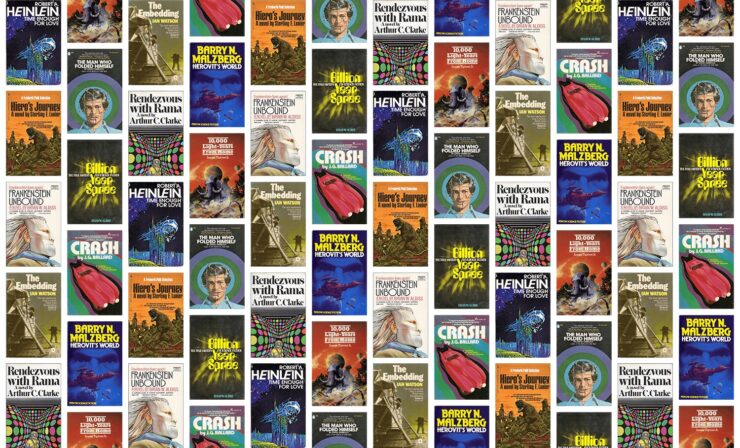
A funny thing happened on the way to my recent essay about finding books to read. I hit on a way of researching SFF history that is potentially an enormous time sink. Specifically, how well-versed am I (and readers in general) in Golden Age science fiction? By which I mean “golden age” in the sense of Pete Graham’s aphorism that “the golden age of science fiction is twelve.”
In my case that year was 1973. Inflation was soaring, the Prime Minister was a fellow named Trudeau, and I had not the smallest familiarity with current fashion. However, I did have access to an abundance of bookstores, new and used, and an allowance measured in books-per-week1. What I didn’t have: any access to SF book reviews2. So, lacking that vital information, how closely did my reading habits follow those of reviewers?
As you know, Bob, the Internet Science Fiction Database is an internet database chock-full of information about science fiction and related fields. It can be searched in various productive ways, one of which is finding out which books garnered the most reviews, listed by year and decade. Thus we can easily discover which books were deemed most worthy of review3 in any particular year4. I could, for example, check to see what reviewers were talking about the year I turned 12.
What resulted was a flood of memories equal to any triggered by Proust’s madeleine. The top one hundred reviews are filled with works familiar to me. In fact, of that top one hundred, I have read fifty-seven5. Many of the books I have not read are familiar to me from all the times I picked up a copy from a bookstore shelf, frowned judgmentally, and put it back.
Lacking access to reviews as I did, I can only assume that my reading habits tracked reviews so closely because books that were widely reviewed were much more likely to be granted precious shelf space than books about which no conversations occurred. Books that sold well when new were more likely to turn up used in second-hand bookstores. It is also possible that because far fewer SF books were published back then, it was more likely I’d accidentally encounter the books reviewers were talking about.
In fact, while I can see clear evidence of my youthful reading preferences in the books I overlooked—I neglected works in languages I cannot read, works that appeared suspiciously literary or New Wave, works by authors whose previous novels I’d disliked, books suspiciously best-sellery—the most common reason I can see for having not read the books in the top one hundred is that I never saw a copy. At that time, book distribution in Ontario, particularly out in the sticks, was rudimentary and many books did not make it to Waterloo Region.
To be honest, I think Graham might have been off by a few years. Looking at the evidence, I became convinced that the golden age of SF was sixteen, because my hit rate for 1977 is even higher6. I credit high school, an environment that did its very best to encourage escapism.
Is my experience unusual? If you peruse the ISFDB list of most commonly reviewed books published the year you turned twelve, do you see an abundance of familiar faces? If you do, which are the ones you remember most fondly?
- An arrangement that no doubt looked much more cost-effective to my parents when MMPBs were 75 cents rather than the exorbitant buck ninety-five of the late 1970s. ↩︎
- I didn’t start buying SF magazines until the April 1977 issue of Analog. Not only did this provide me with access to reviews, it provided access to book ads for upcoming books. I still get a little zing when I see an old-time book ad and can and will discourse at length about them to anyone who makes the mistake of engaging me in conversation. If people didn’t want to know about Del Rey or SFBC ads of the 1970s, why would they even ask me for directions to Needles Hall? ↩︎
- In venues the ISFDB tracks. The 2500+ reviews on James Nicoll Reviews, for example, appear nowhere in the ISFDB. ↩︎
- Hat tip to Dreamwidth user Bolindbergh for explaining this to me. I will be using it to prompt memory when I am trying to decide which books to review for period-specific review projects. ↩︎
- Or in the case of Gravity’s Rainbow, attempted to read. ↩︎
- Just checking 2020 for calibration, I note that I’ve only read twenty-nine of the top one hundred most reviewed books of that year. I suspect recent SF gets crowded out by various retrospective review projects. In 2010, for example, when my employer was sending me lots of upcoming SFF, I read forty of the one hundred most reviewed works. ↩︎



I’m two years older than you, apparently, so our books read probably overlap a lot.
I have all of the books shown in the header to your article–still have them, as a matter of fact.
We’re both old.
I wasn’t expecting much from this since I wasn’t yet a big reader of anything but comic books when I was twelve, but I did note two interesting things on the 1984 list. #1 was Neuromancer, which is my most reread book, but one I didn’t read for the first time until 1990. And way down at #135 is Frontera by Lewis Shiner, which I just happen to be reading right now.
Whoog, even going all the way to the bottom of my age-12 list I only managed 10 titles, many of which I’m pretty sure I didn’t read until a couple of years later (e.g. I didn’t get into Darkover until college, or Drake until high school).
I’m an odd case in that I was reading a lot from my older brother’s collection (older by 7 years) and so the books I was reading when I was 12 was not predominantly 1980’s books but 1970’s books instead.)
That was 1962/63 in my case. I was reading “Astounding”.
I turned 12 in 1972, and it looks like I’ve only read 39 of the 100 most-reviewed books of that year, some of them long after that year (e.g. Bova’s As on a Darkling Plain, which I didn’t read until we were fairly deep into the shallows of the 21st Century).
On the other hand, some of the less-reviewed books rank among my most reread books (e.g. The Worlds of Theodore Sturgeon and Clarke’s Lost Worlds of 2001 and some other books that don’t have “worlds” in the title).
So. There you go there.
Hmm, the books published when I turned twelve certainly aren’t the novels I was reading when I was twelve.
It would be 1979. I’ve somehow never read Hitchhiker’s Guide (I could brutally recite the radio show, and never really felt the need to read the novelisation).
I did read Fountains of Paradise and Ringworld Engineers fairly promptly, and Jem about ten years after. Otherwise there’s an awful lot from that year I’ve never touched.
Well, I’ve read thirty of the top 100 for my year – 1975 – but I’m sure I read most of them a lot later than 1975. That year, I was definitely in my Asimov, Clarke and “Doc” Smith phase. I did get Chris Boyce’s Catchworld at the time – one of those rather forgotten books that I think deserves to be known better. The only other one I remember from that year… is sufficiently embarrassing that even its author released it under a pseudonym, so no, I’m not owning up to that one.
(Yes, it is embarrassing even for someone who owns up to reading “Doc” Smith.)
I get about 25, but I didn’t read most of those until I was well past 12 or even 16.
Unrelated oddity: only 17 of the 20 most-reviewed books for 1976 are fiction, and one of the nonfiction books is Who’s Who in Science Fiction. I wouldn’t have expected that to attract more reviews than, picking two from a little further down the list, The Riddle-Master of Hed or Doorways in the Sand.
Concur with your move from twelve to sixteen. My hit rate for that year was double that of twelve. Great idea for restrospection, thanks.
Age 12 reading for me was heavy on Edgar Rice Burroughs reprints (and maybe ERB-like Otis Adelbert Kline sword-and-planet adventures). Plus even older George MacDonald fantasies, and I was just getting started on Ace double novels. I think Samuel R. Delany’s first novel, The Jewels of Aptor, was one half of an Ace double that I bought that year. Probably Andre Norton and Ray Bradbury from the library, as in the previous year.
Looks like I’ve only read 25 of the top 100 for 1980, and probably fewer than half that the year they came out. (Asimov, Heinlein, Niven, Adams, Tolkien, sure. But others would wait till high school or later.)
I think the only one from 1977 that I read that year was The Silmarillion, which was a Christmas present. Still have it, and reread it last year.
Otherwise I’ve read maybe 30 books in the top 150 or so.
I was 12 in 1977, and Star Trek Log 9 wasn’t even reviewed! Nor was With Friends Like These . . . .
I guess the Endof the Matter got 3.
I devoured Alan Dean Foster as a tween, before I’d developed any idea of “critical respect” in the SciFi ghetto or anywhere else. Now, approaching the age of 60, I’d say it’s near criminal how little attention Foster got within the field, especially considering how many copies he sold and how many half-developed imaginations he inspired. Don’t want to go on a rant, but why did the Baird Seales of the world penalize Foster for perceived lack of literary ambition when Asimov, only for an at-hand example, so clearly got a pass?
Anyway. I’d come to know Gateway, which led in reviews, for the masterpiece it is, but not at the age of 12 I didn’t.
Asimov was a step up from his contemporaries, but trying to be literary under Campbell would have failed miserably. Foster was a step forward in some ways, but after Le Guin et al the idea of what the field could be was much wider.
1973 is a bit early for me, but I checked it anyway and got about a dozen I’ve read, only a few of which I remember distinctly.
Going to my age 12 year, I get about 20 I remember reading, most of them distinctly.
Going to my age 16 year, I get a couple more than that.
We didn’t have a lot of money, so I read books from the library or ones that we bought from year sales and flea markets. I only read 17 books from my 12 yo list. But most of the books I was reading were probably from the 50s and early 60s. I started reading SF (and some fantasy) voraciously when I was in 4th grade because a boy I had a crush on was into it. I’d find an author I liked and then read all of their stuff I could get my hands on, like Bradbury, Asimov, and Clark. I also read a lot of anthologies. The librarians didn’t care if I was taking out books from the adult library, so I read things that weren’t exactly age-appropriate–like Heinlein.
I am now at the point in my life where I am downsizing. I’m skimming books in my collection that I haven’t read to see if they are worth keeping or not. My son went thru my library to let me know which books he wants. It’s a long process because I have a room with floor-to-ceiling, wall-to-wall books, 75% fiction with probably 80% of those being SF/Fantasy. Last year, I came up with 4 boxes of books that I’m ready to part with. Now I just need to post them somewhere and sell them off.
When I was 12, I was totally dependent on what was in my small-town library and my school library. I’m not complaining; that included The Little White Horse and someone left a complete hardback Edgar Rice Burroughs collection to the library from their estate. but it does mean my science fiction/fantasy was limited to a few Heinleins (Beyond Planets was an early favorite), all the Mars, Perelandra, Venus, etc. Burroughs works, and The Space Olympics by A. M Lighter until high school, where Norton, Asimov, Bradbury, Clarke, Simak, and more Heinleins were in the mix. I didn’t have money to buy books or access to new or used bookstores until I went to university in 1967, and not really money to start buying my own books at either of those until the 70s.
I can load your list in the ISFDB, but have not figured out how to search for most reviewed books in a given year, undoubtedly due to my advanced years. Can someone give me some guidance?
On the left side of front page select other pages: statistics/top lists. Then under Title Statistics (about 1/3 down)you’ll find most reviewed titles
Thank you!
Thank you! Got it.
I’m glad you asked! I was trying Advanced Search and getting nowhere with that (was getting told to login or create an account, which I may have done years ago but have no recollection of).
So out of 127 books that had 2 or more reviews, I’ve only read 27, and I’ll bet I read no more than 5 or so in that year. Most of the 27 I read a year or two later.
Twelve was 1958 for me, but there were no bookstores, new or used anywhere that I could get to until I went to Lakeshore Teachers College in 1964 and there was a used book store across the street, which also sold ice cream cones– with sprinkles.
So as a child, it was the library. The librarians allowed me into the Young Adult section at eight because I had read everything in the Childrens section.
So Norton, Bronte, Asimov, Heinlein, Mailer. The librarians were not too attentive about what I was checkingout.
I’ve read two. I’ve heard of a third. But then I guess that’s what happens when I was loitering in second hand stores in rural Australia – jump back to my year of birth and it jumps up to a decent dozen.
Yes, Australia really wasn’t all that up to date on the latest SFF books until the late 80s at best, and that’s in one of the larger cities.
What I found strange though is that I really didn’t get many hits on the year I was 12, but both 11 and 13 have a vastly higher hit-rate, even if I didn’t read them until I was older, sometimes much older. 16 was a much higher hit list though, no doubt helped at least in part by it being in the late 80s, when new books were finally becoming more available to both myself and my school.
I remember when I first saw the quote about the Golddn Age being 12, and I thought it was nuts. I was a voracious reader from age three, but from age 5 on I was laboring under the notion that fiction was waste of my time. I read physics, chemistry, and biology works. I didn’t discover fiction until high school teachers forced me to read Shakespeare, Chaucer. One teacher convinced me to write a horror short story. Same guy gave me a dog-eared paperback: I, Robot.
So, yeah, for me the Golden Age was 16.
On another topic, I thought Aldiss’s Billion Year Spree was an odd choice for the illustration. That’s not SF; it’s a history of SF.
My 12 was in 1969. I have not looked at the list, but am sure that whatever from that year that I have read was later, like many others. At that age I was reading stuff from our junior high library, which had lots of 1950s juveniles (Asimov, Norton, Heinlein, etc). I agree that 16 is a better match because by then I had discovered the SFBC.
I’ve read only 3 of the books in the top 100 from 2002 (and one of those not until 2022). But it strikes me that the later in time one was 12, the deeper backlog of science fiction we had to swim around in. And the less time to catch up since. I expect quite a few of the books I read that year appear on previous years’ top 100.