






This year I decided to conduct an experiment, and like most experiments it’s a bit dangerous. I’ll be going back to the fantasies that first shaped my love of the genre, that I got lost in when very young, and evaluating them with new (yes, older) eyes. I’m doing this in part because I want to understand how these books captivated me. But there’s another, less critical element at work: I’ve in recent years become immersed in non-fantasy fiction and nonfiction, and doing that, it’s easy to forget what made me fall in love with fantasy in the first place. This is true even as I’m as involved in the genre as anyone can be, with one fantasy book out and another on the way. Sometimes the best way to comprehend the nature of a journey, when you’re in the middle, is to look back to its beginning.
The danger is that I’ll inevitably see problems that I didn’t see when I was just starting on the writing road. There’s a temptation to let the works stay limned with nostalgia. A corollary to this new clarity is that I’m now in a better position to appreciate the authors’ strengths, the things they get right.
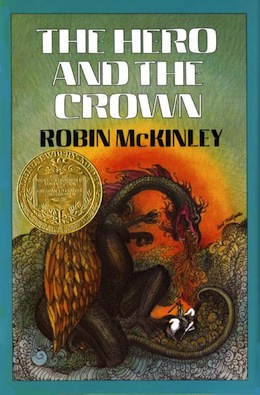
So this begins what I hope will be a monthly column, and first up is what was a huge favorite and inspiration, Robin McKinley’s The Hero and the Crown. It wasn’t easy to choose which of her books to use for this experiment—I might love The Outlaws of Sherwood even more. But Hero was the first McKinley book I read, and I fell into it headfirst, re-reading it for years after to absorb its beautiful language and intangible magic.
These are still some of the most striking elements of The Hero and Crown, years later. The writing is meditative and rich, leavened with wry humor and lines of dialogue like, “Having exposed one of my most embarrassing shortcomings in an attempt to deflect you, you refuse to be deflected.” Yet it is too dark to be described, as books with such dialogue often are, as “delightful.” There is banter and wit, but the atmosphere of the book is brooding. Damar is “a land with a shadow over it,” the protagonist Aerin’s life is isolated and fractured by loss: these elements taken together make for an aura of melancholy that persists even until the end.
But back to the language. One thing I’m learning in the course of this project is that while I loved many fantasy novels growing up, the ones I feel impelled to revisit have this trait in common—the words and sentences matter. This may seem an obvious observation, but it’s not; there are plenty of fantasies I enjoyed that I’m content to leave where they are, because they would probably not have new gifts for me. Robin McKinley’s stories are not the reason to keep returning to her, strong as they often are: the writing is what sets her books apart. People sometimes refer to authors as “prose stylists” and this brings to mind, for me, a hairdresser; but language is not the hair on a novel’s head—it’s the bones and blood.
It’s impossible to talk about The Hero and the Crown without remarking on how feminist it is, yet for me that’s a new response; as a teenager I honestly didn’t notice. I’m not sure if that’s because of, specifically, the sort of teenager I was, or because most girls at that age are not as aware of the sexist clichés that are prevalent—though on another level I was most certainly aware, heaping scorn on weak-willed female characters, not to mention the more obvious embodiments of male fantasy (just what size was her bosom? Just how attractive was she when angry? Yawn). Yet the remarkable characteristics of Aerin as a feminist protagonist escaped me, perhaps because the depiction is subtly rendered.
It’s all in the title: it’s not The Heroine and the Crown. We never forget that Aerin is a young woman, and it’s mentioned that her strength doesn’t match that of her cousin Tor (who is in love with her—another reminder of her femininity) but otherwise her actions simply flow naturally from her character and her gender is beside the point. Determined to accomplish something worthwhile with her life, Aerin sets out to formulate herbs that will render her immune to dragonfire so she can dispatch the dragons that plague the countryside. Layered under this determination for significance is a deep-seated pain: as the “witchwoman’s daughter” Aerin has been summarily rejected and ostracized, despite being the king’s daughter too. She has never known her mother and her father, though benevolent, tends to emotional distance. Moreover, she lacks the magical Gift that is otherwise inherited by those of royal blood.
Aerin’s impulse to become a hero is not solely born of alienation, but the way she goes about it—by re-training the disgraced, damaged royal charger, Talat—is a mirror to her state of mind. Aerin and Talat are both outcasts, each with a flaw that makes them unfit for their assigned roles. So the princess turns to slaying dragons, which is very much outside her role; and the stallion who once bore the king into battle now carries—with undying loyalty—the witchwoman’s daughter.
The first half of the book, which details Aerin’s determined quest to become dragon-killer, is utterly compelling. A large part of this is the immersive, psychological depiction of the Damarian court: McKinley is at her best when employing her facility with words to describe complex shades of emotion and interaction, ranging from dark to comic. What people wear, in which ceremony they participate in and where they stand when doing so, are all important nuances; yet it is unfailingly presented in a manner that is interesting rather than petty. Tor’s love of Aerin is a prevailing tension, yet never takes center stage; he represents domesticity and family duty, things Aerin is not yet ready to accept—the larger battle, for her soul and for Damar, still awaits. There is a wedding, gowns, and dances; but there are also politics, the threat of war, the tragic sense of grandeur nearing its end. It would have the feel of a romantic comedy if the pall of impending destruction did not hang so strongly on the land of Damar and Aerin’s heart. It’s a complicated tone that McKinley pulls off beautifully.
This first half lays the groundwork for Aerin’s magical quest, a quest which did not draw me in quite as much. Interestingly, this was just as true twenty years ago, which leads me to wonder how much tastes really do change over time. One thing that stands out in the second half is how far McKinley is willing to go to traumatize her protagonist; what happens to Aerin when she confronts the great dragon Maur is truly frightful, and recounted in painfully visceral detail. It’s a quality that shows up in many of McKinley’s later books: the tribulations of the physical body are made concrete, rarely glossed over. We experience Aerin’s agonies, just as in The Outlaws of Sherwood the romance of Robin Hood is mercilessly pierced by the realities of medieval combat.
Ultimately, the world McKinley creates through her inimitable prose, together with a memorable heroine, ensure that The Hero and the Crown remains a fantasy classic. Aerin’s matter-of-fact and unshakeable courage, together with her unflagging sense of humor, enshrine her in the canon of enduring fantasy heroes. This is a book that rewards upon a re-read, and reminded me, too, of the wisdom of young people: Even while first forming our taste, we can recognize a gem when it comes along.
Ilana C. Myer has written about books for the Globe and Mail, the Los Angeles Review of Books, the Huffington Post, and Salon. Her first novel, Last Song Before Night, an epic fantasy about poets and dark enchantments, was published by Tor in October 2015.

This is one of my favorites as well; I think the complexity of the ending makes it work for adults as well as children. As a kid, you can think “So, she lives happily ever after, twice!” but as an adult you can see the costs and the choices she is making.
I’m so delighted you’ve done a reread of this, as it was/is/remains one of my most treasured favorites too, and I absolutely agree with you about McKinley’s language being the blood and bones of this epic story. But I have to disagree with you about the second half of the story – i find it absolutely as compelling as the beginning. It’s just that in some ways I see the two quests as the difference between the obligations of childhood and maturity – the child wants to fight the dragon but the adult realizes that they have to fight family/the self (and really, the doubling at the end of Aerin’s uncle using her own voice is so explicit about this you can’t miss it – she’s fighting her own fears). I love Luthe and his valley where she not only rests but where she can’t stay (because after all, no one can stay forever in the place that doesn’t exist), his very inability to be her guide because he is ultimately terrified, and how she doesn’t hate him for that at all, but loves him just as much as she loves Tor. Aerin’s climb up the tower is so viscerally described that I can feel the red pain clawing at my own breast bone where the surka wreathe left it’s sap – and that’s after not having read the book for at least 6 or 7 years. Maur is amazing in his vicious embodiment, but, as Luthe says to Aerin, Asged is to Maur as Maur was to all those little dragons she killed – Asged’s lurking viciousness is the psychological darkness threaded throughout the story even when Aerin didn’t know his name – and it is only when she faces him that she can sit easy with herself.
Fascinating analysis, Kate! I think it ends up being very much a matter of taste, and your explication of the quest makes sense to me.
I haven’t read this book in forever and a day (and am going to have to reread it now – I was just thinking of picking up its sister book The Blue Sword anyways).
As Kate talks about remembering vividly the climb up the tower, I have vivid memories of what happened after – how when she came home, it still wasn’t over. She couldn’t rest, recover – she had to defeat the shadow left over Damar, invited in anciently, as a showy trophy of her victory. The imagery of the dragon’s head rolling down the hill and crashing through the gate, Tor and Aerin working together – the living embodiment of the hero and the crown.
Tor’s love for Aerin is also worth mentioning – its so healthy. He supports her, helps her, believes in her, and saves her. And she does the same. It was awesome to read when I was a blushing teen…
I fell in love with The Blue Sword when I was a teenager. I reread it as an adult and still love it.
I will admit that I haven’t read The Hero and the Crown for many many years. I remember, as a teenager, finding the tower climb anti-climactic. I will now have to reread just to see if I still feel that way.
I have found that some books I loved when I was young do not stand up. And others are much better than I remember.
This is one of my favorite fantasy novels. I read it first as a teen (also completely missing the feminist element) and was utterly sucked into the story. Now, I find myself re-reading it every few years and marveling at how well the story and the prose holds up for my adult self. I prefer it to The Blue Sword, which I also love, because I find Aerin’s struggle more riveting than Harry’s story.