





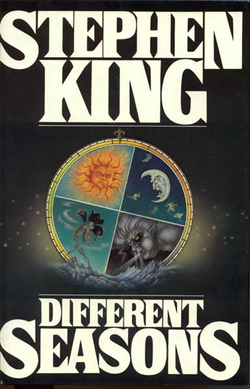
It seemed to happen like clockwork: Stephen King finished the first draft of a novel, set it aside to rest, then banged out a novella. When he was done he put them away in a drawer, never submitting them for publication. But in the early 80’s, when he was morphing from a mere author into a brand name, he collected four of them in a book called Different Seasons. It was supposed to be a fun change of pace, a book of non-horror stories that would serve as a breath of fresh air before diving back into horror with Christine, but it did a lot more than that. Different Seasons became King’s lowest-selling bestseller in years, opened him up to accusations of plagiarism, provided fodder for two of his most popular movies (and one of his biggest bombs), and finally convinced the reading public that Stephen King was capable of writing more than “just horror.”
King generally writes two drafts of his novels, then a polish. In the first draft, he tells himself the story, pounding it out and getting it on the page. In the second, he “takes out everything that isn’t the story,” adjusting motivations, characterizations, cutting digressions, and generally fine-tuning the work. It’s usually after this that he gives the manuscript to his first readers and incorporates their ideas and changes, then sends it to his editor. When it comes back from his editor he incorporates their notes in a final polish, although he says that since switching to writing on a computer this final polish feels more like a completely new third draft.
 In between drafts one and two he lets the book rest for six weeks, and it’s during this period that he writes a novella. As he once put it, “It’s as if I’ve always finished the big job with just enough gas left in the tank to blow off one good-sized novella.” After ‘Salem’s Lot he wrote “The Body.” After finishing the first draft of The Shining he wrote “Apt Pupil” (although after that he stopped writing for about three months, totally wiped out). And after polishing off The Stand he somehow had enough juice left to write “Rita Hayworth and the Shawshank Redemption.” But he never even thought about publishing them. There just wasn’t a market for non-horror novellas.
But in 1981, when Cujo became King’s fifth consecutive bestseller in a row, people started to joke that he could publish his laundry list and it would rocket up the charts. “Well,” King reportedly thought. “I don’t have a laundry list, but I do have some novellas…” He approached Viking and New American Library about this change of pace and they were game, so he gave Alan Williams, his editor at Viking, a manuscript entitled Different Seasons. Williams read it, but had a major problem: the title said “Seasons” but there were only three stories. King added “The Breathing Method” and they were off to the races, despite the fact that Williams was more enthusiastic about King’s upcoming return to horror, Christine, than Different Seasons. Nevertheless, it came out in 1982 and would go on to sell 140,000 copies in hardback during its first year.
The title comes from the subtitles King gave each of his stories:
- “Rita Hayworth and the Shawshank Redemption” – Hope Springs Eternal
- “Apt Pupil” – Summer of Corruption
- “The Body” – Fall from Innocence
- “The Breathing Method” – A Winter’s Tale
The publication order is almost the exact opposite of the writing order, making “Shawshank” the first in the book, but the most recently-written of the three original novellas. In 1982, King didn’t have anything on the market that wasn’t comfortably classified as horror, so reading a prison break story was probably a shock to his fans. Today, most of us are pretty familiar with it thanks to the movie, which was more of a sleeper hit than a big blockbuster.
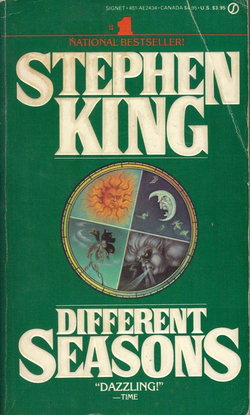 King has occasionally been compared to Dickens and nowhere are the parallels clearer than in “Shawshank.” Sentimental and full of hope, it’s a gothic period piece in which the rich are pigs and the poor are noble, kind-hearted, and oppressed. Narrated by “Red” Ellis, serving life in Shawshank Prison for killing his wife, the story starts in 1948 with the arrival of another convicted wife-killer, soft-spoken Andy Dufresne. He asks Red to help him obtain some rock polishing paraphenalia and a poster of Rita Hayworth. Years later, after running afoul of the pious, sadistic, and deeply corrupt warden, Dufresne seemingly evaporates from his cell. Further investigation reveals that the Rita Hayworth poster has been part of a decades-long escape plot, and Andy is never recaptured, seemingly living out the rest of his days in sunny Mexico.
Well-written, always engaging, sometimes funny, but mostly optimistic and full of noble sentiments about the human spirit, “Shawshank” is best known today as the subject of a 1994 movie starring Morgan Freeman and Tim Robbins. While the movie didn’t gross a ton of money at the box office, it was nominated for seven Academy Awards and two Golden Globes, and has run seemingly uninterrupted on cable ever since. The book has even been adopted into a play, and why not? It’s a nice story that does what it says on the box, never punching above its weight, but containing no obvious flaws. The same can’t be said for the next story in the collection, “Apt Pupil.”
? In an interview, King once said, “I’ve never met a kid I thought was genuinely mean,” and his fascination with the glory and grotesquerie of childhood shows in the large number of his classic characters who are children: Carrie White in Carrie, Mark Petrie in ’Salem’s Lot, Danny Torrance in The Shining, Charlie McGee in Firestarter, Chris Chambers in “The Body,” all the kids in It, and on and on. With this many young protagonists in his books it’s no wonder that so many people first fall in love with Stephen King in early adolescence. King, unlike a lot of writers, has always played fair with his kids, refusing to patronize them, but refusing to sentimentalize them as well. But “Apt Pupil” feels so out-of-character that it’s hard to believe it came from the same writer.
Todd Bowden, a thirteen-year-old all-American boy, is a Holocaust afficionado who figures out that elderly Arthur Denker living across the street from him is actually a fugitive Nazi war criminal named Kurt Dussander. Bowden blackmails Dussander into telling him, “all the gooshy stuff” about the Holocaust, and the two go slowly insane, locked in a psychosexual death dance as tales of the “gooshy stuff” drive Bowden mad, and reawaken Dussander’s Nazism. The story is fun for the whole family, featuring everything from kittens gassed in ovens, to wet dreams about Nazi torture, to multiple claw hammer murders of homeless men.
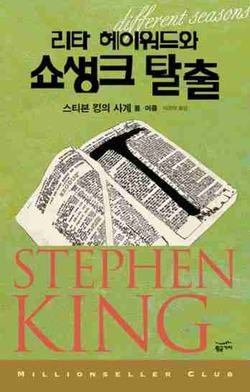 There’s no denying that the story has an original hook, and it’s a compelling read, but there’s also something flawed and lopsided about it. Dussander is a fully-drawn character, a terrible monster but also a pathetic old man. Bowden, however, has no background, no depth, no softness. He’s just an All-American kid (as King tells us repeatedly, as if type is a substitute for character) who turns out to be rotten to the core. His one-note evil personality is like a hammer that flattens the book. For Dussander you feel some small sympathy for his reduced means, his desire to be left alone, his guilt over his crimes, but Bowden is just a monster who arrives fully formed, like an op-ed column about sociopathic kids, bad because he was born this way, with no goals other than the fulfillment of his own sadistic appetites.
“Apt Pupil” was made into a flop movie by Bryan Singer in 1998. Grossing just $8 million, it squats at the bottom of King’s box office chart, down near Lawnmower Man 2: Beyond Cyberspace, more famous for the lawsuit brought by teenaged extras who claimed they were stripped naked while filming a shower scene solely for the sexual gratification of the director and crew, rather than for its actual content. One can only imagine how much better (or worse) the 1987 version of the movie, starring Ricky Shroeder and British theater legend Nicol Williamson, which was abaondoned after 10 weeks of shooting with 40 minutes of completed footage in the can, would have been.
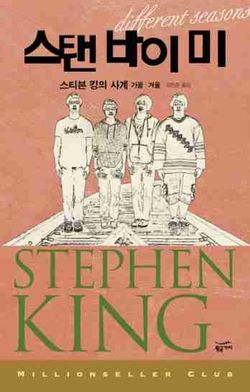 Things pick up with the next story because if King has written anything that should be part of the American literary canon, it’s probably “The Body” which gives us a beautifully detailed flip-side version of the 1950’s, scored to a bevy of nostalgic rock n’roll tunes, and suffused with a genuine sense of anger and loss. King was a kid in the 50’s, and he grew up poor, so instead of showing us a swank and sexy vision of upwardly mobile America he writes about the blue collar types who were left behind in this country’s great leap forward. Ostensibly the story of four boys who set off overnight to find the corpse of a kid killed by a train, it’s so sad, strange, funny, haunting, and fueled with righteous rage at the indignities of poverty that it casts a shadow over the other three stories in this collection.
“The Body” is based on two incidents from King’s childhood, and he only remembered the first because he heard about it from other people. One day, when he was four years old, he came home pale and in shock. His mother couldn’t get him to tell her what happened, but after asking around she discovered that he’d seen his friend struck and killed by a freight train while they were playing. Despite having no memory of the incident, it seems pivotal for King and he’s talked about it many times in interviews. Less well known is the second incident. When King was slightly older and living in Durham, Maine, his friend Chris Chesley came by one day and asked, “Do you want to see a dead body?” King, another friend, and Chesley set out for Runaround Pond where a drowned boater had just been pulled out of the water. “They hadn’t covered up the corpse yet,” Chesley remembers. “It was an educational experience for all of us. It wasn’t a pleasant sight.”
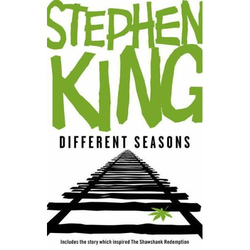 But there’s a third, even more important, source for “The Body.” The novella is dedicated to King’s old college friend and roommate, George McLeod, which may be an unintentional act of cruelty. One day, when King was a struggling writer living in Orono, he asked McLeod what he was working on. McLeod described a short story he was writing based on an incident from his childhood in which he and his friends had set out along the railroad tracks to see the corpse of a dead dog. McLeod’s story contained all the incidents that later appeared in King’s “The Body” but McLeod never finished writing it. When he saw his unfinished story appear years later as “The Body” he decided to let it slide. But when the movie adaptation, Stand By Me, came out, McLeod saw a TV commercial for it and decided to contact King. He asked for his name to be on the movie, and for a cut of the money. King refused and their decades-old friendship came to an end.
This incident is related in Haunted Heart, by Lisa Rogak, an unauthorized biography of Stephen King. Rogak quotes McLeod, and a few other friends of King, who recount similar incidents. “If he’s near something, he will absorb it like a sponge,” McLeod says. “It’s his strength and naturally it’s his weakness, too.” If this account is true it makes the epigraph for Different Seasons, and the motto of the storytelling club in “The Breathing Method,” far crueler: It is the tale, not he who tells it.
And that brings us to the fourth and final story in Different Seasons, “The Breathing Method.” Written to round out the collection immediately after Cujo was edited, it’s an old fashioned ghost story, like the one King was supposed to write on his hiatus to England (where he had produced Cujo instead). It’s one of two works by King that are set in a private Manhattan club located at 249B East 35th Street where old men gather to tell stories (the other is “The Man Who Would Not Shake Hands” collected in Skeleton Crew).
The club contains an infinite number of rooms and corridors, a mysterious butler named Stevens, and its origins are veiled in murky hints and dark mutterings. There, old men gather, play pool, read books, and occasionally tell one another tales. Set in the dead of winter, “The Breathing Method” takes place at Christmas, a traditional time for ghost stories, and it concerns an obstetrician and his patient who is determined to give birth, no matter what happens to her. As inconsequential as it is, “The Breathing Method” is a fun, atmospheric example of King trying his hand at a more traditional kind of horror story and knocking it out of the park.
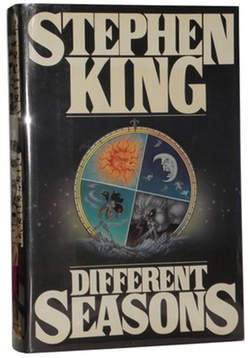 The final score? Different Seasons contains one fun but slight story (“The Breathing Method”), one ambitious but flawed story (“Apt Pupil”), one well-executed middle range story (“Rita Hayworth and the Shawshank Redemption”) and one bona fide classic (“The Body”). It came at a point in his career when King was tired of being typed as “just” a horror writer, at a time when he wanted to prove that he was different from the legion of hacks churning out mass market horror paperbacks with gimmicky covers that were flooding drugstore shelves. Different Seasons arrived right between Cujo and Christine when, by all accounts, King’s rock star behavior was getting a bit out of hand and his addictions were spiraling totally out of control. As such, it provided a nice reassurance that he really was an original and talented writer capable of writing entertaining books, no matter what the subject matter. And that’s good news for his fans because his next book, Christine, would be one of his worst.
Grady Hendrix has written about pop culture for magazines ranging from Playboy to World Literature Today. He also writes books! You can follow every little move he makes over at his blog.


being someone who only enjoys King from afar (i’ve caught most of the movies of his books and have a few people close to me who are fans of his who recount some stories) i liked this article. well written and informative without getting too deep into the details. this makes me want to read at least that last story.
In defense of “The Breathing Method”, at least there’s a woman in it with actual attributes. I don’t recall if there’s a female character in “The Body” at all, and given its focus, that’s okay. But King usually does better with women than “Shawshank” & “Apt Pupil”. I agree in general with what you’ve said about King writing children well & that’s part of his appeal to adolescent readers. But what’s an adolescent girl see reading “Seasons”?
I read this collection as an early teen and I have to say that Apt Pupil just shook me to the core. Flawed or not, for the right audience it was a terrifying story – I still remember it well, almost 30 years later.
I consider Stephen King to be a master story teller. He has kept me intertained for more than thirty years. My biggest critisism is that he has repeatedly turned African American characters in his books into two demensional caricatures. Although a story like The Stand survives this problem, the same is not true for The Dark Tower.
I have to disagree that Todd Bowden is so atypical of the kids Steven King writes. King can write good child protagonists, but he also writes plenty of nasty, 1-dimensional kids: Chris and Billy in Carrie (and to a lesser extent the rest of the school who tormented her), pretty much everyone in IT other than the main characters. Apt Pupil is just the first one where we’ve had one of the bad kids as the main character.
I think Apt Pupil is a brilliant idea. I mean, an “all American kid” with a dark heart wants to know what the Holocaust was really like from someone who actually served the horror. Dussander shows him intimately and the horror is reborn in him. Now, I don’t really want to see the movie, I don’t was to see this happening. Reading it is enough. I think part of the horror is, why would a kid want to know these things? Well, as we have seen in the recent past…why would kids want to shoot up schools or theaters?
Wrt “The Body” and its apparent derivation from an incomplete short story written years before by a friend – King had another short story/novella (can’t remember the name, or where it was published), in which a writer experiences some sort of supernatural shenanigans tied into the fact that he plagiarized his first published story, which had been written by a fellow student in a writing workshop who just drifted out of writing.
Rob, I have to disagree with you. Mother Abigail is a stereotypical Magic Negro, much like Jon Coffey, and Susannah is actually a fleshed out character.
XenaCatolica – You’re right. “The Breathing Method” is set in 1935 and totally deserves more credit for Sandra Stansfield, the woman whose pregnancy is the focus of the story. It’s rare that a woman comes across as this heroic while sticking to historically accurate behavior, without shooting anyone, without snarling “This ends now,” and without challenging the patriarchy, Stansfield comes across as one of King’s best and most complex tough women while doing little more than giving birth.
Raskos – thanks for pointing out King’s story, “Secret Window, Secret Garden” in Four past Midnight and its take on plagiarism. I should have mentioned that. There’s also “The Ballad of the Flexible Bullet” from Skeleton Crew about the paranoid writer Reg Thorpe and the Fornits who live in his typewriter and create his stories. King often speaks and writes about how stories do what they do and their authors are thus absolved of responsibility for their content. See also The Dark Half and his comments about Tad’s death in Cujo (“I didn’t know it was going to happen until I wrote it,” he says in an interview).
GradyHendrix@9: King essentially indictes his audience for not believing this same point in Misery, as I’m sure you know.
As some other commenters have said, I can see your point about Apt Pupil, but I found it to be an incredibly disturbing, and therefore well done, story. Todd Bowden never struck me as one note from the get-go, although the seeds are certainly there, as Dussander himself observes, and what has always fascinated me about him was his complete descent into madness, with sociopathy a…side effect. Perhaps what makes it so compelling is that I first read this story as a teenager (fifteen, maybe?), and I can remember the extensive study of the Holocaust I had been exposed to by that point, and thinking, “How much of this am I supposed to learn? I get that it was horrible, but I learn the same stuff every year, and spend six weeks reviewing what I already know and then learning about even MORE horrible depravities!” It got to a point where it was oppressive, and I loved seeing how the very enviornment I had lived in could produce, with just the right amount of something “off” from the start, something so alien and disturbing, someone that could have been a project partner, for all I know. Very well done, IMHO…deeply unsettling and fantastic.
Not sure if “frivolous” is the right word for the lawsuit over the making of the Apt Pupil movie.
The Body is easily the worst of the four, but they’re all really good.