






When someone decides to sober up, they often eliminate people from their lives who stuck with them through their drunk years. It’s a cruel, necessary housecleaning and one Stephen King embarked on between 1988 and 1989, the year he finally stopped drinking (snorting coke, swilling mouthwash, popping pills). First, King fired his longtime agent, Kirby McCauley, the man who put together the ground-breaking deals that made him rich. Next, he abandoned his longtime editor, Alan Williams, whom he’d followed to Putnam (for The Tommyknockers) and returned to his regular publisher, Viking. Then he stepped back and let his vanity project, hard rock radio station WZON, go from his preferred rock n’roll format to a more conventional, noncommercial public radio station format. Then he stopped publication of his popular Castle Rock fan newsletter.
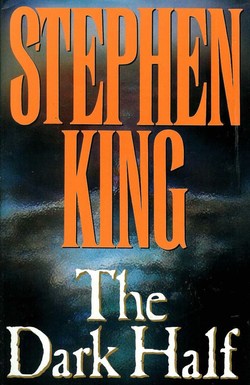
But there was one person he couldn’t get rid of without a fight, his pseudonym, Richard Bachman. The more King tried to lay this ghost to rest, the more Bachman struggled, and the result is one of his most mystical and violent books. It’s deeply uneven, but The Dark Half is like a rough draft for his nonfiction memoir, On Writing. Only more people get beaten to death with prosthetic arms.
The Dark Half is the last book King wrote before he got clean. He started it in November of 1987, the month The Tommyknockers hit stores, and finished it in March 1989, the year he started going to Alcoholics Anonymous. In October 1989 it landed on shelves in a huge first printing of 1.5 million copies, all the better to slake pent-up demand. After years of writing fantasy (The Eyes of the Dragon, various Dark Tower books), a thriller (Misery), and a science fiction book (The Tommyknockers), and after the Drought of 1988 (the first year since 1976 without a Stephen King book) his voracious readership wanted horror, horror, horror! The Dark Half sold 1.56 million copies, enough in one year (from October ’89 to December ’90) to earn it the place as the second-best-selling book of the 1980s. In hardcover and paperback combined it spent 60 weeks on the New York Times bestseller lists.
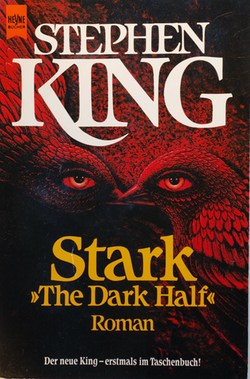 One of the last three Castle Rock stories (including the novella “The Sun Dog” in Four Past Midnight, and Needful Things) which were intended to bid farewell to King’s favorite fictional setting, The Dark Half was the book that tried to answer the eternal interview question, “Where do you get your ideas?” As King said in an interview, “It seems to me that for most writers there really is another person hiding inside,” or as he writes in The Dark Half, “He is two men – he has ALWAYS been two men. That’s what any man or woman who makes believe for a living must be. The one who exists in the normal world…and the one who creates worlds. They are two. Always at least two.” King had long ago given his other man a name, Richard Bachman, writing several science fiction novels and thrillers under his name before killing him off with a case of “cancer of the pseudonym” when a fan exposed Bachman’s real identity after Thinner.
Never shy about literalizing a metaphor, The Dark Half takes this idea, reverses it (Bachman’s books were never as popular as King’s) and gives it flesh. The main character, Thad Beaumont, is like Misery‘s Paul Sheldon, or The Tommyknockers‘s Bobbi Anderson, a writer with literary aspirations who has found enormous success writing popular fiction — romance novels for Sheldon, westerns for Anderson, and ultra-violent crime thrillers starring the Parker-esque criminal, Alexis Machine, and written under the name George Stark, for Beaumont. The Dark Half begins with King wringing more use out of his old Bachman identity, using it as a real-life springboard for the opening of this book.
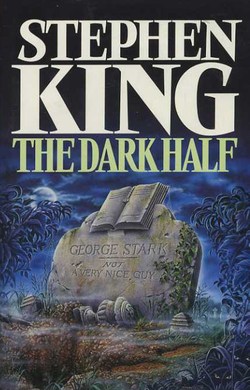
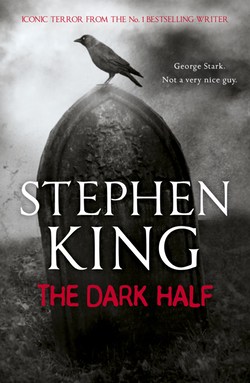 Beaumont’s subterfuge has been blown open, much in the same way King’s Richard Bachman name was exposed. People magazine arrives at his comfy home to set up a photo shoot next to a fake George Stark grave and to interview Beaumont and his wife about the “death” of George Stark. Beaumont confesses he never liked the sonofabitch Stark in the first place, and his wife is glad that she won’t be sharing her home with Stark anymore either since she found him unpleasant to be around, despite the fact that his writing paid the bills. But in some weird, unexplained act of mystical woo-woo, Stark is enfleshed and escapes from his phony grave and begins to murder everyone involved in his exposure. Then he comes for Beaumont. What does he want? In the words of the replicant Roy Batty in Blade Runner as he confronts the man who manufactured him, “I want more life.” Or, in the case of George Stark, he wants another book.
It would be a mistake to turn all of King’s books into psychoanalysis, but this one, about a writer wrestling with his more successful alter ego that wants to kill his family and eliminate his real identity is too rich to resist. One of the things King has said kept him from getting sober was his fear that his talent all lay at the bottom of a bottle. If he stopped drinking, he’d stop writing. Stark is this fear made flesh, his talent viewed as the dark part of his life that made him rich and famous but also made him a danger to his family and friends. If he stopped hurting them, if he stopped hurting himself, he wouldn’t be able to write. And in a way, he’s not wrong.
 For long stretches, The Dark Half seems to be a book written by a man who has read about this fellow Stephen King and is taking a crack at imitating him. Stephen King books are long, so The Dark Half is needlessly long. The book kicks off with a reprint of an entire fake People magazine article, then treats readers to a six page dream sequence which is repeated, with very minor changes, eight chapters later. Chapters take place from one character’s point-of-view, and then the next chapter relates the exact same events from a different character’s POV, adding very little that’s new or useful. The book is larded with pointless stream of consciousness digressions in which characters ponder their crotches:
“Nothing to apologize,” Alan said. He finished his beer and checked his crotch. Dry. Good. There was a light stain there, probably not anything anyone but his wife would notice. “Anyhow, that brings me to the last point…or aspect…or whatever the hell you want to call it.”
There is rampant ellipses abuse, and at one point the book comes screeching to a halt for a thrilling subplot about how on earth the police are going to contact a doctor…who is camping in Yellowstone National Park! And too often, characters seem to make decisions not because they are logical, but to serve the needs of King’s plot, laboriously dragging themselves around on the chessboard of his master plan in order to be in the right place for the big set pieces. As previously-reasonable cops decide to go on missions alone without telling anyone, or minor characters suddenly reveal that they were only in the book to get the main character out of a jam by delivering a set of keys or a bit of insight with all the mechanical clunking of a gumball machine, they keep repeating the same thing, “I have to know how it’s going to turn out.” It’s a mantra heard far too often in this book, a justification for cheating as an author: I will have this character do something ridiculous, because I want to hurry up and get to the end because I want to know how it turns out.
 But all the heavy dragging of the plot comes to a halt when Stark is onstage. A creature right out of King’s fictional id, he’s a descendant of the violent greasers who’ve populated King’s books all the way back to Billy Nolan in Carrie. He’s got a way with women, he’s reckless, gruesomely and inventively violent, and he taught Beaumont to write “the things people want to read.” But what exactly is he? King has always loved explaining his monsters, whether they’re aliens, or psychic powers, or ghosts. It’s not a Stephen King book unless everyone gets a backstory, right down to the guy who delivers the mail, but King can’t put his finger on Stark. He starts the book as an eyeball and some teeth (revealed hilariously in this excerpt from The Dark Half videogame – yes, there is a Dark Half videogame) inside baby Beaumont’s brain, and King gave an interview stating that Stark was, “…the ghost of a twin that never existed.” But none of it makes any sense.
His conjoined existence is brought to a gruesome end in the first chapter. After that is he some kind of psychic construct created by Beaumont? If that’s the case, then what is it that crawls out of the grave and begins sleeping with women and beating Beaumont’s groundskeeper to death with his own prosthetic arm? And what is it exactly that he wants? Stark is clearly flesh, and he’s clearly falling apart, and he claims that Beaumont has to write a new Alex Machine book for him. Stark can’t do it himself because all his attempts come out like Jack Torrance’s “All work and no play makes Jack a dull boy” in The Shining. He needs Beaumont to write the book with him and then he’ll be “alive” and Beaumont will “disappear.” Disappear where? How will he be alive? King doesn’t tell us, and instead leaves it vague and unexplained in a very un-King-like manner.
 And that’s the problem with King’s writing process. It’s spooky, and it doesn’t make any sense. King has tried to explore how and why he writes in The Shining, Misery, and The Dark Half, and he even gives it a try as non-fiction with On Writing, but even there he can only go so far. Sure, King can talk about what makes a good story, and not using adverbs, and making sure he turns in 2000 words a day, 365 days a year, but his description of the actual process of creation are mystical at best. He talks about “finding” his stories, about serving as a vessel for their needs, about being surprised by the turns they take. That’s because the closest analogue you could find for King’s process is automatic writing. He writes in a “semi-dreaming state” (It), he writes so quickly he doesn’t have time to stop (The Shining), or he writes in a Budweiser-induced blackout (Cujo). When Beaumont needs to locate Stark in The Dark Half, he picks up a pencil, lets his mind go blank, and when he comes to his page is covered with Stark’s thoughts. Alcoholics talk about how you have to “Let go and let God.” That’s pretty much all you can say about King’s technique. He’s learned to “Let go and let Stark.”
And that’s the secret of writing. It doesn’t make sense to anyone but the writer. When Stark and Beaumont finally meet, they speak in a shorthand Beaumont’s wife can’t understand, and laugh at jokes she finds decidedly not funny. She’s baffled that Beaumont wants to write the book that Stark is demanding from him for no better reason than he has a good idea of how to pull it off, even though to do so will mean his own destruction. And it’s in this last quarter of the book that The Dark Half shakes off all its creaky plot contrivances, padded chapters, wheel-spinning exposition, and unrealistic character behavior, to get at a hard-to-summarize, uncomfortable, unpleasant truth about writing: writers are usually more in love with their own talent than with other people.
 The final meeting between Beaumont and Stark feels like it was written in a single, white-hot burst of inspiration. The two men meet, travel through a secret door, and begin to write their book together. They hate each other and love each other and seem to be melding into one identity when, suddenly, a massive flock of sparrows descend and tear Stark to shreds. It sounds silly, and it is, but on the page it’s executed with such intensity of conviction that the laughs die in your throat. (King says he’d finished the book and was pretty unhappy with it when he suddenly had the inspiration to add the sparrows while driving one afternoon, and that made all the difference.) The second Stark dies, Beaumont bursts into tears.
The book ends on a minor key to end all minor keys, with everyone brutalized and in shock after their brush with Beaumont’s writerly side. Although his kids may recover from what happened (“maybe, someday…”) it’s clear that Beaumont’s happy marriage is not long for this world. His wife has seen too much, has realized that she’ll always play second fiddle to her husband’s talent, and she can’t go back after that. Beaumont burns his house down, burns up Stark’s car, and burns up his manuscript, hiding his face behind his hands as he watches and sobs. His friend, the sheriff, watches and thinks:
“Standing next to you is like standing next to a cave some nightmarish creature came out of. The monster is gone now, but you still don’t like to be too close to where it came from. Because there might be another…And even if the cave is empty forever, there are the dreams. And the memories. There’s Homer Gamache, for instance, beaten to death with his own prosthetic arm. Because of you. All because of you.”
In other words, it’s all your fault.
In 1991, King’s editor at Viking, Chuck Verrill, suggested that he write the book that Beaumont and Stark were working on together but never finished in The Dark Half, called Steel Machine. It would be published as a Bachman book. King claimed in an interview that year that he was thinking about doing it, but the book never came out. I wonder why.
Grady Hendrix is the author of Satan Loves You, Occupy Space, and he’s the co-author of Dirt Candy: A Cookbook, the first graphic novel cookbook. He’s written for publications ranging from Playboy to World Literature Today and his story, “Mofongo Knows” appears in the anthology, The Mad Scientist’s Guide to World Domination.

In another King novel (forget which), Thad Beaumont is referred to in passing by one of the characters as a divorced drunk, so your prediction is on the mark, Grady.
I seem to recall him dying by his own hand in yet another King novel, but the memory gnomes have lost the file card for that too.
@1, it seems to me that Beaumont is referenced in the Dark Tower books somewhere? Or maybe because everything else is.
Dark Tower books 6 and 7 ends up being largely a rumination on where do the ideas come from, and the fact that sometimes the ideas come from scary places that normal people don’t want to visit.
@1 In Needful Things, Beaumont is referred to as a drunk. In Bag of Bones, we learn he’s committed suicide.
@2 and @3 – thanks.
@3 already answered what I put here while I was typing it.
I know that it isn’t King’s best work by a long shot, but something about the Dark Half has always called to me and I don’t think it’s because I saw the movie version at a young age and it left an imprint on my brain; or that I actually saw the movie before I saw Night of the Living Dead or Dawn of the Dead and was introduced to George Remero thorugh the movie version of this book. I think it was because what you described in the review: that a writer is so in love with his work that others will always play second fiddle. That’s a harsh reality I’ve come to over the years. I mean, don’t get me wrong, I love my son and my son’s mother, whom I’ve been seeing for nigh on 13 years; only I’ve lived with my own head and my own work and my “Writer’s Personality” for much longer. I don’t like my writing to be interfered with in a way that I’ve never attached myself to any other thing that’s not flesh. I suppose I write in that semi-spirit walking state as well and I too don’t know what will happen. Within reason, I don’t know where my stories will go. When I was writing my first novel, I just KNEW how it would end and what was going to happen and which characters were going to make it. But then I came to a point in the story where something happened to one of the three main characters and I knew that he had to go, just like that, and that it was he who was supposed to live. That all sounds very cheesy and like I’m only trying to relate to an author who is successful, however, I’ve read of other writers who do similar things-just throw out the outline at some point. I think that’s why, though the book isn’t his best work by a long sight, I still feel a connection to it.
I remember reading excerpts of The Dark Half published in a woman’s magazine here in Australia my mum would by each week. Not sure what the publishers thought they were doing buying excerpts from a story like this, but it’s probably testament to how huge a figure in the publishing landscape King was back then.