





When I reviewed the season 1 finale of The Handmaid’s Tale eight (!) years ago, I commented on how it basically split the final two chapters of Offred’s story in Margaret Atwood’s novel into season-long bookends. Now, the series finale “The Handmaid’s Tale” reaches back across time to that finale but really the entire first season, through myriad callbacks on the visual and linework level as well as the returns of significant people, places, and things.
The final episode does a fine job of balancing winning battles with still fighting a war. Boston falls for a second time, this time returning to the Americans. But Gilead, even in retreat, is still strong enough to pose a clear threat to this generation and future ones. The fertility crisis is nowhere near being solved; Gilead has the capacity to mold hundreds of impressionable children, either assimilated or born into its system, which is more than the rest of the world can say.
Spoilers for The Handmaid’s Tale series finale.
So of course June Osborne has to go back in. Boston may be safe, but she isn’t. Neither is Holly, or Moira, or Janine, or Charlotte, or any girl/woman that Gilead could drag back into its hell if given half the chance.
The Handmaid’s Catharsis

But first, June gets to walk through Boston as a free woman. Neither enslaved nor in disguise, but as the person she was before Gilead. Yet that June can obviously never be the June whose life was never touched by Gilead. Luke reflects, in their bittersweet breakup, that they have both become such different people from the day that they fled and Hannah was wrenched out of their arms. Holly says she’s only just starting to get to know this June. More effectively than these characters telling her as much was one of the episode’s standout scenes, June’s AU dream sequence of life in Boston if Gilead had never happened—except that all of the women she’s lovingly singing karaoke with she would never have met if not for their imprisonment as Handmaids and Marthas. For all of the episode’s Hannah flashbacks with a noticeably younger June, there is no moving backwards in time; everyone got older, even if they feel like there’s just a void that obliterated their lives between before and after. It’s a very familiar feeling for a post-covid world, even if the showrunners didn’t intend that in 2017.
This epilogue is smartly structured along June’s walk, which used to be her only limited outlet as a Handmaid—for bare-minimum exercise, for seeing other people outside of her household, for confirming if there were any small pockets of resistance in Gilead. That framework also allows the series to wrap up characters’ storylines neatly without feeling too pat, though Moira is noticeably absent. June getting to burn her Handmaid robes on the impromptu bonfire is cathartic for all of us.
Serena and June

It’s fitting that these two say their farewells on another vehicle, though at least June isn’t pushing Serena off a train this time but helping her onto a bus. Serena is getting a brighter future than she deserves, for all of her complicity in creating Gilead, maintaining it, and recommitting to its culture, albeit for her and Noah’s survival. Yet of all of the Wives, Serena has also had the closest experience to life as a Handmaid, like when she was locked in the Wheelers’ home while pregnant, considered a fertile womb but an unfit mother. (The refugee worker’s comment about “a chair, a table, a bed, all you need” was a sly nod to Offred’s accommodations in the Waterford house.) Similarly, Serena’s exchange with June sounds like the kind of advice that someone could have given a Handmaid as much as to a fallen yet fertile Wife: “Looks like I’m just nobody.” “You’re his mother. Just be that.”
Serena stumbling through an apology shows genuine remorse, even if it can never be enough for what she put June through. June choosing to forgive her is the height of grace, and likely as much for her own sense of closure than for Serena’s comfort and guilt.
This is not the kind of epilogue where Serena gets placed somewhere near June and they continue forward as mom friends, Noah and Holly having playdates while their mamas contemplate how they’ve hurt and helped one another. June will probably never see her again, though I imagine they’ll keep tabs on one another.
“Mommies Always Come Back”

Bringing back Emily (Alexis Bledel) was a clever move, not least to recreate the pilot scenes of Offred and Ofglen walking along the Wall—now strung up with Guardians and graffitied with former Handmaids declaring their true names—with the benefit of Emily being able to offer wryly excoriating commentary without fear of punishment. But most importantly, it was to set up June’s decision to (once again) return to Gilead. You get the sense that creator Bruce Miller got to work a little self-aware joke into this script, as June says that she thought Emily had just completely abandoned her family when Bledel stepped away from the show after season 4. Instead, Emily maintains that she had never left their lives; she called as much as she could while carrying out the Mayday resistance, and she’s still Oliver’s mama.
This season especially The Handmaid’s Tale excellently used the TV trope of proxies, or characters standing in for one another, to create conflict and establish some closure. Moira telling June that “I can’t keep living your life for you” when June kept trying to force her back to Canada with Holly and Luke has stuck with me all season. Especially since June is now asking her mother Holly to stand in for her while she tries to get Hannah out. It’s not just Emily, but also Mark Tuello, who offer examples of how to parent from afar; his son is safe in Hawaii, but Mark is working across the country to save other kids. Janine gets Charlotte back, which June is overjoyed to see but also has to duck her head at some point because it still hurts too much. (Good on Naomi Putnam for letting go of her pride and selfishness to do the right thing, and to Lydia for facilitating it.)
The series has retread this ground over and over; peace in Boston doesn’t change June’s need to bring Hannah back. To do that, she can’t be just a mother; she has become a myth. Or maybe she has knowingly turned herself into a myth. She can’t offer her full self to either daughter, because it would mean neglecting the other. So it seems that the best she can do is give both of them part of herself.
Tape Recorder as Time Travel

Yes, of course I’m bummed that we didn’t flash-forward to 2197 for the Thirteenth Symposium on Gileadean Studies. I was still holding out hope after “Landslide” and the bonfire, but it makes sense that the action would remain in the present up until the ending shot. The century-long time jump would have been more ambitious and potentially alienating to viewers, versus the familiar and bittersweet symmetry of returning to Offred’s room, where the closet door has been blasted off revealing the hidden mantra for any interloper to see. For June to properly tell the story of the past five-plus years, she has to return to that room.
The trope of “you should write this all down” probably worked only ever once, the first time the narrative then played the dramatic irony of there already being a story. Holly’s speech followed immediately by Luke’s teasing felt very Gilmore Girls: A Year in the Life, to the point where I half-expected someone to tell June, “Don’t call it The Handmaid’s Tale, just Handmaid’s Tale.” There is just such a difference between a narrative recorded out of desperation and hope in the midst of Gilead, written (forbidden!) on scraps of paper or cloth, or hidden on mixtapes; and a memoir recorded in hindsight, in safety before returning to danger. Of course, the series already brought forward both of those illicit artifacts and played out those scenarios. So it makes sense that they changed the context in which June gets to immortalize her story. It just plays so differently when instead of an anonymous Handmaid it’s the June Osborne. I hope that The Testaments engages with this shift, with how Offred is long forgotten but June can’t be erased from history.
Even moreso because there’s a chance that this document may be Hannah and Holly’s only connection to their mother, depending on how the Testament showrunners decide to go. June’s mother encouraging her to tell the story of the last few years acknowledges that Hannah may never escape Gilead, but at least she could have the asynchronous option of understanding just how hard her mother fought for her. The same goes for Holly, across the border. She can’t be there for both of them at the same time, and she may not be able to be there for either of them; but at least she will exist as a voice on a tape, saying her piece.
Gileadean Studies
- Kudos to the Vulture review for pointing out that if you listen to June’s opening narration in the pilot, you can hear the recorder click. Though that begs the question, do we treat all of June’s voiceovers for at least that season, if not the entire series, as part of the same oral document?
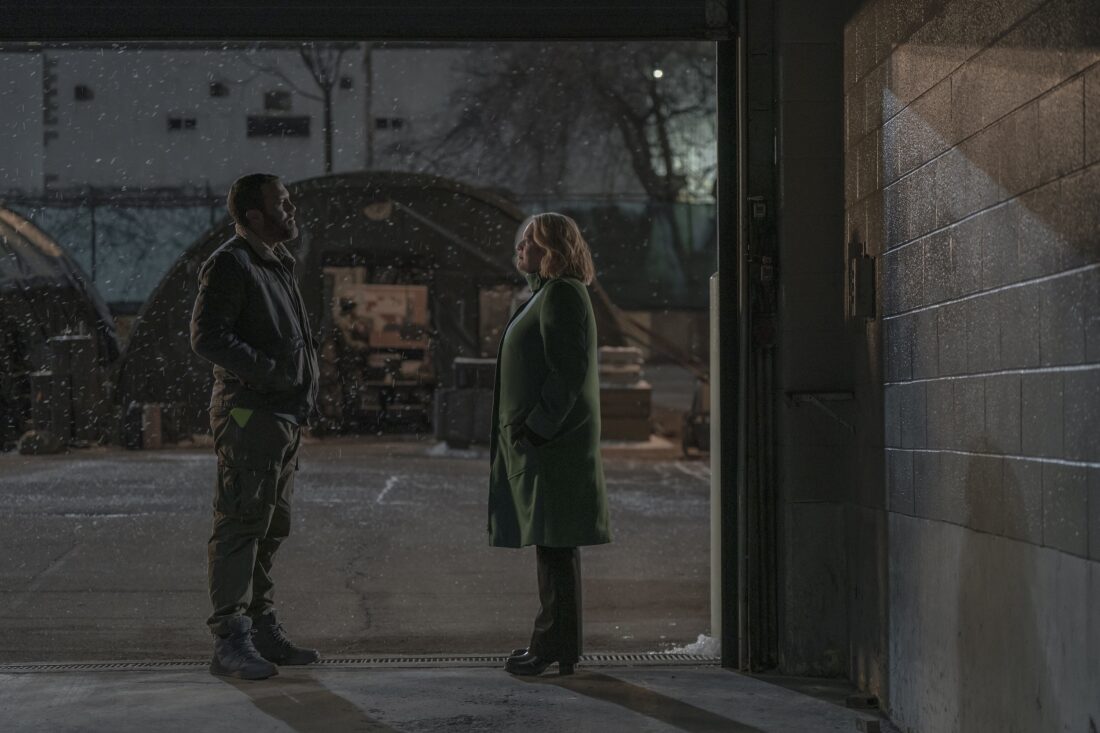
- “Meet you there?” is a much better sendoff for Luke and June versus her and Nick’s “see you later”s.
- Mark Tuello wryly admitting that his formal title is Commander was a chilling little joke. Words can certainly be reclaimed, but it’s a keen reminder of how power tempts normal men. And considering the lingering look he was giving Serena, perhaps her third husband will also be a Commander…
- I’m hoping that part of June’s decision to record instead of writing it all down is keeping her audience in mind: Hannah/Agnes may not be able to read by the time she gets to discover The Handmaid’s Tale, so this is the best way of ensuring that her daughter gets to hear her mother’s story.
Setting Up The Testaments
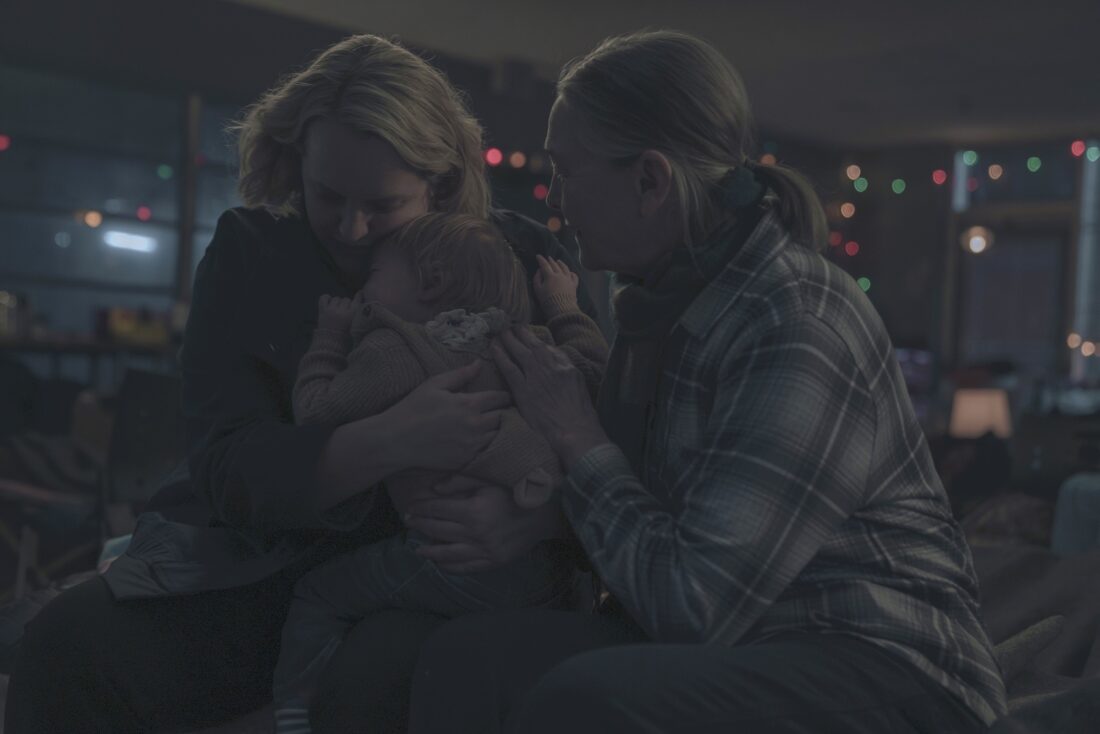
- The visual of June reaching across time to hold hands with an older Hannah/Agnes seems to indicate that the two will connect in some way in The Testaments, even if it’s only through her Handmaid narratives.
- The series’ two young leads (in addition to Ann Dowd returning as Aunt Lydia) are Agnes (Chase Infiniti) and Daisy (Lucy Halliday). I think that Daisy being described as “a Canadian teenager whose life is turned upside down when she learns of her connection to the Republic of Gilead” should make it clear to even non-book readers who she is. Though that would seem to imply that she never gets reunited with her birth mother, if she doesn’t know where she came from.
- I wonder if Noah will become a prominent character in the series, since he’s gotten so much airtime here. Though honestly he and Serena will probably fade into obscurity. It’s more likely that we’d see Nick’s unborn son. While The Testaments book focused so much on Gilead’s first full generation of future Wives, I would be very curious to watch how Gilead raises its future Commanders, especially with many of their fathers killed in season 6. Not to mention that he’s Daisy’s half-brother…
- Agnes’ father getting hastily promoted to Commander following the DC bombing will no doubt elevate her family’s standing in Gilead, which should add some interesting drama to how her character is perceived by her peers and authority figures like Aunt Lydia.
- What I hope the showrunners do is really lean into showing us how Gilead has doubled down on itself in the past 15 years, by embedding viewers into the culture of daughters being trained to be Wives (or Aunts): the clothes, the adolescent psychodramas, whether the Serena Joy Waterford library ever got built (I’m going to guess not).
- Do we really buy that Gilead would welcome Aunt Lydia back in after she publicly called out all the Commanders? All of those male witnesses are dead, so there’s a chance the new crop of Commanders don’t realize the extent to which she’s been radicalized. While her initial role in The Handmaid’s Tale was a grotesque take on an authority role, hopefully she will redeem herself in The Testaments by acting as a proper aunt to the impressionable young women under her eye.
Thanks for reading along all these years. I’ll be back to talk about The Testaments (whenever it airs) and hope you’ll join me in returning to Gilead to burn it down once and for all.