






Welcome back to Reading the Weird, in which we get girl cooties all over weird fiction, cosmic horror, and Lovecraftiana—from its historical roots through its most recent branches.
This week, we cover Kelly Link’s “The Specialist’s Hat,” first published in 1998 in Event Horizon. Spoilers ahead!
“When you’re dead,” Samantha says, “you don’t have to brush your teeth…”
Claire and Samantha are identical twins, ten years and two months and three days old. Numbers, they know, are significant, and they record them in an address book that belonged to their mother. Their mother has been dead for exactly 282 days. The house where they’re spending the summer with their father is called Eight Chimneys. It’s over two hundred years old. It has eight chimneys, and exactly one hundred windows. Close-growing trees stain all entering light a ghostly green. Also, it’s haunted.
Their father is writing a history of the house and of Charles Cheatham Rash, a poet who lived there a century before. Rash ran away to sea at thirteen, returned at thirty-eight, married, had a daughter. He wrote obscure bad poetry and an obscure bad novel called The One Who Is Watching Me Through the Window. After his wife’s death, he and the daughter disappeared for good. Mornings the twins’ father types in the library. Afternoons he walks in the woods with a recorder and hip flask, alone.
Samantha and Claire prefer to stay inside anyway. Mr. Coeslak, the caretaker, has told them to avoid the woods, where there are copperheads. They can explore the house, as long as they avoid the locked attic. Coeslak also lets them to tag along when tourists visit, listening to his stories
One story about Eight Chimneys is that its owner had an unfaithful wife. So he killed a snake and gave her whiskey doctored with its blood. An island man who’d been shipboard with the owner taught him this magic. Snakes “created” in the wife and crawled between her flesh and skin, hollowing her out until she died.
At dinner their father recites Rash’s poetry. One poem describes a woman in the woods with lips like “two red snakes” and lewd, burning eyes. But Rash’s most famous poem, “The Specialist’s Hat,” is actually plagiarized from a spell that a shipmate used to conjure whales. When that man drowned, Rash claimed his chest and brought it back to Eight Chimneys.
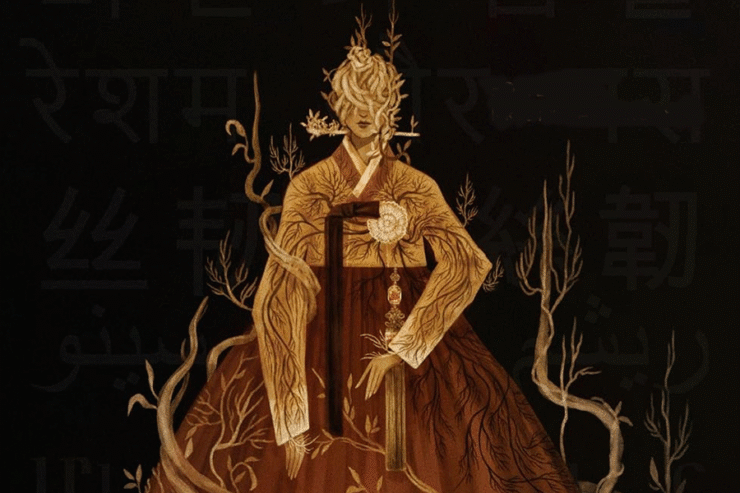
Supposedly, the Specialist’s Hat made noises like many animals, from an agouti to a whale. Rash’s poem ends: “I have hung the hat of the specialist upon my wall.”
In the woods, the twin’s father meets a woman who’s a distant relation of Rash’s. They plan a picnic supper under the stars. As Mr. Coeslak doesn’t stay in the house at night, he says he’ll find a babysitter. Sure enough, though Coeslak isn’t to be found, the babysitter arrives precisely on time. At first they take her for an adult, but as she plays card games with them and even lets them mummify her in toilet paper, they feel she’s little older than they are.
Buy the Book
Just Like Home
Accordingly, they share with her their private make-believe play, the Dead game. Rule One: Numbers are significant. Rule Two: Never play the Dead game in front of grownups. Rule Three, the most important: When you are Dead, you don’t have to be afraid of anything. The babysitter has confided that she lived in Eight Chimneys as a child, in their very nursery room. To prove it, she helps them find a key hidden in their fireplace.
The key opens the attic door. The babysitter says her father used to lock her in the attic, but she didn’t mind. There was a bicycle that she’d ride around the chimneys rising like trees through the attic floor, so fast the Specialist couldn’t catch her. The Specialist, she replies to Samantha’s question, “wears a hat. The hat makes noises.”
The three go into the attic, where there’s indeed a bicycle, and a lumpy black object the babysitter insists is the many-voiced Specialist’s Hat. To Samantha, it nickers like the horse she longs to own. After the babysitter’s father made the hat, the Specialist took him away. The babysitter escaped by hiding in the nursery chimney. Wasn’t she scared? Claire asks. “Rule number three,” the babysitter replies.
Though the hat’s brim is ornamented with teeth from animals and Rash’s wife, Claire dons it. She mounts the rusty bicycle and chases Samantha and the babysitter around the chimneys. The babysitter recovers the hat, but it bites her, then thumps downstairs and vanishes.
The three retire to the nursery, where the babysitter tells the twins how much easier it is when you are Dead. And then she shows them “exactly what she means.”
***
Later Samantha realizes she’s now stuck “indefinitely between ten and eleven years old.” Stuck, too, are Claire and the babysitter. She wonders if she’s made the right decision and if her mother would have chosen to be Dead instead of dead, given the chance.
Outside, Mr. Coeslak calls their names. He’s been locked in the tool room, by “Goddamn spooky things.” Are they all right? Is their father there? The three girls wave at him from the window. Maybe he sees them, because he goes away. Soon, the babysitter warns, he will come. They hear something creeping upstairs. It’s the Specialist, the babysitter says.
The Specialist’s voice, calling Claire and Samantha’s names, is “blurry and wet.” It sounds like their father, but can’t the Hat imitate any sound? The babysitter urges them to retreat to the attic via the chimney. She goes first, showing bricks that afford climbing holds. Claire follows. Samantha stays behind long enough to hear the Specialist reach the nursery door, where it complains it’s been bitten by a “goddamn snake.”
Then she too ascends the nursery chimney.
What’s Cyclopean: Everything is snakes, except snakes, which are women. Or in women. Ew.
The Degenerate Dutch: Mulatuppu, the ostensible source of the Specialist’s Hat chant, appears to be an island in Panama inhabited by the Kuna people. Most search engine hits are for transcriptions of oral storytelling: sometimes about snakes, not generally about the mimicry skills of hats.
Weirdbuilding: Link’s stories are often described as “slipstream,” yet another overlapping locale on the non-Euclidean map of weird fictional territories.
Libronomicon: Samantha and Claire’s father is writing a history of Charles Cheatham Rash, who in his turn wrote three volumes of poetry and The One Who Is Watching Me Through the Window. None of these appear to be tomes for the ages.
Madness Takes Its Toll: The boundary between mental states is no clearer in this story than any other boundaries.
Anne’s Commentary
The Weird’s editors preface this story with the comment that it’s “technically as perfect as Shirley Jackson’s ‘The Summer People’ and showcases the effortless complexity of Link’s fiction.” The VanderMeers are right on both counts, especially in the comparison to Jackson. Thematically, however, “The Specialist’s Hat” reminds me more of another Jackson work.
The overwhelming presence–and malevolent agency?–of Eight Chimneys recalls Hill House. I think too of Hugh Crain’s two young daughters, recently motherless and immured in a vast house with a father who stocks their imaginations with horrors. Claire and Samantha, similarly “half orphans,” wander an Eight Chimneys as darkly encompassed by woods as Crain’s mansion is by its hills. Crain indoctrinates his daughters with his twisted version of Christianity, while Claire and Samantha’s father recites Rash’s “bad, obscure poetry” every night at the dinner table. Excerpts of what I take to be Rash poems are sprinkled at (only apparent) random through the story. They’re “obscure” in three meanings of the word: (1) dark, (2) not readily understandable, and (3) little known. Most tourists probably visit Eight Chimneys for the architecture. Even the twins’ father comes across as an academic scrounging for a subject no one else has exploited rather than a Rash fanboy. I guess he becomes a true believer after seeing the orange-eyed probable inspiration for Rash’s The One Who Is Watching Me Through the Window.
Brief aside: For me, “Specialist’s Hat” also recalls Edith Wharton’s “Afterward.” In that story, a couple sojourning in an English country house are assured it does have a ghost, only it’s a ghost they’ll only recognize as one afterward, as in when it’s too late. Link introduces us to her ghost on page one, but why should we suspect that innocuous-seeming babysitter? According to classic horror movies, babysitters are monster-bait, not monsters. The deftness with which Link drops clues to the sitter’s nature is ample matter for an essay of its own!
Back to Hill House. The idea of death as an entree into a more desirable existence figures in both the novel and Link’s story. Eleanor’s gradually seduced into the semi-conscious belief that to die in Hill House will deliver her to longed-for home and community. Claire and Samantha, struggling with the loss of their mother, develop the Dead game, in which being Dead confers freedom from mundane constraints and, most importantly, from fear. Rule Three: “When you are Dead, you don’t have to be afraid of anything.” The babysitter who will turn out to be the ghost of Rash’s daughter tells the twins they’re right. Rash, a worse magician than he was a poet, used his islander shipmate’s lore to create the Specialist’s Hat, and the Specialist came to “take him away.” Rash’s daughter escaped by hiding, and no, Claire, she wasn’t scared of the Specialist because Rule number three.
In actual Death, the twins too can be unafraid. They can trust the babysitter because of a Rule she introduces: “When you’re Dead, you’re not allowed to tell lies.”
Claire spots the catch to this Rule: Because when Dead you’re constraint-free, you can lie if you want to. A fatal corollary doesn’t occur to Claire or Samantha: Constraint-free, you can also believe a lie if you want to. A lie like the babysitter’s: If she’s Dead and unafraid, even of the Specialist, why does she always run and hide from it?
Is crucial Rule Three untrue, then? And, by the way, what is the difference between being Dead and being dead? Best I can figure: If you die and choose to become a ghost, you’re Dead. Whereas if you die and don’t become a ghost, you’re dead. Lower-case, an inferior state. Or is it a superior one, because the dead are truly unafraid, being without consciousness?
Numbers have significance, which is why Samantha likes them. Take the number 8, she reasons post-life. Upright, it looks like a woman. On its side, it looks like a snake looped over itself to take its tail into its mouth. Ouroboros, the symbol for infinity, or to put it another way, of the eternal cycle of life and death, destruction and recreation. In the woods around Eight Chimneys, there are copperheads, venomous snakes, and there is a snake-lipped woman. Is she the ghost of faithless Mrs. Rash, snakeblood-cursed by her husband to combine the human and the ophidian, the feminine and the phallic-symbolic? Eve united with the Serpent that can speak in more than one voice?
See how Ouroboros-convoluted we can get with this story, and I haven’t even tried to figure out what the Specialist is! The island man Rash met on his last ship practiced a sort of specialty, summoning whales and presumably other creatures via his many-voiced hat. Did Rash bump him overboard to steal the magic lore in his trunk? Is he now a ghost periodically invading Eight Chimneys for revenge?
This is one terrible and beautiful hell of a story, as never-ending as Samantha’s favored lazy-eight or autophagic snake!
Ruthanna’s Commentary
Lovecraft described his priority, in writing a story, as invoking mood. This is a common approach to horror in general, and an even more common approach in the weird. If you don’t successfully convince the reader that something, well, weird, is happening, perhaps you haven’t written weird fiction at all. And the more successfully weird you get, the more confused the reader may be. This is, after all, a subgenre one of whose central assumptions is that there are things beyond human ken. And there’s a balance—writing stories that you hope humans will want more of—that places the reader just the right side of the boundary between mere frustration and unfulfilled curiosity, awe, attraction/repulsion.
Kelly Link specializes in that boundary. I therefore now face the challenge of coming down on the right side of the boundary between saying useful things about a story, and just typing “Wow, that was amazingly weird and creepy!” over and over until I hit word count.
Wow, that was amazingly weird and creepy! Wow, that was amazingly weird and creepy!
But what kind of weirdness is it, exactly? It doesn’t bend well to my human categories. There are strange children, whose strangeness may have supernatural components or may just be a natural response to their mom dying abruptly less than a year ago. There’s a neglectful father becoming strangely obsessed with a house and a poet and an unseen woman, all of which may have supernatural components or may just be a natural response to his wife dying abruptly less than a year ago. There’s the terrible poet, who may also have been a terrible magician. There’s the babysitter and the unseen woman in the woods, who are probably ghosts but could be something stranger than ghosts. There’s the distinction between dead and Dead, and the line that both babysitter and twins may have crossed (maybe by force or maybe by choice). There are snakes. So many snakes. Mostly, but not exclusively, metaphorical snakes.
Choose your own interpretative adventure on each of these points of uncertainty, and get a slightly different story. Therefore this story contains well over 500 possible stories. Yes, I calculated that, in a vain attempt to impose comprehensible human analysis on the incomprehensible.
A different approach: what disturbs and intrigues me most? Not the Specialist’s hat, nor the Specialist, both of which I forgot to include in the above list of ambiguities. I was more drawn by the twins, whose world has been so turned inside out by mundane trauma that the line between normality and weirdness is already lost before it’s crossed.
The mystery of the dead poet, and the snippets of his terrible poetry, also attracted and repulsed me. There’s something about transcendently bad poetry that draws by the sheer degree to which sincerity overwhelms artistry. (“For the stronger we our houses do build, the less chance we have of being killed.”) What sort of sincerity, then, leads Rash to declaim: “Your eyes sink in, your flesh decays. You grow accustomed to slowness; expect delays.”?
“At least the novel isn’t very long,” says the twin’s father, a review to match “This book has nice wide margins.” But something is watching him through the window, so perhaps he ought to read the book more closely after all.
Or throw it away swiftly, if it’s the sort of book that one suspects a terrible poet-magician–who uses his wife’s teeth in hatmaking–might produce.
Next week, we continue N. K. Jemisin’s The City We Became with Chapters 2-3, in which it appears we’ll meet Staten Island.
Ruthanna Emrys’s A Half-Built Garden comes out July 26th. She is also the author of the Innsmouth Legacy series, including Winter Tide and Deep Roots. Her short story collection, Imperfect Commentaries, is available from Lethe Press. You can find some of her fiction, weird and otherwise, on Tor.com, most recently “The Word of Flesh and Soul.” Ruthanna is online on Twitter and Patreon, and offline in a mysterious manor house with her large, chaotic, multi-species household outside Washington DC.
Anne M. Pillsworth’s short story “The Madonna of the Abattoir” appears on Tor.com. Her young adult Mythos novel, Summoned, is available from Tor Teen along with sequel Fathomless. She lives in Edgewood, a Victorian trolley car suburb of Providence, Rhode Island, uncomfortably near Joseph Curwen’s underground laboratory.


I live a few miles from the Blue Ridge Parkway offhandedly mentioned in the story.
Wow, that was amazingly weird and creepy! … and ambiguously close to home …
The Blue Ridge Parkway is really beautiful. I’d give anything to be able to pull off and see such a house. Though I’d have to assume the house would be seeing us back. And comes with a groundskeeper who must be in on it. Otherwise why would he suggest a Dead babysitter?
I’m caught up on the hat that can sound like anything – and was so beautiful and casually and creepily described. What was Rash trying to attract when his unfaithful wife became an ingredient? Perhaps another woman, who would be a prize to him just as a whale would be to the shaman on the sea? Could the Specialist be any man on the hunt, seeking something without care or passion? That’s why father became the Specialist – not in that sort of misidentification that happens in stories, but because he’s now the one looking for acclaim in a field he gives little regards for, yet is still fine all but abandoning his children?
I just want to say that Kelly Link is fantastic.
My hidden shame is that I always get frustrated reading Link- everyone I respect loves her! So spooky and weird! But I’m analytical and when story elements are teased but not fulfilled, it’s physically irritating. Like an itch I can’t scratch.
So it was very, very comforting to see two bright women I respect also notice the incomprehensible bits, even if you don’t find them obnoxious. You also, as always, presented the story with enthusiasm and insight, and helped me appreciate Link’s skill. Thank you.
For any of you who haven’t yet read it, I’d like to note the story is available free on Kelly Link’s own website, at:
‘The Specialist’s Hat’ (https://kellylink.net/specialists-hat)
I’ve been obsessed with this story for something over 20 years now.
I don’t remember exactly when I came across it, but it was back in that earlier age of Internet before Facebook and Twitter. My social networks were email and Usenet, I was still using sig quotes on them, and for a long long time that quote was:
I reread the story from time to time, and each time I feel like I figure out a little bit more about what makes it work.
On one of my last rereads, I finally understood that what makes the scene in the attic so spooky. By putting the hat on, Claire has become the Specialist, so her chasing them on the bicycle (closer and closer) is a scene of real danger, until the babysitter knocks the hat off her, and the hat bites her hand and rolls away downstairs. It’s all dream logic, primary process thinking, but it all coheres in that way.
Perhaps 15 years ago or more when Google still really worked, I tried searching “Mulatuppu” and a couple other words from the Rash poem as our hosts may have done, and stumbled on an academic paper containing the words of the original spell – yes, there was one! – an actual chant from magic-workers among the Kuna people. One kind of their magic workers/healers, it seems, have a title usually translated as ‘Specialist’. This chant had many of the same words about the “Specialist’s Hat” and the types of animal sounds it can make, and ended with the words “I have hung the hat of the Specialist on my wall.” It was quite a joy to find this piece that might have been a seed for this story, and to know that that oblique truth (about the stolen poem) is part of what makes the story tick.
(Alas, it doesn’t seem like it’s possible to find that source any more or at least not for free – using a similar collection of search terms now just takes you to academic paywalls at different universities.)
Finally, if you enjoyed this story, another incredible Kelly Link story is also online at
‘The Girl Who Did Not Know Fear’ (https://tinhouse.com/the-girl-who-did-not-know-fear/)
I love this story and find it fascinating because it seems to be a conventional “lit fic” slice of life kind of story from the start, telling about entirely mundane events. If you read it carefully, by the end you may know it’s something completely different, and yet it’s hard to figure out exactly at what point you knew and how you know. (Then if you reread, you can see the story laid it out overtly for you, in plain view, much earlier on, but you didn’t see it as such.)
Thanks, and I hope you enjoy reading through these thoughts as well as the fiction.
Iris @@@@@ 4: I’ve felt this way in the past as well. This time, I found that the broad reading I’ve done for this column gives me more context for slipstream, and for better appreciating the lack of resolution!
Iris @@@@@ 4: I’m glad to hear I’m not the only one who doesn’t like Kelly Link’s stories. I wouldn’t describe them as physically irritating, but I find it very unsatisfying how they never seem to cohere.
Arrgh.
A while ago I submitted a long comment about this story and my great fondness for it, and it got held for moderation (because it had multiple URLs, I think) and then eventually released.
Then I saw a minor error in it, I foolishly tried to make a small edit to it (correcting “Samantha” to “Claire” or vice versa), and it vanished again, possibly held for moderation again. This time it seems to have vanished forever. Well. If the secret guardians of this site wish to release it, I would not be displeased but I won’t count on it.
I won’t repeat the whole thing – I couldn’t – and I will avoid including URLs this time, but I do want to let you all know that the entire story is available to read free on Kelly Link’s website (which your favorite search engine should find) and say that in my opinion it is worth many rereadings over a long period of time – I gradually find more in it on each reread.
Finally I also highly recommend Kelly Link’s more recent story ‘The Girl Who Did Not Know Fear’ – also free online, search for it as I don’t want to give an URL – which does some equally fabulous things with narrative and also is well worth multiple rereads to appreciate and to understand how it does what it does.
Last point of interest: There really was a magical chant from Mulatuppu about “The Specialist’s Hat” and the sounds it makes, recorded in an academic paper which at one time could be found by a Google search, but apparently not any more. Worth reflecting how that relates this story to the contents of Rash’s poetry & the reader to the father.
CliftonR @@@@@ 8: I can see it as comment #5!
R. Emrys @9: It reappeared! Hooray!