






Walt Disney had never hesitated to tweak his source material while developing animated films. He and his animators happily added and subtracted characters and events, tinkered with characters and character development, and to a certain extent even played with the settings and backgrounds, especially in Cinderella. In some cases, as in Pinocchio, this was in part to ensure that the original source material could be squeezed into a 75 minute adaptation. In other cases, as in Bambi, this was to add plot to what was otherwise a mostly introspective, philosophical work. And in still other cases, as in Cinderella, this was to flesh out a very short story into a 75 minute adaptation. But even in these adaptations, Disney had, for the most part, been true to the main plot and building blocks of the story.
This was to greatly change with Sleeping Beauty, so transformed that in many ways it’s not even the same story at all. And I’m not just talking about taking out the uncomfortable, quasi-rape bits and the ogre. That willingness to completely transform the original story was to fundamentally change the direction of Disney animation.
But before we get to that, a note or two about the most important non-story factor that shaped Sleeping Beauty: the film. And by this I mean the actual celluloid film. The most important technical thing to know about Sleeping Beauty, if you care about these sorts of things, and even if you don’t, is that it was the first Disney feature to be filmed on 70 mm film—more or less the 1950s equivalent to IMAX. For non-technically minded people like me, this means two things: one, the film looks fabulous, and two, 70 mm instead of the standard 35 mm forced Disney animators to put an incredible amount of detail into the work.
(For the most part, I’m going to avoid recommending specific editions of any Disney films. In this particular case, however, be aware that some previous DVD releases of Sleeping Beauty are in the wrong aspect ratios. The more recent platinum and diamond editions restored the original aspect ratios, so if you are still holding on to a 20th century release, this is one case where it’s probably just as well to give into Disney’s ongoing How Can We Reach Into Your Wallet This Time and invest in the more recent versions. And now back to the post.)
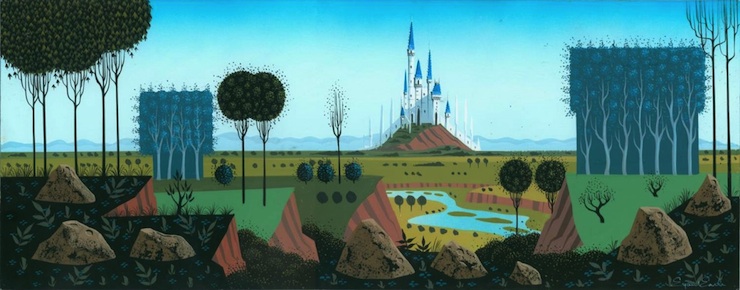
I said “animators,” but what I really meant was “Eyvind Earle,” who not only designed the general look of the film, but almost single handedly created all of the backgrounds for the film. I said “created,” but what I really meant was “drew and painted by hand,” filling out paintings and designs inspired by the unicorn tapestries still on display at the Cloisters in New York City.
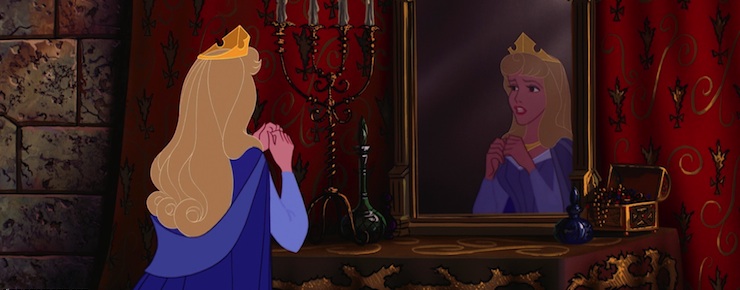
If you can, stop at any point just to marvel at the details: the way even some of the square trees in the distant background have individual leaves and all of the carefully painted individual flower petals in the forest scenes; the way each and every stone in Sleeping Beauty’s castle looks different: the images in the tapestries and banners; the pebbles on the floor in Maleficent’s dungeon. Or the scene where Aurora is crying in her castle bedroom: the detail is fine enough to suggest the actual weaving and stitches in a tapestry, several wall hangings and the rich embroidered cloth on the furniture (with details obvious in the painting). The chandelier and the candelabra are clearly made of different metals. The wooden beams well in the background are given individual grains. And then realize that Earle did all of this almost single handedly over the course of a few years—the equivalent to at least 60 multiple, massive fine art paintings. It was the most detailed, beautiful background work Disney had yet created: even the closest comparisons, Pinocchio, Fantasia and Bambi, never went into this level of detail.
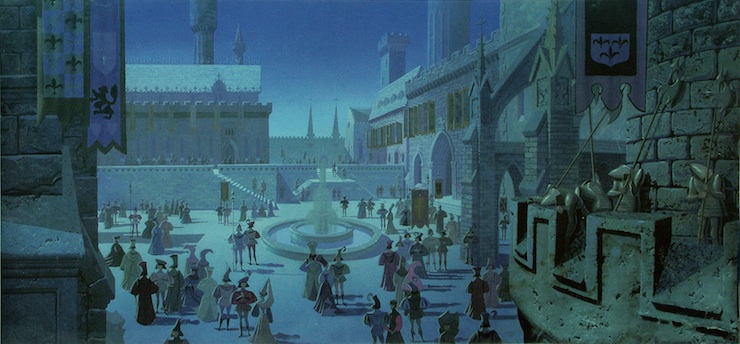
It also created headaches for nearly everyone else involved in the film, not all of whom were the sort of film buffs excited about the technical advancements created by 70 mm film. For one, creating that kind of background work by hand and painting all of the animation cels by hand (done by different artists) took time. About four years of time, part of why Sleeping Beauty ended up costing $6 million to produce—more even than Peter Pan, which also had strikingly beautiful background paintings and hand painted cels and ran over budget at $4 million.
For two, this created headaches for animators, who had to design characters who could visually fit into this detailed, angular world. This was not a cartoon background, and so the round, cartoon like creations that had featured in previous work could not, for the most part, be used—even in the scenes focusing on cute animals. Not that the final characters exactly looked realistic—but they were, for the most part, formed of triangles and sharp colored lines, in contrast to previous films. And, complained animators, difficult to bring to life.
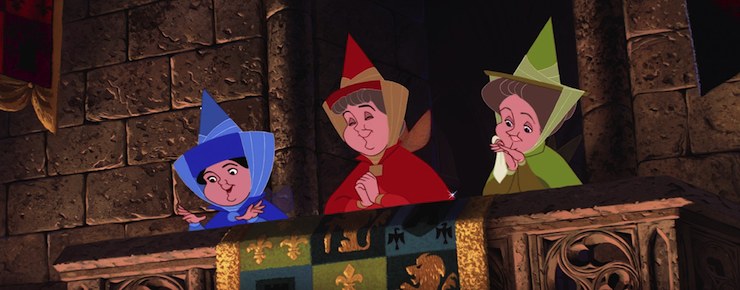
This was not a completely new innovation—Alice in Wonderland has some of the same sharp, angled characters, as does the second half of The Adventures of Ichabod and Mr. Toad. But in those films, the sharp, angled characters stand out as oddities against a usually softer background. Here, it’s the round, cartoonish characters—the three fairies, one of the kings, and two cute bunnies—who stand out—not as oddities, precisely, but as just a bit different. The bunnies, after all, are bunnies. King Hubert is a comic figure—though to be fair, so is the drunken minstrel who appears with him. And the fairies—well, they are magical. And maybe a bit just more than that.
Which brings us to the story, where Disney faced an entirely different problem: in almost all of the original stories, Sleeping Beauty does very little except, well, sleep.
Snow White, after all, escapes to the woods; Cinderella dances; Beauty heads to the Beast to save her father; the unnamed princess of the Princess and the Frog tosses her ball into a well, and bargains to save it; and the little mermaid, as we’ll see, does quite a lot. Sleeping Beauty simply falls asleep. Even in long Tchaikovsky ballet, she falls asleep in the middle of the first act, and spends most of the second act asleep, although she does at least get to dance at her wedding. In one of the original tales, about her only action is to do a strip tease—at someone else’s orders—which was not really the sort of thing Disney was looking to include in its 1950s animated films. She is continually acted upon, not acting, and that created a problem for animators trying to create a story for her.
So instead, they decided to make the story about the fairies and their antagonist, Maleficent.
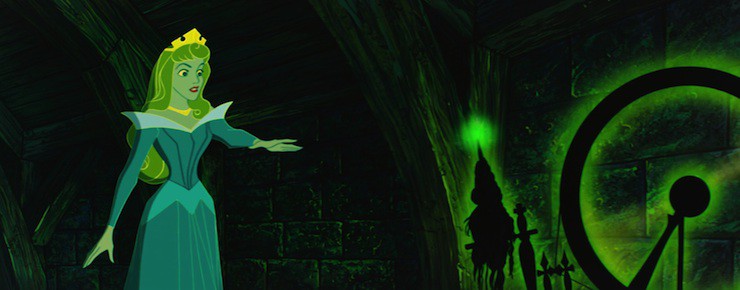
This choice did have the unfortunate side effect of turning the titular character into arguably the blandest of the Disney princesses, and certainly the one who does the least to earn her happy ending. This does work in her favor at least once, when Aurora’s already bland face barely moves as she climbs up the stairs, following Maleficent’s sickly green light. The stillness of her face—admittedly more a side effect of the animation than the character—just adds to the horror, helping to create one of Disney’s most terrifying animated scenes since Chernobog in Fantasia.
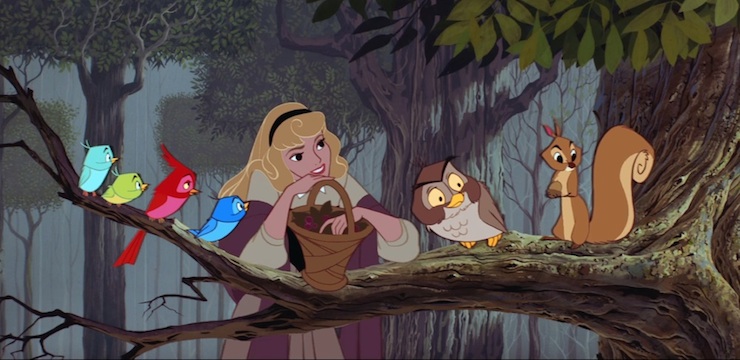
But that terrifying moment doesn’t make Aurora/Rose any less boring. I can’t even handwave this by pointing out her innate goodness: unlike Snow White and Cinderella, who grew up in hellish family situations with very little kindness, let alone morality, Aurora has been raised in a supportive, loving atmosphere by three good fairies. She has no reason to turn evil, so her innate goodness seems more a gift than something earned. Oh, sure, she’s not allowed to meet anyone else, or have friends her own age—and in some ways, that’s one of the most awful things that can happen to anyone. But she’s not completely alone, either, and her dancing, singing and elegant curtsey suggest that the fairies haven’t completely neglected her court training and education. And yes, those fairies have lied to her about her heritage—or perhaps just failed to tell her the whole story—and she is devastated when she finds out the truth. But her bout of weeping seems to stem less from finding out that the fairies have kept some rather important information from her, and more from finding out that she’s not going to be able to marry a guy she’s known for a grand total of five minutes, which, yes, I’m all about love at first sight, especially in my animated films, and the girl’s only sixteen, but, perspective here.
The one thing that is slightly puzzling: given her isolation from, well, pretty much everyone, I would have expected her to be just a little bit more shocked during her meeting with Prince Philip. Oh, she’s a little shocked, but this is the first man, let alone prince, she’s ever met, so, really, more shock seems called for here. But then again, as the film keeps reminding us, she’s just sixteen, so it makes absolute sense for her to fall in love instantly with a good looking guy, especially since she hasn’t met anyone else, especially since he can sing and dance, and especially especially since he wears the sort of boots that bunnies can’t resist stealing. And especially especially especially since she’s so unused to meeting new people that she doesn’t even notice the difference between the touch of a boy and the touch of an owl until Prince Philip starts singing to her.
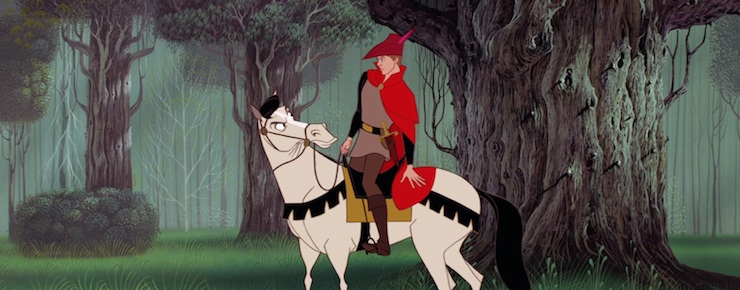
Speaking of Prince Philip—well, yes, it’s true and perfectly understandable that many viewers prefer his horse. (I may be part of that group.) He is, however, definitely a step up from Disney’s two previous princes, if only because he gets to do more than simply meet a girl and kiss her—or dance with her. He talks to his far more interesting horse. He has—gasp—an actual conversation with his father. He gets captured by a woman.
And he gets rescued by three women.
And then the four of them fight a dragon.
In another post on this site, Leigh Butler argued that Sleeping Beauty is Disney’s most feminist animated film. I tend to agree, though I disagree with her that this happened accidentally: it’s a direct result of adapting a story where all of the literary versions feature at least one, and often several, women with agency and power, who are, for the most part, a lot more interesting than the sleeping protagonist princess.
But it’s still remarkable that a film that features three plump, middle aged women rescuing a prince from a dungeon and helping him fight a powerful dragon—who just happens to be a powerful woman in her own right—also just happens to be a film developed in the 1950s that otherwise contains some rather mixed messages about women’s roles. To start with, for instance, in order to protect Aurora, the three fairies need to give up their magic—that is, their jobs—and retreat to a house and focus on domestic duties, like, not subtle, Disney. In a later scene, the three fairies struggle to make a dress and bake a cake by hand.

Sidenote: this scene kinda makes me wonder what, exactly, they’ve been doing for the past sixteen years—ok, dressmaking skills take some time to develop, and I wouldn’t expect any of them to be expert pastry chefs, but still, they should be better than this, as hilarious as the scene is. And I’m a little worried about Merryweather’s observation, 16 years into protecting Aurora, that Fauna has never cooked. Who, exactly, is cooking the meals in this cottage? Let’s hope Merryweather or Flora, especially since Fauna’s idea of cooking includes folding in eggs with the shells still on.
Anyway. Eventually, they give up, and turn to magic—read, appliances and other labor saving devices—which allows Maleficent to find them.
The message: women are safe if they abandon their professional work and labor saving devices for domestic, labor intensive work. It’s a logical progression, perhaps, of both Snow White and Cinderella, which also suggested that women could earn their happy endings through housework. It’s also a rather uncomfortable message in a film where a sixteen year old girl is told that she must marry a prince everyone believes she’s never met—but a similar announcement from a twenty year old boy is greeted only with ineffective protests.
And it’s a message completely rejected by the film itself just a few minutes later, when it becomes clear that the fairies can only save Philip and Aurora from Maleficent by rejecting their ordinary, domestic selves (something they weren’t all that good at anyway) and becoming skilled, magical wielding fairies again.
The result: three kindly grandmother types saving the world. It’s pretty awesome.
Also, let’s all cheer Merryweather on for being able to come up with not just a spell to soften Maleficent’s spell, but an entire rhyme. On the spot. Under major stress. Well done, Merryweather.
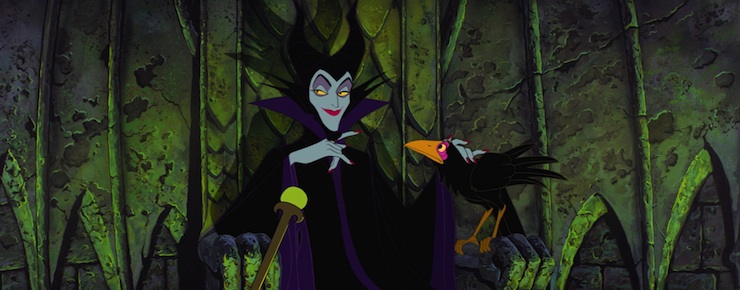
Also awesome: Maleficent, one of Disney’s most terrifying villains. And not just because she can transform into a dragon—a sequence animators later regarded as the one of the artistic highlights of the film. She has her weaknesses, certainly—for the most part, she’s really not good at hiring competent staff, with the exception of her raven. As the fairies demonstrate, she can be easily tricked for nearly sixteen years. And as one of the fairies says sadly, Maleficent probably isn’t really happy.
Moment of total honesty here: I feel for Maleficent, really I do. I mean, it’s not just that she didn’t get invited to the christening party and Merryweather is totally mean to her, but, honestly, having to deal with those minions must be incredibly frustrating. The moment when she finds out that her trolls are still searching for an infant sixteen years later is another highlight of the film, with her incredulous, “AN INFANT?” her shriek of “IMBECILES!”, and her heartbreaking realization that her goons are a disgrace to the forces of evil. My heart felt for her. Especially when she later—after all that—throws a party for them, which is incredibly sweet given everything that she’s gone through up until that point. Ok, she might not be great at finding competent goons during the hiring process, but three cheers for throwing an awesome office party for her largely useless goons afterwards.
Beyond throwing great parties, Maleficent quietly dominates every scene she’s in —partly thanks to her height, partly thanks to her black dress, which pops out against all of the brilliant colors of the film, partly thanks to the terrifying musical cues that accompany her wherever she goes. And partly because everyone in the film, except possibly her raven, is terrified of her. For good reason: unlike most of the Disney villains, Maleficent is remarkably successful. She curses Aurora, forces the royal parents to lose their child for sixteen years; puts Aurora to sleep; captures Philip; surrounds the capital with dark, tangled trees, blocking all roads and thus contact with other kingdoms; becomes a dragon; and almost, almost wins. Most Disney villains are brought down by a single antagonist, or their own hubris, or even not really brought down at all. Five people (I’m counting Philip’s much more interesting horse here) have to band together to defeat her—and they barely succeed.
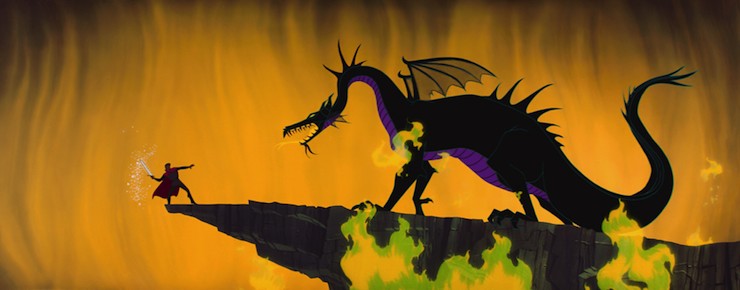
And, of course, she becomes a dragon. Maleficent was not Disney’s first or last animated dragon, and was arguably later eclipsed in popularity by Mulan‘s Mushu (if the number of plush toys is any guide), but she is one of their most magnificent creations, animated with rich, black and purple bitterness. That final confrontation was the most terrifying (and beautifully animated) sequence Disney had created since at least Bambi and arguably Snow White, and nothing would come close to approaching it for years.
But changing Maleficent into a dragon had another impact, well beyond this film. This was not, as noted, the first time Disney had altered the source material, but it was the first time they had altered the source material this much. The Perrault and Grimm versions, after all, have seven or twelve fairies, not three, and no dragon; Sleeping Beauty is asleep for one hundred years, not the single night of this film; the prince is never captured by the evil fairy, and only has to fight briars, not goons and dragons, to reach his princess. The real danger in the Perrault story comes afterwards, with the ogre mother in law; with Disney, once the dragon is defeated, all is well. It was the start of an increasing tendency in Disney films, with a few exceptions here and there, to not just tinker with but completely alter the source material, regularly changing the endings and, as we’ll see, many other things. Interestingly, with the exception of The Little Mermaid, going forward, the biggest alterations would be made to source material from books, not fairy tales, particularly with The Fox and the Hound, but we’ll get to that.
Since I mentioned the musical cues, we should also probably discuss one of the film’s other strengths: the score. Oh, not the syrupy song that Aurora sings and later dances to with Philip. That song has failed to reach the list of most popular Disney songs for excellent reasons. But the rest of the music, based on portions of the score that Pyotr Ilyich Tchaikovsky had composed for a Sleeping Beauty ballet. This was in part a cost saving measure—the score was not copyrighted in the United States, and using it saved Disney the cost of hiring a composer for the entire film. But it was also a brilliant choice that melded well with the film’s rich, quasi-medieval look and added emotional depth to multiple scenes. For several young viewers, it was their first (and perhaps only) exposure to Tchaikovsky at all.
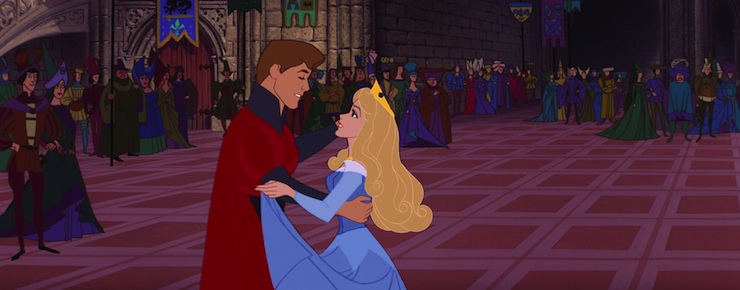
It’s only fair to note that some Tchaikovsky purists decried the result, especially when, decades later, Disney decided to trademark the term Princess Aurora, the name used in the ballet. As far as I know, Disney has not attempted to use the trademark to control or veto performances of the ballet, but that did not make this a popular move among Tchaikovsky scholars.
Oh, and trivia note: It’s also the only Disney film worked on by Chuck Jones, better known for his Looney Tunes/Merrie Melody cartoons over at rival studio Warner Bros, though he returned to WB before he had done enough work on this film to be credited.
Chuck Jones’ departure, however, did not affect the rest of the animation much: between the backgrounds and the animation—which also, for the first time since Bambi, featured multiple characters moving in the multiple scenes, a sign, perhaps, that having gone this far, Disney felt it might just as well throw more money at it—this was the studio’s best looking, richest film since the pre-World War II. Spectacular animation, adorable animals, splendid villain, narratively unnecessary dance sequences, cake ingredients hurrying to get themselves baked, syrupy songs, bunnies, a Disney princess—this may be perhaps the quintessential Disney animated film.
It was also a box office flop.
Whatever the reason—a lack of appreciation for Tchaikovsky, impatience with long scenes involving blonde girls singing to adorable animals hopping around in stolen boots, the decision to make three grandmotherly types the heroes of the film instead of the sidekicks, or the fact that, despite some amusing moments here and there, Sleeping Beauty is more remarkable for its beauty and emotional power than its humor—it flopped. Badly.
Decades later, Sleeping Beauty was to be recognized by many critics as one of the greatest of the Disney animated films, ranking with Pinocchio and Fantasia as the highlights of Disney animation until the computer age—a judgment that watching the films in order like this does seem to verify. But in 1959, Walt Disney had only his guts and box office receipts to guide him. Deciding that Sleeping Beauty was too emotionally cold, not to mention expensive, he ordered several changes.
First, he decided that Disney would slow down, just a little, on the costly animated films that never seemed to stay within the original planned budget. This was to be studio policy for nearly three decades until Jeffrey Katzenberg reversed it in the late 1980s. Second, Disney needed to retreat from fairy tales and focus on funny animals. That was studio policy up until The Black Cauldron, a financial disaster that was immediately followed by—you guessed it—films focused on funny animals. (This is also one reason why The Little Mermaid has funny animals.) Third, the beautifully detailed, hand painted backgrounds were out, absolutely out. This was occasionally fiddled with—mostly in The Jungle Book and one or two scenes in The Many Adventures of Winnie-the-Pooh—but in general remained studio policy until the advent of computer animation made the detailed backgrounds financially feasible again, as we’ll see in later films.
And fourth—if the animation studio planned to remain open, it was going to have to find some cheaper way of dealing with animation cels. Hand inking and hand coloring—all out. Absolutely, positively out.
One Hundred and One Dalmatians, another animation landmark, if for entirely different reasons, coming up next.
Mari Ness lives in central Florida.

This is my favorite of the “classic” era princess films. For one thing, it had actual action — fighting a dragon! For another, I had a bit of a crush on Philip. I thought he had a lot of personality (though, true, perhaps not as much as his horse), especially for a Disney prince. He had a sense of humor and a bit of life to him, and he was really hot while fighting the dragon. This movie got a theatrical re-release when I was in high school, and I’m a little embarrassed by how many times I went to see it at the theater. I really need to get this on DVD. This is one case where the Disney rewrite improved matters because this version is like 1000 percent less rapey than the fairy tale and improves on Snow White. The prince here isn’t just macking on a random sleeping/dead stranger because she’s hot and he’s into that sort of thing. He’s met her, they’re already in love, and he knows she’s under an enchantment, so the kiss is deliberate to break the enchantment.
I finally saw the ballet last fall and was surprised by how out-of-context all the music was. I’d been under the assumption that this film was based on the ballet. Fortunately, it isn’t, as hardly anything happens in the ballet — the princess is awakened in act two and act three is all their wedding celebration, as various storybook characters and other people come and dance at their wedding. The way they give Aurora something to do is with a big dream sequence pas de deux while she’s still asleep — the prince is being shown a vision of the woman he needs to find and save. But that “insipid” song (I’m rather fond of it, myself) is music from the ballet. It just isn’t any kind of big, romantic number. It’s an interlude in which the village girls dance. I found it funny how much of the ballet music I recognized from the film, and how very different the situations were where it was used.
I don’t have a lot of sympathy for Maleficent. For one thing, I’m more likely to go crazy with vengeance if I’m forced to go to a baby shower than if I’m not invited. That seemed like very weak motivation for such terrible vengeance. And has she maybe considered that she’d get more party invitations if her first response to every little slight wasn’t to cast fatal curses? No wonder she’s not high on the guest list.
I watched this again and again and again as a kid. I swoon every time I hear the waltz now as an adult! I had the movie’s companion book (big and glossy). I would pour over the book looking at the fine details, trying to insert myself in the scenery.
Love this movie – the music, the animation, the characters :) I never thought of Aurora as bland though, and I love ‘Once Upon a Dream’, so there ;) Certainly not the main focus of the film but I always saw personality in her interactions with the animals and the fairies…but you’re right in that the film is really not about her, anyway. Prince Philip is definitely one of the better Disney princes/heroes…maybe the best/most proactive until Aladdin?
Honestly, I always saw the thing that got them caught was not the fact that they turned to magic/appliances, but that they were fighting over the dumb dress color (it’s blue!).
I remember it was such a big deal to me that Maleficient says ‘hell’ in the movie, haha.
So what would Merriweather’s gift have been, do you think? I think she would have given her some sass/smarts :)
This was one of the only “princess” movies I owned as a child, along with the Monster VHS version of Cinderella. Unlike Cinderella, Sleeping Beauty was illicitly recorded from a premium cable channel onto VHS, immediately following our recording of the Tom Selleck Sci-Fi Horror Flick, Runaway. I had to sit through the terrifying scene of Gene Simmons being killed by his poisonous robot spiders to watch it, but sit through it I did, that’s how much I loved this one.
Once Upon a Dream? Favorite Disney song. Maleficient, favorite Disney villain(Gaston is second, because of the guy that plays him at Disney World). Merriweather, Best Fairie EVER
Count me as one who didn’t feel much sympathy for Maleficent; talk about an over-reaction!
That said, Maleficent one of my favorite villains; hell! I like her as much as Darth Vader – she’s so deliciously evil it’s fabulous.
Phillip’s horse continues a great tradition where the side kicks, especially animal ones, are often the best part.
Tchaikovsky’s Sleeping Beauty has gorgeous music in it but don’t forget that children would have been exposed to The Nutcracker as well; or at least, I was.
All in all, I love this one and remember when my mum took my brother and I to see it when it was released at some point. Didn’t notice the potential implication that women should stay @@@@@ home. This was probably due to the fact that I came from a family that didn’t believe in that nonsense.
Kato
@3
but that they were fighting over the dumb dress color (it’s blue!).
It’s Pink!
I remember it was such a big deal to me that Maleficient says ‘hell’ in the movie, haha.
Me too! This was my first “swear word” movie, it gave me a word that I got to say and get away with, because I had an annoying habit(still do) of reciting movies verbatim as I watch them.
A few years later, I read the book Hatchet, wherein I discovered that “damn” is spelled with an “n” and my potty mouth was born!
“Interestingly, with the exception of The Little Mermaid, going forward, the biggest alterations would be made to source material from books, not fairy tales, particularly with The Fox and the Hound, but we’ll get to that.”
Does Frozen not count for some reason?
I don’t think Mari will do Frozen, these are “Classic” movies 20 years and older, IIRC
@Everyone – the ReadWatch is going at least up to Tangled, including films in the “inspired by” category – Treasure Planet and The Princess and the Frog, but skipping films not based on a textual source – like Lilo and Stitch.
That puts four films into a questionable category. The Lion King is supposedly Hamlet, but I feel this is a stretch. The Emperor’s New Groove started out as an adaptation of The Emperor’s New Clothes, but certainly didn’t end there. Atlantis: The Lost Empire was supposedly inspired by Jules Verne, but again, a bit of a stretch here. Frozen started out as an adaptation of The Snow Queen, but the only thing the two have in common is that they both have a reindeer and they both have a character really into the whole ice thing. Having said that, Frozen has certainly become a major Disney film, so the ReadWatch might end with it.
@scipio Smith – Well, I’m not sure that Frozen really counts as an adaptation – it’s really closer to an original Disney story. That said, the two are at least still fairy tales. The adaptation of The Fox and the Hound virtually changed genres.
Does anyone else see the resemblance between the horses in Sleeping Beauty, Mulan, and Tangled?
I am with you on the Hamlet stretch; I think Lion King definitely borrowed some tropes/themes from Hamlet, but my understanding is that it wasn’t something they set out to do.
But I would love to see Frozen done since…yay, more posts :)
This is my favorite Disney movie. Maybe it caused a sub-conscious love of the Medieval. My baby’s nursery had a mural painted that was inspired by the backgrounds. I even have four small paintings of the cute animals on canvas that are painted to fit with the background. The Owl overlooked his crib and bed until just recently.
So the art works, even if the movie didn’t in the 1950s.
Totally agree with the Fairies. They are the stars. And how were they cooking and cleaning for years?
I also prefer Aurora in BLUE!!!! I’m always annoyed that the “Disney Princess” line puts Cinderella in blue, therefore Aurora has to wear pink. :-/
@11: Yes I do. When I first saw Tangled, I thought of Philip’s horse.
Funny how “Walt” was deemed an Author an OUaT, given that Authors are only supposed to record events as they occur.
Add me to the list of those who like Once Upon a Dream. It’s playing in my head as I type this.
It never ceases to amaze me how many things we’ve come to regard as masterpieces were considered failures in their own time.
My favorite as a kid (pre-Belle) and still in my top 3. And now? My four-year-old, who wants to be a train engineer/knight/rock star when she grows up, bounces between wanting The Princess and the Frog and Sleeping Beauty. Tiana, a working woman, or Aurora (and Maleficent). I feel like that, more than anything, proves its feminist credentials.
and my husband insisted we get the Bluray version. Because it’s gorgeous. Thanks for the tribute–I love this film, and it deserves all the kudos!
In regards to the various releases, I wanted to note that not only is the modern release in the proper widescreen format of the original, but was also restored in 2007 off the negatives, so the colors are far better than any release on VHS/DVD before that.
Maleficent is the best! The dragon is pretty much my favorite thing in all of film, and I have a lot of Maleficent stuff (I’m looking at a snowglobe with her perched on top of it right now, what a nerd). And I loved Philip also for being one of the only classic Princes who has any personality. But I like Aurora pretty much only because she’s in my fave Disney movie. Oh, today I also like that there are parents! unfortunately Aurora still doesn’t get raised by hers, but at least they exist.
One of the best parts of the Maleficent live-action film is the opening Disney title card where it’s Maleficent’s castle instead of Sleeping Beauty’s castle from Disneyland. That’s just so perfect.
I’m with @KatoCrossesTheCourtyard in that I never noticed the implication that women should stay at home. Probably because I grew up in a country where very few women do stay at home so it was not an idea I had in my mind as something normal.
Normally, I’m not a fan of changing the original source too much when doing an adaptation, but I was very happy that they gave Aurora a chance to meet and fall in love with the prince before falling asleep and that she slept only for one night. In the fairy tale it always seemed awful to me to wake up and have to marry a stranger…
And the dress is blue for me ;)
@3, 7, 13, 17: Are you sure the dress should not white and gold?
My favorite movie as well. Not entirely certain why, though I think the humor, while limited, is the sort of dry humor I’ve always appreciated. I also liked the fact that both Aurora and Philip had names. I hated princes being referred to as just “the Prince,” and Snow White and Cinderella both struck me as names that would really suck to be stuck with.
I’d never noticed how detailed the animation was before. It really is incredible.
As far as “Who, exactly, is cooking the meals in this cottage?” I thought it was pretty clear that it’s probably Merriweather. When the fairies are discussing the plans for Aurora’s birthday, her response is, “But I’VE never baked a really fancy cake before,” which seems a clear implication that she’s the one who’s always done the baking of past birthday cakes (and probably the rest of the cooking as well), and she assumed she would do it again as always. They only let Fauna do it because “She’s always wanted to, and this is her last chance.” Clearly, Fauna has watched Merriweather bake before, and assumes that it’s easy because she’s never tried it before.
And yes, the dress is BLUE. It was clearly blue when they finished the dance and closed the book on it. (Though given how childish both of them were in that scene, I felt Fauna should have done a “Make it green” and then sent both of the others to their rooms.)
This has always been my favorite of the classic princess films. Probably because it is the first one I remember seeing, although probably not on its first release. I remember in those days that the matinees had a cartoon, a nature film of some kind, and then the main feature. And that one of the only buildings in town that had air conditioning in the summer was the movie theater.
Princess Aurora was OK to me, but what made the movie special was that Malificent felt like a truly powerful villian. I felt a real sense of jeopardy when Prince Phillip went to rescue Aurora. And that battle with Malificent in dragon form was one of the scariest and exciting things I had ever seen at that point in my life. Which brings up the fact that Prince Phillip was, more than most of his Prince counterparts, a real character with agency, bravery, and a real role beyond just being an object of affection for the Princess. So instead of being a handsome cipher like some of the others, he was a character that I truly admired.
And the stylized backgrounds were just superb, and shaped my appreciation for art for years to come. They were stylized in ways I had never seen before.
I had this on bootleg video; I remember it being a huge installment in my childhood, setting my visual tastes and making me a huge Tchaikovsky fan (I still am). The feminist nuances definitely were missed at that point in time. That said, I still don’t know how I feel about the recent Maleficent movie. It’s got its Strong Female Characters too, but rewrote the Sleeping Beauty story (again!).
I rewatched Sleeping Beauty today in order to admire the backgrounds. It’s never been one of my favourites, but the post and comments have given me some new things to look at. And I much prefer the blue dress.
I do now want to know if there’s a story that focuses (or at least touches) on the effect burning all the spinning wheels in the kingdom had. Did they revert to using hand spinning or would they have a pricking effect too, so they imported all their… yarn? (I don’t know much about this stuff myself!)
Early spinning wheels had a metal spike as part of the workings – hand spindles are all wood usually, and have no sharp bits! So more work for spinsters with hand spindles in the Kingdom!
I never caught the women should stay at home thing either, but maybe that’s partly because I tend to take things at face value. But it also seems clear to me that the message was that trying to hide Aurora away from the curse was entirely the wrong thing to do in the first place. They should’ve gone after Maleficent with the Sword of Truth or whatever from the beginning.
But Prince Philip is by far the best Disney prince. And “Once Upon a Dream” is a really good song.
Seeing the commercials for the Blu-ray edition on other recent movies kind of makes me really want to get the Blu-ray. And a Blu-ray player. And a high definition device to play it hook it up to.
I’d heard the generic version of Sleeping Beauty before seeing the movie. General impressions: destroying all the spinning wheels was overkill and selfish of the king; warning Sleeping Beauty what a spinning wheel looked like and making sure she knew to stay away from them might have been more effective; I figured the princess who wandered off to a tower everyone seemed to avoid (probably in a part of the castle that needed repairs and should have had “Danger: Keep Out” signs on it) was having a really bad birthday and wanted to be alone. Probably because everyone blamed her for the national shortage of spinning wheels and properly made cloth.
I heard the music before seeing the movie, too. I originally took the “Once Upon a Dream” thing seriously and thought Aurora and Philip really had been meeting in their dreams. I was really disappointed when I found out it wasn’t so.
On the swearing: Technically, I think Maleficent ““Now shall you deal with me, O Prince, and all the powers of He–” and the rest is sort of lost in the rumbling fire sounds. As a kid, hearing that for the first time, I was impressed with how close they’d come to getting the whole word out but knew they wouldn’t be allowed to say the WHOLE thing (so maybe I convinced myself they hadn’t? Time for a rewatch).
On the Spinning Wheels:
It’s worth mentioning that several storybook versions say she’ll prick her finger on the spindle (which was part of the spinning wheel as well as something that could be used separately)
In one short story version, The prince enters a land where everyone wears badly cut leathers since cloth production is illegal.
In the Fairy Tale Theater version, the king says they are spending a fortune on textile imports.
In McKinley’s Spindle’s End, the people simply adapt their spindles to a less pointy design because no one is dumb enough to think you can get a whole kingdom to give up cloth and clothing for 16 years.
@18, Aw, I wanted to say it :(
Anyhow, it’s blue and black.
On the women staying at home: Hmm, I never saw that message as a kid. On the one hand, the fairies are making a big sacrifice by staying home to raise the princess and giving up their professional lives. They can also hardly wait to get the wands out again. That sounds pro-work-outside-the-home.
On the other hand, the film was made after the big exodus of women from the workplace at the end of World War II. Messages about the joys of homemaking versus professional life were part of the tension spawned from that.
It’s true Philip sees himself as free to rebel against his father’s marriage plans for him and Aurora doesn’t. Aurora, however, was raised under rather tighter control. Philip brings the total of people she’s spoken with up to a grand total of four. She’s had a much stricter set of rules and, because her life depends on them, has probably gotten away with a lot less defiance.
Besides that, she’s just been told that everything she thought she knew about her life is a lie. After her extremely isolated childhood, she’s about to get thrown into a completely alien world where her family (mother, father, fiance, future father-in-law) outnumber the people she had ever met previous to bumping into Philip earlier that day. I think the shock alone could be keeping her from thinking of things like arguing.
When I became more familiar with the different versions of the Sleeping Beauty story, I appreciated that the film acknowledged some alternate takes, like how the princess’ name is both Aurora AND Briar Rose and that Maleficent mentions the hundred-year enchantment even though it doesn’t come to pass.
Definitely my favourite of the early Disney fairy tales, though I have described Aurora as the macguffin rather than a character. The beautiful visuals, the improved music, the dragon (Even though it should have much much grander wings, a problem with virtually every animated dragon I ever saw and an opinion I had even in childhood before I studied aerodynamics in grade 9).. the lack of hideously annoying mice….
But I wouldn’t count it the first exposure to Tchaikovsky. I wasn’t aware it **was** Tchaikovsky as a child, I learned that as a teen. Whereas the Nutcracker Suite in Fantasia was clearly labelled as such. (And realistically, with a mother who was a classical music fan and took me to the ballet in time, even that wasn’t likely my first exposure. It was the first one I knew and recognized as such.)
I have to admit, I always found Sleeping Beauty to be tremendously dull, even as a child. People always talk about how pretty it is, but as someone who was born right before the start of the Disney Renaissance, it… well, it just never really was all that good-looking to me. It is hard to be impressed when your standard is The Little Mermaid, The Rescuers Down Under, Beauty and the Beast, Aladdin, The Lion King, and Pocahantas (not to mention the Don Bluth films of the era).
I’ll be honest – I mostly remember this movie for Maleficent and the fairies, and can never remember Prince Philip or Princess Aurora’s names. Maleficent is a gloriously archetypal villain, and she works wonderfully in her role, and it was cool that the fairies were such a major part of saving the day. But the actual normal human characters in this movie never interested me.
Make it Blue.
This was the very second animated feature I ever watched as a child – the first was The Secret of NIMH, released the year I was born. With those two movies as my foundation, me turning into a huge fantasy geek is kind of a given.
This film forms the bedrock of so many things about Disney: the beautiful, do-nothing princess, the stalwart, bland hero, the high fantasy dragon fight…and yet none of those are why I LOVE this movie so much. Well, okay, the dragon fight.
No, this movie has two of my all-time favorite Disney characters as part of it.: Merryweather and Maleficent.
Maleficent should be self-explanatory. She is THE most iconic Disney villain, bar none. Frollo and Chernabog are scarier, Gothel and Gaston more realistic, Ursula and Scar are funnier, and the Evil Queen and Wicked Stepmother are older, but Maleficent is still the one with the staying power. She wields her presence in the same way she wields her power, and in many scenes it’s that that sticks with me more. This is all boosted, of course, by Eleanor Audley’s majestic, sinister contralto that can rise into shrieking, maniacal laughter at a moment’s notice. Given the sheer amount of monologuing Maleficent does (casting the curse, lamenting the incompetence of her mignons, gloating over Phillip, growing the thorn forest), she doesn’t need a villain song to be memorable or quotable.
Merryweather, by contrast, is the best of the three fairies. The one with common sense, she was described by the animators as “feisty” and that’s the perfect adjective. For a being devoted to kindness and benevolence, she can be incredibly confrontational and ill-tempered. You get the feeling that she gets tired of her sisters’ (I think?) bossiness and spaciness, and so willingly became The Fairy Who Gets $#!+ Done. Also, she’s really got the right idea regarding nearly everything – arranged marriages are bunk, magic is awesome, Aurora looks MUCH better in blue than pink, and Maleficent needs a good wand-blast to the face every now and again. Also she straight-up kills the raven Diablo via petrification. Go Merryweather.
LOVE this film!. Always did. One earlier poster mentioned ”Maleficent”. But, the less said about THAT alleged ”remake”, the better.
This is my 2 year old son’s (believe it or not) favorite movie at the moment. I never appreciated it when I was younger, but after watching it 150 TIMES, I am surprised that I am not really tired of it at all. I love anything medieval, the classical music, and enjoy watching a movie where evil is unmistakably evil and good is good. My boy loves watching the prince gallop around on his horse, and given the role models of the other Disney princes, I’d say this dragon-fighting jock is notably better than his sissy counterparts. I also love the frirndship of the two fathers, King Stephen and King Hubert in the story. That drinking scene is spot on what would have happened.
The last time I saw Sleeping Beauty I found myself really empathizing with Aurora who on her sixteenth birthday finds out her whole life has been a lie. Her aunts are not her her aunts, the KING and QUEEN are her parents (how scary is that?) And she’s going to have to live with them in the palace and marry a prince instead of seeing what develops with the cute guy in the forest. That’s a whole lot to process. And when you’ve been brought up as a peasant girl you can’t even imagine rebelling against the KING and QUEEN.