






R. A. Salvatore is an author I can’t quite shake. Let me explain.
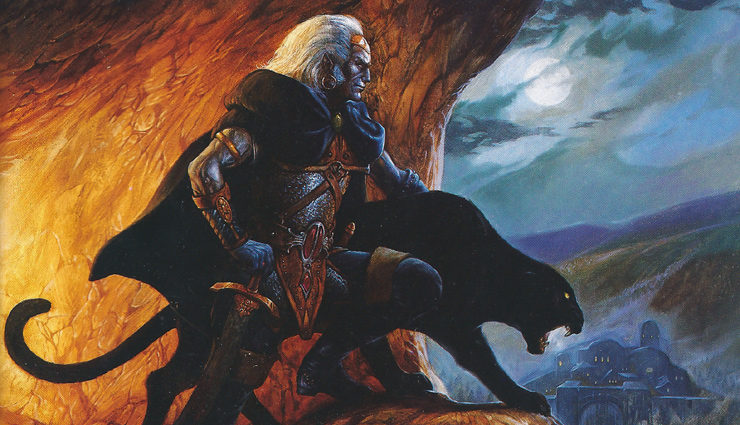
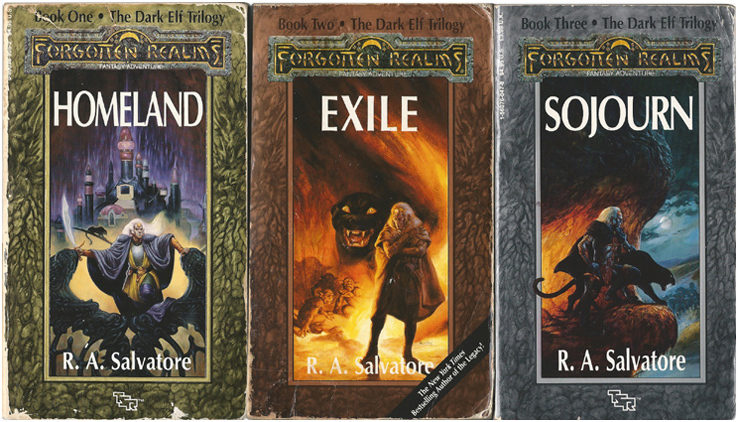
I was part of TSR’s target demographic—I think—back when his illustrious Dark Elf Trilogy came out 25+ years ago. I saw the covers of Exile and Sojourn first, with their fiery cave walls, strange cloaks, some grim-faced elf-dude with long white hair…and an awesome black panther! This was a long time ago when a whole lot of novel and D&D game book covers were painted by fantasy art luminary Jeff Easley (among others). I was immediately drawn to the central figure. I had questions. Who was this guy? Hey, has he got a scimitar?! What’s with the crazy pirate earrings? Why the skullcap? Is that panther his friend? Where is this?!
Fast forward some fifteen years later: I published a novel for Wizards of the Coast, penned a second, wrote for both Dragon and Dungeon magazines, and contributed to a few RPG books. And all these fantasy projects—humble as they were—came about, in part, due to encouragement I received from R. A. Salvatore directly. Can I tell the tale?
Anyone who’s seen my name on Tor.com probably knows that I’m a Tolkien nut. And yeah, as a kid my head was filled to the brim with Rankin/Bass goblins, Glenn Yarbrough’s Middle-earth tunes, and Ralph Bakshi’s terrifying ringwraiths. But I didn’t really become a book fan of the Tolkien’s work until some years later.
Before that, for me, came the stories of R. A. Salvatore. And I wouldn’t change a thing about how it all went down.
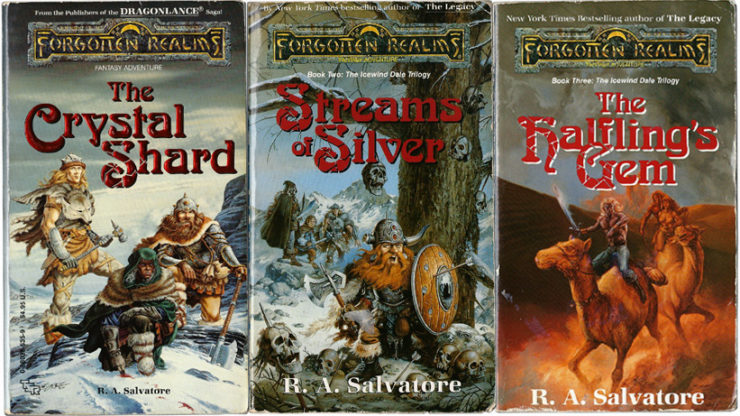
I was already a reader of the Dragonlance saga, but hadn’t paid much heed to the Forgotten Realms. Then came Homeland, the mass market that gave us the origin story of Drizzt Daermon N’a’shezbaernon, aka Drizzt Do’Urden. I later learned that this legendary dark elf already been introduced in the Icewind Dale Trilogy (published prior to Homeland, though it takes place chronologically later)—but not even as its chief protagonist. Rather, he was just one member of its gang of heroes.
Drizzt was part sidekick, part mentor, for Wulfgar, a young and brash human of the Icewind Dale’s barbarian tribes.
Not so much now. Now, Drizzt is the central character in the Dark Elf saga.
Sure, all of Salvatore’s books in stores now have slick Todd Lockwood covers (and they are fantastic and probably more true to the characters), but I’m going to credit Easley first for drawing me in, along with a whole bunch of my peers. The drow—the wicked dark elves of D&D, with their obsidian black skin and white hair—were still rather new then. Bob Salvatore didn’t invent the drow—a dash of real-world folklore and the creative mind of Gary Gygax did that—but he absolutely popularized them. He put them (and himself) on the map, and it was he who breathed colorful, if treacherous, life into them.
I loved—no, still love—the Dark Elf Trilogy. It reads differently to me now as an adult, sure, but it’s infinitely re-readable. Especially Homeland. Most of the trilogy takes place in the Underdark, the vast, monster-filled labyrinth far beneath the planet of Toril. Drizzt is a young noble in a city of dark elves, born to a family who will immediately offer his infant (and more importantly, male) life to the Spider Queen, Lolth. Only the murder of one of his older brothers by another spares him from the sacrificial blade—and sets the stage for one of the most enduring characters in contemporary fantasy. It’s not until the final book, Sojourn, that Drizzt finally reaches the sunlit surface world, becomes a ranger, and meets his future companions in the arctic region known as Icewind Dale.
Drizzt was still shiny and new, the perfect character for any fantasy-loving reader to latch onto: the heroic outlier, with his whirling scimitars, his people’s evil reputation to overcome, and his best friend beside him—the magical six-hundred-pound panther, Guenhwyvar.
And there were, of course, plenty more Drizzt books to come, including some spin-offs involving various allies and erstwhile foes. Over the years, the very concept of a dual-wielding drow elf ranger has become a caricature, an infamous trope, in the role-playing game world. But even that’s evolved over time; the alleged swarm of so-called Drizzt clones at gaming tables led to endless message board rants, but it seems to me that the fans were always more numerous than the haters, and TSR, then WotC, responded with various sourcebooks relating to the dark elves.
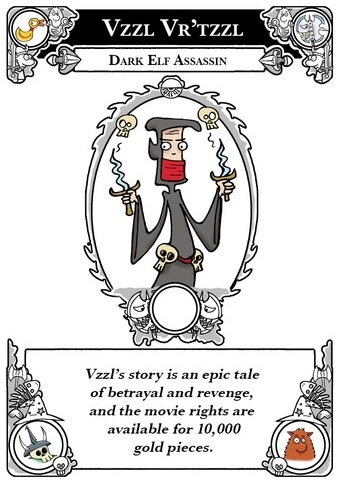
He’s even been parodied in other corners of the game world—like Zz’dtri in the webcomic The Order of the Stick or Vzzl Vr’tzzl in the card game Munchkin Gloom.
So, the first time I met Bob Salvatore was in a Waldenbooks in Newport, Rhode Island, and he was there to sign copies of The Legacy, which (1) marked the first hardcover TSR ever produced, (2) was a fast New York Times Best Seller, and (3) continued the saga of Drizzt after the events of the Icewind Dale Trilogy, but now benefited from all the new lore dreamed up in the Dark Elf Trilogy.
It was a respectable little crowd that turned out to meet him, nothing like the ginormous lines you’ll find now at GenCon when Salvatore shows up for a signing. And, of course, it was a memorable experience for me. For one, who were all these other people who read the same books as me?! This was mind-boggling for a kid at the time, especially since plenty of them were adults. D&D itself still had a stigma attached to it, at least where I came from, and supposedly only nerds read tie-in fiction.
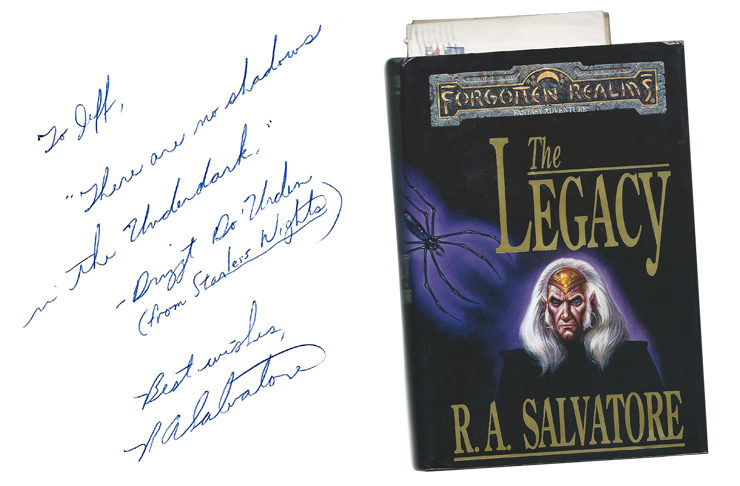
But the whole experience was also great because Bob’s an approachable guy; he talks the gamer talk and walks the gamer walk. It’s fun to recall now: I went to that signing early, and while I was loitering in the science fiction section to kill time, I overheard Bob (who was also early) ask the store clerk if they were expecting any kind of turnout.
Cut to a couple of decades later—not only do you get long lines at Author’s Alley book signings, you get huge Drizzt and Lolth the Spider Queen sculptures carted around to conventions.
Anyway, on that same day in the early 90s, with my hard-earned and very limited money I also bought the Menzoberranzan boxed set (ahh, back when they still made boxed sets regularly), which detailed the city of Drizzt’s origin. Now Dungeon Masters and players alike could fill their campaigns with feuding noble houses, evil matron mothers, and vile plots, but this time with actual maps of the city and ready-made NPCs. Geek that I was, I already owned (and had read through a gazillion times) Ed Greenwood’s The Drow of the Underdark, which had come out the year before.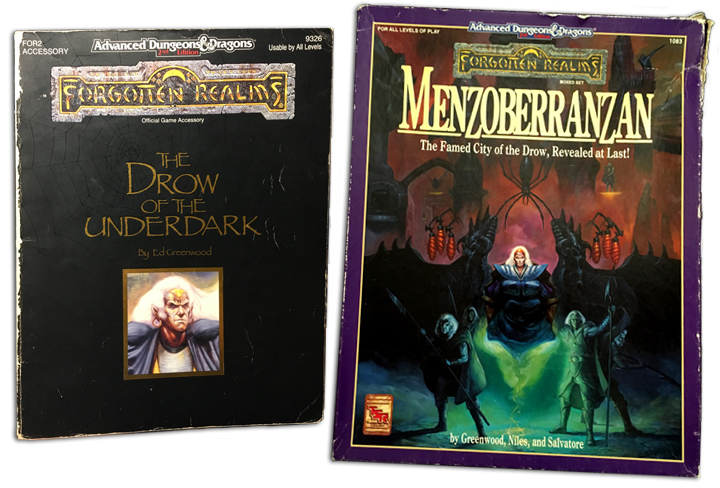
That had been the first game book in 2nd Edition Advanced Dungeons & Dragons to introduce drow culture, along with tons of drow- and spider-themed spells and magic items. You know, like your standard-issue whip of fangs for enthusiastic Lolth’s priestesses, your fire-resistant piwafwi (the drow version of the ol’ cloak of elvenkind), and the always-handy light pellets (good for temporarily blinding the dark-loving drow). But there were also lesser known toys like the wand of viscid globs. Those things were nasty!
It also revealed the names and symbols of all the Menzoberranzan noble houses and some cool phrases in the Deep Drow language. Like:
Nindyn vel’uss kyorl nind ratha thalra elghinn dal lil alust. (Those who watch their backs meet death from the front.)
Never mind that I was never able to use much of this stuff in my nerdy Stranger Things-but-in-the-90s D&D group. But that’s okay—I still had innumerable hours of thinking up drow-based adventures ahead, whether I’d use them or not. More than half of the job of being a regular DM is just dreaming up encounters, making maps, and working up stats…not actually running the game.
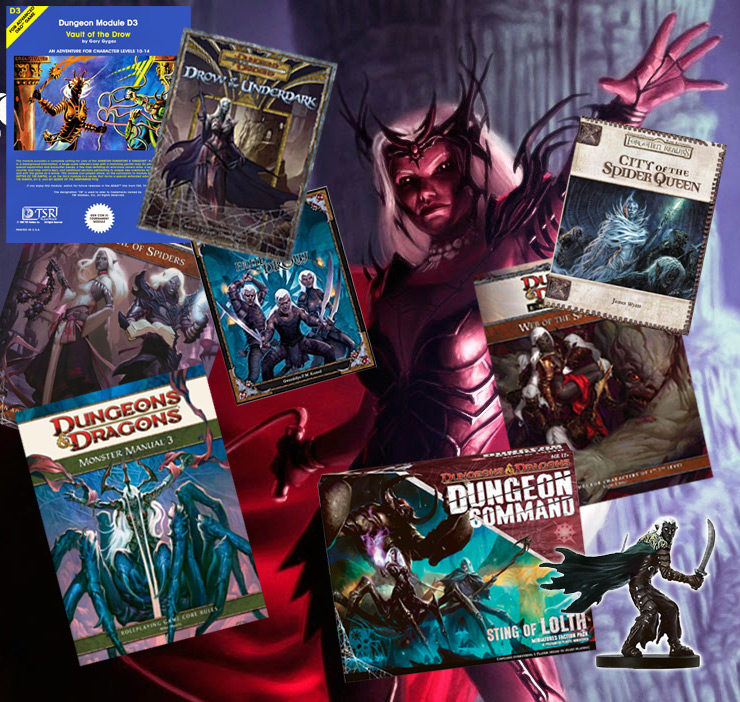
But I digress. Time passed, and as more R. A. Salvatore novels appeared, so did the demand for more drow among gamers and readers. At least I assume it was demand driving the output; the D&D market sometimes felt rather saturated with dark elf-, spider-, and Lolth-filled products. And I guess, why not? The Underdark makes a fascinating backdrop, and the appearance of the drow in any adventure—usually as villains, but sometimes as allies—makes for an exotic plot device.
And of course, they don’t all have to fit the mold of chaotic good male drow fighter/barbarian/rangers with dual-wielding feats and character builds (okay, so that was Drizzt with 3rd Edition stats—he’s existed now in four incarnations of the game). Other authors have written some inventive and not-so-straightlaced drow protagonists in the wake of Salvatore’s success. Dark elves of the heroic, anti-heroic, and villainous varieties, like those in the Starlight and Shadows novels of Elaine Cunningham or the six installments of the War of the Spider Queen series, wherein each novel was written by a different author: Lisa Smedman, Richard Lee Byers, Thomas M. Reid, Richard Baker, Philip Athans, and Paul S. Kemp.
As for the thousands and thousands of gamers in their own homebrew campaigns? Whether using published adventures or inventing their own, there have always been different ways to use the drow. But yeah, they’re usually the bad guys.
Still, Drizzt Do’Urden remains iconic—introspective, stat-free, and, sure, sometimes a little too powerful. But his soft spots, his flaws, and his vulnerabilities have always revolved around his friends and the choices he makes, not his whirling scimitars. At the end of the day, I remember Drizzt’s principles, and his struggles to retain them in the face of adversity, more than anything else. I’m the type of fan who favors the dialogue, the relationships, and the internal strife over even the battles (of which there are many).
Not to mention all his very interesting friends! Drizzt doesn’t carry the books alone. First, there is Guenhwyvar, who spends most of her time on the Astral Plane, but who Drizzt can call forth with his figurine of wondrous power (an item out of old D&D rules) for up to 12 hours in a 48-hour cycle. The fact that he often summons her just for her company and not only as a battle aid is delightful. In Exile there was Clacker (a hooked horror—sort of!) and Belwar (a maimed svirfneblin gnome; in Sojourn there was Montolio (the blind human ranger who mentored Drizzt), and the eventual companions of Mithral Hall—Bruenor the dwarf fighter, Cattie-brie the human fighter, Wulfgar the human barbarian, and Regis the halfling thief. All part of Drizzt’s adventuring party, you might say.
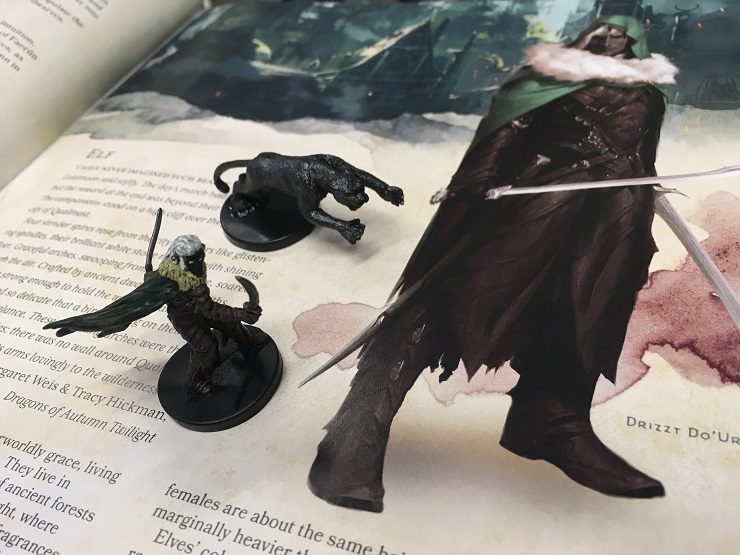
Also—sorry, haters—there is an illustration of Drizzt in the 5th Edition Players Handbook under the entry for Elf. As if this renegade drow was the quintessential elf PC. I mean, he’s not, but the mere sight of him sends a good message to a D&D newbie: you can be anything you want in this game: outlandish, formidable, heroic. That’s as worthy a goal now as it was when Drizzt first came on stage.
So anyway, after I read The Legacy, 15-year-old me wrote a letter to its author because I felt the need to tell him what I thought about Drizzt, and what he meant to me personally. Most fantasy heroes seem to be defined by the enemies they vanquish, the people they save, or the places they go. Drizzt, for all his larger-than-life heroics and nefarious foes, is defined first by the thoughts he has. Which I know sounds sentimental, but man did that resonate with me as a moody teen. For one, Drizzt’s actions are driven by his morals in a very clear way. Sure, plenty of our favorite book characters make moral choices, but there’s something different about this one…we don’t just see him brood in silence as he watches over his adopted homesteads like some fantasy version of Batman (despite the brood-y original cover of Sojourn, above). We actually get inside his head and understand what he’s going through—in his own words.
See, with Homeland, Salvatore began a tradition I’ve noticed he’s carried into a lot of his books, even non-Drizzt ones. At the opening of each new section (Homeland has 5 parts) is a short essay describing the central character’s thoughts on a particular subject related to what’s going on in the plot, written as though it was a memoir. I’ve heard some readers complain about these, or describe Drizzt as whiny and emo, and I just shake my head. I feel bad for them, for being that jaded. Obviously these essays do work for a lot of people; they’ve made Drizzt an especially compelling character. These writings are reflective and intimate; to me, they provide a refreshing contrast to the grimdark sensibilities of a lot of today’s fantasy. When you consider how foreign and fantastical Drizzt’s life actually is, these written thoughts have a way of grounding you—you don’t have to defeat mind flayers and demons to relate to his thoughts about loss, guilt, or friendship.
In any case, my letter to Salvatore was sent by snail mail because I was a kid and email wasn’t quite so common yet. Just a few weeks later, he responded. And, well, I’d like to share it now, all these years later. You’ll notice I was (and often still am) interested in the spiritual associations of the character.
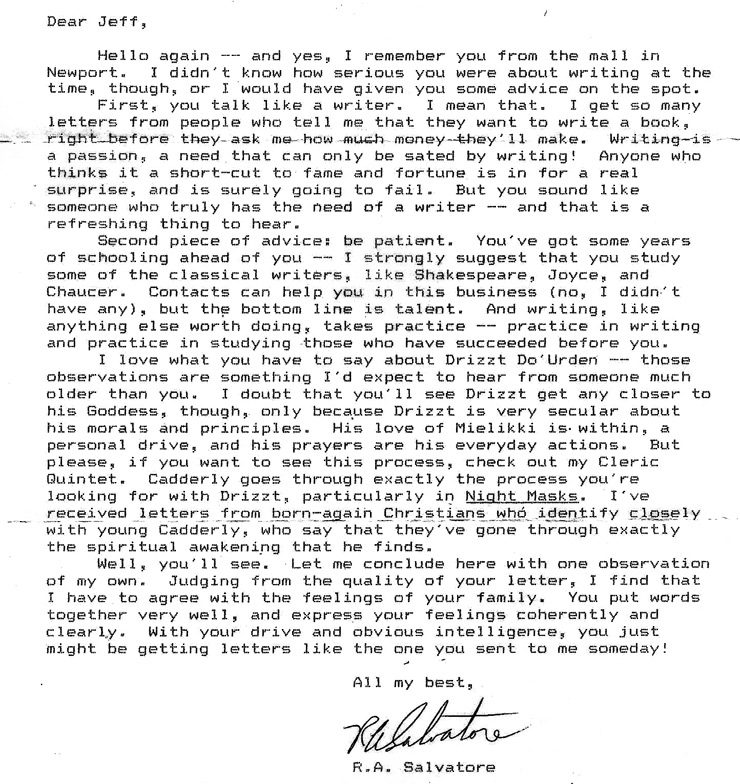
Needless to say, I was very encouraged by this, as I think any fan would be who received this kind of written response. Email is all well and good, but this letter is something I’ve always appreciated and held onto.
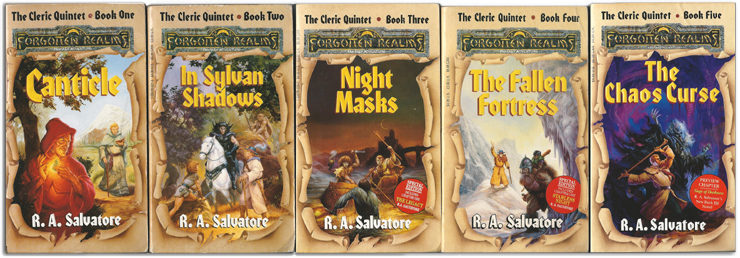
Now the series he mentions, The Cleric Quintent, was a five-book story I had already begun to read by then anyway. The primary character is Cadderly, a peace-loving and bookish young priest of Deneir (god of art and literature) who lives in a cloistered mountain library. He’s a far cry from the mighty warrior Drizzt. He’s got knowledge and wisdom but sucks in a fight, resorting to imaginative solutions to all his challenges. Yet he’s still beset with perilous adventures which come right to him. Luckily his girlfriend, Danica, is an ass-kicking monk and he’s also got the help of a pair of resourceful dwarf brothers, Ivan and Pickel Bouldershoulder. The series is a good time, and there’s a hell of a lot of heart and humor in it.
As with Salvatore’s others books, Wizards of the Coast would eventually redo the covers (more than once), but nostalgia wins me over, and so I still dig the Jeff Easley paintings best. Plus they’re just more colorful:
After writing these and a bunch more dark elf novels and short stories (and contributing to plenty of official D&D products), Salvatore did eventually break out into a new setting of his own outside of Wizards of the Coast. The world he made was Corona, and the first book was The Demon Awakens.
On the book tour for this first DemonWars novel, he stopped through the Borders Books in Novi, Michigan—where I worked the event. So that was our second meeting. I admit I was a bit wary of this DemonWars saga at first. Why? Not because Salvatore had left Drizzt behind for a while (he deserved the break), but because of how it started. The story begins with an orphaned young man who becomes an elf-trained ranger, then fights alongside his friends against a demon and a horde of goblins and giants. This seemed like all-too-familiar territory, particularly for Salvatore. Orc and goblin hordes are kind of his thing! I wanted something new.
But when you stay the course in The Demon Awakens, you find a whole bunch of clever new twists to the otherwise well-trodden fantasy archetypes. The character of Brother Avelyn, and the legacy he begins, has probably stayed with me the most, looking back. Even better, as the saga goes on, the very nature and complexity of the conflicts mature greatly.
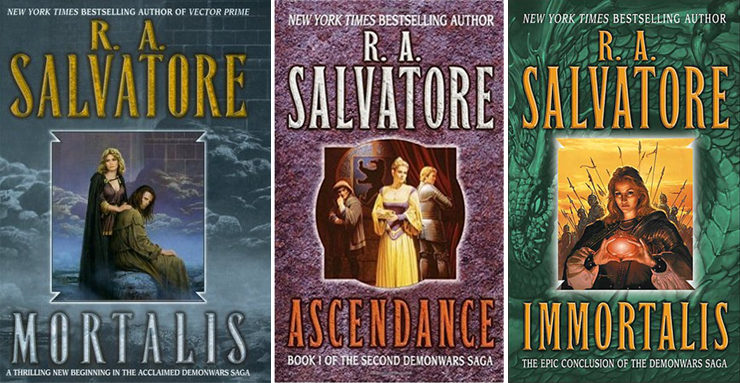
I remember writing to Bob again—this time by email—after reading Mortalis and Ascendance, because I was impressed at how thoroughly I’d been drawn in to the developing story of politics and religious corruption. This wasn’t Drizzt material by a long shot! And the character of Jilseponie, a peasant girl turned warrior turned queen turned grieving mother turned politician, struck me as one of the most believable characters in all of his books. Pony has to deal with some really grown-up shit in these books, but you know what? It works, and I was enthralled all over again. I almost wonder what teenage me would have thought of them…would I have appreciated the nuances? Maybe not.
All in all, Salvatore has produced something like ten or eleven books in the world of Corona—and oh yeah, a couple of Star Wars novels—even as he returned again to the Forgotten Realms and threw Drizzt under the bus a few times. (In a good way!) Say what you want about how he can’t be killed and how he can take on ten thousand orcs—Drizzt still has to go through the wringer each time; he suffers, and sometimes loses friends.
There have been some seriously crazy things happening in the Forgotten Realms over the years (I’m looking at you, Spellplague!), mostly due to the D&D game itself going through some turbulent edition change. For years I used to read every Drizzt book as soon as it came out, but I have to admit I haven’t been able to keep up with Drizzt as easily in more recent times—life interferes.
But I also can’t ever shake him, or his maker. I know I’ll go back again, and I suspect I won’t like everything I discover about what’s become of Drizzt. Wizards of the Coast advanced the timeline of the Forgotten Realms a hundred years now, so…things will change. Plus ça change, plus c’est la même chose. Such is life. At the same time, not having read all the Drizzt books to date means there’s always something to go back to.
Buy the Book
Child of a Mad God: A Tale of the Coven
So now we come full circle: Just this week, Child of a Mad God hits both brick-and-mortar and online stores, published by the company I now work for! This is Salvatore’s return to the world of Corona, but the story’s set in a region far removed from his Demon Wars books and seems to incorporate some crazy new ideas I look forward to discovering. In this world, gemstones and crystals are the source of magic, and young Aoleyn belongs to a coven of witches. There are barbarians, humans with misshapen heads, monster-occupied lochs, and demons. And also, some of those first-person essays I mentioned before—in this book they’re written by an exiled king, Aydrian, who factors heavily in the DemonWars Saga but whose story you don’t need to know to appreciate.
Should anyone reading this have even an inkling of interest, whether you’re familiar with Salvatore’s legacy of dark elves or not, know that you don’t need to start anywhere else. Start here…and then go back and meet Drizzt and Cadderly!
Finally, the few subsequent times I’ve run into Salvatore again or otherwise made contact with him, he claims to remember me from that original Waldenbooks book signing way back in the 90s. I’m still not sure I believe him, but he’s good people. Thanks again, Bob, if you’re reading this!
And you know, I never did find out why Jeff Easley painted Drizzt (quite a few times) with that gold skullcap on his head. But you know what? It doesn’t matter. The art first drew me in, and Bob kept me there. The kid in me never really left Icewind Dale, while the adult looks fondly back. Waiting to jump back in.
Top image: “Sojourn” by Jeff Easley
Jeff LaSala (who riffs on Tolkien and sometimes writes his own fiction) not only got many of his friends into R. A. Salvatore, he also helped made a Drizzt fan out of his wife. He even bought her an impractically large stuffed black panther once. Because Guenhwyvar!

Great article! I’ve only read The Icewind Dale Trilogy -decades ago- and Servant of the Shard, Sellswords #1, but, maybe because I’ve never been an RPGer, I was kinda “meh” about them -I’m just not a fan of magic being used for mundane things like replacement for camping gear. That said I’ve always wanted to get into Salvatore’s books more and I have an kindle of the DemonWar omnibus.
Can someone tell me; are all of Salavatore’s non-Forgotten Realms books in his world of Corona?
No mention of the world of the Crimson Shadow?
But I don’t know if Salvatore knew what he was unleashing when he created the character of Drizzt Do’Urden.
Like setting fire to the forest with a single bolt of lightning.
1, to answer your question with TWO MORE SERIES, Besides Crimson Shadow, no they are not, there’s also the Chronicles of Ynis Aielle and the Spearwielder’s Tale.
@2: Right, the Crimson Shadow books. Well, I didn’t set out to be comprehensive here, which is why I didn’t also mention his actual first novel, Echoes of the Fourth Magic. Also non-Realms.
@1: I think the answer is no, as LordVorless mentioned.
Thanks, LordVorless and JLaSala
Anyone else see these at conventions in the last few years?
The Drizzt books were my first entry into fantasy when I was a teen. My brother got me started on them. I saw him reading a new Wheel of Time book his girlfriend got him, and wanting to copy anything he does, asked to read that book. He said it wasn’t the first book in the series and probably was too complex for me anyways. He recommended I start with something smaller and easier to digest. So it was Drizzt and then Dragonlance.
The Jeff Easley covers are clearly superior to the later more generic looking covers. Bring back proper cover art!!!!
Great article! Makes me want to go back and read Drizzt again. It was such a thrill to discover those books – even though I’ve never played D&D in my life – and they’ll always occupy a special place in my heart.
Nice to know R.A. Salvatore is a good guy, too.
Agreed Random22
Salvatore ruined the Drow.
Great article i too started off with Dragon Lance stories about the Heroes of the Lance and wandered over to Drizzt. I loved them all but got away from them as i grew older my taste changed now i read Urban Fantasy but your article is making think about going back and seeing what happening in the realms…Thank you
2, no worries, I kinda wish he’d go back to that world, but I can’t complain about Corona either.
8, cover-wise, I still like the original trilogy’s best.
7,12, What were your favorite Dragonlance characters? I have to admit, Tasslehoff Burrfoot was my favorite in the trilogy, but Galen the Weasel was my favorite spinoff.
Oh my stars! A wonderful review of R.A. Salvatore and Drizzt du’Urdan… and the dark elves!
I play Darksugar, a dark elf in Everquest II almost daily! And I have loved Salvatore’s books. I think I shall have to reacquire the entire collection, if they are all available at Tor Books. Thank you for this wonderful memory!
@13, for sure. Although I love the artwork of the original two Drizzt-based trilogies, over time in the 90s depictions of drow got very…weird. Not to mention far too human. Possibly the most cringeworthy example is the version of Drizzt is on 1999’s Drizzt Do’Urden’s Guide to the Underdark. That art is Fred Fields, who had a photo realism to his stuff that oftentimes—most of the time—worked very well. But not always. In that particular cover, the art direction just wasn’t good, and what they ended with was what looks way too much like Matt Damon as a drow. :D
That skullcap!
All that said, most of the Todd Lockwood covers used nowadays are pretty amazing.
@14, the dark elf books aren’t with Tor. However, a bunch of the Corona books are.
@15 — for me, at least, that first image link doesn’t seem to be working, but I looked it up elsewhere and yeah, wow, that picture really is …
The Lockwod cover is showing up fine, though, and yes, is much better, although I do have a soft spot for the originals.
TBH, I haven’t read much Drizzt yet — I know I read The Crystal Shard back when it came out, together with Darkwalker on Moonshae and the first couple of Dragonlance trilogies, but I think I was just a few years too old by that point. I do keep meaning to go back and give them a try, though.
I remember walking into the local Waldenbooks (kids! ask your parents) in the late 80s/early 90s and the Dragonlance & Forgotten Realms books took not just a single shelf but an entire stack.
Does WotC still do fiction? I was checking and it doesn’t look like they’ve put out any new books in a couple of years, although I could very well have missed some thing.
Another Drizzt parody was Drizz’l from 8-Bit Theater.
15, I like his cover of Dragon #203. Todd Lockwood? The man can draw a good Dragon. I’ll give him that.
16, I know they stopped their novels, they are still producing short-fiction for Magic, but I don’t know about D&D.
17, and here’s the truth about Drow.
@18 — That’s kind of a shame, especially if Paizo is also shuttering the Pathfinder novels.
Really not a fan of Lockwood, or Wayne Reynolds for that matter. Give me Easley, Elmore, Parkinson, and Caldwell all day, every day. Not a fan of the cartoon-like styles of Lockwood. It’s good, just not for me.
I never became a Drizzt fan personally, but there’s a lot to be said for the favourites that inspire and their authors who encourage. Glad to hear R.A. Salvatore is one of the good guys.
19, We’ll always have Isekai…but no, I’m afraid that particular genre of fiction is dying. I’m not sure what will be left, I don’t even look at the book sections in department stores that often any more, it’s too depressing to see nothing stocked that I’d want to read or re-read. I barely find much in the discount stores.
Jeff,
Great article and an uncanny reflection of my own experiences.
I love this article. Lots of similarities with me, although I loved Tolkien and Lord of the Rings first, and happened upon the Forgotten Realms first through Moonshae Trilogy by “Douglas Niles”, then found Icewind Dale trilogy. I’ve read through the series several times, and still like reading Icewind Dale before the Dark Elf Trilogy – maybe because that’s the way I was introduced to them.
Totally awesome, I love they way you express yourself. Im also a lifetime fan of R.A. and have been reading his books since the beginning. I have been playing DND since 89 ish, so im old school.
I hope that you get all you strive for, and again, love the tribute to one of my favorite characters.
S.L.Holst.
Well it looks like Drizzt, at least, will go on.
https://io9.gizmodo.com/everyones-favorite-dungeons-dragons-dark-elf-returns-1822925022
Wow! I can really tell Salvatore’s books and characters are important to you. I’ve discovered fantasy in my early twenties, and after a few Dragonlance novels it was Drittz my friends introduced me to. We’ve shared a long journey (I read Hero last year) and it’s true, even to a young person past her teen years, this thoughtful hero has a lot to communicate. Not to mention, thanks to him I became I fully-fledged sci-fi/fantasy adult reader.
Dear Jeff,
I love your article!
Especially the parts dealing with your first contact with Mr Salvatore, and of course the letter he wrote to you.
That’s so nice and heartwarming!
I only just stepped into the world of the Forgotten Realms, as our roleplay-group started with the D&D system. And in the Players Handbook, which you also mention here, I was so struck by the image of Drizzt do’Urden (yes, exact the one that is below your article!), and by what I read about him in that book, that I ordered and read the books in chronological order immediately! (I’m not done yet with reading, and waiting impatient for the next 4 books to arrive…)
Especially the parts where “he” writes his own words and thoughts, and the way he’s described when he’s still in the Underdark, his struggle and doubts, are what makes him absolutely interesting and totally sympathic for me.
A hero I want to read about is not all shiny and glory, and wins all the time. That’s why I don’t like The Crystal Shard that much, plus the fact that his character is described completely different (likes to torture his enemies suddenly, for example). I wondered where “my” Drizzt was… But that’s because of the chronological order I read the books in, I guess, and that they were written in different order.
Anyway, thanks alot for your great article and sharing your thoughts!
Best wishes
From Eve from Germany
At the risk of pointing to the elephant in the room, D&D was and is racist and speciesist. Orcs are savage, dwarfs are dour, sun elves are always patronising but well-meaning, and dark elves are always malicious and selfish. The only race allowed any kind of variation was humans. Then Drizzt came along, and he seemed to act as a catalyst. After Drizzt, you still had the racial and species stereotypes, but they were more like guidelines. Players and stories were no longer rigidly bound. Yes, there were suddenly a disproportionate amount of good-aligned Dark Elves dual wielding Scimitars all over the place, but you also got intellectual Orcs, jolly dwarfs, and humble sun elves with evil intentions.
Or Order of the Stick’s Belkar, the self-described “sexy shoeless God of War” that everyone else describes as a hobbit to avoid, and if you can’t avoid him, stay on his good side…
The push for this didn’t come entirely from Salvatore; Elfshadow came out at the same time and <SPOILER> the antagonist is a Sun Elf. Interesting one that maintains their good alignment despite their nefarious plans because it’s “for the greater good”.
Regardless, Salvatore took the ball and ran with it. Later books about Drizzt deal explicitly with prejudice and its consequences.
So, yeah, Drizzt made D&D less racist, and maybe the world a bit less racist as D&D players learnt that you can’t assume stuff based on how people look…
@29: There is indeed an elephant in the D&D room. It’s called a loxodon, and they’re apparently from Ravnica, the Magic: The Gathering world, which I’m not much into but there is clearly some cool stuff coming out of there.
Any other kind of elephant in the room, I would say, is a matter of perception. Not seen—indeed, not necessarily existing—except by individual. Good thing D&D has a complex cosmology and planes can overlap and everyone can have a point of view!
But seriously, this isn’t the forum for that. This is specifically about Salvatore’s Dark Elf books and not even D&D in general. Might I suggest Eberron for you? Shades of gray from the start; drow are more often neutral than evil, orcs helped save the world once, goblinoids are a full spectrum, and you can worship any god and be of any alignment. Maybe that has what you’re seeking.
@28: Thank you very much. I admit, it’s been so long, now I’m forgetting when that “torture” point of view came up in the original Icewind Dale trilogy? Incidentally, have you ever read “Dark Mirror,” the Drizzt-based story that first appeared in Realms of Valor. .
Wow Jeff! SO cool!! Sounds like you and I have walked a similar path as far as appreciation of RA Sal’s astounding work.
Back in the late 80s I was reading RA Sal, Creating characters/adventures and working as an adolescent mental health counselor. I remember getting a couple kids into RA Sals books because of the quality of hero he portrayed –all of the things you shared about Drizzt Cadderly, Dananca, the Boulder Shoulders Wolfgar and the rest. I do in-home family therapy now in the Framingham,MA area near where RA Sal reportedly lived. I just lent Homeland to one of my kids last week! My hope is that it will spark some motivation for this teen who is suffering with depression/anxiety but also has a deep appreciation for fantasy fiction.
At some level I believe we are shaped by what we consume. Not only our food but what we take in through the media. RA Sal’s Work gets a double thumbs up from me for healthy fictional diet content! :-)
Thanks for taking the time to write this excellent article!
J.