







The right book can stay with you forever, especially one given as a thoughtfully chosen gift. Whether it’s your first childhood foray into fantasy, or a new adventure found later in life, these are the books that shape us as readers, and lead us to our next literary discoveries.
Below, some of the Tor.com staff remember the books that they’ve received that have gone on to shape (or reshape) their lives. What will you unwrap this year, and what paths will it lead you down? Let us know your own memorable book-gifting experiences in the comments!
The Hitchhiker’s Guide to the Galaxy by Douglas Adams
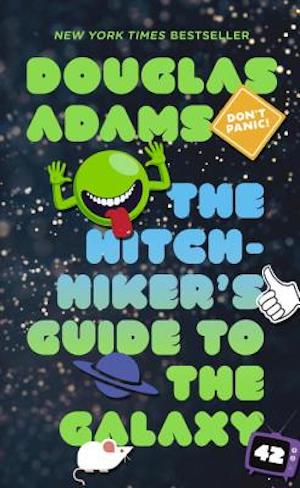
My dad was the sort of parent who never pushed his interests on me. He waited and watched and if he noticed that we happened to have something in common, he would broach the subject one afternoon. Which meant that he got a pleasant surprise when my SFF obsession got much more pronounced around age eight, and thought that it might be a good idea to hand over his battered old copy of The Hitchhiker’s Guide to the Galaxy. Not a gift, exactly. A bestowal.
Hitchhiker’s is a gateway book for a lot of early fans, of course, but this was an ace on my dad’s part due to how we spent the majority of my early childhood—trading movie impressions (usually of the Robin Williams and/or Monty Python variety) and generally trying to make each other giggle. Up until that point, I had no idea you could make prose funny. It was like having my head winched open, and dumping a bowl of sunshine into it. He handed me the book before a vacation, which meant that I wanted to spend all my time on a sandy beach reading—much to my mother’s chagrin—but that was nothing new in the history of my summer break habits. I read it cover to cover, demanded the next one, and memorized all my favorite exchanges verbatim.
To make my dad giggle, of course.
—Emmet
The Sparrow by Mary Doria Russell
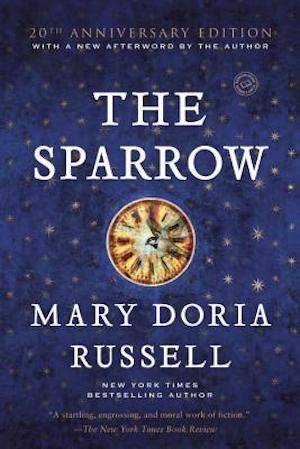
The Sparrow was one of the last books I received as a gift, before I began working in publishing and my loved ones assumed that I would want for neither books nor recommendations ever again. Maybe that’s part of why I remember so precisely picking it up under the Christmas tree in my childhood home, or my initial trepidation when my mother mentioned that her book club had read it. I doubted not her taste, but the taste of a group of moms who spent more time gossiping and drinking wine than analyzing the books—still fun, but I was surprised to hear that they had picked up a sci-fi novel from the ’90s.
That early-20s snobbishness kept me from reading The Sparrow for about six months, but I’ve since read the book at least four times—both cover to cover and a selection at a reading series a few years back. I revisited it this year, the 20th anniversary, to discuss it in conversation with Arrival about how human/alien gift-giving can be disastrous. One of the passages was a reading at my wedding. It’s one of those rare books that has everything: naturalistic characters who contain multitudes; an easy way in to space travel and time dilation for the less scientifically-minded like myself; humor, pathos, the ache of unrequited love and devastating horror in ways that don’t feel contrived. I get something different from it every time I read.
The biggest impact that The Sparrow has had on me is that it’s the book I most often recommend. It was one of the first pieces of media I pressed upon my partner in the first few months of dating, and it was his father’s first impression of me (which, considering that the man is very religious and the book has a very anti-faith ending, had me worried). But both parties loved it, and it’s become a frequent conversation topic that’s led us to share subsequent books: Ancillary Justice, The Three-Body Problem, The Left Hand of Darkness.
—Natalie
The True Confessions of Charlotte Doyle by Avi
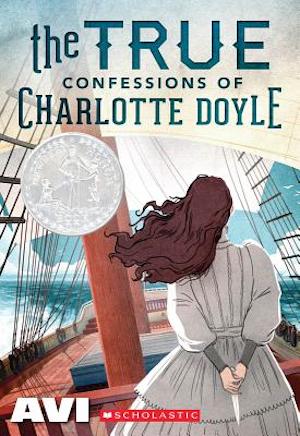
My elementary school librarian gave me The True Confessions of Charlotte Doyle to read when I was in fourth or fifth grade, so this wasn’t a book gift in the strictest sense of the word, but I’m going with it.
I’ve always been an avid reader, but not a reader who likes to reread books much, even when I was younger. The True Confessions of Charlotte Doyle is one of the few exceptions to this—I must have checked it out at least a dozen times that school year. It was a story about a well-to-do 13-year-old girl from the 1830s taking a ship from England to the United States. During that voyage, she sheds her constricting dresses, becomes a crew member on the ship, and is accused of murder, among other things.
I forget most of the plot, to be honest. But what I remember from this book, what I still think about regularly to this day, is how Charlotte ultimately shed her life as a “proper” lady and took to the high seas. She left the only world she knew, threw off the dictates that society placed on her, and became true to herself. That escape, that freedom Charlotte has at the end of the book stuck with me. I couldn’t articulate it then (or for decades after, really), but I felt just as trapped. Eventually, however, I broke free in my own way, and maybe I’ll give the book another reread this holiday season to see how Charlotte’s story resonates with me now.
—Vanessa
The More Than Complete Hitchhiker’s Guide by Douglas Adams
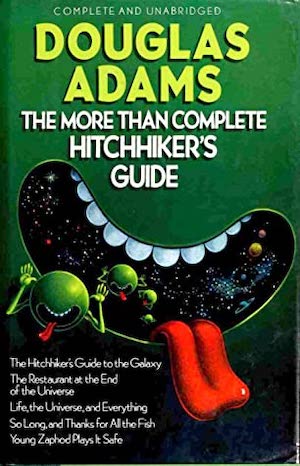
By the time I was in middle school, I was a pretty solid fantasy reader. I read The Lord of the Rings every year—my own pilgrimage to Mordor and out again—and spent all my birthday and Christmas Waldenbooks gift certificates on the fattest fantasy novels I could find. I read everything on my mom’s shelves that had an intriguing cover (Kathleen Sky’s Witchdame!) or a feisty, troubled young heroine (Jo Clayton’s Duel of Sorcery series!).
But I rarely picked out anything funny.
When my uncle sent me the leather-bound, gilt-edged More Than Complete Hitchhiker’s Guide, it wasn’t the first funny book he’d sent. (I read a lot of Xanth books. I’m not ashamed.) But it was funny science fiction, not fantasy. It took a while for me to commit to reading the whole thing, but I did, and my ideas about stories, about the way the galaxy might look, just bloomed. I’m a very visual reader; there are movies in my head that play whenever I think about a story I’ve read. And these movies looked different than anything I’d dreamt up before. People had fun in these stories. Adams’s sense of the absurd felt so familiar to me that it made the entire universe seem … accessible. And like a thing you could also laugh at, maybe. (Halfway through the book, I realized I’d heard my mother and stepfather listening to the radio production of Hitchhiker, years before. Once you’ve met Marvin, you don’t forget him.)
It’s hard to explain Adams to people who haven’t read him, to explain that you can laugh your face off and also feel like you’re reading some impossible truth about life (the universe, and everything). Adams informs my sense of humor, my references, my ideas about the world(s), in a way that’s somehow more down-to-earth than all the epic fantasy I adore. When I was a kid, those books felt like dreams of living in a different world. Hitchhiker felt like it might know something about being a grownup, here, on a mostly harmless planet.
—Molly
Jim Henson: The Biography by Brian Jay Jones
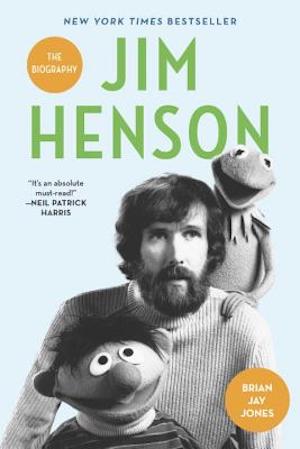
I tend not to receive books as gifts. I think because between the books I buy, the ones I borrow, the ones I’m sent to review, the ones I have as pdfs from assorted ediTors—books are the only thing, other than food and liquor, that I collect for myself. Given that, I’m going to talk about a book I bought as a gift to myself, with the caveat that I have not finished this book, and probably never will.
The book in question? Brian Jay Jones’ Jim Henson: The Biography. In the interest of returning to childhood I bought it with Christmas money my parents sent me. On the 26th, family obligations completed for the moment and New Year’s Eve but a distant glow on the horizon, I embarked on what I can only refer to as a truly childlike reading experience: I stretched out on my bed and fell into that book, for hours at a time, coming up only for the most necessary of biological functions. As a person who reads professionally, losing myself in something I didn’t have to review or critique or discuss felt incredible, and I read almost the entire 490-page-long book by midday on the 27th.
But about that “almost”—we all know how the story ends, yes? Jim Henson’s illness, the way-too-early death, the funeral you can watch on Youtube if you want to be unable to function for the rest of the day. So when I got to Chapter 16, “Just One Person”, I gave myself the greatest gift of all and stopped reading.
—Leah
The Alchemyst by Michael Scott
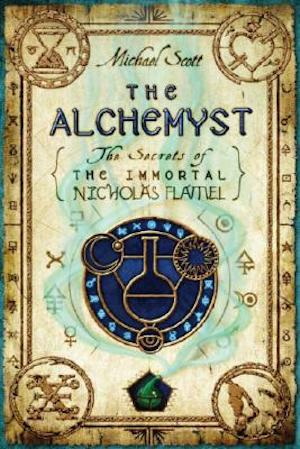
After years of gifting my much-younger cousin all of the entry-level SFF books that I had loved at her age (the usual classics from The Phantom Tollbooth to Narnia, and the comparatively newer Series of Unfortunate Events), she turned around and surprised me at the age of eleven with the first book in her favorite new series, The Secrets of the Immortal Nicholas Flamel. She was on the cusp of crossing over from middle-grade to young adult stories, and she was inviting me along for the ride. And honestly I was a little snobby about it at first, hung up on the formulaic set-up—but eventually I got caught up in the fun of the adventure and mythological references. More importantly, reading it reminded me that there was a whole world of new potential entry points to SFF that I was overlooking by simply replicating my old reading list. The Alchemyst helped redirect me to the thriving YA genre, experiencing it with fresh eyes alongside my cousin.
—Sarah
The Neverending Story by Michael Ende
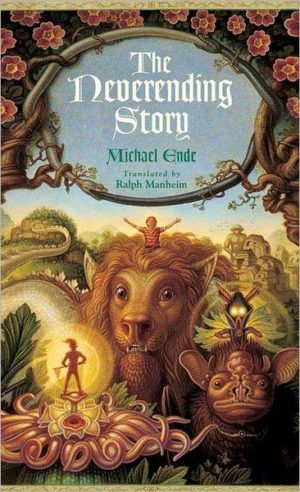
One of my most vivid book-related memories goes back to the first time I read The Neverending Story by Michael Ende. Some time between its 1979 publication and the 1984 release of the movie, my parents gave me a copy of the novel for my birthday. I’d just turned 10 and didn’t speak or read English (or German) yet, so this was a Dutch translation—a beautiful hardcover edition with a big AURYN in relief on the cover and text printed in two colors, red for the part of the story set in our world, and blue for the parts set in Fantastica.
I was, much like main character Bastian Balthazar Bux, a shy and bookish kid. I immediately identified. To say I got sucked into The Neverending Story would be an epic understatement. What happened to me was probably closer to what Bastian experiences in the story: I found a quiet place to read, and I read, and read, pretty much nonstop until I’d turned the final page. The next morning, my parents found me still awake; I’d read through the night.
At ten years old, I obviously wasn’t familiar with metafiction. Bastian reads the book and thinks it’s just a story, until it becomes clear that it isn’t. Events in the green-printed “fictional” sections of the book begin to impinge on the red-printed “real” world. I can still remember the chill I felt when I realized what was happening. The fact that the book I held in my hands looked exactly like the fictional book Bastian reads made it even more uncanny.
The second half of the novel was also the first time I experienced seeing a character I loved and identified with turn into someone completely different and much less likable. And the first time such a character started losing memories and basically losing himself. Heady stuff for a ten year old.
Of all the many books I’ve been gifted in my life, The Neverending Story is still one of the most memorable. In some ways, I’ve been chasing that same reading experience ever since.
—Stefan
An earlier version of this article was published in December 2016.

There are two I can think of:
1)The Hobbit and The Fellowship of the Ring – when I was in middle school (actually it might even have been 5th grade), I remember attending a funeral for one of my aunts (who died young from cancer) and feeling a little out of place and chatting with another uncle about books and he had mentioned Lord of the Rings and how I should read it. For Christmas he sent me those two books which sparked a whole love of the trilogy and nerd dom/fandom in general.
2)Anne of Green Gables – I had a cousin who worked doing book reviews for a newspaper (I think) and so she got sent a lot of books in the YA age group and she often gave them to me as I was known for being a big reader. I still remember several of those books, most of which ended up obscure (but were still enjoyable and I still wonder what happened to some of them as over the years various ones got given away). They were mostly just standard fiction types (although The Golden Compass actually was one I was gifted!) but I remember once she also included Anne of Green Gables in the stack of books one year. I don’t even remember why. I avoided it for awhile, because it was so big, but once I read it I fell in love and it’s still one of my treasured books.
My 6th Grade teacher handed me “Dune” and Ray Bradbury’s “The Illustrated Man” and said, “I think you’ll enjoy these” and I did….
I’m not a follower of celebrities, I just don’t give a dang about their private lives, but Henson’s death killed me. He was such a creative, wonderful person. I don’t blame you a bit about not reading that chapter.
All the important books in my life have wandering in by themselves, not as gifts, but the most important books I’ve ever given were the LORD OF THE RINGS trilogy. Those books say more about life and moral character than any other books I’ve ever read so I gave it to my much younger brother and, later, to my nephews. My brother still knows many of the songs by heart.
I’m guessing that the Harry Potter series will be the gift books of choice for more recent generations of readers.
Mine was Alexander’s Chronicles of Prydain in third grade, from one of my parents’ friends, while I was in the hospital and recovering afterwards. Love them and still re-read them periodically. Still annoyed by the awful Disney version of the Black Cauldron….
It’s always interesting to see what other people like to read and why.
The My Book House series bought at the State Fair when I was a preschooler helped put me on the road to reading. It was the issue of Mother Goose magazine that included the “Riddles in the Dark” chapter of The Hobbit that started my Tolkien/fantasy fandom and led to being gifted LOTR and later The Letters of JRR Tolkien and other volumes.
A gift of a Lucy Maud Montgomery anthology with Anne of Green Gables, Anne of Avonlea, and Anne’s House of Dreams made me a Montgomery fan and I particularly appreciate Montgomery’s The Blue Castle which is a great read on various levels.
For my 8th birthday, my parents give me Tom Swift and His Flying Laboratory and one other “Tom Swift Jr.” I’m not certain of from the title list in Wikipedia. I had probably read scraps of mythology before this (I think we had a copy of some version of Bulfinch), but I think this was the first SF I’d read — and it was endorsed by my family, not something a sympathetic teacher passed to the misfit I was in school. I read a handful over the next couple of years, interspersed with much else. The books were dreadfully formulaic and cliched — I can’t imagine liking them at age 11, let alone the up-to-14 they were recommended for — but they were my first step into a larger world; I don’t know whether I would have read Lord of the Rings, or Dune, (both at age ~14) or even Andre Norton if I hadn’t had that opening.
Norton is the other key I’d point to; Galactic Derelict was about people being humane rather than heroic (I didn’t get to Heinlein until later), and was the first story I read about mainly-white characters in which a non-white was the lead. These days I find Norton’s writing very awkward, but in grade school her stories of despised or outright broken people surviving were a huge support.
A Wrinkle in Time, The Hobbit, the E Nesbit books from home and then a little later Bradbury short stories and Asimov in jr high from the school library.
The Kraken Wakes and the Collected Ghost Stories of MR James. The first now has a new and horrible relevance; the second still scares me from time to time.
27 years ago last week I “won” a book at a White Elephant party just before Christmas Break my Freshman Year at college: The Great Hunt, Book 2 of Robert Jordan’s epic Wheel of Time series. As you probably know a White Elephant party involves participants to wrap a present — literally anything around your dorm — and bring it to the Party. Then presents are distributed in a random order, often by order of playing cards or other randomizer. When it is your turn you either select a wrapped present or “steal” a previously unwrapped present, which can lead to bitter fights and/or conflicts. After I had a very much coveted Roll of Quarters “stolen” from me, I opted to select a small rectangular present about 6″ x 4″ x 4″. I devoured the Prologue that night when I returned to my room, and decided I needed to start at the beginning, so I set it aside to prepare for exams. I caught a ride to the airport with a friend who had a 6:00 am flight to St. Thomas, Virgin Islands. My flight wasn’t until 4:30 pm. I visited with Karen until her flight boarded and then browsed the various stores in O’Hare Terminal 1. While visiting a book seller’s I noticed an End Cap advertising The Shadow Rising on Hardcover. I eschewed that copy and picked up books 1 & 3 being a poor college student. I then proceeded to my gate in Terminal 3 and began reading The Eye of the World. By the time my plane boarded I was just entering The Queen’s Blessing with Rand and Matrim and I was hooked!
My Uncle got me the Wheel of Time preview book from way back when the series was just starting. It would be years before I actually cracked it open but once I did. It had about a third of Eye of the World. I had to read more and eventually I would be reading a new WoT book on every math trip. I was in on the forums. My away message was WoT based, my usernames were and are WoT based. I wish I didn’t have to toss all my books in a move. There are changes I take great issue with in 2nd+ editions. But still The Wheel of Time really changed things for me.
My 5th grade teacher loaned me a copy of The Hobbit when I had finished our other in-class reading. That same year I found The Time Traders by Andre Norton in the school library. The combination of the two was my gateway into SFF, more than 50 years ago now.
I fondly remember the first book I bought with my own money – I, Robot by Isaac Asimov. I was 10. It opened worlds in my mind, and was followed by everything the Doctor had written until then that I could find in libraries and book shops.
Maybe because my parents and grandparents were used to giving books to me, no other books stand out in the crowd until much, much later – first when my grandad presented Sphere to me, introducing to a skeptical youngster the fantastic works of Crichton, then when my dad gave me Warrior’s Apprentice, changing the way I was imagining space opera.