






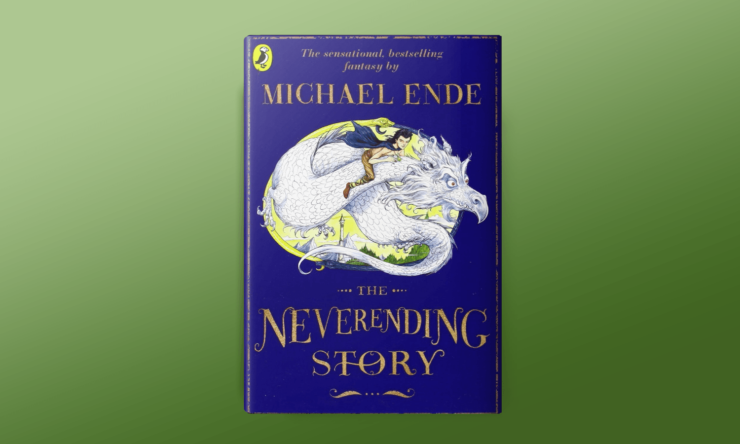
An ’80s children’s classic, chances are you’ve seen the movie version of The Neverending Story, or at least heard of it. And if you’re a child of the 80s like me, it may very well have a treasured place in the corner of your heart reserved for your favorite childhood nostalgia. While I loved the movie as a kid, it was only years later as an adult, when I chanced to pick up a copy of the book at my local library, that I learned there’s far more to the story than what I saw on the screen.
Sometimes all it takes for a book to hook us is a sentence. A phrase, a passage, or simply an idea that latches onto our minds and won’t let go. For me, that moment came a third of the way into the book, when Gmork tells Atreyu the secret of what happens to Fantasticans who are sucked through the Nothing into the human world.
“That’s right—and when you get to the human world, the Nothing will cling to you. You’ll be like a contagious disease that makes humans blind, so they can no longer distinguish between reality and illusion. Do you know what you and your kind are called there?”
“No,” Atreyu whispered.
“Lies!” Gmork barked.
It was this moment when I first realized that The Neverending Story isn’t simply an imaginative tale; it’s a tale about the nature of imagination itself. What it means for us as humans to dream, to hope, and especially to wish.
Wish fulfillment becomes a huge theme in the second half of the book. The main character, a human boy named Bastian, is given a great gift: a gem called AURYN with the ability to grant any and all of his wishes. On the back of AURYN is inscribed a single line: Do What You Wish. Armed with the gem, Bastian sets off to do just that. But what he eventually finds is that doing what you wish isn’t nearly as simple or easy as it seems.
Don’t be fooled into thinking this is merely a children’s fun adventure tale. Through Bastian, Michael Ende explores adult themes such as power—its usage, consequences, and ability to corrupt; freedom, and what true freedom really requires; the power of names, including issues of identity and memory; and the journey we all take to discover our heart’s true desires. As the great lion Grograman says:
“Only a genuine wish can lead you through the maze of the thousand doors. Without a genuine wish, you just have to wander around until you know what you really want. And that can take a long time.”
Is this not true of all of us at some point?
I often look back fondly on books I read in the past, recalling how much I enjoyed this one or that, but without really remembering much about them. Not so with this book. When I think back on The Neverending Story, I recall the haunting conversation between Atreyu and Gmork about the nature of human fantasy; the dark side of AURYN as it slowly steals Bastian’s memories away even as it fulfills his every wish; and the hopeful moment Bastian pulls an image of the father he forgot from the Picture Mine. For these scenes are embedded with ideas about the human experience, and this is what ultimately makes this story not just worth reading, but worth remembering.
Originally published May 2015 as part of our Writers on Writing series
Margaret Fortune wrote her first story at the age of six and has been writing ever since. She lives in Wisconsin. Iolanthe, the third novel in her Spectre War series, is forthcoming from DAW in February 2022.

The most thought provoking part of the book is the second half, in which Bastian rebuilds Fantastica by telling stories. At one point he describes a city on an island in a lake formed by the tears of creatures who have been crying for thousands of years. The next day, he meets some of the creatures and is astonished to find that they have really been crying for thousands of years, even though he only imagined them yesterday. That’s what stuck with me about the book, that as soon as you write “A long time ago there lived a man…” something can be old and brand new at the same time.
Ende wrote a whole book about time, but Momo seems to be unknown in English (although there is a movie, too, that is better than the Neverending Story one that stops in the middle of the book).
I have, and am looking forward to reading, a copy that has the original red and green text depending on whether the paragraph is happening in Fantasia or our world.
@2 I actually read Momo as a teenager, after The Neverending Story. And had to find a copy as an adult because it was charming.
Perene, I have a copy like that too. Love it!
I read this book to my children years ago and I remember feeling saddened about the 2nd half, which was very different from the film (though I cannot remember why). You’ve inspired me to pull it off the shelf again (figuratively, as I’ve a Kindle version).
I’ve only read Momo, and never The Neverending Story. I should read it – some of the ideas here remind me of E Nesbit’s story The Magic City, which is a world created by a child in an afternoon, and yet somehow has a long history.