






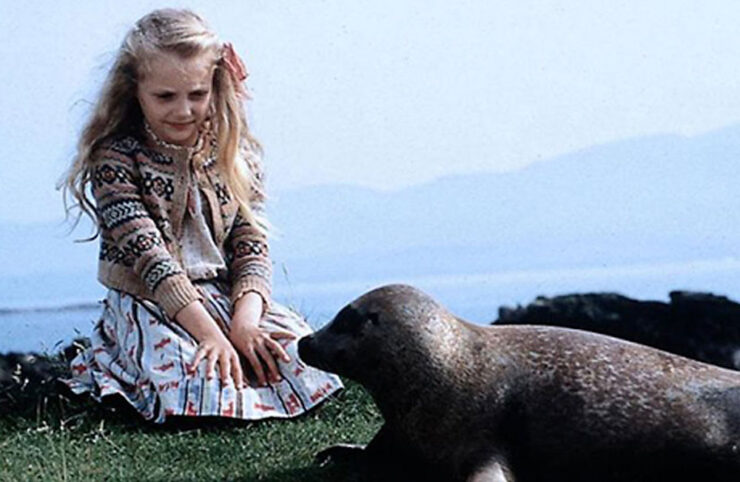
This film has been on my radar for a long time. It’s flitted on by when I’ve been streaming this or that, it’s appeared in “Recommended for You” lists, it’s done its best to get me to watch it. But one way and another I’ve never quite committed to it. When I was looking for examples of films about selkies, it turned up as one of the icons of the genre. And now, finally, I’ve seen it. And. Oh yes. Iconic.
It’s based on a book, Secret of the Ron Mor Skerry, by Rosalie K. Fry. For his 1994 film, auteur John Sayles moved the setting from Scotland to Ireland and changed a few names, but otherwise kept the main elements of the plot.
Young Fiona’s family comes from an island off the west coast of Ireland, Roan Inish, which means Island of the Seals (or, in fact, Selkies). After the end of World War II, when most of the young people had left for the mainland, the remaining inhabitants of the island are evacuated, but not before Fiona’s mother died and was buried on the island. In the evacuation, as Fiona and her older brother and father are about to embark on the ship, Fiona’s infant brother Jamie is left alone in his cradle. The cradle is a most unusual one; it looks like a huge wooden shoe or a very small boat, carved all over with sea-imagery, and it’s designed to float.
Which it does, suddenly. It’s carried far out to sea before anyone can catch it. Jamie is lost, and presumed dead. His father won’t speak of him; his siblings mourn him.
Some years later, in the big city, Jamie’s father has all but drowned in drink, spending most of his time in the pub. His older brother is working in a noisy, crowded factory. And his sister is so thin and pale that it’s decided she should be sent into the country to live with her grandparents.
Tess and Hugh live in a rented cottage on the shore within sight of Roan Inish. Another grandchild is already living with them, Eamon, who is somewhat older than Fiona. Eamon and Fiona quickly form a friendship, and Fiona settles in to life on the edge of the world.
That life is full of stories. Everyone has one to tell. The central story, the heart story, is the one Hugh tells about the origins of the family. Once upon a time, he says, a young man of the island rowed out to sea and came back with a strange dark bride. Nuala was a selkie, and we get to see the truth of it: how a seal comes up on the rocks and sheds her skin. The young man, Liam, steals the skin and takes the stunned and silent woman home, and marries her.
It’s a happy marriage, as far as anyone knows, with numerous children. Until one day one of the daughters asks why her father keeps a leather coat in the rafters of the house. Nuala runs into the house and leaves her standing there. And when Liam comes home that night, the children are all alone and their mother is gone. Because, says Hugh, even love can’t keep a selkie from the sea.
Ever since then, every generation of that redheaded family has had one dark child. That child in Fiona’s generation was Jamie. And Jamie’s cradle was made by Liam at Nuala’s instruction, built like a boat so that the child in it can be rocked by the sea.
Fiona is convinced that Jamie is still alive, that he’s been living with the seals. She finds proof of that when she visits Roan Inish: one of the cottages shows clear signs of being inhabited. Then she sees a naked child running in the grass; when she calls to him, he runs away toward a strange small boat that looks exactly like Jamie’s cradle. The boat-cradle carries him out to sea.
Fiona determines that if she can get her family to come back to the island, the seals will let Jamie come back to them. She enlists Eamon’s help to make the island habitable again. If this weren’t already a fantasy film, that would be an accomplishment of fairytale proportions: two young children rebuilding and thatching the cottages, clearing them out, planting the gardens, all while pretending to be out on daily mussel-hunting runs. The grandparents never happen to ask where the mussels are, nor is it ever made quite clear how the children have all the skills needed for the renovations, including cutting and installing thatch, building walls of stone without mortar, and making whitewash for the walls.
Meanwhile there is a crisis in the grandparents’ house. The landlord wants to evict his tenants and sell the house to rich vacationers. There’s nothing else available locally, and no one can bear the the thought of moving to the city.
Buy the Book
The Navigating Fox
All of this comes to a head as a huge storm bears down on the islands. How the family pulls together, and how the legend of the selkie’s children comes full circle, makes a lovely and satisfying conclusion.
It’s not a tragedy, though bits of it are sad. The selkie seems to love her human husband and all her children. As soon as she knows where her skin is, she has to retrieve it. She can’t resist the call of the sea.
But she hasn’t forsaken her human children. There are clear indications that she still watches over her descendants. The seals whom another of the dark cousins, Tadhg, calls “the other side of the family,” are always present and always watching.
One yearling seal welcomes Fiona on her first arrival, along with a young gull. They watch and guide her, and help her understand things that no one else does. It’s through them that she knows what she’s supposed to do, and how to bring Jamie back to his human family.
This is a beautiful film. The combination of music and imagery is deeply evocative, and the interwoven stories build a rich and complex world. The past is very much a part of the present; the magical and numinous lives side by side with the mundane. It’s all one. It all belongs together.
In quite a few ways it reminds me of another Irish indie film of the same era, Into the West. It shares the theme of city versus country, magical past and hardscrabble present; Ossie and Tito, like Fiona and Eamon, set out on a quest to bring their family back together. The West represents the past, but it’s also the family’s future. And it’s full and brimming over with magic.
Judith Tarr is a lifelong horse person. She supports her habit by writing works of fantasy and science fiction as well as historical novels, many of which have been published as ebooks. She’s written a primer for writers who want to write about horses: Writing Horses: The Fine Art of Getting It Right. She lives near Tucson, Arizona with a herd of Lipizzans, a clowder of cats, and a blue-eyed dog.



Missing the word “cottage” in this sentence.
Why wouldn’t they? Those are ordinary rural tasks that they’ll have helped the grownups with all their lives. When a child’s too young to help with the plowing any other way, you give the tyke the biggest rock they can handle of those you’ve plowed up from the field, and tell them to go put that on the drystone field wall. If the kid’s a little older, a thatching knife is small enough they can wield it, so it’s off to cut thatch while pa scythes the wheat. Whitewash is dead simple to make, although where they got the quicklime from is a good question. Maybe the book addresses that.
One of my favorite fantasy films.
This is one of my top ten favorite films, along with “Song of the Sea”–that’s two selkie movies in the ten! One of the things I love in this movie is the way the young girl’s view of reality is vindicated. She’s the one who sees the truth of things. I also love the visuals, including the scene of the selkie’s transformation, which is the one fantasy scene which was fully as magical to me on seeing it for the first time as an adult as any magical scene that captivated me as a child. I agree that the music dovetails beautifully with the visuals.
And I can see what you refer to when you link this movie with “Into the West,” another movie I liked very much and which has stayed with me better than most. Similar children’s quest, similar magical feel.
This is greatly belated; I meant to post this comment when the article was first posted, but…
The Secret of Roan Inish is one of my favorite movies, even though it has been a number of years since I last saw it. I first saw it as an American expat in Moscow in the 1990s, at an art theater that specialized in showing foreign films in the original language, and have rewatched on video since then. I loved the fact that it was a story about stories, and that the stories told by the characters were part of the movie.
With regard to the question of whether the children would have been capable of fixing up the cottage on their own, I can’t say for sure, although I can say that my father, who grew up on a farm in South Dakota, learned more about building and fixing things at a young age than I or my brother, growing up in a more suburban setting, ever did. My recollection is that Eamon, as the older cousin, does most of the more physically demanding labor; I remember him being the one who patches the walls and rethatches the roof, while Fiona sweeps and cleans the inside of the cottage. It may be that part of the goal is simply to show these activities for a modern audience; I read a review of the Secret of Roan Inish in which the reviewer commented that the film shows the concrete details of daily life by “teaching” the viewer how to tar a canvas boat (which Hugh does in an early scene), and how to thatch a roof (as Eamon does).
@3: Looking back, I agree about the music and the visuals; the background music does a particularly good job of adding emotion to the scenes.