






I never thought this would be an issue for me, I really didn’t. As someone who first fell in love with costume dramas watching A Little Princess as a child (the original with Shirley Temple, and also the ’90s remake), who graduated to swooning over Colin Firth in the BBC Pride and Prejudice mini series (no disrespect to Kiera Knightley and Matthew Macfadyen, but the film just didn’t hit the same), if you put actors in period dress in front of a camera, I am almost always there for it. But lately, even as I keep watching, I sense a kind of uneasiness creep over me.
It’s not that I didn’t wholeheartedly enjoy the most recent season of Bridgerton. I did; in all honesty, it felt like a return to form after a lackluster previous season. I also enjoyed The Favourite, as well as the BBC version of The Pursuit of Love, and I even gave The Great some time before it was cancelled. And it’s not that I can reasonably expect everyone to be as aware of anachronisms in a given costume drama as I am; after all, I’m a historian. It’s quite literally my job to care more about these things than the average person.
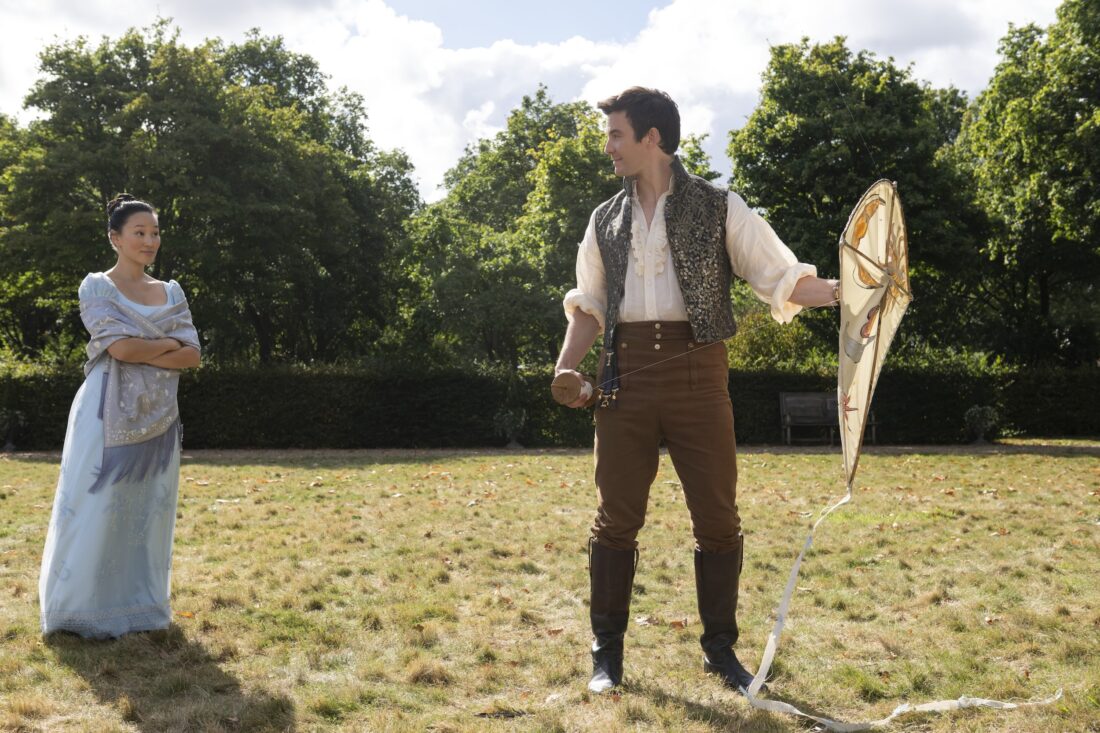
It’s more that anachronism is one thing, in and of itself. When all the anachronisms are of the same flavor, something inside me twitches. And if the return of The Artful Dodger to television, coupled with the anxiety I’m feeling about the upcoming Sense and Sensibility adaptation (after Netflix’s butchering of Persuasion, I fear no Austen is safe) are anything to go by, something weird is afoot.
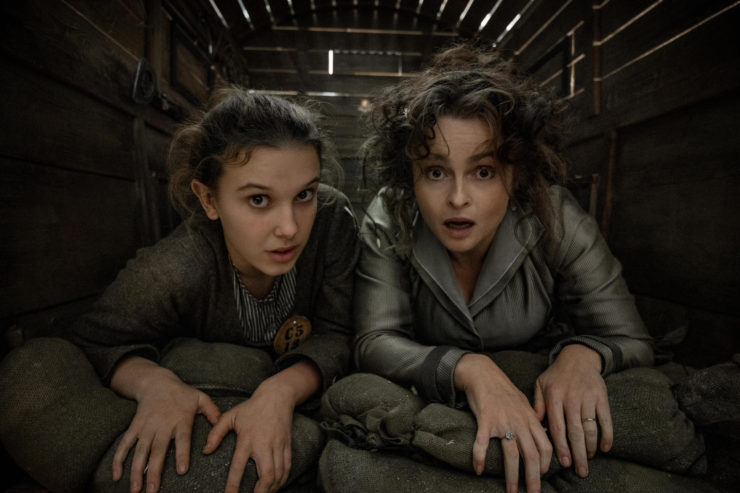
While it’s hard to put an exact name and shape to the phenomenon I’m describing, it’s definitely something where you Know It When You See It. When Enola Holmes (now inexplicably slated for a third installment), The Pursuit of Love, and (shudder with me now) Persuasion all feel as if they could be part of a shared cinematic universe, despite being set decades apart and allegedly belonging to different genres, you know that something is up.
These self-consciously playful, colorful, never-taking-themselves-entirely-seriously adaptations can be fun, when done well. And they serve a purpose, beyond the fluffy delights of string quartets playing Olivia Rodrigo while sauciness ensues in a staircase. They send a message; “people in the past: they were like us!”
And yet. That message starts to lose its power when there seems to be only one definition of “us” available. Watching some of these costume dramas, I wonder who exactly they’re for. They’re probably not meant for me, a historian; but I don’t think they’re made for a generic “not a historian” population. They’re made, seemingly, for a market-researched demographic. At their worst, they’re the equivalent of romance novels that list the tropes they contain on the back cover, seemingly begging the reader to discuss them on BookTok.
And say what you will about the commodification aspect at play here, that kind of narrowing also stymies much of the mission of anachronistic adaptations before the show or the film even starts. If you, the viewer, are not the kind of irreverent, post-ironic soul who uses the word “girlypop” in casual conversation, this isn’t relatable. It’s just two alien ways of being, one overlaid atop the other.
But, well, there’s something else that can’t be fully ignored. People in the past weren’t “just like us.” They were still people, yes, who laughed and cried and hoped and feared and fought and loved. But they were different from us, in ways both great and small.
“The past is a foreign country; they do things differently there,” wrote L. P. Hartley. I first encountered this quote as an opening to a period drama; the sweeping Australian multigenerational melodrama, A Place to Call Home. The quote, though, is from the beginning of The Go-Between, a novel about a teenage boy’s disillusionment with the human suffering caused by rigid late Victorian social norms. Hartley published the book, which is told in flashback, in the middle of the twentieth century, and his own past of 1953 would seem a world away to us today were we to visit.
While period dramas don’t have to be history lessons, surely there should be some point in setting them in the past. Yes, “those lovely costumes” does count as a point, but not the only one. Whether or not you want to expose the past, or celebrate it, or even change it in the newly-ascendant Bridgerton tradition, using historical settings is a choice. Experimenting with and altering those settings is a choice too. And there should be a reason to make these choices.
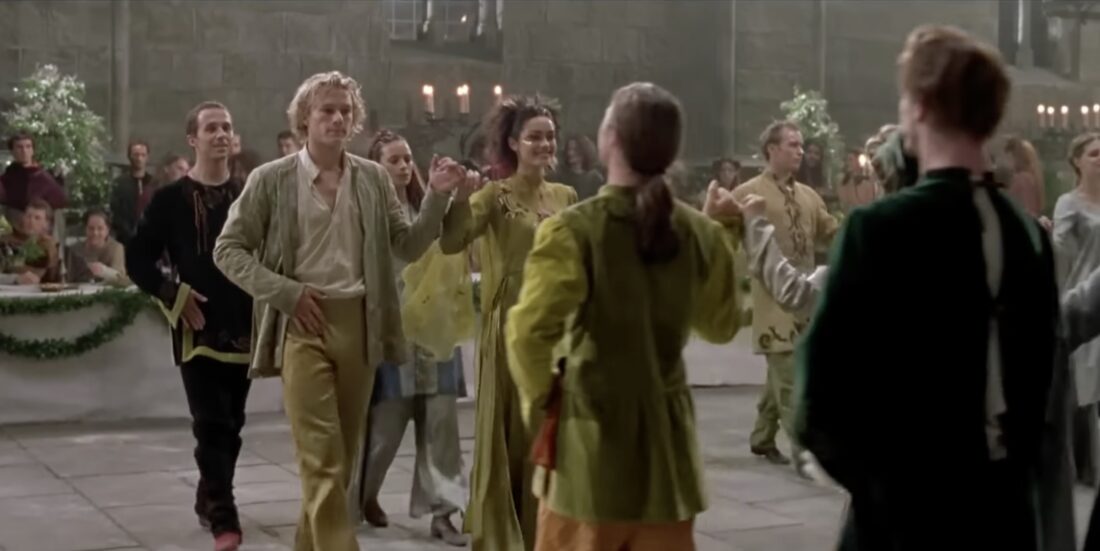
At its best, anachronism in period dramas can serve to bring something fundamentally alien to an audience in language they understand. Sofia Coppola’s famous soundtrack choices in Marie Antoinette helped underscore the surreal combination of indulgence, pleasure, boredom, and loneliness at the heart of Louis XVI’s court. Though silly, the audience of peasants doing the wave in A Knight’s Tale made the bizarre-to-modern-eyes sport of jousting feel like something to sincerely get excited about.
On the other hand, Anne Elliot skulking around a window ledge with a bottle of wine complaining that she and Captain Wentworth are “exes” doesn’t make a foreign concept comprehensible; it takes a feeling that the audience might not immediately understand (the mourning that comes from breaking off a relationship that never had a chance to become physically, or to an extent, emotionally, intimate, for social reasons that don’t exist in the twenty-first century) and replaces it wholesale. When Dickinson takes Emily Dickinson, who was both famously reclusive and, during her lifetime, displayed minimal interest in publishing her work, and makes her a quasi-suffragette who declares that it’s her “purpose” to “be a great writer,” they’re taking a fascinating artist who really lived and swapping her memory for a story we’ve all already heard.
Even when there is some genuine fun to be had with the finished product, like in The Buccaneers, it’s hard not to look at the fluffy romance and a protagonist who worries about if she’s “supposed to be the main character,” and not miss what could have been. In the case of The Buccaneers, that’s both Edith Wharton’s sardonic eye, and the hard-nosed ferocity of the real “dollar princesses,” whose lives were stories that are unromantic in the “hearts and flowers” sense, but heaped with intrigue worthy of the Tudors (though probably not sexy enough for The Tudors, which at least had the courage to present its anachronisms and inaccuracies as straightforward titillation). When we try to flatten our adaptations of history into a single modern subculture’s worldview, so much is, and inevitably will be, lost. And for what, exactly? Who is really still falling in love with what feels like an increasingly formulaic way of making these? Who is making these things, and what, if anything, do they want them to mean? Who, well, cares?
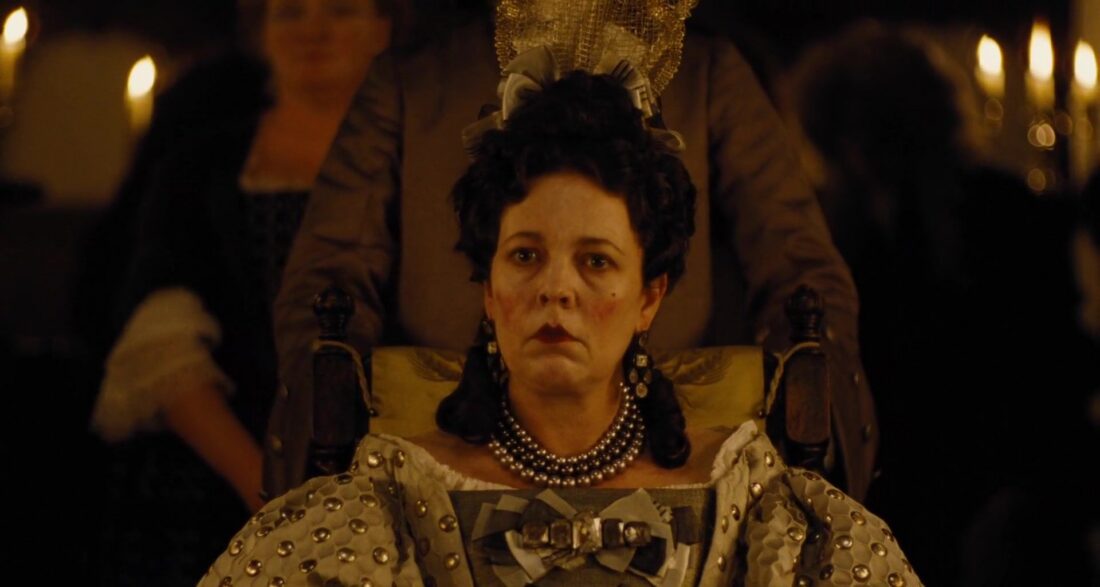
Perhaps that’s where the line is drawn. While The Favourite may have been one of the earliest of this new, sly breed of period drama, and it may have spawned imitators and homages (The Great in particular was fun, but for Tony McNamara, scriptwriter on both projects, a shameless retread of already well-explored territory), it had one standout element that, say, Rosaline or even House of Guinness just doesn’t, at least to my mind: it took its subjects, and the story it wanted to tell, seriously. That’s why it worked where others that followed don’t.
This doesn’t mean that the movies and shows themselves have to be serious; I did, after all, praise A Knight’s Tale a few paragraphs up. But history carries weight, and stories have power. What we tell matters, but so does how we tell it. By all means, have a little fun with the history books, and take your creative liberties—but only if you really mean what you’re saying.

Thank you for this thoughtful essay! The “flattening” of mainstream historical fiction into something that has seemingly no relationship to (or understanding of) the context of its setting is extremely frustrating. It reminds me of what I have read about the difference, in live theater, between “colorblind casting” and “color-conscious” casting. The former just steamrolls ahead, usually foregrounding the lived experience of the privileged and pretending there’s nothing else. The latter requires research, listening, understanding and care.
I am a “general audience non-historian” and not someone who watches much historical drama. I have, however, recently read a good deal of queer historical romance by modern authors (some swings and misses, some absolute home runs).
I find great comfort in reading a story set in an imaginary and anachronistic past when queer and trans people could openly be themselves (or could be truly seen and loved in certain pockets of community). Similarly (as in Mr. Malcolm’s List, which I thoroughly enjoyed) I love a very light-handed color-conscious casting that leads to a feeling of inclusivity in the delight of the romantic story. I think these very much fall within your idea of anachronisms existing for a clear reason and creators making choices that take the history (and characters and audience) seriously, even when they are a bit silly. And, at the same time, going back to queer experiences, I adore a well-researched historical novel that bring in the genuine ways that queer and trans people were able to be (relatively) safe in community.
One of my favorite books is Maurice by E. M. Forster (and the adaptation is one of my favorite films). The story of a happy-ending queer romance inspired by actual people in that exact time period (early 1900’s) is an exceedingly rare treat. People watching or reading it without context could scoff at the idea. How anachronistic! But the novel was based on real people and real experiences in that time. Similarly, the film Wild Nights With Emily is an absolute queer romp version of Emily Dickinson’s life. Ridiculous! However, its creator provided a 40-page historical packet of research to back up the real truth of the story she told, a crucial element of which was the purposeful erasure of the details of Dickinson’s actual life.
Which is all to say, I agree enormously with your unease about creators stumbling blind into historical fiction for the “beautiful gowns.” And a great solution (to my mind) is bringing in the “hidden” truth of what was going on historically. The stories that weren’t allowed to be told, that were destroyed or suppressed, and thus feel “too modern” or “anachronistic.” And then those of us who have been “left out” of history and media get to have our time in the sun *with* proper research, context and thoughtfulness. Not just dropping chronically online 21st century lives into Victorian slippers.
(Feel free to delete this, but I did just want to quickly say that Mr. Darcy in the 2005 Pride & Prejudice is played by Matthew MacFadyen, not James MacFadden!)
This ties in with a lot of thoughts I have about how afraid movies and TV seem to be of sincerity these days, and every emotion has to be undercut by a joke. It all seems to come from a similar place of thinking audiences are only present for a surface-level good time, which is a real pity!
Yes, I came here to say that too! Hey, admins—can you make a correction up there?
Updated, thanks!
It is becoming a more subtle chalice, although melancholic dramas and Dantean novels still continue to attract quite a bit of attention.
I found ‘The Tudors’ unwatchable. Apparently little attempt to cast people who looked anything like their historical counterparts (Henry VIII especially) and the costumes were so far off, it was like a modern teen romance gone wrong. A friend and I separately found ourselves yelling, “But where are their shifts?!!” at our respective televisions.
‘The Great’ was deliberately pitched tongue in cheek, but the costumes looked right (to me) and the acting was good.
‘Bridgerton’ is glorious in its colour blind casting. Although the real Queen Charlotte did face racial slurs in the press of the day for being a woman of colour.
Queen Charlotte was not a woman of color. She had some Portuguese ancestry several hundred years back, that’s all.
The weird truth is both are true. There is no proof she had any black ancestry and she did also get called slurs for black people. We have actual written record of that.
This frustrates me as well. I blame the Hamilton musical for the trend, though I also agree that there’s nothing wrong with self-conscious anachronism in isolation; it’s the trend that’s tiresome.
Julia Quinn, author of the Bridgerton book series, is to my mind one of the biggest causes of this. Before this point (around the turn of the century) most romances were expected to at least try to be historically accurate, but she laughed at the idea and her books took off, leading to so many imitators and changing the romance landscape. And they’re fun. But the romances and other books that make characters live within historical accuracy are so much more rewarding reads to me.
I got interested in history as a teenager way back in the 1970s, because I watched things like the BBC/PBS series about Henry VIII and Elizabeth R, not to mention A Man for All Seasons, Anne of the Thousand Days, The Lion in Winter, etc. All of which were pretty much faithful to their time period, but all of which did take many liberties.
My point being, those productions somehow spoke to me, drew me in, and made me want to know more – which is how I’ve spent so much of the years since reading history. Real history. (Not just English, though I think I know more about English history than any other country, including my own!)
So my hope is that these anachronistic, arch, revisionist series and movies and books do the same thing for today’s young people: draw them in, interest them, and spark enough attention that they decide to use the flip entertainment as an entry to the real thing.
I am the target audience for these shows and movies, although I haven’t watched all of them. I’m curious what you found especially arch or wonky about The Artful Dodger and The Seven Dials. Is it the intentional inclusion (or addition, in Christie’s case) of elements to appeal specifically to modern audiences, like an African scientist and references to modern knowledge of public health? In both cases, the female protagonist is seen as scandalous and too independent.
For the record, I’m not that excited about “strong female characters” in any setting, so if that’s the issue, I’m probably on board. I found Bundle kind of irritating, though I like Belle in TAD- there really were women forcing their way into the medical field and becoming surgeons at that time, so even if she’s over the top as a character, she fits within historical reality (not, obviously, reading literature and revolutionizing hospitals, but that kind of thing happens all the time in historical fiction).
For me it comes down to whether or not the anachronisms are done intentionally – like in A Knight’s Tale – or because they just seem to want to tell a story cut wholesale from modern motivations and dramas but with slightly different aesthetics, like most of the examples here. That’s just lazy. Or if they’re the aggressively “quirky” settings that Helena Bonham Carter often appears in. She always rubs me the wrong way.
Exactly; having a good knowledge base and choosing to mix it up is very different than not knowing any better, or crafting historical cosplay onto modern sensibilities.
There’s the interesting phenomenon in fantasy literature I think of as the fantasy faux-medieval setting. It’s a mish-mash of different levels of technology, society, government, warfare etc., that has been adopted for writing epic fantasy novels, but is not rooted in historical accuracy or an understanding of how all these things interact with each other. I could see the same thing happening with costume dramas.
The Enola Holmes mysteries are well-made and funny; the books are even more entertaining than the films. They’re not meant to be historically accurate, they are supposed to be fun. And that they are. But it is also a chump’s game trying to find actual history in Holmes…
Yes–I’ve had a similar reaction. As a few have said, it’s fine when anachronisms are there deliberately and joyfully (knight’s tale) but I think it’s frustrating when changes are made without consistency–so one character is able to act like a modern it girl but another character in exactly the same social situation is punished, faces ostracism, etc, which makes it feel, as a viewer, like there are no rules. As that means there’s no way to anticipate what actually matters in the world of the story, it guts the feeling of internal tension.
My favorite shows are the ones that take the time to educate the viewers about the rules of the world as the story progresses, so you understand what’s at stake. It’s something secondary world fantasies and sci-fi universes have to do (not always successfully) as a matter of course, so I wonder if the problem that some historical fiction authors run into is the assumption that since it’s “our” world that kind of work doesn’t need to take place.
Thank you for this! So many people say “What difference does it make?”, but I say that if it doesn’t make a difference, write your own story set in Manhattan in 2026 and call it a day.
My position is, if you’re going to make a modern drama–make one. Don’t call it a historical drama.
Some levity is OK. For example in the show Rome, the town crier who summarizes points for viewers also throws in one-sentence commercials for local businesses. “This baker sells the best. bread. in. Rome!” It’s funny. But, I can take that only up to a point. Otherwise it just seems to constantly mock the period the show/movie theoretically takes place in.
Also, I cannot stand obviously modern music in period dramas. And can I mention all the actors who are supposed to waltz or whatever, who cannot dance at all? They learned to act, can’t they take a few dance lessons?
I can’t help thinking of the typewriters and motorcycles in Derek Jarman’s Caravaggio. And he was hardly the first. Creative anachronism (apologies for other connotations that might be haunting those words) is nothing new. Some tropes might be a bit overworked right now, but I still find lots of the ways anachronism is used entertaining.
Is it even possible to represent the past now without doing it through the lens of the present? I’m pretty certain the Romans portrayed the Greeks almost as inauthentically as Jarman did Renaissance Italy. Though perhaps not with typewriters or motorcycles.