






Our journey began with two friends—Jack and Tollers—walking together, and reflecting that if they wanted to find stories they loved—the kind of stories they wanted to read—then they themselves would have to write them. They went on to create a variety of works that caught our imagination and set us out walking through the woods and saying to ourselves, well, if I want more of what I love in stories I suppose I’ll have to write it myself…
In this, our final article on C.S. Lewis’ Narnia books in the Great C.S. Lewis Reread, I wanted to share some thoughts about the ways that Lewis has shaped my own creative world, my novels, and my thoughts about what is possible as an author. I’d love to hear about your own creative journeys and where (or if) Narnia fits into them in the comments as well! It’s great timing, as the final book in my own fantasy trilogy—which was, in many ways, me wrestling with my love of Lewis and Tolkien and trying to wring something more from that tradition—has just come out this week!
So: When two of my dear editor friends wrote to say they wanted to take me to lunch to talk about doing some books together, my first question for them was, “What are you looking for?” (My second was what they liked to eat!) They were launching a YA line, and they immediately said, “We’d love for you to write a young adult fantasy series.”
To say I was thrilled was an understatement.
We sat at the Country Cat Café in Portland, and I spilled my whole idea to them over lunch. They asked questions, and I did my best to outline this story… What if there was a portal world where teenagers could go, and in exchange for a year of service get their heart’s desire?
As we explored the idea further I realized that this was, more than anything, me grabbing hold of Lewis and Tolkien and wanting to drag them with me, out of my childhood and into my world, today. I wanted an adventure that contained some of the things I loved, dropped the things that bothered me, and included the things I’d always wished their books had held.
It wasn’t subtext for me. It was part of the core of the story, and I felt an effusive excitement to get started. I wrote the proposal, pitched the trilogy, and sent it off—and as soon as I got the green light, my frenzied typing began.
Some of the things I loved about Narnia that I wanted in my books:
I love that Lewis’s kids are largely committed to each other, no matter what happens. Your brother might betray you, but he’s still your brother. Your cousin might be a pill, but you’re not going to abandon him on some desert island. I was tired of reading books where the conflicts centered on kids who aren’t allowed to get along. I wanted to read (and write) kids who loved each other, who had friendships you would cheer for and maybe wish you had something a little more like it. There aren’t angst-ridden teens making dour faces at each other in my books. They love each other. Yes, there are occasional misunderstandings, hard conversations, disagreements about what’s to be done…but at the end of the day they have each other’s back.
I also love portal worlds. Even as a kid this rang true to me. I believe there are worlds in the spaces between worlds and that we can fall through them. I believe there are forces that are hard to see at work in our world. That sounds like fantasy, but I believe it’s true. I knew my story had to be a portal world, some other place that might have been represented in a pool in The Magician’s Nephew.
More that I loved: that story of Reepicheep sailing into Aslan’s Country, the story of Digory’s mother, the sadness in Aslan’s eyes when he talks about knowing grief, even, yes, the whole story of what happens at the end of Narnia resonated with me. I love that Lewis didn’t shy away from grief, even in his kid’s books. My close friend was dying of cancer as I wrote the first book in my trilogy, The Crescent Stone. I remember being up late into the night at her house, writing downstairs, while she and her mom were settling in to bed upstairs. I didn’t want to shy away from grief, either, so the first character I brought into the novel was Madeline Oliver, a teenager with a terminal disease. Her heart’s desire in exchange for a year of service in The Sunlit Lands, is, of course, for her healing. The first book is dedicated to my friend.
I also love the sense of humor in Lewis’s work. There are many moments of laughter, of joy, in the books, and I wanted to bring that into my own novels. Madeline’s close friend, Jason Wu, joins her on her adventure to the Sunlit Lands. When he’s told he has to choose his own heart’s desire in exchange for a pledge of fealty to the Elenil, the rulers of the Sunlit Lands, Jason refuses. He just wants to stick close to his friend. After a bit of haggling he makes no promise of service, but he’ll tag along for a life’s supply of chocolate pudding. Oh yeah, and a unicorn. Jason’s really curious about the plumbing situation in the Sunlit Lands, a strange side quest that brings some important insights as the novel progresses.
I loved the magic and the sense of wonder in Narnia, and that clear feeling underlying all of the books that the author was having the greatest time of his life. If it made Lewis happy, he threw it in. A faun walking through the woods with parcels? Sure! A bear overseeing a chivalric duel? Yes, please! Talking beavers? Santa? Cannibalistic giants? Pirates? Creatures from the center of the earth? Yes, yes, yes, and of course yes. So when my daughter showed me a picture of a winged cat and said, “This is Remi, she is the Guardian of the Wind” and asked if she could be in the second book of the trilogy, I said, sure, let’s have a flying cat. (I was sternly rebuked. Remi is the Guardian of the Wind. Not a cat. It’s a common mistake.) There are at least three magic systems in the Sunlit Lands. There are bog creatures and rocs and necromancers and shape-shifting troublemakers and a culture that uses stories as currency. There are battles and Black Skulls and riots and an accidental engagement and a Spanish knight in a doomed romance and everything.
Yes, there was joy and fun and humor but Lewis also pushed into deep waters addressing things like power, spiritual abuse, and dangerous leaders. I knew I wanted to do that, too, and in fact those three themes are deeply embedded in the Sunlit Lands trilogy.
I loved that Lewis had no embarrassment about writing spiritual truths into his works for a broad audience. There were plenty of books I read as a kid that pretended religion wasn’t a part of life in fantasy worlds, or in the future, or if you got past the rings of Saturn, and I wanted to be able to embrace that some of my characters—fantastic creatures as well as humans—might have some connection to spiritual things. That’s not to say it’s simplistic…multiple faith stories and myths, even conflicting ones, exist in the Sunlit Lands. There’s no Jesus lion in my books but there is…well, I don’t want to give away any spoilers here. Let’s say that Lewis inspired me, but I also subverted a few Narnian tropes.
Why no Aslan? Well, I love the big guy (I really do), but as far as stories go I didn’t want the literal deus ex machina to show up and give instructions, point out missed signs, put things on track, or punish the evildoers. Don’t get me wrong, I enjoy that overall in the Narnia books, but it doesn’t match my personal experience of God in the world (so far) and it moves the narrative tension from “what’s going to happen?” and toward “when will Aslan show up?”
There were things I wanted to do differently, too. I wanted to expand the audience a little…make it less narrowly ethnocentric than Lewis. I didn’t start with four British school kids. In fact, the Elenil are recruiting teens (largely teens in some sort of difficult situation, hmmmm, why is that?) from around the world… Madeline’s roommate in the Sunlit Lands is Shula Bishara, a teen on the run from her past in Syria. I wanted to talk about women differently than Lewis. Women in the Sunlit Lands aren’t all children, matrons, or monsters. And when we do come to a woman who is a terrifying monster, we eventually dive into that…why is she seen this way? Is that accurate? What’s her story? One of the great strengths in bringing in a broader set of characters was the rich story world they created. Their insights taught each other, their histories brought unique knowledge and skills to the table.
Having kids from all these different backgrounds also forced the narrative into some questions about the intersection between the real world and the spiritual, questions of justice that matter in the Sunlit Lands and in our own world. Lewis dealt with some of this intersection…often by showing how Aslan would deal with badly run educational systems. I wanted something bigger. My teens and their friends are looking at systemic issues in a portal world and working to change them. I think teenagers can be and often are heroes who see the broken places in the world. They’re the ones who keep looking at the adults in wonder and asking, “Are you okay with this? Really?”
Buy the Book
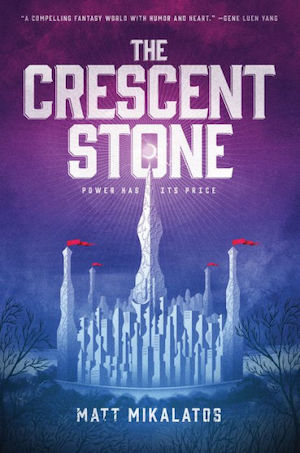
The Crescent Stone
So, yes, in The Crescent Stone we talk about power. We explore privilege and how you can be like Madeline—born into majority culture, beautiful, smart, wealthy—and also be someone who is dying and would trade it all to be able to live. And we explore how big the questions get when you realize that maybe, just maybe, the people providing you with your heart’s desire aren’t the Good Guys.
In the second book, The Heartwood Crown, we talk about how to destroy evil that’s deeply embedded in a culture. It’s not as easy as throwing a ring into a volcano or having a god-lion kill the witch. It could and probably will (and maybe should?) destabilize society. It might cause harm to both victims and victimizer. And what if you suspect that the answer may not come from violence? What if it’s not a magic sword that you need, but something deeper and sharper and more personal? What if it costs you something?
In the third book, The Story King, we explore questions related to common memory, to history, to the lies we tell ourselves so that we can be okay with the world we live in, and the stories we tell that illuminate and ultimately transform the world.
The last thing I wanted to focus on, in terms of enhancing what I love about the Narnia books, was to complicate the simplistic path to dealing with evil. I—like Lewis—believe there is an ultimate judgment coming for evil, but I wanted to explore what it looks like in the everyday world, not just at the end of it. The solutions to destroying evil are not always easy and are almost never entirely external. What I mean is, more often than not when we discover true evil we find that it needs to be rooted out of our own lives, too. It’s not just destroying the Bad Guys, it’s allowing ourselves to be transformed into people truly able to stand against evil by removing evil from our own hearts. I wanted my heroes—like me, like all of us—to be surprised to discover their own complicity in evil. I wanted them to make sacrifices. I wanted them to disagree about the right thing, the best thing to do. I wanted them to learn lessons that we could look at and say, wait a minute…if that’s true then maybe I can be a hero here, in my own world.
The third book in the Sunlit Lands trilogy, The Story King, is out this week. This trilogy is a love letter in the truest sense…to C.S. Lewis and specifically to Narnia. It’s three books where I gather up all the wonder, all the love, all the moments of joy that I got from Narnia and set them against the pain and confusion and frustrations and say, “I would do it a little differently, seventy years later, but I can’t deny my love for you came first and shined brightest.” And The Sunlit Lands are named (of course) for the world of Narnia that lies above the Earthmen in The Silver Chair.
And so, my friends! My dear companions! This brings us, at last, to the end of the Narnia portion of our reread. In a few weeks we’ll return to take a quick look at a standalone book, The Great Divorce. Then on to the Space Trilogy, and Till We Have Faces, and maybe even The Screwtape Letters! I am deeply, deeply humbled by your kindness, your excellent comments and insights, your questions and feedback along the way so far.
Now, before we go, I want to hear your stories. What do you create? Are you writing, painting, sculpting, making films, something else? How has Narnia shaped you or your work in some way? And hey, don’t be afraid to really sell it…I’m in the market for some new entertainments now that we’ve come to the end of Narnia (again).
Remember, dear friends, we may find ourselves too old for fairy tales and magical portal adventures for a time. But we are all part of the royal family in Narnia. And there is, we are told, a wood between the worlds. Perhaps if Narnia is not to your liking there is another pool by another tree, and if you were to wade into it…well, who knows where we may find ourselves?
 Matt Mikalatos is the author of the YA fantasy The Crescent Stone. You can follow him on Twitter or connect on Facebook.

This is lovely, Matt, both in where you have emulated Lewis in your own writing and where you have diverged. I think the greatest thing I have taken from Narnia isn’t anything so specific, but rather the sense of wonder and of joy I have always had from the Chronicles. The greater-than-life beauty and sheer exuberance in them has always stirred me deeply. When I was at my lowest in my struggle with depression, one of the hardest things for me was losing that sense of anticipation, that instinctive belief that something wondrous is out there–and these stories were one of my greatest bulwarks against the depression, because I knew that even if I had lost of ability to tap into it, that joy and beauty and goodness still existed, somewhere. The door to Narnia might have closed to me for a time, but that didn’t mean Narnia itself was gone.
I have tried to capture some of that sense of wonder and anticipation, and that joy, in my own stories. My fantasy detective series, Whitney and Davies, is more “Agatha Christie with magic” than Narnia, but still owes a great deal in tone and hopefulness to Lewis. And my sci-fi story From the Shadows is deeply influenced by Narnia, in the protagonist’s zest in facing this new and strange adventure, the bonds of friendship that form between the characters, and the light that pierces the darkness of the protag’s personal life.
Thank you again for this series! I’m looking forward to The Great Divorce, and to the rest of them.
‘Why no Aslan? Well, I love the big guy (I really do), but as far as stories go I didn’t want the literal deus ex machina to show up and give instructions, point out missed signs, put things on track, or punish the evildoers.’
I think some authors can take this too far, though. I remember reading one book which effectively mimicked the key plot points of the LWW, except that the kids had a lot more agency. God’s emissary in this instance wasn’t Aslan, but Saint Patrick, who as a result came across as a well-intentioned but bumbling imbecile – which I felt was kind of disrespectful, although I appreciate it was a natural consequence of empowering the kids (who were all American for some reason).
Wonderful article, Matt. And I look forward to reading The Story King.
As for my recently completed work, it’s heavily influenced by Lewis’s work. Imagine it as The Magician’s Nephew meets The Place of the Lion. It’s an extended metaphor that retells Paradise Lost as a magical disinformation campaign in a world like Pixar’s Inside Out. As you can expect, the worldbuilding was extremely challenging, but everything gelled in the end.
Things that this work borrowed from Lewis:
1) Talking about religion without actually talking about religion
2) Literary allusions (more on that later)
3) References to Platonic philosophy (but made accessible to kids!)
4) Symbolism (more on that later)
With regard to symbolism, just like Lewis, I tried to pack my worldbuilding with so many layers of symbols that it would take another book to point them all out (this column inspired me in that endeavor when it came to Lewis’s subtler symbols). Everything from word choice, to names, to even certain colors in the technicolor thought-world I’ve used to help me craft my story. Despite my symbol-heavy goal, the book still feels like an enjoyable read with nothing coming across as forced (always my biggest worry).
With regard to literary allusions, I accidentally borrowed something from Lewis here. There’s a bit of a story behind this one…
Because my MS is geared toward the younger side, I thought chapter titles would be an interesting place to drop literary allusions (my MC is a storyteller, and she uses stories to perform “magic,” for lack of a better word). As I was searching for appropriate allusions, I–inspired by Lewis–decided to look into some titles by Chaucer. And what title should I find but A Parliament of Fowls, which is a poem about a dream of being led through the “celestial spheres.” This immediately reminded me of the chapter in The Silver Chair entitled “A Parliament of Owls” (itself a superb pun on the fact that a group of owls is called a “parliament,” and that said owls were holding a quasi-political discussion). Long story short, the avant-garde literary device I thought I had been pioneering to offer subtle commentary on my own work was scooped by CSL about 70 years prior and topped off with a pun. I’m still incorporating the allusions, but definitely not with CSL’s flair.
But throwing the Ring in the fire didn’t end evil. Neither did Aslan slaying the White Witch.
@@@@@ 4
Throwing the Ring into the fire killed one kind of evil, others can survive. And Aslan did kill the witch
The thing that baffles me is how long it took to get non-human stories really rolling. I have a series planned where no humans exist at all, but “thinking animal bipeds” do. Several species with their own quirks and problems dealing with others, all set against a Lewis-timeline jumping in and out with a Silmarillian-level dissertation of politics and religious study for their planet. Unfortunately I’m nowhere near publication.
I fell in love with Narnia at a young age. I have thoroughly loved your series so far and can’t wait to keep reading. The Great Divorce is a personal favorite and I loved the first two books in The Space Trilogy (like everyone else I struggled with the last one). My work cannot be helped but be inspired by these books. My first work, which I am hoping to publish by this fall, is a series of tales for children focusing on a religious historical figure named Nicholas. The second I am writing now, and it is of course a portal story. Once everything is published I will be sure to share.
Please keep up the good work, I am truly enjoying these posts.
I came late to Narnia (I was 12) but it became one of my favourite secondary worlds and has informed a lot of my life since then (except for the whole atheism thing, of course). My first role in amateur theatre was as Mr Tumnus in a production of LWW at 16. At university I read A. N. Wilson’s bio of Lewis and spent several days in the library checking up on all the things that were referenced in it, becoming a huge fan of Matthew Arnold in the process. Finally, my own first novel (published under a pseudonym for fairly obvious reasons (not the least being that it was shockingly awful)) was a portal fantasy inspired partly by Narnia.
Hi Matt,
I will have to read your trilogy. Sounds wonderful. My dad gifted me The Chronicles of Narnia when I was 10 and I fell in love. I feel like the rest of my life, I’ve been searching for that same feeling in a book or series. I wanted to create something along those same themes, portals, talking or “telepathic” animals, poetry, lore—but for adults. I wrote my first book Hidden Knight: A Novel of a Bear. It’s not published yet, but I’m working toward that and hope to join the “pool.” :) My new up and running author page is leannarapier.com.
Just thinking fond thoughts of Fillory here
Matt, I’ve been reading your articles since the beginning, and have adored them, including being moved to tears on more than one occasion. I read Narnia over and over as a child (after my dad read it to me), but I hadn’t read them again until the past couple of years when my son was old enough for me to read them to him. It was so nice to have this to help balance my reading, since it took us a similar amount of time to read through them. I have changed a lot since my conservative evangelical upbringing, and I was worried about how my change in perspective on life in general would affect my childhood love of Narnia. Your articles have helped me get through them again, for which I am thankful!
I’m also thankful that reading these led me to your books! I read The Crescent Throne December 2019 and loved it. I remember grinning and looking at my wife to say “I’m reading a book published by a Christian book publisher that’s describing police brutality and systemic racism in a meaningful and non-reductive way!” It has given me hope for the future, and I thank you for that. I hope there’s more about The Peasant King in the final book, because I have found him far more relatable than any similar figure in literature in a long time!
I think what I’ve most obviously drawn from Lewis in my own work came from his background as a professor of Renaissance literature: the permission to use the mask of paganism in order to write a book with a Christian heart.
In my case, it’s a sword-and-sorcery heist caper series (which owes a lot to Leverage and Lankhmar as well as to Lewis) called Hand of the Trickster.
The eponymous Trickster’s purpose in the world is to exalt the humble and humble the exalted. Yes, straight out of the Magnificat.
Thanks for your work, Matt, especially your exemplary generosity and fair-mindedness. Wish more Christians would follow your example in public life.
I’m very much enjoying your series on Narnia, Matt, and looking forward to a dissection of Lewis’ adult works as well. I feel like his space trilogy held a lot of the more advanced concepts he couldn’t fit into the Narnia series. Whether it turned out well…that’s another discussion.
I’ve always had a big place in my heart for Tolkien and Lewis. I read the Hobbit in third grade and the Lord of the Rings in fourth (all the way through the appendices, thank you!) and devoured Narnia several times in those years.
I started writing my first book in my teens, but it would take about twenty years before I finally brought that book to the concept that I wanted. In the meantime, I wrote about six other books to hone my skills. I finally published The Seeds of Dissolution in 2017, and the second and third in the trilogy in 2020. As you might guess from the title, it deals with universe beginnings and endings and what happens when a stable society is disrupted. It’s also, of course, a portal fantasy, or rather a portal science fantasy, because the main character travels from Earth to a place where magic exists, but also has alien species. In the great vein of Tolkien and Lewis, I based my magic on the music underlying the universe, like Tolkien’s Music of the Ainur. In my case, I called it the Symphony.
Thanks again for this excellent series, and I’m looking forward to reading about the rest of Lewis’ works!
Will the essays of The Great C.S. Lewis Re-Read ever be collected in book form themselves? I’d like to own that book.
@15/Skallagrimsen. We’d need to figure things out with the Lewis estate, but it’s not impossible!
Interesting series! I’m looking forward to your article on The Great Divorce; I haven’t read that since C.S. Lewis class in undergrad days . . . I’ve still got my copy but I haven’t read it since, but I must again! I still have and still reread from time-to-time, including this past week, my copy of Surprised By Joy; will you be discussing it?
I’m a writer, and I didn’t think that my writing really had Narnian influences. Now that I’m thinking about it, though, the shape-shifting deity that pops in + out of the half-demon hero’s life is a bit like Aslan. He/she/it takes different forms as needed, “obeys his own rules,” and has a relationship with a young “angel” girl rather like Aslan’s with Lucy.
Plus, while it’s not meant to be a religious book per se, it’s gotten at least one rejection for being “too spiritual,” so…
Thanks again for this series, Matt! I now want to read your books.
I do have a quibble or two. You say that overcoming evil is not as easy as throwing a ring into a volcano. Two things about that:
1. Destroying the Ring does not destroy evil. It destroys one dark lord, Sauron, but at the same time signals the end of magic and the loss of many good things.For example, within a lifetime, all the elves and their civilization will be diminished or gone altogether. Evil still exists, will rise again (many characters state this plainly, including Gandalf), and will have to be fought.
2. Still more important, destroying the Ring is not easy. It breaks Frodo–and he fails. It was very important to Tolkien that his readers recognize Frodo’s failure as well as his real heroism. This point, especially, is why the book is adult, not a children’s book at all, though children certainly love it (I did!). And, of course, Sam is the true hero of the quest–something else children don’t typically “get”.
But I loved reading about how Lewis inspired you–especially the deep friendships between kids and the portal fantasy. Oddly, as an adult, I don’t especially like portal fantasies. I prefer books set in the future or in other worlds altogether, like Ursula Le Guin’s, or books in which the magic is part of our own world, like Madeleine L’Engle’s or Diane Duane’s.
As to my own writing, curiously, except in style (I hope!), Lewis doesn’t seem to have influenced me much. My biggest influences on my first two novels-in-progress are J.R.R. Tolkien and Gene Roddenberry. And, I hope, Ursula Le Guin! She and Madeleine L’Engle are my queens; Tolkien is my king. What I got from these authors:
1. An examination of greed, and of dragons as a personification of greed (both books).
2. How does your family and your society influence you as you grow up? What causes you to question, or even challenge, your society?
3. What is faith, and how does it influence our lives?
4. The idea that a very ordinary person can be a hero. My young MC pushes back against that idea pretty hard early in my first WIP.
5. A multicultural, mutli-ethnic cast.(Le Guin really influenced me here, and I do hope I’ve done her justice.)
Congratulations on the publication of your novel–I’ll be looking for it. And thanks again for this series and for letting me chime in.