






When I began the SFF Bestiary, one of the editors’ first requests was that I talk about talking animals. I’ve been circling around the subject ever since. Touching on it here and there, sometimes very tangentially.
I dipped a foot in the water with cats, notably Tailchaser’s Song, along with Warriors and Princess Donut. It was an easy transition from those to Rita Mae Brown’s world of cats and dogs and horses and foxes, all doing their best to get through to oblivious humans.
Brown’s humans never quite catch on to the fact that animals are talking to each other all the time. Fluently, in full sentences, expressing complex concepts. These concepts, like many of the animals’ names (Reynard the fox, Athena the owl, Lafayette the horse), are ultimately human-centric. They live their own lives and are presented as superior beings, but everything comes back, sooner or later, to human ideas and preoccupations.
Humans all over the world tell stories and sing songs of animals who talk to each other like humans, act like humans, think like humans. The world is a mirror. Everywhere we look, we see ourselves.
The technical term is anthropomorphism. Imputing human traits to nonhuman things. When that thing is an animal, the animal talks, because humans do. Human language, human ideas, human ways of doing things.
In folklore and oral storytelling, animals talk to each other. They talk to humans. Humans talk to them. Everyone communicates on the same level, in the same words.
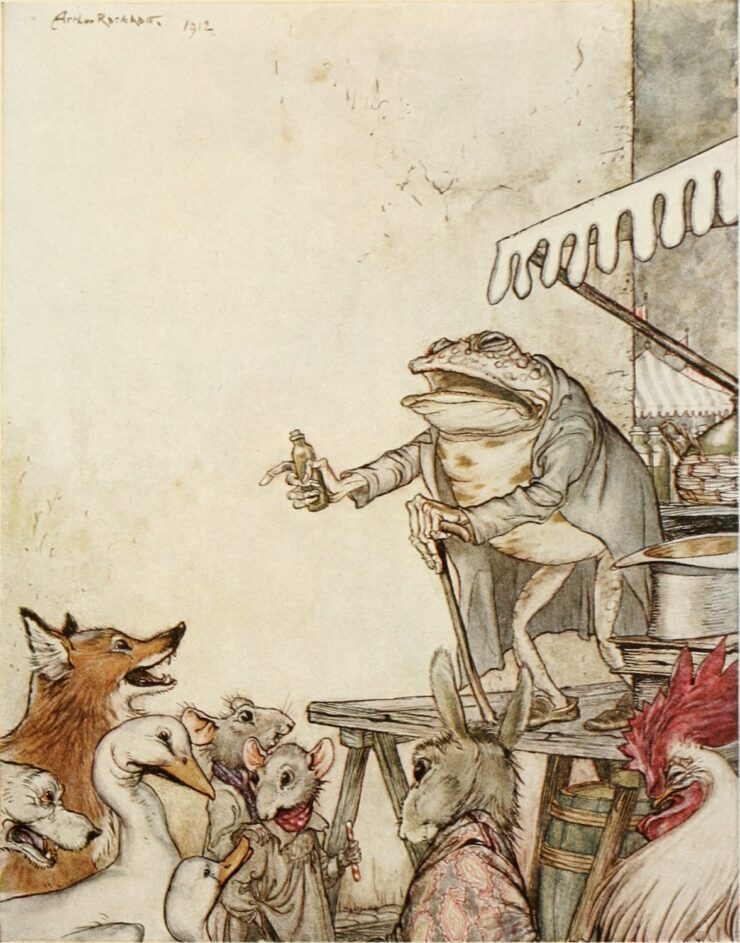
Literary animals may be their natural selves—rabbits, lions, horses, cats—or they may be fully anthropomorphized. Peter Rabbit and his family wear human clothes and do human things. So do Toad and his friends in The Wind in the Willows. And then there’s Winnie the Pooh, who begins his life as a child’s toy, inhabiting a world of toys based on living animals: a bear, a donkey, a tiger, a kangaroo. (And let’s not forget Paddington Bear and Calvin’s inimitable Hobbes.)
Animals rule the world of animated comedy. Mickey Mouse, Mighty Mouse, Donald Duck, Bugs Bunny, Felix the cat, Sylvester the cat and his arch-foe Tweety Bird, Foghorn Leghorn (whose accent inspires a human avatar, Benoit Blanc), Yogi Bear, Rocky the flying squirrel and Bullwinkle the moose, the list goes on and on.
These animals and their stories are often consigned to the children’s section. Adults are expected to grow out of them. Grownup stories are “real” stories, stories about humans doing “real” things, in a world in which animals stay strictly in their lane. They may make sounds, but they’re not talking. Talking is a human thing.
And yet, humans of all ages keep right on loving their talking animals. Cartoons are grand entertainment for kids, but there are whole levels and layers of wit and satire that the grown-up kid will catch. Bugs Bunny’s riff on Wagnerian opera is central to my childhood; the older I get, the more I appreciate the gloriously cracked genius of a wiseass rabbit in a brass bra and a winged helmet (and that horse) .
This is going to be an epic chapter of the Bestiary. I’ve got a list, a very long list. Watership Down is on it. The Wind in the Willows. The first volume of Redwall. Bambi. The Lion King. And that’s just the beginning.
What are your favorite talking animals in books and films? What’s classic? What’s new? What should I most definitely not miss?

“Foghorn Leghorn (whose accent inspires a human avatar, Benoit Blanc)” Foghorn’s accent, and many of his catchphrases, were a lift from a radio character of a southern senator in the late 30s/early 40s.
“What’s Opera, Doc” and “The Rabbit of Seville” brought opera to the masses for generations.
The Youtube video I linked had a comment that “What’s Opera” was the first cartoon to be archived in the Library of Congress. That’s pretty cool.
Yes, Senator Beauregard Claghorn (Kenny Delmar) was one of the regular characters on The Fred Allen Show, from a segment where Allen would go down his (supposed) street and chat with various colorful neighbors. A lot of characters, gags, and catchphrases in Warner Bros. and other old cartoons were references to the pop culture familiar to the audiences of the day, like how Pépé Le Pew was a parody of Charles Boyer in Pépé Le Moko, and the Abominable Snowman was a riff on Lon Chaney Jr.’s Lenny in Of Mice and Men.
S.T., a domesticated crow, from Hollow Kingdom by Kira Jane Buxton.
There’s a sequel to it, though I haven’t read it yet.
I thought we were talking fiction. Everybody knows Crows talk! They’re notorious gossips.
My other favorite is Nighteyes from The Realm of the Elderlings by Robin Hobb.
A series that did not get nearly enough attention when it was published in the 1980s, and ditto its author: Phyllis Gotlieb’s Starcat books, “A Judgment of Dragons,” “Emperor, Swords, Pentacle,” and “Kingdom of the Cats.”
Imagine a bunch of Terran leopards, transported to another planet by a godlike mischief maker, force-bred to sapience and then left alone to make what they can of a culture and world. Then imagine a Galactic Federation finding them, and finding out the cats are intelligent and telepathic. And, finally, imagine those cats – the Ungruarh, as they call themselves – traveling the galaxy as diplomats, trouble-shooters, and mystery solvers.
It is a delightful series that does a great job of portraying its characters as cats – with their own very feline perceptions, philosophies, and attitudes, down to how their language is structured – while making them emotionally resonant.
Gotlieb does the same with all the alien sapient species in these books – and there are a LOT of strange and wonderful aliens. Sapient isopods. Jellyfish-type blobs who are metalsmiths extraordinare. Sapient birds of many kinds. And so on. Each has its own viewpoint, its own voice, its own distinct self.
Absolutely a crime these books aren’t better known.
it’s not at all for kids. There’s a lot going on these books, which generally revolve around some terrible crime the cats help solve and make right. But beautifully, intelligently written and the characters pop right off the page.
Drat. There’s no kindle version (I can’t hold physical books anymore, sigh).
Maybe you can find an eVersion that downloads to your computer or phone…? These are old books, so maybe not, but they are worth the try!
For one, I highly recommend the “Chet and Bernie” series from Spencer Quinn (pen name of Peter Abrahams). These are detective novels narrated by the dog, Chet. Technically, since the author is a human, it’s more human-accessible than anything truly narrated by a dog, but the narration definitely has the “flavor” of dog-think. Quinn manages to convey essential information even though “Chet” doesn’t really understand what he’s seeing or hearing. It doesn’t really fit your premise, though, as Chet doesn’t really “talk” in the books.
But for true talking animals, I also recommend Shirly Rouseau Murphy’s Joe Grey series, starting with the first, Cat on the Edge, in which Joe Grey gradually realizes he’s becoming more than just a cat. He can understand what humans are saying, and what the things they are saying mean. So when he witnesses a murder (and is almost murdered himself for the crime of witnessing it), he has to figure out how to let humans know who the murderer is. Thus begins a series of adventures and mysteries that now run to more than 20 books. He eventually meets other cats who have human-like thinking skills, and eventually some of the humans in his life learn that he (and a few other cats) have these human-like cognitive abilities, but Joe Grey also and always remains the scrappy grey tomcat he’s always been.
We had a cat named Joe Grey. He was a great kitty! But not much of a talker.
I actually have one of the Joe Grey books. Will put in the queue. Thank you for the referral!
Chet and Bernie is one of my favorites! (with the unfortunate exception of the end of the first one–a disaster Chet has been apologizing for ever since)
I named my pets after the Disreputable Dog and Mogget from the Abhorsen series by Garth Nix. They’re not really a dog and a cat, but they look and behave like them most of the time, even when they’re speaking human language.
There’s a talking cat in Tamora Pierce’s books. Also a lot of animals that learn to think like people, though only one person can speak to them.
I wrote about the Nix series here
Snuff and the other animal companions (plus one impostor) in Zelazny’s A Night in the Lonesome October.
Don’t forget the dark side. When Rick gives Morty a device that allows him to understand what animals are saying, he points it at squirrels and discovers that they run the world. Rick has to destroy this reality and shift to a new one.
He’s not talking per se, but I didn’t think of it earlier in your series. I should have have mentioned The Silver Robin by Dean Marshall. You’re not likely to find it in a present-day library and the only copy I find online is priced out of my range (my daughter “stole” mine to read to her kids), but this was an important animal story in my personal history. I’m sorry others won’t have the opportunity.
I’d mention Terry Pratchett’s Gaspode, but everyone knows dogs don’t talk.
oh YES! this one.
Woof!
Oh, indeed, there’s no shortage of examples….
Doctor Dolittle is obviously already on your radar (and well worth discussing the varying incarnations – I quite liked the Robert Downey movie, and there was a short-lived but amiable animated series in – I think – the early ’70s).
Two specific callouts from L. Frank Baum’s Oz books: there’s a short scene with Toto at the end of The Emerald City of Oz that addresses the way that Oz affects animals from outside its borders, and The Magic of Oz is set almost entirely in the Great Forest of Ugu, involving a plot wherein talking animals and animal transformations come into play.
For mice, the two obvious picks are the Miss Bianca books by Margery Sharp and the “Basil of Baker Street” series by Eve Titus – and see also Mrs. Frisby and the Rats of NIMH by Robert C. O’Brien (and note that in the case of all three series, the books and the associated movies each have their own unique merits).
There was a novel in the early 2000s called One For Sorrow, Two for Joy by Clive Woodall featuring a great variety of talking birds; I remember it as being fascinating but that’s from a long-ago reading; the Goodreads reviews are far less kind. You may or may not want to write about it afterward, but I think it deserves a reread if you can track down a copy.
I left a post in one of the previous cat articles about a brand-new feline fantasy called A Basquet of Cats by Christian Bieck, set in an alt-medieval France; that one looks fascinating as well.
And not exactly talking animals, but unique in the annals of Saturday morning television, you might look up Lancelot Link, Secret Chimp, which was NOT an animated series, but a live-action comedy spy series in which the principal characters were portrayed by actual chimpanzees. This is at once exactly as cheesy and as bizarre as it sounds, dead flat amazing in terms of what they were able to do with the chimpanzees onscreen – and (IF I am remembering my Web sources correctly from a long-ago surfing session) much less exploitive than might have been expected for its time.
One other TV example that’s a little sideways from the sandbox – it occurs to me that the Muppets are interesting in that on the one hand, the majority of the major characters are animals, there are also human Muppets in the mix (the Muppet newsman, Dr. Honeydew, Crazy Harry). And their animal natures occasionally come across directly onscreen (see particularly A Muppet Christmas Carol, in which the opening musical number has rats and mice playing rats and mice).
In Nicholas Stuart Gray’s Grimbold’s Other World, all animals can talk in the night-world, and once a human has been taken there, they can understand animal speech in the daytime world as well.
A classic, but it’s been out of print since the 80s.
Diane Duane’s cat wizards — who hang out with the human wizards from the Young Wizards series sometimes — in The Book of Night with Moon , To Visit the Queen, and The Big Meow. And the Talking Animals in Narnia, of course. And the cats in The Midnight Folk.
I just read Christopher Rowe’s novella The Navigating Fox, set in a world where some animals are sentient and can talk, and others of the same species are not sentient. It’s very impressive.
Hmm, others worth considering. I feel Duncton Wood deserves a shout out simply for choosing moles, but it holds up well alongside Watership and Tailchaser, although the immediate sequels get a bit overtly Christian.
On the lighter side, there’s the Spellsinger series with a memorably communist dragon and a very disreputable otter.
Mouse Guard is worth a look too, if only for the beautiful artwork, it’s a darker take than Redwall.
Speaking of Graphic Novels, Blacksad is a very good crime noir with anthropomorphic animals, while Usagi Yojimbo mixes them with Medieval Japan and all sorts of historical and mythological happenings.
I cannot recommend Mouse Guard highly enough. The artwork is simply superb. In a similar vein is The Mice Templar, which is almost as good.
Alan Dean Foster’s Spellsinger series is a fun, lightweight isekai adventure in which a twentysomething slacker is summoned by Clothahump the tortoise wizard to help defend their kingdom against an insect army called the Plated Folk. Unfortunately, said slacker is the Wrong Guy thanks to misunderstanding of the word “engineer”.
I was thinking of spellsinger books as well. It’s been ages since I read them. I vaguely remember a girl from our world also gets brought into the kingdom and gets together with a character that’s a rabbit?
I quite liked the series, I think I still have the books in the loft somewhere!!
I am amazed that you got through this entire article without mentioning or even hinting at the furry fandom and subculture.
(My faves include but are not limited to Marjory Sharp’s Miss Bianca (and her Disney counterpart), Miss Piggy, and Rarity from My Little Pony: Friendship is Magic. I May Have A Type.)
How about Clare Bell’s book Ratha’s Creature and its sequels, about sentient big cats learning to control fire (in the first book).
(I only learned just now there were more than 2 books in the series!)
Andrei Alexis’ Fifteen Dogs, of course. Speech is not a blessing
Some knee-jerk memories. Bandit, Tinker, and Pirate in WE3 and Manchee in The Knife of Never Letting Go left with pieces of my heart for sure. Mogget from Sabriel as performed by the wonderful Tim Curry.
Tim Curry is actually a Muppet himself in many respects as we saw on MUPPET TREASURE ISLAND.
Oh, man. If WE3 leaves you unmoved, can you really be said to have a heart?
The Shady Hollow series by Juneau Black for sure! They are delightful murder mysteries that take place in a world of anthropomorphic woodland animals. The main character and sleuth is Vera Vixen, a fox and town journalist. Despite their cozy world and the charm of the characters they’re well-built mysteries that don’t shy away from plenty of adult goings-on, like murder, affairs, fraud, and cons.
I got these for my Mom at the recommendation of the seller at my local coop bookstore… and she *loves* them! Couldn’t wait to get the next in the series. And, to be clear, my Mom doesn’t read fantasy or talking-animal novels generally. These seem to just be really good mystery books.
In addition to my favourites of Watership Down and Wind In the Willows (and of course Winnie the Pooh!) there’s also:
Your description of Winterset Hollow is ringing all of my bells! Thanks for the rec!
The Mammoth books by Stephen Baxter are also quite good.
MRS. FRISBY AND THE RATS OF NIHM, along with the animated version.
Second to the Wild Road books. Which I should reread!
I have a real soft spot for the book version of The Amazing Maurice and His Educated Rodents, as it was a favorite bedtime storybook for my own son. I’m about to start querying a middle grade horror best described as “Paw Patrol meets Dawn of the Dead,” so if any agents are reading this and want sample pages, ask Reactor how to contact me. ;)
While it isn’t exactly about talking animals, Frankie and Benjy from The Hitchhiker’s Guide to the Galaxy don’t just talk, they give orders. The Ameglian Major Cow (aka the dish of the day) wanted to be eaten and was capable of saying so clearly and distinctly. The short-lived sperm whale didn’t talk but it did philosophize briefly. And of course the dolphins – the most intelligent creatures on Earth – attempted to communicate “So long and thanks for all the fish.”
I think Adams mainly used talking animals to throw humans’ mean callous heartless exterior into sharp relief.
I remember a talking horse when I was very young. Mister Ed
A little-known novel I found called Kursed Kreatures. Sorta like Redwall with epic fantasy.
Animal Farm, Honor Harrington’s tree cats? Of course Princess Donut frim Dungeon Crawler Carl.
Mongo would be appalled! Did you download book 8 of DCC, came out this week.
I wrote about Princess Donut here.
Honor Harrington! Yes! Thank you.
So many amazing suggestions. Thank you thank you!
Not a favorite animal — but a favorite tidbit:
Children’s books are frequently challenged or banned, both in the US and abroad, due to talking animals for various reasons.
As recently as 2006, Charlotte’s Web was banned in Kansas because talking animals are “blasphemous and unnatural”. The UK banned Alice’s Adventures because talking animals challenged societal norms by placing them on the same level as humans.
Hong Kong imprisoned the publishers of a series called Sheep Village for using animals as a thinly-veiled political allegory.
It all makes Perdido Street Station look normal!
@ridcully is right — a case of divided attention and fingers typing faster than my brain — I’d started writing something about UK/Piglet ban but remembered that was not for being a talking animal. When I pivoted to the Alice ban, I didn’t delete back far enough. Hunan/1931 is correct. Thanks for the fact-check and correction!
I can find no evidence that Alice’s Adventures were ever banned in the UK, do you have a reference for that claim?
I doubt it, because rkjustrk is confused. Alice was banned for that reason in 1931 in Hunan, which is a province of China, not the UK. (Wikipedia entry gives a 1931 New York Times article as a reference.)
If adult fantasy is your thing, you can’t go wrong with the amazing comic Monstress, by Marjorie Liu and Sanaa Takeda. It’s won an armload of awards including the Eisner and the Hugo. Top-shelf worldbuilding and a prickly heroine who is not afraid to kick as much butt as there is to kick.
I’m not sure if this category counts, but the dragons in Anee McCaffrey’s Pern books speak to their riders telepathically. Same for the Companions in Mercedes Lackey Valdemar books and the Jhereg in Steven Brust’s Vlad Taltos books. These intelligent “animals” are key characters to these stories. Maybe this is a special sub-genre, as these characters don’t speak aloud, and have high intelligence. Food for thought.
My first thought when they said cats was the Ghatti’s Tale series, but they, too, are telepathic companions. First book to physically make me cry and definitely not talked about much.
I strongly recommend THE SHEEP DETECTIVES–it has the talking sheep, but they behave in many ways like, um, sheep. Ok, it’s a dumb movie but I liked it anyway!
I thought the book the movie is based on (and its sequel) are delightful. Leonie Swann, Glenkill: A sheep detective story (in the US as One Bag Full) and Garou: A Sheep Thriller (in the US as Big Bad Wool). there is a third that isn’t yet translated, I believe, called Widdershin. Translated from German by Anthea Bell.
Freddy The Pig.
I just found this series of posts a few weeks ago and I am enjoying them enormously and adding ever more books to the towering stack of TBR Thank you!
Richard Adams (Watership Down, which is a classic for good reason) wrote other books with talking animals that aren’t mentioned as often, perhaps because the topics and point of view can be devastating (at least it was to me). The Plague Dogs broke my heart when I read it, changed my attitude towards animal welfare and while I can’t bring myself to do a re-read, it is one of those books that lives always in my head. I thought Traveler was less successful but it is a very ambitious retelling of the US Civil War told from the perspective of Lee’s horse, Traveler.
There are just so many children’s classics that fit the call for animals that talk to each other, but not the humans. Charlotte’s Web was the first to come to mind for me. Someone else mentioned NIMH, which would probably be high on my list as well.
Paul Gallico wrote a number of classic cat novels, including Jennie and Thomasina. His The Silent Miaow: a manual for kittens, strays and homeless cats purports to be a found manuscript written by a cat on how to take over a human household. Get the illustrated hardback 1964 edition if you can, the photo story makes the text completely convincing. And then there’s Manxmouse.
I just took a peek at The Silent Miaow. I can’t wait to get my hands on a copy! Thanks for the rec! 😸
In relation to chimpanzees, Paul Dickinson’s award-winning book Eva is about a girl whose mind is transferred to a chimpanzee and who thereafter communicates with both humans and chimpanzees.
Getting back to talking cats, Austin in Tanya Huff’s Summon the Keeper is a favourite of mine.
I’ll recommend Allen Andrews’ The Pig Plantagenet, set in 13th century France. All animals understand each other, but have difficulty understanding humans.
I’m deeply disappointed in myself as I realize I have not read *any* talking animal books in recent memory. What am I doing with my life!? 😹
The only recs I have are:
Thank you for the great series!
I was charmed by the profane communist dolphins of John Scalzi’s Starter Villain (not to mention the cats).
Funny that talking animal books can be the subject of bans for being “unnatural” and unChristian, given the whole, y’know, snake/Eve thing.
And yes, as others have noted, the entirety of My Little Pony and its fandom. Perhaps cartoons, though, are their own category, since it seems more common for them to have talking animals than not. Offhand, I’m having trouble thinking of any from my ’70s/’80s childhood that didn’t have at least one.
The talking frogs in Euripides’ “The Frogs” and in my lifetime “Mister Ed”
Coming to this a little late, but A Night in the Lonesome October by Roger Zelazny is a classic where all the characters have animal familiars that talk and interact with each other, although I don’t think they talk directly to their human partners.
It’s been a long time since I read it, but I remember liking The Heavenly Horse from the Outermost West by Mary Stanton. The horses had their own mythology, customs, rites. It was quite a ride.
I bounced hard off that one (and its sequel) – for me, the prose was readable but the world-building just Did Not Work (I recall the cosmology as being grounded in a weirdly breed-conscious and human-centric view of equine culture). She later wrote a series of cozy mysteries – under a pen name I’ve forgotten, darnit – that I liked much better.
A Cricket In Times Square and its sequels: the animals are the main characters. They can all talk to each other. They can xwaeaunderstand human language but can’t converse with them, though at times they try to communicate with them.
Other books that follow this paradigm are Charlotte’s Web and the Bunnicula series. Actually I’m not sure where these fall in the taxonomy of Talking Animals.
I know I’m late to this convo and I realize this is a bit of an unusual reference but when it comes to classics I’ve always enjoyed the story the story of Balaam and his talking donkey in Numbers 24, it’s such an amusing and deceptively profound fable.
Talking animal stories cover such a broad spectrum, and there are a lot of good examples listed above. The first two that came to mind for me, already mentioned, were Watership Down and Mrs, Frisby and the Rats of NIMH. (Note that there are significant differences between the book and the film The Secret of NIMH; I prefer the book, but your mileage may vary,)
Three examples that I have encountered recently, which fall into different categories:
1) Talking animals without humans: Urchin of the Riding Stars by M.I., Mcallister, the first volume of the Mistmantle Chronicles. A bit like Redwall, with talking animals in a semi-medieval setting (sword-wielding squirrels, otter boatmen, etc.). The author is from the North of England, and focuses on animals from her native region.
2) Talking animals with humans: Hemlock and Silver by T. Kingfisher includes a cat with significant attitude, inspired by own of the author’s own cats.
3) Non-talking animals (sort of): Issue #11 of the comic book Hawkeye, including Hawkeye (Clint Barton) and Hawkeye (Kate Bishop), but told from the point of view of their canine companion, Lucky the Pizza Dog. In terms of showing an animal’s perspective, the comic does a remarkable job: Lucky does not think in terms of words, but in smells (shown by pictures of what he smells) and memories (also shown in images). When the human characters talk, much of the dialogue is shown as incomprehensible scribbles, other than words Lucky can understand (like “Good boy!”), and a few others shown as concessions to the reader.
I’d add Blood in Ellison’s A Boy and His Dog