






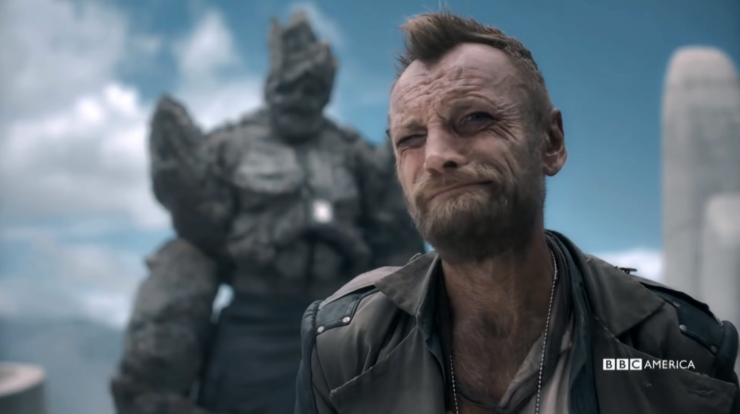
Let me start by saying that I will not be arguing that The Watch—BBC Studios’ TV adaptation of some of Terry Pratchett’s Discworld novels—is Good, Actually. It isn’t good: it’s a hot mess. But in amongst the janky chaos are some really interesting ideas that I want to honour before this whole thing sinks without a trace.
[Note: The following essay contains spoilers for S1 of The Watch]
Pratchett’s beloved novels are notoriously difficult to translate to the screen. The film versions have, largely, been thuddingly unfunny, mostly because they hew too closely to the text and refuse to make the changes necessary to make the most of the different medium. Going Postal did better as a mini-series and I see what The Watch was trying to do: take the core ideas and spirit of the novels and transliterate them into the format of a crime drama TV show. It was a good idea with poor execution. Quite apart from its troubled relationship with the source material, The Watch is just…not very good television. Other critics have pointed out its many flaws and I will not be listing them all here. Zack Handlen summed it up well in his thorough review for Polygon: “The pace is zippy enough that watching the show never becomes an active chore, but [Pratchett’s] charm is almost entirely absent.”
Buy the Book
Battle of the Linguist Mages
Before we get on to what I’d like to celebrate about The Watch, I must first mourn what they did to Lady Sybil Ramkin. I love that they cast a Black woman, and Lara Rossi did a fine job with the material she was given. But as for the rest!
What I love about Sybil in the books is that she is a fat, bald, middle-aged woman who is quietly confident in herself. She is a supporting character operating largely in the background because—I like to think—she doesn’t need the intense character development a book’s protagonist must go through in order to create a satisfying narrative arc. Sybil is already complete unto herself. The older I get, the more I am drawn to her mana and self-knowledge.
The Watch takes this wonderful, subtle person, makes her thin and young and gorgeous, and puts her through the Strong Female Character mill. As Sophia McDougall wrote in her seminal 2013 essay “I hate Strong Female Characters”, the trouble with SFCs is that they respond to the problem of shitty representation of women as sexpot/victims by simply making them feisty and good at punching. This completely flattens the characterful variety and moral complexity of women. The Watch makes Sybil not only good at violence (HASHTAG STRONG) but has her fall into the Batman trap: somehow ‘fighting crime’ (and even getting revenge for murdered parents, sigh) by assaulting individual poor people, vigilante-style. We learn that Sybil has been using her aristocratic privilege not to, for example, improve public health, but instead to kidnap street people and forcibly re-educate them into being good citizens who don’t do crimes no more. (Literally, she chains them to desks at her Sunshine Rescue Centre for Broken and Bedraggled Things.) It’s like a pscyhosexual MRA fever dream of the project of feminism: individual men being forced into SJW submission by a sexy woman. Thanks, I hate it.
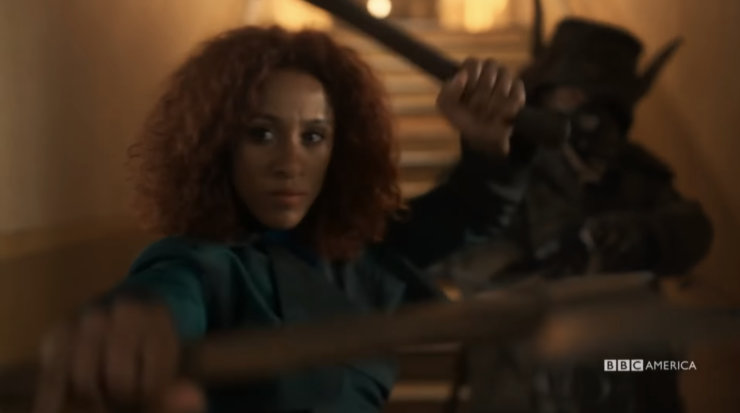
(The only thing I can think to say in the show’s defence is that by the end of the season, Sybil has grudgingly decided to give up vigilantism in favour of attempting institutional reform—but you have to really squint to catch this development in amongst the overburdened plot strands. It’s her horrifying ‘Rescue Centre’ that sticks in the memory.)
This is a particularly baffling giant misstep for a show that otherwise has an enthusiastic approach to upending gender norms and diving headlong into an exploration of gender freedom. (I’m trying not to use the phrase ‘embrace diversity’ because it makes me think of the gag in one of the Moist von Lipwig books in which a character mishears it as ‘embrace divertingly.’) Dr Cruces of the Assassins Guild has been gender-swapped, played by Ingrid Oliver, whose slow slide into feral rage over the course of the show’s eight episodes is a joy to witness. (As a side note, the Assassins Guild is one of the things I think The Watch gets right, really leaning into their effete vanity and out-of-control cosplay viciousness.) More interestingly, Lord Vetinari remains a male character—referred to in-universe as he/him, ‘sir’ and ‘Lord’—but is played by female actor Anna Chancellor. The show never explains this and is the better for it.
I also love that Cut-Me-Own-Throat Dibbler has been reimagined as a disabled woman who uses a wheelchair. It is so rare to see a disabled character who is neither noble nor pitiable, and—importantly—who is neither cured nor dies. Instead, Throat in The Watch—as in the books—is a sleazy small-time crook, constantly on the take, and by the final episode she is thriving.
Throat is played by disabled actor and wheelchair user Ruth Madeley. I wish this were not notable: I wish it were standard practice to employ disabled actors to play disabled characters. So that is something else The Watch got right—though it’s a pretty damn low bar to clear. (But if they were open to employing actors with marginalised bodies why on earth couldn’t they retain Sybil’s fatness? Is it because they couldn’t conceive of a character being fat while also feistily kicking ass? And why are none of the dwarf characters played by little people? Aaargh!)
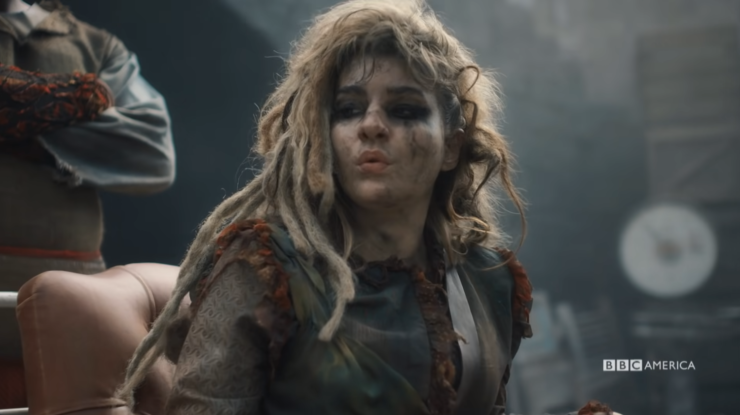
Where The Watch really shines, though, is in its depiction of Cheery Littlebottom; making her transness—a long-running sub-plot in the books—gloriously centre stage. Cheery is a dwarf who uses she/her pronouns at the beginning of the show, and they/them by the end. Cheery is played by with an engaging combination of flair and gravitas by genderqueer actor Jo Eaton-Kent. In the world of both the books and the show, dwarfish society is what we might call comp-masc; that is, weighed down with a compulsory masculinity whereby everybody, regardless of gender identity, has to present as male or risk ostracism, or worse. The ‘worse’ in the show is being left for dead to be consumed by The Dark. The Watch diverts from the books by repurposing The Dark—instead of a demonic entity or mine sign it becomes a force of gender euphoria.
At one point the plot requires that Cheery, Carrot, and Angua go back to Cheery’s home mine in order to search for one of the various maguffins with which The Watch is overloaded. They all wear beards in order to comply with the comp-masc rules. But Cheery is betrayed, and she and Angua are chained down and have their beards stripped from their faces so that The Dark will come for them. Angua is unaffected by The Dark but Cheery has a revelation.
When Cheery is enveloped by The Dark she reconnects with her mother, who she realises is not dead but has instead ascended to a new plane where her previously forbidden femininity can run gorgeously rampant. Cheery’s mother explains that The Dark is not a threat but a multidimensional source of freedom and power. I love this idea and I think The Watch gets the tone right as well: gender policing (i.e. transphobia) as a social force is taken seriously but there’s also an explosive playfulness to it all, along with some splendidly camp costuming. (That pink wig! I love it.) I also love the way that the gender binary is left far behind, and gender freedom is presented instead as a joyous, endless range of options. Cheery tells Angua that The Dark is “an infinity of all that I can be, and there’s no shame, there’s no right or wrong; in there you can be anything, everything.” Cheery leaves the mine on her own terms, reclaims her beard, and wears it with a pink dress.
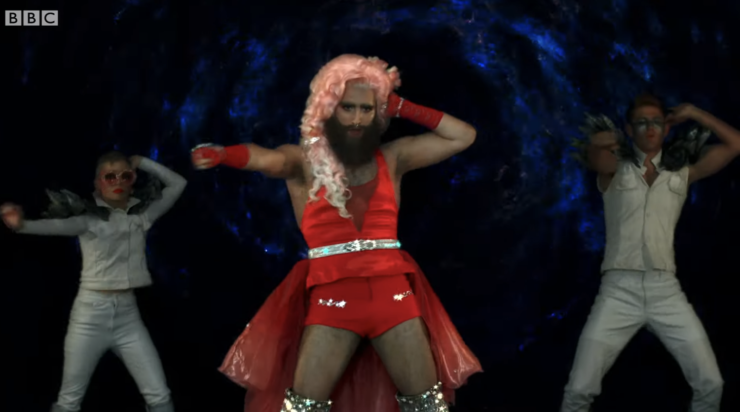
Thus fortified, Cheery goes on to be instrumental in solving the central problem in The Watch: a dragon is attacking Ankh-Morpork and can only be stopped using—wait for it—the power of song (oh did I mention that the City Watch had formed a band? FFS). It’s a great message about the freedom and strength derived from embracing one’s own identity fully, and succeeds despite the eye-rolling ridiculousness of the plot.
On balance, then, I’m glad I watched the show. That said, I know that The Watch has disappointed and even enraged fans, and I can understand why. For myself, I am mostly irritated that in this golden age of television, The Watch is unforgivably incoherent and a real missed opportunity.
If I’m being honest, part of my irritation comes from the fact that I have some personal headcanon that I’m irrationally offended The Watch didn’t include. Carrot and Angua’s romantic relationship in the books skeeves me out. This is partly because I find Carrot creepy; partly because I like to read Angua as gay (and…you know…married to me, obviously); and partly just because Pratchett is at his weakest when writing sex and romance. The Watch addresses this somewhat: Carrot has merely some run-of-the-mill folksy charm rather than the spooky, manipulative charisma he exhibits in the books, and the show goes out of its way to establish that he definitely isn’t a chosen one of any kind.
And they were so close to making Angua gay! As a werewolf Angua is already a queer-coded character, with an essential identity she has to keep secret in order to avoid becoming a social outcast. Whereas in the books Angua in human form is classically white-feminine (conventionally attractive with long blonde hair), The Watch makes Angua short, butch, and grubby with spiky hair (SO GAY YOU GUYS). Marama Corlett does a good job of conveying the tightrope Angua walks between her physical strength and her social vulnerability. I did hope that with trans and disabled characters in the mix we might also get an openly gay werewolf, but alas—The Watch retains the Carrot/Angua ship. If any fanfiction writers want to fix this for me I would be very grateful. (Please note that my name is spelled with a z, thank you.) I will continue to believe in my heart that Angua is bisexual like me and that we are meant to be together. Maybe I can find her in The Dark.
My ancestors come from England
I am here in Aotearoa New Zealand by virtue of the Treaty of Waitangi
I was born in Auckland in the traditional tribal area of the Ngāti Whātua tribe
Waitematā Harbour is the body of water that is special to me
Mount Albert is the mountain that is special to me
I now live in Wellington in the traditional tribal area of the Te Āti Awa tribe
My name is Elizabeth Heritage


Thanks for the spoilers. I’m now comfortable with my decision to not waste time watching this “hot mess”. I’m in the middle of my latest Discworld re-read and am once more enjoying Sir Terry’s wit and wonderful turns of phrase. And actually, I thought Hogfather was a pretty good movie adaptation. Susan was done particularly well and seeing Death with a fake beard was hilarious.
Isn’t the problem with Dwarf society that women like Cherie aren’t trans? That they are femme women being forced to present masculine?
Sounds like the writers had a vision of a fabulous gender queer fantasy world which they regrettably decided to force into Pratchett’s framework instead of creating something original.
Sybil is a large, middle aged woman who shaves her head because hair is dangerous when working with dragons. She is also immediately attractive to Vimes and others. She is actually quite well adjusted by Ankh-Morpork standards, if a little lonely. She certainly isn’t a revenge obsessed vigilante Batman character. That’s what Vimes could have become without his dedication to the Law. Sybil is a positive character who influences the more troubled personalities around her for the good.
It’s great to read an article about the Watch that finds positives to pull out of it without trying to argue it’s a good adaption. Also good to read a full survey of the various kinds of queering of the characters that the show went in for: it’s clearly conscious and it had interesting results.
Would we call Cheery in the books ‘trans’? Trans as the term operates for the nonfictional inhabitants of roundworld? I’ve always thought of Pratchett’s Dwarven Gender-Norms thread as being about lots of different things to do with presentation, living authentically, gender, sexuality and even religion. As such, it’s helped me think about trans-ness, about gayness, about stifling social norms that prevent you living as your true self, whatever those norms are and whatever that self is. About fundamentalist religion and toxic masculinity. I don’t think I’m overstating my case in saying that thinking about all this stuff in 2D on the Discworld as a fairly sheltered teenager has helped me be a better, kinder adult when I’ve encountered it in 3D in real life.
I don’t want to be rude or dismissive. I just mean, reading Cheery as trans without acknowledging it’s *a* reading among many seems a bit reductive?
@2- Well, haven’t seen the show, but Dwarven gender issues in the book aren’t going to map to contemporary Western issues because the underlying assumptions are different. Cheery’s trans* in the very basic sense that she transitions from occupying one gender identity to another.
Thanks for this! I am rereading all the discworld novels in english right now (have read some before but the rest only in german). I love Sybil and I really don´t want to see that version of her so I don´t think I ´ll be watching the show….although maybe the patrician is worth it…Also, I read Angua as bi, especially after she met Sally, their interactions were one of my favorites as a teenager and now I know why.
If they had changed the names of the characters and just based it on them I could have been happy with it as a fantasy show. It was a bit nuts and a bit fun and a bit weird and that was great, but every time they said Vines or Carrot or Cheery I was completely jerk out of any enjoyment of the show as a show.
I have to quote Mr Burns regarding The Watch: “I don’t know art, but I know what I hate…. and I don’t hate this.”
For all its hot mess, it was mostly fun. The weakest points were turning it into a videogame plot “get the three things” quest, and as you mention, the whole changing of Lady Sybil. Pratchett never has end-of-the-world villains, it’s all more petty and rolls up into existential danger from there.
The almost-modern punk-rock aspect I expected to despise, and really didn’t: the actors gave it their all, even if the scripts didn’t support it. I’d watch another season if they ever made it.
Thank you for taking the time to write this.
I feel that Pratchett had something for everyone. It had diversity of ability, gender, sex, religion and nationality, all in a fantasy setting.
Being disabled I liked how a carrot was disabled in Guards Guards, and all the stigma that comes with disability (The way his dwarf family and community treat him).
Detritus and Cuddy are my favourite characters, especially how Cuddy doesn’t treat Detritus like he is stupid. Their partnership deals with racist and ableism in such a lovely way that made me feel normal growing up.
Then their is Sybil and the calming effect she has on Vimes, she is the real hero, without her Vimes would be a drunk and probably a murderer to boot. To make her the borderline psychopath and him the calming factor in their relationship is so wrong, dare I say toxic, having a down on his luck 50 year old drunk and a hot young 20 year old psychotic vigilante fallowing in love is cringe worthy at best.
I can’t watch the show, I physically shake and cry trying, it literally has the opposite effect on my mental health and happiness as the books which I love and which saved me so many times growing up. If the books make me feel that life is worth living this show does the opposite.
Well. I watched this series the other day, and I must admit that as an ardent fan of the discworld created by Sir Terry Pratchett, I was very unhappy with how the TV adaptation was created.
On so many levels, it was just wrong. It is not how I envisioned the world created by by Sir Terry. In my minds -eye, I had a vision of the characters and how they sounded. And this was not it.
However… the creators of this series did say that this was “inspired” by Sir Terry’s works. So taking that as a starting point, and accepting that the TV series is an “alternative” take on Sir Terry’s works, I can sit back and enjoy a romp through the world created in this series.
Was it enjoyable? Mostly. Was it coherent? Nope. Was it eye candy? Definitely. A disjointed story that was covered by so many flashbacks. Back and forth… it got hard to keep on track. I got a surprise out of C.M.O.T Dibbler as portrayed here by a lady in a wheelchair. THAT was a “take” that i didnt expect. (I had a mental image of someone like Timothy Spall), and the part of Vetinari being played by a woman… After seeing Charles Dance doing a fantastic job in “Going Postal” there is no one else I can envision for that part. (Sorry, but he did it so well).
The location… it was… ( I’m a little lost for word here).. not what I had in my minds-eye. Sir Terry created a world that was colourful. It had depth. A taste. A flavour. This was not it. In this TV adaptation it lacks any of the above.
So… final words (I hope) I will watch another series if made. They have created a fantasy world “BASED” on something created by Sir Terry. As a stand alone thing, it has merit. But don’t compare it to the world created by the author. They are not the same.
I love love love what they did with Throat! So awesome.
That being said, like most others, I hate what they did with Sybil. I know Sybil, she’s a favorite of mine in the “Prachettverse”, and that was not Sybil.
I’ve read pretty much every pterry available, (Discworld and others), and this show fails to feel like a Pratchett. Hell, even his final few books had more of his charm and wisdom.
The showrunners are clearly non-believers. Why should we waste time on kabuki?
I simply LOVE the show. I really think it conveys the spirit of Pratchett in a contemporary way. I am sure they could have done better, especially with the pace and complication of hundreds of plot strings, but what I mean – who would not be tempted to do that when given a chance to portray Ankh Morpork? There is just so much to show, so much to play with. I think screenwirters and directors in Discworld are simply like children on cocaine let loose in a ball pit playground with slides made of infinite cake and candy. IT IS SO HARD TO CONTAIN ONESELF. They did great with characters and casting, I think if they would get a chance to re-write it calmly and in organised manner of having an outlook for like 4 seasons, it would be much better. In this case I think they just crammed so much because all of the authors, not sure if there will be season 2, wanted something they love about Discworld in it and this created the hot mess.
I hate the show, not for what it did for my Discworld but for what it did to viewers who have not read the books.
If this is the first time people experience Pratchett they will have no appreciation of Pratchett. And if they are drawn to read the books, any book that they pick up will disappoint them.
As far as tampering with the characters to check off boxes in the showrunners’ minds, I wouldn’t mind if they retained the characters’ motivations. For example, Dibbler works but Sybil most definitely doesn’t on so many levels. Beyond the fact that she is middle age and thick set (not so much Rubenesque as Wagnerian), she is a do-gooder with no indication that her parents were murdered and no hints of vigilante tendencies.
Another problem is that it tries to do too much too quickly in order to check more boxes. Guards! Guards! could have made a good adaptation by itself but The Watch was not the same back then. If they wanted to explore LGBTQ issues they would have to create non named characters.
Well….I found Terry Pratchett when Colour of Magic was first published in paperback…40 years ago?
Have bought every one since, some hardback, some paperback.. even had some signed. I live in Wiltshire so Sir T lived just down the road.
I really enjoyed the Watch. Not a slavish attempt to recreate the book, obviously. As a series based on the original concept and within the limitations of using real actors and CGI rather than cartoon I think it succeeds
I look forward to a second season
I, happily, do not have a TV nor access to any streaming media that would show this.
From what I have read, this would seem that someone “may” have read the book or more likely been given a synopsis, and thought “What a great idea for a mediocre to poor television series.
The book (series of books) has distinct characters that interact quite intimately, the whole story line depends on this and matures throughout the subsequent books. Reassign genders, colour, species actually detracts from the story as written.
Why break something almost perfect down to the bare bones only to rebuild into something that will never “fit” with the original idea. The playwriters/producers & cast should really take time out and READ the books so they can understand the humour, characters, story line and morality of them before embarking on another annellation of another of his works.
As I said at the beginning, I do not have access to the show but with everything being posted, expressed & opined in the media, “Give it up” until you actually find the subject matter, social commentary and poke in the eye of the darlings funny. If you don’t you are turning the world into a very sad place.