





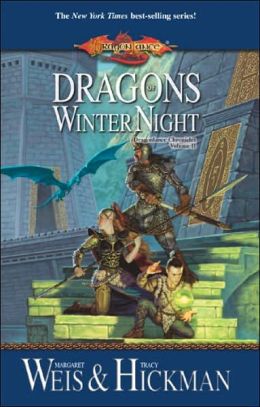
The best thing Sturm Brightblade ever did was die.
I did not discover literature of any kind until I was about eleven, or ten. I was, without a sliver of a doubt, a no good, lazy slacker of a child, and after I discovered literature, I was totally and utterly a no good, lazy slacker of a child who read books. A lot of books, good and bad, but my favourite—the books I read and reread in my teens—were by Margaret Weis and Tracy Hickman. Specifically, I had a deep and complete love for the Dragonlance Chronicles. First published in 1984 when I was nothing more than sticks of bone at seven, Dragons of Autumn Twilight began what would be one of the icons of my grunge stained disenchanted childhood. I know it all, back and front, left and right and, thirty years after the first book began the series, I still remember the scenes at the end of Dragons of Winter Night, where Sturm Brightblade slowly and surely, walked to the top of a tower to fight a dragon with little more than the sword his father left him.
He died, of course.
In Dragons of Autumn Twilight, Weis and Hickman presented him as the noble knight, living his life to a code referred to as the Oath and the Measure. It was, as you would suspect, fairly standard fair: don’t lie, don’t back down, try to rescue a woman if she looks vaguely in distress. For all that I love Weis and Hickman’s Chronicles, I will not claim to be immune to their faults as an adult. In their first book, Weis and Hickman did not stray far from the tropes of fantasy and role playing, and you could almost hear the book being read in a gaming sessions, somewhere between Missouri and Utah, wherever the TSR office at the time was kept. At thirty-six and twenty-eight, Weis and Hickman had not intended to become the authors of the series, but had rather been responsible for mapping the project out and managing the author who would write it. They would take control of it because of their own desire—and perhaps ambitions, as well—but it would not be until their second trilogy, Legends, that they would begin to find their feet properly in novels. But for all that, they still managed to make one irritating character out of Sturm Brightblade and his Oath and Measure.
But then, in Dragons of Winter Night, Weis and Hickman stripped him of his knighthood, revealing him as a man who clung to an ideal that was long gone, to a family history that was more a weight than a blessing—
And then he walked up into that tower, to die.
Characters die, all the time. At times, they die amongst a reader’s tears, and at others, amongst the applause, and some, still, in quiet satisfaction. Yet, the death of Sturm Brightblade was the first violent death of a character in a book I can remember. In his final moments, it made Sturm likeable. It was the last breath, desperate attempt to help your friends by the sacrifice of your life and, in that one moment, Sturm Brightblade did the best thing his character could possibly do: he died. He left a legacy within the book that, realising that it was not the act of his death that gave it such strength, but rather his mortality, Weis and Hickman let the legacy of his physical failure and demise settle into their world and their writing.
Over the remaining books, the characters who appeared in Dragons of Autumn Twilight would all touch their own mortality. Flint, Tasslehoff, Raistlin, Cameron, Tanis, Goldmoon and Riverwind—each of them would die, though in Riverwind’s case, it would be at the hands of a different author, a violation that felt somehow worse than the event itself when I was young. Indeed, perhaps it was this lack of control over their own characters that also dictated Weis and Hickman’s actions. But if that played a roll or not, Weis and Hickman, through sword, age, heroism, kindness, and cruelty led each character to their own mortality. For the last surviving member of the cast, Laurana, Weis and Hickman even return to Sturm’s death, crafting a demise that mirrored Sturm’s at the end the second book in the War of the Souls trilogy.
Thirty years after the initial publication of Dragons of Autumn Twilight, I can honestly say that Weis and Hickman have go on to write better books in terms of simple craft. The Death Gate Cycle was probably my favourite and, I believe, their best. But the Rose and the Prophet trilogy always felt to me as if it slid under the radar of a lot of people. The Darksword trilogy was always a favourite of other people, though it fell behind the other two for me. There would be a few proper missteps in their career, though. The Sovereign Stone Trilogy was a misfire, oh yes, but it was not the disaster that two Starshield novels were. Nor was the return to the series that made their name always excellent. Despite a fine finale in Dragons of Summer Flame, they returned for a tired War of the Souls trilogy, and a series called the Lost Chronicles, which I suspect, only for die-hards like myself were up for.
Weis and Hickman would write solo novels and novels with other authors, as well. Weis turned first to a science fiction series for her solo start. The Star of the Guardians was four books and I devoured each as they were released. With her now ex-husband, Don Perrin, Weis would write a trilogy in the same world called Mag Force Seven, which featured a cyborg, a transsexual, and gay poisoner with a stable drug habit. Loosely referencing the Magnificent Seven (Xris, the main character, was pronounced Chris, and his appearance to Yul Brunner did not go unnoticed by myself) it wasn’t as good as the originals it spun out of, but I loved it regardless, as I always would such a series. She would write the Dragonvarld Trilogy later, and it is a smooth and sleek trilogy from start to finish that shows her steady hand throughout. Most recently, Weis has been writing a trilogy called the Dragon Brigade with Robert Krammes.
I never quite gelled with Hickman as much on his solo projects, sadly. For me, his prose was never as accomplished or developed as Weis’, but I admired the social awareness by which he undertook to address AIDs fears in the mid nineties in the Immortals. He would eventually take to co-writing with his wife, Laura Hickman, and they would produce the Bronze Canticle Trilogy and the Annals of Drakis, and they have just begun a new series with The Eventide, which you can sample here on Tor, if you’d like.
Sadly, Weis and Hickman’s collaborations appear to have stalled somewhere around the fourth book of the Dragonships of Vindras. Originally planned to be six books, then cut to four, there has been little news of it in the last few years, though I do wait for it to be published, as I await for their next project. At thirty years in the game of fantasy fiction, they are old hands, and those original books of my youth, no matter their faults to my adult gaze, still resonate strongly in my memories with characters whose mortality was never once forgotten.
 Ben Peek lives in Sydney, Australia with books, a cat, and a photographer named Nik. He has written several books and contributed to many, many anthologies. His first novel in the Children trilogy, The Godless, publishes August 19 from Tor Books in the US and Thomas Dunne in the UK.


As they say, the golden age of SF was fourteen, and this is pretty much what I read at the time. It’s so long ago now, but I think that Chronicles was my gateway series to fantasy… probably alongside Eddings as well I think.
And gods was Rose of the Prophet something…to me, that was certainly their best series. Death Gate just went weird at the end, and Darksword was angst-y to the extreme. Rose of the Prophet however had some interesting world-building, and actually had diverse protagonists. As a teenager in Malaysia, there was only so much reading about various eurocentric characters (even in a world with dragons!) that I could take.
I find it oddly fitting that the killing of characters is what made their books good.
For those who don’t know, GEN CON every year. the Hickmans host the Killer breakfast. The ultimate goal is to have fun, and kill everyone who apears on stage over the course of 2 hours (easily 100 people). They play GM’s gone wild, and everyone elses goal is to survive a round or two with all the hilarious events happeneing around them. The event has becoe a staple at Gen Con and i hope it remains so for years to come.
As a kid in small town america, finding the Dragonlance novels for sale at my local library was a great moment, I read the first copies I had till the pages fell out
There’s a bittersweetness to knowing that my experience of discovering the Dragonlance Chronicles as a young kid, and it helping to launch me into reading, gaming, then fiction writing and game writing professionally. So yeah, I’m with you. I was fond of Sturm from the start, but I will agree that his arch was exactly as long as it needed to be.
Essentially, Dragonlance was my Harry Potter.
This was also my gateway series to fantasy. Sturm’s death was definitely a great one, but it didn’t affect me nearly as much as Flint’s death, which made me cry.
@@.-@,
Essentially, Dragonlance was my Harry Potter.
Hear hear.
I enjoyed the Death Gate cycle for Zifnab alone. If ever a character deserved to NOT be confined to a single trilogy.
And Sturm’s death, while I wasn’t a fan of his character(on a recent reread he REALLY bugged me), really hit me profoundly. At this point in my reading, never had a major character DIED like that. At the hands of another major character, no less. It really raised the stakes of the story.
A couple of interesting tidbits, from a behind the scenes book the friend who introduced me to these books had.
-Sturm was slated for death from the start.
-The effort to conceal the identity of the Blue Dragonlord was so in depth, they put a man’s figure on the cover of the first edition.
I loved loved loved Star of the Guardians. So what if it was a Star Wars ripoff? It was a better Star Wars ripoff that any Star Wars book I tried. And it became something more in the end, with two of the most memorable characters I’d ever read. And yeah, they died, most magnificently.
I reread the original trilogy recently (first time in many years) and the nostalgia, it runs strong although I certainly can see the imperfections. I’ll have to dive into Legends in the not-too-distant future.
I did like the first four Death Gate books, at least — after that it started to get a bit weird. And I actually like Starshield — the idea, if not the execution.
It’s amazing how fast it took off — I remember in the early 1990s going into bookstores and seeing an entire rack of nothing but Dragonlance.
Gah! Double post! OK, so I’ll change it to say: I remember when it all first began — there was Gary Gygax’ Saga of Old City, Douglas Niles’ Darkwalker on Moonshae and Weis & Hickman’s Dragons of Autumn Twilight (not necessarily in that order). Three surprisingly different takes on RPG tie-in fiction.
It’s great to see a post giving some love to Weis and Hickman. I often see their names associated with hack-fantasy. I think they deserve much more credit than that.
I wish someone would give some similiar love to R. A. Salvatore. I think his fantasy writing is really good, especially his description of battle scenes.
I keep meaning to shake Margret Weis & Tracy Hickmans hands and thank them for the Dragonlance series. Like most other people here, it is what got me into reading and fantasy in general.
Since then I went gone through most of their books and enjoyed them. To my adult mind Rose of the Prophet has held up the best.
To touch on the War of Souls series, had you read what became of Dragonlance prior to that?
It was a mess, complete character assassination of Palin, complicated and unncessary additions to the mythology of dragons. After a few books into the Age of Dragons, I WAS DONE. So the War of Souls was like a breath of fresh air. I enjoyed how they fleshed out Gilthas, how Alhanna, despite her many changes and growths, still ended up raising arrogant and entitled Silvanoshei. I enjoyed Laurana’s parallel journey.
Aeryl: no, I never read the dragonlance stuff outside the Weis and Hickman books (well, with the exception of the riverwind novel, and another trilogy, if I remember right).
Sn0wcrash and a couple of others: I haven’t reread the rose and the prophet trilogy for a long time, so I am not sure how it holds up. Perhaps better than the death gate cycle. I agree that it fell apart a bit at the end, especially that last book, but overall the ideas and characters, I think, have resonated better than the rose and the prophet. But to each their own and it certainly remains a favourite of mine.
Shellyb: yeah, star of the guardians did have a star wars vibe with the bloodswords, but Wei’s pushed it well beyond that by the end, and yes, with such a tragic strand to it
I actually jumped into Dragonlance from the War of Souls add all its accompanying oddness. I must say, it was greatly satisfying to discover after finishing it that there was more to the world and I gladly tore through all of the mainline volumes that they wrote.
Reread most of their stuff in the last few months.
Dragonlance Chronicles have shown their age, but aren’t as bad as I expected. Legends was better than I remembered. Rose of the Prophet wasn’t the twisty plot my mind made it to be, but very enjoyable.
Death Gate was hugely ambitious for the time – I remember waiting on every book the moment it hit my library.
As has been stated by so many, Dragonlance was my intro to fantasy as well. These characters weremy archetypes for all fantasy I’d read earlier in life. I even have Raistlin tattooed on my back!
When I was eleven, a good friend loaned me a Dragonlance book – Dragons of Winter Night. That book, and the others that followed, blew my mind and set my taste for fantasy stories (both the reading and writing of) for the rest of my life. So even though they probably don’t quite stand up to the test of time, I’ll probably still love the original stories forever anyway. (Confirmed when I bought and promptly hated most of the latest trilogy. I was so looking forward to Hourglass Mage, too *sadface*)
Outside of DRL I’d only read Sovereign Stone, Mag Force 7 and Starshield since those were what could be found in the local libraries. I should probably start hunting down the rest, especially if they have ebook versions. And am I the only one here who still really wants to know what would have happened in Starshield book 3??
Also as a kid in small town amnesia … I’ve forgotten what I was about to say. Never mind.
To me, Sturm Brightblade was the archetypal suicide bomber/kamikaze pilot/US President with finger on the Button. (Oops, now I’ve mixed up something noble with something tawdry – who can forget Monica Lewinsky … ?)
I am so happy coming on here and seeing the love. Discovering Dragonlance changed my life. I still remember vividly how excited I was to read ‘Dragons of Autumn Twilight’ after school as a 13 year old. Agreed on R.A. Salvatore as well…
Hi. I’m Chris Pierson, and I’m the guy who killed Riverwind. I’d like to note, for the record, that (a) it was a terrifying thing to be asked to do in one’s first novel (especially, as you say, because I’m the only person to permanently kill a major DL character besides Weis & Hickman), and (b) I had Margaret’s blessing to give him a proper sendoff, given that the games team had already decided he was dead. I tried to give him a death befitting one of the original eight. I didn’t want readers to feel betrayed, and I’m sorry if you did at the time. I was a DL fan long before I wrote for the series, and Sturm’s death was the clincher for me too. I also wanted that particular novel to explore the feelings I had at the end of Summer Flame, through the characters as proxies.
@13, well, it was more than just the swords. It was the smalltown kid finding out about his royal heritage, the Vader stand-in, the Han Solo stand-in, the Obi-wan stand-in, the war between the empire and republic. But yes, those are staples of a lot of heroic journey tales so perhaps not so much a ripoff as following in the same tradition.
Darn, now I want to re-read them again.
Mr. Pierson, I never read your novel, but learning in the later books that Riverwind died trying to save kender moved me a great deal.
Shellywb: well, its true, I suppose, though many of those things Lucas himself lifted from films like Kurosawa’s hidden fortress, so I never truly held that against Weis.
And Chris Pierson, thanks for coming by. I didn’t feel betrayed in any real fashion, though I did like my theory connected to it. Ah well. Like the best of them, they must all come to an end.
I could not agree with the article more. I too started my fantasy reading love affair with the Dragonlance series. It was totally RPG on paper at first! Weis and Hickman found their stride later though and created awesome, meaningful and lovable characters. Death Gate Cycle remains a favorite to this day. Well written article. This puts my thoughts into words so perfectly.
I still have my first edition paperbacks of the Dragonlance Chronicles and Legends, handed down to me from my dad’s youngest brother over twenty years ago now. They’ve been read to the point of falling apart, then scotch taped back together and read over and over again. I still read through the lot of them every couple of years because even though there’s better fantasy out there, I’ll always love this series that was the first epic fantasy I ever read.
At the same time my uncle gave me Dragonlance, he gave me R.A. Salvatore’s first six Drizzt books, which I also loved well into my teens. However, I consider the original Dragonlance books to be far and away better than any of the Forgotten Realms stuff I ever read.
As a woman (then a little girl) I can’t even explain how important characters like Laurana, Tika, Goldmoon, Kitiara, and Crysania were to me. They rank right up there with Lessa of Pern and Alanna the Lioness in terms of how much I loved reading their stories as a child. So much fantasy is even now focused on male characters, so to find Dragonlance at such a young age, with multiple awesome women was just plain awesome.
I’d also say that the Chronicles have held up well over time. They’re not progressive exactly, but they’re still worth reading. I actually just bought them for my 11-year-old nephew, and I’m hoping that someday my daughter reads my old, very loved copies.
@25, Oh man, Laurana and Tika and Goldmoon and even Kitiara. The plethora of women characters was unlike anything I’d read before, aside from Nancy Drew mysteries and Babysitter’s club. My beloved SW EU was still stuck in the Only One Woman, plus on interchangeable one paradigm.
Can I just say how much i hate Weiss and Hickman? Their shallow, uninspired characters. Their inability to see the world in shades of grey. Their confirmed belief that ambition is somehow the undoing of humanity. Their complete and utter belief that sentient creatures can be good or evil. Sorry folks. Acrtions are good or bad. Thinking, feeling creatures have choices. No, they can’t be born into an evil race. There is no such thing as evil, exactly. Selfishness is what comes closest. Self interest however, is respectable. its a very fine line, truthfully. Anyone willing to kill something simply because it is dangerous to human beings is probably evil themselves. There is a reason we don’t allow people to kill say…Siberain Tigers, even though every single one of them would happily kill a human baby. Humans are not all important. There is always a downside to every violent action. Good people, would use force as the last of last resorts. Mr Brightblade was far from good, except in the warped minds of the morality duo.
I didn’t come to the Dragon Lance books until I was perhaps fifteen, and then only through an aunt who knew of my prolific reading and passed them to me. I’d been reading from authors like Isobelle Carmody, Stephen R. Donaldson, Ursula K. Le Guin, Raymond E. Feist, Anne McCaffrey and David Eddings before then.
I liked most of what I read, but the standout (which I didn’t read until I was twenty), was the Death Gate Cycle, though it threw me at the start because there was no immediate protagonist to latch onto. Unlike a few people on this thread, I did NOT think it finished weirdly. I have re-read those books many times. In contrast, although I liked them, I only read the Rose of the Prophet series and the Star of the Guardians books once.
I recognised the lack of moral nuance in their writing, but it did not annoy me like it seems to have annoyed others. I try not to make the mistake of pointing at the writer when I don’t like the way a story goes. It doesn’t always have to be an agenda; imagine, it might just be the story. To do otherwise is to destroy the wonder and pleasure that is the reading of fantasy or sci-fi. Why would I do that to myself?
I just read Bones of the Dragon. Wow! I’ve never read a book that has such an idiot for a main character. The stupidity of Skylan Iverson is beyond measure. It became increasingly difficult to finally reach the end of the book only to be forced to potentially read (endure) more inept and simple-minded antics by Skylan. Well, no thanks. It was a valiant effort, ladies, but it just kept falling on its face.
For the most part, I like your article, but please don’t post spoilers concerning later books in the series. I was re-reading chronicles and legends for the first time in 20 years, and I actually was googling for the forewards the authors put into the combined 3-1 versions of those two series. This article came up top in the search, and now I know about Laurana’s death. Please, warn about spoilers in a book or author review!
I’m 30 and just started working my way into the Dragonlance series complex, reading the Chronicles trilogy and starting Time of the Twins. I have no idea what I would think these books if I hadn’t previously read loads and loads of fantasy. As it is, I find them pleasant background noise (that’s also how I’ve described the Malazan series and some other works) but too blandly trope-y to really fascinate me. And they have a most frustrating tendency to skip over some of the most interesting and perilous parts of characters’ adventures, only describing them in retrospect. I read books for their settings, and want more of this one. But their strength is more in character development and interpersonal stuff, and I found the deaths of major characters to be among the most moving, sad, beautiful ones I’ve read. I care about them but, but, as importantly, they care about each other.