






Welcome to Seeds of Story, where I explore the non-fiction that inspires—or should inspire—speculative fiction. Every couple weeks, we’ll dive into a book, article, or other source of ideas that are sparking current stories, or that have untapped potential to do so. Each article will include an overview of the source(s), a review of its readability and plausibility, and highlights of the best two or three “seeds” found there.
Normally, Seeds of Story is a book column. But I’ve had a couple of weeks of fascinating travel, full of museums and conferences and Scottish mountains, and I want to talk about ways that non-fiction trickles into science fiction other than books. Sometimes when you’re looking for inspiration, you’ve got to go out and touch grass. Or listen to a neolithic flute melody, or hang out in a pub with philosophers of technology.
So this week, I’m taking a reading break to discuss some recent highlights from Belgium and Scotland, and share some of the inspiration I found there. Internet ecologies, weird musical instruments, and a mountain that probably wasn’t Camelot, ahead!
Beauty, Ugliness, and Petty Artistic Revenge in the Renaissance
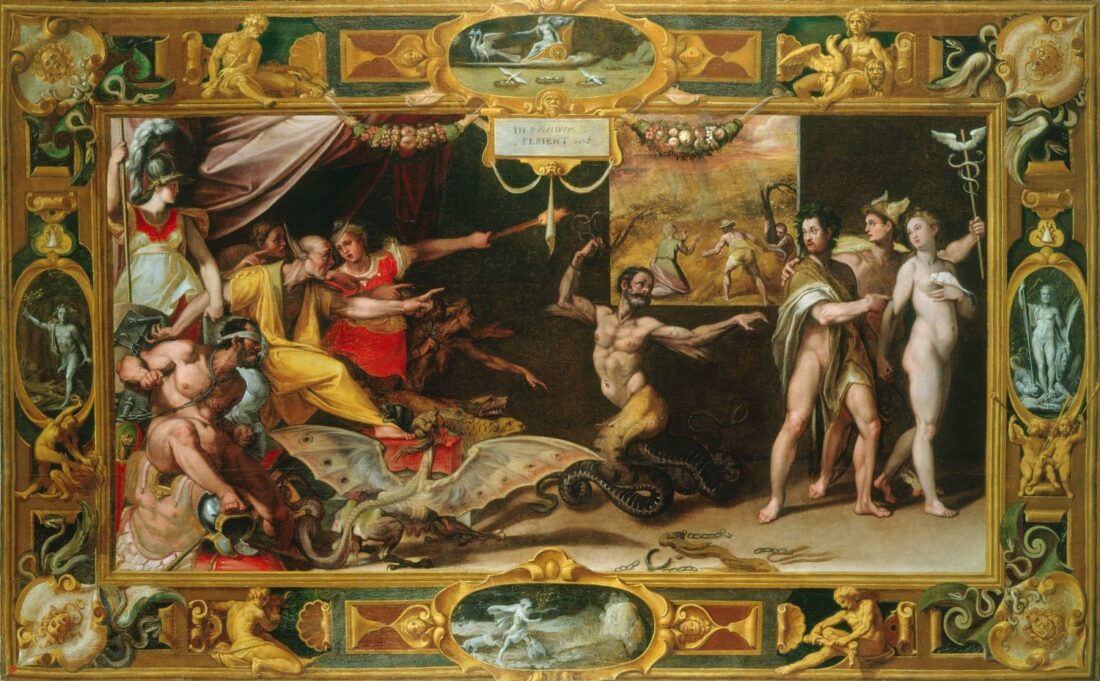
My wife and I went to Brussels (two hours away by train, living in Europe feels like cheating sometimes) for a Bozar exhibit on “Beauty and Ugliness in the Renaissance.” We did this because they advertised Botticellis (note the plural); we saw a lot of his work in the Uffizi a couple of years ago, and were hoping for more lore on his personality-filled angels. His paintings make you wonder what the characters are thinking, and what gossip the angels are sharing after they’re done holding up halos—science fiction of a piece with Dante’s infernal gravity.
The Bozar exhibit, alas, had one small Botticelli, a portrait of his beloved Simonetta, no angels involved. What it did have, though, were two intensely snarky pieces by Federico Zuccari. Allegorical “calumny” pieces date back to a lost classical painting by Apelles, and lots of Renaissance painters (including Botticelli) tried their hand. Zuccari’s is notable for the back story, which gossip the docent was delighted to share: he was late on a commission, and his client hired someone else—who took the job. Such horror! Such betrayal! He couldn’t be arsed to meet deadlines, but he absolutely could be arsed to paint his ex-client with donkey ears, his replacement with truly fabulous tentacle legs, and Truth snuggling a lop-eared ermine. Then there’s another painting in which Minerva herself shows up to tell his client (the Pope) not to criticize his commissioned work-in-progress. No word on whether the commission itself ever got finished.
Please enjoy the dubiously-accurate serpents on the floor, and the thing that I’m pretty sure is not a dingo.
Zuccari is an inspiration to us all: self-indulgent spite can produce a masterpiece.
Snake-Headed Trumpets and Two-Necked Guitars
Our second pick for the Brussels trip was the Musical Instrument Museum. We expected this to be a relatively brief expedition, maybe a couple of hours, the gallery equivalent of a microhistory. Except that they have the best audio tour I’ve ever encountered: you can enter a code and hear most of their instruments played as part of a full piece. This is terrific, and also means that we spent three hours on the European Musical History floor alone.
For me, half the story-prod of a place like this is the reminder of just how deep any given expertise goes. All the common instruments of the modern orchestra have long histories of experimentation, new production techniques, side-experiments that excited people for a few years in the 13th century and then vanished. Instruments are designed for contexts: open-air religious parades, campfire melodies, parlor demonstrations, military direction. They show off wealth via ornate design, or can be carved in a single night. People put whole careers into playing or constructing a single type. There’s telling detail to be had in any given one (give your evil overlord a snake-trumpet chorus)—and a reminder not to default to the equivalent of a modern guitar without considering the possibility of extra necks, the sounds made possible by different string materials, and the possibility that a much-needed clue might be hidden in the lining of your lute.
Rewilding Online Ecosystems
Next stop: a solo trip to Edinburgh for a workshop on Rewilding the Web, a concept proposed by Maria Farrell and Robin Berjon. The general idea is that the reduction of the internet to a small set of corporate walled gardens parallels the destruction and regularization of ecosystems, and some of the solutions might be similar as well. We need more, smaller sites. We need more models for how people can interact, find information, and share their own information. Fewer monocultures, more healthy complexity. In a week where we learned that Google will soon stop sharing search results and just keep users on-site talking to Gemini, it all felt very close to home.
Some people gave extremely practical talks, presenting on bioregional governance in rural Scotland or new tools for moderating neighborhood networks. Others were philosophical: Berjon asked what computers should be for, and urged a push toward enhancing user agency. That doesn’t mean replacing choice with external control (as many “personalization” functions do), and it also doesn’t mean offloading responsibility for avoiding surveillance onto individual users clicking through opt-out menus on every site.
Others used art as a route into thinking about technological ecology. Sonia Sobrino Ralston talked about a concept for “sensor gardens” on Superfund sites, where mechanical sensors and indicator plants combined to make both pollution and recovery visible. I talked about how science fiction portrays networks—only partly an excuse to quote Diane Duane’s Spock’s World on a Powerpoint slide. I used bison rewilding on Dutch dunes as an example, and Farrell asked “What are the bison that will do the necessary tearing up soil for the internet?” Definitely a provoking question!
Obscure Cameras, Underground Bookshops, and Underemployed Warriors
Edinburgh is rich in history, culture, geology, and tourist traps. Around the conference, I explored all four—though it would have taken many weeks to get into all the museums or follow half of the themed walking tours. But living in the Netherlands, I’ve missed proper hills, and I spent a lot of time just walking around, ducking into whatever seemed interesting. (Good for my head and heart, iffy for my ankles.) I found a museum on optical illusions—the first building in Edinburgh to be erected specifically as a tourist activity, with a 19th-century camera obscura at the top. “You see how that building has normal windows on the side, but narrow ones facing us?” asked the guide. “That’s because it belonged to the first owner of the camera obscura, and he didn’t want anyone peeping in!”
On High Street, apparently-underemployed woad-streaked warriors posed for tourist selfies. The time travel economy strikes again!
Then there was the Edinburgh City Museum, a small gallery of the sort we’d expected from the Musical Instrument Museum. They had up a temporary exhibit on the history of queer book stores in the city, with a focus on one that, in the ’70s, was located down a particularly terrifying set of stairs. I was delighted to find a shelf of early slash zines, alongside IDIC pins and a discussion of the connections between Trekkies and gay liberation in Scotland. We have always been here. Alas, the gift shop didn’t include anything related, because I desperately wanted a reproduction zine, a reproduction “Lesbian Vegetarian Vampire SF Fans Against the Bombs” pin, or both.
“What’s King Arthur Doing in Scotland?”
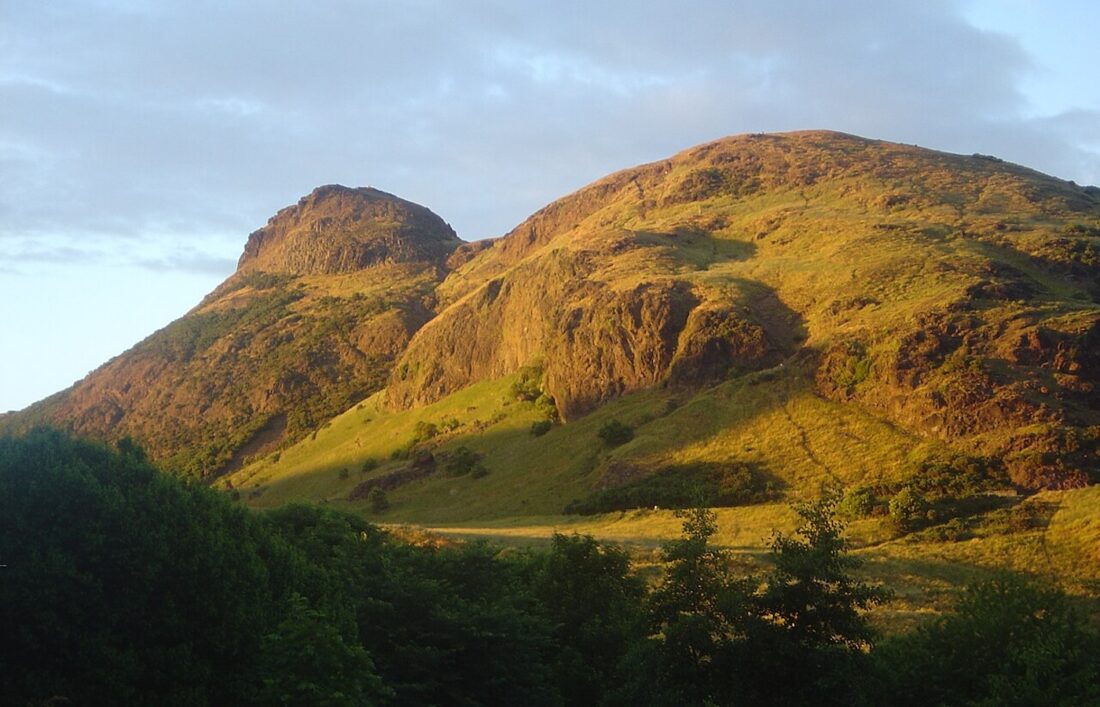
Out past the castle in Holyrood Park is what Robert Louis Stevenson called “a hill for magnitude, a mountain in virtue of its bold design.” Arthur’s Seat is a gorgeous crag and a popular hiking spot, and did I mention that I’ve missed hills? The path is well-tended and full of locals and tourists, ranging from fit students to stragglers loudly expressing their skepticism. It’s full enough to be a great opportunity for people-watching and people-overhearing, especially if you’re a bit of a straggler yourself and taking frequent rest breaks. It was a good place to touch grass, watch seagull vs. raven drama, gaze out over the city, and consider taking up a career as a nature writer.
It was formed by a 340-million-year-old volcano, now extremely extinct—one of the students at the conference explained, deadpan, that it’s “where geology was invented.” I assumed this was a joke, but no. An explanation of the old flow is also carved beside Parliament along with literary quotes. It isn’t quite on the International Appalachian Trail, but it’s at least an older cousin to the Pangaean range. The connection to King Arthur is even more tenuous than these things usually are. It’s suggested as a possible location for Camelot, but so are many places in and around the UK. My best answer to my householdmate’s question—“What’s King Arthur doing in Scotland?”—was “Sitting.” Which, indeed, anyone would want to do after making it to the top of the peak.
New Growth: What Else to Read
You didn’t think I’d skip this section, did you? Traveling and talking inevitably add to my reading list (as well as putting me behind on the already-existing pile). At the Bozar gift shop, I picked up 140 Artists’ Ideas for Planet Earth, edited by Hans Ulrich Obrist and Kostas Stasinopoulos. It’s full of short artistic pieces about ecology and the Anthropocene, mostly in the form of instructions. Both Cosmo and Merlin Sheldrake are in there. So is Kim Stanley Robinson. I’ve been picking through it like a box of truffles, reading a handful of the entries when I need to get my brain moving.
The Musical Instrument Museum has a podcast, with each episode focusing on a specific instrument.
At Rewilding the Web, Elena Rovenskaya recommended Fritjof Capra and Ugo Mattei’s The Ecology of Law: Toward a Legal System in Tune With Nature and Community.
The Scottish love their poets, and Parliament was studded with quotes from Kathleen Jamie, Norman MacCaig, and George MacDonald (Lewis Carroll’s mentor!).
I spent much of the Edinburgh trip reading Ada Hoffman’s Ignore All Previous Instructions. I finished it too late to include in my conference presentation, but it’s a great celebration of queer artistic weirdness and a great cynical critique of LLM companies. It reminds me in some ways of Alexis Hall’s recent Hell’s Heart on account of both the queer joy and the Jovian corporate dystopia. Highly recommended!
Where are you going this summer to find inspiration? Share in the comments!
