






Spider-Noir wasn’t even supposed to be a thing.
The character has its origins in a series of “Noir” comics that Marvel did from 2009-2010. Besides Spider-Man, they did Depression-era versions of the X-Men, Daredevil, Iron Man, Luke Cage, and the Punisher. The line had its run and then went away, and that should’ve been it. But then in 2014, Marvel did the “Spider-verse” event, which brought together every alternate version of Spidey we’d seen over the years (Miles Morales, Spider-Ham, Spider-Man 2099, and, yes, Spider-Noir, among others), along with some new ones (most notably Spider-Gwen).
Then two things happened in 2018. First, Marvel did “Spider-geddon,” which was designed to cull the herd, as it were, with several alternate Spideys being killed off, Spider-Noir among them. But then came the animated film Spider-Man: Into the Spider-Verse, with Nicolas Cage voicing the animated version of Spider-Noir. The character existed only in black-and-white, and he was captivated by a Rubik’s Cube, which he carried around for most of the movie.
Suddenly, thanks mainly to Cage’s delightful vocal performance, there was renewed interest in a 1930s Spider-Man, and so the comics character was resurrected by a mystical handwave, and has continued to show up, with new miniseries released in 2020 and 2025.
The love for the character was strong enough to get him his own TV series, with Cage going back on his long-avowed desire to not do television because he loves the character so much.
SPOILERS FOR ALL EIGHT EPISODES OF SPIDER-NOIR AHEAD! YOU HAVE BEEN WARNED!
There’s a lot to love about this eight-episode season of Spider-Noir, which dropped all at once on Amazon Prime after a preview on MGM+. One is that you have a choice of watching it in black and white or in color. I know many who chose b&w because what else could you possibly choose? But I went for it in color. The only reason so many films from that era are dark and grainy-looking is because of the quality of the film used, combined with age-related degradation. But the actual New York City of the early 1930s existed in color, and I’m pleased to see that the producers embraced that. The color version of Spider-Noir is vibrant and impressive.

Still, it’s cool that we have the option.
Sony has not had the best luck with their Spider-adjacent projects in live action, with only the three Venom films even coming close to being successes, and everything else—Morbius, Madame Web, Kraven the Hunter—being unmitigated disasters. With this TV series, however, they’ve finally hit paydirt. Spider-Noir is a love letter to the film noir genre while also being a really good superhero story in general and a really good Spider-Man story in particular.
Unlike the comic-book version, which has gone out of its way to have direct analogues to the mainline Spider-Man cast of characters, Spider-Noir’s relation to the comics characters is more thematic. Only three names will be familiar: Ben Reilly, Flint Marko, and Joe “Robbie” Robertson. And that first one is actually the name of the protagonist. They decided to go with Reilly, which was the name chosen by the clone of Spider-Man to distinguish himself from his genetic brother Peter Parker. For that matter, the superhero identity Reilly uses isn’t Spider-Man, but just the Spider—which can be viewed as a tribute to the pulp character of the same name. Said character, who was created in 1933 as competition for the Shadow, was allegedly one of the inspirations for Spider-Man, and Spider-Noir’s costume has all along been an homage to the original Spider’s outfit.
Spider-Noir’s main thing is to play with pulp tropes. Reilly is a private investigator, he’s got a long-suffering secretary and a best friend, a femme fatale comes through his door with a dangerous case, there’s corruption, mob bosses, love triangles, smoking, drinking, and lots of fisticuffs and gunplay (with webbing thrown in for good measure).
The story also leans into the fact that Cage is, um, not a young man. (Allegedly, one reason for using the Reilly name was because the alliterative Peter Parker sounds too much like a teenager.) As the story commences, he hasn’t been the Spider for five years, and he’s old enough to have served in the Great War. He quit the hero game when the love of his life died, a death for which he blames himself. (Said love of his life was a blonde named Ruby. Comics fans are likely to be confused as to why they didn’t just name her Gwen Stacy, but that happens a lot in this story…)
The story also leans into the fact that latter-day Nic Cage can get, um, weird. The origin of the Spider’s powers, as well as that of the four super-powered bad guys we meet over the course of the series, is from genetic experiments done on American prisoners of war by the Germans during what we now call World War I. It involved combining the genetics of humans with animals. Reilly was in charge of the platoon that freed the POWs, but during the rescue he was bitten by a guy who was being transformed into a spider, hence the powers. Because of that bite, he’s constantly wanting to act like a spider rather than a human, and so he has to really fight and concentrate to act normal. He uses movies as a guideline, basing his speaking patterns on James Cagney and Humphrey Bogart, and also occasionally makes weird gestures and odd facial tics because of the spider bite. This allows Cage to be completely batshit (spidershit?) and it actually has a plot reason!

Four of the POWs Reilly and his platoon rescued wind up in New York, and also wind up working for Silvermane. The main bad guy of the piece, played by Brendan Gleeson, Silvermane is your prototypical crime boss—he’s pretty much Sidney Greenstreet with an Irish accent, and it’s a bravura performance. (Also based on a comics character, but the four-color version is an Italian mobster named Silvio Manfredi.) One of the POWs, Addison, is killed in the first episode—indeed, the confrontation that ends with him being shot is pretty much what catalyzes the plot of the whole season. He has the ability to generate flames. The others include Lonnie Lincoln (Abraham Popoola), who has super-strength and invulnerability (he seems to be a cross between the Lizard and Tombstone), Dirk Leyden (Andrew Lewis Caldwell, who leaves no piece of scenery unchewed), who has the ability to harness electricity (a mix of Electro and the Shocker), and Flint Marko (Jack Huston) who can turn to sand (the Sandman, and the only one of the four who uses the actual name of his comics counterpart).
The inevitable love triangle comes from Marko, Reilly, and the aforementioned femme fatale, Cat Hardy (an impressively steely performance by Li Jun Li). She’s a riff on the Black Cat, who in the mainline comics is a thief and love interest of Spidey’s named Felicia Hardy, and in the Spider-Man Noir comics was the owner of a night club called the Black Cat. Hardy is a lounge singer and a favorite of Silvermane’s, and is in love with Marko. But she also starts to fall for Reilly, and when she thinks Marko has disappeared she even considers running away with him. But then, like any good femme fatale, she betrays Reilly, revealing that he’s the Spider to a scientist who is trying to cure the POWs (Amy Aquino).
I love that Hardy figures it out, which happens after she watched the Spider in action. Cage and his stunt double both have very unique body language (part of that spidery stuff mentioned above), so it’s not surprising that Hardy picks up on it.
While Spider-Noir embraces all the tropes of the genre, it also doesn’t soft-pedal the aspects of the era that the films of the time ignored. We start with the racism. Robbie Robertson (Lamorne Morris) is a reporter, who was very obviously fired from the Daily Bugle because of the color of his skin, and whose attempts to get rehired are made more complicated by the fact that he’s Black. And when he is finally rehired, he gets a crappy desk and the rest of the staff, which is entirely white, looks at him with disdain. When Marko is trying to talk Lincoln into working for Silvermane, Lincoln angrily replies that he’s done being beholden to powerful white men, and he has to remind Marko that, while he’s been deemed a monster by the public since being outed as the Sandman, that’s been Lincoln’s reality all his life.
We also see the crippling poverty of the era, including several “Hoovervilles,” and the general struggle to make money in the midst of the greatest economic crisis in the country’s history. And, naturally, the massive criminal empire that sprung up thanks to Prohibition, as Silvermane’s main source of income and power is his bootleg booze.
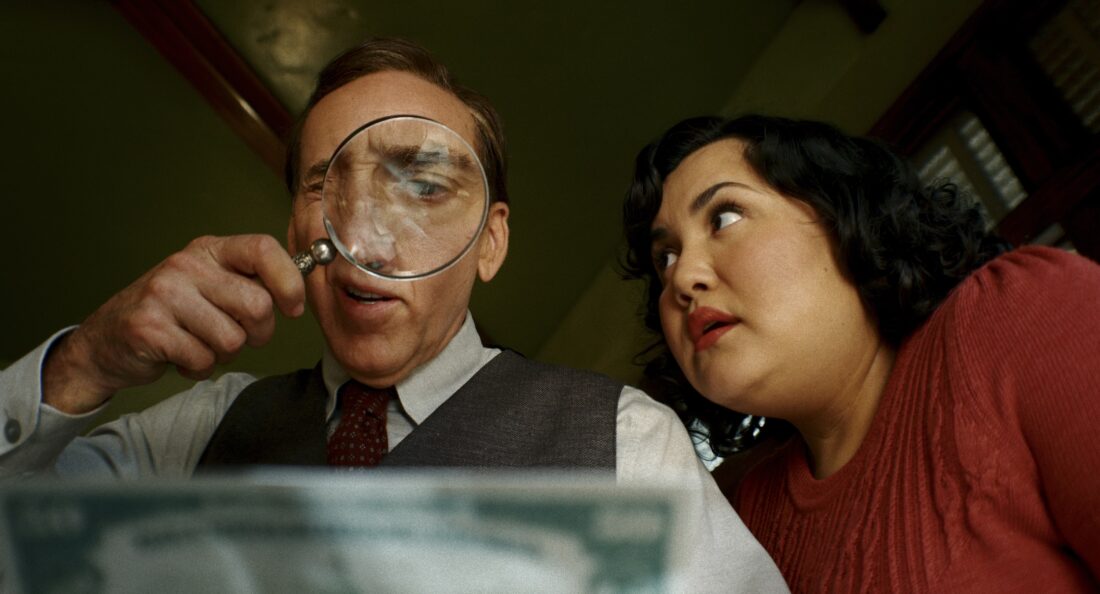
One of the things I liked best about this is the relationship among Reilly, Robertson, and Reilly’s secretary Janet Ruiz, played with magnificent charm and verve by Karen Rodriguez. First of all, Rodriguez is fantastic; Ruiz is my favorite character in the whole thing, as she’s the glue that holds Reilly’s office (and, often, Reilly himself) together. She’s sassy, smart, compassionate, brilliant, and hugely valuable to the effort. On top of that, she’s a type rarely seen in pulp and noir (but seen all over New York City), a plus-sized Latina.
And the dialogue among these three characters is superlative. They sound like three friends who’ve known each other forever, and care for each other, and also have very little patience with each others’ nonsense. One of my absolute favorite moments in the season is when Reilly shows up to the office after being away dealing with stuff to find Robertson and Ruiz in his office with some revelations of their own, which necessitates a trip. Reilly says, “What are we waiting for?” as he grabs his coat, and Robertson stares at him and says, “You, asshole, we were waiting for you!” It was just a perfect moment.
There are some flaws. Mayor Morris (Michael Kostroff, who will always be sleazy lawyer Maury Levy on The Wire to me), running for reelection, makes repealing Prohibition a part of his campaign—except that’s a federal law, a city official would have no ability to repeal it. Also, we never get any impression of Morris’ opponent, Hudson, beyond his existence, even though he’s the one Silvermane winds up backing. The connection between Reilly and the POWs is eventually revealed to be sufficiently deep that it retroactively strains credulity that Reilly didn’t put the pieces together sooner. And Marko’s loyalties keep shifting in ways that are less dictated by character and more dictated by plot and the need for action scenes. In particular, the climactic fight on the street between the Spider and both Leyden and Marko in the finale is a bit head-scratching, as at that point, Marko really didn’t have any reason to be beating up the Spider. At one point, Reilly covers his involuntary spidery moves by saying he’s practicing tai chi, but that martial art wasn’t even seen in the United States until 1939, several years after this takes place. (We don’t get a specific year, but it has to be between 1929, when the Depression started, and 1933, when Prohibition was repealed.) Also, the field of genetic study wasn’t anywhere near advanced enough to do what they were talking about doing during World War I—a lot of the terms that were used to describe the procedure weren’t even coined yet in the 1930s…
Still, this is a really good series. While it doesn’t embrace its comics roots as much as it might, the storyline does understand the important part of any Spider-Man story of any flavor: he’s a hero, even when he doesn’t want to be, even when he thinks he isn’t, and even when the world has defecated in his trousers. The world has defecated in Reilly’s trousers a lot—what has often been referred to in the comics as “the ol’ Parker luck, all of it bad”—but when it matters, he antes up and kicks in.
On top of that, this is an eight-episode season that actually tells its story in eight episodes. The pacing is strong, the plot moves, there’s no filler, no stretching out of plot points to create artificial suspense. Too many of the superhero TV shows in the streaming era have had a lull at the two-thirds point, but there’s no such lull here.
More to the point, for the first time I can look at a live-action Sony Spider-project and unreservedly say that it’s fantastic. And it’s about damn time.

Minor research failures:
Well, yes… but as we’ve seen over the last few real-world elections, politicians often promise things outside the remit of the office they’re seeking, and an unfortunate percentage of the electorate don’t understand the legal powers/limits of government.
How much I LOVED this series! I watched it in B&W but i think I will rewatch in color next time, for a completely different experience. Didn’t you just love Nicolas Cage’s absolutely brilliant expressions?! One of my favorite moments is him trying to hold back that he’s in love and is going to leave town, and when Janet figures it out, his FACE BURSTS with so many different emotions before he just unloads everything he’s thinking about it. His mouth and eyes scrunch up like he’s angry, but he’s so happy to be able to talk about it, and explain it. I was delighted in all the ways he uses his face and his line delivery to make already good dialogue into fantastic dialogue. I was a little alarmed by the 2 min dream sequence when he’s sedated–as me and all the other arachnophobes will confess. But other than that, I just ate up this series. And I was very very glad that it could wrap up its series and plots and characters without having to be invaded by the wider Marvel cinematic universe. Like you, I was surprised that Sony got this so right—and now they know they can do it. I hope they keep up this good work!
I did enjoy the show but thought the first half could’ve been tighter. A few reactions to both it and Keith’s review:
Ben Reilly almost certainly was Peter Parker. He changed his name when he became a private eye to break from his past after what happened in the War.
No mention of the surprise (to me, watching) guest appearance by simple tail— uh, lab assistant Mr. Andrew Robinson?
They didn’t really embrace Nicolas Cage’s age, whether due to his own vanity or an unnecessarily stubborn insistence on a certain time frame, because he’s still about two decades older than the character. I’m with a friend who suggested they could’ve kept him a WWI vet, retired from his Spider days a bit longer, and made the younger guys vets of WWII who’d gone through a newer, more refined if nonetheless horrific battery of genetic experimentation.
I found it interesting that Prime ended up with non-DCU and non-MCU retro noir-ish versions of Batman, in the animated Caped Crusader, and now Spider-Man, both happily cast with a multicultural eye. The former is more fantastic in how its inclusivity works in-universe, granted.
I’m only through episode 5, but I love the revelation that the Spider got his powers from being bitten by a radioactive spider-man.
I thought it was a good series. Perhaps not as gripping as Veronica Mars, but fun.
I gave some anachronisms such as the genetics research a pass as I was watching a show where people have super powers. Who knows what science they have in that universe? The mainline MCU stuff takes place roughly in our present, yet I’ve never seen anyone develop what Tony Stark did even before discovering vibranium. Speaking of universes, I absolutely loved that the very first line of the narration for the series was him saying “Hey, we’re not sure what universe this is, if it’s the same as the animated film or not, doesn’t matter, move on.”
I had two “Robert Knepper moments” as it were. The first was Megawatt, who I knew as Mitch Bilsky since my son has binged all of Henry Danger and Danger Force a couple of times. Then, there was something about Andy Robinson’s voice that clicked and I was like, “Wait…Garak?!?!” Kind of a funny reversal as on Stak Trek it was about recognizing an actor in the makeup, and here it was recognizing someone out of alien makeup.
I finally finished. This was an excellent, well-written and well-made series, feeling very noirish, albeit with a somewhat happier ending than you’d probably get in a true noir. I think there must be something very wrong with the feature film industry in America, since Sony’s feature animation division and their TV division have both created superb Spider-Man productions, but their live-action feature division hasn’t managed the same without Marvel Studios’ help since the Sam Raimi films, and instead has mostly churned out terrible movies about Spider-Man side characters.
.
I watched mostly in black-and-white; for some reason, my smart TV wouldn’t let me toggle between color and B&W even though it’s an Amazon Fire TV and this was an Amazon Prime series, but once I watched episode 2 in B&W on my computer, subsequent episodes showed up in B&W on my TV (so the setting must have gone with the account rather than the device, which surprised me because it’s not how subtitle settings work for Prime). It looked good in B&W, but I think I’ll rewatch in color sometime. A couple of things didn’t work so well. The FX shot of Cat falling out the window wasn’t balanced right for B&W, with Cat’s image looking more exposed/lighter than the background so that it was obviously composited. (For greater authenticity, they should’ve used a real projection screen behind her, like a classic process shot.) And Janet’s lines about Ben looking yellow (I presume jaundiced) after his ordeal came as a surprise in the B&W version.
.
I’d been wondering when this was set, since I’d assumed the skyscraper under construction in the first episode was the Empire State Building, which was completed in 1931. But there were references that pegged it as 1933, such as Dr. Faber mentioning King Kong, and the theater marquee in the finale for Bob Hope’s Broadway musical Roberta. So I guess that was a different skyscraper near the Chrysler Building.
.
(I’ve inserted periods between paragraphs because Reactor has suddenly changed its comments to a different format that doesn’t display line breaks between paragraphs. I’d like to request that they change it back.)