





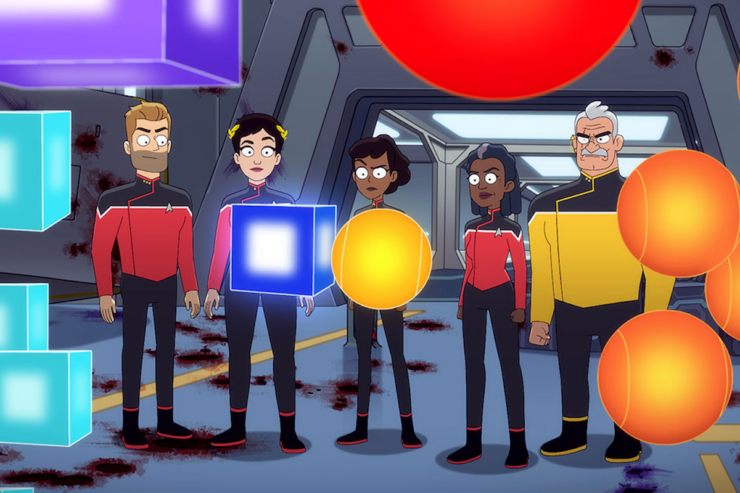
One of the fun things about Lower Decks is that they take joy in the obscure to a degree usually reserved for tie-in fiction. Over the nearly sixty years that Star Trek has been around, there’s been a lot of weird-ass stuff that only showed up in one episode and was mostly forgotten. That “mostly” is necessary because tie-in writers have taken those weird-ass things and run with them. (As an example, your humble reviewer took a thirty-second conversation between Bashir and Garak in a DS9 episode about the Betreka Nebula Incident—which has never been mentioned before or since—and built a 100,000-word novel out of it.)
LD has continued this tradition, from a fifty-foot skeleton of Spock to the use last week of the Acamarians (which I totally forgot to mention in my review of “Starbase 80?!”). This week, we get something even more obscure, as it’s from a part of an original series script that was cut from the final episode.
Back in 1967, the original series episode “Who Mourns for Adonais?” posited that the gods worshipped by the Greeks were actual alien beings. We meet Apollo in that episode, and the original script ended with Enterprise officer Carolyn Palamas, with whom Apollo has been making smoochy faces with, announcing that she was pregnant with Apollo’s child. While that was cut from the final episode, “Of Gods and Angles” runs with that notion by giving us Ensign Olly (wonderfully voiced by Saba Homayoon), who is descended from Zeus and a human woman.
Olly is on the Cerritos as kind of her last chance, as she’s been transferred multiple other posts thanks to all the times she’s messed things up, blown things up, damaged things, and so on. Plus she’s always late and doesn’t follow orders. Mariner—who has some experience in being the fuckup ensign—offers to take her under her wing, and hopefully lead her on the same path Mariner herself has been on. (Though Freeman has to point out that Mariner isn’t 100% there yet, either, given that she yanked a padd out of Freeman’s hands without asking, which isn’t something you do to your captain or your mother…)
Another thing LD does well is take advantage of being animated to give us some truly alien aliens. In this case, the Cerritos is hosting peace talks between two sets of beings of pure energy, one of whom contains their energy in cubes, the other of whom does so in spheres. Complicating matters is that one of the cubes has gone missing, the teenaged offspring of one of the leaders. There’s evidence pointing to the teenaged cube being dead, but it’s not conclusive. Freeman bends over backward to make sure that nobody accuses anybody of murder without way more evidence, but Olly jumps to that conclusion with both feet and acts accordingly while she and Mariner investigate. (They do the investigating because Shaxs and his security detail are already spread thin maintaining security with all the energy beings on board, plus if security is investigating, it’ll look like they think the cube was killed, which will upset the delicate negotiating balance Freeman is trying to maintain.)
The biggest flaw in this episode is that I saw the fact that the teenager was missing and not murdered and off canoodling with a sphere a mile off, as that plot had whiskers on it when Shakespeare wrote Romeo and Juliet in 1597 (not to mention when TNG did “The Outrageous Okona” in 1988).
However, what I particularly like about this plot is that it’s some of the best evidence that Mariner really is evolving. Mariner turning back into a good Starfleet officer has been a slow, laborious process, which has been frustrating for me because she was so awful in the first season. But seeing her mentor someone incredibly similar to her in Olly (but not exactly the same—I like that Olly is her own kind of messed up, different from Mariner’s brand of messed up) is encouraging.
I especially like the final scene. Olly has been thrown in the brig. While she did help save the day by using her gods-given powers to suck the energy from the cubes and spheres when they start fighting each other on the Cerritos, Olly also lied about having those powers and also hid evidence from the missing cube’s quarters. (She was worried she’d be accused of causing the cube to be killed or go missing or whatever, so she hid the fried computer terminal.) Mariner insists on sitting with Olly—the same way Boimler, Tendi, and Rutherford always sat with Mariner when she got tossed in the brig. Olly isn’t all that thrilled with it, but Mariner doesn’t take no for an answer.
The B-plot is Boimler’s continued attempts to be more like his alternate-universe counterpart. His mustache is completely grown in at this point, and the beard is, er, coming along. The funniest part of this plot is that both Rutherford and Tendi know he’s been surreptitiously looking at alt-Boimler’s padd, which they recognized as being from the other universe because the bevelling is a few millimeters different. (Both times this is mentioned, Boimler pointedly remarks that the other universe’s padd is also red, and the response is a surprised, “Oh yeah!”)
It turns out that alt-Boimler and alt-T’Ana were very close friends, with the doctor referring to Boimler as “Flip” and Boimler being part of her book club. Boimler’s attempts to make this happen on his own ship are, of course, absolutely dismal failures that make T’Ana just be more annoyed at him. As usual, when Boimler gets out of his own way, things work out better, as during the climactic donnybrook involving the cubes, spheres, and Olly’s electricity powers, Boimler gets a lightning bolt up his ass. T’Ana has to perform a very delicate, career-improving operation to remove it, and that’s what ingratiates Boimler to her. She invites him to her book club, and does indeed give him a nickname: “Fuck-o.” Boimler is thrilled.
I’m genuinely curious what the endgame is of Boimler’s quest to make himself over into his seemingly-more-successful counterpart, and it’s been fun to watch him make an idiot of himself trying to do so. I like that his friends remain supportive.
This episode is exactly what LD is best at: telling a Star Trek story with humor. The resolution of the sphere/cube storyline is very Trek, with the forbidden-love couple (complete with funky-shaped offspring named SquAaron) inspiring everyone to go back to the negotiating table to try to make it all work. Olly gets a transfer to engineering, which is where she always wanted to be. (Her powers kept futzing out equipment, so she was kicked out of engineering, but now that her powers are publicly known, they can be compensated for in a way they weren’t when she kept them secret.) And Boimler makes friends with T’Ana. All of it is done in a way that’s genuinely funny, from Olly’s OTT reactions to, well, everything to all the comments about corners and smoothness coming from the spheres and cubes to “Also it’s red” to T’Lyn’s delightfully deadpan recitation of all the “incidents” Olly had that should probably have already gotten her transferred off the Cerritos.
Random thoughts
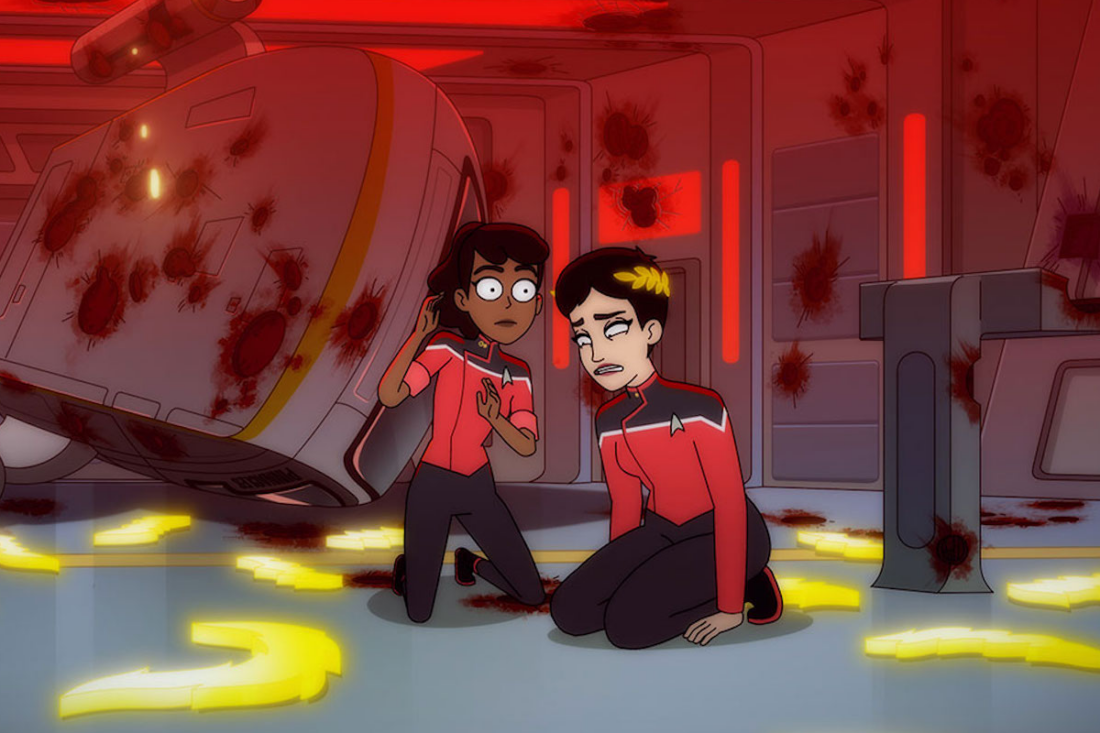
- This episode establishes that the laurel crown that was in Apollo’s hair in “…Adonais?” and the one that Olly has as well isn’t an affectation, it’s actually attached, which is hilarious. Also, she can create physical lightning bolts as well as generate electricity, which is why one of them gets stuck up Boimler’s ass…
- The most extensive use of the cut line establishing that Palamas was pregnant was by Peter David in the Star Trek: New Frontier series, where the novel Being Human established that one of the main characters, Mark McHenry, is a descendant of Apollo and Palamas (and who was partly raised by Artemis, whom McHenry as a child thought was his imaginary friend). In addition, John Byrne did a direct sequel to “…Adonais?” focusing on Palamas in issue #11 of his New Visions photo-novel-style comic book series
- When the cube and sphere reveal their love affair, they also reveal that the mess made of the cube’s quarters was because of their kinky sex play. Olly is appalled to realize that she touched the fried computer terminal…
- When Ransom rants and raves about how annoying Olly is, the thing that pisses him off the most is that he thinks Olly may have stolen his kettle-bell weights. Because of course that’s his main concern…
- We see Kayshon again in this episode. He has two lines of dialogue, one in regular English, one in Tamarian metaphor, and this refusal to commit to the bit still isn’t working for me. He should really just only talk in Tamarian metaphor. If you’re gonna do the joke, do the joke. Kayshon remains one of LD’s biggest misfires, alas.
- I forgot to mention the Acamarians last week because I honestly forgot all about them ten minutes after I watched the episode. To be fair, I also totally forgot about the Acamarians ten minutes after I watched their only other appearance, in TNG’s incredibly forgettable fourth-season episode “The Vengeance Factor.”


Between this and the previous episode, it feels like Lower Decks is introducing a lot of new characters for a final season. But I approve; I like Ensign Olly quite a bit.
Incidentally, “The Vengeance Factor” was in the third season. That’s how forgettable it was, you didn’t even remember what season it was in.
I’m surprised they didn’t introduce three or four recurring ensigns and build a season arc around the original Lower Deckers mentoring their successors.
That doesn’t always work so well, though… Scrubs and a certain show with colourful horses that shall remain nameless both did that, and the results were… Not so great.
That was kind of what I had been expecting with the ensign on the “Moopsy” mission last season
I found this episode pretty unremarkable. I thought the idea of the warring shapes was cute; they reminded me a lot of the Anticans and Selayans. Once we learned that both of their young beings were missing, I knew what had happened. It was pretty predictable and I wasn’t fond of the destruction they caused to the Cerritos.
Mariner’s story with Olly was interesting because we could really see the similarities between them. Boimler’s story was painfully annoying.
I laughed so hard at this episode, particularly at everything involving Dr. T’Ana (as always). Giving that cursing is considered her “true” language, I’d say the nickname she gave regular Boimler is actually *more* affectionate that “Flip.” I also liked Rutherford and Boimler walking off happily while Tendi rages at them learning the wrong lesson.
But I think Ransom wins my vote for best line of the episode: “They’re forming… a giant orb and a giant cube! They’re not very creative!” Something about the delivery of that had me howling.
“THEY’RE NOT CREATIVE AT ALL!” I agree, I cracked up at that one. I’m surprised there was no mention of a Borg Cube considering they did the whole Fusion Cube thing.
I didn’t really care for the Boimler plot. It feels like he’s regressing as a character, which is an odd choice for the show’s final season. I also disliked the scene where T’Ana physically attacks him for swearing at her, and I was confused as to why Rutherford, who has always been the most comfortable with himself of the show’s regulars, would conclude that staying true to yourself is a bad idea.
The Mariner/Olly plot was a lot more entertaining, even if it was predictable. I actually read your review before watching the episode this time, and as soon as I got to the words “teenager offspring,” I knew what was going to happen. But it was still pretty fun, and I liked both the way Olly was voiced and how she was drawn. Too bad the show’s almost over, or she might have made for a good recurring character.
I dunno if I’d consider Boimler regressing as he was happy to enter Klingon blood rituals and otherwise do a lot of stuff he normally wouldn’t.
Being inspired by his alternate self really has given him a lot more confidence.
It’s just it’s confidence in himself….to be someone else.
I guess that’s a fair point. I liked him in A Farewell to Farms. It felt like the return of Bold Boimler. His behavior in this episode, however, reminds me a lot more of how he acted in the first couple of seasons.
Sadly, I feel like Mariner stabbing Boilmer, Doctor T’Ana going off on Boimler is a court martial offense. At the very least, she should be spending some time in the brig as well.
I do think that Boimler trying to model himself on his duplicate will also result in a confrontation with Section 31 Boimler. A set up for the “but for the grace of god go I” moment when he finds out his cool version was evil that way perhaps.
Artemis was also his lover in a clear case of grooming. Another reminder that Peter David threw a lot of very dark stuff into his otherwise very funny novels. It’s why he remains one of my primary influences as an author.
Oh yes, Artemis being a virgin goddess didn’t stop her because the legends are just wrong.
Wow, we really disagree. This one didn’t work for me much. Decent idea, pairing Mariner off with a similar ensign to contrast against her growth, but I had issues with the story. For one thing, why is the Cerritos, a support vessel, doing a delicate peace negotiation of the sort that should be the purview of a hero ship? That breaks the whole premise of the series, that the ship does the cleanup work after the big crises are solved and the treaties signed and whatnot. They don’t negotiate the peace treaties, they do the nuts and bolts of enacting the treaties’ provisions after the fact.
And yes, as soon as they mentioned that the son and daughter were both missing at the same time, the rest of the orb/sphere plot became completely predictable. You’d think a character as genre-savvy as Mariner would’ve seen it instantly, but they had her pick up the idiot ball (or was it a cube?).
Also, Ensign Olly (whose name I assume is a pun on Olympus) is not a bad character in herself (and I like that she adds a bit of body-type diversity to the cast), but her existence is a highly problematical concept on more than one level. If a child of Zeus’s species and a human inherits “god” powers, then Ancient Greece should have been home to tens of thousands of half-humans with superpowers and laurels stuck to their heads, because the male Greek gods were serial rapists on an epic scale, Zeus most of all. And yes, it was rape, nearly always (it certainly was with Apollo and Carolyn Palamas), so it’s in rather poor taste to build a comedy plot around it.
I didn’t care for the Boimler-T’Ana subplot at all. I agree with David Pirtle that Boimler seems to be regressing back to his old insecurity, and I hate it that, rather than fleshing out T’Ana as a character, they’ve Flanderized her to nothing but “the one who cusses all the time.”
“He should really just only talk in Tamarian metaphor.”
I disagree completely. I shouldn’t have to tell a New York City native that bilingualism and code-switching are commonplace things. It’s logical that Kayshon would’ve had to learn English to function as a Starfleet officer, but it’s equally logical that he’d fall back into his own idiom from time to time, as immigrants often do. The way Kayshon talks is the equivalent of something like how Michelle Yeoh and Ke Huy Quan’s characters in Everything Everywhere All at Once casually blended English and Chinese in their dialogue, often within a single sentence.
Rarely do I contradict you, Christopher, but “son of a god has superpowers” is pretty much the “was born with an X-gene” of the original superhero fiction. Herakles was the guy with super strength, Helen of Troy had mind-bending soul-crushing beauty, and the other heroes possessed the ability to do fantastic feats of strength or arete. While saying that these individuals are all now canon superhuman empowered entities in Star Trek seems a stretch, we already have them as sufficiently advanced aliens established within the context of the setting.
We also have empowered Trekian descendants of supernatural aliens in Star Trek to begin with.
Given Olly’s powers are weakened after one generation, we also have a solution as to why all individuals of Greek descendant don’t have powers like Electro.
The point is that if such people actually existed, we would’ve known about it all along, so finding Apollo wouldn’t have been a surprise. There would simply have been far too many of them, given how routinely the Greek gods fathered children on human women whose consent was considered a non-issue.
Also, it was at least two generations, probably more, from what they said. Apollo was the last of them to dissociate, and he did so something like 115 years before this. So Zeus was probably her great-grandfather or something. So the traits would have persisted through more generations than you suggest.
Eh, I think you overstate how many demigods were actually born as all of the ones we know about are legendary heroes of myth. It was also accepted historical fact that they existed as Julius Caesar claimed he was a descendant of Venus. Which is ridiculous as clearly they’re descended from Mars *rimshot*. Also, that’s the premise of the episode “Who Mourns for Adonis” after all, that such people did actually exist.
As for Zeus, it says he was her grandfather and not longer so either her mother was extremely long lived, a time traveler, or Apollo was wrong about being the last one. All of which are possible in Star Trek. For all we know, Olly herself could be centuries old.
I don’t understand why you’re talking about the myths as if they were literally true in every detail. I’m talking about the situation as presented in the episode: That there were powerful aliens who lived on Earth millennia ago and interbred with humans, and that their descendants have a visibly inhuman trait they can’t hide, as well as inhuman abilities. If those things were the case, then humanity would have had undeniable proof of alien life for thousands of years. I don’t care what the myths say, I’m saying that the facts as presented make no sense in the context of the Trek universe.
And I don’t they said Zeus was literally her grandfather; I think Mariner was just speaking figuratively. I think they said before that it was just several generations back.
She says in the episode that Zeus was her grandfather, which isn’t such a problem if some demigods inherit the Olympians’ extreme longevity (maybe this is where Lathanites come from?); also, maybe demigods, like mules, have extreme difficulty reproducing.
(Also one of the League of Extraordinary Gentlemen comics postulated the idea that the Trojan War was orchestrated by Zeus to cull the race of demigods, which is an interpretation in this context)
Demigods in Greek Myth are also mortal and do get killed or die of old age. Herakles was the only one to be raised to full divine status after all.
If Kayshon was an actual character, I’d agree with you 100%. But he’s a gag character, this show’s equivalent of Morn or Chef or Mr. Mot. He has absolutely no discernible personality or character arc or anything, and in most of his appearances he doesn’t even speak. The whole point of the character is “ha ha, there’s a Tamarian in Starfleet,” but they refuse to truly embrace that.
Citing two primary characters in a serious movie in your argument isn’t just comparing apples to oranges, it’s comparing apples to trout.
—Keith R.A. DeCandido
I don’t accept that a gag character shouldn’t be allowed to be written with credible traits. Heck, Morn was given a lot of personality beyond his basic “never talks on camera” joke.
I also don’t see how having Kayshon know English is somehow a failure to embrace the Tamarian-language gag. He couldn’t plausibly have gotten through the Academy if he were incapable of grasping English syntax and understanding what his crewmates were saying, so it would make no sense for him not to be able to communicate in English. Communicating imperfectly in English and falling back into his own idiom part of the time is the only way that remotely makes sense.
Also… you’re calling Everything Everywhere All at Once “a serious movie?” Have you actually seen it? It’s totally madcap. (Wikipedia classifies it as “an absurdist comedy-drama.”) And it doesn’t matter how prominent the characters are in the story — I’m merely citing them as an illustration of how bilingual people casually code-switch in real life. You can see the exact same thing with the supporting characters of Katy’s family in Shang-Chi and the Legend of the Ten Rings, for example, or with various Latin American characters who drop in and out of Spanish when talking with family or neighbors.
I feel exactly the same way about Kayshon being bilingual. It might be funnier if he only spoke in metaphor, but it wouldn’t have made any sense in-universe.
They’re also not biologically incapable of speaking “normally”, they just had a language the universal translator struggles with.
Same that Picard can speak in their language.
I posited in my story “Friends With the Sparrows” in the TNG: The Sky’s the Limit anthology that the Tamarians did have a different neurology with a weaker sense of self and of the flow of time, so that they tended to identify with past archetypes, and it was therefore difficult to bridge the perceptual gap and allow mutual communication. But I can reconcile that with the English-speaking Tamarian in Kirsten Beyer’s Voyager novels, and with Kayshon, by remembering that any species would have individual variations in its neurology, so at least some Tamarians might have an easier time thinking in human terms and getting a handle on our language.
It could also be that children raised with an outside language may be able to learn the foreign communication more easily. Kayshon seems to be just the right age to have benefited from a combined language institute.
I actually really, really like the notion that Kayshon may be a neuro-atypical Tamarian (Since this would add an intriguing extra wrinkle to his character, if only by suggesting that while this makes it somewhat harder for him to speak ‘proper’ Tamarian, it makes it slightly easier for him to parse another species’ way of thinking – which makes him the perfect exchange officer/First Tamarian in Starfleet).
It’s a very STAR TREK twist on a fairly straightforward character.
Okay, just a personal sore spot: The proper term for a person of part Greco-Roman deific ancesty is not “Demigod”, which refers to secondary or minor gods, such as Pan. The proper term for such a person is “Hero” – Poul Anderson wrote of a modern scion of Hermes who was “A hero in the original sense, whose first victory was over a pill.”
Also, the “Laurel Crown” thing may be involuntary in Olly’s case, but obviously could be disguised or made invisible by pure-blood Olympians, else Zeus’ many shape-shifting escapades/date rapes would not have been possible. Possibly other mixed ancestry individuals had the ability to set a “don’t notice me” glamor on such things, but it’s skipped Olly’s generation.
And yeah, a lot of elements in this season were obvious set-ups for a prospective sixth season passing of the torch — Last episode’s obvious back-door pilot status for a Starbase 80 spin-off being just the most blatant. Hopefully some of these threads will be picked up in the new Lower Decks ongoing comic series.
Hmm, no, “demigod” literally means “half-god,” and the dictionaries I checked say it can be used to mean either a secondary god like you say, or the offspring of a god and a mortal, such as Herakles or Cú Chulainn. You’re speaking in terms of classical Greek usage, but the word “demigod” is a 16th-century English coinage derived from Ovid’s semideus and Greek hemitheos, so purism about classical usage isn’t really applicable here. https://en.wikipedia.org/wiki/Demigod
Although a human with a divine grandparent would be a hemidemigod, I suppose, and third-generation would be a hemidemisemigod.
@ChristopherLBennett, I’m more with you than against you on this one: Lieutenant Boimler’s arc was cringe comedy at best (He essentially harasses the Doctor, but she then proceeds to PHYSICALLY ASSAULT HIM, which just makes a bad situation worse): the only thing that keeps me from seeming this B plot a dead loss is that I’m willing to believe – hopefully that need not be ‘willing myself to believe’ – Lieutenant Rutherford was pulling Lieutenant Tendi’s leg by deliberately missing the point of the moral she put to this particular sequence of events.
This is Rutherford, I trust him.
The main plot was rather better (If nothing else this episode made me realise how very, very beautiful this show can be) but I’d like it better were Ollie being set up as someone Mariner has excellent reason to sympathise with, while still being a villainous (super?)human being, because quite frankly for most of this episode Ollie* came across as less as a screw-up desperately in need of a mentor and more as a Bad Actor working to reignite a local war (Either as a way to cover her own *** or as operative seeking to destabilise the region and discredit Starfleet in the process).
*Amusingly, my own thought was that this was nodding to a name like ‘Apollonia’.
Keeping the fact that she can conjure deeply, deeply embarrassing lighting boots a closely-held secret is one thing; keeping her electrical powers a secret when those powers have a verifiable track record of overloading Starfleet technology (In a line of work where technology is the difference between Life & Death) is irresponsible in a “Why didn’t you tell us this? We’re Starfleet, we not only can help you to cope with this, we will be delighted to help you work through this” fashion that’s easy enough to forgive in a fairly young, insecure ensign (Though it says nothing good about Ollie’s judgement or what looks like foolhardy Pride).
But taking thirty minutes to hide evidence relating to what looks like a political kidnapping, an assassination or a murder, rather than reporting it immediately?
Doubling down on that dumb*** decision by conducting your part in a should-be-discrete investigation in a fashion that looks precisely-calibrated to turn that investigation into a full-blown Diplomatic Incident? (Not to mention, as ‘Bad Cop’, rehearsing the sort of racially-charged language that normally precedes Hate Crimes – which would be grotesquely unprofessional in any circumstances – to one member of the delegations at a Peace Summit).
Watching as that Peace Summit actually goes up in flames (Largely because you have concealed evidence and done your best to cover your own ***) WITH A SMILE ON YOUR FACE?!?
This isn’t ’Mariner’s Mariner’ behaviour, this is “Kiss your Starfleet career goodbye” behaviour of the that got last season’s villain kicked out of the service – and I’m not convinced that Ollie doesn’t deserve exactly the same treatment.
It’s a good thing Ollie has looks (and OH MY, but if you put her up on a pedestal I would worship her from afar), but so far I find her demonstrated personality repulsive and really, really hope she’s destined to be revealed as Beckett Mariner’s Evil Opposite.
After all, think of the Drama!
Ollie definitely has that Zeus’ daughters thing where her hotness could fuel Hephaestus’ forge.
I kept trying to type something to the effect of “Unfortunately she’s more Helen of Troy than …” but I stumbled over the fact that the Daughters of Zeus tend to wreck just as much havoc as the male children: I can’t decide if this is an uncommon example of Ancient gender equality or just bad parenting.
Also, my apologies for a wealth of un-caught Autocorrect ‘improvements’ in my original post: one would like to pretend that I spent the weekend hiding my face in shame, but that would be horrible fib (I mostly spent it watching the latest semi-season of COBRA KAI).
I think most of us saw the “star-crossed lovers” bit coming from that proverbial mile away. Cute kid, though, and kinda fun that they smashed the room making, uh, the shape of things to come.
“Olly isn’t all that thrilled with it, but Mariner doesn’t take no for an answer.”
Which is… also like what got them both into trouble so often? There’s a fine line, or just a matter of perspective if not cloak of euphemism, between tough-love intervention and — I promise that this isn’t meant to be specifically political in any way — enforcing what’s supposedly best for someone else whether they want it or not. Mariner is clearly trying to be supportive; I just know from personal experience that “you’ll thank me later” isn’t always the right approach.
I feel constrained to point out that the lovers here weren’t star-crossed in any way, because that means cursed by fate to failure and doom, born under a bad star. Romeo and Juliet were star-crossed because their love was doomed from the start and ended in disaster. These two were more like Florizel and Perdita from A Winter’s Tale, in that their forbidden love worked out happily and brought reconciliation between the opposing sides once everything was cleared up. (Okay, R&J’s fate brought reconciliation too, but too late to do the two of them any good.)
Well if our young lovers weren’t star-crossed, they certainly got some wires crossed in the course of their elopement (At least one of which was Danger Red).
Nah, the actual couple seemed to have been quite successful from their perspective. It was everyone else who got their wires crossed.
Note that I didn’t say the lovers got their own wires crossed … 😉
Arben, his face red
Funny thing I just noticed on a rewatch. When Radiara and Quadralon float into the hangar bay, the first thing she asks is “Why isn’t anybody glowing?“which it dawns on me is her asking, “Why is everybody naked?” Ahh, that’s great. That was a good laugh.
Every now and then, Lower Decks throws us a sneaky teaser. I thought for sure this was going to be Ransom’s big episode. They even opened with his personal log. After last week’s Migleemo subplot, I was eager for more time with the non-Lower Deckers characters aboard the Cerritos. And I would love a Ransom-centric adventure for once.
That misdirect aside, this was a good one. I don’t see Boimler’s story as a case of character regression. It’s a reminder that for all the evolution the character’s gone through over the past five seasons, he’s still in his core Bradward Boimler, an insecure basket case who will never completely outgrow that core aspect. He can become XO or captain and he’ll still have these flashes of insecurity. I buy it that he’s so incensed towards becoming his alternate universe-self that he’s doing anything, even adopting a Mariner-esque attitude towards danger. Which of course reinforces his fear of not living up to his alternate-self by being his most needy self during the T’Ana scenes.
After a season where our Caitian doctor has been mostly absent, I am beyond glad we got this. That bit where Boimler decides to adopt her language is easily the funniest moment I’ve seen this year. I pretty much lost it during that scene, especially when T’Ana goes berserk at him.
And the Mariner story was just as good. Olly was very much Mariner in the sense of not being able to vent her frustrations in a positive way, always jeopardizing her stance within Starfleet. Never would I have thought of revisiting the “gods” from the Adonais episode and somehow come up with a positive character with a Trekkian arc out of that. “Adonais” was never one of my favorite episodes, let alone the Apollo character. But Olly became the perfect one-time character with a clear arc. And the cubes/spheres plot gave us the best way to tell that story (and yeah, I saw the Romeo + Juliet vibes coming from a mile away).
And I loved the fact that she was still thrown in the brig despite the promotion, and that Mariner decided to bunk with her and be there for her no matter how much she didn’t want to. A surprising mix of hilarious dialogue and a fun moment of human empathy and connection.
One little side note: I love it that they added Apollo’s hand during the opening credits this season, and it’s so gigantic it can rival a Borg cube’s own dimensions. That’s something TOS was never able to convey due to the VFX limitations of the era.
Here is Lower Decks getting extremely obscure with their references:
When Rutherford was teasing Boimler about his alt-universe PADD, Boimler called him “a real Ronald B. Moore”. For a half-second, I though they were referencing former Trek writer, Ronald D. Moore. Then, I remembered that there was also the former Trek visual effects supervisor, Ronald B. Moore. Either way, I was scratching my head at their breaking of the fourth wall seemingly at random.
Turns out, they weren’t breaking the fourth wall; the holodeck comic that Joe Piscopo played on TNG’s “The Outrageous Okona” was apparently named Ronald B. Moore (in honor of the visual effects producer) on the holodeck interface seen (but not verbalized) in that episode. That is a deep, deep easter egg.
https://memory-alpha.fandom.com/wiki/Ronald_B._Moore_(comedian)
Truly LOWER DECKS is the Easter Bunny of STAR TREK shows.
Just so folks know, my review of “Fully Dilated” won’t go live until Monday because of the Thanksgiving holiday.
Enjoy the weekend!
—Keith R.A. DeCandido
SPOILER ALERT: My review is favorable. :)
—Keith R.A. DeCandido
I am also interested in your thoughts, positive or negative, on The Roddenberry archive and OTOY’s ‘Unification’ video.
I started watching and got bored — and also annoyed. I may try it again, but seeing Shatner CGI’d into youth while Robin Curtis — playing a Vulcan! — wasn’t, kind of turned me off.
—Keith R.A. DeCandido