







One of the things I really like about how television in general has evolved over the past couple of decades is that the folks writing them and acting in them have finally started to admit that trauma is a thing and that actions have actual consequences. Part of this is a natural byproduct of the trend toward serialization and, even in shows that aren’t serialized, stronger continuity between episodes.
And it’s all for the better, because I have always found it frustrating that shows haven’t dealt with those consequences. I think it was one of the reasons why I loved, for example, Hill Street Blues so much, because that show, unlike most, dealt with consequences and trauma on a regular basis.
To keep this to Star Trek, it has always frustrated me that the conventions of TV at the time prevented them from truly dealing with the traumas that the characters went through. I mean, look at the end of the first season of the original series: first Kirk has to allow the great love of his life to die in order to save history, then in the very next episode he has to listen to his sister-in-law die shortly before finding the dead body of his older brother. That’s the kind of thing that would take months for him to work through, but 1960s TV didn’t do that sort of thing. Hell, they barely had the consequences make it to the end of the episode.
This didn’t get much better with the first wave of spinoffs. The example that stands out the most for me is La Forge being brainwashed in “The Mind’s Eye,” which acknowledged the trauma at the very end of the episode, with LeVar Burton plaintively crying to Troi, “But I remember everything!” about his trip to Risa that never happened. But over the course of the character’s remaining appearances on three seasons of TNG, four movies, and one season of Picard, this trauma is never even mentioned. Not to mention things like Kim on Voyager doing the same coming-of-age story over and over and over and over again.
The current crop of shows, however, have embraced the notion of consequences and especially of how characters deal with trauma, whether it’s small—Detmer’s difficulties handling the leap forward in time in Discovery’s third season—or large—Picard’s visceral reaction to being back at a Borg Cube in Picard’s first season. TNG had the good sense to put a shrink on the ship, but it wasn’t until Picard’s “Nepenthe” that Troi truly felt like a therapist rather than a plot device.
All this is a long way toward saying that “The Life of the Stars” is a superlative example of showing the characters dealing with trauma. There’s a lot that’s impressive about this episode—which finally brings in Mary Wiseman’s Tilly, who was originally promised to be a recurring character, but who is apparently only in this one episode this season—but perhaps the thing that impressed me most was that it used the Thorton Wilder play Our Town, a play I have always despised with every fibre of my being, and in the end I actually liked the use of it.
The thing that impressed me the second-most was that it wasn’t just the trauma of the events of “Come, Let’s Away” being dealt with here, as the EMH gets himself a story arc that deals with the Doctor’s own centuries-old trauma.
Let’s start with Our Town. Tilly arrives from the original off-Earth Academy campus she was seen transferring to in Discovery’s “All is Possible” in order to help the cadets who went through the Miyazaki mission.
The class she offers that our main characters participate in? A theatre class!
The cadets all think this is stupid. Darem goes so far as to say that it’s stupid, and Tilly says that the ones who say that are the ones who don’t become captains. Stagecraft is a big part of being an officer in so many ways. The students are asked to suggest plays that can be performed and discussed. Jay-Den suggests a Klingon opera, while SAM—who has, of course, studied every play she can get her photonic hands on—suggests Our Town.
Unfortunately, SAM is unable to stick around, because she’s still glitching. The patches applied at the holographic spa she went to in “Ko’Zeine” aren’t taking. (The EMH is a bit peeved that SAM kept this from him until she collapses in class.) The solution is to return to the Kasq homeworld, which Ake, the EMH, and SAM do. The Kasq live in a place where time moves more quickly than it does elsewhere, prompting the EMH to recall a similar planet Voyager encountered in “Blink of an Eye,” including the Doctor living there for three years and having a family. Because the EMH and Ake don’t hardly age, they are the only ones who can go.
The EMH continues to resist SAM’s attempts to have him as a mentor, which we saw from the moment they met in “Kids These Days,” and extends here to the EMH refusing to hold SAM’s hand when the Kasq supervisor—again voiced by the great Chiwetel Ejiofor—examines her. This seems unimaginably cruel, but eventually it all comes out when the EMH explains about the events of Voyager’s “Real Life,” when he created a family for himself on the holodeck and had to watch his daughter die. Since then, he has lived for centuries, and everyone he was close to when we saw him in the twenty-fourth century on both Voyager and Prodigy is now long dead. He’s resisted SAM’s overtures because he resists everyone’s overtures. He doesn’t want to go through the trauma of losing someone he loves all over again, as he’s done that plenty of times, and it’s awful, and he is a self-described coward.
But then SAM’s problem is diagnosed. The reason why she continues to have cascading failures is that she’s not equipped to deal with trauma. Sentient beings build their ability to suffer through childhood. That’s part of what growing up is: learning how to deal with life. SAM, though, didn’t have a childhood. She was created as a seventeen-year-old, but she didn’t actually have those seventeen years of infancy, childhood, and adolescence. Therefore the EMH recommends that SAM be re-created as an infant, have her grow to seventeen years of age. She’ll still have the memories of the previous iteration of SAM, but that will be integrated with the new SAM that has lived seventeen years, with the EMH as her parent (and Ake presumably as her eccentric aunt, as she’s still around for all of this).
Because time passes more quickly on Kasq, the seventeen years is only a few weeks back at the Academy, during which Tilly is trying to get the kids to process their trauma—especially Tarima.
Yes, Tarima is back, and she has transferred to the Academy from the War College, having been given an implant that is better, faster, stronger at regulating her empathy-gone-wild. Zoë Steiner does superlative work, as Tarima is so very brittle here, as she may have recovered physically, but the psychological recovery still has a long way to go. When she first arrives, she makes almost no eye contact with anyone, and is holding herself so tightly you fear she’s going to break in half.
Tellingly, she doesn’t loosen up until she gets drunk, at which point she summons Caleb—which is the first time she truly acknowledges Caleb, despite his best efforts. She tries to seduce him, but to his credit, Caleb refuses to give in to that while she’s inebriated. She then opens up to Genesis in their shared quarters (shared with SAM, but she’s off on Kasq at this point) about how she doesn’t know who she is anymore. She wanted to go to the War College to learn discipline, but now she’s been forced to focus on the sciences to keep her out of trouble. Genesis reminds her that they’re all doing that: trying to figure out who they’re turning into.
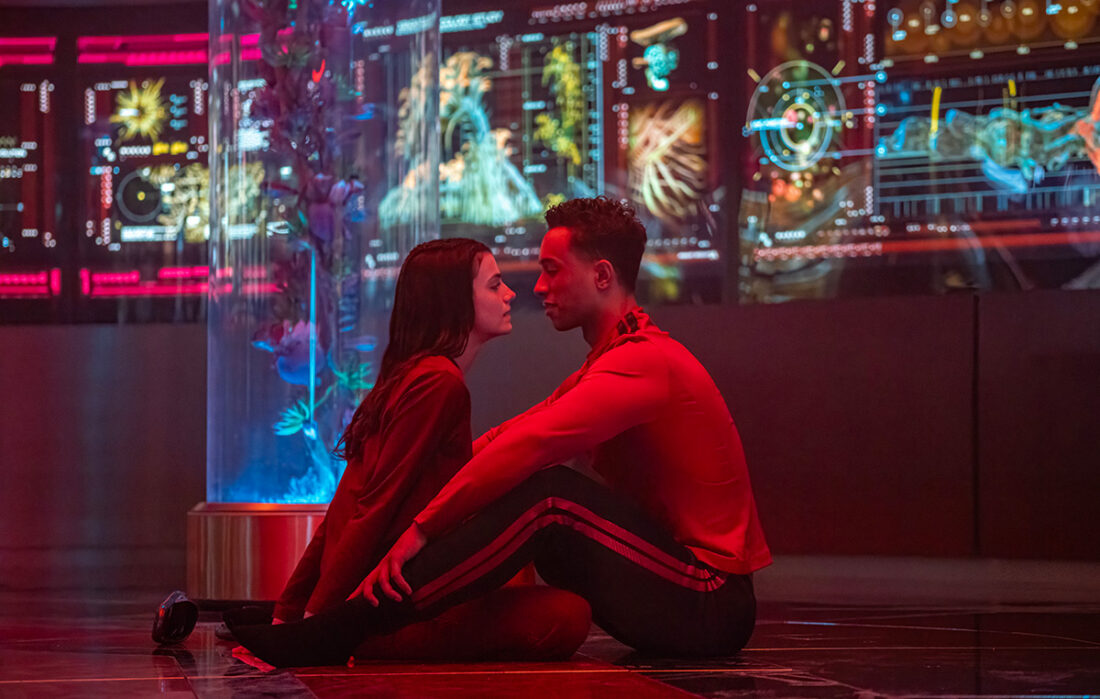
In class, though, Tarima keeps refusing delivery of what Tilly is trying to provide. She’s so stubborn about not wanting to address her issues that even her brother tells her to quit it, as tiptoeing around her has become exhausting.
Tilly, of course, doesn’t give up, and continues to do what she’s there to do: educate. I love how first SAM, then Tilly, then all the students—though it takes them a while to get there—use Our Town to help process what they’ve been through. Like I said, I have never liked that particular play (it’s entirely populated with characters about whom I don’t give even the tiniest shit), but I can see why writers Gaia Violo and Jane Maggs used it. The relationship between George and Emily is a bog-obvious comp for Caleb and Tarima, with Tilly going so far as to cast them both in those roles. And the play is inherently about change and the cycle of life.
This is a beautifully put together episode, and a complex one that incorporates many different characterizations and elements. I came out of it wanting more, truly, but I think it addressed what it came to address very skillfully. I loved Ake and the EMH talking about the effects of immortality on their ability to love people, I loved Reno and Tilly having their reunion, I loved Ake, Reno, and Tilly sharing a drink and passing the Bechdel Test with flying colors, I loved the sheer joy on everyone’s face when SAM returned to the Academy, I loved how absolutely goddamned brilliantly Robert Picardo played the EMH’s emotional struggles, I loved Ake returning to the Academy after seventeen subjective years and just sitting alone on the bridge.
Most of all, I loved seeing how Tilly has matured and thrived in her role as teacher. Watching Tilly’s progress from motor-mouthed bundle of anxious energy cadet in Discovery’s first season to the mature, superlative educator has been an absolute joy. I really hope they use her more in season two.

And speaking of traumas that were never mentioned (onscreen) again, Kirk also had to kill his best friend in Season One of TOS as well. So he lost Gary Mitchell, Edith Keeler, his brother, and his sister-in-law all in one year!
Oh, Kirk had tons of other traumatic events in his life — watching another love of his life die while pregnant with their child, encountering the cloud creature on the Farragut with half the crew dying, living through martial law and genocide as a teenager — but I picked those two in particular because they happened one right after the other.
—Keith R.A. DeCandido
The reference to “Real Life” felt weird to me precisely because it was one of those throwaway traumas that took place and was never again referenced in canon, but I liked this one. I look forward to seeing how being retroactively raised by the Doctor will have changed SAM’s character (will she be really into opera now, for example?). And I really appreciate that this series seems to be making a case for the importance of the humanities (humanoidities? whatever) in education.
Still hoping they bring back the Romulan cadet and show her reaction to B’Avi’s death.
I remember liking Our Town — in fact, I still have a copy of Three Plays by Thornton Wilder on my bookshelf (which also includes The Skin of Our Teeth and The Matchmaker), and I was thinking I should reread the play to remind myself. I remember being intrigued by the metatextuality of it, the Stage Manager being a character in the story yet outside the story, as they talked about. Which sort of resonates with the Doctor in “Real Life” and here, stage-managing a simulated family life that he’s also part of.
The thing that bugged me is the continued practice of depicting a universe in which human beings might as well have stopped creating all art, music, and literature after the year 2000 or so (with rare exceptions like the Tales of the Frontier comic the other week). I mean, out of all the plays in history, what are the odds that SAM would’ve latched onto one from the 20th century? But of course, a story like this wouldn’t have worked if it didn’t resonate with a real, known literary work, so I can excuse the cliche in this case.
While we’re at it, Jay-Den’s description of the climax of the Klingon opera sounded a lot like how Shakespeare’s Titus Andronicus ended, so even the alien culture feels like historic Earth culture. And again we contend with the problem that, while human culture has evidently ceased to exist, alien cultures remain stagnant over nearly a millennium.
Still, this was mostly pretty compelling, and there was some strikingly unusual writing, like the dialogue between Caleb and Tarima in her drunk scene. Incidentally, watching Zoe Steiner’s physical peformance in that scene, I found myself thinking, “She’s a dancer, isn’t she?”
It bugs me that the Doctor is still so hung up on Belle from “Real Life,” given that his holo-family there wasn’t actually sentient, just NPCs convincingly programmed to mimic human behavior. I would have thought he would have eventually grown beyond that training-wheels relationship and pursued more genuine connections with real people. Still, it was used effectively here to tie in with his relationship with SAM.
I do wonder how Ake managed for 17 years with only the Doctor and SAM for company. I wish they’d explored that a little more, and hopefully it will get some followup. Meanwhile, I’m so tired of the whole “We illusion-casting aliens have recreated your show’s standing sets to save money, err, I mean, make you feel at home” trope, though I understand the need for it. And in a way, I guess it resonates with the whole minimalist-staging thing of Our Town.
It bugs me that the Doctor is still so hung up on Belle from “Real Life,” given that his holo-family there wasn’t actually sentient, just NPCs convincingly programmed to mimic human behavior. I would have thought he would have eventually grown beyond that training-wheels relationship and pursued more genuine connections with real people. Still, it was used effectively here to tie in with his relationship with SAM.
The way I see it, even if the “Real Life” family were a case of NPCs, I’d argue the Doctor still formed a real attachment there – one very hard to let go of. Riker still fell for Minuet in spite of knowing she was a product of the Bynars’ programming. And at the very least, this development sheds a light on how Voyager as a whole avoided emotional repercussions due to its episodic nature. “Real Life” should have had a longer-term impact on him back then, especially when it came to the crew losing Kes not long after.
And I would say the Doctor had unresolved issues with protecting and fearing the loss of loved ones – not just the aforementioned family, but the Voyager crew as well – going as far back as season 5 of VOY. “Latent Image” is a case study. He was unable to cope with the fact that he chose to treat the colleague he knew and cared more for over the other, to the point where that feedback loop over his subroutines caused him to break down and require a 24 hour watch.
You can form strong attachments to fictional characters — that’s the essence of fandom — but it’s not the same as loving a real person. When Belle was diagnosed as terminal, the Doctor’s first choice was to turn off the simulation and forget the whole thing, which shows he did think of it as a simulation. Paris convinced him to confront the painful ending of the story, to experience the emotion of it, but that’s like the catharsis of reading a novel or watching a movie that hits close to home and makes you cry. It’s a bit much to say he felt it as intensely as the real thing.
We studied Shakespeare, 500 years old, and some of the Greek plays, over 2 millennia old, when I was in high school. The Illiad is almost 3 millennia old and it’s still part of the cultural conversation.
I’m not saying it’s implausible that they’d still study ancient plays in general. I’m saying that, statistically speaking, if you pick just one instance of them choosing a play to perform, out of thousands of years’ worth of drama from thousands of planets, it’s very improbable that they’d coincidentally chose one from the TV audience’s recent history. SAM has no reason to be biased in favor of 20th-century Earth in particular, since she’s not human and her psyche, and therefore her aesthetic sense, is brand-new. So she would’ve been just as likely to choose a play from 28th-century Andoria or 4th-century Bajor as 20th-century America.
And I’m saying, more broadly, that science fiction set in the future often makes it seem as though human creativity ceased to exist after the audience’s present day. Characters in the far future are always fans of things in the audience’s past, and there’s this gigantic gap in the cultural worldbuilding that rarely gets filled in. Alien societies still have robust art and literature and music in the future, but we rarely see future human culture.
As I said, though, I understand the reason for the contrivance in this case, because it wouldn’t have worked as well if it hadn’t resonated with a real, well-known dramatic work.
Agreed. It would have been more resonant if they added in a little more of the Doctor’s 800 years of loss, but time limits made the reference to Real Life more efficient….
My high school drama club used Our Town as a teaching tool many times. It enabled us to try out many emotions and states, as well as processing what it meant to act and to make those emotions visible to an audience (and maybe to ourselves). I never thought of it as a good or bad play, but I loved it for what it taught us. It was a perfect choice in this episode.
A lovingly and intricately constructed, powerful episode that resonates on many levels. It calls out the intertwining similarities and differences between the subplots using the iconography and dialogue of Our Town itself, not just on the literal plot level, but the deeper emotional level.
As only one example, I liked how the Stage Manager’s lighting cue descriptions were thematically carried into much of the Sam and Doctor subplot on Kasq.
I think this is the most that a Star Trek episode has engaged with a real-life play since “The Conscience of the King” — even more so, really, since that drew on several different Shakespeare plays. (Macbeth was the main one, but the title and some of the plot dynamic is from Hamlet, and the Tarsus IV famine is a reference to Pericles, Prince of Tyre.) TNG: “The Defector” excerpted Henry V in the teaser, but it was only referenced once afterward. We’ve had a couple of episodes heavily involving fictional plays, though, like TNG: “Frame of Mind” and VGR: “Muse.”
Anyway, I like the idea that Starfleet considers theater an important skill for a captain, considering that pretty much all the classic Trek series’ lead actors came from theatrical backgrounds, or at least did both theater and screen work.
I wasn’t a big fan to be honest.
Part 1:
Part 2:
Additional
IIRC, they said Tarima was transferred because her brain couldn’t withstand another outburst of her powers, and the more military missions undertaken by War College cadets or graduates posed a greater risk of triggering another such incident.
They didn’t say anything about B’Elanna, and that joke is absurdly wrong, of course. B’Elanna just programmed the simulation to be more random and realistic, and the Doctor chose to see it through. B’Elanna had no more involvement with it after that point. When Belle developed her terminal condition, the Doctor shut the program down and walked away, but Tom Paris convinced him not to hide from the experience.
But if you’re referring just to the existential-trauma part, maybe, yeah. The fact that the Doctor’s first reaction was just to abandon the simulation shows that he still saw it as a simulation, albeit a moving one. I think this episode exaggerated the impact it had on him. But then, maybe over 800 years or so, the Doctor’s memories have proven just as mutable as a human’s. Maybe losing other friends and loved ones over the centuries reminded him of his first experience of loss with Belle, and so that reinforced the intensity of the emotional association in his memory, so that it became a synecdoche for his later, greater losses.
I don’t think that was a cube planet, I think it was a hexagonal portal to their pocket dimension.
The height difference I noticed was between Genesis and Caleb.
Thank you as always, Keith. Question: Did Ake actually live out the 17 years on Kasq? Doing what? We didn’t see her there during SAM’s childhood scenes. I know she said they weren’t the only ones, but wouldn’t it have made more sense for her to hang in orbit catching up on paperwork for the two weeks than to, what, meditate for nearly two subjective decades? {Jonathan}
Ake may have returned to San Francisco and then returned to Kasq, for all the episode told us. I wondered if it was just the Doctor and SAM for those 17 years, but then realized there’s no reason why they couldn’t also interact with the rest of Kasq’s population, whoever and whatever they are and look like. SAM probably had a rich and full childhood, learning all about her civilization’s history, mores and rituals.
I wondered that too, but as you said, her log entry seemed to indicate that she stayed with them.
I imagine that Ake’s perspective is kind of like Frieren’s in her self-titled manga/anime series. She’s a near-immortal elf with a very different time sense from humans, so that she thinks nothing of spending a few years or decades engaged in some pet research project. Of course, even Ake’s a young whippersnapper next to Frieren, though the Doctor is closer to her age (at least, Frieren is a millennium or so past her wizard training, though it’s unclear how old she was at the time).
One interesting thing that comes from the episode display is that the Starfleet cadets are completely directionless and have no teamwork in the simulations and we’re meant to think that’s because of their trauma. Except, they were like this in Episode 3 because of the fact they had bad leadership from Darem and only Genesis stepped up. Now Genesis has been removed from all leadership roles due to her falsifying records and…now they’re screwed. I think Jet Reno assumes one of the others will step up but none of them are going to and Genesis is the only one who can.
Which is kind of anti-Trek.
She can’t rise above what she did.
She was not removed from all leadership roles, just not stood up for the Pre-Command track of additional coursework to give her a leg up. Which (along with self doubt and yes, trauma) may have resulted in -her- choosing to step back, but there was no change to her role as a cadet. (She may full well be the team captain for whatever that laser tag was)
Actually I had an issue with that scenario. Reno was in the chair, which means she was in command. If not, it can be implied that no one was in command at all, which may have been the point of the class, which is someone should have taken the chair. But they never said that.
I don’t see that as an issue. A starship has only one captain and hundreds of other crew members, so it follows that over 99% of Starfleet officers will never achieve command. And captains can’t do anything without highly trained crews to carry out their commands. Logically, most cadet training should focus on following orders rather than giving them, on being an effective member of the team. Command-track training is a special program you have to earn admission to after you’ve learned the basics, as we saw with Genesis.
I don’t know what you’re talking about. I’m just saying that it makes no sense to expect every Academy lesson to be focused on command, because command is just one of many important jobs in the service. So it wasn’t a problem here to have Reno in the chair instead of one of the cadets. I obviously wasn’t saying they’d only train for following orders, I was saying there was no reason for this single specific class to be command-oriented. Specific argument is not general argument.
I honestly thought Ake had stepped back out of the time dilation and went back to get the Doctor and Sam a couple of weeks later (only because they never showed her at all in the montage).
I wonder if they created holographic kids for Sam to play with and learn from growing up (as that is an important part as well).
Directorially, the contrast between the arrival at Tarima in the beginning of the episode and SAM at the end was masterful.
‘What took us two centuries to create you destroyed in 209 days”. Ouch. And it remains to be seen how different SAM will be now (she really is a different person(a))
I also wondered whether Ake spent the 17 years with the Doctor and SAM, or just waited the two weeks for them outside the time dilation. Was it clear and I missed it?
Ake said in her final log entry that “they weren’t the only ones” who spent 17 years on Kasq, but she didn’t elaborate. So it’s implied that she was there with them, but it wasn’t made very clear.
How did it take two centuries to create SAM, though? And how is that reconcilable with the idea that she was only a few weeks old at the start of the series? Do they mean it took two centuries to develop the underlying software? Why did it take so long?
Keith, Tilly did NOT cast Tarima as Emily. She cast SAM, who then chose Tarima in her goodbye note.
True, but Tilly would’ve had to approve that suggested change.
Mary Wiseman is even better than usual in this episode. More chill Tilly is a delight.
Having Tilly finally was great. Dealing with trauma properly is also good. dedicating an entire episode to nothing else but dealing with trauma is OK, but i think Family in TNG dealt with it significantly better…overall i was not happy with many bits and I especially hate that it is assumed that not only some random US play would be known in the future, but that it would be known in the present…maybe it’s just me, but i’ve never even heard about it. Choosing international classics give at least a real multicultural reference, this felt like aiming for US audience only…
Yeah, I must admit, I’d never heard of this play before, but I think they do a good job of explaining the relevant aspects.
It helps that the characters were unfamiliar with it too. Always a good way to work in exposition.
I’m not particularly into theater in general, meaning I didn’t even know about Our Town to begin with. That being said, Starfleet Academy has been exemplary with its character work and how it’s been able to build very simple, very abstract episodes with a surprising lack of plot but copious amounts of pathos. Like “Ko’Zeine” last week, and “Series Acclimation Mil” not long before that, this week’s outing has been an emotionally satisfying journey.
I’ve said it before, the show’s writers are keenly aware of the audience emotional investment in how they designed these arcs as rollercoasters by introducing SAM’s Emissary arc so beautifully to then immediately rip that heart into an open emotional wound when she got shot in “Come, let’s Away”. When she glitched, I said out loud “they are going to have to deal with the repercussions of that“. No amount of Holo-spa was going to fix that.
Of all the Trek shows over the past 9 years, SA is fast becoming the best one when it comes to dealing with long-term trauma and dealing with past events. We’ve seen some of that over the past Secret Hideout shows, but this is the one that has finally embraced it, and bringing light to an overlooked Voyager episode at that. To me, this was the best Picardo performance in 27 years. The last time he looked this small and helpless was in season 5’s “Latent Image” when he couldn’t deal with his medical choices that ended up causing the unfortunate loss of a crewmember. I am very glad the show brought new context to “Real Life”, as we finally understand why he’s become so cranky and aloof, especially when it came to SAM’s wide-eyed eagerness to please and be close to him.
I’m also very glad the show didn’t let the Kasq fall into obscurity as stock overbearing parents after their last talk with SAM in the fifth episode, instead giving us a very understanding culture as they realize the mistake in the way they programmed SAM to begin with. Just like that, the show gave us a Trekkian solution to a classic problem.
And while Tarima’s B story couldn’t possibly compete with that A plot, it still delivered in itself. Few moments were as heartbreaking as Tarima’s “I can’t” – Zoë Steiner’s body language and voice just kills me with its inherent sadness.
I’m glad they finally provided a story reason to bring back Sylvia Tilly. Now there’s a character who’s overcome and grown a lot. I hope the show doesn’t squander her next season. I never fully understood why they removed her from Discovery (one can see Adira more or less filled that role in the later seasons), and I think Wiseman deserves better.
Incidentally, I think this episode just low-key answered our questions about what’s projecting SAM’s holographic body. At the beginning of her “rebirth” montage, we saw the Doctor picking up a small metallic object that was presumably SAM’s mobile emitter (or what Red Dwarf would call her light bee). Although that doesn’t account for how she can teleport from place to place at will, unless the emitter has a built-in transporter.
Incidentally, the Doctor’s presence in the shuttle and on Kasq implies he still has a mobile emitter, though he doesn’t seem to be wearing one on his uniform. Maybe it’s inside him now, like SAM’s apparently is (or like Rimmer’s light bee). Or maybe it’s built into his insignia.
This has really turned into a great show. The Caleb Mir focus in the first two episodes had me very concerned, but that focus seems to have mercifully disappeared.
On tbe issue of Ake’s whereabouts during those 17 years, it definitely sounded like she stayed on Kasq. I took it to be her way of recovering from the Miyazaki incident. The cadets needed their theater class with Tilly (yay!), SAM needs to be regenerated, the Doctor faces his trauma by raising her, and Ake needs some alone time. Time heals all wounds, as they say, so it makes sense that a near immortal would (try to) heal their wound by taking 17 years off. She’s only gone a few weeks from the Academy’s perspective.
It’s sad that Wiseman is limiting her involvement with Trek since she was raked over the coals by toxic fandom due to body shaming issues. She just doesn’t want to deal with all that toxicity. Who can blame her? Must be hard being in the limelight like that! Such a shame, I love her character and her portrayal of said character (Tilly).
When a Jeopardy clue that I think is a gimme ends up flubbed and/or unanswered by the contestants, or the reverse occurs, I’m reminded that every question is easy if you know the answer. Our Town is very familiar to me, although I’m partial to Wilder’s Skin of Our Teeth, so hearing others say they’ve never heard of it is wild yet perfectly understandable because we all lead different lives. I’m among those skeptical over its choice for this class but can excuse it partly because, I say hoping this comes across how it’s meant, the show isn’t to blame for us viewers living in a time not very long after the play came to be.