





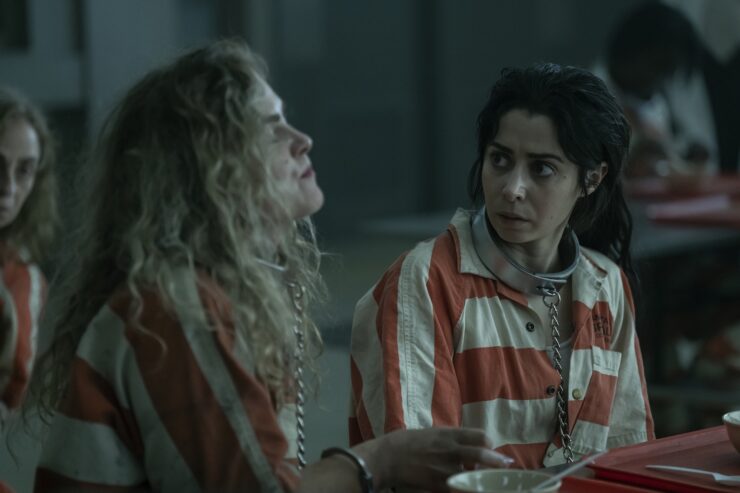
After watching this week’s episode of The Penguin, I find it impossible to believe that someone on the production staff, whether it’s executive producer/showrunner Lauren LeFranc or someone underneath her, isn’t very familiar with Charlotte Perkins Gilman’s short story “The Yellow Wallpaper.”
Written in 1892, Gilman’s story is a scathing indictment of the treatment of women by the nascent psychiatric community of doctors, with women fobbed off into useless and/or harmful “treatments” to cure them of whatever ailments they were suffering from, whether real or imagined, and often an excuse to get rid of “problematic” women. The narrator of the story is confined to a room with yellow wallpaper. The tale is both a brilliant bit of social commentary and a magnificent horror story, as we get a first-person look at the narrator’s descent into madness, which is due, not to hysteria, as the male doctors have insisted, but her confinement in this one room that’s supposed to be for her own good.
The reason why I know that someone on the staff has to be familiar with the story (or, perhaps, one of the film adaptations of this nineteenth-century classic that has been done in the twenty-first century) is that Sofia Falcone’s story in the “Cent’Anni” episode of The Penguin is a pretty direct analogue to that of Gilman’s never-named narrator.
About two-thirds of the episode is given over to Sofia’s backstory. We start with the other half of the end of last week’s episode. Nadia Maroni makes it clear that she’s not going to put up with Penguin’s nonsense anymore. She also reveals to Sofia that Penguin, not Sal Maroni, killed her brother Alberto. Then Vic runs over one of Nadia’s thugs, Penguin shoots two more of them, and they get in the car and drive off. Somewhere in there, Sofia suffers a major head injury. She calls Dr. Rush to ask for help, then passes out…
…at which point we flash back a decade. Sofia is the good daughter to Carmine Falcone, the one who actually knows what she’s doing, as opposed to ne’er-do-well fuckup Alberto. We get the full story of how Sofia’s mother died: nine-year-old Sofia found her having apparently hanged herself. Carmine (played by Mark Strong due to John Turturro not being available to reprise his role from The Batman) tells her that he’s going to name her, rather than Alberto, his heir. Sofia is thrilled.
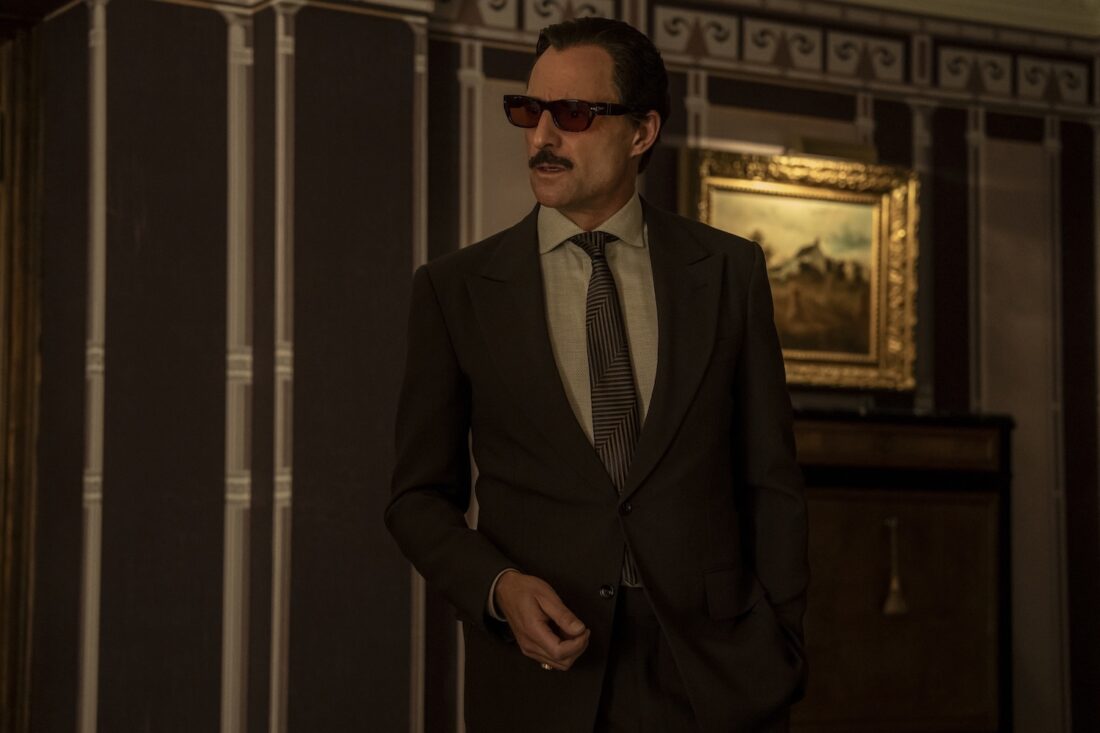
(The recasting is only partly successful. Strong has made a career out of playing bad guys—indeed, he has three other comic book villains on his resumé, Sinestro in Green Lantern, Dr. Sivana in Shazam!, and Frank D’Amico in Kick Ass—but one of the reasons why Turturro’s performance in The Batman worked so well is that he had a pleasant charm as the velvet glove over the iron fist of his menace. Strong is all iron fist; his drinking wine with Sofia when he makes her his heir should be more familial, but Strong’s sneer makes that not quite work as well as planned, thus diluting the impact of later scenes when the menace is more overt.)
And then Sofia makes her first mistake: she talks to a reporter. Summer Gleeson of the Gotham Gazette (a character who originated as a TV reporter in Batman: The Animated Series, played here by Nadine Malouf) approaches Sofia, and shows her evidence of several women who were killed by being hanged, just like her mother. It also looks like evidence was suppressed, both in the case of her mother and these women, who all worked in the secret “44 Below” club underneath the Iceberg Lounge (which we also saw in The Batman). We already know from the movie that Carmine sometimes slept with the women who worked there—one of them produced a child, Selina Kyle, a.k.a. Catwoman. And now it seems that someone has killed them but made it look like suicide. Gleeson thinks it might be Carmine.
Sofia’s driver, Oz Cobb—whom we see as someone friendly and helpful to Sofia, even though she mostly treats him like the help—is the one who takes her to a second meeting with Gleeson. At first Sofia is concerned, but then she tells the reporter to fuck off, particularly after Gleeson asks her to wear a wire into 44 Below.
Penguin tells Carmine about this, of course—how can he not? But Carmine’s reaction is devastating. It’s clear that Carmine is responsible for these women’s deaths—and also possibly for his wife’s death—and it’s equally clear that Sofia is starting to put it together. Carmine is no fool, and he knows his daughter is also no fool. So he preemptively takes her off the board, as it were, using his influence with his family, with the press, and with the police to have Sofia arrested for the murders of all the women, plus the latest victim: reporter Summer Gleeson.
Sofia is committed for psychiatric evaluation. Part of the evidence presented for that are affidavits from several family members, including Carla Viti. You might recall we saw an awkward conversation between Sofia and Carla last week, and this week the flashback shows the two of them thick as thieves prior to Sofia’s arrest. So Sofia is rather devastated to see that one of the affidavits claiming that Sofia has a (wholly fictional) history of mental illness is from Carla.
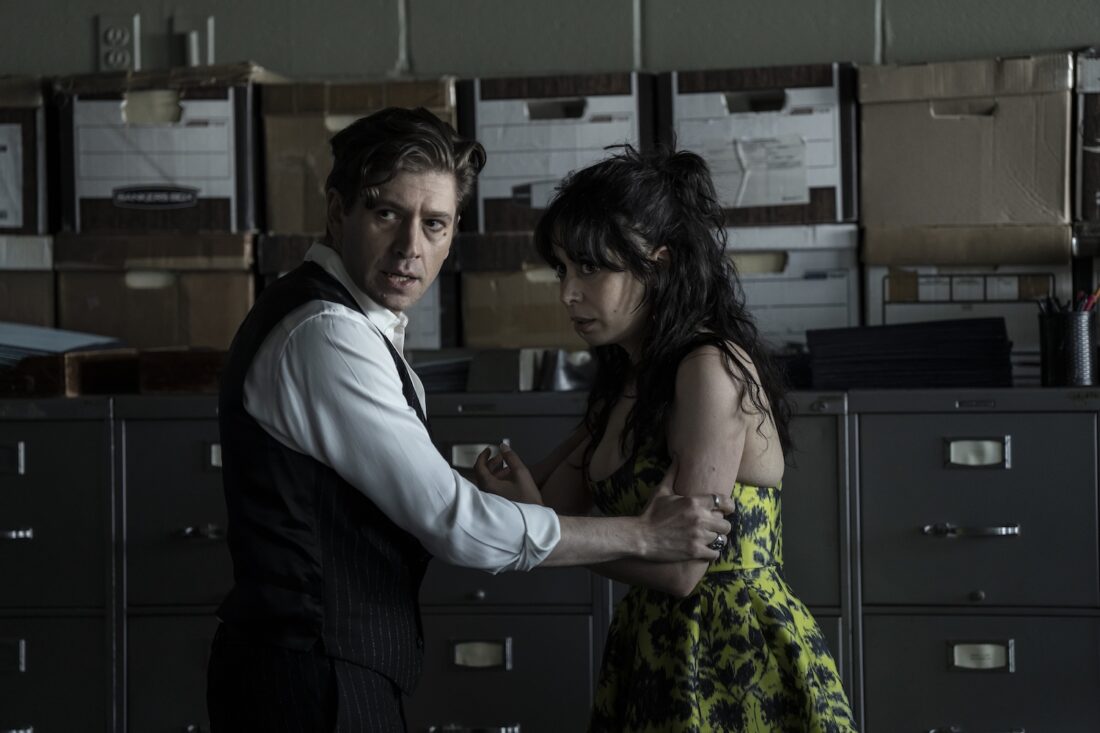
And so Sofia goes through what the narrator of Gilman’s short story goes through, only on a much bigger scale. She’s committed to Arkham State Hospital for six months to see if she’s competent to stand trial. We see Rush when he first met Sofia, the assistant to the head doctor, who treats Sofia like she’s already guilty, already diagnosed as being mentally unfit. Sofia’s next door to a blonde named Margaret Pye, who calls herself Magpie. (We also see her being given a red drug that we recognize from last week as Bliss; Magpie calls it “candy.”) Magpie is based on a Gotham City-based villain from the comics, and she’s also completely ’round the bend.
Sofia suffers through the half-year, which includes a rather appalling amount of electroshock therapy, expecting a trial at the end of it. But then we find out that the director of the hospital, no doubt at Carmine’s instruction, declared her unfit for trial and recommended she remain hospitalized.
And there she stayed for ten years. Throughout, we see the dehumanizing treatment, the assumptions of insanity based on no evidence except for the denial of same, which is both what a crazy person would say and what a sane person would say, so it’s rather poor evidence. The tiny cells, the abuse—at one point, a fellow inmate has somehow gotten out of her chains and assaulted Sofia; she later commits suicide with a fork—and the electroshock do their job a little too well. Driven to her breaking point by the denial of a trial, she beats Magpie to death in the mess hall and then declares to the doctors that she’s “fucking innocent.”
During all this, we see the wallpaper in her cell, and it’s yellow (matching the wallpaper in the room where she found her mother). She claws at it, just as Gilman’s narrator did, and it contributes to her downward spiral.
Then we cut back to the present. Rush apparently quit his job at Arkham in protest for how Sofia was treated, which is why he’s treating her privately now. We don’t see the exact circumstances of her release, though the fact that it happened after Carmine’s death is probably not a coincidence.
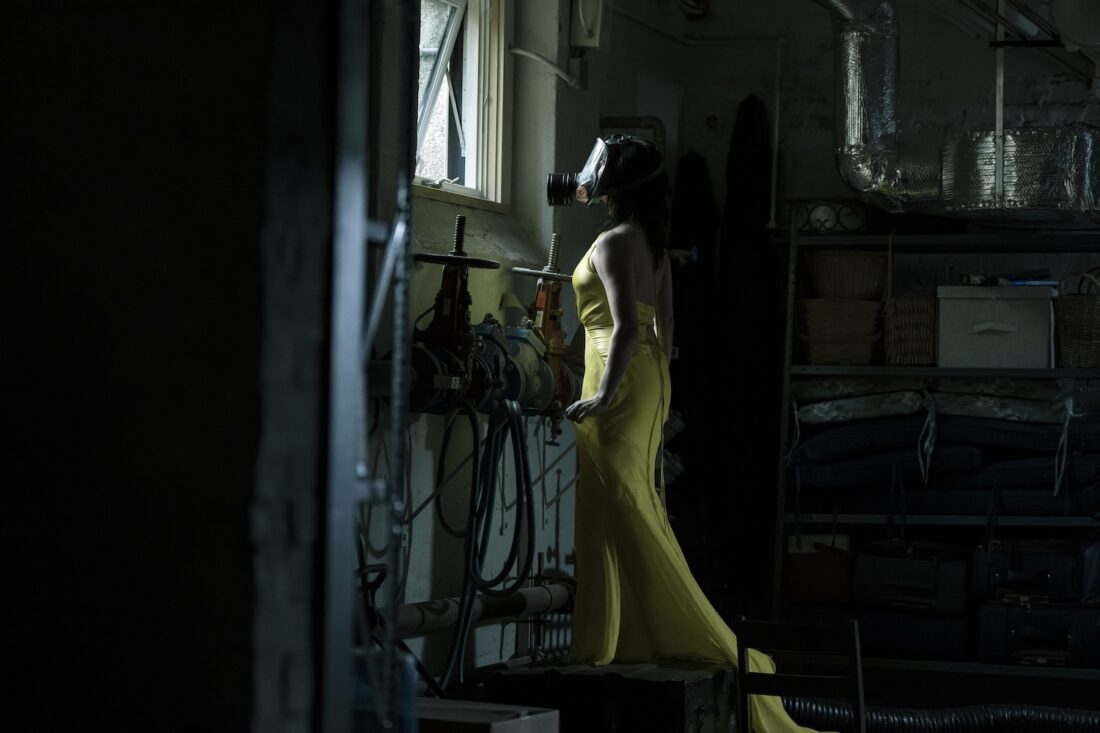
The main difference between Sofia and Gilman’s narrator is how it ends. Sofia not only is freed, she’s liberated. She isn’t the Hangman murderer, but everyone thinks she is, so she embraces it. She’s spent all her life being victimized at least in part because of her gender. (At one point before she’s arrested, and before Carmine initially makes her his heir, she says frankly to Penguin, “You have a dick, so at least you’re eligible for promotion.”) But now, she’s taking over in the only way she can. Wearing a bright yellow dress, she intrudes on a family dinner and tells everyone there how much she “appreciates” all the support she got from the family, who lied in affidavits and/or never visited or cared about her in the least after she was unjustly committed.
Then she wakes up Gia, Carla’s little daughter, and takes her out to the greenhouse for a midnight snack, and they then sleep there, just like she and Alberto did when they were kids. In the morning, she leaves Gia asleep and checks the house while wearing a gas mask: she’s gassed almost the entire house, and with the exception of Gia, safe in the greenhouse, and Johnny, whose room was spared, the entire Falcone family is dead. Why she kept Johnny alive (beyond Michael Kelly being in the opening credits) is not yet clear, but we’ve still got four episodes to go…
“Cent’Anni”—an Italian toast that means, “May you live a hundred yeas,” a toast Sofia gives to a room full of people she intends to murder that night—is a brilliant treatise on how it’s still, more than a century after “The Yellow Wallpaper,” incredibly easy to marginalize and relegate smart, capable women by deeming them hysterical. The difference here—because it’s fiction, and you can create your own ending—is that Sofia survives and now thrives.
As much as the title character, Sofia Falcone is a smart person who had the misfortune to be born with characteristics that make it easy for them to be dismissed. For Penguin, it’s his looks, deformities, and background. For Sofia, it’s that she was born with a uterus. It will be very interesting to see how the rest of this plays out, especially since they’re on opposite sides now, and the Maronis are still a wild card.


I think my key responses to this episode were:-
– This episode puts Sofia Falcone through Hell and makes her look just FABULOUS by turns, yet somehow manages to do both equally well (The Revenge Dress speaks for itself, but I have an even greater fondness for the black-figure dress she wears at her arrest).
– Summer Gleason arguably deserves close attention from a (non-Evil) mental health specialist, because the woman is suicidally over-ambitious: working with the GCPD is dangerous enough, but going after The Roman in his own city? Trying to persuade Mafia Princess and Daddy’s girl Sofia Falcone to wear a freaking wire IN FRONT OF HER DRIVER?
I can’t decide if Ms. Gleason is simply desperate or actively pursuing Suicide by Mobster, but this is an especially vivid demonstration of what happens to intrepidly heroic reporters in Gotham when the Dark Knight isn’t in the job.
– Go into Arkham for long enough and you’ll either come out crazy, feet-first … or deadly dangerous.
It is known.
– Was Carmine Falcone’s offer of the succession to Sofia based on the idea of pulling a Full Rhaenyra or did he intend for her to be the Eminence Gris of the Falcone Crime Family? (Presumably using a male figurehead while she wields the actual power, a dynamic that might well be the one she has in mind when sparing Vitti).
– It’s difficult to blame Cousin Carla for doing exactly what The Boss and the Heavy Mob required of her: if it could happen to Carmine Falcone’s favourite child, it could most assuredly happen to a mere niece.
That Sofia chose to spare Carla’s daughter (Possibly with an eye to taking custody of her) has all the elements of a classical tragedy: I wonder what she intends to do if – when – Gia puts the pieces together?
– Incidentally, while most of the mayhem in this series to date has been the sort of thing a Batman busy trying to fother the holes left in Gotham by The Riddler so that the city can pump ship (Almost certainly whilst facing the challenge of being More Bruce Wayne, possibly even out of town) might reasonably pass over, a whole family being wiped out overnight (Even if it’s a Crime Family) is EXACTLY the sort of thing that would push The Bat’s buttons.
For all his faults, Batman is not the sort to shrug and whisper “No humans involved” when he gets wind of a Gangland Killing.
– Another disquieting thought: if it had been Alberto who threatened to rumble Papa’s little … sideline … would HE have been liquidated or just marginalised?
– It’s interesting to speculate on how much of a role Oswald played in Miss Fakcone’s downfall: my impression is that his contribution looms larger in his own mind than it did in the actual case (Since I’d bet money that all he was in position to tell was that Miss Falcone had been speaking with a reporter, while Falcone’s connections in the Police Department would almost certainly have provided far more vital information and it was Sofia herself who let on her suspicions).
– Nonetheless, in the wake of recent developments it’s not just the Penguin’s wings that are going to get clipped…
I vividly recall getting Batman #401, a Legends crossover with a Magpie cover drawn by John Byrne, off the racks the same week she debuted at his hands as writer/penciler in Man of Steel #3, which told of the first meeting between Superman and Batman as it occurred in the wake of Crisis on Infinite Earths.
I’m not sure what I ate for breakfast on Monday.
It looks like this is the first time Summer Gleeson has been featured in an onscreen production since B:TAS, though she’s made cameos in a couple of comics continuities.
It’s interesting to me how some of B:TAS’s original characters have had major post-B:TAS careers — mainly Harley Quinn and Renee Montoya, but a few others like Lock-Up, Baby Doll, and even Condiment King — while others like Summer Gleeson and Veronica Vreeland have been mostly ignored. And not just B:TAS. Some characters created for adaptations have been embraced by the comics or by subsequent adaptations — Jimmy Olsen, Perry White, Otis, Eve Teschmacher, Mercy Graves, HERBIE the Robot, Phil Coulson — yet others have failed to make the leap, like Batman ’89‘s Alexander Knox or Smallville‘s Chloe Sullivan (who made a brief comics appearance and was name-dropped in Supergirl but otherwise never took off).
Having wrapped Smallville earlier this month, one thing that stood out to me is how absent Chloe was from that final season. I assumed that happened because of Allison Mack’s growing involvement with NXIVM. I imagine that as time went on DC would have wanted to avoid using the character in comics due to that unfortunate association.
No, I think it was simply a matter of budget. Actors get a raise for every successive season, which gets really expensive after a while, which is why most series end in 7 seasons or less, and why longer-running series generally either replace cast members or reduce the cast size in later seasons. Smallville season 10 did both, reducing its regular cast to only four people (only two of whom appeared in all 22 episodes) and keeping Allison Mack around on a part-time basis (7 episodes). Mack was the only season 10 main cast member other than Tom Welling who had been a regular in seasons 1-3, so she would’ve gotten paid more per episode than anyone except Welling. Thus, it makes sense that they would’ve reduced her role to economize.
It’s true that Mack was involved with NXIVM as early as 2006, but I get the impression that she didn’t get deeply involved until Smallville ended and she moved to New York to live with the cult leader. It’s possible that the cult may have been a factor, but it’s not necessary to explain her reduced role, since the budget issue alone could plausibly account for it.
Quinn and Montoya had the benefit of being interesting. Gleeson and Vreeland didn’t really stand out — Gleeson was mostly there to serve as vehicles for exposition, while Vreeland was there to be Wayne’s arm candy. They didn’t distinguish themselves the way Montoya and Quinn did….
—Keith R.A. DeCandido
Sure, but if someone wanted to feature a reporter in a Batman story, why not use Gleeson (or Knox) instead of making up a new one? That’s what this Penguin episode did. And if they wanted to feature a wealthy social butterfly, why not use Veronica?
Also, you’re really selling Veronica short — she had major roles in both “Birds of a Feather” opposite Penguin and “Harley’s Holiday” opposite Harley and Ivy. She was a much more developed and interesting character than just “Wayne’s arm candy.” She started out shallow and spoiled, but proved to be capable of growth. She was a very useful character, a representative of Gotham’s high society who could either be sympathetic or create problems through her self-indulgent pursuits. And Marilu Henner made her fun and likeable.
As for characters needing to “distinguish themselves” to warrant adaptation elsewhere, I give you Condiment King. In B:TAS, he was a one-time gag character, not even a real villain but just one of several stand-up comics brainwashed by the Joker to think they were supervillains. But he ended up getting added to the comics and has been adapted in multiple TV and game continuities including Young Justice and Harley Quinn. Okay, you could say he distinguished himself by being silly, but it goes to show that it doesn’t take much for a character to get picked up elsewhere.
Heck, I think Alexander Knox certainly distinguished himself in Batman ’89. He was effectively the viewpoint character in the first act of the film, and Robert Wuhl made him quite engaging. Yet he’s never been brought back outside of his cameo in the Arrowverse Crisis. By the same token, Chloe Sullivan certainly distinguished herself as a major character in Smallville, yet somehow there’s been little interest in adapting the character elsewhere, even before Allison Mack’s cult activities became infamous.
I loved this episode. The more Sofia, the better. And her revenge in the end was very sweet indeed. All of which sets her up to be a formidable opponent to Oz and his future survival. And we still have four episodes to go?!? This series has been a very pleasant surprise, all around.
I’ve never read Yellow Wallpaper myself, but I figured the constant cuts to the actual wallpaper were a reference to something. What a masterpiece of an episode! Reinforcing just how marginalized Sofia had been in previous episodes and bringing that traumatic experience to the forefront with no brakes and no disguising makeover. Just brutal.
In previous episodes, I could still question whether she was guilty of the murders. After seeing what Carmine and that one doctor at Arkham did, I could never question her innocence ever again. She was – pardon my French – fucked over big time. And it also paints a damning portrayal of the justice system in Gotham, when a mob boss can collude with authorities to screw over his own daughter like that with no repercussions. This is one screwed-up situation that even a vigilante like Batman couldn’t possibly repair or make right. And the sad thing is that by doing so they deliberately pushed her into becoming the very thing she rightfully claimed she wasn’t. Now she is in fact the Hangman after what she did to the Falcones (even though they had it coming after the way they sold her out).
I guess that was a factor in the writers’ decision to spare Gia. There had to be humanity left in Sofia to salvage. I’m very intrigued to see if she survives this to the end and whether she becomes a player in the upcoming movie. It’s also a credit to the show that it can pivot away from the title character for this long. Even though last week’s episode was Victor-centric, his story was still deeply connected to Oz. Not this time. They made it look effortless. That’s how strong the writing for Sofia has been – we can root for her and still despise the choices she made.
That damning portrait of Gotham was already painted in the movie, though. We saw, in graphic detail, how corrupt law enforcement was and how much influence Carmine had over it in the film. That was, indeed, the entire thesis of Riddler’s rampage in the film…..
—Keith R.A. DeCandido
Sofia Falcone was assuredly innocent on the charge of murder, but it bears pointing out that Carmine Falcone’s (Apparently serious) offer to make her The Boss in succession to him strongly suggests she wasn’t entirely harmless (or oblivious), even before Arkham worked it’s usual magic.
I think there is a difference there. A mob boss theoretically isn’t supposed to get his/her hands dirty with direct dirty deeds like murder. They’re supposed to be businesspeople who supposedly stand above the common working rabble (the social abyss is also a recurring theme on the show). I think the issue here is that Sofia started to put the pieces together regarding the murders, figuring out that even her father couldn’t hold himself true to that alleged standard. And caught with his pants down, his pride got the better of him.
Otherwise, I don’t think Sofia was chosen to be the heir to the Falcone empire because she had a ruthless streak, but because she could lead and manage like a true professional, unlike her brother Alberto.
@Eduardo S H Jancarelli, that’s a fair interpretation: my own suspicion is that Carmine Falcone could well have been driven by panic, as much as by pride – given that Sofia was apparently his own preferred heir and a businesslike young lady, he might well have seen real potential for her to exploit a police investigation and her insider knowledge of the Falcone crime family to put Papa out of the way.
You know, doing exactly the sort of thing Falcone himself had done to Boss Maroni.
Also, my initial point was not that Sofia Falcone was a born killer: it was meant to point out that, as she seems to have been aware that her Papa was a crime lord and was sufficiently familiar with his operations to be seriously considered as his heiress, Sofia Falcone was at the very least winking at (and possibly even an accessory after the fact to) a multitude of criminal activities.
I’m not saying she actually deserved what happened to her – I’m just pointing out that there are some intriguing ambiguities (arguably outright complexities) involved when describing her as an innocent.