





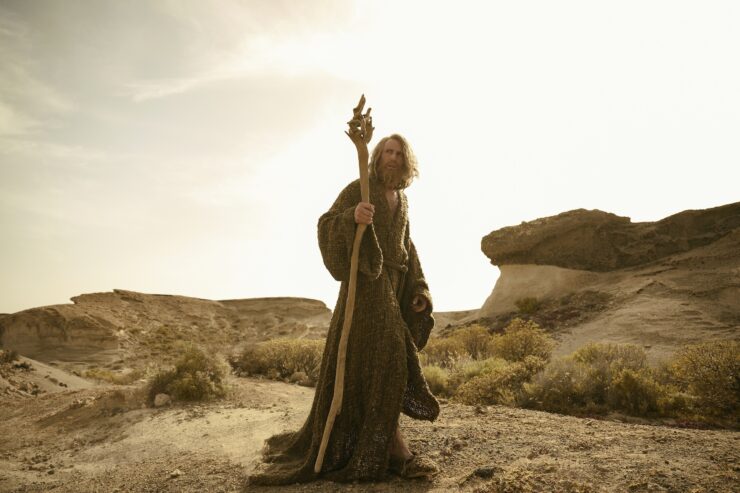
Episode Eight, “Shadow and Flame,” opens with Durin IV going to confront his father. The King refuses to listen to his son’s pleas to take off the ring. He breaks through into a great cavern of mithril, but the Balrog appears, and Durin takes off the ring. Naming his son as King Durin, Durin III attacks the balrog, and the shock of the conflict causes the hole in the wall to close. In Rhûn, the Stranger finds the Stoor’s home. The Dark Wizard is there, greeting him as a brother and offering the Stranger the opportunity to become Sauron’s successor alongside himself, but the Stranger refuses him. The Dark Wizard uses magic to tear down the Stoor’s homes and leaves, but the Stranger discovers the ability to stop the rocks from falling, giving the Poppy, Nori, and the Stoors time to get to safety.
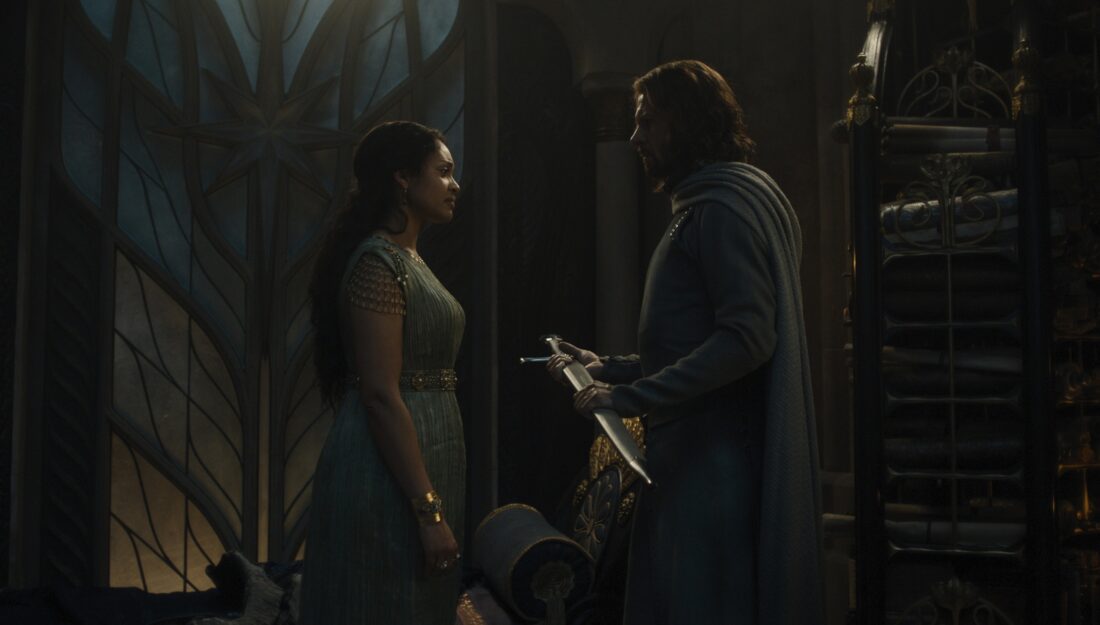
In Númenor, Pharazôn declares that Míriel was only able to survive the trial because she is allied with Sauron. Those faithful to her are also labeled as dangerous traitors and a purge begins. Míriel refuses to escape with Elendil. She gives him the sword Narsil, and tells him to use it to claim his destiny. Adar’s army invades Eregion. Orcs find Galadriel leading a group of elves to safety, and she offers herself and the Nine Rings in exchange for the survivors being released. In the tower, Sauron tortures Celebrimbor for the location of the rings. Celebrimbor prophecies that the Rings of Power will destroy Sauron, and that One alone will prove his utter ruin. Infuriated, Sauron impales him on a spear.
In Pelargir, Estrid tells Isildur that she doesn’t love her betrothed, and they kiss. He asks her to come to Númenor with him. But when Kemen arrives with Númenor soldiers, he refuses Estrid passage to Númenor, and tells Isildur that Pharazôn is now king, while Elendil is wanted for treason. He starts giving orders to the villagers, refusing to bring the aid Númenor promised unless the villagers provide timber for “the King’s armada.” Galadriel is brought before Adar, who reveals his possession of Nenya and the fact that his elvish appearance is restored while he wears the ring. He returns it to Galadriel and promises that once Sauron is dead he will recall his children to Mordor and never make war on Middle-earth again. He asks that the rings be used to heal the rift between elf and Uruk. Grugzûk is brought in, apparently wounded by Sauron. As Adar kneels beside him, the orc stabs him. The rest of the orcs descend upon him, and Sauron picks up Morgoth’s crown. The orcs cheer for him.
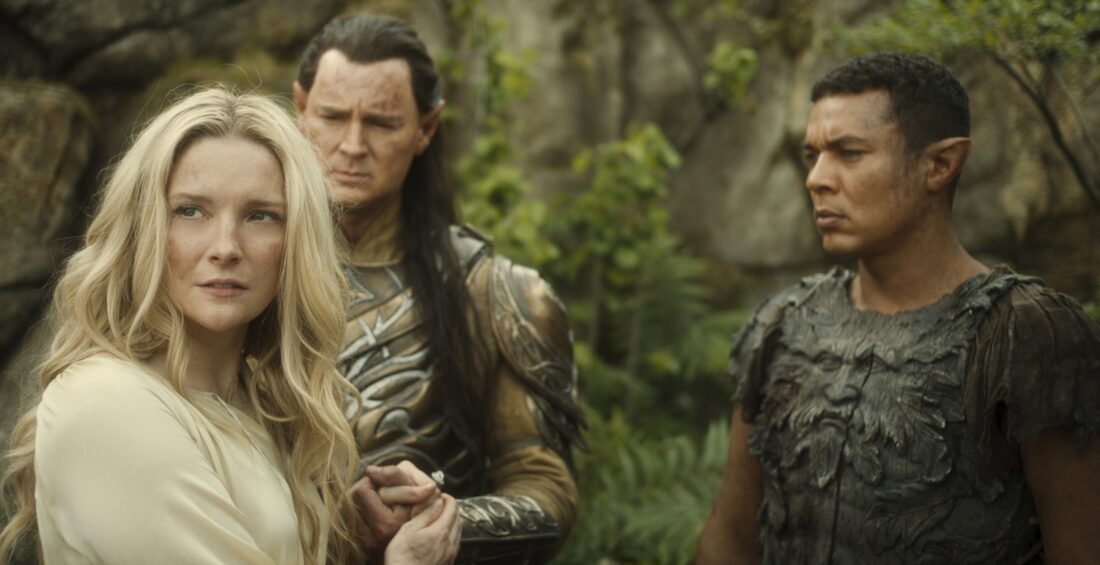
Galadriel and Sauron fight, with Sauron taking different guises, mocking her with her pain and her mistakes. She resists him until he stabs her with Morgoth’s crown, telling her that he would have made her the Queen of Middle-earth. He takes the Nine Rings from her. Sauron uses hypnotic power to force Galadriel to take off her ring and hand it to him. At the last moment she closes her hand and flings herself off the cliff. In his anger, Sauron slays Grugzûk. The dwarf army, led by Narvi, arrives to fight off the orcs, rescuing the captives, including Gil-Galad, Elrond, and Arondir. Gil-Galad and Arondir find Galadriel, still alive, and the king observes that the wounds are infected with evil, drawing Galadriel’s spirit into the shadow realm. He tries to use his ring to heal her but it doesn’t work. Finding Nenya, Elrond declares that together, they can save her.
In Rhûn, Nori grieves for the loss and damage to the Stoors’ home, and Poppy tells her that sometimes things that are broken can’t be fixed. Over a montage showing all the main characters from the show and the losses they are currently experiencing, she explains that sometimes, all you can do is try to build something new. The Stoors leave their home to become nomads. Poppy and Merimac say goodbye to the Stranger, leaving with them. Meridoc and Gundabel call the stranger “Grand Elf.” Nori says goodbye to him last, leaving to walk her own path. The Stranger finds his staff in the rubble and returns to Bombadil’s house, having realized that he was meant to choose friendship over power. He has found his staff, and his name; Gandalf. They sit and sing Bombadil’s song together.
Narvi reports to Durin IV that the other dwarf kingdoms are asking for the rings they paid for, and that Durin’s brother is gaining support for the succession over Durin himself. Galadriel wakes in a peaceful place, and Elrond tells her that they have created a sanctuary protected by the elven rings. Gil-Galad declares that they must decide whether to attack Sauron or to withdraw and prepare their defenses. Galadriel tells them of Celebrimbor’s words to her, that it is not strength that overcomes darkness, but light. The four stand together, and Gil-Galad draws his sword as the rest of the elves cheer.
There were moments in this episode I really enjoyed, but although the latter half of the show has been much stronger than the first, somehow the finale manages to encapsulate everything that the show is failing at in one episode. Again we see the prequel problem, which I talked about previously, but even worse than before; this episode seems to want to show us the origin of everything, and reference every important moment in the books or movies. A overwrought origin for Gandalf’s name, the Dark Wizard asking Gandalf to join him in becoming the new Sauron, presenting Narsil to Aragorn’s heroic ancestor and encouraging him to go find his destiny without her, the healing of a wound exactly like the one Frodo sustains on Weathertop (and in exactly the same way), Sauron’s use of hypnotic power over the bearer of a ring, Sauron wanting to make all of Middle-earth bow down to Galadriel as a Queen, echoing almost exactly the words Galadriel says to Frodo when he offers her the One Ring in Fellowship, a second film season speech given by a Samwise-like character over a dramatic montage of heroes and suffering—the list goes on. And once again, we are left feeling that The Rings of Power doesn’t know how to stand on its own, but must continually borrow imagery and symbolism from Jackson’s films in order to give any emotional resonance to the story it is telling.
This is not entirely true, of course—the last conversation between Durin IV and his father was very moving, and beautifully acted, as we have come to expect from Mullan and Arthur. The story Durin IV tells about the arm wrestling is the highlight of the scene, and it’s a great addition to their story because it perfectly encapsulates both what is beautiful and what is wrong with their relationship as father and son. Durin IV came out of that childhood experience with an awe and respect for his father’s strength, but he also believed he was being toyed with, that his father was only letting him feel for a moment as though he might be able to win, with the intention of taking that feeling away a moment later. Durin III has said a few times throughout the series that Durin IV lacks the strength or the confidence to lead, and this revelation leaves the viewer wondering what might have been different for the prince if he’d always known that he really was exhibiting strength, and that his father recognized it. The greatest tragedy of the king’s death is that he was only able to share this truth with his son as he stepped away from him forever. And now Durin faces the daunting task of cleaning up the mess his father made without ever being made to feel that his father truly believed in him.
I could wish that Durin’s decision to remove the ring had been presented a little better, however, and that it was made clear that Durin III realized that the ring had deliberately betrayed him, and that is why he took it off. The subtext is there—when Durin and Disa warned him of this danger earlier in the season, he insisted that Disa’s ability to hear the stone was less accurate than his ring’s ability to see everything in the mountain—but his rejection of his son’s plea to remove the ring came just moments before, and then he’s like “oh, big fiery monster, better take off this ring, face it, and die” and it doesn’t quite play as effectively as it might.
But we do seem to have answered the eternal debate of whether or not Balrogs can fly, or at least, if this one can, as it clearly was trying to climb the cavern walls to reach the dwarves, and only managed it when there was enough rubble to stand on. So there’s that!
I will also give some credit to the scene of healing Galadriel, despite how much it rips off The Fellowship of the Ring, because Elrond’s choice to wield Nenya was very emotionally effective—there has been a deep rift in the friendship between Elrond and Galdriel because of the rings and Elrond’s mistrust of them, but in this moment, he chooses his friend over his belief that they should not use the Three. This moment will be even more powerful if Elrond still struggles with his decision to accept the use of the rings in the next season, though it may be the writers’ intention to have him fully committed now that he has used Nenya both to save Galadriel as well as to fortify the elves’ resting place—which one assumes will become Rivendell.
Less effective was the scene in which Elrond begs the orcs not to burn the collection of scrolls and knowledge looted from Celebrimbor’s library. Book burning, with its obvious references to Nazi Germany, is often used in cinema to make the thematic connection that Good values knowledge and learning, while Evil restricts or destroys it. It may also be that the scene was intended to show that Sauron is drifting away from his own stated values—he spent a lot of time in both this episode and last weeks episode telling Celebrimbor how much he values the knowledge the elf smith shared with him, how he’s not like Morgoth and doesn’t want to destroy everything, and yet here is the army he is claiming as his own doing just that. But Elrond’s speech to the orcs is just terrible, and it makes the whole scene very heavy-handed; the moment would have been much more effective if the elves had watched in grieved silence, or perhaps if the scrolls were shown burning as part of the montage during Poppy’s speech.
The entirety of what was done with Gandalf and Poppy and Nori in this season was just pointless. The entire story could have been done in a single episode, and it doesn’t fit tonally with anything else that’s happening throughout the season, other than by connecting the Stoors’ lost home to the losses sustained by the elves of Eregion and by the men of the south. But worse than this is the fact that Nori’s role in the narrative has been reduced from what she was in season one, a character whose good heart, stubbornness, and curiosity helped shaped the Stranger into little more than a pawn, bait in the test that Gandalf must face to prove that he will not be like Sauron or the Dark Wizard. Having the entire encounter be a single episode would have lessened this feeling, at least, since it would feel like a small part of their story, rather than an entire arc carrying equal weight to that of season one.
Tellingly, this same problem also exists with Míriel’s character. She spends an entire season telling Elendil to follow her lead and help her, goes to the trial for him, and then all it comes to in the end is her giving him a special sword and sending him out to find his destiny elsewhere, leaving her to, presumably, perish in Númenor’s fall. The strife in Númenor is his story, not hers.
I really wanted to like Poppy’s speech. Sam’s speech at the end of The Two Towers was an addition to the films that didn’t exist in the books series of The Lord of the Rings, and yet somehow perfectly encapsulated the best part of Tolkien’s message and also fit very powerfully with the way many people felt about the world we lived in back in the early aughts. With Poppy’s speech we have a different message for a different time, earlier in the world of Middle-earth, and later in ours, and it almost works. But Richards was clearly directed to pace the speech out in slow half sentences, with long pauses, so that the words could be fitted to the montage, and it loses its effectiveness as a result. And indeed, the very awareness I had of the fact that they were trying to recreate that moment from The Two Towers pushed me out of it, especially because the show tried the same thing last week with Celebrimbor’s speech about light, not strength, being the thing that overcomes darkness.
But even worse than the pacing of the speech is the inclusion of Sauron in the montage, as he stands with Fëanor’s hammer in his hand. Throughout this season I have questioned whether the show intends the audience to have some kind of empathy for Sauron, and connecting his “loss” of Celebrimbor and of Nenya seems to confirm that it does, and it really robs the entire montage, by placing the architect of all the loss and pain sustained in this season on a level with those who fought him. It is one thing to suggest that Sauron is a complicated being, not just a one-dimensional Evil, but in this moment he almost seemed to be presented as an anti-hero, or a fallen hero, and the dissonance of the moment was really jarring.
The scene between Sauron and Celebrimbor was much more effective, and it was actually a perfect moment to include the reference to future events, as much as the show gets it wrong elsewhere. The idea that Sauron has enslaved himself to the rings as much as anyone else foreshadows the way he will tie his own being into the One, thereby creating the loophole that will eventually destroy him. Celebrimbor seems to see Sauron clearly, in this moment, while Sauron experiences both anger and grief. I have continually praised Edwards’s performance, and must do so again here, as he grounds the entire scene. After being frustrated with the character’s journey for much of the season, the last few episodes made me love him, and I was proud of him at his death.
I saw Adar’s death coming a mile away, and although the parallel between his murder and his killing of Sauron was powerful, the character never really recovered from the fact that Joseph Mawle had more presence in the role than Hazeldine does. The show also didn’t really bother to develop the character much in season two, though he is at his best when paired with Galadriel. With the idea that Nenya restores something to him that was lost, the fact that it is a physical restoration, returning Adar to the image of an elf, rather than the “ugly” uruk, ruins the message. The equating of goodness with beauty and evil with physical ugliness is, of course, built into Tolkien’s work, but this was a moment where the show could actually have improved the narrative—especially given how it is attempting to humanize Sauron and present antagonists like Sauron and Adar as beings with whom we should empathize.
Adar’s love for the orcs has been his defining characteristic since his introduction in season one, and his tragic downfall is that his fear and hatred of Sauron drives him to lose the loyalty of the very beings he is trying to protect, leading not only to his own death, but also to the very enslavement by Sauron he was trying to protect the orcs from. If the dialogue had made it clear that he was rejecting the restoration to elfhood because he chooses the orcs, chooses his life as an Uruk for the love of his children, the whole thing could have worked, but since he was about to be murdered anyway, one wonders why we had this little detour at all.
Another thing that could have worked but didn’t was Galadriel sharing Celebrimbor’s last word to her with the other elves. That should have been a nice callback at the end of the episode, but it’s so unclear what Galadriel means, and what everyone takes away from her words. It was very unclear if she was arguing for a pause in the fighting to rest and shore up their defenses—i.e., turning to light, not strength—or if she was saying that because light exists there is still hope and that they should keep fighting. Gil-Galad drawing his sword and presenting it while everyone cheered and raised their fists seemed to suggest the latter, but I really didn’t know how to read it.
Honestly, as much as I disliked Gandalf’s arc and how Tom Bombadil was used in the show, their moment together by the fire, singing Bombadil’s song, might have been a better way to end the season, especially if the message is that light still exists to fight the darkness. Though I will ask: how could anyone put the lyrics of that song into the script and then not make sure that Bombadil’s jacket is bright blue.
And finally, I know I have complained about the show not seeding anything ahead of time, but are you telling me that Durin has had a brother this whole time? How did this never come up before, especially when Durin was briefly disinherited? Is this a secret brother? Is it some kind of dwarf in the iron mask situation? I need to know more right now, but I’ll suppose I will have to wait until season three.


That was a good finale overall. A little jumbled and as busy as expected but entertaining and has me looking forward to next season.
RIP Adar. We barely got to know ya. Wish they would have explored his POV more. Such wasted potential.
Glad the Gandalf mystery is settled. I guess they’re implying tongues eventually shorting and twisting Grand Elf into Gandalf. Ok. Anyway, the singing was a nice touch at the end. Now, please don’t let the dark wizard be Saruman, even though he probably is.
And you’re totally spot on, the entire Gandalf/Nori/Wizard plot didn’t really add anything to everything else going on, so they could have condensed it into a single episode or less or put it off till next season. Could say the same with Isildur, except for getting Arondir to go north, but even Arondir’s part could have been filled by any of the other elves. Or flip it and have him fill the role of that elf who died last episode they really wanted us to feel for.
I feel like a broken record when I talk about this show. I want to like it more, but the writing and how busy some of these episodes get with all the plots they have to check in on gets in the way.
Without spoiling, I’ll simply say that I don’t think the “dark wizard” will turn out to be Saruman. There is source material from Tolkien that I would say very clearly explains who he is far more likely to be.
I don’t think it’s spoilery for the majority of people who have read “The Lord of the Rings.” I’m pretty sure that it’s the origin story of the W____ K___ of A_____.
Actually, it is said throughout the books that there were five wizards, and in supplemental published materials of Tolkien’s writings (which I realize Rings of Power may not have full access to), the two Blue Wizards not mentioned in LOTR are named and said to have “gone to the East and been lost”. While it’s obviously possible that the show may stray quite a bit from the books and/or just leave this vague, this appears to me to be one of these two.
I guess the show could go the direction of one of these wizards becoming the W___ K_____, but that certainly wouldn’t come from the books.
I don’t think he could be Saruman, as one of the main plot lines from LOTR is that the turning of Saruman to evil is a surprise to all (although some have gradually started to suspect it earlier than others!). It would make no sense at all to have it be so obviously declared, so long before the events of LOTR.
Except that this character could pull off a whole turn around from evil, and convince even Gandalf that he has become “the White”?
I don’t see how. The Dark Wizard is an istar who Gandalf had to talk into coming along. The WK is not. We’ll likely see his origins though as the next big thing teased comes. If they want to use an established character on the show, there’s someone who is rather bratty who fits the bill.
Saruman or one of the two blue wizards TDW will be. Exploring what happened to the latter would be my preference.
While that would have been a much more interesting direction, that character is indubitably a mortal man at the outset, whereas in this episode the Dark Wizard confirms that he’s a maia from Valinor.
Hopefully. But this show seems like it’d rather go for the nostalgia hit related to the movies.
I generally agree with the opinion of the writer, but I’ll blame many of the issues of the series (especially this season) on simply trying to fit too much story and too many characters into too few episodes. In the 8 episodes of this season, Rings of Power should have simply stuck to the story of the Elves and Dwarves, and the making of the Rings. The stories of Numenor (split into parts both in Numenor and in Middle Earth) and the Stranger (who it was painfully obvious was Gandalf for almost two full seasons before the big “reveal”) were simply time taken away from telling the main story. This diversion accomplished nothing – it took time away from the main story and didn’t take enough time to develop their part of the story to the point it was enjoyable. If these stories were going to be included, the season should have had a minimum of 10-12 episodes, and maybe even more. I’m guessing budget issues may have gotten in the way
I guess my main question is what’s the rush? A third season could very easily have been made out of primarily these rushed stories, if they cared enough about them to go in that direction. If they went this way, and stayed fairly true to the source material, this would have left Seasons 4 and 5 of the show’s promised minimum 5 year run to deal primarily with the War on Sauron and events in Moria, with room for a subplot or two to wrap up the events and characters of Season 3. Tolkien’s overall story in these areas is vast in scope, but very short on detail, and is perfect for TV in that it leaves a lot of room from the writers to fill in the details, create subplots using the great characters, and surround the “tentpole” events of the books with as many new details and fresh storytelling as they would like.
This season, there were 2 and a half storylines which were both consistently good and advanced the story of the show as a whole: the Dwarven story, the Eregion/Lindon story, and half of the Numenor story. I say Numenor is only half a good storyline since for the first few episodes it is boring with boring characters, but Elendil as a defiant leader while his country declines into tyranny is very good. Given good material, I expect that next season Lloyd Owen will be just as good as Charlie Vickers this season.
The other storylines, the Harfoot/Gandalf story and the Isildur/Pelargir story, are both boring and borderline irrelevant. It is especially telling that several episodes completely dropped these storylines, and nearly everyone agreed that the show was better for it. Gandalf will eventually have to make his way to Mithlond to collect his ring from Cirdan (shame he didn’t come back for the finale), but I really hope the writers minimize that plot next season. As for Isildur, stranding him in Middle-Earth was a baffling decision, and as things are moving it seems like he is going to remain there until after the Downfall.
Final note, as a geek of leitmotifs in scores: Bear McCreary has said about the final tune in this episode (Nolwa Mahtar, introduced in season 1) that it is one of his favorites. It certainly is one of mine. But he also said that it was written as a standalone and wasn’t intended to represent anything particular at the time. But it seems like he’s decided to use it as a theme for the Elves at war. I very much hope we get to see its continued use through the rest of the show.
I readily agree that the constant attempts to call back to the visuals (“we can do it even better–see?”) and the dialogue (“hey, remember this one? let’s do it again”) from PJ’s films is mostly annoying, but I’ll confess that in this episode, I loved the use of the the line “Pity will never defeat Sauron.”
I seem to be this show’s target audience and/or perfect mark, because I really liked this finale (Which, if nothing else, introduces us to ‘Friendly Sarcasm’ Gil-galad, who is of course the BEST Gil-galad: more of this next season please*), which I’d argue left HOUSE OF THE DRAGON standing in terms of giving us a finale that felt like a fitting climax to a season, rather than something more like the prologue to season three than even the epilogue of season two.
*Also, for the record, I am deeply amused to learn that Mr Benjamin Walker provided the voice of ‘King Troll’ Damrod last episode, since his OTHER character played a key role in making dead meat of the big fellah.
Bah! Comparison is odious. In any case this, this episode gave us so many goodies – the last charge of Durin III, Narsil becoming the Sword of Elendil, ‘Lord Adar’ experiencing his own Ides of March and his children suffering the consequences of their Parricide almost immediately, “Heal yourself” and the duel leading up to it, the rather flawed Baby Gandalf storyline still managing to make me smile as it comes to a perfect end after an imperfect course (The Dark Wizard should have been the future Witch King, he really should – but it’s hilarious to see him completely fail to pull the wool over Our Hero’s eyes, ‘Grand Elf’ made me smile and ‘Old Tom Bombadil’ made me smile fit to burst), Master Elrond putting aside his pride and doubts for the sake of his friend … heck, even Prince Charmless of Númenor rocking up to make life miserable at Pelargir and getting the shock of his life when he sees a very much alive Isildur is a promise of some juicy drama to come (Given this episode pretty much confirms that Earwen is driven above all by love for her family, one looks forward to seeing her cope with the realisation that all she’s done this season has not only been a horrible mistake but was never actually fuelled by a family tragedy to start with).
Also, ANARION LIVES! (and seems to have beaten Prince Daeron Targaryen’s record for Not Appearing In This Movie, albeit only just).
Best in Show, however (as mentioned above) was the Death of Celebrimbor which – for my money – shows that THE RINGS OF POWER absolutely can channel Pure Tolkien when it feels the need to (Celebrimbor combining his last defiance with a Fair Warning to Sauron about the Doom which awaits the latter if he continues to walk down this road was – CHEF’S KISS – absolutely Perfect and Mr Charlie Vickers continues to nail it as a Dark Lord who achieved everything he planned for, but still somehow failed to get what he wanted).
Honourable mention to whomsoever it is on the writing staff who keeps smuggling in sly little Biblical allusions where appropriate – Sauron saying “Be not afraid” was a delightful misuse of the classic Angelic greeting, but Durin III crying “Come and see!” as he throws open the door to the Pit and it’s diabolical resident was even better).
Anyway, I’ve had a Good Time and am looking forward to seeing Season Three: for all this show’s occasional faults, it does continue to make me smile.
I found this entire season so dire that I’m ready to throw in the towel on streaming tv series. If it wasn’t for the existence of Amazon’s Poker Face, I would swear that the things I find enjoyable in a television program – tension, character, and plot – have been superseded by emotion. And… helmets?
a lot of these episodes were like watching wuxia, except with a much higher budget and less wire work. Like wuxia, Rings expects us to buy into its central idea without comment, but then presents us with outlandishly cartoonish dwarves as some of the main characters, elegantly festooned elvish armoury, and then the darkest, drabbest costumes for the “low men”. Perhaps part of the epic budget was used for a mighty behind the scenes grading where cgi melded the awkward fusion of the mise-en-scene, but it came across quite awkward.
finally, the writing was terrible at all points. The lord of the rings movies were not boring. This was, and that’s the worst sticking point. I don’t expect season three to improve, but also I think if you’re not going to treat your actors, material, or audience with respect, you can’t expect people to continue watching
Obligatory related XKCD….
I saw Adar’s restoration was more spiritual than physical. He was turned to Morgoth’s side through torture, which left him scarred and beaten. Holding the ring and having it heal his skin also was restoring him to the elf he was before evil warped him.