





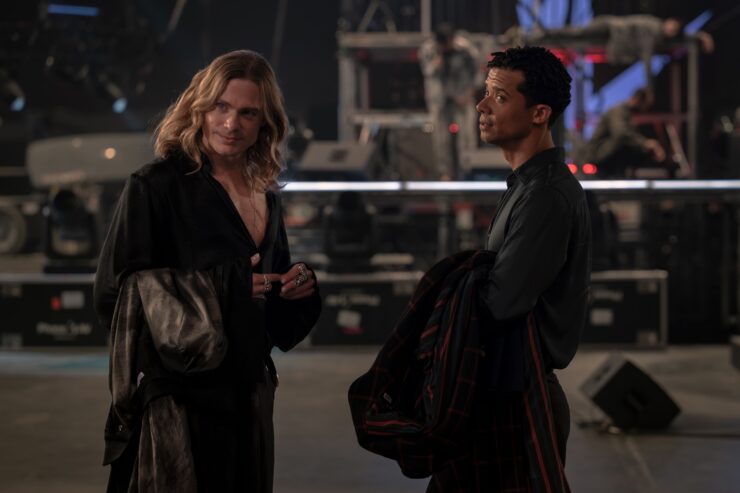
There’s Chekhov’s gun, sure, but how about Chekhov’s musing about how long Lestat could live after being beheaded? Earlier this season, Lestat listed the ways he could be killed, including beheading. Furious after the fake revelatory interview, Daniel Molloy said Lestat would have been a head mounted above a coven toilet if not for him, but Dr. Fareed wasn’t so sure about that. A vampire as old and powerful as Lestat, he thought, could survive some time without his head attached to his body. Maybe eight to ten hours? Ish?
In “Toronto,” this seemed like a tease reference to Louis’ imminent beheading of a member of the Fang Gang. But no: here we are at the heartstring-tugging penultimate episode of this season, and neither of our leads have kept their heads.
One certainly wonders if Fareed’s thoughts about Lestat apply to Louis as well. Given that he appeared in the future scene at the very start of the season, it seems clear that this isn’t the end. But how do we get to there from here?
“Montreal” is written by Ryan Kattner (aka Salamander) and Kevin Hanna (who also co-wrote last season’s “I Could Not Prevent It”), and it is unlike anything else this season. For one thing, there are no flashbacks. What happened in the past weighs heavily on the present, but now it’s time to stay here, in the moment, and deal with it.
After a couple of moments of voiceover at the beginning. we are largely present with Lestat as he goes through a fateful evening. It’s Halloween again, two years to the day since he barged in on Satan’s Night Out and changed the trajectory of all of their lives. This time Lestat has a houseguest, a costume, and a lot of things to do. No more handing out candy; the sign on the door will have to do in his stead. (The internet tells me it basically says “Take one each,” which no kid, faced with a bowl of unmonitored sugar, has ever done.)
He also has a 3.1 from Pitchfork and a single, “Cabbages,” that only hit number 68 on the Billboard charts. The world is fairly unimpressed by The Vampire Lestat’s new vampire-centric sound. (The title sequence song did not change to reflect this apparent change. One might notice the ice-cream scoop in said titles, though. And the room with the circle of salt.)
Voiceover Lestat, who reminds us that he is speaking to us from some time after all of this, lists the “nesting dolls” of his identity: The stutterer, the ape, the actor, the keeper, the tourist, the recluse, the rock star. In-person Lestat slowly meanders about his cozy yet elegant house, fondling a scarf on the piano bench and a pile of passports with ridiculous names. Fifty thousand vampires are descending on Montreal for the concert Gabriella and some unseen others have put together, and he is doing it all for her.
It’s almost funny that he thinks he can do this and yet ignore the Great Conversion of it all. Maybe he thinks it won’t happen. Maybe he just isn’t thinking. He’s sort of loose and happy, considering the end of the rock star portion of his existence. And also his houseguest.
Louis—sleeping over at Lestat’s, chastely, in his own fancy coffin—thinks it is all a bad idea. Dinner is a bad idea. The concert is a bad idea. The bad idea is a bad idea. It is not clear, for a while, what “the bad idea” itself is, but Lestat has been shopping, and has a voicemail from “Mary Rick,” who calls from airport customs to make sure all is ready for later.
Louis, it transpires, does not like witches. And Mary Rick is Merrick Mayfair, who Louis says is “the worst kind of witch”—by this I assume he means a Mayfair, but one way or another there is clearly some history here. Lestat says that Merrick and “the uncle,” Cortland, are different, and for one thing, he used to be in a book group with them. I am wishing now that I had watched Mayfair Witches, but at least that gives me something to do when this season is over and I’m waiting breathlessly for news about whether this show will continue.
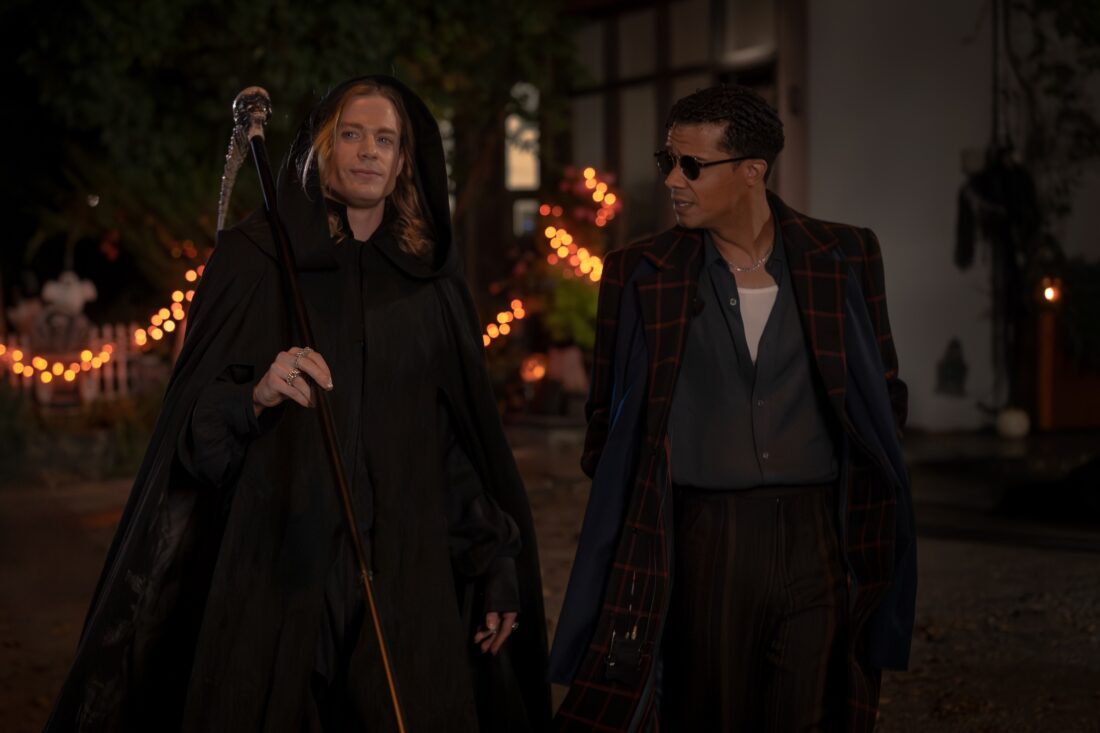
It being Halloween, Lestat is dressed as the grim reaper, and Louis has his sunglasses on, almost as if he is costumed as himself, like the little kids who showed up on Lestat’s doorstep two years ago. The two of them walk through Halloween eve—briefly accosted by a ghost who gives them a flyer and intones “Obey the five laws!”—surrounded by people in costume and a general, genial sort of chaos that feeds into the vibe of two bickering longtime partners, at ease with each other even in the casual ways they lie to one another. “We could talk about the proximity of your restaurant to my home,” Lestat says as they walk up to another one of Louis’ investments. Louis protests: “It’s a catastrophic coincidence.”
Mmm hmm.
Everyone in the restaurant recognizes Lestat and stands to applaud him as he strolls through, looking lightly smug. I’m a little bit hung up on his willingness to play along with the Great Conversion, even with Louis reminding him that all those vampires are going to straight-up murder all those little humans running around playing dress-up like monsters. Lestat is blasé as hell. It snagged me, that casualness.
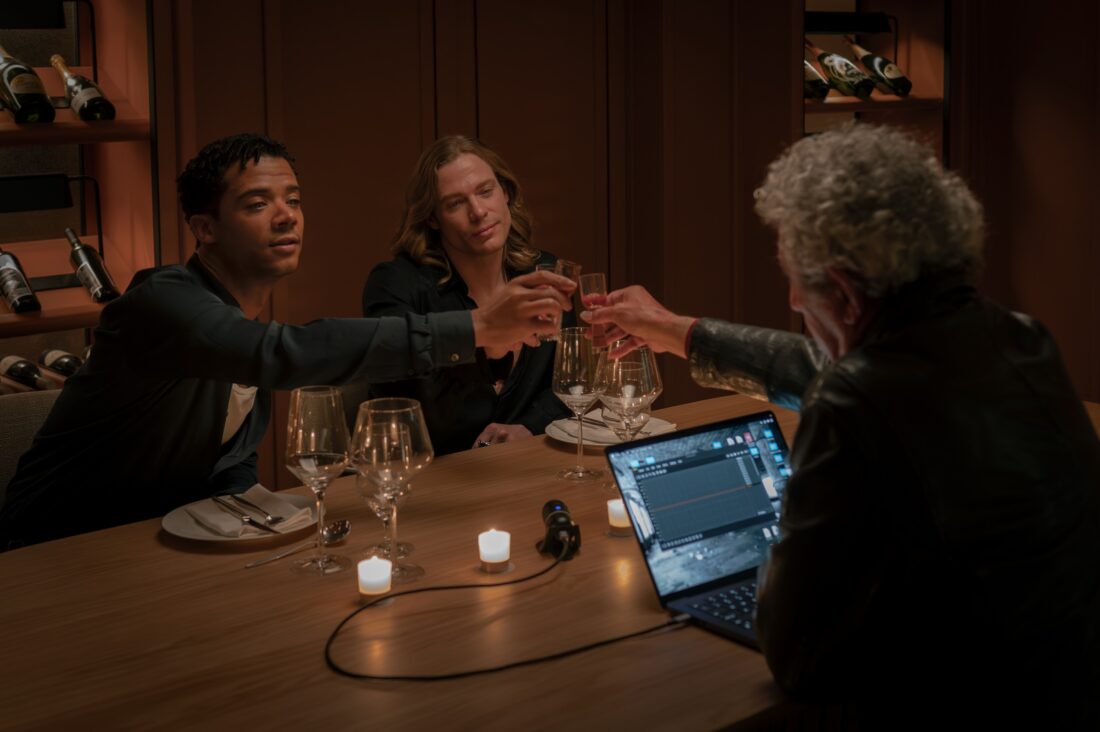
Dinner, it turns out, is a chance for Daniel Molloy to get some closure for his documentary. Dan is very orange. He quizzes Louis and Lestat about the hurricane in New Orleans that we saw at the end of season two, and about what they said to each other, and this is very funny because every single person watching this show probably has asked the same question. Loustat collectively demur. They don’t remember. They couldn’t hear each other anyway. It was a hurricane, Dan. They are fucking with him, like they always fuck with him, and he is not having it. But they’re too caught up in themselves to notice.
Daniel brings up the whole fog of vampiric love thing, with Louis saying he simply tried not to read Daniel’s thoughts, in Dubai, out of respect. If Armand was telling the truth, though, and he was running home to share his notes about Daniel with Louis, then Louis has never respected Daniel’s privacy. Lestat talks about dreaming of forests, with an odd line about transcribing birdsong at night. Daniel asks if he’s still “fanging” Sofia.
He’s trying so hard to needle Lestat, to bring the old combativeness back, to get a rise out of him. Perhaps there’s an element of performance to this. “Ready to eat your own?” Daniel asks as they sip the blood of a distant descendent of the Lioncourt line. The weird tension of this dinner reminded me of the last time we saw Daniel in a fancy restaurant, when he met up with Louis only to relinquish his seat to Raglan James and real Rashid. That was only a few episodes ago, and yet that was a very different Daniel.
In the car, Louis mentions that Daniel seemed off, and Lestat brushes it off with a little diva-behavior about the chip on Dan’s shoulder, and how he and Louis are better than Daniel, “and it’s exhausting to pretend otherwise.” More relevantly, Daniel was trying to read their minds, and Louis says he got in his. What did he find there?
Every scene with Louis and Lestat alone, this week, is gorgeous. The absurd, alluring, hilarious intensity with which Reid plays Lestat performing for the screaming vampire fans? The little proud-partner look on Jacob Anderson’s’ face as Louis watches and bops along, and appreciates, and finally thanks Lestat for his fancy guest-bed coffin? It’s catnip. These two playing off each other attain something that the show—much as I love all of it!—doesn’t have when they’re apart. They both play their roles with lived-in richness at all times and with all scene partners, but put them in close proximity, like the back of this car, and it’s like you can feel the decades Louis and Lestat spent together. And all the horrors they’ve done to one another.
The excellent script has them bicker in revealing ways, talking over each other, interrupting, hiding and admitting to things in turn. Lestat has questions; they both do so many attentive, emotive, interesting things with their faces. Guilt, Louis says, is one of the reasons maybe he saw Lestat’s spirit in Paris. Lestat denies that the same thing has ever happened to him, then says, “The songs might have shook loose a bone or two,” and Louis erupts in frustration about all the things Lestat never said about himself.
The nesting doll of identity, still nesting, still hiding the little parts inside.
But when Lestat tries to blame his behavior with Antoinette on the blood of Akasha, Louis isn’t having it: “It ain’t the blood. It’s what you do with the blood.” It’s about time someone told him that. Lestat makes a cartoonish shocked face, laughs, starts teasing Louis about Vampire Equinox, but the question lingers: Why is he like this? “Because, Louis,” Lestat says, “I’m a monster.”
This line could have been delivered so many ways; Reid says it with a complex mix of resignation, irreverence, inevitability, something that isn’t regret or bitterness, but comes close. The look out the window, afterwards, the way the scene ends here, it all combines to give the definite sense that a monster might be what he is, but it’s not what he wants to be.
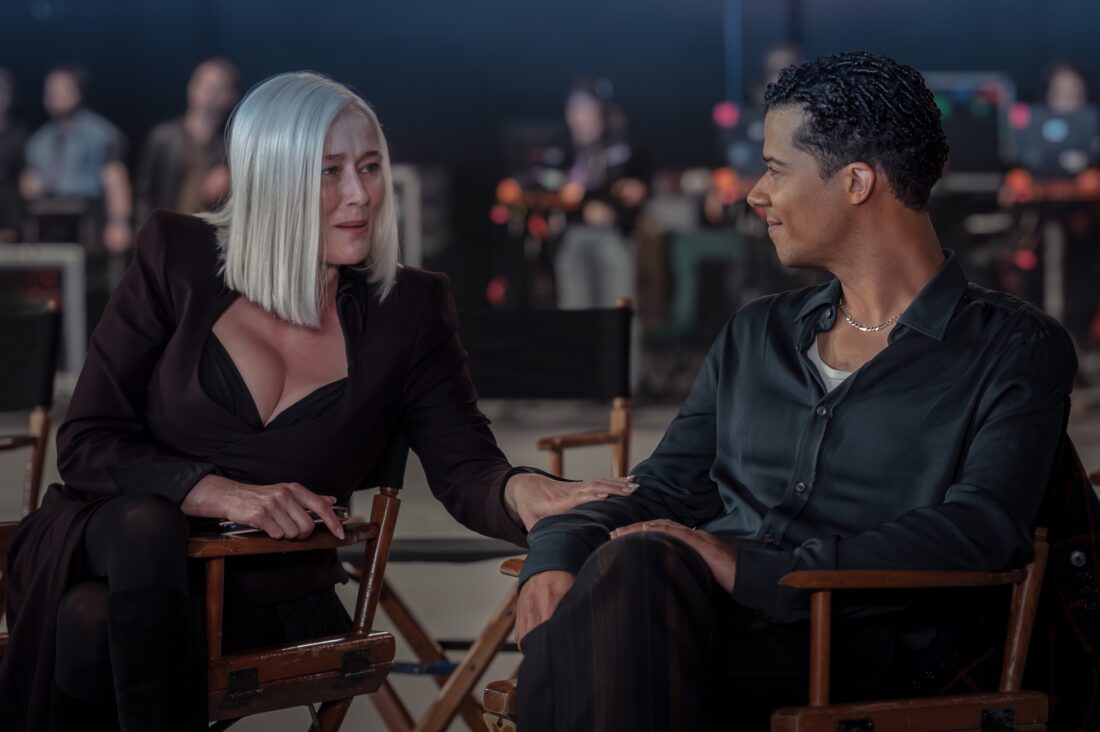
At rehearsal, he throws Louis to Gabriella without even an introduction, and those two circle each other, feinting, jabbing, testing the waters. Gabriella watches Louis more than he watches her—a nice performance of indifference—and eventually suggests that perhaps he shouldn’t come to tomorrow’s vampire hijinks, where vampires from everywhere, including Detroit, will be present. They have different ideas about what Lestat would want: “I think he’d be hurt if I didn’t show,” Louis says, but she counters, “I think he’d be more hurt if you were hurt. You should stand by me. I will protect you.”
Suuuuuure you will, Gabriella.
Lestat and the now-all-vampire band, including Sam on keyboards, play around with “Dancing With Myself” before offering up “Brutal Love” for the “brutal truth” of Louis’ opinion about it. I don’t love this song—it feels unfinished, and we didn’t need another slow jam right after “Stained Glass Eyes”—but I loved watching Gabriella realize that Lestat is singing directly to Louis, and watching Jacob Anderson simply sit there, letting a thousand complicated emotions play across his face. (The set decoration in this venues scene is perfection, all that empty space around the band, the lights, the pyrotechnics! It’s enough to make me want to go to that show, even if it would be the last one I ever went to.)

The little Gabriella and Lestat scene at the end of rehearsal is an odd one; she tells him to pack for Cadiz, which is apparently where they’re going after whatever the hell happens with his concert. They kiss, and Lestat is clearly not into it, and the proximity to Louis, waiting in the car, makes the false notes of this all the falser. Before Lestat can escape, Gabriella tells him Armand is in town, and Lestat says he knows. He can sense the gremlin. This will also be very relevant later.
But in the car, Louis waits with a bomb: Daniel has released a sex tape of Gabriella and Lestat. Lestat tries to play it off as a deepfake, but Louis plays the beginning, which involves both Daniel and Armand in the sunlight, Armand explaining who “Sofia” was when he met her hundreds of years before. “Are you hitting the same vagina you spent the first nine months of your mortal life in?” Louis asks, and Lestat protests. I must give Lestat a bit of credit here for having a better grasp of reproductive anatomy than a lot of human men. But he’s deflecting, and deflecting, and then the panic gets so great that he vomits blood on Louis’ expensive shoes and the two of them have an epic sidewalk meltdown/conversation that is ugly and painful and possibly the most honest these two immortal dingbats have ever been with one another.
The writing in every one of these episodes is fantastic; the writing in this one is intensely dense and rich and emotionally devastating, as Lestat twists his panic into fury at Louis’ judgment and sobs about how he was in the midst of his own “fracturing” while trying to help Louis deal with his terrible guilt. They have horrified one another with their choices, but the show isn’t interested in ranking their mistakes, in trying to make one wounded, traumatized vampire more sympathetic or terrible than another. Every horror marks them. Lestat absolutely unraveling when Louis finds out about his deepest shame, his longest trauma, is a heartbreaking scene played nakedly. And it’s not even the emotional climax of this wild episode.
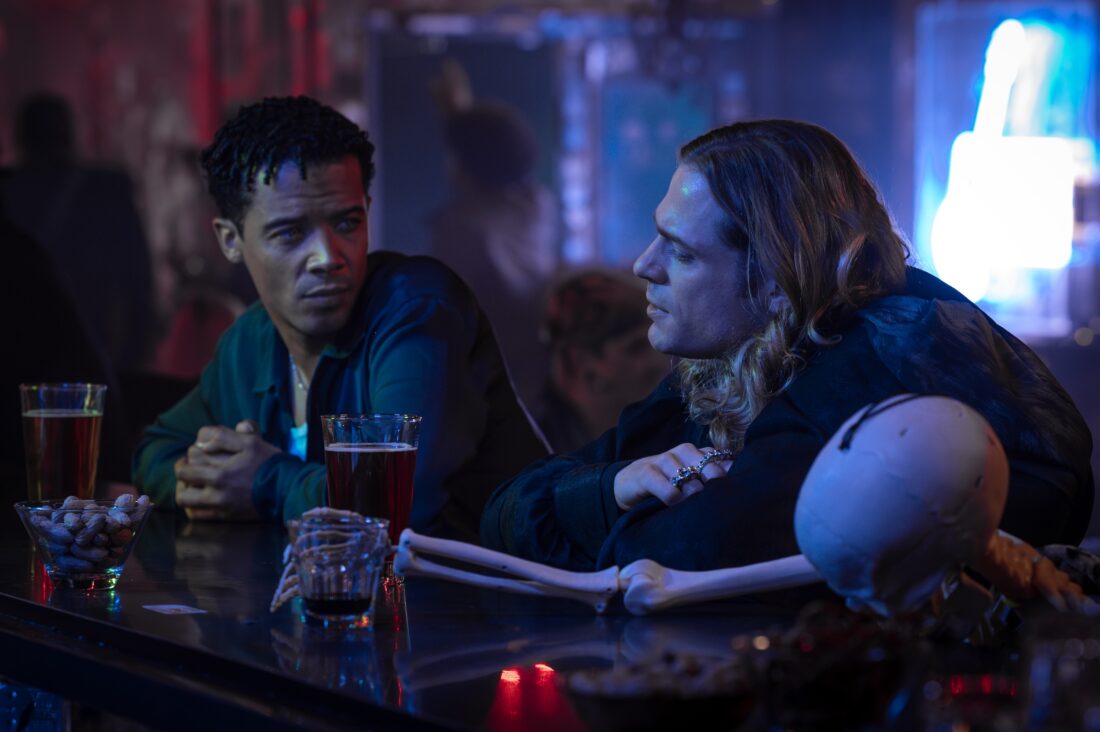
I love that these two pull it together in a dive bar, drinking blood-spiked beer. This scene has the same sort of exhausted feeling that comes after a visceral ugly cry. The fury spent, they can try to understand each other, to “reset,” as Louis says. But Lestat can’t deny it when Louis asks if “it” ever happened before Gabriella was a vampire, and he can’t help but hit back, and you can see the patterns these two have fallen into, the old ruts. You can also see them try to pull themselves back out of those ruts. This whole episode is them trying to find their way back to one another, to try to find common ground in a space full of chainsaws and sinkholes. It’s all over-the-top and melodramatic; it’s all raw and real. It’s exactly why I love this show: the emotional honesty wrapped around vampire misbehavior, the moments of vulnerability (Louis talking about the cousin who sexually assaulted him) right up against the moments of frantic defensiveness and blame.
This, somehow, is when they talk about Daniel in the sunlight. Lestat’s wish to know if the video is everywhere is part and parcel of his fear of loneliness, his need to be good and loved: Will it make him a pariah? Will he be shunned? Louis reminds him that the internet’s memory is short and fickle. And Louis owns up to his own failures: “I am my own zip code of mess right now and I’m not proud of how I just was. I’m sorry.”
Now that, my vampire dudes, is progress.
Time to bring up some whole other trauma.
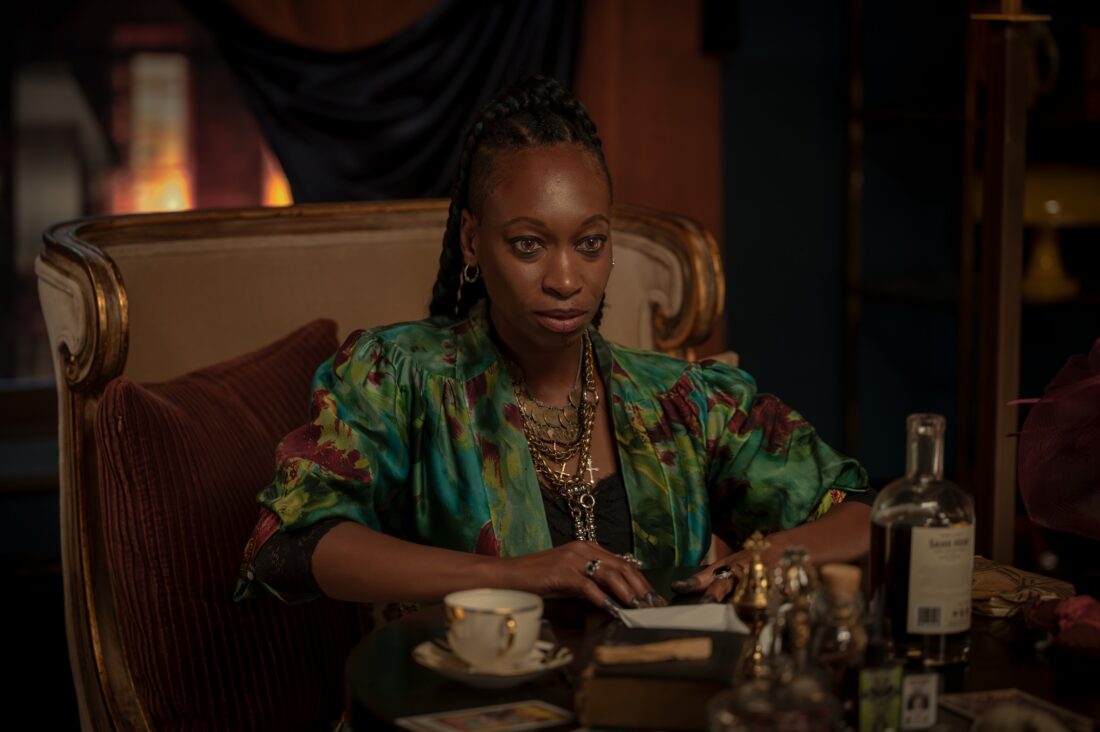
Merrick Mayfair has arrived in Lestat’s beautiful apartment in order to do a seance and call up Claudia’s spirit. Sarah Afful is excellently intimidating as Merrick, swanning about in Lestat’s place (temporarily “Papa Legba’s make-do room of diablerie”), poking at Louis with her knowledge of the du Lac boys. She calls Claudia a burned girl called up by her killers, and while Louis gets defensive, Lestat understands. It’s a great moment of him reading people, watching cues, seeing what is and isn’t said—what is being inferred. Of course a trauma-made vampire who fears being alone would want to be able to see what people aren’t saying.
Claudia doesn’t mince words, though. She manifests in Merrick’s body and slams her head on the table so hard she breaks teeth; she stalks through her summoning circle vibrating with fury. Delainey Hayles nails this scene, just exponentially increasing the fury Claudia had in life into an undead rage that she aims, pointedly, at Louis: “You weren’t even my favorite. I liked him better. He knew who he was.”
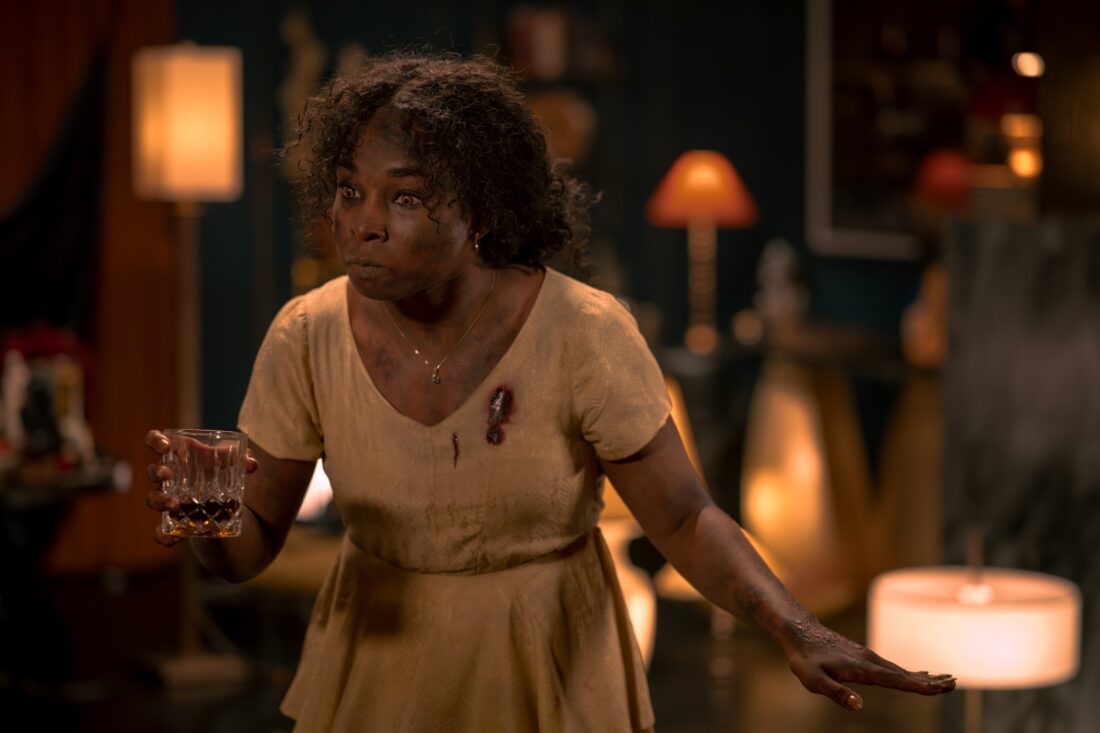
But she starts her rant looking at Lestat while saying Louis’ name. It’s odd. That oddness carries through. Hayles is a force of nature, and the rawness she brings here makes every one of Claudia’s barbs just that much sharper. Louis says the worst possible thing—that she ought to be thanking him for taking out Bruce—and she flattens him with scorn. That was always about Louis. It was all about Louis: that he wanted to say goodbye; that he wanted to avenge her. And now he wants credit for that. Anderson is so good, so sympathetic and convincing, that when he destroyed Bruce, I rooted for him; Hayles is so good, so much fury and fire, that when she tears Louis a new one, I root for her.
You can do that, in a show like this: slide your loyalty around, share it with everyone, hate a character one week and love them the next. Louis was wrong, but I understood why he did what he did. He felt a need to do something about his guilt. And it does nothing for Claudia, who has nothing, nothing to lose, nothing to treasure, not even Madeleine. Her wretched screaming for the one good thing in her life brought me near tears, and it makes me feel like a little bit of a monster for what I want to say next:
I just think that when you summon the ghostly spirit of a dead vampire you ought to take what they say with a grain of salt, you know?
There’s the way that she looks at the wrong man; there’s also the way that she talks about Lestat, which sounds more like Louis’ version of Lestat than the Lestat we’re seeing now. Nothing that spirit Claudia says is exactly wrong, and her rage fits Claudia’s rage (there’s that bit Daniel says in the “previously on,” about how Louis chose Lestat over her over and over again, and “cursed her into the darkness,” phew). I know these two very bad dads are dealing with a lot, and perhaps not in a frame of mind to question what they heard—and what they probably think they deserve. But I have questions.
That scene, though. What a doozy. And what a beautiful way to distill one of this show’s most powerfully carried constant themes: That loving someone is not the same as doing right by them. Parents harm children, children dismiss parents; lovers lie to one another, hide things, misstep; one person’s version of events felt entirely different to another. You can love someone and hurt them so badly. And because we’re in vampire territory—immortal territory; superpowers territory; abilities beyond those of us normal folks, including abilities to hurt—the harm is epic, the scale grandiose.
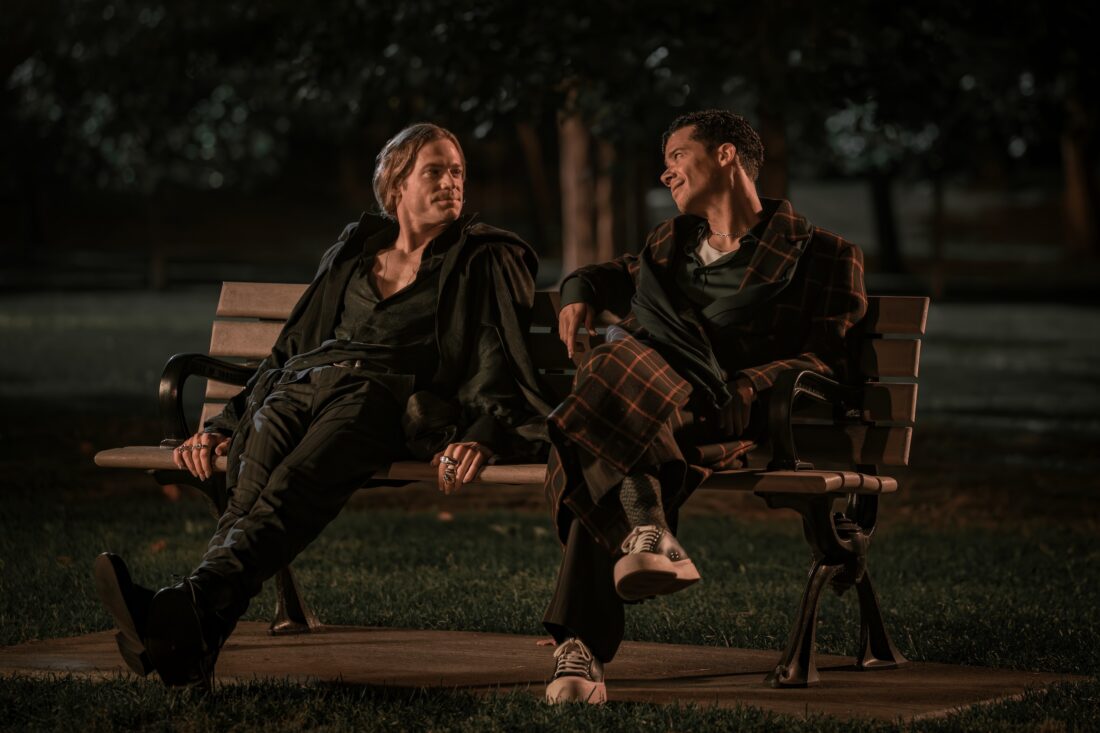
And somehow, it is still Halloween. Louis and Lestat go for a walk to process, which is one of the most relatable, human-scale things ever to happen on this show. There are ghouls and gremlins at large in the park (the park Lestat mentioned while on the phone to Louis, all those episodes ago). Louis, again, is not proud of what he said. He’s all defensiveness and lashing out, and he knows it now: “Got some work to do on myself.”
Their brief, pointed, poignant exchange about how that was not something one did in their eras—either of their eras—is succinct and wise about how people are in some ways a product of where and when they come from. You cannot expect a man born in the 1700s to have the best grasp on self-improvement, you know? Let alone a man with Lestat’s upbringing. He and Louis have faced their demon—who was also their daughter—and have been shaken into acceptance: “I guess we just carry that.”
Rattled, laid bare, they find honesty, and Lestat asks the question that gives his later narration its name: “Where I am a mystery to myself is why I wanted it now, the night before I go onstage the hour before the witch arrives. Why do I actively, manically pursue failure?”
Louis, having already told Lestat off for his worst actions, having faced his own, has a new level of understanding: “Maybe it’s just the vampire’s burden. What do you replace death with? What’s to live for if there’s no end? Maybe it’s just how you keep your nights straight.”
They are philosophical, they are revealing—the songs are about Louis; the restaurant’s location is no accident—they are pinkies-touching-on-the-knees close (sorry, Lem?) and they are fantasizing about desert trailers and night-blooming flowers and birds when Louis notices “thrift-store Dracula,” which is a very funny way to describe Alex on multiple levels.
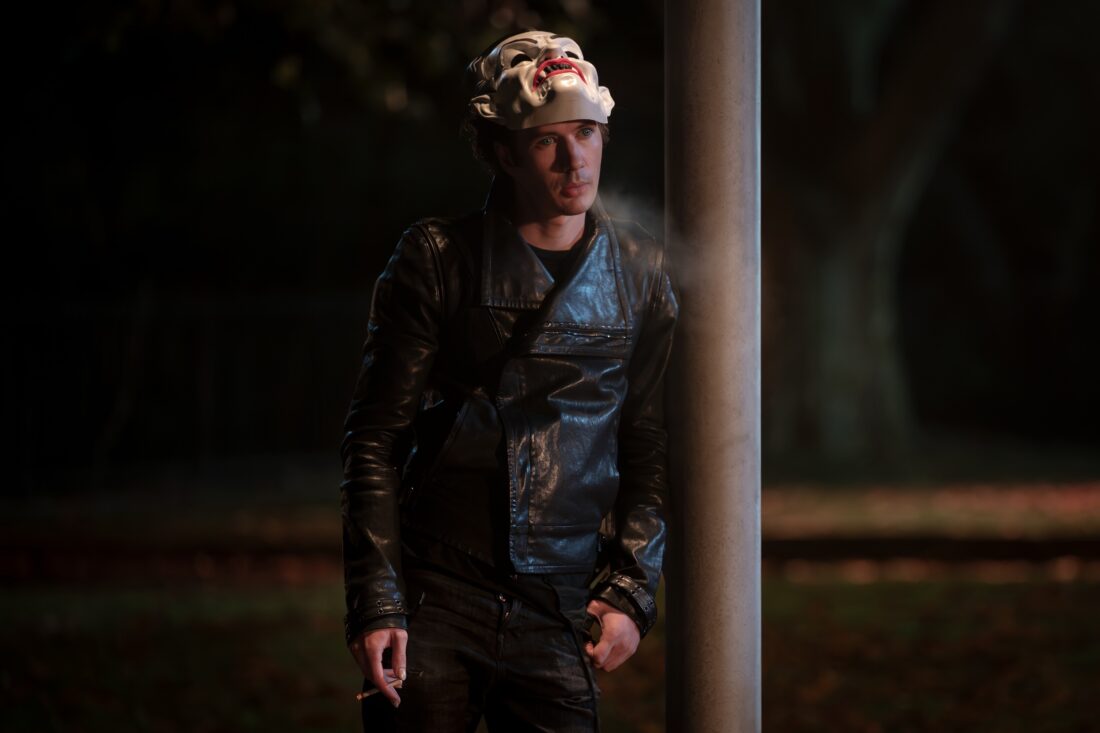
And then it all comes crashing down. Their heads, I mean. That final shot, of their shoes, unmoving, while blood seeps off the bench—I had my hands over my face and was silently shrieking. Armand and Daniel take their own masks off and turn away, and that’s all she wrote, except that it so clearly isn’t. The trailer for next week is all timers and shots of bodies whose faces we can’t see, and bowling bags (I laughed) and ominousness. And what is surely Lestat’s billowing cloak.
This scene is genuinely shocking, not least because of the cold expressions on the murderers’ faces. But we know some things. We know Louis is present at the auction in the future. We know Lestat records those spoken-word albums. And we know—thank you again, Doctor Fareed—that vampires can survive beheading. The scene is shot to suggest that Daniel and Armand just walk away afterward, but I don’t think they do. In “Toronto,” Fareed tells Daniel, specifically, that Lestat would survive this very thing. If Daniel really wanted to kill him, he’d have chosen something else.
And Lestat says, earlier in the episode, that he can sense Armand in the city. So would he not sense the gremlin creeping up behind him? I don’t think it’s beyond Lestat to plan his own (temporary, carefully timed) death. He has been acting a bit like a man tying up loose ends. He can’t get away from Gabriella. He has done what she wanted; he says he’s gifted the Great Conversion their anthem. And he’s just so chill about it all. What if he’s in on this? What if it’s so that he can’t perform? (Surely even a vampire wouldn’t be great at singing less than 24 hours after having his head removed and reattached?) On the other hand: Would he have wanted this for Louis? Or is he collateral damage?
I’m still working on this theory. It is hard to theorize much about Daniel and Armand when we’ve seen so much of them, and no matter how you slice it, I don’t think Armand killing Larry was part of Lestat’s game plan. (On the other hand, there is that “Please, turn Larry down” at the end of the title sequence this time around.) No one seems to have many feelings about Larry’s absence other than Alex, and Alex was already in Armand’s pocket.
There are other options: The murder is real and Gabriella saves them; the other unexpected attendee at the concert at the end of the novel shows up; Daniel and Armand aren’t actually walking away from the corpses, but going to fetch those shiny bowling bags and a truck so they can take them somewhere for re-attachment, or refrigeration, or some nefarious plan I haven’t even begun to imagine.
It’s so much. It’s so dense. The finale ought to be three hours long. And we are only halfway through The Failures.
LITTLE SIPS
- The seance to summon Claudia also happens in the books—but much, much later, in the book called Merrick.
- Just imagining Louis watching Degrassi.
- FRAUDIA.
- Lestat in New Orleans, Lestat in Montreal, Lestat going where there are echoes of France.
- “Justice for Antoinette.”
- The Halloween costumes worn by mortals on the street now include Lestat’s blood-script fancy top.
- The way Lestat gives Louis credit for pointing out Gabriella’s portrait in New Orleans in the middle of the “fracas” is a hilarious version of one viewer of this show complimenting another for noticing one of the many rich details hiding out in the perfect sets.
- Alex is Gabriella’s fledgling, but what about Salamander and TC? I would guess Sam to Salamander, and Lestat to TC, based on Magnus mentioning a drummer at the table. But interesting that this is only clarified for Alex, who joins the mommy issues party.
- I keep thinking about unreliable narrators and unreliable characterizations, and wondering what, exactly, is going on with Gabriella that we aren’t seeing because Lestat can’t see it.

What an episode. I’ll have to rewatch everything before next week.