





In this bi-weekly series reviewing classic science fiction and fantasy books, Alan Brown looks at the front lines and frontiers of the field; books about soldiers and spacers, scientists and engineers, explorers and adventurers. Stories full of what Shakespeare used to refer to as “alarums and excursions”: battles, chases, clashes, and the stuff of excitement.
We live in a world of “re-”: reboots, remakes, and reworkings of all manners of myth and entertainment. Sometimes overtly and sometimes more subtly, old favorites are made new again—and often, they are all the worse for the wear, and the new version cannot stand up to the original. But such is not the case of the recent novel Avengers of the Moon, by Allen Steele, an adventure featuring the pulp hero Captain Future, which I will be comparing to the original novel which started the series, Captain Future and the Space Emperor by Edmond Hamilton. In this case, I’m pleased to report that the new book is a success—one in which we see the exuberant energy of the pulps channeled into a new and more scientifically plausible setting.
People love new things, but they also love the familiar. Consider the television police procedural or situation comedy, where the cast and basic shape of the plot is the same from week after week, with only the details changing. Like a favorite pair of shoes or a comfortable couch, we enjoy returning to those predictable entertainments. The pulp magazines of the mid-20th century were no different. One of the big successes was Doc Savage (I reviewed one of his adventures here). In each installment, Doc and his highly individualistic band of adventurers would be presented with a mystery involving a murder, a kidnapping, a scientific oddity, or a far-away land, and charge off to save the day. It was a highly successful formula, which made the magazine a best-seller throughout the 1930s and into the ‘40s.
There are strong parallels that suggest that the Captain Future stories were a deliberate effort to bring this same formula to a science fiction setting. Doc Savage was an orphan trained from birth to serve humanity, and so was Captain Future. Doc had a team of five distinctive companions: a lawyer, a chemist, an electrical engineer, a civil engineer, and an archaeologist. Captain Future had a more science fictional version of this team that included a giant industrial robot, a rubbery android master of disguises, and the disembodied brain of a scientific genius. Doc had a sleek trimotor aircraft that could take him anywhere in the world, while Captain Future had the Comet, a ship that could travel anywhere in the solar system. And both of them regularly cooperated with law enforcement officials: Doc with the New York City Police Department, and Captain Future with the Planetary Police. Each hero is launched into action by a mystery that must be solved before the reader finishes the magazine. And of course, the Doc Savage novels were primarily written by Lester Dent, whose pen name was Kenneth Robeson; in the first Captain Future adventure, there is a character named Kenneth Lester—an amalgamation of the two names.
About the Authors
Edmond Hamilton (1904-1977) was among the first and most prolific authors of science fiction in the early 20th Century, beginning his career before the term “science fiction” was in common use. First published in Weird Tales, he soon branched out to the many pulp fiction magazines appearing in the 1920s and 1930s. As with many magazine authors in the period, he wrote in other genres as well. Along with E. E. (Doc) Smith, Hamilton was a pioneer of the space opera sub-genre, writing sprawling and often lurid adventure stories in which the fate of whole planets hung in the balance. In the 1940s, he created one of his best-known characters, Captain Future. As the science fiction field matured, his brand of adventure tales fell out of fashion. Later in his career, he wrote comic books for DC, including adventures featuring Superman, Batman, and other characters. In recent years, he may be better known by some as the husband of author Leigh Brackett rather than for his own work. As with many authors who were writing in the early 20th Century, a number of works by Hamilton can be found on Project Gutenberg.
Allen Steele (born 1958) is an American journalist who turned to a quite successful career as a science fiction author. He first appeared in Asimov’s Science Fiction Magazine in the late 1980s, with his work appearing frequently in that magazine in subsequent years. His first tales, which became known as the “Near Space” stories, were notable for their grittiness and realistic feel, while at the same time being infused with optimism about mankind’s prospects in space. Steele expanded his tales to other stars with the Coyote series of stories and novels, which followed colonists who fled to another world to escape tyranny at home. He has also written a number of stories set in alternate histories, many in which the space program is more advanced than our own. Steele has won the Hugo Award three times: for the novella “The Death of Captain Future,” for the novella “…Where Angels Fear to Tread,” and for the novelette “The Emperor of Mars.” The first of these stories is a sardonic look at an eccentric tramp space freighter captain, a fan of the Captain Future pulp novels, who became a hero. As in the movie The Man Who Shot Liberty Valance, however, the truth of the matter is far less noble than the legend. Steele had been a fan of the Captain Future series since encountering it in his youth, and in 2017, he produced a novel, Avengers of the Moon, which put the pulp character into a new, more realistic, setting. Moreover, we recently learned that Steele is not yet done with Captain Future, as the first two issues of the recently relaunched Amazing Stories magazine included a new two-part novella entitled “Captain Future in Love.”
Captain Future and the Space Emperor
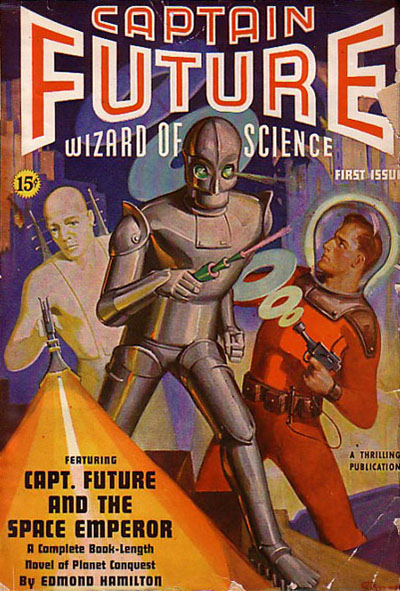
Edmund Hamilton wastes no time leaping right into the action. The President of the Earth Government, James Carthew, is confronted by a man devolving before his eyes into a savage beast, the victim of a strange plague of atavism that had been centered on Jupiter, but could now spread its horrors throughout the solar system. The plague is being spread by an evil villain known only as the Space Emperor. Carthew orders his staff to launch the polar signal flares that will summon Curt Newton, more widely known as Captain Future (a rather strange but colorful means of communication, but fitting for a hero with a strange but colorful name). Before Captain Future can launch himself into action, however, Hamilton pauses us to give us a recap of his history, a recap that will no doubt be repeated in future adventures. The time is fifty or so years in the future, in a solar system where mankind has found intelligent races on most planets and many moons, along with all sorts of marvels and wonders. We find out about Curt’s companions—Grag the giant robot, Otho the android, and Simon Wright, condemned to live as a disembodied brain—a group known as the Futuremen. We also learn that the evil gangster Victor Corvo and his minions murdered Curt’s parents, leaving him to be raised on the moon by these three very odd guardians.
Their ship, Comet, is attacked by a mysterious craft on its way to Jupiter, but they are able to cripple the attacker, then follow it when it crashes on the moon Callisto. The attackers are pursued by the creeping crystals of Callisto (how’s that for alliteration?), and in return for help, they tell Captain Future that they were sent by the Space Emperor, who can be found in Jovopolis.
Buy the Book
A Memory Called Empire
Hamilton pauses here to explain how scientists were wrong about the composition of Jupiter’s atmosphere, and that the planet is actually quite habitable to anyone who wears the gravity equalizers needed to compensate for the planet’s massive size. And as a reader, I was willing to go along with it, since a Jupiter covered with jungles (and a Great Red Spot that is actually a giant sea of fire) is a lot more fun as a setting than an uninhabitable toxic soup of chemicals. Almost as soon as they land, the team encounters the black-clad Space Emperor, only to find that he has the power to make himself immaterial and escape their attempts to capture him.
Next, Curt and the team meet a collection of local officials and industrialists—one of whom no doubt will turn out to be the infamous Space Emperor in disguise—and tour a local hospital full of men reverted to savagery by the atavism plague. A nurse there, Joan Randall, turns out to be an undercover Planet Police agent sent to evaluate the situation, and the local marshal, Ezra Gurney, also turns out to be of value to the Futuremen. Otho disguises himself as a Jovian, infiltrates their ranks, and heads off to their city of Jungletown. The Jovians are a primitive people whose ancestors, called the Ancients, once built great cities of advanced technology. The Jovians are not all happy that humans have come to their world to establish colonies and exploit their resources, and some are eager to cooperate with the Space Emperor.
I don’t want to spoil things, so I will end the detailed recap here. Suffice it to say, before the story reaches its end there will be captivity, native uprisings, narrow escapes, mysterious ruined cities, and all sorts of derring-do. And at the end, Captain Future will prevail and head off to face the next threat to humanity.
Reading this story, you can sense that Hamilton was enjoying himself as he wrote, developing all sorts of exotic flora and fauna to threaten the heroes, and imagining colorful settings for their adventures. I also enjoyed the fact that Joan had more agency and independence than some of the other female characters in the old pulps. The team barrels along from challenge to challenge with nary a pause to catch their breath, while scientific accuracy and plausibility are left by the wayside in the interest of adventure and excitement. Those who are willing to work extra hard to suspend their disbelief will find a lot of fun in Captain Future and the Space Emperor.
Avengers of the Moon
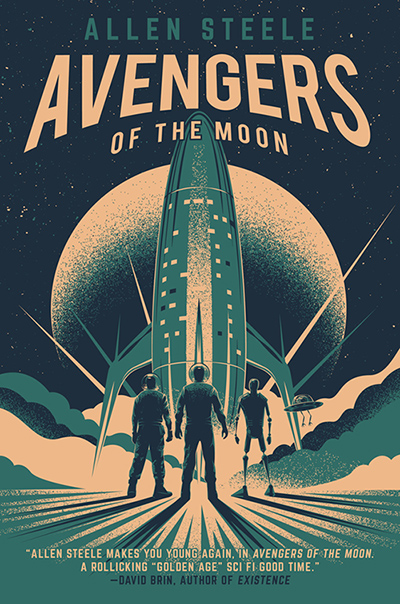
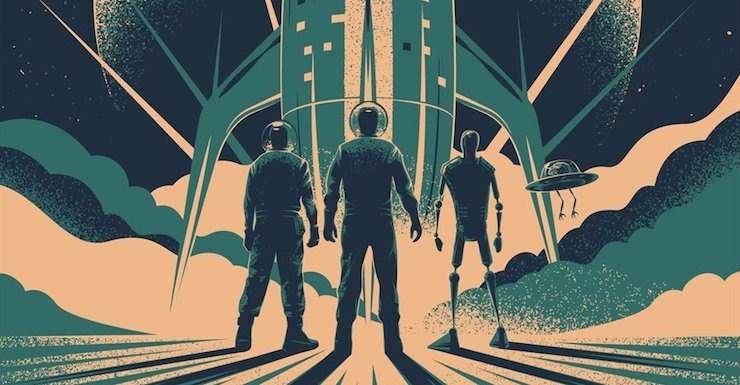
Allen Steele’s novel starts with the dedication of a facility on the moon that’s designed to protect relics from an apparent visit by aliens from another star (a mystery that will not be fully unraveled in this book). Curt Newton’s guardians have allowed him a rare trip out in public, accompanied only by the human-looking android Otho. Two Interplanetary Police Force officers assigned to event security, Joan Randall and Ezra Gurney, are suspicious of Curt and Otho. A politician named Victor Corvo is speaking at the event, and Curt is finally told that Corvo is the man who killed his parents, and learns the true story of his parents’ death. The twist of Corvo surviving the attack gives the narrative a lot more energy, as Curt immediately plans revenge. Steele also creates a more plausible backstory for the team, and explains that Corvo funded the Newtons’ research until they rebelled against his immoral plans for their application, causing them to flee to the moon. Simon Wright is given a small drone body with manipulator arms, so he is much less helpless in this version of the team.
The story unfolds in the solar system which is currently known to us, which requires some modifications to the original setting of the Captain Future adventures. Curt lives not a half century into the future, but four and a half centuries. During this time, humanity has partially terraformed Mars, established numerous outposts around the solar system, and also developed several new races through genetic engineering, tailored to the conditions of a variety of worlds and moons. This allows the characters to visit a wide variety of locations and cultures while avoiding the colonialism that infused the original tales.
Curt decides to assassinate Corvo and, with Grag, infiltrates his lunar compound. But instead of carrying out his plan, Curt stumbles across a plot by Corvo to assassinate the visiting President Carthew, using criminals who are loyal to Ul Quorn, a gangster also known as the Magician of Mars. Curt reveals this to Carthew, and to Joan and Ezra, who are on the security detail. Carthew deputizes Curt to go to Mars and investigate, with Joan assigned as his governmental liaison. Steele does a nice job portraying the attraction between Joan and Curt, which is humorously complicated by the awkwardness that comes from his odd upbringing. They will use the Comet for their trip, but because the small ship cannot reach Mars on her own, they will dock with a “beamship,” a carrier vessel that uses orbital laser beams and solar sails to propel it to Mars. Unbeknownst to them, Corvo has overheard their plans and will attempt to sabotage their voyage—and if that fails, will attempt to foil their efforts on Mars.
Steele does a good job evoking a partially transformed Mars and the culture of the humans engineered to live in its harsh conditions, taking as much pleasure in this effort as Hamilton did in describing his more fanciful environments in the original series. The team, while just as odd as in the original series, feels more realistic and more fleshed out in the new version. And while the new series is better rooted in current science and reasonably extrapolated technology, its overall plot and pacing harken back to the old pulp days, with the adventurers facing one challenge after another. The result is a brisk and enjoyable read that left me wanting further adventures of the new Captain Future and his Futuremen—in fact, the only time the narrative felt strained was when Steele bends over backwards to explain how the new team uses the same lurid and improbable name as the old one.
Final Thoughts
Reading these two books back to back was an interesting experience for me. I had read some Hamilton stories in my youth, but had missed Captain Future—which is a shame, because anyone who enjoyed Doc Savage tales as much as I did would enjoy the Captain Future books. What drew me to these two books was my appreciation and enjoyment of Steele’s work, curiosity about how he would handle the challenge of updating the pulp adventure format, and a desire to see how it would compare with the original. Now, I am encouraged to seek out the rest of Hamilton’s original Captain Future tales, and am look forwarding to seeing more of Steele’s version in the future. And, as James Nicoll argues in a recent Tor.com column, there seems to be a resurgence of interplanetary adventures lately, so perhaps their time has come again.
And now it’s time for you to take the floor: Have you read any of the adventures of Captain Future? Or any other works by Hamilton? What are your thoughts on planetary adventure stories? Are you as willing as I am to ignore the clichés and stiffness of the pulp genre as long as the stories are fun and full of adventure?
Alan Brown has been a science fiction fan for over five decades, especially fiction that deals with science, military matters, exploration and adventure.


According to what I’ve read, it was the Captain Future stories that codified the distinction in SF usage between “robot” to mean an obviously mechanical automaton and “android” to mean an automaton that appeared human. Before then, the terms were more interchangeable and could even apply to synthetic biological humans like the robota in Kapec’s R.U.R. (which were more like Blade Runner replicants than robots as we understand the term today).
I like the idea of updating the old pulps with a more realistic approach. There were times in the past when I mused about possibly developing something along those lines myself, perhaps with humanity colonizing the Solar System and then having some cataclysm that regressed it to a pre-industrial state, so that by the time Earth and the colonies eventually regained spaceflight, they’d diverged into distinct humanoid cultures.
However, the idea of reintroducing Captain Future by giving him a mission of revenge and assassination troubles me. I preferred the days when fictional heroes were genuinely heroic and stood for noble principles. The kind of “modernization” where every protagonist has to be a morally gray killer is not what I consider progress. Even if this is a story where the hero goes on a journey and chooses at the end to take a nobler path, that’s still more cynical than the days when characters would just choose by default to use their gifts to help people.
Hi
As a Hamilton fan I have read a number of his Captain Future’s adventures and enjoyed the exuberant flat out pulpiness. Our solar system was such an exciting place in those days with its mixture of the elements of planetary romance and more (somewhat) straight forward science fiction. The solar system was thick with not just life, but Jovians, Martians, Venusians and every other kind of ians you can think of. I have been eyeing Steele’s book for some time and I know I have a copy of Captain Future and the Space Emperor here so I think I will be getting Avengers of the Moon and then sitting down to read both books. I really enjoy your columns and they certainly encourage me to seek out new/old books and read, reread or at least generally ponder all the things that brought me to science fiction in the first place.
Thanks and happy reading
Guy
What I’d give for a modern take on “The Star Kings” cycle which I loved as a child is hard for me to underestimate. Typical grandiose stories of that era but I liked them far more than, say, Doc Smith’s stories. They had far more interesting moments, to me, than the boy scouts of the Lensmen who would make Superman look corrupt. The lack of scientific plausibility bothered me less in the days when Star Wars was new.
Much of Leigh Brackett’s work deserves this treatment too.
I’ll check this out but I never cared for Captain Future as much; still if it keeps their memory alive? That alone would be a great thing.
I don’t know, I think Star Kings would lose a lot without the retro flavor.
Hamilton’s work in the pulps actually tended to be thoughtful and a lot closer to post-War SF. It was his work on Captain Future that hampered him and caused a lot of fans to be rather dismissive of his work. He finally managed to get out from under the cloud in the early 60s. He didn’t quite fit in with the New Wave, but he may have been closer to it than a lot of the old hands.
I read most (if not all) of the Captain Future novels brought out in paperback in the ’60s; most were attributed to “Brett Sterling,” which I believe to be one of Edmond Hamilton’s pen names; one other that I know of was written by Manly Wade Wellman. (A history of SF by James Gunn, I think, claims that only two of the CF serials were authored by anybody but Hamilton.)
They should all be out of copyright now, which suggests that some enterprising person could scan them and have Gutenberg make them freely available; there is also a set of three hardcover volumes ($40 each) that claims to have the whole set.
I haven’t read Captain Future: for long-running pulp space adventure I was more attracted to E. C. Tubb’s Dumarest series. I do have other stories of Star Kings and Starwolves in my collection. @5 is of course right to point out that Hamilton had a more mature side: I recall he wrote “What’s It Like Out There?” before the war but couldn’t sell it while later on Leigh Brackett’s influence also helped him to improve.
In 1978 Toei Animation produced a gorgeous and mostly-faithful adaptation of the Captain Future stories, beginning with the Space Emperor storyline and chock full of nods to other SF media – I have a screencap of a space town with, I kid you not, the floating head from Zardoz.
I watched the Latin American dub as a kid and it’s one of the cornerstones of my love for SF to this day… and, apparently, my taste in men.
Sadly, it’s almost impossible to find online with a decent audio track. I believe the soundtracks (original Japanese, German, and US/Latin American versions) can be found for sale online.
@1 That is interesting info on the android/robot distinction; I hadn’t heard that before. Regarding the involvement of a revenge plotline, the original tended to overlook the trauma involved in the murder of Curt’s parents, while the new version of the origin story leaned into it. I saw it as a chance to show Curt growing and becoming more mature; and finding a positive way to channel his emotions. I do understand why you would think even a failed attempt at revenge is a little too dark for the story.
@5 and @7 Like a lot of people who wrote for the pulps, Hamilton churned out a lot of work. Some of it reads like it was a way of paying the bills. But by all accounts, he also could write some excellent work when he put his mind to it.
@8 I had seen mention of the Captain Future animated series while researching this column; it would be interesting to see it at some point.
I’ve read both Avengers of the Moon and a selection of the original Captain Future stories.
I bought Avengers of the Moon expecting a deconstruction or re-imagining, but really it’s a very respectful freshening, removing some of the dated social conventions and racial stereotypes of the originals. Joan Randall is now the most interesting character in the book; I wish she had more “screen time”. This is quite a contrast to the original stories.
One thing I don’t like is that Steele didn’t push technology far enough. There isn’t nearly enough of the strange and wonderful in the book. It does work well as an adventure yarn though.
I know Captain Future only as the anime series on German TV when I was a child (although I didn’t know the term anime then).