







Welcome back to the Lovecraft reread, in which two modern Mythos writers get girl cooties all over old Howard’s sandbox, from those who inspired him to those who were inspired in turn.
Today we’re looking at August Derleth’s “The Shuttered Room,” first published in The Shuttered Room and Other Pieces (edited by August Derleth). Spoilers ahead.
“At dusk, the wild, lonely country guarding the approaches to the village of Dunwich in north central Massachusetts seems more desolate and forbidding than it ever does by day. Twilight lends the barren fields and domed hills a strangeness that sets them apart from the country around that area; it brings to everything a kind of sentient, watchful animosity—”
Summary
Abner Whateley, educated in the best schools of Europe, returns to the Dunwich homestead of his grandfather Luther Whateley. When visiting as a child, he sometimes felt the area’s forbidding atmosphere so keenly that he begged his mother to take him away. Now he comes back only to settle Luther’s estate. In the crumbling house he finds a missive from his grandfather. Abner, he writes, is the only Whateley who’s gone forth into the world and will succumb neither to “the superstition of ignorance nor the superstition of science.” He must destroy the ancient mill on the Miskatonic, attached to the house. If he finds anything alive inside, he must kill that creature—however small, however humaniform.
Weird, Abner thinks, but then so was Luther. The old man locked his daughter Sarah in a room over the mill and tended to her himself, carrying up trays of mostly raw meat. No one else saw her, from the time she came home “mazed” from a visit to Innsmouth kin, until the time of her death.
Forbidden as a boy to approach his aunt’s room, Abner goes to explore it now. He finds a barren cell of scattered bedclothes and darkened windows – their exterior shutters have been nailed shut. The fishy smell of the place sickens him, and he kicks out the shutters of one window to get some air; one window pane also breaks, but hey, he’s got to tear down the whole mill, so why worry? He shoves a bureau aside, looks down to glimpse a frog or toad scrambling back under it. Abner doesn’t bother routing the harmless beast.
That night he’s disturbed by the deafening chorus of crickets and katydids, frogs and whippoorwills. Next day he has an odd encounter with a formerly unknown Whateley cousin, Tobias, who runs the one store in Dunwich. Tobias hopes Abner’s not back to “start things again.” Back at the house, Abner finds Zebulon Whateley, Luther’s brother. The old man speaks of the Whateley curse and warns Abner to beware whatever devil’s work went on under Luther’s roof. Zebulon doesn’t know what happened when Sarah visited their Marsh cousins in Innsmouth, but knows Luther kept a record.
Abner resolves to get his Dunwich business done as fast as possible. He inspects the mill for salvage and notices batrachian footprints on the millwheel, leading to and from the broken window of Sarah’s room. A closer look perturbs him – the prints look like tiny human hands and feet, except for webbing between “toes” and “fingers.”
Among Luther’s papers are letters describing the Marshes’ queer doings: their mixing with South Sea islanders, their “degenerate” appearance, their worship of outlandish gods like Dagon and Cthulhu. Legend says the “islanders” are really Deep Ones, amphibians who have an underwater city beyond Devil Reef, and who’ve spawned hybrid offspring with the Innsmouthers. Apparently the Deep Ones and their hybrids can grow huge, provided they’re well-fed; starved, they shrink. Not that rational Luther will believe such nonsense, but he should know that Sarah’s been seen with the particularly repulsive Ralsa Marsh, and swum out to Devil Reef with him and a bunch of other Innsmouthers, all of them naked.
With the letters is a 1928 news clipping about a Fed raid on Innsmouth, said to have carried off the Marshes, and the torpedoing of Devil Reef.
Abner reads on. After Luther writes that he’s “punished” Sarah, entries describe increasing frog and whippoorwill populations around the mill. One cryptic entry is “R. out again.” R? Ralsa? Next Luther catalogs killings of local animals, from turtles to cows. People disappear next. Then “R. back at last” and Luther notes nailing shutters over Sarah’s windows.
Meanwhile the window Abner unshuttered has fallen entirely out, as if pushed from inside. Sarah’s old room has a fresh stench, like an animal’s lair. Also, the Dunwich party line’s humming with gossip about mutilated cows and frightened speculation about whether “it’s come back.”
Abner struggles with the puzzle Luther left him. Then comes another panic on the party line. Luke Lang screams for help, because “it” is trying to break into his house, an unearthly thing that snuffles and hops. Sound of a window breaking. Luke’s last screech. One of the listeners cries out, “It’s Abner Whateley done it!”
Abner throws his things into the car, then pauses for more puzzling, even after a rock-borne message crashes through his window: “Git out before ye git kilt!” He hears noises from the shuttered room and grabs an oil-lamp to investigate.
What he finds squatting and slavering in the tumbled bedding is a monstrous beast neither all frog nor all man. It rises, towering, and launches itself at Abner. Abner throws the oil lamp, setting the beast on fire. It wails, “Mama-mama-ma-aa-ma-aa-ma-aaah!”
Abner runs for his car. As he gets the hell out of Dunwich at last, Luther’s mill and house go up in flames. Tearing through the brooding hills and clamoring whippoorwills, Abner thinks, oh, of course, Sarah Whateley and Ralsa Marsh had an unblessed union and produced little Deep One Ralsa, whom Luther locked in the shuttered room with his mother. A monster, but still, too bad he was never released into the sea to join the other minions of Dagon and Cthulhu!
What’s Cyclopean: Batrachian batrachian batrachian batrachian batrachian batrachian! (Ichthyic, ichthyic.)
The Degenerate Dutch: Perhaps the rumors against the Marsh family are driven by race prejudice. Really? You don’t say!
Mythos Making: Innsmouth and Dunwich come together, and the results aren’t pretty.
Libronomicon: Abner never does get around to going through Luthor’s rare book collection. Bet he’d have found some weird ones.
Madness Takes Its Toll: Old Luther Whateley seems obsessed with the family’s tendency towards “madness.” He, at least, was “normal,” an eminently desirable state that apparently involves locking your relatives in the attic to keep up appearances.
Anne’s Commentary
Supposedly August Derleth based “Shuttered Room” and fifteen other tales on fragments left by his friend and mentor. Frequent collaborator though Lovecraft was, his ghost doesn’t seem to have assisted Derleth much, for the sixteen tales are largely Derleth’s invention and writing, and it shows in our reread of the week. I admit to an adolescent fondness for “Room,” but it doesn’t “rediscover” well for me. The melding of Dunwich and Innsmouth lore is awkward. The protagonist, who’s supposedly researching the ancient civilizations of the South Pacific, has never seemed to hear of Deep Ones. Not surprising, though, given his general density. Or maybe Derleth just forgot to make use of Abner’s specialty? And the prose is pedestrian, certain run-on sentences almost admirable in their tumbling eschewment of full stops. There’s no prose poetry here, even in that opening that mimics the Master’s lush and unsettling description of the Miskatonic backcountry in “Dunwich Horror.”
From “Dunwich Horror,” Derleth has borrowed the atmosphere (much watered down), and the dialect-drawling rustics, and the party line bouts of secondhand narration (here less suspenseful.) Wilbur and Lavinia Whateley get shout-outs, as do the funky business on Sentinel Hill and Wilbur’s twin. There are books, the reading of which is dangerous to one’s mental health, but Abner never gets to them, alas, before they go up in flames. Overall, the story’s too short for all the backstory it tries to handle.
In fact, it’s the backstory I’m interested in. When Tolstoy remarks that all unhappy families are unhappy in their own way, he’s more right than when he contends that all happy families are the same, and here is one unhappy family. What do the Karenins and Levins have to whine about compared to the Whateleys of Whateley Mill? Here’s Luther, by his letters much more articulate and educated than the other local Whateleys, and he’s still unable to avoid that Whateley curse. His practical knowledge is faulty, though – why does he have to depend on correspondents for info on his cousins, the Innsmouth Marshes? And why does he disregard the warnings he gathers? Abner supposes Luther just didn’t believe the crazy gossip, or he wouldn’t have sent Sarah on a solo visit to that city by the sea. On the one hand, Luther prides himself on his stern rationality. On the other, he can believe in the fantastic. Or he’s learned to believe in the fantastic, what with Sarah’s kid and that little Dunwich Horror he must have lived through a few years later.
Luther’s kind of a cool character, or he could be. So could be Sarah. So could be Ralsa and Ralsa Jr. Here we have the makings for great family drama of the megadysfunctional variety. I mean, someone needs to sic the social workers on old Luther. Maybe someone like Libby, Sarah’s prettier (and luckier) sister? Imprisoning Sarah and later her son, not cool, old man. Although if you were so horrified by little Ralsa, why didn’t you kill him yourself, at birth? Or when he started getting out and eating the livestock and locals? Did Sarah stop you? Although if you cared so much about Sarah, why’d you lock her up? Or maybe you had some freaky affection for little Ralsa? You couldn’t just starve him down to tadpole size and then step on him? You had to leave that for Abner? And if so, why weren’t you a bit more explicit in your instructions, like, oh, and squash that frog in the shuttered room, k?
An awful lot of too-cryptic and too-obtuse going on in this story.
Back to the family drama. What great potential dynamics: the iron-willed patriarch (with some soft spots?), the daughter lost to a wild and crazy passion, the innocent monster-child. The extended family, like Zebulon and Ralsa Sr. Ralsa Sr. especially, because hey, when he went to all the trouble to carry Sarah out to Devil Reef (for traditional Deep One marriage rites?), why would he just abandon her and his son? (I thought the “R” Luther wrote of WAS Ralsa Sr., come to liberate his consort and kid, but no, that’s misdirection, maybe deliberate.) I’d love to see the story redone in Sarah’s POV, or Luther’s, or Ralsa’s, or Ralsa Junior’s. Or, for a little more distance, from Zebulon’s? At any rate, Abner’s point of view seems too distant, too ignorant. Sure, it’s a traditional Lovecraftian POV, the outsider set up to be horrified by the terrible truth! But here things turn out more like a B horror movie, with the monster neatly destroyed at the end.
In the last (italicized) paragraph of this story, Derleth tries to evoke Lovecraft’s terror-fascination relationship with the outer, the other, the cosmically vast. He tells us Abner will never get over what he saw. He half-heartedly hints it would have been better for Ralsa Jr. to go to the glory that is Y’ha-nthlei and the service of Dagon and Cthulhu. But it feels hollow, this evocation of the sublime. Pasted on.
Last, gotta note the shout out to another horrible offspring. Wilbur’s twin calls on his Father while fading on Sentinel Hill, while Ralsa Jr. calls for his mother. That call could have raised some feels in the context of the family-centered story. Here, I’m afraid, it feels kinda cheap.
Ruthanna’s Commentary
You can imagine it, can’t you? Sarah Whateley, away from her stern, controlling father for the first time, visiting family in Innsmouth. Ralsa Marsh, her debonair (if odd-looking) cousin, sweeps her off her feet with tales of glory beneath the waves—and the Dionysian permissiveness of the rites of Dagon. Overcome by the possibility of a new life, she follows him to Devil’s Reef under a full moon…
Then her father orders her home, and she obeys, driven by the habits of a lifetime of meekness. When he finds out she’s carrying Ralsa’s child…
Derleth follows the template from “Shadow Over Innsmouth,” showing at the last sympathy to Sarey, locked in the attic for life for her impertinent abnormality, and baby Ralsa Jr., raised there—what could he become other than a ‘monster’? You can imagine that too: Sarey, cut off from her lover and the life she wanted, raising her child with the full measure of that bitterness. Is she really going to teach him that eating people is wrong?
Dying, he calls for his mama, just as Wilbur Whateley’s brother called for his dad. I have no resistance to a crying baby.
This story’s an odd mix. It shows off the things Derleth does better than Lovecraft: characterization, motivation, nuance. And it shows off the things he does worse: worldbuilding, language, plot. I’ve heard people suggest that some of Lovecraft’s reputation for poorly turned phrase is down to Derleth’s posthumous “collaborations.” They’re certainly a shock after Howard’s living collaborations, where his style and language are unmistakable even when plot and characters bear another author’s distinct mark. Lovecraft, we’re told, chose every word with a precise eye to the exact meaning he wanted. He may not have worried about whether he used the same word earlier in the sentence, or if one more adjective would send the whole jenga crashing down—but he wasn’t prone to extraneous words that didn’t carry meaning. Derleth tends towards the unnecessary prepositional phrase and the unclear explanation.
Also on the topic of inaccurate attributions, I woke my wife this morning to announce: “Derleth! ‘Batrachian’ is Derleth’s word!” I was thinking, of course, of Neil Gaiman’s delightful “Shoggoth’s Old Peculiar,” in which the denizens of Innsmouth, England complain drunkenly about how Lovecraft described them. “Batrachian” is a particular sore spot.
Lovecraft never made the Deep Ones able to change their mass, either. That was a good decision.
Abner makes for a good narrator (in the 3rd person!), an outsider and an insider all at once. He can never be fully detached, or fully involved—the tension drives the story, in a way that ye random visiting Miskatonic professor couldn’t. But it makes the failures of logic, and too-convenient attempts to add to Lovecraft’s worldbuilding, more frustrating as well. I want Abner to get back to his own life, and want Sarey and Ralsa Jr. to have had one—and then I start thinking of awkward questions like, if Abner could kick out the window, why couldn’t Sarey do the same? If she’s too weak, what about the ever-watching, ever-peeping frogs, who are presumably Deep Ones in adorable batrachian lemur form? They can’t scamper up the drainpipe and break their relations free?
Probably that baby called for his daddy sometimes, too. If only Daddy had been a little smarter and less constrained by plot force, we could’ve had another happy Innsmouth ending.
Next week, we delve into a story performed before several of the Crowned Heads of Europe, garnering their plaudits and praise: Neil Gaiman’s Hugo-winning “A Study in Emerald.”
Ruthanna Emrys’s neo-Lovecraftian novelette “The Litany of Earth” is available on Tor.com, along with the more recent but distinctly non-Lovecraftian “Seven Commentaries on an Imperfect Land” and “The Deepest Rift.” Winter Tide, a novel continuing Aphra Marsh’s story from “Litany,” will be available from the Tor.com imprint in April 2017. Ruthanna can frequently be found online on Twitter and Livejournal, and offline in a mysterious manor house with her large, chaotic household—mostly mammalian—outside Washington DC.
Anne M. Pillsworth’s short story. “The Madonna of the Abattoir” appears on Tor.com. Her first novel, Summoned, is available from Tor Teen along with the recently released sequel Fathomless. She lives in Edgewood, a Victorian trolley car suburb of Providence, Rhode Island, uncomfortably near Joseph Curwen’s underground laboratory.

[Once again, I am having endless difficulties trying to post a comment. Attempt four? Five?]
“The Shuttered Room” is very minor: the Mythos equivalent of one of the lesser Universal “House of” movies.
August Derleth: doesn’t really need an introduction, does he? The author of the Sac Prarie saga, creator of Solar Pons and Lovecraft’s literary executor, Derleth and Arkham House saved Lovecraft from pulp obscurity but his own reputation was dragged down by a variable output of Mythos fiction. Few of his solo Lovecraftian stories are worthwhile; I would say that the better tales, such as “Beyond the Threshold” and “The Dweller in Darkness”, are those set in his beloved Wisconsin rather than New England.
The posthumous “collaborations”, incorporating usually homeopathic quantities of Lovecraft’s prose, are frequently derided, not least by fans lured in by deceptive book packaging: my Carroll & Graf edition of The Watchers Out of Time doesn’t have Derleth’s name on the front cover or spine. (Additionally, one of the quotes on the back cover is from Edmund Wilson.)
However, on rereading the “collaborations” for the first time in untold eons, I found several of them have their moments: the best is “The Survivor”, which was based on Lovecraft’s plot sketch and notes: indeed, the story doesn’t feel out of place alongside something like “The Thing on the Doorstep”. Also of interest are “The Peabody Heritage”, where the cursed lineage material had some effective results in spite of some out-of-place Satanism, and “The Lamp of Alhazred”, a slightly glurgy tribute to (rather than a pastiche of) Lovecraft that reminded me of “The Silver Key”. (I haven’t yet read The Lurker at the Threshold, though the stars may soon be right…)
Drake on Derleth: from “A Belated Thank-You”:
“Like many other veterans, I came back to The World with no physical injuries but in a very disordered frame of mind. Mr Derleth had given me the tool which I’ve used to keep myself between the ditches all of those years since: the ability to write.
Sure, he was rough as a cob–but if Mr Derleth hadn’t given his time to the incredibly naive kid (which should be obvious to anybody who reads this account) who visited him in August, 1965, I don’t know what would have become of me. The result wouldn’t have been as good, and it might have been very bad indeed.
So thank you, Mr Derleth. If we’d become friends over the next fifteen years (as I did with Manly Wade Wellman) I might call you Augie, but we weren’t on informal terms in life. I’m not going to change that now.
There’s nobody who has done more to earn my thanks.”
Wheeee, Dunwich Horror with Deep Ones. Except that Sarah’s father opposed her trysting and the existence of her wild hybrid son, instead of facilitating them like Lavinia’s father. And we don’t get the details of his upbringing, which would have been less fun than Wilbur’s anyway. Sad.
Oh well. Happy endings involving aquatic humanoids drive me up the wall with envy. Mind you, romances with aquatic humanoids do that even when they end sadly. *glares westward in Seanan McGuire’s general direction*
I was unable to find the box that currently holds my Arkham House books, so I’m working largely with the description here and some very vague memories. I’ve never been terribly fond of Derleth as an author. He’s usually weakly derivative (the very few Solar Pons stories I’ve read make his mythos stories look like deathless literature) and his interpretation of the mythos really clashes with HPL’s vision, as far as I’m concerned. For me his great contribution to literature was keeping the memory of Lovecraft alive and founding Arkham House.
I’m not sure which of you to “thank” for the batrachian earworm. But it keeps flipping its tune between “Badger, Badger” and “Snape, Snape, Severus Snape (Weasley, Weasley)” and I may not get any sleep tonight.
@2: “The Fisherman of Falcon Point” (from the same volume) is a kind of inverse Innsmouth selkie story. (I’m not saying it would help with the envy…)
Ugh. Derleth’s “collaborations” are ham-handed attempts at pastiche that end up mocking the master. We all owe Derleth a debt for helping to rescue Lovecraft from obscurity, but he owes us a debt for passing off his own shlock as collaborations.
His non-Lovecraftian work is at least passibly competent, but any time he tries to write in the Mythos he manages to not only completely miss the point, his prose becomes as nails on a chalkboard.
Leaving this here: Christopher Plummer to voice Herbert West in graphic novel adaptation. That is all.
@@.-@: Selkies, and occasionally their lovers, have been giving me the worst trouble lately, thanks to Seanan McGuire and also Franny Billingsley. Dratted fictional characters.
Ooh, I need to use ‘batrachian’ for a password for something.
DemetriosX @@@@@ 3: My fault. I’m not sure it will help anything to admit that “Badger Badger” is the correct tune, or at least the one I’m stuck with.
MouldySquid @@@@@ 5: I presume he intended it to honor Howard. But he definitely suffered from a bad case of Dunning-Krueger.
Neil Gaiman pointed out on Twitter that I was incorrect–Lovecraft does use “batrachian” once in “Shadow Over Innsmouth.” Although, as he says, Derleth did “abuse” it. And now don’t mind me, I’m just going to be over here fangirling because Neil Gaiman corrected me about Lovecraft’s use of language.
@1: May I just take a moment here to pause in admiration of the phrase “incorporating usually homeopathic quantities of Lovecraft’s prose”?
And for myself, I’m hearing “Batrachian, batrachian” sung to the tune of “Spectacular spectacular!” from Baz Luhrman’s Moulin Rouge. And now I want Baz Luhrman to do a Mythos movie.
R.Emrys @@@@@ 9: Oooh, oooh, divine correction! CGs!
On the other hand, the variable size thing does allow tying “Dagon” in with “Shadow over Innsmouth”: the oversized critter in the first story is just a Deep One with an eating disorder.
Bruce Munro @@@@@ 12 – I’ve noticed this tie-in, too. The rate of growth Derleth describes strikes me as plot-useful rather than “realistic,” unless the Deep One metabolism is so efficient that every ounce ingested converts to, oh, 0.5 to 0.9 ounce of Deep One body mass. Or maybe only very old Deep Ones get really huge. Possibly because they’re revered and stuffed with seafood offerings by worshippers? Maybe only Dagon and Hydra, Father and Mother, are so big, and one of them was the visitor to the “Dagon” monolith?
@13, this ties in somewhat with real biology. Fish grow “indeterminately”, that is, a fish keeps getting bigger the more it eats and the longer it lives. In nature, the rate of growth slows down the larger the fish becomes, so there is a practical size limit for most fish, even if technically they continue to slowly grow larger. The part that is not part of (known) biology, is starvation causing a “perfect” shrinking. (I am trying to reduce my mass at the moment, but I expect that will mainly occur in two dimensions, not three :). Human or fish bones and other organs don’t shrink, and as a result, a starved organism dies rather quickly lacking energy to maintain the life of its rather large parts. Being able to shrink during times of starvation sounds like a pretty good way to conserve energy and survive a lot longer on short rations. The calorie demands of a 3 oz frog-person are a lot less than a 300 lb frog-person.
My impression–and admittedly, Derleth isn’t the best at clearly and precisely communicating his ideas–was that a well-fed Deep One could grow and shrink at will. Otherwise, where are all those watchful frogs coming from? Are they… just frogs? That would imply that in addition to growing extremely rapidly when well-fed, Deep Ones are also like Aquaman for amphibians. I’m not sure which of these options would be a weirder attempted addition to the Mythos.
I think the frogs are just frogs. Otherwise, why is Ralsa Jr. the only one who feeds on the local livestock. If the frogs are Deep Ones, why are they content to stay small and not eat the locals, and why wouldn’t at least one or two of them want to grow big if only to break Ralsa out of the house? It sounds more to me like there is a spiritual affinity that the frogs have for frog-like people. On the other hand, if well-fed Deep Ones grow big and starved Deep Ones shrink, that explains why Ralsa didn’t break out the window on his own. Luther confined him and kept watch on the mill long enough for Ralsa to starve and shrink. By the time Luther died, Ralsa was too shrunken to effect his own escape.
It’s been a long time since I read any of Derleth’s “collaborations”, but even in my younger, more uncritical days I recall them being a struggle. Like the third grader who comes home with a plastic recorder and a book of tunes. But regardless of my feelings about him as an author, I have nothing but admiration & respect for what he did as an editor and as a founder of Arkham House.
(In this way, my feelings are similar to my feelings regarding Lin Carter.)
@14, it also occurs to me the maximum size is determined by available food supply – and larger predators need larger prey. Lions do not live off mice. So, the critter from “Dagon” would depend on the availability of whales and other very large sea animals to be able to maintain it’s size – the pillar shows others of its kind hunting whales – which suggests that by 2015, after a century of overfishing and intensive whaling, such giants are either extinct or have been forced to shrink substantially…
Whales eat krill. It is possible for large animals to feed on small ones.
How closely can we take the Deep Ones to correspond to giant amphibians? The Chinese giant salamander has the tendency to eat virtually anything from freshwater crabs to other, smaller, amphibians. (Video.) It has been suggested that water temperature plays a role in their growth (“Temperature effects on the Chinese giant salamander”), however, at average Pacific temperatures giant salamanders would most likely stop feeding, so they can’t be an exact analogue for the “Dagon” creature. I then started to consider the ability of the Crab-eating frog to survive in salt water but this tree is epileptic enough as it is, so I will stop here.
@17: I tend to the opinion that Derleth preferred writing his regional novels but needed to put out Mythos fiction for the money. There’s an interesting section in one of his letters to Ramsey Campbell where he reflects on turning one of Lovecraft’s Commonplace Book entries into “The Shadow in the Attic”:
“…couldn’t bring myself to make it a Cthulhu tale-I’ve reached saturation point, I suspect; so I settled for witchcraft.”
It’s notable that Derleth discouraged Campbell from adopting his own worse tendencies: he advised Campbell against using a New England setting and helped develop his style and techniques by suggesting that he went back to authors like M. R. James to learn how to convey horror through suggestion; you can see the improvements in Demons By Daylight.
@19: they’re shown hunting whales on the monolith and I hardly imagine that either Derleth or Lovecraft imagined their critters as baleen feeders. But we’re drifting off on a tangent.
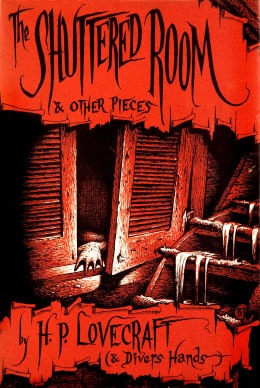
That’s a pretty nice cover, Arkham House commissioned some decent artists.
Tangents and epileptic trees always welcome here. I’m delighted by the discussion of the ecological implications of overfishing on Deep One growth patterns.
This raises interesting possibilities for the anatomical changes needed to make humans not only amphibious, but deep-sea-dwelling. “Froglike” won’t cut it.
@22: The artist is the acclaimed New Yorker contributor Richard Taylor: here’s a gallery of his Arkham House work.
SchuylerH @@@@@ 24 These Taylor covers are fantastic — I want the full set, framed in ebony!
Because it amuses me:
“The most merciful thing in the world, I think, is the inability of the human mind to correlate all its contents.“
– H. P. Lovecraft, “The Call of Cthulhu”, 1928.
“It is fortunate that the limitations of the human mind do not often permit viewing in proper perspective all the facts and events upon which it touches.”
– August Derleth, “Something in Wood”, 1948
“It is singularly fortunate that the ability of the human mind to correlate and assimilate facts is limited in relation to the potential knowledge of the universe even as we know it – to say nothing of what lies beyond.”
– August Derleth, “The Testament of Claiborne Boyd”, 1949
On a couple of later occasions (“The Keeper of the Key” and “The Shadow Out of Space”) Derleth just uses that Lovecraft quote directly.
When I see “Tobias” in a Lovecraftian context I can’t help but think of
I cannot share much, as low sales keep me from full focus on writing. I did low-pay regular jobs instead of daydreaming in poverty.
https://www.dropbox.com/s/o6buqdzlyzvsxtv/Blood%20on%20my%20touchscreen.pdf?dl=0
But more thrilling: https://t.co/Lc8dxR6xp1
And my most beloved wallflower, but strictly Lovecraftian (if only corrected once more):
http://www.ffproject.com/bodies.htm
That’s is all since my preference of original stories switched to ‘Dreams in the Witchhouse’ & ‘The Temple’.
Woo! I’m so glad I’m not the only one to have made the connection between ever-growing fish and the size changes in a Deep One hybrid of this story. Seriously, the fact that fish can more or less grow forever is HPL-level creepy in itself.
I’ve always had a soft spot for this story, and I still think it has great potential. Unfortunately, Derleth was too busy trying to write his own Dunwich Horror to realise how much better the story could be if it didn’t desperately try to emulate that one.
There is a lot of great content to be mined, IMO, from the motif of an adult man returning to a house where, as a child, he crept up to the door of his inexplicably imprisoned aunt and tried to listen in. The aunt is long gone, the house is just a house now, planks and hinges, but the terror of that incomprehensible and tragic situation remains.
It should have been a story of a posh, uppity family (the Sorbonne-attending scion would fit in better, too), living somewhere “normal and civilised.” Say, Boston. The house should have been a prime bit of real estate… only with that one room at the top and its creepy history. Ramp that up. Don’t have a key just fitting the lock – have it boarded up later, when grandpa remained alone with the aunt. Have the protagonist steel himself before breaking the door in and entering the place.
Most importantly, have him know nothing at first. Don’t drop the Innsmouth or Marsh names until the last third. Get rid of the whole grandpa-letter, which gave everything away while not adding anything to the story. Have the educated, man of the world protagonist quickly realise Sarah probably got pregnant out of wedlock, and despair at his family imprisoning her for life for that. Have him slowly put it together that this was no ordinary bastard child.
I actually really like the idea of the deceptively small creature the monster has become, released by mistake. I like the idea of it going off in the night and growing. I don’t like the human-eating bit, because I don’t think the Deep Ones ate humans (they did sacrifice them, but that’s not the same, and I can’t remember if people being “offered” to them for “mating” is anywhere in HPL canon or just an addition of our generally oversexed popculture) and it’s generally very melodramatic. I don’t have a great alternative right now, but I’m sure something cool could be done.
The ending, where it calls for mum, is also way too music-hall tragedy. It made far more sense for the Whateley offspring to call on its father (dad-sothoth having powers and stuff), plus the Whateley offspring was relatively young. The monster in this story is an adult, and should know its mum is long gone. (What did happen to Sarah’s body, by the way? And how did she die? There’s many logistics questions here, for starters.)
I am so disturbed by the ending of this story that I’m re-writing it with a female protagonist who doesn’t SET AMPHIBIANS ON FIRE WHILE THEY CRY FOR THEIR MOTHER!
*enraged panting*