






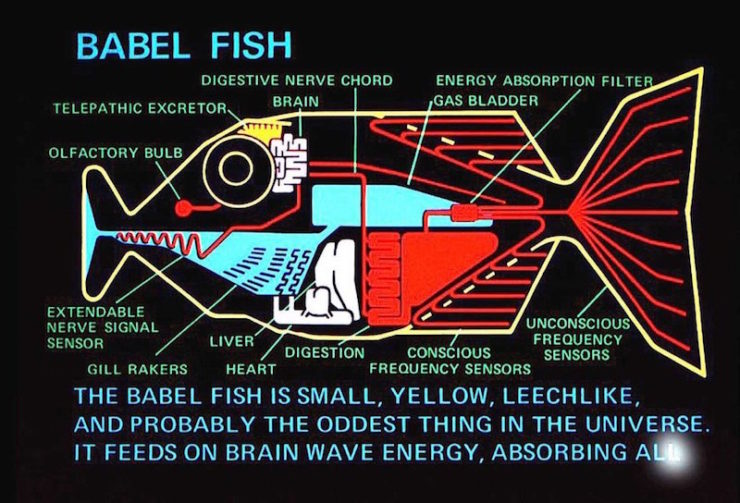
Science fiction is full of miraculous technology. You’ve got instantaneous teleportation across great distances, time travel, faster-than-light starships, cryogenic suspension that lasts centuries, and so on. But one of the most fascinating science fiction tropes is the universal translator. (Or, in Hitchhiker’s Guide to the Galaxy, the Babel fish.)
On one level, the universal translator seems like no big deal. After all, Google can now translate dozens of different languages into English with reasonable accuracy, though it does struggle sometimes. And of course, most of the stories we love simply wouldn’t work without a universal translator, because characters would have to spend months—or years—learning a new language, every time they traveled someplace new. That would make Star Trek and Doctor Who a lot less fun.
But at the same time, the notion of instantaneous, flawless translation feels very aspirational. In order to get better at writing Elza, a Brazilian travesti, in my young adult Unstoppable trilogy, I learned to speak and write Portuguese pretty fluently, and it was a huge struggle. So many irregular verbs! Not to mention the overcomplicated conjugations, and all the accents. (Turns out learning a language is harder as you get older; who knew?) Along the way, I learned firsthand that there are serious limits to any kind of automated translation we have now. Google sometimes fails to grapple with the idioms, culturally specific terms, slangy abbreviations, and random stuff that Brazilian Portuguese has. Not to mention false cognates—in our weekly Portuguese lessons over Zoom, my teacher Hailey has become accustomed to saying “No, that’s a false cognate” at least once per session.
This experience left me feeling as though it’s a lot easier to convince yourself that you understand everything that people are saying than it is to actually understand. Come to think of it, that’s kind of true even if everyone is speaking English.
And this led me to thinking that the trope of the universal translator is fundamentally about wishing that understanding other cultures would be simple, and that we didn’t have to work so hard. That we could go on endless voyages and encounter colorful people, and never have to worry about embarrassing gaffes where we announce that we are jelly donuts. (Though apparently, that’s a myth.) In other words, more boldly going, less patiently learning.
Or really, when you get down to it, the universal translator trope is about wishing that everyone spoke perfect English, wherever you go.
Star Trek is often at its most interesting when Starfleet’s finest need to work harder to understand other people. Case in point: “Darmok,” the famous Next Generation episode about the people who speak only in allusions. (Though I always wondered what those allusions were to. Was the story of Darmok and Jalad at Tanagra also written entirely in allusions to earlier stories—and if so, does it just keep going forever? Or is there some ur-story that’s written in a non-allusive language, which everything else is ultimately alluding to?) More recently, on Star Trek: Discovery, the Federation encounters Species 10-C, which is so different that it communicates through emotional hydrocarbons and flashing lights, which the science team has to work hard to translate. I’m also a sucker for films like Arrival, where a visiting alien species communicates in glyphs that actually mess with your awareness of time as you learn to use them.
And then there are always creatures like the Horta, which appear to be unsophisticated animals until we learn how to understand them better.
Given that fictional aliens are often a stand-in for real life cultures here on Earth, this question of how hard we need to work to communicate feels pretty relevant. Especially in TV and movies, the overall effect of a universal translator is that everybody appears to be speaking English, as if everyone in the galaxy has absorbed our culture—even if we know on some level, they’re actually speaking a different language, and we get hints about how their culture differs.
And then… there’s Star Wars. Officially, the Star Wars universe has a kind of lingua franca called Galactic Basic Standard, which most people speak perfectly. (Did all of these species and civilizations have their own individual languages, and were those languages wiped out? I think we never find out.) But now and then, we meet people who speak other languages. Sometimes there are subtitles and sometimes there aren’t—and it appears that George Lucas added subtitles to Jabba the Hutt in the Special Edition of Return of the Jedi. Also, sometimes C-3PO actually gets to fulfill his main purpose and translate alien languages into Standard.
I’m obsessed with the inconsistent subtitle practices in Star Wars. Why do some aliens get subtitles and others don’t? Check out this scene from season one of The Mandalorian, in which Kuiil (Nick Nolte) gets subtitles but the Jawas don’t—even though both Nick Nolte and the Jawas are speaking Jawa to each other:
Still, Star Wars often contains a stock scene in which one character is speaking Standard and the other is speaking some other language, and they seem to understand each other just fine. (e.g., Han Solo and Chewbacca, C-3PO and R2D2, Lando and Nien Nunb.) This is usually played for laughs, because getting to hear one side of an argument is inherently kind of funny, but it’s also a bit strange. How is it that Han Solo understands Chewbacca, but doesn’t speak Wookiee himself? And vice versa? The Star Wars universe is full of people who speak languages passively rather than actively—and you’re left feeling as though it doesn’t entirely matter if we understand the nuances of what some characters are saying. Everyone at least understands English—I mean Standard—after all.
For the Unstoppable trilogy, which ends with the brand-new Promises Stronger Than Darkness, I spent a lot of time poking at the trope of the universal translator. The kids who leave Earth to explore the galaxy come from all over the world, and when they speak Mandarin or Portuguese, the English-speaking Tina doesn’t quite understand their idioms. This comes up a lot in the first two books, until the characters have to wonder how well they’re really understanding the languages that aliens are speaking. After all, if Portuguese is a challenge, how the heck is a machine going to translate a language spoken by someone with a very different type of mouth, who evolved in a very different biosphere?
In Promises Stronger Than Darkness, I go all in on this trope. It’s one of the main things our heroes struggle with, as they learn that building real friendships with aliens is a lot harder than they thought at first. They come to realize that their universal translator, called the EverySpeak, has been designed to make their lives easy rather than helping them understand perfectly. This feels like an inescapable trade-off: comfort versus communication. When they’re faced with a species that has a drastically different physiology and culture, our heroes have to accept that the EverySpeak has been oversimplifying and misrepresenting everything these people have said, from the beginning, and this makes it impossible to be real friends.
I love the notion of the universal translator, because at its core it’s a hopeful ideal: we can all learn to understand each other better. But I also think we need to acknowledge how much work goes into understanding, and how often it goes wrong when we try to take shortcuts in real life. In my books, the characters don’t stop using the EverySpeak. Instead, they reprogram it, hack it, and mess with it, until they’re just a little bit more confused and everyone else is able to speak a little bit more clearly.
And that’s what it comes down to: in addition to offering us miraculous technologies, science fiction also helps us to become more comfortable with being a little bit confused, knowing that making sense of things will be more than worth the effort.
This article was originally published at Happy Dancing, Charlie Jane Anders’ newsletter, available on Buttondown.
Buy the Book
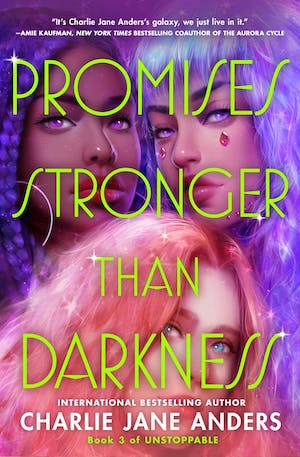
Promises Stronger Than Darkness
Charlie Jane Anders is the author of the young-adult trilogy Victories Greater Than Death, Dreams Bigger Than Heartbreak, and Promises Stronger Than Darkness (which published on April 11, 2023), along with the short story collection Even Greater Mistakes. She’s also the author of Never Say You Can’t Survive (August 2021), a book about how to use creative writing to get through hard times. Her other books include The City in the Middle of the Night and All the Birds in the Sky. Her fiction and journalism have appeared in The New York Times, the Washington Post, Slate, McSweeney’s, Mother Jones, the Boston Review, Tor.com, Tin House, Teen Vogue, Conjunctions, Wired Magazine, and other places. Her TED Talk, “Go Ahead, Dream About the Future” got 700,000 views in its first week. With Annalee Newitz, she co-hosts the podcast Our Opinions Are Correct.


Here on our Earth, we have excellent examples of those who learned new languages in order to be able to translate the Bible. Here were statements originally recorded in Hebrew, then translated into Greek, that were then re-translated into English and from there re-re-translated into whatever language was new to the English-speaking missionaries. Unfortunately, I do not happen to know of any ridiculous mis-translations, but I am sure there were at least a few!
Technically Han Solo CAN speak ‘Wookiee’ he’s just really, really bad at it (Watch his first meeting with Chewbacca in SOLO and you may see the exact moment at which the latter thinks “You must never, ever insult my ears like that again”).
It also bears pointing out that some species may lack the equipment to speak each other’s languages properly, in terms of subtle and blatant physical differences between them.
Spoken perfect English? That’s for formal conversations :).
And everybody in Doctor Who has a UK accent :). From what I remember.
@3 “Lots of planets have a North”
And everybody in Doctor Who has a UK accent
Except for Peri from the classic era and Captain Jack Sparrow Harkness from the modern…
“Sorry, I don’t speak Celtic” when Donna Noble tried speaking Latin…
@5 Yep, I’d forgotten about some characters who didn’t have a UK accent.
The local PBS station is rerunning The Good Life (known as The Good Neighbors in the US) and there’s a hilarious Dalek impression in episode one.
My favorite Universal Translator was from “Farscape” – sometimes, it translated great, and sometimes you just got the word itself with no attempt, and the listener just had to pick it up from context clues, and sometimes it led to hilarious exchanges:
John: “Slicker’n snot”
Aeryn: “My translator microbes MUST have gotten that wrong.”
There was a Dr Who episode where Clara (I think) was stuck in a Dalek chassis. It translated everything she said as “EXTERMINATE!” It’s an interesting question whether that was done to her specifically, or if every Dalek is subject to the same process. How many Daleks have just been trying to order a cup of tea without being able to make themselves understood?
(Now I mentally translate every “EXTERMINATE!” as “I LIKE CATS!”)
I accepted those universal translators at face value as a kid.
However, in adulthood, as a professional translator, they make me roll my eyes…
@8: the Dalek chassis allows at least one other word: a Dalek begs “Mercy!” when caught out by River Song. (No, I don’t remember the title; it was almost certainly a Hugo nominee some years ago, as I’m not a regular watcher.)
@0: wrt Galactic Basic: one notes that the Xian “New Testament” is written (?mostly?) in turn-of-the-Common-Era Greek, which IIUC passed for a common tongue (e.g., preferred 2nd language) around the eastern Mediterranean. OTOH, I’ve never found out how many of the Epistles would have been understood by all of their addressees rather than translated into local speech by an expert, and I read a claim some time ago that Revelations shows signs of being written by someone whose command of that Greek was not strong — except perhaps in florid phrases. Early D&D assumed that everyone spoke “Common” because otherwise sessions would have been excruciatingly long — suggesting that universal translators go along with FTL drives as WIBNIs for most storytellers.
I do like the touch that the Babel Fish, by acting as a universal translator, has been the cause of more and bloodier wars than any thing else in the history of creation. Sounds about right.
“Britain and America are two nations divided by a common language.” — attribution uncertain, including to George Bernard Shaw and Oscar Wilde. (see https://quoteinvestigator.com/2016/04/03/common/)
I think pretend technology like universal translators and teleporters have more to do with studio economics than anything else.
The most amazing thing the universal translator does is make aliens’ lips look like they’re pronouncing English.
The last season of Babylon 5 had a human ship meet an alien ship with no common language. So the humans transmitted a perfectly regular artificial language that the aliens could learn much more easily than English, and could be translated into English. I always thought that was an interesting way to handle the problem.
Excellent question re: the culture represented in “Darmok.” I had a similar question on first watching it, which was: how do children learn to speak? Don’t you have to start with some non-allusive language? I thought, maybe there’s a non-allusive language which only children speak, and on becoming a grown-up you give that language up and switch to full-on allusions. Now there’s an impressive rite of passage!
Glad to see others having issues with that “Darmok” episode and language.
My specific issue was how could they develop a technical civilisation when every scientific notation had to be a allegorical? Boyles Law (PV/T=K) would be like: “the strength of the wind and the size of the sky is included in the steam rising from the water that is the Mountain that never changes” . I am a lousy poet but you get my meaning.
But only Morlocks ever need to know about Boyle’s law….
In the “classic” Doctor Who serial, “The Masque of Mandragora,” Sarah Jane Smith questions the Fourth Doctor as to how she can understand 14th-century Italian. He explains that it’s a form of “limited telepathy” that he can “share’ with his companions. Presumably, this means that they’re really “hearing” what’s in the mind of the speaker as they’re articulating the word, rather than the words themselves.
I have to disagree:
Google translate is awesome!
Of course, it isn’t perfect.
I think the concept of “Euro english” is very interesting. It runs also on the assumption that mistakes in the language are made.
https://en.wikipedia.org/wiki/Euro_English#:~:text=Euro%20English%20or%20European%20English,of%20its%20non%2Dnative%2C%20English
My wife’s aunt is Colombian, so her cousins grew up with both Spanish and English. As they grew up, they moved to using mostly English, but still have the understanding of Spanish that they got when their brains were little language-acquiring sponges.
I’ve been there for many conversations where Aunt Josie speaks English, and the cousins speak Spanish. See it in Star Wars doesn’t seem weird to me, at all.
I remember when Babelfish was the hot machine translator. One thing a lot of people did for fun was translate their native language to a different language and then translate the result back to the original. The state of the art has advanced since then.
Count me among those who’ve wondered about “Darmok” for decades. I suspect there’s a language that’s only used for telling the stories, and this language isn’t used with outsiders, for cultural reasons. Maybe it’s like Shakespearean English, rather flowery and difficult to parse, so the aliens use the allusive language for ease of communication.
As for the TARDIS telepathic circuits, they translate the *intent* of what people are saying, rather than the literal meaning. So when the Doctor says “allons-y,” he means for it to be heard in French, so it is. According to Big Finish, it converts units of time and distance on the fly (except for Dalek “rels,” apparently), and can even translate non-audio languages, such as insects who communicate by pheromone. None of which explains why Judoon doesn’t translate. The Doctor says it’s “too primitive,” but I suspect it’s because the translator doesn’t work when the plot calls for it not to work.
I question the idea that having a limited idea of the nuances of what people saying means you can’t really be friends. People can be real friends without having a common language at all! It helps if the chips are down, mind you. If someone has shared their limited food/water/shelter with you, helped you out when you were in danger, fought at your side or whatnot, they are your real friend. Actions speak.
Janet Kagan’s book “Hellspark” deals with te communication obstacles in a group of people from very different worlds who speak a common language but whose unconscious body language is totally different.
There’s a recent article discussing how people, using the same language, still have different conceptualization of something as simple as a penguin.
I love “Hellspark” for a variety of reasons, including the way it deals with language. Wonderful book.
Uhura’s Song uses both language and music to translate a very old song, the last verse of which has the cure to the Deadly Plague (Janet Kagan knew her stuff).
“In Cleveland, when the turkeys fell…”
As a person that has minor in linguistics (so I’m by far not an expert, but better educated about language than most), universal translators are a super weird thing in Sci Fi. That’s not how I actually thing it would work, but it depends on the “alien”. So for example say they did vocalization. An actual good example is that STNG episode where we have another culture speaking in metaphors. That’s actually an easy one! Without learning grammatical structure that implies other parts of language it’s SUPER hard to translate anything. It’s like any other data you are trying to marry. You need one common thing to link to the rest. Unfortunately “alien” means just that. It’s out of our comprehension.
It also means that we need leaders that don’t shoot first!
You might be interested in “Outpost of Jupiter”, by Lester del Rey, in which our hero has to urgently communicate with a race of Jovians who don’t even speak the same kind of language we do – as one character puts it “we speak in individual words and concepts; they speak in processes”. We never see the aliens; they communicate by using the side of their spaceship as a vast screen, starting off with a dot which “evolves” into more and more complex images. Our hero has to respond by using his finger as a stylus, modifying the original images to try and get his messages across – successfully, I’m pleased to say, as it’s a matter of life and death, for Humans and Jovians.
Very sophisticated stuff for a juvenile novel in the early 1960s. and still very relevant.
“In Cleveland, when the turkeys fell…”
Wasn’t that Cincinnati? Or is a turkey drop a general Ohioan thing?
This is where I have to ask people if they’re from America or elsewhere in the Anglosphere; I’ve noticed that Americans specifically have a lot of baggage about English.
I remember when Star Trek Discovery started, and Concerned People on social media were incensed about Captain Georgiou being an offensive ethnic stereotype –ignoring that A) that was Michelle Yeoh’s actual accent, and B) Yeoh herself requested that she be allowed to use it.
In America specifically, where English is the default taught to all children, ability to speak is a one-to-one indicator of intelligence; failure to speak perfect English reflects a lack of education, either due to poverty or intellectual unworthiness (which are usually seen as equally shameful, which is a whole other problem that I won’t get into). Thick accents and creole are automatically seen as offensive, regardless of anything else about the speaker.
In reality, of course, this reflects one of the great strengths of English; it’s error-tolerant and thus relatively easy to learn well enough to get by. It’s not about being able to deliver a Captain Picard Speech on cue, but about being able to bridge between three co-workers who speak Urdu, Dutch, and Guatemalan Spanish at home but all work at the same bank.
Logically, any common language that gets spoken in the wider galaxy would have to have the same qualities, and be spoken primarily as a second- or third-language on most planets. If used well, this could also be useful as a narrative shortcut; maybe the reason we keep running into Popular Recurring Character is because they’re the only member of their group qualified to serve as an interpreter.
srEDIT:
My reaction to the admittedly little I’ve read of “The Book of Mormon” was ‘This reads much more like the ‘King James’ Bible on which Jos. Smith grew-up (or at least got older) than the Tanakh.’.
…and why don’t the post-{original series} Star Treks’ Universal Translators translate a whole mess of Klingon terms, and the original series’ a few Vulcan? Diegetically, my head-canon is that the Klingons demanded that it not, and the Federation decided not to press the issue.
It seems to me there’s a related theme: settings that avoid dealing with other languages by having just the one. For example, Gordon R. Dickson’s The Dragon and the George’s protagonist is multilingual but the world to which he is transported is not: “In the domain of the Powers there is only one language possible by definition.”
It’s clear that the Federation hasn’t perfected translation to English, the Klingons frequently note how much better several works are in their original language. :-D
Also, RE Darmok, I just saw this really amusing bit.
@36 YES. Thank you!
Huh. Looks like the image in my comment #36 got removed for some reason, for context to my comment it’s a multi panel screen grab from “Darmok” where all the allusions have been replaced with references to memes, for instance “Anime man pointing at butterfly.” Picard quickly figures out he’s talking in memes and they communicate.
Regarding Han Solo and Chewbacca, I can read and understand French fluently but can’t speak it very well. I spent two weeks in France last summer understanding almost everything that was said to me but mostly only replying in English.